Author(s) Koh, TY; Tuuli, MM; Rowlinson, S
Citation
The 29th Annual Conference of the Association of Researchers in Construction Management (ARCOM 2013), Reading, UK., 2-4 September 2013. In Proceedings of the 29th ARCOM Conference, 2013, v. 1, p. 369-379
Issued Date 2013
URL http://hdl.handle.net/10722/191885
Koh TY, Tuuli MM and Rowlinson S (2013 A relational approach to high reliability organising for construction project safety: a conceptual framework In: Smith, S.D and Ahiaga-Dagbui, D.D (Eds) Procs 29thAnnual ARCOM Conference, 2-4 September 2013, Reading, UK, Association of Researchers in Construction Management, 369-379.
A RELATIONAL APPROACH TO HIGH RELIABILITY
ORGANISING FOR CONSTRUCTION PROJECT
SAFETY: A CONCEPTUAL FRAMEWORK
Tas Yong Koh1, Martin M. Tuuli2 and Steve Rowlinson1
1
Department of Real Estate and Construction, University of Hong Kong, 2
School of Civil and Building Engineering, Loughborough University, UK.
In Hong Kong, current safety management regimes in the construction industry are largely based on compliance, error detection and prevention, and safety climate intervention. While these approaches have improved construction project safety performance, significant limitations still exist. First, compliance and error detection/prevention approaches are based on rigid and ideal formulations of
construction work processes. Second, safety climate interventionist approaches have a limitation of mixing psychological and human factors issues that are somehow detached from construction work contextual consideration. As a result, current safety management approaches are less effective in ensuring safety in construction
operations which are emergent and dynamically complex. These situations require adaptive human inputs and interactions to ensure safety on projects that are grounded in the social capital among project team members. However, as social capital is a primordial feature of human interactions that is likely to lie dormant, its impact on safety performance is likely to be indirect and mediated by some organising processes such as high reliability organising (HRO) processes. Adopting the systems view of safety, we draw on these concepts to highlight the relational aspects in the
management of construction project safety, and explain how these relational aspects can contribute to improving project safety. We accomplish these objectives by putting forth a conceptual framework and methodological suggestion.
Keywords: health and safety, high reliability organising, human factor, project management, social capital.
INTRODUCTION
The building and construction industry of most countries and regions is often
characterised by poor safety performance. This industry has often recorded a high rate of industrial accidents. The Hong Kong construction industry is no exception to this phenomenon. In fact, in Hong Kong, 79.31% of all industry fatalities in 2011 occurred in the construction industry (Labour Department 2012a). In addition, with the increase in construction activities and volume in recent years, there is a corresponding increase in the number of accidents. For example, the construction industry accident numbers have increased from 2,775 to 2,884 and to 3,112 from 2009, 2010, and to 2011 respectively. The number of fatality also increased from 9 in 2010 to 23 in 2011
1
370
(Labour Department 2012b). For the first six months of 2012, 7 fatalities were
reported and this figure is an increase of 4.7% from the same period the previous year (Labour Department 2012c). With the strings of on-going construction projects, new projects that are recently rolled out, and those that are in the pipe line, the trend is likely to continue into the next few years.
Within the above context, a myriad of safety management initiatives have been introduced and implemented in construction projects since 1998 with the recognition of the need to manage construction project safety. While these initiatives have brought about improvement in the safety performance of the Hong Kong construction industry since 1998, the safety performance of the industry has plateaued since 2005. This stagnation, together with the phenomenon that accident statistics tends to trail the construction volume, calls the effectiveness of current safety management initiatives into question. Specifically, current safety discourse in Hong Kong construction industry neglects the construction team micro-processes of organising in the
performance of construction operations in a safe manner. This aspect of human factor is however important as the construction operation system deviation can only be absorbed by the human operators interacting with the system components and
organising processes (Dekker 2005; Leveson 2011). Hence, there is a need to explore new dimensions in the management of construction safety from the human and social perspectives.
Because the phenomenon of social capital is grounded on the utility of relationships of a group of technically inter-related individuals bounded in a project, and high
reliability organising (HRO) is predicated on the premise that untoward event (e.g. safety breach that leads to an accident) can be prevented through the mindful organising processes of those individuals, we suggest that the concepts of social capital and HRO are possible avenues to pursue improvement in the safety
management capacity of the workers and frontline staffs in construction projects. In this paper, we first identify the gap in both literature and practice in managing construction project safety; invoke the systems view of safety management and the ensuing impetus of human inputs to cater for system deviations; follow by delineating the underlying conceptual and practical need to invoke the relational concepts and human factors through social capital given the systemic nature of safety; and
encapsulate and synthesise these concepts into a theoretical framework. We conclude by suggesting methodological approach in pursuing this exploration.
THE THEORETICAL AND PRACTICAL GAPS
In Hong Kong construction industry, current initiatives in the management of construction project safety are largely based on compliance and error detection and prevention (Koh and Rowlinson 2012). In the compliance approach, the idea is to control project participants’ behaviours by having them comply with the safe conduct and punishing them upon the breach of safety rules (Mitropoulos et al. 2009;
Rasmussen 1997). The error detection and prevention approach concentrates on error management by the removal of the causes of error (Mitropoulos et al. 2009). These approaches inevitably focus on the internal and static nature of the construction production system. In the internal aspect, the approaches focus on the characteristics of the participants (e.g. skill level). In the static aspect, the approaches emphasize the nature of the tasks being performed (e.g. task design). Both approaches do not cater for the dynamics that emerge in the construction operations.
371 In the literary discourse, within the Hong Kong construction industry, a wealth of empirical studies has been conducted to investigate various aspects of construction safety management and its relationship to project safety performance. Tam and Fung (1998) studied a myriad of safety management strategies and their impact on safety performance and found that the provision of safety training, the use of direct labour, using post-accident investigation as a feedback, and safety promotion by safety award campaigns and incentive schemes are the effective tools in reducing site accidents. Fung et al. (2010) have developed a risk assessment model that purportedly predicts the high-risk construction activities which in turn prevents accidents from occurring. Several safety climate studies have also been undertaken within the local construction industry. In this string of works, Choudhry et al. (2009) find that perceived safety performance is inversely related to safety climate item of “inappropriate safety procedure and work practices.” Hence, they conclude that safety climate can be used as an effective measure to assess and improve site safety for construction projects. Fang et al. (2006), in their study of safety culture and climate in a construction firm (including the firm’s sub-contractors), have found that significant relationship exists between safety climate and workers’ safety behaviours.
While these works illuminate some aspects of safety management in the industry, limitations still exist. The safety culture and climate conceptions have been criticised as a catch-all concept that mixes psychological and human factors issues that are devoid of contextual consideration (Guldenmund 2000; Reiman and Oedewald 2007). The context can be the work itself or the sociotechnical processes by which the work is accomplished. As such, (safety) climate phenomenon is somewhat disconnected from the physical performance of the work. The other stream of work, while concentrating on the management aspects of safety provision, neglects the team micro-processes of organising for safe work performance. Together with the mechanistic approach in managing construction safety noted earlier (i.e. the
compliance and error detection and prevention approaches), the current Hong Kong construction safety management state of affairs urgently needs the exploration of new dimensions in the human and social aspects in improving the industry safety
performance. We suggest that this aim can be achieved through project social capital and HRO.
We explore next the underlying structural features of construction operations that provide the impetus for human inputs.
THE SYSTEMS' VIEW OF SAFETY AND THE IMPORTANCE
OF HUMAN INPUTS
Viewed from the total production system’s perspective, current approaches are devoid of the attention to the dynamics and interactions among the production (construction) elements. These dynamics result from the interaction among the human operators, the physical objects to be put together, the tasks, and the operating environments and contexts. In the systems perspective, a production model needs to be considered as a socio-technical system in its entirety that includes not only the parts of the system but also the relationships among those parts and the ways they interact. The interactions of these parts give rise to the emergent property of safety (Leveson 2004) in which dysfunctional interactions of those parts lead to problems. When a localised decision which is correct under the limited context under which it is made come into
372
organisational behaviours can interact in dysfunctional ways that likely lead to accident (Leveson et al. 2009).
In Hong Kong, from the systems perspective, current safety management approaches are less effective in ensuring safety in the construction projects as the result of the dynamics, complexities, and emergent interactions of components in construction operations. In this respect, because human operators and their interactions are the catalysts in managing projects, there is a gap in the lack of recognition of a social explication in the management of construction safety (Koh and Rowlinson 2012). This argument is predicated on the structural and organisational features of construction operations. Construction operations are reciprocally coupled at the site activity level. These activities are time dependent and are invariant in their sequence. At the work organisational level however, together with the human operators, these inter-related features are intertwined into forming a complex and dynamic sociotechnical systems. These systems are complex and dynamic because of the presence of multiple goals (speed, quality, cost, and safety), multiple interacting parties (various trades and professional disciplines some of which have different mental models, and work packages, heterogeneous client organisation), complex social structures (hierarchical sub-contracting arrangements, multiple stakeholders), and the complex technology and operating environments (market pressures, political and institutional regulations) (cf. Reiman and Oedewald 2007).
There is a high level of interdependence among these elements within the
organisational environment that is continuously changing. These interactions are likely to lead to unexpected high-variety disturbances. The events that unfold through such a system are likely to be invisible nexus that are hard to anticipate. These events are also likely to cascade in an interactively complex manner whereby the interactions among various processes and elements can have hidden and unintended consequences (Perrow 1999). As the events unfold, the daily controlling and steering activities involve a continuing process of organising amidst the dynamics and complexity. In terms of organising for safety, the dynamics and complexity imply that operators continuously experience change in the form of adaptations in response to short-term productivity and cost objectives. In the course of these adaptations, it is possible that safety defences degenerate as a result of the production pressures and changes. When the system complexity increases and adaptations are required the need for human input is significant as a means to coordinate not only the work processes but also to achieve safety of the activities (Dekker 2005; Weick 1987). Thus, to keep the
operating system within the safe limit and maintain system adaptation, human inputs are essential as it is through human inputs that recognition, communication, and improvisation of unexpected events, changes, and disruptions that system safety is achieved (cf. Mitropoulos and Memarian 2012).
THE HUMAN FACTORS IN PROJECT ORGANISATIONS
The above conceptions imply that human and social factors are fundamental in the management of construction project safety. In a project team, team members can exert considerable influence on one another. This influence may also shape the attitudes and in turn behaviours of the members. For example, the team’s expectations of members to adhere to safety rules create strong social control in ensuring members’ safe conduct (Lingard and Rowlinson 2005). In addition, the work practices and team processes shape the situations that the team members must face. Project participants need to deal with the work practices and systems on one hand, and their own373 interactions within the organisational and production contexts on the other
(Mitropoulos et al. 2009). These features have brought to prominence project team relations and processes in managing construction project safety. In construction project organisations, the congregation of individuals from an array of disciplines involves a network of firms, their relationships that are embedded in these networks and their interactions with a socio-technical system. This structural form implies distributed organising activities. The focus of organisational analysis should therefore be placed on a network view of the situation and, crucially, on the interactions among project participants. The emphasis should be placed on the way the web of
relationships, especially those manifested as goodwill, facilitate actions among
participants in the management of project safety (Koh and Rowinson 2012). Goodwill, generally referred to as social capital (Adler and Kwon 2002), has been known to be able to add value to network-based organisation such as a construction project. Specifically, social capital is conceptualised as “the sum of the actual and potential resources embedded within, available through, and derived from the network of relationships possessed by an individual or social unit” (Nahapiet and Ghoshal 1998: 243). The project organisational characteristics of interdependence and intensive interactions, diffused authority, temporality, and relative closure of project
membership make the application of the social capital concept relevant (Nahapiet and Ghoshal 1998; Jones and Lichtenstein 2008). Social capital provides a mechanism and means by which coordination and collaboration among project participants can be effected. As such, social capital can be appropriated and exploited to achieve project organisational objectives (Nahapiet and Ghoshal 1998; Coleman 1988), including safety objectives.
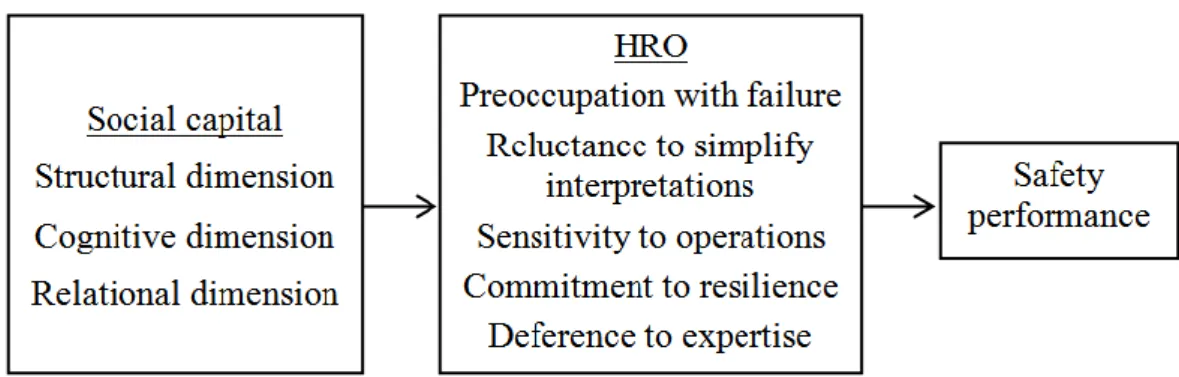
Social capital can be conceptualised by three dimensions - the structural, cognitive, and relational dimensions (Nahapiet and Ghoshal 1998). The structural dimension refers to the impersonal configuration of linkages between persons or social units. The main facets under the structural dimension are network ties among project participants and the existence of appropriable organisation (Coleman 1988; Nahapiet and Ghoshal 1998). The cognitive dimension refers to the shared representations, interpretation, and system meaning among group members (Nahapiet and Ghoshal 1998). It reflects the condition whereby project team members share a common understanding (Bolino et al. 2002) and the extent to which they have developed a shared cognitive scheme (Maurer and Ebers 2006). The relational dimension is characterised by the personal relationships group members develop among themselves through the history of interaction (no less in the construction project setting) (Granovetter 1992). Relational dimension involves emotional closeness and reciprocal services among actors that are affective in nature (Granovetter 1973). It focuses on the quality of the relationships in terms of trust, obligations, expectations, etc. (Bolino et al. 2002).
Previous study (c.f. Koh and Rowlinson, 2012) has indicated that the effects of social capital on construction project safety are mediated through project organisational processes. In social settings, social actors’ interactions are effectuated on the basis of the social structure, roles, norms, and trust among the actors. These aspects of social life represent social capital among the interacting social unit(s). Social capital
provides the foundation for actors’ interactions (Orlikowski 2002). In addition, social capital that resides in participants may lie dormant unless actively seek out and act upon (Maurer et al. 2011). Thus, project social capital provides the conditions necessary for project organisational processes to take place, and those processes in turn contribute to safety performance.
374
SOCIAL CAPITAL, HIGH RELIABILITY ORGANISING (HRO)
AND SAFETY - A CONCEPTUAL FRAMEWORK
However, what are the organisational processes that are effective in ensuring safety in construction projects? In the production systems that are interactively complex and highly hazardous, HRO processes have been suggested as possible ways to prevent errors in high hazard and complex organisations (Lekka and Sugden 2011; cf. Sutcliffe 2011). HRO theory is predicated on the premise that accidents are not
unavoidable and there are processes that organisations can adopt to effectively prevent safety problems (Roberts 1990). HRO can be referred to as a set of organising
processes that allow organisation to continuously operate under trying conditions, reduce the impacts of accidents, and help with the recovery process (cf. Weick and Sutcliffe 2007). In this conception, reliability refers to a group feature of "unusual capacity to produce collective outcomes of a certain minimum quality (and safety) repeatedly" (our addition) (cf. Hannan and Freeman 1984: 153; cf. Vogus and Welbourne 2003).
HRO is essentially grounded on group mental processes that increase the quality of attention across the group of individuals through their alertness and awareness so that they are able to detect subtle changes of contexts and react appropriately (Sutcliffe 2011: 137; Vogus 2012: 665). HRO is characterised by five principles. These are preoccupation with failure (operating with chronic wariness and engaging in proactive analysis of adverse events), reluctance to simplify interpretations (creating a more complete picture of current operations), sensitivity to operations (sharing information on the human and organisational issues to form an integrated big picture of current situation), commitment to resilience (developing capabilities to cope with adverse events), and deference to expertise (allowing decision to be taken by people with the most expertise in high-tempo events irrespective of rank) (Sutcliffe 2011; Vogus 2012; Weick et al. 1999).
The term “organising” in HRO suggests that the performance of safe activity is a continuing and dynamic process. The latter qualifier - the dynamic process - also implies that safe performance is a relating process in group settings. HRO theory emphasises the social and organisational underpinnings of systems safety. Operations can be performed in highly reliable manner despite complex interrelated human activities and interactions through improvisation and adaptation of personnel within the system. Even under trying conditions (hazardous and unpredictable environments), it is possible to achieve real-time problem solving and maintain system safety by incorporating human inputs. This line of reasoning suggests that safety is achieved through human processes and relationships (Sutcliffe 2011). In dynamic situation, safety is achieved by timely human adjustment. This adjustment is effected by organising processes that increases the participants’ quality of attention. This increased attention, in turn, enhances participants’ alertness to details of operations thereby enabling them to be able to detect subtle changes in contexts and respond as appropriate – a process of mindfulness (Weick et al. 1999). Mindfulness enables individuals to continuously interact with others in the system as they develop shared understanding of the situation they encounter and their capabilities to act. This collective capability can potentially forestall errors (Sutcliffe 2011).
Two interrelated human factors underpin the capability of mindfulness. The first factor is the norm of respectful interaction. In the situation characterised by respect, people are more likely to communicate their ideas to others. The opposite party, in
375 turn, is more likely to reciprocate by taking in the ideas. Such communication
generates a shared interpretation of the situation (Christianson and Sutcliffe 2009). The outcome of this process is the integration of multiple strands of ideas into a socially shared mental repertoire that leads to cognitive ability of the group as a whole – the ability to speak up, ask questions, and challenge current perceptions. The second factor is the heedful interrelating among individuals at operational level. Heedful interrelating refers to a situation whereby individual understands the way the system is configured and how their actions fit into the larger scheme (Weick and Roberts 1993). The individual’s understanding of the interrelationships between parts (his
contribution) and whole (his contribution into forming a larger whole) forms a larger pattern of shared action. In the situation where individuals maintain a conscious awareness of their actions at both levels of the shared action scheme, they are likely to contribute to high reliability of the action system. The cognitive dimension of social capital, therefore, leads to HRO.
The two human factors also form the social foundation of HRO. The basis of HRO is that individuals interact continuously to develop, refine, and update a collective mental schema of the situation they encounter and act on that basis. The second human factors described above (i.e. the part-whole relationship) suggests that the access to other individuals within the same system, the intertwining of individuals from different work groups and networks facilitate the building of understanding of not only their contribution to the system goals but also the work norms conducive to HRO. In this respect, the structural dimension of social capital contributes to HRO. In addition, Colquitt et al.’s (2011) study suggests that trust to co-worker is highly relevant in task situation that is characterised by high situational unpredictability and hazard (e.g. tunnel boring operations). This work condition is referred to as high reliability task context. This situation suggests that the relational dimension facilitates HRO. In essence, HRO thrives on the social and relational infrastructure of
organisation (Christianson and Sutcliffe 2009), and it is through these organising processes that the production (construction) system’s (e.g. the project team) safety capability is improved (cf. Weick 1987; Weick and Sutcliffe 2007). This improved capability is likely to ensure better safety performance. Hence, as previously noted, a mediational proposition that links project social capital, HRO, and project safety performance is plausible. This framework is presented in Figure 1.
Figure 1: A mediational framework of social capital, HRO, and safety performance
CONCLUSIONS AND METHODLOGICAL SUGGESTION
In this paper, we set out to explore the proposition and the associated underlying relational conception and micro work processes in achieving construction project safety. The proposed framework links the structural, cognitive, and relational aspects376
of social life within project organisation (in social capital) to the participants’ micro processes of organising work (in HRO). The successful establishment of such relationship and the applicability of the concepts (relational paradigm and high reliability organising) could provide knowledge to inform future direction of construction project safety management through project organisational
re-configuration (e.g. overlapping both formal and informal work groups, bi-directional communication infrastructure) and work practices re-design among the entire
production (construction) system (e.g. incorporating high reliability principle of sensitivity to operations such as dynamic risk analysis of work conditions into supervision practices). The exploration informs on the impact of human factors on construction project safety. This endeavour is in line with the emerging research areas of social factors and systemic rationalisation of production. Further, the propositions and framework are also the recognition that in addition to the established institutional and macro-structural variables (e.g. regulations, regimented safety management system), an equally important dimension in safeguarding construction safety lies with human beings, their relational assets, and organising practices.
Due to the novelty, conceptual complexity, and explorative nature of the scheme, a mixed methods design may be suited for the exploration. Within this methodological approach, an embedded-sequential design could be adopted. The exploration could generally be conducted as a case study. Case study is an ideal design to explore the project team social capital and high reliability practices in the selected case projects, and to examine the organisational processes within these contexts (Yin 2003). To corroborate the results from the qualitative exploration and to ensure the validity of causality of the constructs derived from the qualitative phase, questionnaire survey could be conducted within the case study - hence the embedded-sequential design (cf. Creswell and Plano Clark 2007). With this methodological approach, differentiated yet complementary perspectives could be generated to provide better understanding of the phenomena.
ACKNOWLEDGEMENT
The authors acknowledge funding provided by The University of Hong Kong's to the first author (Project code 201301159001)]
REFERENCES
Adler, P S and Kwon, S W (2002) Social capital: prospects for a new concept. "Academy of Management Review", 27(1), 17-40.
Bolino, M C, Turnley, W H and Bloodgood, J M (2002) Citizenship behaviour and thte creation of social capital in organisations. "Academy of Management Review", 27(4), 505-522.
Choudhry, R M, Fang, D-P and Lingard, H (2009) Measuring safety climate of a construction company. "Journal of Construction Engineering and Management", 135(9), 890-899. Christianson, M K and Sutcliffe, K M (2009) Sensemaking, high reliability organising, and
resilience. In: P. Croskerry, K. Crosby, S. Schenkel, and R.L. Wears, (eds.) "Patient safety in emergency medicine". Philadelphia: Lippincott Williams and Wilkins, 27-33.
Coleman, J S (1988) Social capital and the creation of human capital. "American Journal of Sociology", 94(Supplement), S95-S120.
377
Colquitt, J A, Lepine, J A, Zapapa, C P and Wild, R E (2011) Trust in typical and high-reliability contexts: Building and reacting to trust among firefighters. "Academy of Management Journal", 54(5), 999-1015.
Creswell, J A and Plano Clark, V L (2007) "Designing and conducting mixed methods research". Thousand Oaks, CA: Sage.
Dekker, S W A (2005) "Ten questions about human error: a new view of human factors and system safety". Mahwah, N. J.: Lawrence Erlbaum.
Fang, D-P, Chen, Y and Wong, L (2006) Safety climate in construction industry: A case study in Hong Kong. "Journal of Construction Engineering and Management", 132(6), 573-584.
Fung, I W H, Tam, V W Y, Lo, T Y and Lu, L L H (2010) Developing a Risk Assessment Model for construction safety. "International Journal of Project Management", 28(6), 593–600.
Granovetter, M S (1973) The strength of weak ties. "American Journal of Sociology", 78(6), 1360-1380.
Granovetter, M (1992) Problems of explanation in economic sociology. In: N. Nohria and R.G. Eccles (eds.) "Networks and organisations: structure, form, and action". Boston, Mass: Harvard Business School Press, 25-56.
Guldenmund, F W (2000) The nature of safety culture: a review of theory and research. "Safety Science", 34(1-3), 215-257.
Hannan, M T and Freeman, J (1984) Structural inertia and organisational change. "American Sociological Review", 49(2), 149-164.
Jones, C and Lichtenstein, B B (2008) Temporary inter-organisational projects: how temporal and social embeddedness enhance cooperation and manage uncertainty. In: S.
Cropper, M. Ebers, C. Huxham and P. S. Ring (eds.) "The Oxford handbook of inter-organisational relations". Oxford: Oxford University Press, 231-255.
Koh, T Y and Rowlinson, S (2012) Relational approach in managing construction project safety: a social capital perspective. "Accident Analysis and Prevention", 48, 134-144. Labour Department (2012a) "Occupational safety and health statistics 2011". Occupational
Safety and Health Branch, Labour Department, Hong Kong.
Labour Department (2012b) "Occupational safety and health statistics bulletin issue No. 12 (July 2012)". Occupational Safety and Health Branch, Labour Department, Hong Kong.
Labour Department (2012c) "Summary of occupational health and safety statistics of 1st half of 2012". Occupational Safety and Health Branch, Labour Department, Hong Kong. Lekka, C and Sugden, C (2011) The successes and challenges of implementing high reliability
principles: a case study of UK oil refinery. "Process Safety and Environmental Protection", 89(6), 443-451.
Leveson, N (2004) A new accident model for engineering safer systems. "Safety Science", 42(4), 237-270.
Leveson, N G (2011) Applying systems thinking to analyse and learn from events. "Safety Science", 49(1), 55-64.
Leveson, N, Dulac, N, Marais, K and Carroll, J (2009) Moving beyond normal accidents and high reliability organisations: a systems approach to safety in complex systems. "Organisation Studies", 30(2&3), 227-249.
378
Lingard, H and Rowlinson, S (2005) "Occupational health and safety in construction project management". Oxon: Spon Press.
Maurer, I, Bartsch, V and Ebers, M (2011) The value of intra-organizational social capital: how it fosters knowledge transfer, innovation performance, and growth. "Organisation Studies", 32(2), 157-185.
Maurer, I and Ebers, M (2006) Dynamics of social capital and their performance implications: lessons from biotechnology start-ups. "Administrative Science Quarterly", 51(2), 262-292.
Mitropoulos, P, Cupido, G and Namboodiri, M (2009) Cognitive approach to construction safety: task demand-capability model. "Journal of Construction Engineering and Management", 135(9), 881-889.
Mitropoulos, P and Memarian, B (2012) Team processes and safety of workers: cognitive, affective, and behavioural processes of construction crews. "Journal of Construction Engineering and Management", 138(10), 1181-1191.
Nahapiet, J and Ghoshal, S (1998) Social capital, intellectual capital, and the organizational advantage. "Academy of Management Review", 23(2), 242-266.
Orlikowski, W J (2002) Knowing in practice: enacting a collective capability in distributed organising. "Organisation Science", 13(3), 249-273.
Perrow, C (1999) "Normal accident: living with high risk technologies". Princeton, N. J.: Princeton University Press.
Rasmussen, J (1997) Risk management in a dynamic society: a modelling problem. "Safety Science", 27(2/3), 183-213.
Reiman, T and Oedewald, P (2007) Assessment of complex sociotechnical systems –
theoretical issues concerning the use of organisational culture and organisational core task concepts. "Safety Science", 45(7), 745-768.
Roberts, K H (1990) Some characteristics of one type of high reliability organisation. "Organisation Science", 1(2), 160-176.
Sutcliffe, K M (2011) High reliability organizations (HROs). "Best Practice and Research Clinical Anaesthesiology", 25(2), 133-144.
Tam, C M and Fung, W H (1998) Effectiveness of safety management strategies on safety performance in Hong Kong. "Construction Management and Economics", 16(1), 49-55.
Vogus, T J (2012) Mindful organising: establishing and extending the foundations of highly reliable performance. In: K.S. Cameron and G.M. Spreitzer, (eds.) "The Oxford handbook of positive organisational scholarship". New York: Oxford University Press, 664-676.
Vogus, T J and Welbourne, T M (2003) Structuring for high reliability: HR practices and mindful processes in reliability-seeking organisations. "Journal of Organisational Behaviour", 24(7), 877-903.
Weick, K E (1987) Organisational culture as a source of high reliability. "California Management Review", 29(2), 112-127.
Weick, K E and Roberts, K H (1993) Collective mind in organisations: Heedful interrelating on flight decks. "Administrative Science Quarterly", 38(3), 357-381.
Weick, K E, Sutcliffe, K M, and Obstfeld, D (1999) Organising for high reliability: processes of collective mindfulness. In: R.S. Sutton and B.M. Staw (eds.) "Research in
379
Weick, K E and Sutcliffe, K M (2007) "Managing the unexpected: resilient performance in an age of uncertainty". 2ed. San Francisco: Jossey-Bass.