Secure Device Bootstrapping with the
Nimble Out of Band Authentication
Protocol
School of Electrical Engineering
Thesis submitted for examination for the degree of Master of Science in Technology.
Espoo 14.05.2017
Thesis supervisor:
Prof. Tuomas Aura
Thesis advisor:
Author: Raghavendra Mudugodu Seetarama
Title: Secure Device Bootstrapping with the Nimble Out of Band Authentication Protocol
Date: 14.05.2017 Language: English Number of pages: 8+63 Department of Computer Science
Professorship: Secure Systems Code: S-55 Supervisor: Prof. Tuomas Aura
Advisor: Mohit Sethi, D.Sc. (Tech.)
The smart personal and business appliances which form the Internet of Things are expected to become ubiquitous and to make our daily life more convenient. Most of these devices are connected though wireless networks to cloud-based online ser-vices. However, such devices may be vulnerable to various attacks which could compromise the users’ security and privacy and even cause physical harm. There-fore, securing the network connection for the devices is of utmost importance. In order to secure the network connections, the devices need to be configured with the necessary keys and other connection parameters. There is not yet any widely adopted generic solution for this secure bootstrapping. One proposed solution is out-of-band (OOB) authentication with a protocol called EAP-NOOB, which is a new method for the EAP and IEEE 802.1X authentication framework.
The goal of this thesis is to build a prototype of the EAP-NOOB protocol and deploy the prototype to test it with the real-world scenarios. The protocol requires no a-priori information either about the device or the user is necessary for the bootstrapping. Instead, the user’s ownership of the device is established during the bootstrapping process. The protocol was implemented both by adding support for the new EAP method into existing open-source software, the commonly used WPA_Supplicant and Hostapd packages. We also implemented a web interface for the back-end authentication server, which works in tandem with the AAA server, and out-of-band channels based on dynamic QR codes and NFC tags. We used the prototype to test and demonstrate the EAP-NOOB protocol, includ-ing its usability and authentication latency. The bootstrappinclud-ing procedure can be completed in less than a minute in most cases. The main results of the project are the EAP-NOOB implementation and various improvements and clarifications to the protocol specification. These results are an essential part of the protocol standardization process at IETF.
Keywords: IoT, secure bootstrapping, EAP, out-of-band authentication, EAP-NOOB
Preface
First and foremost, I would like to thank professor Tuomas Aura for providing me the opportunity to work in his research group. I am grateful for all the guidance that he provided and my sincere gratitude for taking the team to IETF-96, Berlin.
I would like to thank Mohit Sethi for his continuous support and for all his timely advice. Most importantly, i am grateful for all the technical guidance that i received.
I sincerely thank my teammate Shiva Prasad Thagadur Prakash for his contri-bution and hard work towards the project. Working with him had been a great learning and enjoyable experience.
Finally, this thesis would not have been possible without the encouragement and support from my family. I will take this opportunity to express my gratitude to them.
Otaniemi, 14.05.2017
Contents
Abstract ii Preface iii Contents iv Abbreviations vi 1 Introduction 1 1.1 Overview . . . 1 1.2 Thesis Organisation . . . 3 2 Background 4 2.1 IoT Security . . . 4 2.2 Secure Bootstrapping . . . 6 2.3 Wi-Fi Networks . . . 72.4 Security in Wi-Fi Networks . . . 8
2.5 Security Protocols in Wi-Fi Security. . . 9
2.5.1 WEP and WPA . . . 9
2.5.2 WPA2 . . . 10
2.6 Authentication in Wi-Fi Networks . . . 10
2.6.1 WPA2-Personal . . . 10
2.6.2 WPA/WPA2-Enterprise . . . 11
2.6.3 IEEE 802.1X . . . 12
2.6.4 Extensible Authentication Protocol (EAP) . . . 13
2.7 Secure Device Configuration. . . 14
2.7.1 PKI and Digital Certificates . . . 15
2.7.2 Diffie-Hellman Key Exchange . . . 16
2.7.3 Elliptic Curve Diffie-Hellman (ECDH) . . . 17
2.8 Out-of-band Channel for Authentication . . . 18
3 Protocol Description 20 3.1 Overview . . . 20 3.2 Protocol Terminology . . . 21 3.3 State Machine . . . 21 3.4 Protocol Stages . . . 23 3.4.1 Initial exchange . . . 23 3.4.2 OOB Step . . . 24 3.4.3 Waiting exchange . . . 25
3.4.4 Key Derivation for Completion exchange . . . 26
3.4.5 Completion exchange . . . 27
3.4.6 Reconnect exchange . . . 28
3.4.7 Key Derivation for Reconnect exchange . . . 29
4 Implementation 34
4.1 Overview . . . 34
4.1.1 OOB Message Transfer . . . 36
4.1.2 About Source Packages . . . 36
4.1.3 Development Environment . . . 38
4.2 Registering the EAP-NOOB method . . . 38
4.3 Message Sequence Implementation . . . 39
4.3.1 Cryptographic Library . . . 40
4.3.2 Persistent Storage . . . 40
4.4 Web Server . . . 41
4.5 Automating the Authentication . . . 42
4.6 Controlling WPA_Supplicant . . . 44
4.6.1 Wait Time Assignment . . . 45
4.6.2 Updating Peer State . . . 46
4.7 Hint Message for User Identification . . . 47
5 Discussion 50 5.1 Results and Analysis . . . 50
5.1.1 Peer-to-Server . . . 51
5.1.2 Server-to-Peer . . . 54
5.2 Use Case Scenario . . . 54
6 Conclusion 56
Appendices
Abbreviations
AAA Authentication Authorization and Accounting AES Advance Encryption System
AP Access Point
API Application Programme Interface
ASCII American Standard Code for Information Interchange BSD Berkeley Software Distribution
CA Certificate Authority CCMP Counter-Mode-CBC-MAC
DTLS Datagram Transport Layer Security EAP Extensible Authentication Protocol EAPOL EAP over LAN
ECC Elliptic Curve Cryptosystem ESS Extended Service Set
ESSID Extended Service Set Identifier.
GSM Global System for Mobile Communication GUI Graphical User Interface
IANA Internet Assigned Numbers Authority
IEEE Institute of Electrical and Electronics Engineers IETF Internet Engineering Task Force
IOT Internet of Things IP Internet Protocol
ISP Internet Service Provider KDF Key Derivation Function LAN Local Area Network LTE Long Term Evolution
MAC Message Authentication Code MIC Message Integrity Check
MIT Massachusetts Institute of Technology MITM Man In The Middle
NAI Network Access Identifier NDEF NFC Data Exchange Format NFC Near Field Communication
NIST National Institute of Standards and Technology NOOB Nimble Out-Of-Band
OOB Out-Of-Band
PMK Pairwise Master Key PSK Pre-Shared Key
PTK Pairwise Transient Key QR Quick Response
RADIUS Remote Authentication Dial-In User Service RC4 Rivest Cipher 4
RFC Request For Comment SSID Service Set Identifier
STA Station
TKIP Temporal Key Integrity Protocol TLS Transport Layer Security
URL Universal Resource Locator.
WECA Wireless Ethernet Compatibility Alliance WEP Wired Equivalent Privacy
Wi-Fi Wireless Fidelity
WiMAX Worldwide Interoperability for Microwave Access WLAN Wireless Local Area Network
WPA Wi-Fi Protected Access WPA2 Wi-Fi Protected Access 2 WPS Wi-Fi Protected Setup
1 Amazon dash for each consumer product . . . 5
2 A WPA/WPA2-Enterprise network . . . 12
3 A IEEE 802.1X based connection . . . 12
4 EAP-NOOB state machine . . . 22
5 Initial-exchange . . . 24
6 Waiting-exchange . . . 26
7 Completion-exchange . . . 27
8 Reconnect-exchange . . . 29
9 Error notification from server . . . 30
10 Error notification from peer . . . 31
11 EAP-NOOB Setup . . . 35
12 In-band and Out-of-band channels . . . 36
13 EAP architecture . . . 37
14 Message handling: supplicant vs server . . . 40
15 Example network block . . . 42
16 Wait time assignment code snippet . . . 46
17 Configuration change code snippet . . . 47
18 Modified Completion exchange . . . 48
List of Tables
1 Development machine specification . . . 382 Authentication latency for URL through NFC . . . 52
3 Authentication latency for URL through QR-code:1 . . . 53
4 Authentication latency for URL through QR-code:2 . . . 54
5 Authentication latency for server-to-peer . . . 54
1
Introduction
1.1
Overview
The Internet of things, also known as IoT, is a new paradigm of technology which is making complex and efficient network of smart devices a reality. The ability to sense and control an environment with ease from a remote location makes everyday life more convenient. Furthermore, the convergence of Internet technology, data science, embedded systems and wireless technology has resulted in creating a solution which has the potential to change our way of living in the near future [1].
In the era of IoT, each connecting device is getting embed with some intelligence to interact with the controlling entity. Some credit should also be given to cheaper memory and microprocessors. It is anticipated that, in the near future IoT will put more devices onto the Internet. Even the traditional household devices like refrig-erator and dishwasher will now be part of the Internet. The homes that we live to clothes that we wear [47], we will be surrounded by a cluster of connected smart devices. Apart from household environment, IoT also has a diverse set of applica-tion. From remote health monitoring [24] to industrial automation, application of IoT can be seen in any area of science. Hence, the network of smart devices will be omnipresent.
Although the IoT is expected to make our daily life more convenient, security of IoT devices when connected to Internet should be a topic of concern. Consider a smart home where appliances like microwave oven and refrigerators can be remotely controlled. Also, there are provisions to control indoor temperature and door locks for the smart home. Without the adequate security measures for the devices, an adversary may gain control over the devices. Now, actions such as unlocking a door or disabling power supply are possible for an adversary. In a worst case scenario, people living in the home may get physically harmed. It can certainly be stated that, irrespective of the deployed environment, adequate measures to secure the Internet connected devices is an absolute necessity
One of the convenient ways to connect devices to the Internet is through wireless access network, especially when the numbers of devices to be connected are more. Both at home and corporate environment, many appliances and devices gain access to the Internet through Wi-Fi access points. A connection to a Wi-Fi access point can be of open or secure type. To have a secure type of connection with an access point, either WPA2-Personal or WPA2-Enterprise security protocols will be used. However, to use either of the protocols, a user will first have to configure the access point to host a Wi-Fi network. Additionally, the user is also responsible for config-uring the devices to have a secure Internet configuration. For an average user, it will be a challenge to configure each of the devices, considering that the devices will differ in their user interfaces. Also, after the configuration, monitoring and manag-ing the device with adequate security will be equally challengmanag-ing.
As part of configuration, each device has to be authenticated and it is done with the help of credentials. Usually, the credentials used for authentication are method dependent. In WPA2-Personal, authentication is done based on a pre-shared key, and the key is same for all the authenticating devices. However, WPA2-Enterprise inherently supports multiple authentication methods and hence credentials vary based on the used method of authentication. Unlike WPA-Personal, here, each au-thenticating device will have its own set of credentials and also offers a centralised governance for the devices. Hence, WPA2-Enterprise is considered to be more ex-tensible.
Irrespective of the chosen protocol for authentication, a user will either have to pre-install or provide credentials at the time of authentication. Pre-installing cre-dentials requires investment in both time and money, and it is definitely not scalable. Also, in the case of change of ownership of a device, the new user may not want to use same set of credentials, as there are no means to find if the existing credentials are compromised. Although the credentials are important for authentication, man-aging them for a large set of devices may become tedious.
As an alternative to user credential based authentication, one can use newly proposed authentication method named EAP-NOOB. The proposed method is a WPA2-Enterprise based authentication protocol and it is not dependent on any pre-installed credential or any pre-assigned identity for authentication. Additionally, the method can also be used to securely configure, monitor and manage all the de-vices of a user from a single platform. Now, considering the expected growth in the number of smart devices in the near future [4], a user friendly protocol to securely configure and manage the devices is expected to be very useful. In this thesis we will implement the proposed authentication and device management protocol EAP-NOOB. Also, we will analyze the protocol to verify its adequacy for user’s needs in the future.
This thesis aims to make the existence of IoT devices on the Internet more secure. Also, it aims to make the activity of configuring IoT devices and managing them from a cloud environment user friendly. Activities planned in this thesis to achieve the set objectives can be listed as:
– Implement a prototype of EAP-NOOB protocol as per the latest specification [42].
– Confirm all the assumptions made by the specification by deploying the pro-totype for secure bootstrapping.
– Authenticating and configuring devices using the EAP-NOOB implementation to gain Internet and cloud connectivity.
– To build a single platform for easy management of all the authenticated IoT devices.
Specifying the EAP-NOOB protocol is an ongoing research project. The specifi-cations are based on both theoretical research and practical implementations. This thesis is done as part of the research group and it has contributed in specifying the protocol by developing a prototype, which provide means to test and analyse the protocol. To achieve the set objectives for this thesis, we have used several research methods on the protocol. The set of methods can be listed as:
– Experimental implementation of the EAP-NOOB protocol. – Testing each of the protocol functionality.
– Detail analysis on the protocol security offerings.
– Redesigning the protocol message sequences to handle real world authentica-tion scenarios.
The EAP-NOOB protocol is defined to be a generic protocol and applicable to IoT devices and appliances of any make. To make the protocol visible to large user community, and also to make devices interoperable with the protocol, EAP-NOOB is proposed to be standardized. A draft version of the protocol specification with the name "Nimble out-of-band authentication for EAP (EAP-NOOB)" [42] has been submitted to the Internet Engineering Task Force (IETF). This thesis is also done as part of the same research group which has specified the EAP-NOOB protocol.
1.2
Thesis Organisation
The rest of the thesis is structured as, in chapter 2 we will discuss all the background topics necessary for understanding the protocol. In chapter 3 we provide a detail explanation of EAP-NOOB protocol. Next, chapter 4 describes the complete pro-tocol implementation. Later we will analyze the authentication latency in chapter 5. Finally, the concluding remarks will be mentioned in chapter 6.
2
Background
In this chapter, we introduce the protocols and concepts necessary to understand the EAP-NOOB protocol. At first, we provide a brief introduction about IoT security and secure bootstrapping. Next, we briefly discuss the available security protocols in Wi-Fi technology. Later in the chapter, we describe a few technologies related to secure configuration of a device. Finally, we will end this chapter with a short explanation of out-of-band channels.
2.1
IoT Security
Smart devices which can operate on the existing infrastructure are now available for affordable prices. For example, Amazon Dash1, a Wi-Fi connected device avail-able for less than $10, enavail-ables the user to restock their household-supply inventory just by a button press. With the prospect of our daily life filled with such Internet connected smart devices, it is absolutely necessary to focus on the security of the devices [28]. Security for Internet connected devices is always necessary, and now it is even more important because a security breach for an Internet-connected device can affect users physically.
The heterogeneous nature of IoT devices makes it difficult to have a single se-curity solution across all the devices. Hence, ensuring sese-curity in IoT is often chal-lenging. A constrained IoT device will only have limited memory and restricted computational power to execute large and complex security protocols. This will not be the case for high-end appliances which are as good as a desktop computer. How-ever, irrespective of the capabilities of the device, authentication and authorization of the device should be done to identify the trusted devices and the back-end servers. Additionally, a secure connection between the device and the back-end cloud ser-vice should be established to protect the privacy of user data. Therefore, ensuring security of IoT devices over Internet is an absolute necessity. Out of many aspects which involves ensuring security of the IoT devices, this thesis only addresses ensur-ing security through bootstrappensur-ing.
An industry-wide common definition and understanding is still to be established for IoT. The network stack in a typical IoT device will have protocols from multiple standardization bodies. IEEE (Institute of Electrical and Electronics Engineers), 3GPP (Third generation partnership project), Wi-Fi (Wireless Fidelity) alliance and Bluetooth special interest group are the prominent standardization bodies or consortiums, individually developing standards for link layer communication. Each of these working bodies will include security solution in their link layer standard for an IoT environment. For example, the Wi-Fi alliance is a group of companies certi-fying Wi-Fi enabled devices and it is specicerti-fying a new Device Provisioning Protocol (DPP) to securely configure diverse set of devices into a Wi-Fi network [31]. IEEE
Figure 1: Amazon dash for each consumer product
image source : https://www.amazon.com/Dash-Buttons/bie=UTF8&node= 10667898011
http://wnep.com/2015/03/31/amazons-dash-button-lets-you-press-button-to-order-your-favorite-products/
Accessed : 30/1/2017
in itself has a specific work group, IEEE-P2413 for IoT. A complete list of specifica-tion from IEEE working group for IoT is still underway. The working group focuses on defining the architectural framework domains of IoT. Also, it is responsible for building an abstraction and identification of the commonalities between the defined domains [25]. Similarly, IETF, a standardization body for IP and transport-layer protocols, has already rolled out solutions like DTLS [32] to facilitate end-to-end security in a heterogeneous IoT network. Also, there are many other proposals mak-ing their way to be a security solution for the IoT environment.
At the same time, researchers at academia have been doing extensive research for suitable security architectures and security protocols for the IoT environment. For example, Lian et al. [33] propose a security framework for multimedia devices. Sanaz et al. [34] have developed a secure and efficient Authentication and Autho-rization architecture for IoT-based health care. In these early days of IoT, based on existing and futuristic IoT device use case scenarios, several security protocols [26], [27], [29] are being developed and tested.
The aspect which differentiates IoT from conventional Internet is scalability. IoT is expected to host billions of connected devices. When the task is to configure and connect large numbers of devices, manual configuration of the devices will not be a convenient option. Especially, configuration involving complex steps will only make the user impatient and less interested in understanding the configuration. This in turn may leave many security loopholes. Instead, a transparent and user-friendly device configuration protocol will improve the chances of being aware of the config-uration by avoiding pitfalls.
2.2
Secure Bootstrapping
The Oxford English dictionary describes bootstrapping as “the technique of starting with existing resource to create something more complex and effective” [30]. The principle remains the same in the context of both computers and network security. When a computer is started, an existing program named bootloader will bring the system to a fully functional state by loading and executing the necessary programs. Similarly, in the case of network security, when a device is connecting to the Internet, an existing program in the device will take care of establishing a secure connection from the device.
Several researchers [35], [36] have shared similar if not exactly the same defini-tion for bootstrapping. There exists multiple ways to configure the security creden-tials (example, keying material or certificates) necessary for secure bootstrapping [48], [49], [35]. At the beginning of the life-cycle of a device, the security creden-tials can be embedded into the device while manufacturing. If not, a device vendor or a distributor can also install the credentials to the device. Alternatively, the necessary credentials can be derived by the device during boot strapping. However, compromise of any credential during the lifetime of a device will make the effect of bootstrapping and the overlaying security measures ineffective.
The importance of secure bootstrapping is still not widely understood. With the growing concern over security and privacy over Internet, secure bootstrapping can be a best practice for configuring a device. Now, in the case of a typical IoT device, after gaining network access, the device is expected to start data transaction with the back-end cloud service. The provision to maintain and monitor the IoT device from cloud service is expected to be part of the IoT framework. Additionally, the provision to gain access over the IoT device from remote locations can act adversely if suitable measures are not in place. Also, with billions of connected devices, the risk of security threats such as sniffing of user critical data and impersonation will be increased many fold. This makes secure bootstrapping essential than ever before. An ideal secure bootstrapping solution should finally grant access to Internet with inherent security features and with minimalistic interaction with the user.
2.3
Wi-Fi Networks
The application of Internet is expanding to multiple diverse fields like health moni-toring, environment protection, road safety and intelligent agriculture [6]. A smart home is no longer a vision in the future but rather a fact in the present. Incremen-tally, the devices and appliances from our daily life are gaining Internet connectivity. This development is not confined to our home or work environment, rather, elab-orate plans and architectures are getting proposed for smart cities and towns [7] to make our living most convenient. With all these developments underway, most convenient ways to join a network for the future devices needs to be analyzed.
Internet connectivity can either be wired or wireless, each being advantageous in its own way. However, the mobility feature offered by a wireless connection has been most useful. Many of the personal devices and appliances already have the facility for wireless connectivity. If not, the newer generation of same devices is at the verge of getting the wireless connection capability. Smart phone and notebook computers are the two most familiar electronic appliances with wireless connection capability. The common technologies used for wireless connections are cellular net-works, Bluetooth, Zigbee and Wi-Fi. The digital cellular network in itself has three generation of technologies from GSM (Global System for Mobile communication) to LTE (Long Term Evolution). The infrastructure to support cellular networks is omnipresent. However, cost is major factor in using these technologies. This is because; a connection to any of these technologies requires subscription from a tele-phone operator. In an IoT scenario, subscription for each Internet connected device may not be desirable from the perspective of the user.
Bluetooth, Zigbee and Wi-Fi operate in global unlicensed frequency bands. How-ever, they are still regulated by respective governing bodies and national authorities. Characteristically, three technologies differ in throughput and coverage area. Blue-tooth is most suitable for personal area networks. At present, it is one of the effective ways for inter-device communication. The latest version of Bluetooth, Bluetooth-5, supports a coverage area of about 240 meters and a maximum throughput of 50 Mbps. Initially, Bluetooth was standardised as IEEE 802.15.1 but currently it is maintained by the Bluetooth Special Interest Group. Zigbee is also used for close range communication. It has a limited coverage of up to 100 meters and maximum throughput of 250 Kbps. Zigbee was standardised as IEEE 802.15.4 specification and is maintained by IEEE 802.15 working group. Both Zigbee and Bluetooth are energy efficient solution for wireless communication. Zigbee is mostly used in con-strained devices. Whereas, Bluetooth can be used in both concon-strained devices and able appliances. In the IoT scenario, one topology for connecting Zigbee or Blue-tooth capable devices to online services is by creating a personal-area network or an office mesh-network with an Internet-connected device. For example, with a smart-phone as a hub and using the hub to connect other devices
Net-work (WLAN) in the infrastructure mode. The Wi-Fi supported devices can connect to the Internet through an Access point (AP). Although connection to the Inter-net through Wi-Fi needs a subscription from an InterInter-net Service Provider (ISP), a single ISP connection can connect one or more WLAN to the Internet. The major advantages of Wi-Fi over the Zigbee and Bluetooth can be listed as:
– Higher bandwidth: The latest specification 802.11ac allows 160Mhz of band-width. This enables to reach higher throughput up to gigabits per seconds.
– Greater coverage: Indoor coverage of about 100 metres and outdoor coverage of at least 300 meters are achievable [39].
– Easy to deploy and expand: Each AP can host at least a hundred devices. To host a larger number of devices, a network of APs needs to be installed. – Cost effective: Infrastructure to host a Wi-Fi network already exists. A WLAN
in infrastructure mode can be easily setup with off-the-shell devices.
– Direct connectivity : In an IoT scenario, devices as part of the WLAN will already have connectivity to the Internet.
Larger coverage and higher data rates are achieved in Wi-Fi by dissipating more power than Zigbee or Bluetooth technologies. However, recent advances made in defining new low power consuming wireless networking standard IEEE 802.11ah [43], also known as Wi-Fi HaLow, is defining several power efficient use cases for the Wi-Fi technology.
Nowadays, Wi-Fi networks are ubiquitous, familiar and convenient for users to connect and share information. Particularly in a home or office environment, users are already acquainted with Wi-Fi networks. Also, to fulfill the future spectrum demands on the cellular networks, new solutions are proposed for using the unli-censed frequency spectrum and co-exist with the Wi-Fi networks [5]. Adapting such solutions will make Wi-Fi networks an integral part of our daily life.
2.4
Security in Wi-Fi Networks
It is recognized that a WLAN is more prone to attacks than its wired counterpart. As the data is transmitted over the wireless channel, anyone in the coverage area of an AP has access to the data. A Wi-Fi connection between a device and an AP can either be of open type, with no security, or of secured type, with authentication and data protection. With the growing concern over user and data privacy, a secure connection for communication is either sought after or at least advised while using a public Wi-Fi connections. In an open connection, a user is particularly vulnerable to data the sniffing and security breaches [8].
A secure Wi-Fi connection ensures both authentication and data protection over the wireless link. The authentication confirms the identity of both the parties par-ticipating in data exchange, and invalidates the chances of an imposter to initiate or hijack a session. There exist two different methods of authenticating a station (STA). First, authenticate the STA at the target AP. Usually a pre-installed secret is used to validate the user at the AP. Second, authenticate the device with a back-end authentication server. In this case, the AP is connected to the authentication server with a secure connection and the AP only relays the protocol messages between a STA and the authentication server. This type of authentication is most common in corporate or industrial environment. The former method is more suitable for home environment.
Data protection splits down to two separate responsibilities, integrity protection and data confidentiality. Data at the receiver end should be able to guarantee that, over the air, it was not readable to anyone other than the involved parties, and the data was not modified during transmission. To ensure data integrity, crypto-graphically generated checksum is embed into every message. At the receiver end, similar checksum will be generated and compared with the received value. To guar-antee the data confidentiality, both STA and AP will encrypt the message before the transmission and will decrypt the message after the reception. Keys necessary for data encryption, decryption and checksum generation are locally derived at both the ends of the connection from a shared master key set up during the authentication.
2.5
Security Protocols in Wi-Fi Security.
Security in a wireless network was taken into account even from the initial days of WLAN. As part of the first IEEE specification for WLAN [9], mechanisms for authentication and data privacy were already introduced. Since from the first specification to the latest one, WEP, WPA and WPA2 are the most prominent security protocols used in a Wi-Fi network.
2.5.1 WEP and WPA
As part of first IEEE specification [9], new data confidentiality protocol named Wired Equivalent Privacy (WEP) was introduced. As the name itself suggests, the goal of this new protocol, was to achieve privacy and confidentiality equivalent of a wired LAN in a wireless network. Soon after the release of WEP protocol, several attacks on the protocol were published [10]. Also, the protocol in itself had many design flaws [12]. The Wi-Fi alliance does not recommend the use of WEP, which is still supported in some legacy hardware. As a quick replacement for the flawed WEP protocol, Wi-Fi Protected Access (WPA) was introduced in 2003. WPA is also a security protocol for data confidentiality. However, the replaced protocol inherited some design flaws from its predecessor WEP and was a subject of several cryptographic attacks [13], [14] . Considering the limitations of the protocol, Wi-Fi
alliance cautions users to not to buy hardware which only supports WPA.
2.5.2 WPA2
WPA2 is the security protocol which replaced WPA. It was introduced in 2004 and Wi-Fi alliance mandated the protocol for its certification in 2006. Any device which compiles to the Counter-Mode-CBC-MAC (CCMP) algorithm from IEEE 802.11i-2004 amendment, is certified as WPA2 compliant by the Wi-Fi alliance [15]. WPA2 uses the Advance Encryption Standard (AES) algorithm for data security and discontinues Rivest-Cipher-4 (RC4) based cipher systems. With this algorithm, a single 128 bit key is sufficient for ensuring data integrity and data confidentiality. However, adapting this new algorithm requires hardware changes.
2.6
Authentication in Wi-Fi Networks
Authentication is an effective method to implement access control in a network. In general, authentication can be done for devices or for users. At times, authentica-tion of a device or a user can be used interchangeably. For example, every device belonging to a user may share the same credentials for authentication, and hence authenticating the device authenticates the user. In this thesis, authentication is done as part of device bootstrapping and it is always specific to a device. Authenti-cation in the new EAP-NOOB protocol always refers to the device authentiAuthenti-cation.
There exists two different methods for authentication in both WPA and WPA2. The personal or PSK (Pre-Shared Key) method of authentication and 802.1X or commonly known as Wi-Fi Enterprise method of authentication. Methods differ in type of credentials used for authentication and the location of the registrar. The registrar is the entity which stores the credentials for the authentication.
2.6.1 WPA2-Personal
In WPA2-Personal, a passphrase is used for authentication. A passphrase is config-ured in the AP by the owner or administrator of the AP. Any associating STA should enter the same passphrase to successfully associate with the AP, and the passphrase is same for all the STAs. In WPA2-Personal, the registrar resides in the access point, so the authentication process ends in the AP. The encryption/decryption keys for the protocol will be independently derived at both STA and AP. The derived keys will be confirmed through a four-way handshake between the STA and AP.
However, there are few shortcomings with WPA2-Personal method. First, the security of the method completely depends on the strength of the passphrase. A weaker passphrase can easily be deciphered by a simple dictionary attack. Later, the encryption/decryption keys for every associated STA can be derived. Second, changing passphrase mandates a universal update. All the associated STAs should update the passphrase if the passphrase at the AP gets changed. Finally, the push
button feature, which involves the Wi-Fi Protected Setup (WPS) protocol is vul-nerable to attack [16] and compromises the security of the Wi-Fi network.
The WPA2-Personal is best suited for a small office or home environment. As there is no provision to individually manage the devices, it is better if this is deployed where there are only a few devices for the association. An effective level of security can be achieved by configuring a strong passphrase and turning off the WPS feature.
2.6.2 WPA/WPA2-Enterprise
This method offers a robust, flexible and easily manageable mode of authentica-tion. A remote authentication server, which is connected to the AP with a secure connection, authenticates the associating devices. The registrar responsible for stor-ing the credentials resides in the remote authentication server. The authenticatstor-ing user or device will get assigned with a personal set of credentials like username and password. The Pair-wise Master Key (PMK), which is necessary to derive the session keys, is created in a cryptographic key-exchange during the authentication process. This method offers the flexibility to individually manage the device. Also, the method facilitates a centralized user or device management. In comparison with WPA2-Personal, this method demands skill and resources to install and maintain an authentication server. But in return, a more secure and flexible mode of authen-tication is offered. Thus, this mode of authenauthen-tication is more suited for corporate and industrial environment.
Remote Authentication Dial-In User Service (RADIUS) is a networking proto-col used for communicating between an AP and the Authentication, Authorization and Accounting (AAA) server. The RADIUS protocol operates from the applica-tion layer of a network stack. It funcapplica-tions in a client-server model. The client RADIUS application in an AP communicates with the server RADIUS application in the authentication server. The information about the RADIUS server should be configured manually in the AP. The secure connection between the client and the server RADIUS application is based on a pre-configured passphrase. The authen-tication servers can also form a hierarchy. The AP will only relay message to the lowest node in the hierarchy, and then the message will be relayed hop-by-hop to the correct RADIUS server. The credentials for authentication are on per-user or per device basis. Thus, during or after authentication, it is possible to exercise in-dividual access control over a device.
The security features of the WPA2-Enterprise outweigh its counterpart. Further, WPA2 is more robust and secure than its predecessor. Also, considering that our goal is not only to provide a user friendly wireless device authentication protocol, but also to facilitate easy device configuration and management from a remote cloud platform. Hereafter WPA2-Enterprise will be the method of choice for authentica-tion in EAP-NOOB.
Figure 2: A WPA/WPA2-Enterprise network
2.6.3 IEEE 802.1X
IEEE 802.1X is a standard with authentication framework for enhancing the secu-rity in a LAN or a WLAN. In this standard, the user or device is authenticated by a central authority. However, the standard does not have its own method for authentication. Instead it makes use of EAP for authentication in both LAN and WLAN. This standard defines the rules to encapsulate the messages of the EAP framework in a LAN or WLAN.
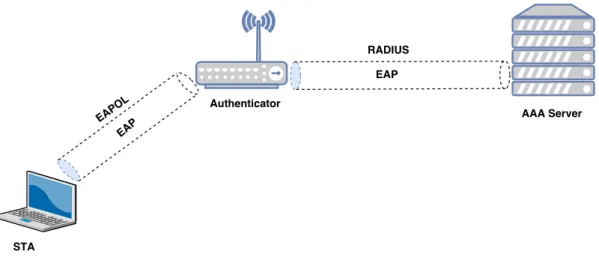
Figure 3: A IEEE 802.1X based connection
The terminology as per IEEE 802.1X is as follows: the authenticating device is called the supplicant, the device controlling the supplicant network access is the authenticator, and finally, the backend server responsible for the authentication is an authentication server. The standard has named the logical link between an AP
and an authenticating device as EAPOL, which stands for EAP Over LAN. A typ-ical network making use of IEEE 802.1X can be seen in Figure 3. RADIUS is the networking protocol used between the authenticator and authentication server. The successor for RADIUS is DIAMETER [44]. However, most of the existing infras-tructure for establishing a WLAN only supports the older RADIUS protocol.
The authentication messages or specifically EAP messages are exchanged be-tween the supplicant and authentication server. The messages are encapsulated as EAPOL between supplicant and authenticator. And between authenticator and AAA server, the messages are encapsulated as RADIUS messages. During the au-thentication process, the authenticator does not read or modify the EAP messages. Instead, it encapsulates the EAP message received from the supplicant in RADIUS message and decapsulate the message received from the authentication server. The authenticator is at the edge of the WLAN network. Hence, it is also an access con-trolling entity for supplicants in the WLAN.
2.6.4 Extensible Authentication Protocol (EAP)
EAP is an authentication framework which provides multiple methods for authen-tication. The EAP protocol operates at the data-link layer of the network stack. It only defines the message formats necessary for the authentication. It supports both wired and wireless networks, and is encapsulated within the frame format of the respective network type. For example in WLAN, EAP messages are encapsulated in a WLAN frame from a device supporting the IEEE 802.11 specification and en-capsulated as per the IEEE 802.1X specification.
The terminology of the protocol is similar to IEEE 802.1X terminology. How-ever in EAP, the supplicant can also be referred to as the peer. The strength of EAP is the flexibility that it offers. As per the concerned numbering authority, there are fifty five recognised EAP methods with a valid method identifier. Neither the authenticator nor authentication server has to pre-negotiate a method with a supplicant. Also, the authenticator need not understand the EAP methods. The authenticator can act as a pass-through authenticator [18] and it is how the authen-ticator is made use of in our EAP-NOOB protocol. When in a pass-through mode, implementation for any EAP method should only be implemented in the supplicant and the authentication server. This allows addition of new EAP methods into the EAP framework without making changes to the existing access network infrastruc-ture.
After the establishment of EAPOL link between the supplicant and the authen-ticator, the first EAP message, Identity-request is sent from the authenticator to the supplicant. The message is to query the identity of the supplicant. The selected EAP method can sometimes be determined by parsing the identity attribute of the response Identity-response message. However, information about the selected EAP
method will be exchanged in the subsequent EAP messages [18]. Both Identity-request and Identity-response are transmitted in plain text. The authenticator for-wards the Identity-response directly to the authentication server. Then, the au-thentication server initiates the method specific EAP message exchange. A series of messages are exchanged between the server and the supplicant before concluding the message exchange. The message exchanging session should always conclude either with EAP-SUCCESS or EAP-FAILURE. All the messages between an Identity-request till EAP-SUCCESS/FAILURE belong to a single EAP session.
In all the sessions which end with an EAP-SUCCESS, the master session key MSK will be derived at both the supplicant and authentication server. The MSK is derived using the message parameters from the recent EAP session, and possibly with some method-specific inputs. Using MSK, the Pairwise Master Key (PMK) will be derived at supplicant and authentication server. Then, the authentication server will export the PMK to the authenticator. Once the authenticator receives the PMK, the next task for the authenticator and supplicant is to mutually confirm that the PMK at both ends are identical. This is done with the help of a four-way handshake procedure [19]. During the handshake procedure, both sides derive pair-wise transient key (PTK), a session key which will be divided into five separate transient keys. The transient keys from PTK will be used for securing the user identity and data over the wireless network.
As part of the handshake procedure, both the authenticator and supplicant will generate and exchange a message integrity check (MIC) digest. The MIC digest is computed using one of the transient key derived at both the ends. Recreating the MIC digest, same as the received one will confirm that the supplicant and authenti-cator are having identical PTK and PMK. The lifetime of the PMK will be greater than PTK. Also, during the lifetime of PMK, multiple PTK can be derived. The four way handshake confirms that the PMKs are identical without disclosing the keys. This is critical for the secrecy of the key. Four-way handshakes were intro-duced as part of IEEE 802.11i-2004 amendment and is extensively used to generate or renew the keys in a wireless network.
2.7
Secure Device Configuration.
In an environment with multiple IoT devices, the owner or administrator configures the device to use the functionality of the device. This requires understanding of the common technologies involved in the configuration of a device. Misconfiguring a wireless network may create security vulnerabilities to be exploited and may affect every member of the network [17]. Ideally, each device should have its own set of credentials to ensure the security of the devices. In this section, we will discuss the protocols and concepts necessary for secure configuration of a device in a WLAN.
2.7.1 PKI and Digital Certificates
Uniquely identifying an entity and validating the received identity are the most im-portant steps of the authentication process. Digital certificates, username/password, challenge-based password and digital tokens are some of the most commonly used credentials in EAP methods for authentication. The level of security for a selected type of credential depends on various factors. For example, the strength of a pass-word is a major factor in passpass-word based authentication. However, authentication based on a digital certificate is considered to be the most secure method [20].
Digital certificate is an electronic document which has the inherent characteris-tics to prove the authenticity of the owner of the certificate. In the real world, it can be compared with the passport issued by any sovereign country. Digital certificates are issued by a trusted third party known as the certificate authority (CA). The CAs issues signed certificate to the requesting entity. The signature from the CA legitimizes the issued certificate. The attribute named as Subject in a certificate holds the name of the owner for the certificate. Other attributes of a certificate include the version, serial number, validity, public key of the owner, algorithm used for public key, signature from the CA and the algorithm used for signature [21]. Apart from the user or device authentication, digital certificates also can provide non repudiation, high level of information confidentiality and strong data encryption [22].
Digital certificates are part of a large system called public key infrastructure (PKI). The PKI defines the policies and rules necessary to create, distribute and manage digital certificates. PKI contains four specific authoritative bodies [23]:
– Certificate authority(CA): Is the root of trust, responsible for issuing digital certificates.
– Registration authority(RA): A subordinate to CA. It verifies the user requests and recommends CA about issuing the digital certificate.
– Repository : Stores and distributes issued certificates. This could be a single entity or a collection of distributed entities. Additionally, the repositories are not commonly part of Internet PKI.
– Certificate revocation list (CRL) issuer: An optional subordinate for CA which has the authority to issue revocation list for the issued certificates.
In the EAP framework, EAP-TLS, EAP-TTLS and PEAP are the most promi-nent EAP methods which make use of digital certificates for authentication. Apart from the EAP framework, digital certificates are extensively used in Internet bank-ing, e-commerce and secure E-mail. A user can certainly generate a certificate and sign it. However, self-signed certificates are not very useful, as they cannot be trusted. A popular practice is to buy certificates from trusted commercial CAs, such
as Verisign2. In an IoT environment, the devices which are part of an ecosystem may own certificates provided by the device manufacturer or vendor. If the device does not contain a certificate or the CAs of the installed certificates are unknown, then the user has to buy and install new certificates to each device. Given the long lifetime of a device, the need for replacing the certificate in its lifetime cannot be ruled out.
2.7.2 Diffie-Hellman Key Exchange
Some of the key components in this thesis rely on the Diffie-Hellman key exchange. In this section we briefly describe the key exchange procedure. Establishing a secure communication on a public network is not a trivial task. Consider two unknown en-tities that want to have a secure communication over an unprotected network. To ensure the security, the communicating entities can encrypt their messages and be rest assured about the secrecy of the messages over the network. The Message en-cryption and deen-cryption will require shared keys. They can be delivered in two different ways. First, a trusted independent entity can distribute the keys to both communicating parties over a secure channel. The independent entity can usually be used to distribute keys, as it is either too slow or expensive to send user messages through it. The second method is to derive the same set of keys, independently, at both the ends. Before the key derivation, both the entities will generate a public and private key pair. The public keys can be exchanged between the entities in plain text. Later, cryptographic operations are performed to derive shared secret keys. For the key derivation, each endpoint’s own private key and the received public key are used as input parameters. This method of key distribution is generally known as public-key cryptography.
A detailed explanation of the Diffie-Hellman key distribution is as follows,
Consider the communicating entities as A and B.
– Two prime numbersgandpare selected by one of the entity and communicated to another in plaintext.
– A selects a random number x and computes m=gxmod p and sends m to B.
– B selects y, a random number, and computes n = gymod p. Then, n is
transferred to A.
– A derives the shared key by operation K =nxmod p. Similarly, B derives the same key by operationK =mymod p.
– In the end, both A and B will have the shared key K =gxymod p.
An eavesdropper can obtain g, p, m and n. However, obtaining x from m will require discrete logarithm operation on m.
x=logg m mod p
Similarly,
y=logg n mod p
Obtainingxfrommand yfromncan be difficult for carefully chosen values ofp
and g. It requires operations in the order ofp1/2 to compute either x ory. Only an
algorithm whose complexity grew at a rate oflog2 pcan break Diffie-Hellman system
. The security of this technique relies on the difficulty of computing the logarithm ofmod p [37]. The logjam attack [38] made use of a flaw in TLS (Transport Layer Security), which internally used Diffie-Hellman for key distribution. In it, the TLS connection is downgraded to make use of a 512-bit p and eventually compromised the security of the connection. Additionally, the possibility to break the protocol with a 1024-bit p was also discussed. To avoid the attack, it was advised either to make use of a 2048-bit prime number for p or use the elliptic curve variant of Diffie-Hellman, which does not require larger values of p.
The elliptic curve variant of Diffie-Hellman is used for key distribution in our EAP-NOOB protocol. The decision is based on the fact that shorter keys can be used which is less computation intensive.
2.7.3 Elliptic Curve Diffie-Hellman (ECDH)
Here, the public key cryptography is applied on a finite field elliptic curve. As in the original Diffie-Hellman scheme, the security of the elliptic curve variant relies on the infeasibility to solve the discrete logarithm problem. Here it is referred to as the elliptic-curve discrete logarithm problem. The shared secret is calculated by performing finite set operations on the curve, precisely the point multiplication of a coordinate on the curve with an integer.
Before the start of key distribution, the involved entities agree on the system parameter: the finite field p, curve constants a and b, and the base point G. It can also be done by agreeing to a standard set of parameters defined for a curve by NIST. Now, consider the communicating entities as A and B. The steps to derive shared key between A and B are as follows,
– At first, the system parameters are shared or agreed on.
– A selects a random integerx and computesm=Gx. Here xis the private key and m is the public key. Public key is sent to B.
– Similarly,B selects a random integer y and computesn =Gy. Thenn is sent to A.
– Shared secret K =nx is computed at A and K =my at B.
– Both A and B have finally derived K =Gxy.
ECDH is only a key agreement protocol and does not authenticate the identity of the participating entities. This has to be handled by external methods. Authen-ticating the entities will avoid impersonation and man-in-the-middle attacks. The public keys in the key agreement can be either static or ephemeral. Static public keys are undesirable as it reduces the random inputs to the protocol. Moreover, the use of ephemeral public keys ensures perfect forward secrecy in the protocol.
When compared to popular public key cryptosystems, the Elliptic Curve Cryp-tography (ECC) needs shorter keys to provide the same level of security. For ex-ample, an elliptic curve over a 163 bit field is as effective as a 1024 bit modulo p RSA or Diffie-Helmann. The security increases with larger keys so that the security offered by a 571 bit field is equivalent to 15,360 bit RSA/ Diffie-Helmann [11]. The shorter key will be less computation intensive, and hence ECC are especially useful for constrained wireless devices.
2.8
Out-of-band Channel for Authentication
A logically and physically independent communication channel, other than the ex-isting channel for data transfer between two communicating entities, can be termed as an out-of-band (OOB) channel. In research literature, there exist many synonyms for an OOB channel. They include auxiliary channel, human assisted channel and manual channel [36]. Conventionally, the OOB channel is used for notifying a state or an event which cannot be sent over the in-band channel. Now, in the context of network security, the OOB channel has been extensively used for authentication. This is because the OOB channel often is robust against attacks. According to Sha-hab et al. [36], the security properties of an OOB channels may include, proven identity based authentication, authenticity of the origin of data, data integrity and confidentiality.
The in-band communication is secured by completing the authentication proce-dure using the OOB communication. For the user, in comparison with authentica-tion over PKI infrastructure, there will be a slight increase in the complexity of the authentication procedure. Also, when the OOB based authentication is used as the secondary verification method for an existing method (two factor authentication), it increases the credibility of authentication and in turn enhances the security. When used as the only method for authentication (single factor authentication), OOB based authentication still can provide strong and reliable authentication.
Based on their nature, OOB channels can be classified into three different cate-gories: private, public and weak [36]. In a private OOB channel, the confidentiality of the data is of utmost importance. Special precautions are taken to avoid disclo-sure of contents of the message while passing it over the OOB channel. An example of a private channel is a secret string read by the user from one device and typed manually into another device. Additionally, it must be made sure that the secret from first device is only read by the user and nobody else. In a public channel, the message to be passed over the OOB channel is publicly available. An example of a public channel is scanning a barcode from a public display. A message on the public channel can be sniffed, blocked and delayed. Finally, a weak OOB channel contains all the characteristics of a public channel, but additionally, the message can be stored and replayed. An example of weak channel is passing a voice message between two devices over wireless interface. Both public and weak channel can only ensure integrity and authenticity of data. All three categories of OOB channel may exist on the same physical medium. However, the channels are classified based on the security feature adhered by the medium while transferring OOB messages be-tween the two entities.
An OOB channel can introduce flexibility in an authentication process. For ex-ample existing infrastructure like cellular and Wi-Fi networks can be used for OOB message passing with the help of familiar user equipments such as smartphones and smart phones. In the case of constrained devices, there may not be provisions to host complex security infrastructure for authentication. In such cases, the OOB channel based authentication can act as a alternative. The OOB channel authenti-cation prevents difficult to conduct security attacks such as the Man-in-the-middle attack.
The EAP-NOOB protocol makes use of a user-assisted OOB channel. In this protocol, the message which is over the OOB channel contains a secret nonce and a cryptographic hash for integrity protection. Although the cryptographic hash will confirm the integrity of the message at the receiver’s end, it is recommended not to revel the secret nonce over the transmitted OOB channel. Thus a private OOB channel will be most suitable for EAP-NOOB.
3
Protocol Description
In this chapter we provide a detail description about the EAP-NOOB protocol. We start the chapter with an overview of the protocol. Next, we describe the terminology of the protocol and the protocol state machine. Later in the chapter, we provide a detailed description about each stage of the protocol. Finally the chapter ends by discussing the error handling and the security offerings of the protocol.
3.1
Overview
EAP-NOOB is a secure bootstrapping protocol that relies on a user-assisted OOB channel. It is added as a new authentication method to the EAP framework. The successful authentication requires message exchange over multiple EAP sessions. The protocol is responsible for key derivation, authentication and registration of IoT devices. The protocol is for off-the-shelf devices with limited user interface ca-pabilities. A display unit or a camera are some example devices that could use the EAP-NOOB protocol. Devices with limited or no user interfacing capability that cannot send and receive dynamically generated messages are not the target devices for this protocol. The protocol is equally effective over devices with or without pre-registration, pre-installed credentials and pre-provisioned device identifiers. At the end of the bootstrapping procedure, the device will be registered with an au-thentication serve, the ownership of the device is established, and the credentials necessary for secure network access and application-level security has been derived.
For the successful completion of bootstrapping, an OOB message exchange be-tween the device and the authentication server is mandatory. As part of the boot-strapping, Diffie-Hellman key exchange is performed over an open channel. The message from the OOB channel establishes the ownership, authenticates the key exchange and completes the shared key derivation. It is difficult to launch a Man-in-the-middle attack on the protocol, as it requires contents of messages from two independent channel to complete the attack. Also, the OOB message is dynamically generated. Compared to static messages, the dynamic code is more secure against dictionary and social engineering attacks. The OOB channel is expected to be par-tially automated. This grants the freedom to keep the message size in the order of tens of bytes. Also, it avoids manual operations such as, memorising and typing a message. An example OOB message passing scenario is scanning a QR code from a display unit through a smart phone.
The EAP-NOOB is specified as an open standard and a protocol for secure bootstrapping of IoT devices. The protocol is considered to be generic as it does not rely on any single OOB channel. Not depending on pre-installed credentials and identifiers enables easy transfer of device ownership. Also, the ability to support different types of user interfaces makes the protocol applicable to heterogeneous environment.
3.2
Protocol Terminology
The following are the important terminology that are used to explain the protocol.
– authenticator: Common entity in both EAPOL and RADIUS links. In this protocol, the entity functions in pass-through mode
– peer/client/supplicant: The IoT device under bootstrapping.
– authentication server/AAA/EAP server : EAP session terminating entity. It is also referred to as server in this section.
3.3
State Machine
The EAP-NOOB is a manifestation under client-server modeled EAP protocol. A peer will contain client side EAP-NOOB and the authentication server will have the server side EAP NOOB. The protocol consists of five distinctive states, and follows event based state transition. The states are named as: Unregistered(0), Waiting for OOB(1), OOB received(2), Registered(4) and Reconnecting(3). Both peer and server have similar state machines. Also, the state changing event affects alike on both the state machines. The state machine and state transitions can be seen in Figure 4.
A server side EAP-NOOB can interact with multiple peers and it maintains a state machine for each peer. Similarly, a peer may interact with multiple authenti-cation servers initially. However, as the bootstrapping is completed with only one of those server, the peer side EAP-NOOB will only have a single state machine transitioning tillRegistered state. At the beginning of bootstrapping, both peer and server should be atUnregistered state. Also, in the event of loss of persistent infor-mation, the state machines should be reset to Unregistered state. Always, the peer will initiate the EAP-NOOB method. Later, based on the received EAP-NOOB message at the server and the current state of both peer and server, the server will decide the next message and next state transition.
Once atUnregisteredstate, the peer can do Initial exchange with multiple servers. Initial exchange is a parameter negotiation session for identifying the suitable server. Completion of Initial exchange will change the state from Unregistered to Waiting for OOB state. Waiting exchange, a probing session for an OOB message is done at
Waiting for OOB state and it will not result in a state transition. Initial exchange and Waiting exchange will always end with an EAP-FAILURE, terminating the EAP session. Then, based on the negotiated OOB message direction, the OOB message sender (OOB output sender) will remain in the Waiting for OOB state. However, the receiver of the OOB message (OOB input receiver) will transit toOOB received
state. The states Waiting for OOB and OOB received are considered ephemeral. Initial exchange in the OOB received state will change the state toWaiting for OOB
Figure 4: EAP-NOOB state machine
transition. Although a peer can do Initial exchange with multiple servers, the OOB message is sent to or received from a single server with which the user has an account.
An OOB message exchange between the server and peer should only happen once for each peer. At the end of a successful Completion exchange, a shared se-cret derivation and confirmation procedure, the OOB output sender will directly transit from Waiting for OOB state to Registered state. Next, the OOB message receiver will transit from OOB received state to Registered state. Later, the state machines will toggle between Registered and Reconnect state, unless the device is reset or either of the entities losses the persistent information. Falling back from the Registered state on either side should only happen with user intervention.
It requires a minimum of two EAP sessions to successfully complete the EAP-NOOB method. Also, the protocol requires mandatory user assistance to success-fully complete the authentication. The total time and the complexity of user as-sistance depend on the chosen OOB channel. Therefore, one cannot pre-estimate the total authentication time. Although, an EAP session does provide timer based waiting mechanism for receiving a message. In case of EAP-NOOB, a fixed time bound approach to complete the user assistance is not a feasible solution. Hence,
the method is completed using multiple EAP sessions. Also, it helps to segregate the method into three distinctive steps: peer interaction with all the relevant servers through Initial exchange, Waiting for OOB message through Waiting exchange and finally, shared key confirmation through Completion exchange. After successful reg-istration, every re-keying is done in a separate EAP session.
3.4
Protocol Stages
In this section of the thesis, we describe the messages and their contents for all the stages of EAP-NOOB protocol. Every EAP-NOOB message will bear a message identifier (ID) as part of the message. The identifiers span from 0 to 7. Message ID 0 is reserved for error messages and rest are used at different stages of the protocol. Characteristics of each of the message parameter are covered in Table 6 of Appendix A.
3.4.1 Initial exchange
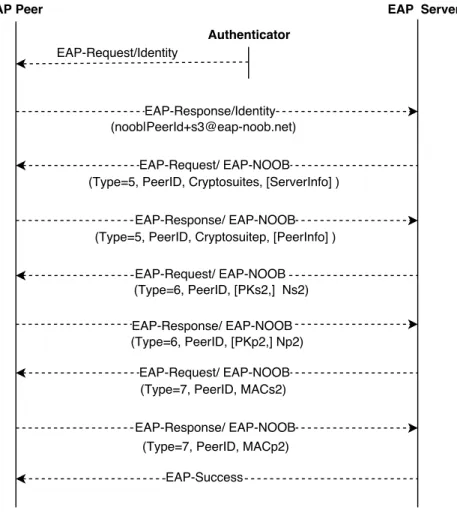
The EAP-NOOB supporting device will initiate the bootstrapping procedure with the Initial exchange. It is started by responding to the EAP-Request/Identity mes-sage from an authenticator. The server need not have to have any prior information about the peer. Instead, the peer will use a generic network access identifier (NAI) string [email protected] in its reply with every server. The receiving server will allocate a unique identifier, named peerID, for each interacting peer. The peerID is used to uniquely identify the client for the complete duration of association and it is also helpful for maintaining the peer context in the server. In case of Ini-tial exchange from any ephemeral state, the NAI will be specific and will have the peerID and the current state information of the peer. The NAI follows the format
[email protected]. Here, s is a character delimiter for state and X refers to current peer state. In every Initial exchange, the reply to EAP-Request/Identity will only contain the current NAI of peer.
After exchanging identities, negotiation of parameters will take place. The peer and server parameter sets containing: protocol version, OOB message direction and supported cryptographic algorithms are exchanged over Type 1 EAP-NOOB message. Type 1 EAP-NOOB Request from server will contain information about supported cryptographic algorithm (Cryptosuites), supported OOB message direc-tion (Dirs) and Supported EAP-NOOB protocol versions (Vers). The peer will then match the received parameters with its own and will reply with a Type 1 EAP-NOOB-Response message. The reply message contains selected cryptographic algo-rithm (Cryptosuitep), supported version (Verp) and OOB message direction (Dirp). Also, specific set of information about the server and the peer are exchanged as pa-rameter serverInfo and peerInfo. The values from these papa-rameters are essential to identify or access either a server or a peer from the application layer. When the se-lected OOB message direction is peer-to-server, a user will select the relevant server based on the serverInfo. Similarly, when the selected direction is server-to-peer, a
user will look for the device information at server side based on peerInfo.
Next, nonces (Ns and Np) and ECDH Public keys (Pks and Pkp) from both server and peer are exchanged over the Type 2 EAP-NOOB messages. The ex-changed public components should be based on the negotiated cryptosuite and are later used for deriving the shared key. Finally, the server will end the session by sending a EAP-FAILURE. Initial exchange with its parameters as represented in [42] can be seen in Figure 5.
Figure 5: Initial-exchange
3.4.2 OOB Step
Based on the negotiated message direction in the Initial exchange, an OOB message is sent either to the peer or the server. When the negotiated direction is peer-to-server, based on the OOB channel and the peer side user interface capability, a peer may generate more than one OOB message, i.e one OOB message for every com-pleted Initial exchange. Then, the user will select the relevant server by selecting the corresponding OOB message generated for that particular server. However, when the negotiated direction is server-to-peer, there will only be one OOB generated.
This is because the server can directly look up for the relevant peer context in its own database and can generate the OOB message for the retrieved peer context. As the OOB message is transferred over an user assisted channel, the OOB mes-sage will not contain a mesmes-sage type. Instead, the OOB mesmes-sage will always have three parameters: server assigned peer identifier (peerID), an OOB message nonce (Noob) and a cryptographic finger print (Hoob). The Hoob is generated using the parameters from Initial exchange.
(Hoob = H(Dir,Vers,Verp,peerId,Cryptosuites,Dirs,serverInfo, Cryptosuitepp,Dirp,peerInfo,PKs,Ns,PKp,Np,Noob).
The cryptographic hash generating functionH is selected based on the negotiated cryptographic algorithm from Initial exchange. The input parameter Dir used for Hoob generation is the negotiated OOB message direction. When the negotiated direction is three, both OOB input and OOB output should be delivered. At the receiver’s end, the integrity of the received OOB message should be verified by computing the Hoob using same inputs, and comparing it with the received value.
3.4.3 Waiting exchange
Although an OOB message is sent over an OOB channel, confirmation of reception of OOB message over the in-band-channel is necessary. A server will have to service multiple peers during its up-time, and continuous probing for the confirmation of reception will utilize the server resources unnecessarily. Instead, a Waiting exchange will be done. Irrespective of the OOB message direction, a Waiting exchange will always originate from a peer. Each Waiting exchange is done over a separate EAP session. Right after the Initial exchange, when the peer and server are atWaiting for OOB state, the peer will respond to EAP-Request/Identity with its current NAI. The server then assigns a wait time in seconds to the peer. Till the end of the assigned time, a peer should refrain itself from probing the server. The server will assign the wait time over a Type 3 EAP-NOOB-request. To which, the peer will respond with a Type 3 EAP-NOOB-response containing the peerID as a acknowl-edgment. Finally, the server will end the session with an EAP-FAILURE. A Waiting exchange message sequence as represented in EAP-NOOB specification [42] can be seen in Figure 6.
When the OOB message is received either at a server or a peer, the next probing EAP-Response/Identity will lead to Completion exchange. The automatic transition from Waiting for OOB state to OOB Received state itself is the confirmation of reception of an OOB message. Waiting exchange also helps to set an upper time limit for the number of OOB message exchanges. When a peer completes Waiting exchange for a certain number of times without an OOB message, then the server will send Unwanted peer error message to the peer. After receiving the error, the peer should refrain from probing for a long interval. As it is the responsibility of the peer to probe and confirm the reception of an OOB message, Waiting exchange in
Figure 6: Waiting-exchange
server-to-peer direction may not seem necessary. However, with the help of Waiting exchange, the concept of setting a maximum time duration for OOB step can be used in server-to-peer direction. So the procedure is carried out in both the directions.
3.4.4 Key Derivation for Completion exchange
After receiving the OOB message, both server and peer will derive the shared keyZ
based on the ECDH algorithm. The Ephemeral Unified Model or C(2,0,ECC,CDH) scheme from NIST specification [40] is used for key derivation. Under this scheme, two ephemeral keys and two static keys are derived. The hash function H used for concatenation key derivation function (KDF) is from the negotiated cryptographic algorithm. The input parameters for the KDF are: shared key between the entities, eight byte ASCII string "EAP-NOOB" as AlgorithmID, Np as PartyUInfo, Ns as PartyVInfo and Noob as SuppPrivInfo. The parameter SuppPubInfo from NIST specification is not provided for key derivation during Completion exchange. The input parameters: Np, Ns and Noob should be 16-byte byte strings.
The derivation will yield 192 byte shared key Z. Later, the shared key is divided into five separate sub keys. The sub keys are MSK (byte 0-63), EMSK (byte 64-127), KMs (byte 128-143), KMp (byte 144-159) and Kz (byte 160-191). MSK and EMSK are used by EAP as keying materials for deriving transient keys. KMs, Kmp and Kz are used internally by EAP-NOOB for computing message authentication codes (HMAC).