Procedia - Social and Behavioral Sciences 119 ( 2014 ) 210 – 218
1877-0428 © 2014 The Authors. Published by Elsevier Ltd. Open access under CC BY-NC-ND license. Selection and peer-review under responsibility of the IPMA.
doi: 10.1016/j.sbspro.2014.03.025
ScienceDirect
27
thIPMA World Congress
Creating holistic project-knowledge society through project
management education in research and development
Neven Žarkovi
ü
a,b, Igor Vre
þ
ko
c*, Zlatko Barilovi
ü
aa “Baltazar Adam Krþeliü” Accredited College of Business and Management, V. Novaka 23, Zaprešiü 10290, Croatia bRuÿer Boškoviü Institute, Bijeniþka cesta 54, Zagreb 10000, Croatia
cUniversity of Maribor, Faculty of Economics and Business, Institute for Project Management, Razlagova 14, Maribor 2000, Slovenia
Abstract
Developing knowledge and creating knowledge society seems like to be among the major factors in founding and further developing modern society. Development is strongly associated with projects as temporary and unique processes, and thus being tools for enabling development. Accordingly, in competitive and globalised modern society, arising of thoughts about project society being able to successfully implement multitude of projects is not surprising. Since establishing knowledge- and project-society appears to be among nations’ strategic goals, it is important to recognise and eliminate their possible deficiencies. In doing so, the paper propose using the holistic, i.e. systems approach and integration of expanded concepts about knowledge- and project-society into holistic project-knowledge society. Efforts for creating such society start with educating and qualifying as many as possible individuals. The final part of the paper shows the case following this idea on Specialist graduate professional study of Project management at the “B.A.Krþeliü” Accredited College of Business and Management in Zaprešiü, Croatia.
© 2014 The Authors. Published by Elsevier Ltd.
Selection and peer-review under responsibility of the IPMA.
Keywords: Project management, educational projects, project education, research and development (R&D), holistic project-knowledge society
* Corresponding author. Tel.: +386 2 22 90 246; fax: +386 2 25 16 681. E-mail address:[email protected]
© 2014 The Authors. Published by Elsevier Ltd. Open access under CC BY-NC-ND license. Selection and peer-review under responsibility of the IPMA.
1. Introduction
Establishing the knowledge-based society appears to be one of the main pillars for establishing competitive and modern society. In trying to preserve or increase the competitiveness, both nations and trans-national regions increase their efforts and resources for implementing developmental projects. While projects proved to be appropriate/necessary tools for assuring progress, the history of modern projects and their outcomes and consequences have shown necessity to treat projects from more holistic – systemic aspect. Separate development of knowledge society and of project society, not incorporating the sufficiently holistic aspects in both, showed to be dangerous for the future of any modern society. In the following chapters we present a concept of holistically oriented project-knowledge society. In such a society, research and development (R&D) plays fundamentally important role. Namely, specificities of R&D projects (basic, target-oriented and developmental) and their outcomes are mutually dependent triggering each other resulting in applicability of results of R&D projects increasing our overall knowledge. Successful implementation of all these different kind of projects demands specific knowledge and competencies of project management necessary for their implementation.
Hence, recruiting R&D-oriented project managers and training researchers in project management competences with holistic approach needs to become one of main developmental and societal goals in modern countries.
Therefore, in the final chapter, the requirements for developing competent and holistic project managers is presented, based on the case from VSPU (“B.A.Krþeliü” Accredited College of Business and Management in Zaprešiü, Croatia), which demonstrated important positive results in creating holistic project-knowledge society.
2. Role of science and research in knowledge development
As the terms "basic research" and "fundamental science" indicate, they represent the fundaments of our overall knowledge in the widest sense of modern science including the entire spectrum of research topics and scientific methodologies. Thus, the fundamental science comprising both theoretical as well as experimental research methodologies rely on projects that tend to be implemented in specific fields of science, namely in life sciences, social sciences, medicine and technical sciences. However, since recent years these all interact in research and development (R&D) of the modern society building rapidly progressing "interdisciplinary sciences and technologies".
Complementary to that, applied research projects are target-oriented, exploring applicability of the know-how gained through scientific basic research projects. Hence, the applied research projects are based on the fundaments of the basic research projects, which discovered novel findings that might be applied in development of society. Such a development can be achieved only with the increase of the overall scientific fundaments on one hand and on the other on the technological progress. Therefore, basic and applied research are mutually dependent, they interact progressively in majority of successful projects, such as drug development based on knowledge generated in chemistry and biology, or development of modern communication systems based not only technical sciences but also on progress achieved by physics and social sciences.
Such mutual dependence and progressive interactions between basic and applied research projects make the essence for development of the modern knowledge society, in which project management is crucial. Namely, project management allows development of strategies and skills necessary to enhance interactions between various projects and successful realization of any project in particular. The relevance of project management in modern Europe is stressed by R&D projects carried in about 300 European Research & Technology Organizations (RTOs), which generate entrepreneurial and industrial activities on the scale of approximately 100 billion €/year.
Unfortunately, public perception of science is usually wrong, especially in the years of crises, when ignorant "decision makers" consider science as a kind of social luxury. For example, for several years in Croatia the project of restructuring national science and technology system under the "Science and Technology Project" (STP) supervised and financed to great extent by the World Bank gave moderate results due to the abuse of the project by directly involved decision makers and administrators having their own goals, not only political. The lack of public control necessary to develop functional system of education and science linking academia and industry was a
consequence of such policy. That would not have happened if project management would have been implemented in every step of the STP.
However, surprisingly positive, indirect and independent result of the STP was initiation of the graduate study in Project Management that gives students not only necessary knowledge and practical skills but also promotes interdisciplinary of project management as profession and as a field of science. As a results of this particular study program, National Science Council of Croatia recognized Project Management as an independent interdisciplinary field of science, while more than 300 students that finished study of Project Management so far, some already being the PhD students, make good precondition for success in further development of modern knowledge based, holistic project-oriented society.
3. Creating and developing holistic project-knowledge society
3.1. Holistic project-oriented society
At the turn of this century, findings of many researchers and project management practitioners led to viewing projects and project management in a wider context, particularly their role in the development. Projects and concepts of project management started to be linked with strategies, concepts of strategic management, and development of a certain social environment (Cleland, & Ireland, 2006; Hauc, 2007). Tanaka (2011) defines strategic project management as a third generation in the development of project management, applied since 2000. He included the need for a systems approach among typical techniques in use in strategic project management (e.g., project portfolio management, program management, modular project approach).
Along came the growing usage of the term project-oriented societies. This relatively new term emerged at the turn of this millennium. In discussing societal contributions of project management, Cleland (2003) asks—based on the identified projects through human history—whether we can say that project-oriented societies already existed in antiquity, although he fails to define what project-oriented society is. According to Gareis (2002), the first person to scientifically research and define the phenomenon of project-oriented society, it is “a society which (often) applies projects and programmes as temporary originations to perform unique processes of medium and large scope and who use them for its developmental, business and other needs; it is a society which carries out the education, researches, marketing and standardization for the sake of project management. In project-oriented societies, not only traditional industries but also the public sector and non-profit organisations consider projects and programmes as appropriate organisations to perform relatively unique processes.” This understanding of project-oriented society has remained unchallenged and unchanged in subsequent studies.
Different models have been devised to assess the project-oriented society’s level of development and influence on other important social issues. The Vienna University of Business and Economics Austria first conducted such studies in the 21st century in a partnership with the International Project Management Association (IPMA). The research involved six countries—Austria, Denmark, Hungary, Romania, Sweden and the United Kingdom—and highlighted significant differences in the level of development of project-oriented societies in these countries (Gareis, & Huemann, 2001; Gareis, 2002; Bodea, 2002; Bargaoanu, & Calinescu, 2008). However, existing contributions to project-oriented societies (and project management maturity models) lack explanations for 1) consciousness about the role, importance, and inevitability of projects for dealing with global strategic issues and the need to accept the necessity of particular projects required to master those issues and 2) the need to holistically, systematically, and objectively understand and make decisions about projects.
Since the world is entering a period of permanently present and intensified influences of global crises, we have to find expert solutions to fight the growth of such influences and their further emergence through projects. It is necessary to secure all necessary resources for this purpose and realize that global crisis projects will continue to grow in priority.
It becomes clear that we have to apply a broader criterion in setting the fundamental commitments of the project-oriented society. The definition of project-oriented society must be expanded to incorporate the idea of a holistic project-oriented society—a fully aware society that consciously accepts and identifies the appearance of global strategic issues as facts of the future (Hauc et al., 2011). It is a society that understands what projects mean
for the survival and development of humankind, in all its organizational environments. Such a society systemically and holistically sets up and accepts strategies for fighting global issues and, in turn, adapts the choice and the pace of implementing projects to them, systematically bearing in mind all effects and consequences resulting from those projects while securing—despite the ever-present shortage—all necessary resources. It is a society, capable of— with an appropriate level of developed project management knowledge and support—carrying out of projects and ready and willing to implement them.
When discussing project-oriented societies, many authors highlight the importance of knowledge and developing project competences (e.g., Gareis, 2002; Omaziü, & Baljkas, 2005) as well as necessary inventiveness (e.g., Hauc, &Vreþko, 2009; Järkvik et al., 2007; Rebernik, & Širec, 2007). They correlate project-oriented society with culture standards (e.g., ethics/morals, diligence) (Carroll, & Buchholtz, 2008) and the level of organizational development of the environment in which projects are implemented (e.g., project organizational structure, information support, multi-project organization, standardization of project procedures). We will not go into details about such views, but rather focus on the need to raise general knowledge about project management and visibly define its position when speaking about a knowledge society.
3.2. Project oriented knowledge society
Society is made up of mutually interrelated groups of people, in which a whole exists only through a unity of functions taken up by all participants and each individual is to a great extent defined by his or her belonging to the whole group (Adorno, & Horkheimer, 1979). Skledar, & Kregar (2003) defined society as an organized whole— namely, a group of people connected by a joint life system (rules and norms) and social institutions. In each society, regardless of the level of its development, a certain organization of joint living exists and assigns each member with social functions and roles, which they basically have to respect.
Throughout history, societies have passed through several major phases of development, such as pre-modern and modern societies (i.e., Giddens, 2007; Lee, & Newby, 1983), although some sociologists (e.g., Fukuyama, 2000; Haralambos, & Holborn, 2002) claim that a new type of society—postmodern society—is being developed by transitioning from industrial modernism. According to Bariü, & Jeleþ Raguž (2010), the current world is on the threshold of changing from an industrial society to an information society and a knowledge society. The knowledge society is often seen as a new civilization that replaces the dying and hopeless era of industrial capitalism with new forms of social, familial, and labor life (Švarc, & Perkoviü, 2011).
Bariü, & Jeleþ Raguž (2010) defined “knowledge society as a society, in which human knowledge, skills and abilities are the most important development resources and initiators of economic and social changes.” They further concluded that the structure of the knowledge society “consists of the so-called four pillars: education, the innovation system, the information-communication-technological sector, and the legal and economic framework.”
Although many researchers emphasize the necessity of building and developing the knowledge society, others warn of numerous problems that result from it. Dahrendorf (2005) stresses that the knowledge society creates new elite of the rich while the poor become even poorer. New conflicts are created as well as social inequity, exploitation, and other social problems. Stiglitz (2009), similar as Beck (2003), focused on negative social and ecological consequences stemming from pursuing narrow subjective interests.
Both supporters and critics of the knowledge society fail to give sufficient consideration to the inter-dependence between the knowledge society and the rise of a multi-project environment (and changed demands in knowledge, support, etc.) and global strategic issues, much less their resolutions. Establishing a highly developed knowledge society, as understood today, will not be sufficient for mastering multi-project environment and global strategic issues discussed herein. Indeed, according to some of the quoted authors, such crises can appear precisely because of the development of the knowledge society, although we argue it is the non-systemic (i.e., not holistically enough) development of the knowledge society.
The knowledge required to find solutions for project-oriented society struggles with influences of crises and for achieving holistic knowledge society, which should help raise awareness that crises are present and that a global resolution is necessary. In this respect, a transition to the project-oriented knowledge society is needed, while the term knowledge society needs to be further extended: Knowledge society covers needs for mastering global
strategic issues, permanently increasing humankind’s general knowledge, based on the development and application of new knowledge from innovativeness and research and development achievements. Such knowledge further contributes to raising awareness of the need to adopt and implement the necessary measures (i.e., projects to resolve global strategic issues), thereby ensuring further development of humankind and maintenance of its dignity.
In establishing the project-oriented knowledge society, it is necessary to incorporate the knowledge of mastering multi-project issues as solving global strategic issues is connected to mastering a number of projects. Here we do not refer only to the narrow, middle section of society, which knows how to plan and implement projects, but to society as a whole, which will have to accept the fact that particular types of projects are needed, although some will demand self-sacrifice for some while creating opportunities for others. Most importantly, society will have to accept the fact that some necessary projects will cause a different distribution of capital, changes in the current power hierarchy, and control over certain world events.
3.3. Creating holistic project-knowledge society
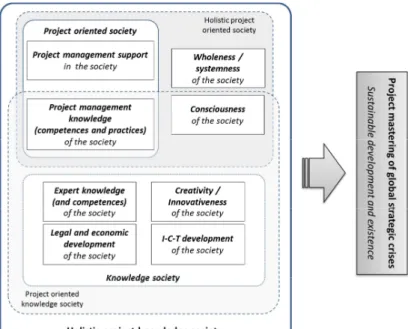
Because of the great importance of global strategic issues for the survival and further development of the world, it is necessary to unite the project-oriented knowledge society and holistic project-oriented society. Knowledge makes it possible to find the necessary solutions and measures to resist influences of global strategic issues; solutions have to be found to increase awareness of the need for a joint action in resisting global strategic issues. To permanently resist their influences, it is necessary to establish a holistic project-knowledge society (see Figure 1).
Fig. 1. Holistic project-knowledge society.
Knowledge society includes the inter-action of expert knowledge and competence, creativity and innovativeness, high-level legal and economic development, and developed informatics/communications/ technology to support the establishment of a holistic project-oriented society and vice versa as it is not possible to successfully master global strategic issues through either a highly developed classical project-oriented society or a
knowledge society. However, integrating these societies into a holistic project-knowledge society set up the appropriate foundation to successfully meet today’s challenges.
4. Developing holistic R&D project managers
4.1. Project management as a science and as a profession
Project management should have crucial role in development of holistic project-oriented society being considered both as highly skilful profession and as interdisciplinary science. Namely, project management allows linking different fields of science into functional interdisciplinary R&D applicable in companies as well as in public services and academia. On the individual level project management could enhance career development and eventually promote holistic project-oriented and knowledge-based society (Table 1).
Table 1. Project management as an interdisciplinary science and as a profession. Project management as interdisciplinary
science
as highly skillful profession
Individual level Development of
research and/or academic career Achieving project goals individually and/or as a team member Company or institutional level Functional,
interdisciplinary integration of basic and applied research with manufacturing and service providing activities Project business orientation following international standards and implementing performance-awarding system of project management
Society level Development of
knowledge-based society
Development of project-oriented society
Major activity Research and
development (R&D)
Education (specialization)
As shown in the table, project management should be used to establish the knowledge-based society and to develop it further as holistic project-oriented society. Project management should be used on all societal levels; on individual, company/institutional and eventually on the level of entire society. To make this possible it is necessary to implement education in project management skills on all levels of education, including life-long learning on project management also as a science, in particular for the R&D. By doing so, we may reach the level of the knowledge-based society tending to promote creativity and continuous development for the benefit of all members of society.
4.2. Holistic project managers from “B.A.Krþeliü” Accredited College of Business and Management Products in higher education can be different (Štimac, 2012):
• knowledge that is offered at colleges and through educational programs,
• students which come out from the educational process as a faculty's "finished product",
• all necessary resources and infrastructure in order to better convey knowledge to students (lectures, seminars, professional practice, equipment, etc.).
Higher education is mainly about performing services, which are particularly challenging due to their characteristics (intangible, variable, inseparable, unable to be put into warehouse). Most services occur only in contact with the customer. Restrictions that services have in relation to the product include the "power" of services that service providers need to transform into a competitive advantage (Štimac, 2012). Higher education institutions use a variety of resources and technology to create a particular benefit to individuals and society as a whole. The product of these institutions can be called educational services. So, we can say that the product or services of higher education institutions can be defined in many ways, and each of the specific aspects must meet basic quality criteria. All aspects are interdependent and their combination makes the product mix (Leko Šimiü, & ýarapiü, 2008).
Taking into account the above elements that make the product/service in higher education, we are focusing on the curriculum and the additional services to present qualities of Specialist graduate professional study Project management.
Study’s program curriculum
Project Management study on the VSPU lasts for 2 years (4 semesters), and the curriculum consists of 12 compulsory and six elective courses in the first year of study and 7 compulsory and 6 elective courses in the second year of study. Last semester consists of consultative sessions and the preparation and defense of the thesis under the guidance of mentors.
Required courses are: Project Management 1, Business Ethics, Specialties and Methods of Research and Development Activities, Teamwork Methods, English 1, Project Management Information Support, Project Management 2, Planning/Preparation/Launching of the project, Project Economics, Projects Risk Management, Human Resources Management, English 2, Strategic Management, Managing innovation and scientific research in the EU and Croatia, Knowledge-based Companies, Intellectual Property, Project Applications, Legal Aspects of Internet Business , Projects Marketing.
Elective courses are: Croatian Public Administration and the EU, Changes in the Organization and Stress, German 1, Business Communication, Multimedia Communications, German 2, Development and Operation of Public Sector, Management of Public Sector, Projects in the EU, Managing Budgets, Projects and Business Plans in Research and Development Work, Fundamentals of Scientific Entrepreneurship.
Study's additional services
In addition to the shortly presented curriculum of the Project Management study on the VSPU, a range of additional services (based on a marketing concept of operations) are also offered to students, in order to raise the overall quality and outcomes of the educational services.
Most of these additional services results from the collaboration with partner organizations, such as:
• Croatian Association for Project Management (CAPM): IPMA International certification for project managers; IPMA Registered Education Program (IPMA REG); the opportunity to participate on the projects of Young Project Managers Section called Young Crew Croatia (YCC), operating within CAPM; participate in fee-free lectures under organization of CAPM and YCC.
• Fachhochschule Technikum Wien (FTW): VSPU initiated collaboration with Fachhochschule Technikum Wien in 2012. FTW is the largest technical university of applied sciences in Austria. All programs are based on a solid theoretical foundation, while also with strong practical orientation. VŠPU students are enabled to attain additional 4 ECTS credits on the FTW, recognized in their Project Management study on VŠPU.
• Faculty of Economics in Osijek (EFOS): From 2010 VSPU students have the opportunity to continue studying at postgraduate level in the organization of the EFOS. In this way, Project Management students have possibility of direct continuing and vertical education, with the final possibility of obtaining a doctoral degree.
• The ERASMUS program: students, teaching and non-teaching staff will shortly be able to increase their mobility within the Erasmus program. VSPU assigned to the Extended Erasmus University Charter based on the decision of the Executive Agency for Education, Audio-visual and Culture of the EU in Brussels. Mobility will be applied in the academic year 2013./14.
5. Conclusion
Establishing the knowledge-based, project-oriented society should be primary goal of undoubtedly prominent scientific experts in research and education together with project managers working on scientific projects and programs. The work of these experts should be based on democratic principles and open to the public to achieve the vision of the holistic project-knowledge society. However, bureaucracy, which cannot be avoided nowadays, together with short-term interests of political oligarchs are opposing creation of holistic project-knowledge society.
To attenuate harmful consequences of this obstruction of development of holistic project-knowledge society it is necessary to establish efficient contingency plans that would overcome various administrative measures imposed by political bureaucrats aiming to control both scientists and entrepreneurs. Efficient system attenuating such malicious bureaucracy could be education of sufficient number of high level project managers understanding the vision of the knowledge based, project-oriented society thus building holistic project-knowledge society. This is the ultimate goal of the Specialist graduate professional study of Project management at the “B.A.Krþeliü” Accredited College of Business and Management in Zaprešiü, Croatia.
References
Adorno, T. W., & Horkheimer, M. (1979). Sociološke studije. Zagreb: Školska knjiga.
Bargaoanu, A., & Calinescu, L. (2008). Romania as a Project-oriented Society. Management & Marketing, 3 (1), 81-94. Bariü, V., & Jeleþ Raguž, M. (2010). Hrvatska na putu prema društvu znanja. Poslovna izvrsnost, 4 (2), 57-77. Beck, U. (2003). Što je globalizacija?. Zagreb: Vizura.
Bodea, C. (2002). Project Oriented Society: From a theoretic concept to a concrete economic reality. Economy Informatics, 1, 13-19. Carroll, A. B., & Buchholtz, A. K. (2008). Business and Society: Ethics and Stakeholder Management (7th ed.). Athens: University of Georgia. Cleland, D. I. (2003). The Societal Contribution of Project Management, IPMA 17th World Congress on Project Management. Moscow, Russia
June 4-6, 2003.
Cleland, D. I., & Ireland, L.R. (2006). Project management: Strategic Design and Implementation (5th ed.). New York: McGraw-Hill Companies, Inc.
Dahrendorf, R. (2005). U potrazi za novim poretkom: predavanja o politici slobode u 21. Stoljeüu. Zagreb: Deltakont. Fukuyama, F. (2000). Povjerenje. Zagreb: Izvori.
Gareis, R. (2002). Management in the project-oriented society. Wien: Projektmanagement Group, Wirtschaftsuniversität. http://epub.wu.ac.at/814/1/document.pdf (1. 7. 2013).
Gareis, R., & Huemann, M. (2001). Benchmarking the Project-oriented Society. Wien: Projektmanagement Group, Wirtschaftsuniversität. Giddens, A. (2007). Sociologija. Zagreb: Nakladni zavod Globus.
Haralambos, M., & Holborn, M. (2002). Sociologija: Teme i perspektive. Zagreb: Golden Marketing.
Hauc, A., & Vreþko, I. (2009). Povezivanje projekta i projektnog menadžmenta s inoviranjem i inovacijskim menadžmentom. In N. Skledar (Ed.), Zbornik radova (pp. 383-401). Zaprešiü: Visoka škola za poslovanje i upravljanje s pravom javnosti "Baltazar Adam Krþeliü." Hauc, A., Vreþko, I., & Bariloviü, Z. (2011). A holistic project-knowledge society as a condition for solving global strategic crises. Društvena
istraživanja, 20 (4), 1039-1060.
Hauc, A. (2007). Projektni management. Ljubljana: GV Založba.
Järkvik, J., Berggren, C., & Söderlund, J. (2007). Innovation in project management: A neo-realistic approach to time-critical complex systems development. In: Project Research Conference—Projects in innovation, innovation in projects. Brighton, UK: The International Research Network on Organizing by Projects.
Lee, D., Newby, H. (1983). The Problem of Sociology. London: Hutchinson.
Leko Šimiü, M., & ýarapiü, H. (2008) Znanje marketinga u funkciji marketinga znanja. In B.Grbac & M.Meler (Eds.), Marketing u društvu znanja (pp.87-98). Rijeka: Ekonomski fakultet Sveuþilišta u Rijeci & CROMAR
Omaziü, A. M., & Baljkas S. (2005). Projektni menadžment. Zagreb: Sinergija nakladništvo.
Rebernik, M., & Širec, K. (2007). Fostering innovation by unlearning tacit knowledge. Kybernetes, 36(3/4), 406-419. Skledar, N., & Kregar, J. (2003). Znanost o društvu. Zaprešiü: Visoka škola za poslovanje i upravljanje “B.A. Krþeliü.” Stiglitz, J. (2009). Uspjeh globalizacije: Novi koraci do pravednog svijeta. Zagreb: Algoritam.
Štimac, H. (2012) Marketing i kvaliteta usluge u kontekstu internacionalizacije visokoškolskog obrazovanja (doktorska disertacija). Osijek: Ekonomski fakultet u Osijeku
Švarc, J., & Perkoviü, J. (2011). Prilog sociologiji društva znanja, 4. meÿunarodna konferencija o naprednim i sustavnim istraživanjima. Odsjek za sociologiju Filozofskog fakulteta, Zagrebu, Hrvatska.
Tanaka, H. (2011). The changing landscape of project management. Project Perspectives—The annual publication of International Project Management Association, 33, 10-16.