Nijmegen
The following full text is a publisher's version.
For additional information about this publication click this link.
http://hdl.handle.net/2066/141390
Please be advised that this information was generated on 2017-12-05 and may be subject to
change.
Computerised Speaking Practice:
The Role of Automatic Corrective
Feedback in Learning L2 Grammar
Published by
LOT
phone: +31 30 253 6111
Trans 10
3512 JK Utrecht
e-mail: [email protected]
The Netherlands
http://www.lotschool.nl
Cover illustration: Listening computers, by Quirijn Backx and Bart Penning
de Vries.
ISBN: 978-94-6093-178-9
NUR 616
Computerised Speaking Practice:
The Role of Automatic Corrective Feedback
in Learning L2 Grammar
Proefschrift
ter verkrijging van de graad van doctor
aan de Radboud Universiteit Nijmegen
op gezag van de rector magnificus prof. dr. Th. L. M. Engelen,
volgens besluit van het college van decanen
in het openbaar te verdedigen op vrijdag 19 juni 2015
om 10.30 uur precies
door
Bart Penning de Vries
geboren op 3 oktober 1981
te Bennekom
Prof. dr. R. van Hout
Copromotoren:
Dr. C. Cucchiarini
Dr. H. Strik
Manuscriptcommissie:
Prof. dr. M. van Mulken (voorzitter)
Prof. dr. A. Housen (Vrije Universiteit Brussel, België)
Prof. dr. J. Colpaert (Universiteit Antwerpen, België)
This work is part of the research programme
Feedback and the
acquisition of syntax in oral proficiency
(FASOP), which is funded by
the Netherlands Organization for Scientific Research (NWO).
And what is good, Phaedrus, And what is not good -- Need we ask anyone to tell us these things?
- Robert M. Pirsig, Zen and the Art of Motorcycle Maintenance
[A]t the end of every commercial break, the show's trademark shot of planet earth as seen from space, turning, would appear, and the CBS day-time network announcer's voice would say 'you're watching As the World Turns,' which he seemed, on this particular day, to say more and more pointedly each time - 'You're watching As the World Turns' - until I was suddenly struck by the bare reality of the statement. I don't mean any sort of humanities-type ironic metaphor, but the literal thing he was saying, the simple surface level. I don't know how many times I'd heard this that year while sitting around watching As the World Turns, but I suddenly realized that the announcer was actually saying over and over what I was literally doing. Not only this, but I also realized that I had been told this fact countless times - as I said, the announcer’s statement followed every commercial break after each segment of the show - without ever being even slightly aware of the literal reality of what I was doing.
Acknowledgements
Working on the FASOP project towards this dissertation has been a great
experience. Especially the experiments were exciting times, because that’s where the theory would meet the road, so to say. But I’ve also immensely enjoyed working with our FASOP group, which in turn was embedded in the friendly professional atmosphere of CLST.
First of all I’d like to thank everyone who participated in the experiments. Over two hundred people (thirty-five different nationalities) practiced with a version of GREET. It was always a lot of fun to meet everyone and receive your feedback. Your comments always sparked many ideas for improvements or for wholly new experiments.1
For the recruitment of the learners, we depended heavily on the assistance of language institutes and schools. We are most indebted to Radboud In’to languages, whose classes we have visited on several occasions. A special thanks to all the teachers, and in particular to José Bakx for allowing our experiments, and to Petra Roël who reviewed the GREET language content. ROC Nijmegen was also very friendly and allowed us to run the experiment twice at their location, and especially teacher Pleuntje Gouwerok was super helpful. At Capabel Utrecht we’d like to thank Tjitske Zondag and Eefke Jacobs for helping us run the experiment with their students and booking the computer room. We ran a pilot experiment with low educated learners at Cumulus Welzijn Utrecht (de Bram). Here I’d like to thank Nienke Witkamp-Bruijn who took the time to send multiple emails to their ICT support to make sure the experiment would work. At Intercity-Nijmegen Henk van Ooij was great to work with as he invested much time to discuss with us the possibilities for an experiment, after which he recruited participants and set us up in their computer room. Thanks also to the James Boswell Institute, Utrecht, and especially Jolanda Straver for approving the experiment and Ine Kievits for
recruitment in her class; and finally also the Language centre at HAN, where Manja Mekking ok’d the experiment and Eric Lemmens whose class we were allowed to visit.
Then secondly I’d like to thank very much the manuscript committee for carefully reading my dissertation over the Christmas period, and for their comments on the text.
For this project I was lucky to have very dedicated supervisors. Roeland, Catia and Helmer were virtually always available for advice or to promptly return useful feedback on texts. Roeland was always willing to discuss analyses and look for further explanations in the data, which was tremendously helpful and motivating.
1 Maybe, if you’re a former participant and you’ve read chapters 3, 4, or 5, you might have
found out that the participants got paid, while you were not! This means you were part of the first of two pilot experiments. We are immensely grateful to you and your participation improved the learning experience of all participants after you. But please contact me if you feel you are entitled to more than thanks.
Catia was great helping me out each time to structure my texts and activities. Helmer was always aware of the big picture and would make sure I stayed on the (straight and narrow) planned path. We were able to have many group meetings where we would discuss the project in detail. I think this resulted in a language learning experiment that covered almost all the bases and where it couldn’t, the best compromise was selected. This way Steve and I could work together both using experiments with GREET for our separate PhDs. Importantly, the atmosphere in our group was always relaxed but one of critical constructive thinking. There was much room for creativity and development of new ideas. Especially for designing the GREET program this has resulted in an experiment program that goes beyond what other CALL systems attempt to do. Way beyond. It just doesn’t make coffee.
Thanks to Joost van Doremalen who developed the speech recognizer and the first version of GREET. You’ve pioneered including Prince in a presentation, and you were also always good to talk to for a no-nonsense perspective on issues in language learning. Or on recording music.
Most of the development and experiment activities described in this dissertation were completed together with Steve. We worked together closely to develop a GREET system that could incorporate both our experiment plans. This has been a very enjoyable and fruitful collaboration and it extended well beyond simple PhD work into other important parts of life such as climbing, kick boxing, donuts, IPA beer, Twin Peaks (Lynch), On the Road, Lila, Cryptonomicon and Neuromancer. I think we also did some ground-breaking work on the key questions in horse-drawn CALL. Besides that important stuff, you were also great to work with. We had many useful meetings to hash out experiment issues (log output, motivation, planning) where the use of either flashcards or the white board was a must. Also the enthusiasm you brought to developing GREET was inspiring.
Our project also benefitted from work by our interns Judith, Polina, Kimber, Irene and Kimberly. Obviously so in their help with annotating (with special mention for winner of the prestigious ‘Best Annotator’-award Polina), but also in their projects using the GREET system to pursue various research questions.
Ineke van de Craats provided valuable advice when we were setting up the GREET experiments with low educated learners and in a later stage also helped to develop content for our longitudinal experiment.
I would also like to thank the two Marijkes (Bakkeren and Bleeker) at the MMS for helping us out with experiment logistics and allowing us all sorts of arrangements that weren't traditional.
Working at the Radboud University was great because of the wonderful colleagues. The open atmosphere at the department ensured that it was easy to ask for and receive help on any research related issue. Special thanks to Henk, Hella, Vanja, Sara, Polina, Remy, Job, Mario, Christina, Eva, Michele and everyone else on the eighth and ninth floor of the Erasmus building.
For kick boxing workouts thanks to Steve, Yang and Eric. It seems that kick boxing and research go very well together. Especially when alternative hypotheses are needed for explaining the data. For transportation from the train station to the
Erasmus building, Eric generously provided me with a bike that I’ve semi-literally rode to rusty bits.
Perhaps as an aside, it is good to explain that GREET can be pronounced as \`xre:t\, \`gre:t\, \`gri:t\, but not as \`xri:t\. Based on the axioma that Dutch names sound cooler in American English (e.g. Van Halen) we initially chose the name GeRT (Grammatica en Regel Trainer), but due to the unintended phonological
resemblance with a politician’s name that did little to enthuse Dutch learners, we opted for GREET instead. A Dutch name with a solid traditional feel to it with the added bonus of the characteristic velar fricative (\x\), which serves well as a symbol of the challenges that learning L2 Dutch poses.2
During our experiments, we've had many types of problems, all of which we controlled for in the next, only for a new problem to arise. We’ve had many disruptions which are sort of amusing now, so for them to have some sort of use I’ll list them here so they won't have been for nothing. Besides your more typical issues such as, computer crashed, server crashed, host server maintenance at the exact time of an experiment, server space full, local network too slow, automatic updates of all sorts of programs when it's least wanted, flash incompatibility and security settings, port configurations and microphone malfunctions, we had the more intriguing problem that we labelled the matrix: speech recordings that were distorted into tinny and slurred sounds with a helicopter in the background. Still nobody knows what the matrix is. When all these issues were solved or pre-empted, we experienced a power out in the building, and in the experiment following, a fire drill.
Getting back on the thanks-track here.
For agreeing to be my Paranymphs: Eric Sanders who is always the calm collected voice of reason in CLST except when going karaoke-ing in Tokio when Motörhead came on, and Marloes Gutenstein-Penning de Vries who continues to set examples for scientific achievement which I’m sure I’ll never reach, but in the spirit of competition will keep trying.
On a personal note, I’d like to thank my family and friends: basketballers (who are slowly turning into cyclists), the culinarios of the CZGZ, the intellectuals in the Boekenclub who push me to read Dutch lit., both bands for musical relaxation, and the guys who operate outside of these groups. In particular for advice on Dutch, Edith van Bodegraven, and Mirjam Streefkerk.
Finally my parents of course, who have always been supportive and gave me my copy of The Language Instinct long ago, and Shakespeare’s tragedies - and my drumkit. I’m sure that shows that they are awesome. The best for last: for loving support thanks to Quirijn who is never anything other than perfect and has been of great help during every step of the Phd enterprise.
2 We cannot discount GREET’s part in the pleasure of FASOP, but we have to remember that
it is a construct. It’s an it, not a she, as Dixie Flatline (Neuromancer, 1984) will point out to you.
Outline
Acknowledgements VII
Outline XI
Chapter 1: Introduction 15
Introduction overview 15 1. Corrective feedback: overview of research 16 2. Corrective feedback and individual differences 20 3. Corrective feedback and learner behaviour 22 4. CALL environment for CF research 23
4.1. Experimental environment 25
5. Goals and outline of this thesis 30
Chapter 2: Adaptive Corrective Feedback in Second Language Learning 33
1. Introduction 34
2. CF in Second Language Learning 35
2.1. Types of corrective feedback 35
2.2. Explicit and implicit knowledge and learning 36
2.3. Interface 37
2.4. Noticing 37
2.5. Learner differences 38
3. Research on corrective feedback 38
3.1. Overview of CF research 39
3.2. Effects of different types of corrective feedback 39
3.3. CF and individual differences 40
4. New opportunities for implementing and investigating CF in L2 learning 41
4.1. CALL systems 41
4.2. An ASR-based CALL system for studying the effect of CF on oral
proficiency 42
5. Conclusions 45
Chapter 3: Spoken Grammar Practice and Feedback in an ASR-based CALL System 47
1. Introduction 48
2. Research background 48
2.1. Spoken grammar practice through computer assisted language learning49 2.2. Language production and second language learning 49
2.3. Research questions 51
3. Method 52
3.1. The GREET system architecture 52
3.2. Participants 53
3.3. Procedure 54
3.4. Target structure 54
3.5. Treatment design 55
3.7. Post-test questionnaire 59 4. Results 60 4.1. System performance 60 4.2. Proficiency tests 61 4.3. Log data 63 4.4. Post-test questionnaire 65 5. Discussion 66 6. Conclusions 68 7. Acknowledgements 69
Chapter 4: Effect of Corrective Feedback for Learning Verb Second 71
1. Introduction 72
2. Research background 73
2.1. Language learning and CF 73
2.2. CF and learner proficiency 75
2.3. Learner behaviour 76
2.4. Research Questions 77
3. Method 78
3.1. The GREET system 78
3.2. Participants 78
3.3. Procedure 79
3.4. Treatment 80
3.5. Proficiency tests 82
3.6. Learner evaluation questionnaire 83 3.7. Logged data of learner behaviour 83
4. Results 84
4.1. Discourse completion task 84
4.2. Grammaticality judgement test 87
4.3. Language background 88
4.4. Post-test evaluation 89
5. Discussion and future perspectives 99
5.1. Do the two treatment conditions have a different impact on learning
Dutch verb second? 99
5.2. To what extent does learner behaviour differ between the treatment
conditions? 101
5.3. What is the relation between learning Dutch verb second and learner behaviour and does this relation differ between the treatment conditions?102 5.4. General discussion and future perspectives 104
6. Acknowledgements 105
Chapter 5: L2 Speaking Practice in CALL: Automatic Feedback and Education Level 107
1. Introduction 108
2. Method 110
2.1. Participants 110
2.3. The FASOP (GREET) system 112
2.4. Treatment 113
2.5. Proficiency test: discourse completion task 114 2.6. Learner evaluation questionnaire 114 2.7. Logged data of learner behaviour 115
3. Results 115
3.1. Participant background 115
3.2. Discourse completion task (DCT) 116
3.3. Learner evaluation 119
3.4. Learner behaviour 120
4. Discussion and conclusion 124
Chapter 6: Discussion and Conclusions 129
1. Introduction 129
2. Prerequisite methodological innovations 129 3. The role of CF in learning oral L2 grammar 132 4. How do Individual differences influence CF effectiveness? 135 5. What is the impact of CF on learner behaviour? 136 6. General conclusions 138
7. Limitations 139
8. Future research 142
References 145
Appendix 161
Appendix A: Grammaticality judgment task items (Chapter 3) 162 Appendix B: Discourse completion task items (Chapter 3) 164 Appendix C: GREET treatment target Items (Chapter 3) 166 Appendix D: Post-test questionnaire (Chapter 3) 168 Appendix E: Grammaticality judgment task items (Chapter 4 & 5) 169 Appendix F: Discourse completion task items (Chapter 4 & 5) 172 Appendix G: Pre-test questionnaire 175 Appendix H: Post-test questionnaire items (Chapter 4 & 5) 176 Appendix J: Treatment Items (Chapter 4 & 5) 178
Nederlandse samenvatting 185
Inleiding 185
Correctieve feedback 186
GREET 187
Overzicht van het proefschrift 188
Chapter 1: Introduction
Introduction overview
The role of corrective feedback (CF) in second language (L2) learning has been a source of discussion for many years. In particular, the contribution of CF to improving oral proficiency has been a topical issue. Several researchers have claimed that providing CF does not contribute to improving language proficiency at all (Krashen 1982; Truscott 1996,1999; Schwartz 1993; VanPatten 1989) putting the burden of proof on theorists that claimed CF was effective (e.g. Long 1996; Gass 1997; Pica 1994; DeKeyser 1998). Theories also disagree on the characteristics of CF, or processes that CF invokes, that are beneficial for L2 learning (e.g. Lyster & Ranta 2013 versus Goo & Mackey 2013). As a result, empirical research on the effect of CF on oral L2 proficiency is necessary to test competing claims in SLA theory. Besides its relevance for SLA theory, CF research may have clear pedagogical implications.
Questions on the role of CF are of continuing interest, as empirical studies on oral CF have provided varying outcomes. Meta-analyses of studies on oral CF reported differences in, e.g., context (classroom, lab, face to face, and more recently computer environments), method (operationalization of CF, type of treatment, measurement of proficiency), and indicated the importance of so far less
investigated variables such as individual differences. As a result, the meta-analyses have been tentative in their suggestions that CF is effective, and more tentative still on the variables that contribute to this effectiveness.
Several researchers, including the authors of the meta-analyses, have therefore called for further research on CF under more controlled conditions, to gain more detailed knowledge on how each of the variables mediates CF effectiveness (e.g. Hulstijn 1997; Russell & Spada 2006; Li 2010; Goo & Mackey 2013). More attention should be paid to learner differences (Dörnyei 2005; Long 2007; Li 2010) and to the language learning process (e.g. how a learner interacts with CF ) (Mackey & Gass 2006). These requirements can be addressed by resorting to a computer assisted language learning (CALL) system, where learners practice individually with controlled input and automatic feedback and where they can be monitored during practice (Heift & Schulze 2007; Presson, Davy & MacWhinney 2013; Chapelle 2009b). However, in order for the CALL system to provide automatic CF on oral production, it has to be equipped with automatic speech recognition (ASR). There are clear benefits to employing ASR for CF research, but so far there are very few studies that make use of ASR to provide automatic CF (Bodnar, Cucchiarini & Strik 2011; Golonka, Bowles, Frank, Richardson & Freynik 2013; Clifford & Granoien 2008).
In this thesis, we respond to the call in the SLA literature for more controlled research on the role of CF in the acquisition of oral proficiency. We developed a CALL system that makes use of ASR to provide automatic CF on oral production
and that records all user-system interactions. As research shows that the target linguistic feature may influence CF effects, we focus on a specific grammatical feature of Dutch grammar, namely verb second (V2).
In this introductory chapter we explain how this thesis addresses outstanding issues in CF research. We have three focus points, briefly introduced here in Chapter 1. In Section 1 we explicate the need for controlled environments for research on the effectiveness of CF on oral proficiency. Section 2 addresses the relevance of individual differences in CF research, while Section 3 shows the need for CF research that investigates the learning process in addition to the learning results. In Section 4 we discuss how these needs can be met in a CALL system, and we then briefly introduce the ASR-based CALL system that we developed and used in the research reported on in this thesis, GREET. Section 5 presents the goals of this thesis, followed by an overview of the chapters in Section 6.
1. Corrective feedback: overview of research
In this section, we will briefly provide an overview of the issues surrounding CF research and how they are addressed in our research. We find that (uncontrolled) variability in CF research is an important issue, and that there is a need for controlled research environments.Definition and role of CF
Corrective feedback (CF) is information given to learners regarding a linguistic error they have made (cf. Loewen 2012; R. Ellis 2006). This information can come from different sources, such as an interlocutor or a teacher; in person, or through a CALL system. The source of CF, as well as the context in which it is given, have been found to influence the way CF is received (Sheen 2004, 2008).
There are various ways in which CF can be provided. Lyster and Ranta (1997) analysed oral CF given in an L2 immersion classroom and categorised it into six types. This taxonomy was applied in numerous subsequent studies, but since the six CF types had not been rigorously defined, interpretations and operationalizations of CF types turned out to vary across studies (e.g. Nicholas, Spada, Lightbown & 2000) discuss the differences in recasts across studies). In a broad sense, CF types are classified along two dimensions: a) the degree of implicitness or explicitness, and b) whether they provide input or prompt output (see Lyster, Saito & Sato 2013). The differences in types of CF influence the learners’ reaction to CF, and its effectiveness (Mackey & Goo 2007). To illustrate the characteristics of CF four examples are presented. In example (1), the teacher reformulates the learner's error (provides input), thus implicitly signalling the presence and location of the error. In (2) the teacher indicates the presence of an error, and elicits a correction. In (3) the teacher explicitly indicates the error and provides the correction. In (4), which is an example from our CALL system, the learner is explicitly told there is an error, and prompted to correct the error.
(1) Recast
Learner: to her is good thing
Teacher: yeah for her it’s a good thing Learner: because she got a lot of money there (Loewen & Philp 2006)
(2) Elicitation
Learner: Once upon a time, there lives a poor girl named Cinderella. Teacher: Once upon a time, there…
Learner: there lived a girl. (Yang 2008)
(3) Explicit correction
Learner: and three pear (sounds like beer). Teacher: Not beer. Pear.
(Sheen 2004) (4) Prompt
Learner: Morgen Melvin gaat naar de gemeente. (word order error) ('Tomorrow Melvin goes to the municipality')
Teacher: Nee dat klopt niet. Probeer het nog eens. Morgen ... ? ('That is incorrect. Try again. Tomorrow ... ?' )
Different theories in SLA ascribe effectiveness of CF to different characteristics. In classrooms, implicit reformulation feedback is most frequently used by teachers (Lyster & Ranta 1997). This is because it minimally impacts the flow of
communication, but at the same time it is likely to be ignored or misinterpreted by the learner; explicit feedback is less likely to be misinterpreted, but is more disruptive for communication and more likely to cause anxiety in the learner. L2 theories based on skill-acquisition theory predict that CF that prompts output is most beneficial (cf. uptake, Lyster 2004 ; DeKeyser 2003, 2007) whereas interactionist theory stresses the importance of modified input during negotiation for meaning as a result of CF (Long 1996; Gass 1997; Pica 1994). Sociocultural theory posits that different types of CF are necessary at different stages of acquisition (Aljaafreh & Lantolf 1994). So far, these issues are unresolved, as findings on the effectiveness of CF type vary across studies (see for an overview R. Ellis,Loewen & Erlam 2006).
Besides the effectiveness of CF type, learners and teachers have different beliefs and preferences for providing and receiving CF (see Schulz 1996; Jean & Simard 2011; Truscott 1999; Lyster et al. 2013). How learners perceive CF is an important factor in how they experience L2 practice (Bodnar, Cucchiarini, Strik & van Hout 2014) which subsequently may consciously or subconsciously influence the effectiveness of L2 practice (Kartchava 2012).
CF and Noticing
Among L2 learners, it is generally assumed that immersion in the target language environment is the easiest way to learn an L2: that, by relying on the same mechanism as for learning the first language (L1), the L2 automatically emerges. Though there is no contention in the SLA literature that the L2 is for a large part acquired through exposure (cf. N.Ellis 2006), there are crucial differences with L1 acquisition. Whereas this latter process leads to uniform success in the L1, adult learning of L2 is characterized by variable levels of ultimate attainment (Birdsong 1992). Even with sufficient exposure to L2 input, learners usually do not fully acquire grammatical accuracy (Swain 1985; N. Ellis & Larsen-Freeman 2006).
Particular features of the L2 may not be acquired for several reasons, for instance, due to interference of the L1, low salience of grammatical forms, the less than perfect contingency between their forms and functions, etc.(N. Ellis 2006; N. Ellis & Larsen-Freeman 2006). This is formulated in the Noticing Hypothesis (Schmidt 1990, 2001), which says that “input does not become intake for language learning unless it is noticed, that is, consciously registered" (Schmidt 2001, p. 3). 3 To improve L2 learning, both in terms of efficiency and higher levels of ultimate attainment, a necessary step seems to be to facilitate noticing (Skehan 2003). This means that the learner’s attention occasionally needs to be directed to language form (cf. Long & Robinson 1998; Long 1990; Skehan 2003). An important method of facilitating noticing of features is through CF.
By drawing attention to language form (making the learner consciously notice an error), CF should result in explicit learning. Implicit and explicit learning are said to lead to distinct types of knowledge: implicit knowledge, and explicit knowledge (N.Ellis 2005). Implicit knowledge allows for rapid access and underlies language (spoken) language proficiency, and explicit knowledge is consciously accessed and only available for offline production. For CF to be effective for L2 (spoken) proficiency, it should have an effect on implicit knowledge.
Researchers who argued that CF was irrelevant, and even detrimental to L2 learning (Krashen 1982; Truscott 1996, 1999) stated that L2 knowledge that was not learned through implicit (subconscious) learning could not result in implicit
knowledge (i.e. the non-interface position). However, studies suggest that explicit knowledge can support the development of implicit knowledge (DeKeyser 1998; Hulstijn 1995), but how CF influences implicit knowledge is still a matter of debate (i.e. through automatization (DeKeyser 1998, 2007; De Bot 1996), or through increased saliency in the input as a result of frequency or explicit knowledge (N.Ellis 2002; VanPatten 2004)). In addition, the way in which implicit knowledge should be measured is a topic of discussion as well (R. Ellis 2005; De Graaff & Housen 2009; Spada & Tomita 2010; Rebuschat 2013) .
3 The role, and necessary degree, of conscious involvement for noticing is a subject of
Effectiveness of CF
As a result of the theoretical discussion on CF and its pedagogical significance, many studies on CF have been conducted. These studies varied in their design, level of control, and statistical power. In response, several meta-analyses attempted to synthesise overall findings.
A first meta-analysis was conducted by Norris & Ortega (2000), who examined 49 studies on language instruction, and within these studies they analysed CF as instructional treatment. They found that CF was effective, and that explicit (metalinguistic) CF was most effective. However, in the discussion they point out that the methods and practices in the included studies were widely variable "and generally not conducive to the systematic accumulation of knowledge about particular variables" (p. 499). Russell and Spada (2006) conducted a meta-analysis of 15 studies (laboratory and classroom, excluded CALL studies). They found an overall effect of CF, stronger for written than for oral CF. However, they observe that “the wide range of variables examined in CF research is spread rather thin; more work is needed to consolidate efforts and focus on those CF variables that appear to be particularly fruitful for future investigation” (p. 156). In an effort to expand the findings by Russell and Spada (2006), Mackey and Goo (2007) conducted a meta-analysis of 16 studies on CF (face-to-face, and two computer mediated
communication studies) and included the variable CF type. They found an overall effect of CF on the short term (no effect on the delayed post-tests), and suggested that implicit CF (recast) is more effective than explicit CF (metalinguistic and explicit correction).4 Li (2010), in a meta-analysis of 33 studies (face-to-face, and computer delivered CF) found a medium overall effect of CF, and the effect of implicit feedback was better maintained than that of explicit feedback. Finally, Lyster and Saito (2010) present a meta-analysis of 15 classroom-based studies. They found that CF (explicit correction, recasts, prompts) was overall more effective than no CF, and that prompts were most beneficial .
Several issues are raised by the authors in their discussions of their findings. Due to small numbers of studies on each of the variables, authors caution for generalizability. Variables that were found to mediate CF effects between studies are the following ones: research context, research setting, task type, treatment length, interlocutor type, CF types, learner age (Russell & Spada 2006; Lyster & Saito 2010; Li 2010). Researchers operationalized feedback differently (Li 2010), which makes effectiveness of types across studies difficult to compare. Norris and Ortega (2000) criticised the studies in their meta-analysis for making claims about implicit knowledge, while they used outcome measures that could be argued to measure mostly explicit knowledge. In a follow-up on this issue, Doughty (2003) further argued that until studies include more measures of implicit knowledge, we cannot be confident that instruction leads to L2 competence that is unconscious, unanalysed,
4 This suggestion is questioned by Spada & Tomita (2010), since this claim is based on only a
and available for use in rapid, spontaneous communication. According to Spada and Tomita (2010), more studies currently include measures of implicit knowledge, though there is still discussion on which tests are most reliable for measuring implicit knowledge.
These issues have resulted in a (repeated) call for more controlled studies (e.g. Hulstijn 1997; Russell & Spada 2006; Goo & Mackey 2013 ), that can more reliably build on each other, preferably through replications of studies. Li (2010) calls for research on "learners of languages other than English, ... that is implemented in the computer mode, ... and the variables that moderate the effects of corrective feedback on SLA, such as age, gender, proficiency, L1 transfer, culture, complexity of the target structure, or interlocutor type, etc." (p. 349). Through rigorous experimental designs that control the research conditions single variables can be reliably investigated.
Clearly, however, language learners are distinct because of many relevant individual differences. These individual differences cannot be controlled, but should be accounted for, as they interact with the language learning environment (Dörnyei 2005).
2. Corrective feedback and individual differences
The variables that interact with CF to determine its effectiveness can bedistinguished in learner internal and learner external variables. The meta-analyses show that external differences influence the results. However, individual differences, the learner internal variables, also play an important role in L2 learning: they have been found to be consistent predictors of L2 learning success (Dörnyei 2005). According to R. Ellis (2010) “The vast bulk of CF studies has ignored learner factors, focusing instead on the relationship and the effect of specific CF strategies and learning outcomes. … The general neglect of individual difference factors in CF studies is surprising because it would seem self-evident that learners will vary considerably in how they respond to CF, whether oral or written.” (p. 339).
Studies that have investigated individual differences found that they interact with feedback (e.g. learner proficiency (Mackey & Philp 1998; Mackey 1999), working memory (Mackey, Philp, Fuji, Egi & Tatsumi 2002), motivation (Uzum 2010), anxiety (Sheen 2008)). Providing learners with CF appropriate to their individual needs is likely to improve learning results (Cronbach & Snow 1977; R. Ellis 1994; Doughty & Long 2003). A successful example is given in Han (2001). The opposite can also apply that CF can be inappropriate for a particular learner, and not be effective at all, for example Lyster 2004 argues that recasts are ineffective in classroom setting.
So far it cannot be easily determined what type of feedback is most effective for a learner, not in the least because these needs may be constantly changing as proficiency develops (R. Ellis 1994) . Research is needed to determine when CF - and what type of CF - is most effective for each type of learner at each stage of acquisition. In order to determine that, only learning outcome results may not be
sufficiently informative. Data on learner behaviour - how participants respond to and use CF - are required to provide additional information (this is discussed in Section 3).
The role of CF should therefore be examined in interaction with individual differences. In Chapter 4, we present a detailed study on CF effects, taking into account learner background and proficiency, and in Chapter 5 we look at the interaction of educational background with CF effectiveness.
Proficiency level
Depending on the proficiency level of the learner, the requirements for CF may change. Ammar and Spada (2006) found that learners at lower levels of proficiency benefitted more from feedback techniques that explicitly signalled the nature and location of errors. This was also found to apply to learning of two different grammatical structures in Li (2013): low level learners benefitted most from metalinguistic feedback as compared to recasts, high level learners benefitted equally from both types of CF. In some cases, therefore, studies on (types of) CF may produce different results depending on the proficiency level of their participants.
Learners also notice features in the L2 without CF, for instance in the input or in their output. Also in those circumstances, learner proficiency plays an important role. More proficient learners are found to notice more of their errors in the output (Hanaoka 2007). For input in general, Carroll (1999) argued that intake is
determined by our grammars and we "perceive what our linguistic systems enable us to perceive—based on the categories and structures of the grammar” (p. 343). As such, for language learning with and without CF, proficiency level influences L2 learning. This is important as learning may also take place in an experimental condition without CF.
Proficiency, however, is a broad concept and so far eludes a clear definition (see Housen & Kuiken 2009 for a discussion on proficiency as defined by the components of complexity, accuracy and fluency (CAF)). To address this problem for experimental purposes, proficiency level needs to be defined in some form of a pre-test (cf. Li 2010). In addition, proficiency should be measured on the basis of the target feature, as CF effect can differ according to the grammatical structure under study (R.Ellis 2007; Li 2013)
Education level
Language proficiency is important for socio-economic integration into the L2 community (Dustmann & van Soest 2002). Learners with a lower educational background, however, generally reach lower levels of L2 proficiency (Young-Scholten 2013). The literature shows that most CF research is conducted with high-educated learners. Consequently, the findings on CF effectiveness so far are based almost exclusively on high-educated learners (Young-scholten 2013). On account of
the individual differences found among high-educated learners with respect to L2 learning (e.g. metacognitive skills (Shute 2008) and working memory capacity (Mackey & Philp 1998) influence CF effect), the findings from SLA may not generalize to low educated learners. One of the few studies on low educated learners (Bigelow, DelMas, Hansen & Tarone 2006) showed that their noticing of the corrective intent of CF (recasts) was lower than that in a similar study with higher educated learners (Philp 2003).
In Chapter 5 we compare learning with and without CF for learners of different educational levels. By inspecting both learner behaviour and learning outcomes, we discuss the differences between learners of different educational levels.
3. Corrective feedback and learner behaviour
SLA perspectives such as sociocultural theory, interactionist theory, and dynamic systems theory emphasise the necessity of taking the learning process into consideration, besides learning outcomes (Aljaafreh & Lantolf 1994; Mackey & Gass 2006; De Bot, Lowie & Verspoor 2007). The effect of CF can be measured in pre- and posttest comparisons after an instructional treatment. In such an analysis, treatment is considered as a sort of a 'black box' which causes changes in learner proficiency. However, how learners behave during treatment, how they process and react to CF, can be an additional source of information to complement the outcome measures.CF is a response to a learner error, which may in turn have an effect on the learner's language behaviour. This effect may be short term, for instance the repair of the error, or longer lasting by impacting the learner's interlanguage grammar, for instance by resulting into a lower frequency of the error. Learner behaviour can therefore provide information about the effectiveness of CF (Hegelheimer & Chapelle 2000).
Various processes that are assumed to be beneficial for L2 learning can be triggered by CF. CF facilitates the noticing of errors (Schmidt 1990, 2001), it can trigger output in the form of uptake (modified output, or repair) (Swain 1985; De Bot 1996; DeKeyser 2007), it can provide the learner with (modified) input (Gass 1997; Long 1996), and it can impact the learner’s affective state (Sheen 2008; Bodnar et al. 2014). Monitoring learner behaviour yields information about these processes. Individual differences are also found in interactions with the L2 practice environment (Dörnyei 2005; Heift & Rimrott 2012). Inspection of differences in learner behaviour can provide more detailed information on differences measured in learning outcome.
A controversial point in the CF literature is the role of uptake. Its importance was suggested by Lyster and Ranta (1997) in their analysis of teacher CF types in the classroom. Uptake is defined as “a student’s utterance that immediately follows the teacher’s feedback and that constitutes a reaction in some way to the teacher’s intention to draw attention to some aspect of the student’s initial utterance” (Lyster & Ranta 1997, p. 49), and they suggest that uptake may be a beneficial by-product
of CF. Repair of the error may suggest that the learner has noticed his/her error (cf. Hegelheimer & Chapelle 2000), but production of uptake itself can be beneficial. R. Ellis, Basturkmen and Loewen (2001) suggest that uptake may facilitate acquisition by "providing opportunities for learners to proceduralize target language knowledge already internalized in declarative form "(p. 282).
However, as Ammar and Spada (2006) observe, several researchers (including Lyster) “acknowledge that immediate repair is a questionable yardstick by which to judge learning because its absence cannot be taken as evidence of lack of learning” (p. 546). According to Gass (2003, p. 236) repair following recasts might be a sign of “mimicking”: repetitions that do not involve any analysis or revision of L2 knowledge. According to interactionist theory, the beneficial role of CF is to trigger negotiation of meaning and to provide modified input, and as such, uptake itself is not effective. Currently, the role of uptake is still unresolved (cf. Goo & Mackey 2013 versus Lyster & Ranta 2013). Studies on the effectiveness of uptake are few. According to Mackey and Philp (1998) uptake does not yield additional learning, whereas Loewen (2004) in an analysis of learner interaction finds that uptake can have an effect on later language use.
Consequently, uptake as a result of CF cannot directly be equated with effective learning behaviour, and more research is needed to understand its role. Analysis of learner behaviour can indicate the amount of received input, produced output, and instances of uptake (repair, modified output). By relating this
information to learning outcome measures, inferences about their contribution to effective practice can be made.
4. CALL environment for CF research
As discussed above, research on CF can benefit from a controlled environment that takes individual differences into account, and which allows for analyses of learner behaviour. A CALL environment offers possibilities to meet these requirements.
Figure 1. A componential framework for investigating CF (adapted from R. Ellis (2010, p. 337) where the diagram applies to oral and written CF).
CF
Individual difference
factors
Contextual factors
As seen in the previous sections, CF effectiveness is mediated by many variables. In Figure 1, a framework for CF research suggested by R. Ellis (2010), two groups of factors interact with CF to determine how a learner engages with the CF, which in turn determines the learning outcome. In order to understand how and when CF is effective, it is necessary that each of these factors be studied independently and in relation to each other. In a systematic approach, these factor groups should be controlled or monitored so that CF effectiveness can be assessed.
CALL as a controlled environment for research on spoken language
learning
As will be discussed in more detail in Chapter 2, a CALL environment allows for much control over the contextual factors, and the learners interact individually with the system. In such a context, the input to the learner can be held constant, and the reactions by the system (CF) to the learner can be clearly operationalized and made consistent. In addition, the learner interactions can be logged. This way, the learning outcomes can be studied as the result of controlled practice, but also learner
behaviour during practice can be inspected. Another benefit of a CALL experiment is that it is replicable. Taken together, a CALL system can be an optimal experiment setting (Hegelheimer & Chapelle 2000; Presson, Davy, MacWhinney 2013).
Within CALL there is a difference between the computer as a medium and as a tutor (Levy 1997). The computer can act as a medium, to allow learners to interact with each other (CMC), or as a tutor, where the learner interacts with the computer. In CMC, learners can engage in written or spoken chat in their L2, and the
interactions and CF can be analysed in detail (e.g. Loewen 2004). In tutorial CALL, the learners interact individually with a virtual tutor that is programmed to react in a specific way. Though the interactions are more constrained, this has the benefit that the learner receives immediate and consistent CF, which is not the case in CMC (Dickenson, Eom, Kang, Lee & Sachs 2008). The consistency of practice is important for the comparison of individual differences in L2 learning. Given the model in Figure 1, we can investigate the individual difference factors by controlling the CF and the contextual factors and analysing how they engage with the CF.
Interestingly, “despite a vast interest in studying the role of [CF] in the oral classroom, very little research has been conducted in the CALL environment” (Heift & Schulze 2007, p. 154). Moreover, most CALL research addressed the written modality. Though there is evidence to suggest that written language practice can influence oral proficiency (Payne & Whitney 2002), CF on oral production is different from CF on written production, despite some overlap (Sheen 2010). In addition, spoken production is necessary for skill-specific practice (DeKeyser 2007), and for research on the role of uptake as a result of CF.
So far, it has proven difficult to conduct CALL studies on spoken language. To make this possible it is necessary to use speech technology. As seen in Presson et al. (2013, p. 153), there is still mistrust of the use of speech technology for L2 practice.
This feeling is misplaced and often caused by inappropriate use of ASR. As Holland & Fisher (2007) and Neri, Cucchiarini and Strik (2002) argue, ASR can be effective, if its limitations are taken into account in the design. Prior research has shown that ASR can also provide reliable results for low proficiency L2 speakers (Doremalen, Cucchiarini & Strik 2010).
Learner behaviour in CALL
A valuable contribution of CALL to SLA theory and pedagogical research lies in its capabilities of tracking learner behaviour (Fischer 2007; Collentine 2000; Hulstijn 2000; Heift & Schulze 2007; Chapelle 2007). Learner behaviour can be analysed to look for indications of when learning takes place (Collentine 2000; Mackey 2006; Chapelle 2007), and inferences about noticing can also be made through
investigation of logged data in a CALL context (Hegelheimer & Chapelle 2000; Chapelle 2005; Presson, et al. 2013).
Heift and Schulze (2007) distinguish between CALL studies that are
performance based and those that are interaction based (p. 154-5). Where the former look at the effects of different types of feedback on the learning outcome, the latter are primarily concerned with the ways in which participants/ students use CALL applications. In Chapter 3, 4, and 5 we show that these two ways of analyses can be combined to triangulate the results, and have learning outcome data informed by learner behaviour, and vice versa.
Through analysis of learner behaviour, and relating behaviour to learning outcome, it is possible to identify which behaviour (and which CF interaction) is most conducive to L2 learning. This has both relevance for SLA theory (e.g. for uptake), and pedagogical relevance for the development of more efficient CALL systems.
4.1. Experimental environment
We identified the requirements from CF research, and determined that a CALL system that makes use of ASR can be an optimal experimental environment to study CF on spoken grammar. For our study, we developed such a system, which we named GREET. With this system, learners practiced speaking with and without CF. In addition, we developed proficiency tests and questionnaires that gauged the learners’ progress and appreciation. For a detailed description of the system, we refer to Chapter 3, but here we will provide a brief overview and a description of its development.
ASR-based CALL system (GREET)
The research reported on in this thesis was aimed at investigating the role of CF in L2 spoken learning. To provide controlled and consistent automatic CF on the
grammaticality of spoken learner output we employed ASR. At the beginning of our project in 2010 there were no systems offering spoken grammar practice and CF (Bodnar et al. 2011). Research at our department In Nijmegen had shown that it was possible to provide pedagogically valid (Neri, Cucchiarini, Strik, Boves 2002) and accurate CF to (low proficient) L2 learners with different L1 backgrounds (van Doremalen, Cucchiarini, Strik 2010; Strik, van Doremalen, Colpaert, Cucchiarini 2013), provided that the limitations of ASR technology were taken into account.
For pedagogical and experimental purposes, the demands on CF accuracy are high. Learners should not receive information that their response was incorrect when it was correct (False Reject), or that it was correct when it was incorrect (False Accept). As a result, it was not possible to allow learners free-response exercises. To ensure ASR accuracy, especially for learners of different L1 backgrounds, it was required that the number of possible utterances were constrained ( providing automatic CF on free-response exercises would require accurate grammatical parsing of unpredicted utterances, which is currently insufficiently accurate). To enable accurate CF on spoken production, therefore, we designed exercises where the possibilities for output were restricted, while still requiring the learners to construct an utterance. In the exercises, learners were given segments of sentences, which they were required to assemble into a whole sentence. In this way, learners could practice Dutch word order and our target feature (verb second, see below), and the system could provide CF.
Taking into account the requirements for accurate ASR thus resulted in design requirements for the language content. We decided to use a virtual teacher-user interaction, as opposed to a virtual peer-user interaction, to make the CF that the learner received feel more plausible. From this starting point we developed a language lesson in the form of a dialogue. A major determiner of the success of language practice is the content of the lesson. Educational publisher Malmberg provided us with the language learning videos from their online course 'Nieuwe Buren'. In cooperation with Dutch L2 teachers at Radboud In'to Languages, we developed question and answer dialogues that were based on clips from the video, and were appropriate for learners at the A2 CEF level.
For our language exercises, we initially wanted to select a CF type that was most likely to be effective. However, as seen in the literature overview, there is no clear answer: both recasts and prompts have been found to be most effective. We selected prompts on the basis of (1) their operationalizability in CALL, and (2) the similarity of the CF type as it is realized in the classroom. Recasts are automatically more explicit in a CALL setting, and thus would be clearly different from recasts in other contexts. The third argument is (3) their propensity to elicit modified output. In order to divert some of the learners’ attention from the fact that the CF only addressed language form, we included some multiple choice questions about the content of the video, to draw some attention to meaning.
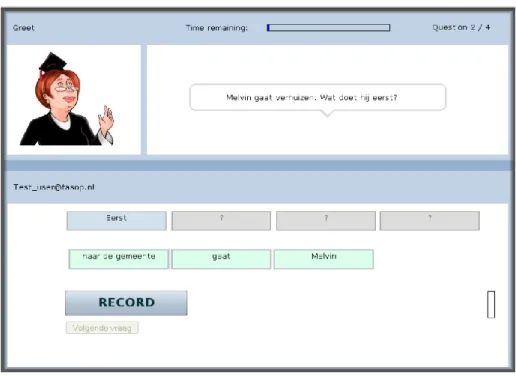
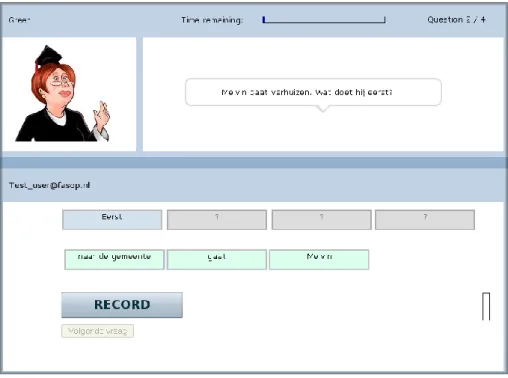
Figure 2. A screenshot of the spoken language activity in GREET
The learner interacts with the system using the interface shown in Figure 2. The learner is asked questions about a film clip: 30 s clips of an ongoing story about a man moving to a new home in Amsterdam. Using ‘word blocks’ on the screen they form a spoken response, which they record.
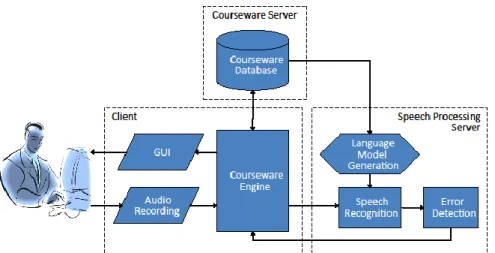
The recorded utterance is sent to the speech recognizer, which outputs a recognition result. This is mapped to a sentence in the language model that is tagged for grammaticality. The system then presents the appropriate feedback message to the learner. CF is provided as explicit notification of an error and a prompt to retry (see Example (4) above). In addition, to assist the learners to reach the correct answer, the system incrementally fills in a part of the sentence after each error.
The CALL system is setup in separate components (the speech recognition server; the courseware database; and the courseware engine that interacts with the client) so that it can easily be adapted to accommodate other types of experiments (though in this thesis it is kept constant). For instance with more, or other language content (videos and questions), linguistic target structures, and other types of feedback.
Finally, the system contains a logging module, which records all the learner’s interactions with the system. In a CALL system, the interactions can be logged in great detail. From the time the learners log in to the program (or website) until they log out, all interactions can be timed and recorded. This can be used for analysis of learner behaviour to inform L2 learning effectiveness and system performance (i.e.
is the system working as expected). In our study we recorded the learner’s responses (as sound files), the time they spent per page and time between certain actions, and the number of actions related to linguistic (target) items in the treatment. These were all available for analysis. In Chapters 3, 4, and 5 we discuss the data that have been logged.
In order to gauge the learners’ experience using GREET for L2 practice, the last task in all experiments was a post-test questionnaire. The questionnaire asked the participants about enjoyment and perceived effectiveness, and in open questions asked them for preferences and comments.
Target feature
R.Ellis (2007) shows that the effect of metalinguistic CF can vary for different grammatical structures (past tense -ed, comparative). For spoken interaction, Li (2013) found that the effect of CF interacted with the target structure and the learners’ proficiency level. As a result, the grammatical target is relevant for studies on CF effectiveness.
In all experiments reported in this thesis we investigated the same grammatical feature, verb-second (V2). As a result of V2, Dutch declarative sentences have a finite verb in second position. In Dutch, the subject precedes the finite verb, but when a constituent other than the subject is in the first position of a main clause, the order of subject and verb is inverted, as illustrated in (5), no inversion, and (6), with inversion.
(5) Bob koopt een brood (‘Bob buys a bread’) S V O
(6) Morgen koopt Bob een brood (‘Tomorrow Bob buys a bread’) A V S O
V2 is an appropriate feature to study, as the acquisition of subject-verb inversion presents a major problem for second language learners of Dutch (Jordens 1988). The reason seems to be that V2 does not affect the meaning of the sentence, and is therefore likely to be non-salient in the input and unlikely to prompt CF in meaning-based communication. Consistently redundant grammatical items take the longest for learners to acquire (R. Ellis 1994; Gass &Selinker 2008). A syntactic account suggests that V2-inverted order is more derivationally complex than V2-straight order in Dutch: it requires more movement (Blom & De Korte 2011). By default learners may opt for the less complex sentence, and will continue to use it until CF triggers noticing of the error.
With our system we can test learners with various L1s and see if the treatment interacts with L1 (or any other, additional language) background. The V2 target feature that we investigate is found in some L1s. The L1 is a factor that interacts with L2 acquisition (N.Ellis 2006; Rebuschat 2013), and knowledge can transfer from the L1 to the L2 (Odlin 1989; Ringbom 1992). This may be affected by the
learner’s knowledge of another L2, for example a German learner with L2 English (non-V2) may not automatically transfer the V2 feature to Dutch, on account of their knowledge of English (cf. Bohnacker 2006). It is important to take the learner’s language knowledge into account, therefore.
Proficiency tests
Some previous research on CF has been criticised for employing tests that were considered measures of explicit knowledge (R.Ellis 2007; Norris & Ortega 2000; Doughty 2003). It is important to determine the effect of CF on implicit knowledge to understand its role in L2 learning. There is no clear consensus on how implicit L2 knowledge should be measured and each proficiency test has its limitations
(Rebuschat 2013). Therefore, it is important to measure L2 knowledge in various behaviours (Norris & Ortega 2003; R. Ellis 2005; Rebuschat 2013). For the selection of our proficiency tests, we followed the recommendations from the study by R. Ellis (2005) that compared the performance of native and L2 speakers on different proficiency tests. He found that performance on the timed grammaticality judgment task (GJT), oral production task, and an oral repetition task relied mostly on implicit knowledge. In our proposed experiment design in Chapter 2, we initially decided to use an elicited imitation task. Ultimately, for the experiments we selected an elicited oral production task instead (the Discourse Completion Task (DCT); see van de Craats (2009) for its application in a L2 study), because elicited imitation is less time efficient (only sentences that are incorrectly repeated yield information), and because it would require adaptation to high educated and low educated learners (for the experiment in Chapter 5), on account of working memory capacity, which would confound the comparison. We determined that our experiment session should not last much longer than 1.5 hours, for fatigue, logistic and recruitment purposes. The necessity of implementing two proficiency tests required that the tests be relatively fast and short.
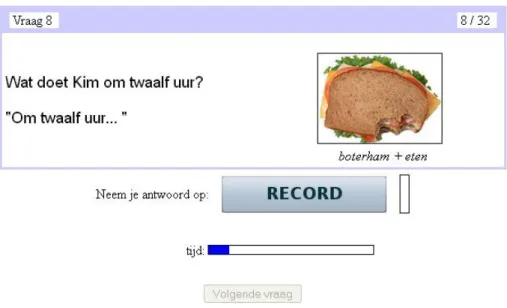
The DCT task presented learners with a lead-in sentence, and then a sentence that they were required to complete. They were shown a picture for context, and given one or two words that could be used to make a sentence. Within 30 seconds, the learners had to record their answer (i.e. press record, speak their answer).
The GJT is one of the most often used tests in L2, but it is subject to discussion. This has to do with the level of explicit knowledge used in the GJT , but which, according to R. Ellis (2005) is dependent on the time limit: under time pressure, learners are assumed to rely more on ‘feel’ or intuition, and respond using their implicit knowledge. Another source of discussion is the nature of
grammaticality. As Bard, Robertson & Sorace (1996) argued, grammaticality in a learner’s mind does not have to be dichotomous ‘incorrect/correct’. Instead, sentences should be viewed in degrees of acceptability. They argue for judgments through magnitude estimation: with learners indicating how acceptable they think the sentence is in comparison to a given stimulus, or compared to their previous
judgment. However, for participants it is difficult to rely purely on their feeling to indicate degrees of acceptability. Thus, such tasks are likely to invoke using meta-knowledge, or to reflect learner confidence and not acceptability (Sprouse 2008; Bader & Häussler 2010). To address the problem of acceptability in a GJT, we designed the task so that the participants judgments could be given on a gradient scale, but with a clear dichotomy. Learners indicated whether the sentence was correct or incorrect, but the sentence could be ‘more or less correct’ depending on where in the bar they clicked. (see Chapter 3 for a screenshot of the GJT).
The proficiency tests were analysed independently and in combination with each other. They were also correlated with questionnaire results, and with measures of learner behaviour from the logs.
5. Goals and outline of this thesis
In this thesis, we respond to the calls in the SLA literature for more controlled research on the effect of CF on oral proficiency, for more attention to individual characteristics, and for studying the learning process in addition to learning outcomes. The thesis is organized in the following way.
Chapter 2 outlines the theoretical need for systematic and controlled studies on CF to advance SLA research, and CF research in particular. We find that more research is needed on individual differences in L2 learning. This points to the necessity of developing research paradigms for CF that can take account of individual learner variation. To conduct such studies, interesting new possibilities are offered by combining ASR technology with CALL. We discuss the desirability and the possibilities of such a system that can provide individual practice, and potentially individualized practice through adaptation to learners’ needs and preferences. We present an initial experimental design which is feasible from a technological, a research, and a didactic point of view.
Following the aims for SLA research as outlined in Chapter 2, we developed and twice piloted our experiment environment that employs spoken practice with an ASR-based CALL system, GREET.
In Chapter 3, we present the system setup of GREET, the design of the speaking exercise, and how the ASR is employed to provide CF. The system is evaluated in a language learning experiment with participants with various L1s. In order to compare practice sessions and learning outcomes with and without CF, the learners were randomly assigned to one of two conditions. In one condition the learners practiced speaking with immediate, automatic CF (the CF condition), and in the other the learners practiced speaking without CF (the NOCF condition). Analysis of the proficiency gains, the logs of the practice sessions, and the learners’
evaluations of (practice with ) the system, show that GREET was successful in providing L2 speaking practice. The proficiency of the learners improved in both conditions, with spoken practice in the NOCF condition being equally effective in improving proficiency as in the CF condition. However, learner behaviour proved to be clearly different between the conditions, and learners evaluated the CF condition
more positively than the NOCF condition. As such, the CALL experiment we developed was shown to be well-suited for L2 research on oral CF. It successfully provided spoken practice with and without CF in a controlled environment, and the learners’ interactions with the system could be successfully logged and meaningfully inspected. We discuss the performance of the system, and the obtained proficiency and learner behaviour results, and relate them to current views in SLA. An important issue was the initial proficiency of the learners. An additional effect of CF was assumed to be obscured by a ceiling effect. In Chapter 4 we address this issue by recruiting lower proficient learners and closely monitoring language proficiency.
Chapter 4 presents a detailed study on the role of CF in the development of L2 oral proficiency. This chapter presents a follow-up experiment to Chapter 3, using the same experimental setup, with improvements to GREET for usability and logging capability, and to the proficiency tests for greater reliability. We addressed the issues that were discussed in Chapter 3, and recruited learners at a lower proficiency level. This chapter also compares the two learning conditions: the CF condition and the NOCF condition. With lower proficient learners, we find differences in learning outcome, learner behaviour and learner appreciation of practice. In the analysis, we suggest ways in which learner behaviour in the CF and the NOCF condition is related to the learning outcome. Especially the differences in learner behaviour between the two conditions are discussed with references to the issues (output production, repair, and input) in the CF literature.
A benefit of our experiment system is that it allows for comparison of multiple individual practice sessions. In both Chapter 3, and 4 we found that individuals practice quite differently with the system.
Chapter 5 presents a study that inspects how the education level of the learners influences the effectiveness of speaking practice with and without CF. Studies on L2 learning are found to be conducted mainly with high educated learners, just as the previous chapters discussed high educated learners. There are arguments to be found in the SLA literature to assume that education background interacts with L2 learning efficiency. Because of the consistency of GREET practice, the participant sample from the language learning experiment in Chapter 4 could be expanded to include learners with different education backgrounds, from learners at primary school level upwards. The education level is seen to interact with both the CF and the NOCF conditions. This is seen for both learning outcome (proficiency gain) and learner behaviour. Similar to Chapter 4, characteristics of learner behaviour are found that relate to proficiency gain. We argue that our study substantiates that CF research with high educated learners cannot be generalized to account for all L2 learners, and that for SLA research and L2 pedagogy more effort needs to be invested in
recruiting learners of various educational backgrounds.
In Chapter 6 we discuss the findings from the preceding chapters and draw conclusions. In addition, we discuss the limitations of the current research and provide perspectives for future research.
Chapter 2:
Adaptive Corrective Feedback in Second
Language Learning
This Chapter has been reformatted and slightly modified from:
Bart Penning de Vries, Catia Cucchiarini, Roeland van Hout & Helmer Strik (2011) Adaptive Corrective Feedback in Second Language Learning. In De Wannemacker, S., Clarebout, G., De Causmaecker, P. (Eds.) "Interdisciplinary Approaches to Adaptive Learning”, Communications in Computer and Information Science series, Volume 26, (pp. 1-14). Berlin: Springer Verlag. http://dx.doi.org/10.1007/978-3-642-20074-8_1
Abstract
The role of corrective feedback (CF) in second language acquisition has received much attention, and it is still a topical issue. Studies on the effectiveness of CF have produced mixed results. An essential problem seems to be that most studies on CF do not take account of individual differences, even though there are clear indications that individual characteristics influence the effectiveness of CF. This points to the necessity of developing research paradigms for CF that can take account of
individual learner variation and that can adapt to the learner's needs and preferences. In this paper we suggest using a CALL system that exploits automatic speech recognition (ASR) and that is designed to adapt to individual learner differences.
1. Introduction
The term corrective feedback (CF) has been used in the literature on second language acquisition (SLA) to refer to “any indication to the learners that their use of the target language is incorrect” (Lightbown & Spada 1999). As these authors explain: “This includes various responses that the learners receive. When a language learner says, ‘He go to school everyday’, corrective feedback can be explicit, for example, ‘no, you should say goes, not go’ or implicit ‘yes he goes to school every day’, and may or may not include metalinguistic information, for example, ‘Don’t forget to make the verb agree with the subject’” (Lightbown & Spada 1999). Further examples of different types of CF are provided in Section 2.1 below. Although intuitively one might think that correcting errors will help improve language performance, so far this has not unequivocally demonstrated in the literature. Proponents of nativist theories claim that second language (L2) learning is driven by exposure to positive evidence and comprehensible input, without any need for CF (Krashen 1985; Schwartz 1993), with Truscott (1998) taking the extreme position that CF can even be harmful.
Nevertheless, there are numerous examples of L2 learners immersed in L2 surroundings, whose language proficiency stopped developing well before they fully acquired the target L2, despite ample (positive) language input (Han 2004). This suggests that exposure and input alone are not sufficient for high-level L2 learning (e.g., Swain 1985). This seems to apply particularly to adult L2 learners, 5 who are already committed to their first language (L1) (Rohde & Plaut 1999).
Empirical studies on the effectiveness of CF have produced mixed results. This has to do in part with the fact that teachers’ CF turns out to be inconsistent (within and between studies), especially in oral (classroom) sessions of L2 learning (Carroll & Swain 1993; Iwashita 2003; Sheen 2004). For instance, teachers may correct a specific error by a learner the first time, but not react at other instances. Relevant conclusions are that CF, to be effective, should be unambiguous, consistent (Chaudron 1988), intensive (Han, 2002), and should provide opportunities for self-repair and modified output (Panova & Lyster 2002; Havranek 2002; Lyster 2004). Such conditions cannot easily be met, if at all, in natural interactions or classroom situations.
Another essential conclusion is that most studies on CF do not take account of individual differences, but discuss CF effects on groups as a whole, thus assuming that all learners use CF similarly, whereas there are indications that the effectiveness of CF is dependent on individual characteristics (see Section 3.3). The motivation for focusing on group settings and specifically on classroom settings is that these are informative about the overall educational value of CF (Lyster & Saito 2010). However, this view seems particularly tied to traditional approaches to L2 learning and ignores recent developments in CALL and language and speech technology that
5 Throughout this paper, L2 learning and acquisition refers to adult L2 learning and