Basic and Applied Research
(IJSBAR)
ISSN 2307-4531 (Print & Online)
http://gssrr.org/index.php?journal=JournalOfBasicAndApplied
---
Model and
A
pplication of
R
isk
D
egree for
V
essel-
B
ridge
C
ollision
B
ased on
T
heory of
S
hip
C
ollision
A
voidance
Liu Yihua
a*, XiaoYingjie
ba
Shanghai Maritime University 1550 Haigang Ave, Shanghai 201306 ,China b
Shanghai Maritime University 1550 Haigang Ave, Shanghai 201306 ,China a
Email: [email protected] b
Email:[email protected]
Abstract
In recent years, there are many ship-bridge collision accidents in the world, which caused huge casualties and property losses. The main risk not only come from itself, but also come from the vessel in the water. Following the development of economy, more and more vessels sailing in higher level inland rivers in China, it causes the traffic density climb sharply, and with the heighten speed of ship, bridges crossing navigational channel be confronted with more higher risk of ship-bridge collision. So it is necessary to take measures to control or minimize the risk of ship-bridge collision, but the traditional methods for bridge safety not enough is clear. In this paper proposes the model of risk degree of ship-bridge collision based on theory of ship collision avoidance, which is the one of most important index in the system of active warning of ship-bridge collision avoidance to control or minimize the risk. The model can indicate the index of dynamic risk degree for passing ships, give real-time monitoring information for administer department.
Keywords: Vessel-bridge Collision; Ship Collision Avoidance; Risk Degree; Active Warning ;Closest Point of Approach (CPA);Automatic Radar Plotting Aid (ARPA);
--- * Liu Yihua. Tel: (86-21)38282000 *2901
E-mail address: [email protected].
1.Introduction
Following the rapid development of transportation in China, bridge plays a more and more important role on the development of economy and society, as the connection hub between different regions; especially the large bridges have great significance for improving facilities of transportation in land, which not only short the distance between different regions, but also promote industrial construction and enhance regional economic competitiveness. However, the field of safety research for vessel-bridge can not keep up with the demands [1].
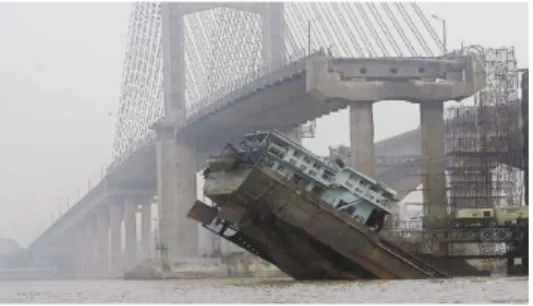
On June 15, 2007, the highway 325 bridge over the Jiujiang River in Foshan, Guangdong, China, collapsed due to a ship collision, with the deck of the middle span dropping into the river, the accident led to eight fatalities and four vehicles plunging into the river [2].
On march 27, 2008, the deck of the under-construction JinTang Bridge in Ningbo,Zhejiang,china, was struck by the mast of a ship, resulting in one span of the box girder dropping into water, four sailors were killed in the accident. On May 12, 2013, the ship named "Xin Chuan 8" had collision with Nanjing Yangtze River Bridge at the 6th pier when the ship passed through the bridge, there had been 36 times of ship collision since 1968. There had been more than 70 times ship collision with the Wuhan Yangtze River Bridge since 1957.
The system of traditional methods for avoiding vessel-bridge collision cannot meet the security needs for bridge, which just focused on strengthen the bridge’s own structure, such as casting large-scale bridges cushion caps or building anti -impact steel casing box or crash pile groups to minimize the loss caused by the ship collision, this facilities really protect the bridge pier in fact, but it also occupy the navigational water area, which would increase the risk of vessel-bridge collision to some extent.
In the paper presents the model of risk degree of vessel-bridge collision based on the theory of ship collision avoidance, and through the practice in Jiashao Bridge to illustrate the feasibility of active warning system for vessel-bridge collision avoidance.
Fig. 1. The highway 325 bridge over the Jiujiang River collapsed due to a ship collision
2.Theory of ship collision avoidance
2.1.The algorithm of distance and the relative speed for both ships
According to the definition, the ship collision avoidance is defined as prediction and avoidance. Prediction is to forecast the target ship when and where will stay the same point or have collision risk with own ship on the sea. Avoidance is that the action been taken by both ships, so that the two ship are not simultaneously occupy the same point or avoid to encounter the situation of risk of collision [3].
As figure.2 illustrations, the origin of the coordinate O shows the position of own ship ,T shows the position of target ship, set λ1、ϕ1as longitude, latitude of position fo own ship ,λ2、ϕ2 as
longitude, latitude of position of target ship, DλandDϕas difference of longitude and latitude between both
ships. y T B T D 1 V T O ( ,λ ϕ1 1) x 1 C CPA D R C (λ ϕT, T)CT α R V T V
Fig. 2. Diagram of calculation theory for DCPA and TCPA
It could be expressed as:
1 1
60(
)
60(
)
T TD
D
λ ϕλ
λ
ϕ ϕ
=
−
=
−
(1)
And the true azimuth of target ship relative to own ship :
T B (°)=arctan(Dλ/DM)+τ (2) | / cos( ) | 0 | | 0 T T D B D D D D ϕ ϕ λ ϕ ≠ = = (3) 1 ( ) ( ) M T D =M ϕ −M ϕ (4) 0 0 0 180 0 360 0 0 D D D D D λ ϕ ϕ λ ϕ
τ
≥ ≥ = < < ≥ , ,(5) 576
( ) 7915.70447lg tan -23sin( ) 4 2
M ϕ = π ϕ+ ϕ
(6) Where: DM= Difference of meridian parts between target ship and own ship;M( )ϕ = Meridian parts;
τ
=The parameters of circumferential azimuth adjustment(°);DT=Distance of target ship and own ship(n mile). 1 1 1 1 1 1
sin(
),
sin(
)
cos(
),
cos(
)
x Tx T T y Ty T TV
V
C
V
V
C
V
V
C
V
V
C
=
=
=
=
(7) 2 2 1y 1 ( ) ( ) R Ty Tx x V = V −V + V −V (8) 1 1 arctan Tx x R Ty y V V C V V
β
− = − + (9) 1 1 1 1 1 1 1 1 0 0 0 180 0 0 180 0 0 360 0 0 Tx x Ty y Tx x Ty y Tx x Ty y Tx x Ty y V V V V V V V V V V V V V V V V
β
− ≥ − ≥ − < − < = − ≥ − < − < − ≥ , , , ,(10)
Where: V1=Speed of own ship(kn)、C1=Course of own ship(°), V1x= Component On the
x
axis of own ship、V1y= Component On they
axis of own ship; VT=Speed of target own ship(kn)、T C
=Course of target ship(°), VTx= Component On the
x
axis of target ship、VTy= Component On they
axis of target ship; VR=Relative speed between own ship with target ship(kn);CR=Relative course (°);
β
= The parameters of circumferential azimuth adjustment(°).2.2.Algorithm of DCPA and TCPA DCPA and TCPA can get from:
) ( sin
α
T CPA D D = (11) RV
)
(
cos
α
T CPAD
T
=
(12)|
180
|
−
+
=
C
RB
Tα
(13) 577
≥
>
≥
>
≥
=
0
180
180
360
-360
360
360
-α
α
α
α
α
α
α
(14)
where:
α
=the angle between the relative movement line and target ship bear line(°). i) Target ship pass through the bow of own ship: DCPA>0;ii) Target ship pass through the stern of own ship: DCPA<0; iii) Both ships are close to each other: TCPA≥0;
iv) Both ships has been passed the closest point of approach: TCPA<0.
DCPA is positive always, it only shows the minimum distance between the pier and the target ship in this paper, TCPA illustrates that whether target ship passed the closest point of approach or not, use “(14)”for setting the value of α.
3.Model of risk degree of vessel-bridge collision
DCPA and TCPA are the two parameters usually to determine the degree of risk of ship collision at sea. DCPA can directly reflect the minimum distance at most dangerous moment for both ships, TCPA also can directly show reflect the extent of urgency both ships . In the present, automatic radar plotting aids (ARPA) can calculate the tracked object's course, speed and closest point of approach (CPA), thereby knowing if there is a danger of collision with the other ship or landmass through the two parameters. Thus DCPA and TPCA have been recognized as very important parameter for research of ship collision in marine industry.
This paper adopts the normalization of DCPA and TCPA and weighted synthesis to determine degree of model of vessel-bridge collision risk, k as value to descript the degree of risk of collision,
bigger, more dangerous. ρ is the index of degree of collision risk.
(
)
2 2= a
m
TCPA
DCPA
b
ρ
+
(15) 1 k
σ
ρ
= (ifk
≥
1
,k
= 1)(16) where:
a
andb
are weighted value, if target ship pass through the pier of bridge from right side:5
a= ,b=0.5;from left side: a=5,b=1;
m
=1.4, as constant is to eliminate the influence of different dimensions of TCPA and DCPA.σ
=revision coefficient, which value depend onactual practice. According to the target ship motion parameters from sensors, it will get the dynamic curve of risk degree of vessel-bridge collision by calculating the circulation finally.
4.Model test and application
4.1.System for simulation
In the paper, simulation experiments are carried out using the full-mission simulators of Shanghai Maritime University, which have been widely practiced and made good results in port and waterway engineering [4]. The fields of study from assessment of navigation safety and methods of ship maneuvering, had been extended to safe under-keel clearance(UKC),ship stopping Distance, turn region, the track width, the width of channel, ship navigation subsidence, settings of the navigation aids, and ship traffic management, emergency evacuation[5]. Its applications benefited in social and economy very good. This paper has made the model of risk degree of vessel-bridge collision for Jiashao Bridge using the Visual Basic 6 programming language, which includes three main modules: monitoring information, results display and data analysis. Software interface as shown in figure.3.
Fig.3. Interface of collision risk analysis program
4.2.Purpose and contents of model test
In order to get the traffic information of vessels passing through bridge after been built, this paper gets the data from simulating according to the nature condition and representative ship types based on full mission ship handle simulator in SMU, and then check the model of risk degree of vessel-bridge collision by using the simulation data as inputs.
The contents of the ship experiment include two operations: under control and not under control, under control just simulate ship pass through bridge area normally, not under control has three conditions: Engine Failure, Rudder Failure and Engine and Rudder both Failures.
Under the actual situation, setting the states and types of ship, nature conditions ect.. It got the tracks of ship based on full mission ship handle simulator, and then verify the rationality of the model of risk degree
of vessel-bridge collision on the basis of data of simulation. It gave references for active warning system for vessel-bridge collision avoidance [6].
4.3.Application
The Jiashao Bridge is located in Hangzhou Bay of Zhejiang province of China, the area has very strong tides and urgent currents, the angle between the normal direction of bridge axis with the direction of currents in the area of navigable waters also more bigger than normal, the water deep groove swing frequently, the risk of vessel-bridge collision is very higher than others when ship pass through the bridge. So the Jiashao Bridge was selected as project for simulation on basis of above-mentioned factors [7].
According to the contents and requirements of simulation, combined with the natural conditions of the Jiashao Bridge, execute the simulation experiment of routine operation and ship out of control, and then get the track information and test data, finally verify the model of risk degree of vessel-bridge collision by using simulation data, in order to provide reliable index of risk degree of vessel-bridge collision.
Simulation include establishment of electronic chart of bridge area, the selection of prototype ship, the building of mathematical model of ship based on prototype ship ,the persons put the simulation scheme into practice. The application of simulation data is to verify the model of risk degree of vessel-bridge collision at the end.
The ship model was adopted to have simulation descript in the table 1.
Table 1. Parameters of simulated ship
NO. Ship tonnage (t) Parameters (m) Remarks Loa B Draft
1 3000 108.0 16.0 6.0 Simulation ship 2 500 53.0 8.4 3.4 Simulation ship
Simulation were carried out by normal condition and ship not under control two states, the later not only execute the simulation of routine conditions, but also carried out
limited condition, simulation Scheme is shown in table 2.
5.Results
5.1.Result of Simulation under normal condition
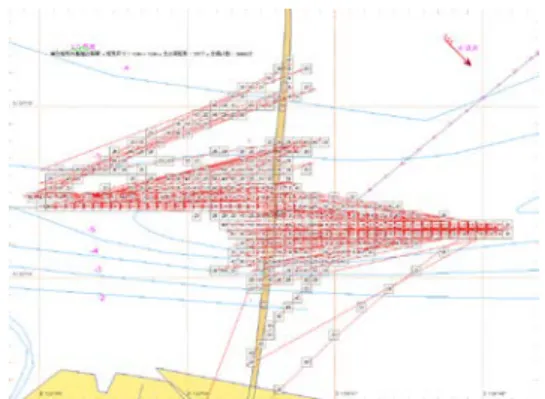
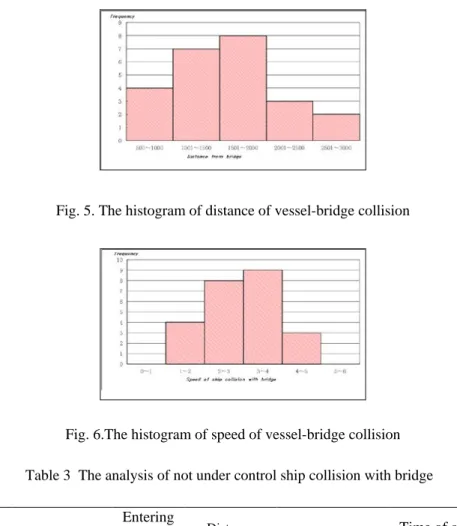
As result, the probability distance of vessel-bridge collision is 500m to 2000m, the speed of vessel-bridge collision distributes between 2.0 kn and 4.0kn, the shortest time of vessel-bridge collision from start position is 4.7 minutes, the average time is 11.9 minutes. The results of simulation are shown in figure.4 to figure.6.
Table 2. Simulation scheme table
NO. Ship tonnage (t)
Entering /
Exiting
Wind Current
Direction Velocity(level) Direction Speed(Kn)
1 3000 Entering 000° 6/7 261° 3/5 2 3000 Entering 045° 6/7 261° 3/5 3 3000 Entering 090° 6/7 261° 3/5 4 3000 Entering 135° 6/7 261° 3/5 5 3000 Entering 270° 6/7 261° 3/5 6 3000 Entering 315° 6/7 261° 3/5 7 3000 Exiting 000° 6/7 82° 3/5 8 3000 Exiting 045° 6/7 82° 3/5 9 3000 Exiting 090° 6/7 82° 3/5 10 3000 Exiting 135° 6/7 82° 3/5 11 3000 Exiting 270° 6/7 82° 3/5 12 3000 Exiting 315° 6/7 82° 3/5 13 500 Entering 000° 6/7 261° 3/5 14 500 Entering 045° 6/7 261° 3/5 15 500 Entering 090° 6/7 261° 3/5
Fig. 4. The probability distribution of ship passing through Jiashao Bridge
Fig. 5. The histogram of distance of vessel-bridge collision
Fig. 6.The histogram of speed of vessel-bridge collision
Table 3 The analysis of not under control ship collision with bridge
NO. Ship tonnage (t) Entering / Exiting Distance from bridge (m) Speed of collision (Kn) Time of arrive the bridge (Min) 1 3000 Entering 1260 3.0 9.1 2 3000 Entering 2035 3.7 14.7 3 3000 Entering 2600 4.0 18.7 4 3000 Entering 1869 4.8 13.5 5 3000 Entering 1630 2.4 11.7 6 3000 Entering 875 3.2 5.6 7 3000 Exiting 1396 3.2 10.1 8 3000 Exiting 1400 2.5 10.1 9 3000 Exiting 1462 1.8 10.5 10 3000 Exiting 2044 2.3 14.7 11 3000 Exiting 2000 3.7 17.1 12 3000 Exiting 1945 3.5 14.0 13 500 Entering 1489 2.6 10.7 14 500 Entering 1736 2.5 12.5 15 500 Entering 1532 4.6 11.0 582
5.2.Result of Simulation under limited condition
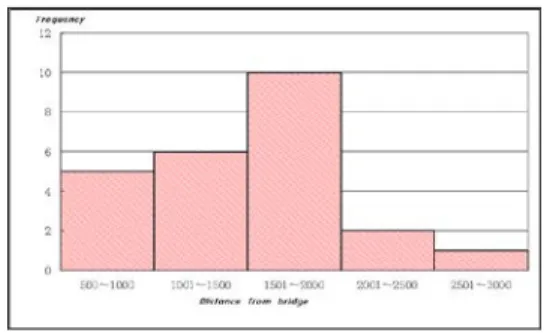
The probability distance of vessel-bridge collision also is 500m to 2000m, the speed of vessel-bridge collision distributes increase to between 4.0kn and 6.0kn, the shortest time of vessel-bridge collision from start position is 3.8 minutes, the average time is 9.2 minutes. The results of simulation are shown in figure.7and figure.8
Fig.8. The histogram of speed of vessel-bridge collision under limited condition
Table 4 The analysis of not under control ship collision with bridge under limited condition
NO. Ship tonnage (t) Entering / Exiting Distance from bridge (m) Speed of collision (Kn) Time of arrive the bridge (Min) 1 3000 Entering 1985 4.9 12.0 2 3000 Entering 1897 3.8 11.5 3 3000 Entering 2345 5.6 14.2 4 3000 Entering 2600 5.6 15.7 5 3000 Entering 1968 4.5 11.9 6 3000 Entering 1299 4.8 7.9 7 3000 Exiting 1669 6.1 10.1 8 3000 Exiting 1562 5.6 9.5 9 3000 Exiting 1140 4.8 6.9 10 3000 Exiting 1058 5.4 6.4 11 3000 Exiting 2000 7.2 12.1 12 3000 Exiting 1783 6.7 10.8 13 500 Entering 745 4.0 4.5 14 500 Entering 1691 4.7 10.2 15 500 Entering 1584 5.7 9.6 583
Fig. 7. The histogram of distance of vessel-bridge collision under limited condition
As result, the probability distance of vessel-bridge collision is 500m to 2000m, the speed of vessel-bridge collision distributes between 2.0 kn and 4.0kn, the shortest time of vessel-bridge collision from start position is 4.7 minutes, the average time is 11.9 minutes. The results of simulation are shown in figure.4 to figure.6.
5.3.Result of verification
In the verification, sets the third pier as own ship, had checked 155 simulations, which including 24 simulations under normal condition, the same number under engine failure, 11 simulations under rudder failure, 96 simulations others. The 155 simulations data is as the input resource to run the software of risk degree of vessel-bridge collision as a part of active warning system of vessel-bridge collision avoidance to judge efficiency of the model. As result, the model of risk degree of vessel-bridge collision had accurately distinguished 132 times, lost 6 times, mistake 17 times, especially the 17 mistake times always make the safe as dangerous.
The accuracy of the model of risk degree of vessel-bridge collision has been verified above 85%, which can judgment the majority condition that vessel-bridge collision really exist. It’s accuracy is satisfied with the demands of anti-collision function for active warning system of vessel-bridge collision avoidance without considering the success or not of the result of ship collision avoidance. However it is just checked by simulation data, the test in practice must be carried out in order to improve the accuracy of model which can meet requirements for vessel-bridge collision avoidance actually.
Table 5. The verification data of the Model of risk degree of vessel-bridge collision
Correctly recognition Error recognition
Dangerous 44 2
Safe 88 21
Total 132 23
6.Conclusion
The model of risk degree of vessel-bridge collision provides the key dynamic parameter for system of active warning of vessel-bridge collision avoidance and has good performance based on simulation data. The further works is to practice the model in application for project, to improve the preciseness and stability of model in order to security the safety of navigational water area nearby bridge. In the future, if the model can efficiently combined with the structure design of bridge for anti-collision, this would play very important role on safety of vessel-bridge and operational management.
Acknowledgements
The paper is supported by Shipping Simulation Technology Engineering Research Center of Ministry of Education and the National Natural Science Foundation of China (No.20120372).
References
[1] Am. Assoc. of State Hwy and Transp. Officials. “Guide specification and commentary for vessel collision design of highway bridges.” U.S. Washington D.C. 1991.
[2] Genbo . “Assessment of Bridges due to Vessels Impact.” D.A. thesis, 1. University of Tongji, China, 2007.
[3] Fangquangen. Decision-Making of Ship Collision Avoidance. Beijing, China: China Communications Press, 1996, pp. 1-47.
[4]Xiao Yingjie and Liu Yihua. “Analysis on Active Risk of Ship Bridge Collision,” in The 2nd RACR, 2009, pp. 606-612.
[5] Liu Yihua and Xiao Yingjie. “Risk Evaluation of Berthing and Depart-ing of LNG Carrier for Yangkou Port“. in The 2nd RACR, 2009, pp. 601-605.
[6] Xiaoyingjie and Liuyihua. “Key Technologies Research and Application of Safety Facilities and Standard for High-grade Channel Bridge Group Section.” Research. thesis, University of Shanghai Maritime, China, 2013.
[7] Xiaoyingjie and Liuyihua, . “ Risk Control of Vessel-bridge Collision for Jiashao Bridge.” Research. thesis, University of Shanghai Maritime, China, 2013