2016
Building an executive functioning
toolbox: an interactive online
course for school-based
occupational therapy practitioners
https://hdl.handle.net/2144/19557BOSTON UNIVERSITY
SARGENT COLLEGE OF HEALTH AND REHABILITATION SCIENCES
Doctoral Project
BUILDING AN EXECUTIVE FUNCTIONING TOOLBOX: AN INTERACTIVE ONLINE COURSE FOR SCHOOL-BASED
OCCUPATIONAL THERAPY PRACTITIONERS
by
ALLISON ASHLEY LAYGO B.A., Claremont McKenna College, 2007
MOT., Loma Linda University, 2013
Submitted in partial fulfillment of the requirements for the degree of Doctor of Occupational Therapy
© 2016 by
ALLISON ASHLEY LAYGO All rights reserved
Approved by
Academic Mentor
Nancy Wolcott Doyle, OTD, OTR/L Instructor of Occupational Therapy
Academic Advisor
Karen Jacobs, Ed.D., OTR/L, CPE, FAOTA Clinical Professor of Occupational Therapy
Dedication
To my parents, Armando and Anita Laygo, who have been my biggest cheerleaders throughout my life. Thank for your abundance of love, support, and faith in me. I dedicate this accomplishment to you. I love you both forever.
Acknowledgements
I extend my sincere gratitude to the following people who have supported and enriched my journey throughout this program.
I am thankful for Nancy Doyle, my academic mentor, for her patience, guidance, valuable advice, thoughtful comments, and positive encouragement. Her support and mentorship has inspired my capstone project. Thank you for helping me design a program that I will continue to develop to fulfill my intended goals.
I am thankful for Karen Jacobs, my academic advisor, for empowering my occupational therapy career. Ever since I emailed her regarding the program application process, she has made herself available for guidance or just a listening ear. She inspires me with her example of advocacy within and beyond the occupational therapy profession.
I am thankful for Wendy Coster and Linda Niemeyer, for their guidance during course topics that have enhanced my perspective of meaningful health and wellness.
I am thankful for my peer mentors, Hyun Jeong Lim and Kathryn Wise, for their friendship, encouraging words, and comedic relief throughout the program.
I am thankful for my classmates, Leah Baumann, Kevin Berner, Flora Cole, Leanna Katz, Manisha Sheth, and Michal Tsipris, for their innovative projects, ideas, and professional insight. Thank you for enriching my occupational therapy practice and life.
I am thankful for my partner, Sonny Enriquez, for his patience, love, and constant belief in me throughout this program.
I am thankful for my parents, brother, and sister for supporting my professional and academic journey and inspiring me with their example of helping others in their personal
careers. I am thankful for all my family and friends for the kind and uplifting words during this program.
BUILDING AN EXECUTIVE FUNCTIONING TOOLBOX: AN INTERACTIVE ONLINE COURSE FOR SCHOOL-BASED
OCCUPATIONAL THERAPY PRACTITIONERS ALLISON ASHLEY LAYGO
Boston University, Sargent College of Health and Rehabilitation Sciences, 2016 Major Professor: Nancy Wolcott Doyle, OTD, OTR/L, Instructor of Occupational
Therapy
ABSTRACT
School-based occupational therapy practitioners actively support students’ functional participation in school-related activities. Underlying these daily school activities are executive functioning skills. Although addressing executive functioning (EF) skills is within occupational therapy’s scope of practice, school-based practitioners typically do not support the development of these skills in students. Identified factors that contribute to this gap in practice are limited (1) EF knowledge, (2) availability and access to EF resources, and (3) time to complete job demands. To address this clinical gap, an interactive online course for school-based occupational therapy practitioners was developed which presents current EF research, knowledge, and resources. The course utilizes interactive features to support practitioners in applying course information in the school setting. This includes practicing EF assessments, designing EF interventions, and preparing advocacy resources and dissemination tools to share with school administrators and school staff about the importance of addressing executive functioning skills in
occupational therapy practitioners committed to improving EF skills in students through contributions in research, assessment, interventions, and school collaborations.
Table of Contents Dedication iv Acknowledgements v ABSTRACT vii Table of Contents ix List of Tables x Chapter 1- Introduction 1
Chapter 2 - Theoretical Evidence Base to Support the Project 8
Chapter 3- Description of the Project 39
Chapter 4 - Evaluation Plan 57
Chapter 5 - Funding Plan 65
Chapter 6 - Dissemination Plan 71
Chapter 7 - Conclusion 83
Appendix A: Explanatory Model of Identified Problem 87
Appendix B: Executive Functioning Course – Week 1 Content 89
Appendix C: Executive Functioning Course – Week 2 Content 102
Appendix D: Evaluation Plan Logic Model 112
Appendix E: Implementation and Dissemination Budget 113
Appendix F: Executive Summary 114
Appendix G: Fact Sheet 122
References 125
List of Tables
Table 1. Assessments of Executive Function 29
Table 2. Executive Function Interventions 33
Table 3. Needed Resources: Budget 66
Table 4. Dissemination costs 67
Chapter 1- Introduction
Occupational therapy practitioners are empowered by their world and national organizations to positively contribute to the well-being and health of individuals (AOTA, 2013; WFOT, 2014). The profession’s national organization in the United States, the American Occupational Therapy Association (AOTA), has identified Children and Youth to be a practice area that requires occupational therapy practitioners to promote
participation in children, from birth to early adulthood, throughout their daily activities. Currently, pediatric occupational therapy practitioners are found in a wide variety of practice settings, which include schools, clinics, hospitals, and homes. Within each of these settings, occupational therapy practitioners collaborate with parents, caregivers, and team members to support children’s participation in daily and desired activities (AOTA, 2011). This chapter describes the role of occupational therapy practitioners in the school setting, identifies a clinical gap specific to school-based practice, validates occupational therapy’s role in addressing the clinical gap, and provides an overview of the developed solution to the clinical gap.
Background
Occupational therapy practitioners are an integral part of the public education system for children with disabilities (AOTA, 2014a; Case-Smith, 2002). Practitioners collaborate with caregivers, educators, and other school staff to support children’s ability to engage in academic related tasks (Case-Smith, 2002; Schultz-Krohn & Polatajko, 2013). Currently, occupational therapists commonly receive referrals from the school team due to academic concerns related to a child’s fine motor, visual motor, or sensory
processing skills (AOTA, 2014a; Schultz-Krohn & Polatajko, 2013). Delays in these skills may affect a child’s handwriting legibility, task completion, visual attention, and self-regulation behaviors in the classroom (AOTA, 2014a; Case-Smith, 2002; Schultz-Krohn & Polatajko, 2013).
Research studies suggest that executive function (EF) skills also directly affect a child’s ability to effectively participate in the same school related tasks (Cameron et al., 2012; Cramm, Krupa, Missiuna, Lysaght, & Parker, 2013a; Dawson & Guare, 2010). Executive functioning enables an individual to appropriately adapt to the new situations frequently occurring in daily life (Baum & Katz, 2011; Wolf, Barbee, & White, 2011; Wolf & Baum 2011). Specifically, EF is responsible for an individual’s ability to effectively plan, manage, and organize behavior to complete desired novel activities (Baum, Foster, & Wolf, 2009; Cramm, Terry, Krupa, Missiuna, Lysaght & Parker, 2013b; Wolf & Baum, 2011). In the school system, children are actively exercising their EF skills as they engage in academic and social activities throughout their day (AOTA, 2014a; Schultz-Krohn & Polatajko, 2013). Students are expected to manage various aspects of their school schedule, such as following class routines, remembering academic curriculum, engaging with peers appropriately, participating in several school transitions, and maintaining attention and focus in the classroom (AOTA, 2014a).
Executive functions are inherent skills that children continue to develop well into adulthood (Center on the Developing Child at Harvard University, 2011; Cramm et al., 2013a; Schultz-Krohn & Polatajko, 2013). As a child progresses in his or her education, research suggests that EF skills are developed and nourished by the child’s daily
experiences (Cramm et. al, 2013a; Schultz-Krohn & Polatajko, 2013). Specifically, research findings suggest that caregivers as well as educators play a role in modeling appropriate strategies that contribute to overall EF development (Connor & Maeir, 2011; Dawson & Guare, 2010; Kaufman, 2010; Magalhaes, 2014). For example, classroom teachers who establish a consistent daily routine and structure foster a student’s ability to plan, organize, and sequence for an upcoming task, all of which are EF components. However, recent literature reports that everyday experiences may not always be sufficient for early EF skill development (Schultz-Krohn & Polatajko, 2013). For school-age
children who demonstrate difficulties with EF skill development, incorporating EF knowledge into the occupational therapy evaluation and intervention process will ensure a holistic response in supporting the needs of students in the school setting, ultimately increasing overall occupational performance of school age children (Schultz-Krohn & Polatajko, 2013).
Identified Problem
Occupational therapy practitioners work closely with children on fundamental skills that affect academic success, many of which are components of EF. Evidence-based research demonstrates that EF impacts school readiness, however, there is limited research in the application of EF considerations in the occupational therapy evaluation and intervention process (Cramm et al., 2013a; Dawson & Guare, 2010; Schultz-Krohn & Polatajko, 2013). This clinical gap prevents a comprehensive portrayal of a student’s academic and occupational needs and limits successful participation in meaningful school activities. The proposed causes for the problem are:
● Occupational therapy practitioners’ lack of understanding about EF: what it is, where it falls within occupational therapy’s domain of practice, and how a child’s occupational performance in the school setting is affected by EF impairments. This problem is occurring because there is limited information explaining how school-based occupational therapy practitioners should implement EF in the evaluation and intervention process. The lack of information is present not only in the occupational therapy literature but also in the occupational therapy graduate programs (Cramm et al., 2013a).
● Occupational therapy practitioners in the school setting are still trying to educate the IEP team members regarding occupational therapy’s scope of practice. This contributes to the clinical gap, as occupational therapy practitioners are unable to further educate the team regarding EF if practitioners are not comfortable with addressing this area of need (Cramm et al., 2013a).
● Assessments of executive functioning in children are limited and challenging to develop. There are only a few assessments for EF in the school and clinical based settings that evaluate EF abilities in children. These assessments are not
comprehensive and are only able to determine a component of the EF process (Wolf & Baum, 2011). Furthermore, it is difficult to develop EF assessments that do not reduce the novelty of a situation or environment (Dawson & Guare, 2010). Assessments that evaluate cognition incorporate testing structure protocol, which decreases the occurrence of assessing an individual’s participation in a new task (Dawson & Guare, 2010; Schultz-Krohn & Polatajko, 2013).
● Occupational therapists working in the school setting typically are juggling more than one school and are expected to manage large caseloads. The demanding workload may contribute to a practitioner’s ability to keep up to date with current literature or new assessments and may limit time for practitioners to advocate for the relevance of EF as children participate in school related tasks (Cahill, Egan, Wallingford, Huber-Lee, & Dess-McGuire, 2015).
● Occupational therapy practitioners are required to consider reimbursement and resources, which plays a role in practitioners’ choices in the school setting. This issue relates to the clinical gap, as practitioners may feel they have limited resources that could help them include EF into the school-based evaluation and intervention process (Cramm et al., 2013; Daunhauer, Fidler, & Will, 2014). Domain of Occupational Therapy
Occupational therapy practitioners are becoming increasingly aware of EF delays in children and discovering that they are not currently prepared to meet these clients’ EF needs (Cramm et. al, 2013a; Schultz-Krohn & Polatajko, 2013). As a result, researchers are beginning to demonstrate how to effectively conduct EF assessments and implement appropriate intervention plans to address a child’s EF needs (Cramm et al., 2013b; Rocke, Hays, Edwards, & Berg, 2008; Weiner, Williamson, & Berg, 2012). Additionally,
research studies suggest that allowing children with EF impairments to continue their academic experience with no opportunity for EF development may increase the
likelihood of secondary mental health problems, decrease job opportunities, increase risk for academic failure, lead to a higher likelihood for criminal punishment, and increase
dependence on government income support programs (Schultz, 2003). Furthermore, neglecting to include an EF perspective into how a school-based occupational therapist views a child may limit true client centered practice (Cramm et al., 2013a; Josman & Rosenblum, 2011).
Research studies suggest that EF is a relevant area in occupational therapy and a critical component in cognition (Connor & Maeir, 2011; Foster & Hershey, 2011;
Schultz-Krohn & Polatajko, 2013; Wolf & Baum, 2011), which is part of the profession’s domain of practice (AOTA, 2014b). Occupational therapy practitioners are trained in observing and analyzing how an individual performs a task; cognitive performance is a consistent factor considered in such task analysis (AOTA, 2014b). Practitioners engage an individual in occupations, or meaningful activities specific to each client, in order to accurately evaluate performance difficulties and needs (AOTA, 2014b). EF skill components become apparent as they are being actively utilized during occupational performance (Connor & Maeir, 2011). Occupational therapy practitioners need to continue exploring the effect of EF on novel participation of tasks specifically in the pediatric population (Wolf & Baum, 2011). Determining more efficient ways to assess and evaluate EF in children will address an occupational performance need that the profession has an obligation to support (Cramm et al., 2013b; Schultz-Krohn & Polatajko, 2013).
Project Overview
The purpose of my doctoral project is to educate school-based occupational therapists and occupational therapy assistants on current executive functioning resources
and provide strategies for incorporating an EF perspective into the occupational therapy evaluation and intervention processes. The outcome of the doctoral project is to create an interactive online course that will equip practitioners with the necessary knowledge and resources to beginning addressing EF delays experienced by students. Specifically, it will provide school-based occupational therapy practitioners with the most recent research on EF development in the brain, guidelines for incorporating assessment of EF skills in the school system, and intervention ideas. Additionally, the online course will support
occupational therapy practitioners in preparing templates that present a student’s baseline executive functioning skills in required documentation for an individualized education program (IEP). Finally, this course will provide course learners an opportunity to develop advocacy resources such as a presentation and handout to begin educating school staff regarding the importance of developing EF skills in school age children. The goal of the online course is to empower occupational therapy practitioners to help create a more comprehensive picture of a student’s strengths and needs to encourage overall student success.
Chapter 2 - Theoretical Evidence Base to Support the Project This chapter provides a description of two main topics, an overview of the identified problem and a review of current approaches and methods used to address the identified problem. The overview of the problem includes the theory utilized to
understand the problem and the evidence that further explains that problem’s occurrence. The review of current methods and approaches includes a synthesis of the evidence and the conclusions drawn from the evidence, both which were utilized to guide the
development and design of an executive function online course for school-based occupational therapy practitioners.
Theoretical Base to Support the Project
The diffusion of innovations theory describes how a new idea is spread. The theory is comprised of four main constructs: innovation, time, communication channels, and social systems (Oldenburg & Glanz, 2008; Rogers, 2004; Sharma & Romas, 2012). This doctoral project focuses on the clinical gap involving occupational therapy
practitioners’ limited use of executive functioning based assessments and interventions in the school setting. The theory’s four guiding constructs shape my understanding of why the clinical gap continues to exist in school-based occupational therapy practice.
According to the diffusion of innovations (DOI) theory, an innovation is composed of the following attributes: perceived relative advantage, compatibility, complexity, demonstrability, clarity of results, cost, reversibility, pervasiveness and reinvention (Rogers, 2004). This doctoral project will focus on the attributes of complexity, compatibility, and reinvention as each contributes to the current
understanding of the clinical problem. Complexity refers to the perceived difficulty of understanding and applying a new innovation: in this case, how to utilize executive function-based assessments in the school setting (Oldenburg & Glanz, 2008; Sharma & Romas, 2012). Implementation of EF resources in the school setting is complex for three main reasons. First, research on executive function knowledge in pediatrics is constantly being developed as new findings are discovered (Center on the Developing Child at Harvard University, 2011). EF development in children is still being investigated by researchers. The continuous research focused on the development of EF in children demonstrates an innovation with a high level of complexity, which strongly influences innovation adoption (Center on the Developing Child at Harvard University, 2011; Rogers, 2004; Sharma & Romas, 2012). Second, the need for EF skills to be assessed in a natural environment contributes to the challenges regarding creating EF assessments. The level of presented complexity for the innovation impacts OT practitioners’ access to EF resources, impact EF’s translation into practice, and prevents the development of consistent information available regarding EF (Cramm, Krupa, Missiuna, Lysaght, & Parker, 2013a; Sharma & Romas, 2012; Oldenburg & Glanz, 2008; Wolf & Baum, 2011).
Compatibility refers to whether incorporating EF considerations into school-based practice is consistent with the ideals of occupational therapists. EF is within occupational therapy’s domain of research and practice (American Occupational Therapy Association, 2014b), however many OT practitioners are not confident with their knowledge of EF and its potential application with the school-age population (Cramm et al. 2013a; Cramm, Terry, Krupa, Missiuna, Lysaght, & Parker, 2013b). This demonstrates an inconsistency
with the compatibility characteristic of the innovation. Consistency with OT ideals can begin to occur as OT practitioners begin to gain knowledge of EF, implement EF based strategies, and share information about the benefits of EF with school staff (Cramm et al., 2013a; Sharma & Romas, 2012; Wolf, Barbee, & White, 2011).
Reinvention refers to the degree that a potential adopter can adapt an innovation to meet specific needs (Rogers, 2004; Sharma & Romas, 2012). Although guidelines have not been set for evaluating EF skills in the school system, the available EF
assessments and intervention resources for the school setting can be graded and modified (Rocke, Hays, Edwards, & Berg, 2008; Schultz-Krohn & Polatajko, 2013; Weiner, Williamson, & Berg, 2012). The innovation’s flexibility for reinvention is consistent with OT ideals as the innovation can be graded and adapted to specific client needs (American Occupational Therapy Association, 2014b; Schultz-Krohn & Polatajko, 2013). The attribute of reinvention is critical for innovation adoption as adaptability of resources is important in achieving student-centered practice (American Occupational Therapy Association, 2014a; Magalhaes, 2014). OT practitioners are skilled in the modifying and grading activities to provide the just right challenge to individuals. The innovation’s flexibility to change should be highlighted in order to increase the likelihood of OT practitioners’ implementation of EF considerations in the school setting (Cramm et al., 2013a; Rogers, 2004; Sharma & Romas, 2012; Wolf & Baum, 2011).
The Diffusion of Innovations theory utilizes the construct of time to refer to the time period between becoming aware of an idea and adopting the idea (Sharma & Romas, 2012). For school-based OT practitioners, the decision to implement EF assessments and
interventions is largely impeded by OT practitioners’ limited knowledge of the
innovation (Cramm et al., 2013a; Rogers, 2004). The limited knowledge regarding EF use in the school system is impacted by three components. First, in the OT professional community, published research offers limited strategies to begin implementing EF tasks in the school system (Cramm et al., 2013a; Daunhauer, Fidler, & Will, 2014).
Furthermore, among the published works regarding EF assessment protocols, the follow up research is extremely limited (Daunhauer et al., 2014; Dawson & Guare, 2010; Stern & Maeir, 2014; Weiner et al., 2012). Finally, school-based OTs are expected to manage high caseloads as well as collaborations with school staff impacting their ability to participate in professional related activities such as continuing education (American Occupational Therapy Association, 2014a). OT practitioners that are knowledgeable of EF or begin to develop their EF knowledge have an opportunity to play a critical role in sharing the information with colleagues, which will contribute to innovation adoption (Rogers, 2004; Sharma & Romas, 2012). The introduction of EF resources that can quickly be accessed by OT practitioners may help to decrease the time period between awareness and adoption of an EF lens in OT practice and thereby increase the
implementation of EF applications in the school settings (Cramm et al., 2013a; Rogers, 2004; Sharma & Romas, 2012).
Communication channels, an additional construct of the DOI theory, refer to how the innovation has been communicated to others and through what avenue (e.g., mass media, face-to-face, or Internet; Rogers, 2004). The current communication channels being used to share information with school-based OT practitioners regarding the
utilization of EF considerations in the school system include mass media, face-to-face, and social media (American Occupational Therapy Association, 2014a; Schultz-Krohn & Polatajko, 2013; Sharma & Romas, 2012). OT professionals that have expertise in using EF in the school system have communicated their knowledge in mass media forums such as OT professional journals and in resources published by AOTA (Schultz-Krohn & Polatajko, 2013; Rocke et al. 2008; Weiner et al., 2012). However, the use of this communication channel has not yet proven to be effective, as OT practitioners report feeling ill equipped with EF knowledge and uncertain with EF application in the school system (Cramm et al., 2013a; Hahn et al., 014). Face-to-face communication between OT practitioners in the school system may vary with each district and it is unknown whether many address the use of EF in the school system. Social media in the use of Internet forums is another communication channel that serves to inform OT practitioners of EF considerations in the school system. These social forums are utilized frequently to seek advice, ideas, or different perspectives from fellow OT professionals (Jacobs, 2012). Social media threads have been created to share information on utilizing EF in the school system. Occupational therapy practitioners’ use of the Internet to gain information on desired topics has been an effective means to exchange information (Jacobs, 2012). Professional forums in social media are inundated with daily posts from OT practitioners either seeking or providing advice. Resources, equipment, and supplies are shared or available for purchase. The OT professional forum accessibility is observed to efficiently share relevant information between OT practitioners. However, it is currently unknown whether the shared EF strategies and ideas are effective or implemented in school-based
practice. Nevertheless, the inquiries observed and presented in social forums suggest an increasing interest about EF and how to apply this knowledge in school-based
occupational therapy practice.
The social systems construct of the diffusion of innovations theory also helps explain the barriers that inhibit implementation of EF considerations in school-based occupational therapy assessment and intervention. A social system is defined as individuals in a group or society that is linked together by a common interest (Rogers, 2004). Currently, it is unknown whether school-based OT practitioners share similar beliefs regarding the use of EF in the school system. Furthermore, research is lacking about what OT practitioners’ social systems may be able and available to support the diffusion of EF innovation in the school setting. In order for EF to be utilized in the school setting, OT practitioners need to develop increased communication and rapport with fellow OT practitioners in the school district and nationwide (Stoffel, 2014). Developing a formidable social system among school-based OT practitioners will
increase awareness and identification of student needs for successful school participation (Jacobs, 2012; Schultz-Krohn & Polatajko, 2013).
Summary of Theory Base
The diffusion of innovations theory guided the understanding of school-based occupational therapists’ limited use of EF in school-based practice. Specific theory constructs identified inconsistencies in OT practitioners’ EF knowledge, availability of EF resources, practice demands, and a common network to support the incorporation of EF strategies in the school setting. Occupational therapy practitioners need to address
these inconsistencies by increasing clinical knowledge and advocating for the use of EF-based assessments and interventions in school-EF-based practice. Supporting EF
development in practice will further support students in successful and functional participation within their academic environment.
Proposed Explanatory Model of Identified Problem
Occupational therapy practitioners demonstrate limited utilization of executive functioning (EF) considerations in school-based practice. Research reports that EF difficulties impact diagnoses such as autism, specific learning disabilities, or intellectual disabilities (Daunhauer, Fidler, & Will, 2014; Hahn-Markowitz, Manor, & Maeir, 2011; Kentworthy et al., 2014; Piek, Dawson, Smith, & Gasson, 2008). The lack of EF-related considerations applied by occupational therapists in the school setting leaves students with EF-related delays having limited support as they participate in their educational curriculum. Therefore, the IEP team, which includes the occupational therapist, is not comprehensively addressing student’s needs. This will ultimately inhibit a student’s successful participation in their specific school program.
The proposed explanatory model (See Appendix A) depicts two pathways that contribute to the limited application of EF in the school setting. The first pathway
indicates that the EF assessments and intervention resources are not commonly available to school-based practitioners (Main factor 1). The second pathway illustrates OT
practitioners’ sentiments of having minimal knowledge and experience applying EF applications (Main Factor 2). These two pathways are negatively influenced by two moderating factors, (1) lack of EF resources provided by a school district and (2)
comprehensive task demands required of school-based practitioners. As long as these two pathways continue to be affected by these moderating factors, the portrayal of student academic and occupational needs will be incomplete. This incomplete portrayal, in turn, will limit students’ successful participation in meaningful school activities.
Evidence for Proposed Explanatory Model of Identified Problem
A literature review was conducted to determine the accuracy of the proposed explanatory model previously described in this chapter. The following five questions were utilized to guide the literature search on executive functioning resources available in the school setting.
● Is there evidence that limited availability of EF assessments in the OT literature is related to limited application of EF considerations in the OT evaluation process? ● Is there evidence that limited intervention resources targeting EF in the OT
literature is related to the limited application of EF considerations in OT treatment sessions?
● Is there evidence that OT practitioners’ knowledge of EF in the school setting is related to the likelihood of applying EF knowledge in the school setting? ● Is there evidence that school-based OT practitioners’ job demands decrease
opportunities for school-based OT practitioners to advocate for use of EF to school staff?
● Is there evidence that school-based OT practitioners’ task demands decrease the time available to participate in continuing education?
The research evidence was evaluated to determine how well it supports the proposed explanatory model. The literature criteria used for analyzing Main factor 1 included a thorough search of the American Journal of Occupational Therapy, OT seeker,
PubMed, and the CINAHL database. Keywords utilized to guide the literature search were: executive function, executive function assessment, executive function evaluation, executive dysfunction, executive control, cognitive assessment, and occupational therapy. Search results were examined for relevance to the proposed research question. Related research articles were selected and reviewed.
Is there evidence that limited availability of EF assessments in the OT
literature is related to limited application of EF considerations in the OT evaluation process?
Main factor 1 (See Appendix A) proposes that there is limited availability of EF assessment and intervention resources. The literature search yielded 21 research articles that indicate support for main factor 1’s impact on the clinical problem. Thirteen articles discussed EF-specific assessments and eight articles discussed EF-related intervention. Thirteen articles discuss four assessments that evaluate EF skills: the Behavior Rating Inventory of Executive Function (BRIEF), the Executive Function Performance Test (EFPT), Do-Eat, and the Weekly Calendar Planning Activity (WCPA) (Baum et al., 2008; Daunhauer, Fidler, & Will, 2014; Hahn et al, 2014; Hahn-Markowitz, Manor, & Maeir, 2011; Hilton et al., 2014; Josman, Goffer, & Rosenblum, 2010; Maeir, Fisher, Bar-Ilan, Boas, Berger, & Landau, 2014; Pfeiffer, Henry, Miller, & Witherell, 2008; Rosenberg, Maeir, Yochman, Dahan, & Hirsch, 2015; Stern & Maeir, 2014; Toglia & Berg, 2013; Weiner, Toglia, & Berg, 2012; Well, Chasnoff, Schmidt, Telford, &
Schwartz, 2012). Eight of these articles report on the assessment validity of the BRIEF in the adult and pediatric populations (Daunhauer et al., 2014; Hahn-Markowitz et al., 2011;
Hilton et al., 2014; Pfeiffer et al., 2008; Rosenberg et al., 2015; Stern & Maeir, 2014; Well et al., 2012; Tal-Saban, Ornoy, & Parushm, 2014). All eight research teams recommend the BRIEF as a rating scale for school-based occupational therapy. In addition to the BRIEF, there are 2 of 13 articles that focus on investigating the validity of the Executive Function Performance Test (EFPT) in adults (Baum et al., 2008; Hahn et al, 2014). The Do-Eat assessment is discussed in 1 of 13 articles. This instrument is reported to be a reliable tool for determining whether a child is at risk for DCD, a motor impairment that impacts child’s daily performance and academic achievement (Josman et al., 2010). The WCPA is presented in 2 of 13 articles focusing on EF assessment
resources. This assessment was reported to be a valid tool for understanding EF skills in adolescent age students (Toglia & Berg, 2013; Weiner et al., 2012). Although the EFPT, Do-Eat, and WCPA are accessible evaluation tools for OT practitioners, there is limited evidence of their use in school-based practice setting.
Is there evidence that limited intervention resources targeting EF in the OT literature is related to the limited application of EF considerations in OT treatment sessions?
Similarly, the literature also illustrates a limited availability of evidence-based EF interventions to use with children. From the literature selection criteria previously
mentioned, 8 of the 21 articles discuss potential EF interventions. These 8 articles discuss novel and innovative interventions that can be utilized to target EF skills in the adult and pediatric populations. Rosenburg, Maeir, Yochman, Dahan, and Hirsch (2015)
intervention when implemented with preschoolers with attention deficit hypersensitivity disorder. These researchers included the BRIEF as measurement for their study and determined that students with identified delays in EF skills demonstrated improvement after the Cog-Fun intervention. Two articles reported on the Cog-Fun program and demonstrated the program’s ability to address EF delays. These studies suggest that the Cog-Fun program may serve as an appropriate resource for developing future EF interventions (Hahn-Markowitz et al., 2011; Maeir et al., 2014). Similarly, 2 articles demonstrated the effectiveness of EF programs, Tools of the Mind and Unstuck and On Target (UOT). Tools of the Mind is geared for the early childhood setting and was reported to decrease disciplinary-related behaviors (Bodrova, Leong, & Akhutina, 2011). The UOT is an EF program aligned to the classroom setting. This program was reported to decrease inflexibility behaviors in students with autism spectrum disorders (Bodrova et al., 2011; Kenworthy et al., 2014). One of research articles on interventions reported the use of a speed-based interactive game to address EF skills and recommended the game to serve as a supplemental activity to occupational therapy interventions (Hilton et al., 2014). Additional research evidence demonstrated parent support, parent modeling, and classroom tools were each reported to target components of EF skills including attention and self-regulation (Bibok, Carpendale, & Müller., 2009; Bodrova et al., 2011; Pfeifler et al., 2008). Overall, the literature demonstrates an emerging development of EF based interventions. However, all interventions still need to be investigated further to
determine effectiveness when implemented in school-based practice (Bibok et al., 2009; Bodrova et al., 2011; Hahn-Markowitz et al., 2011; Hilton et al., 2014; Kenworthy et al.,
2011; Maeir et al., 2014; Pfeiffer et al., 2008; Rosenberg et al., 2015; Wells et al., 2012). Overall then, the published research on EF-focused assessments and interventions in school-based settings is in the emerging stages for occupational therapy and school-based practice. Therefore, main factor 1 is an accurate component of pathway contributing to the clinical problem. The minimal availability of assessments and intervention resources specifically targeting EF continues to significantly impact school-based occupational therapy practice.
Is there evidence that OT practitioners’ knowledge of EF in the school setting is related to the likelihood of applying EF knowledge in the school setting?
Using the search method previously mentioned, the following keywords were utilized to examine main factor 2: Executive function (EF), EF intervention, executive dysfunction, executive control, cognitive training, school-based occupational therapy, school, related services, and special education. Only one article recognized main factor 2 as a relevant contributor to the clinical problem. Cramm, Krupa, Missiuna, Lysaght, and Parker (2013) used qualitative methods, through in-depth interviews and inductive content analysis, to portray occupational therapy practitioner’s perspectives regarding their current knowledge of executive function. The interview data revealed OT
practitioner sentiments including the belief that EF is beyond OT’s scope of practice, the uncertainty with how to gain more information regarding EF, and the reports that EF strategies with children were not taught in OT school curriculum (Cramm et al., 2013). Although only one article demonstrated the impact of main factor 2, there is a consensus in the research evidence that EF is an emerging field that requires further investigation
and future implementation in the school-based setting. (Aarnoudse-Moens et al., 2011; Anderson, 2002; Bodrova et al, 2011; Cramm et al., 2013; Daunhauer et al., 2014; Hahn et al., 2011; Hilton et al., 2014; Kentworthy et al., 2014; Maeir et al, 2014; Toglia et al., 2013; Weiner et al., 2012). Overall, the current research suggests that occupational therapy practitioner knowledge regarding EF in the school setting is related to their application of EF resources with school-age students.
Is there evidence that school-based OT practitioners’ job demands decrease opportunities for school-based OT practitioners to advocate for use of EF to school staff?
The impact of the moderator 1 between the pathway of main factor 1 and the clinical problem is not directly discussed in the research. Instead, there were
professionally focused articles that provided a perspective of the available resources and professional boundaries occupational therapists experienced in the school setting. The following keywords were used to investigate moderator 1: Executive function (EF), EF intervention, EF training, school-based occupational therapy, classroom, related service, and RTI. Four articles were determined to provide current information regarding OT’s role in the school setting and to understand current professional boundaries impacting OT practitioners (Clark & Holahan, 2015; Kardos & White, 2005; In school setting, 2010; Wehrmann, Chiu, Reid, & Sinclair, 2006). Clark and Holahan (2015) reported that OT practitioners use specific knowledge and expertise to support students’ participation in their academic and non-academic curriculum. More specifically, the school-based OT practitioners assist with student outcomes related to social skills, math, reading, written communication, behavior regulation, recess, self-help skills and much more (In school
setting, 2010). In the current literature, 21 of the articles reported on EF assessment and potential intervention strategies. Each of these articles reported in their discussions that EF is an area that should be addressed in the school setting (Baum et al., 2008; Bibok et al., 2009; Bodrova, et al., 20ll; Clark & Holahan, 2015; Daunhauer, Fidler, & Will, 2014; Hahn et al, 2014; Hahn-Markowitz et al., 2011; Hilton et al., 2014; In school setting, 2010; Josman et al., 2010; Kardos & White, 2005; Kenworthy et al., 2011; Maeir et al., 2014; Pfeiffer et al., 2008; Rosenberg et al., 2015; Stern & Maeir, 2014; Toglia, & Berg, 2012; Toglia & Berg, 2013; Wehrmann, et al., 2006; Weiner et al., 2012; Well et al., 2012). This suggests that OT practitioners have an emerging role in supporting EF in students. Additionally, there are dynamics occurring within the school setting that directly impact occupational therapy practitioner’s job expectations. School
administrations are at times restricted by district guidelines. For example, Kardos and White (2005) reported that school-based OT practitioners held the perception that OT services were traditionally not recommended during transitional services due to financial reasons. Additionally, Wehrmann et al. (2006) demonstrated that OT service delivery in the school setting was impacted by inadequate communication from school
administration and funding constraints in the healthcare systems. Furthermore, school-based occupational therapy practitioner job demands are not recently reflected in the research literature, however, it is an emerging concern that needs to be addressed by school-based OT practitioners (Workload Approach, 2014). The American Occupational Therapy Association (AOTA) encourages OT practitioners to identify their workload and communicate with school administration how OT can best meet student needs. The
communicated evidence demonstrates how overseeing administration may impact OT practitioners and therefore their clinical choices such as providing EF-related assessment and intervention services. Such findings support the continued relevance of moderator 1 as impacting proposed pathway one.
Is there evidence that school-based OT practitioners’ task demands decrease the time available to participate in continuing education?
Moderator 2’s impact on the clinical pathway between main factor 2 and the clinical problem was addressed in 2 articles. These articles focused on whether the task demands of school-based OT practitioners impacted professional learning opportunities. Using databases previously mentioned, the selection criteria used the following
keywords: executive function, job demands, caseload, workload, advocacy, school-based occupational therapy, classroom, related service, and special education. Qualitative analysis from Cramm et al. (2013) reported that some school-based OT practitioners feel constrained by the program expectations of their school district. Another study found that OT practitioners’ participation in a new intervention, specifically Response to
Intervention (RtI), was inhibited by limited resources such as time, finances, and appropriate staffing (Cahill, Egan, Wallingford, Huber-Lee, & Dess-McGuire, 2015) Additionally, it was identified that school district administration provided limited
guidelines and support regarding how OT practitioners should engage in specific policies associated with RtI (Cahill et al., 2014). These findings demonstrate accurate challenges faced by OT practitioners resulting from the introduction of new intervention. By extrapolation, incorporating EF considerations in the school system may face similar
challenges. In summary, this body of evidence indicates that Moderator 2 does contribute to the pathway between main factor 2 and the clinical problem.
Summary of Evidence for Explanatory Model
All parts of the visual model proposed continue to contribute to the current understanding of the clinical problem. However, after analyzing the evidence, the pathways originally presented are no longer an accurate visual representation of the clinical gap. An improved visual model (See Appendix A) merges the two pathways, presenting a linear track towards the clinical problem. As demonstrated by the evidence, main factor 1 serves as the key component that drives the gap in occupational therapy school-based practice. Sub-factor 1 (formerly Main Factor 2) in the linear pathway is a result of main factor 1 as limited EF resources significantly impact an OT’s access to EF material, ultimately affecting professional knowledge. Furthermore, moderator 1 (school administration guidelines) and moderator 2 (OT task demands) maintain their role in the pathway as each negatively influences the pathway between the factors and the clinical problem. The improved visual model more accurately represents the current dynamic between available research evidence and clinical practice in occupational therapy. Furthermore, the visual model illustrates the critical components that have led to the current clinical problem.
Review of Current Approaches and Methods Introduction
School-age children need executive functioning skills to effectively participate in their academic curriculum (AOTA, 2014; Cramm, Krupa, Missiuna, Lysaght, & Parker,
2013; Dawson & Guare, 2010). In current school-based occupational therapy practice, evaluation and intervention services are not focusing on student-related EF needs. There are at least 3 underlying factors that impact this clinical problem. Professional literature and research articles indicate that the limited number of effective EF assessments and intervention strategies impede occupational therapists from accessing current EF
resources (AOTA, 2014; Cramm et al., 2013; Schultz-Krohn & Polatajko, 2013). There is emerging research suggesting that school-based occupational therapists do not feel knowledgeable applying EF resources to the school-age population (Cramm et al., 2013). Additionally, professional literature and forums suggest that administrative-enforced boundaries and workload expectations may be contributing factors to occupational therapists’ current limited use of EF strategies in the school setting (AOTA, 2014; Cramm et al., 2013; Schultz-Krohn & Polatajko, 2013). To further evaluate the underlying factors that contribute to the clinical problem, the research evidence was synthesized to understand current research about the developing brain, EF assessments, EF interventions, and specific school-age populations that benefit from EF support in school-based occupational therapy practice.
Review of Current Approaches and Methods
Is there evidence that features new EF development research in the developing child’s brain?
Researchers currently are working to understand which key areas of the brain facilitate EF development (Center on the Developing Child at Harvard University, 2011). Research evidence has identified the involvement of the prefrontal cortex, the anterior
cingulate, parietal cortex, and hippocampus. Additionally, brain circuits and systems, which involve each of these brain areas, support the gradual acquisition of EF skills from infancy. As these brain areas develop, the involved circuits and systems begin to mature and build connections that further refine EF skills during adolescence and into early adulthood (Center on the Developing Child at Harvard University, 2011).
There are three core executive functioning skills that work together specifically when an individual is learning a new concept or solving a problem (Center on the Developing Child at Harvard University, 2011). These skills are working memory, mental flexibility, and inhibitory control. Working memory is an individual’s ability to hold and utilize specific information for a short time period. Mental flexibility is an individual’s ability to maintain or shift attention according to different demands of a situation. Inhibitory control is an individual’s ability to stop oneself from engaging in actions or responses. Developing these EF skills as early as infancy will yield lifelong benefits, especially in learning and development (Center on the Developing Child at Harvard University, 2011; Howard & Melhuish, 2016).
Research evidence reports that within the first five years of life the basic functions in language and cognition develop (Center on the Developing Child at Harvard
University, 2011; Howard & Melhuish, 2016). As early as the first three years of age, cognitive and emotional control systems are emerging; these will continue to develop into adulthood. Executive functioning skills develop alongside a child’s language, cognition, and emotional regulation skills. Research evidence has determined that children do not develop EF skills solely on their own (Center on the Developing Child at Harvard
University, 2011; Dawson & Guare, 2010; Howard & Melhuish, 2016). Instead, the research suggests benefits from facilitated experiences in the home and school
environment (Center on the Developing Child at Harvard University, 2011; Howard & Melhuish, 2016). Typically, as children start school, EF skills continue to be refined and play a role in overall school participation. However, if a child is not developing EF skills as expected, providing early intervention for EF skills is critical to improving daily participation in all of the child’s natural settings (Center on the Developing Child at Harvard University, 2011; Howard & Melhuish, 2016; Maeir et al., 2014). A child with EF delays should have access to early intervention to decrease risks for future disabilities (Maeir et al., 2014). To improve adult support for children, more accurate assessments and effective interventions are needed to gain a comprehensive understanding of the child’s developmental level (Center on the Developing Child at Harvard University, 2011).
As students enter secondary school, there are changes in the environment, academic demands, EF demands, and motivation levels. One study reported that
underachievement in school is due to limited support for EF skills, specifically attention, inhibition, and self-regulation (Boyer et al., 2015). Research evidence shared that
developmentally there is a dramatic change in cognitive maturity that impacts students. Complex behaviors such as forming an identity, choosing peer circles, and various opportunities to shift between decisions and activities demonstrate the actions the brain must execute in the progression towards adulthood (Toglia & Berg, 2013). Research evidence determined that supporting adolescence in inhibition, increased concentration,
self-control, and less distractibility would increase an adolescent's navigation through the various expected task demands (Toglia & Berg, 2013).
Executive functioning skills continue to develop while navigating through the additional environmental demands that occur in the school setting (Boyer et al., 2015). Occupational therapy practitioners must be mindful of the additional executive
functioning load that adolescents experience enter secondary school and beyond (Boyer et al., 2015; Toglia & Berg, 2013). Occupational therapy practitioners can play a
contributing role with the adolescent population through collaboration with school staff on effective strategies to use in the classroom, parent education to encourage executive functioning development in the home and community setting, and bringing awareness to adolescent students regarding executive functioning skills that need development to support success into adulthood (Boyer et al., 2015; Center on the Developing Child at Harvard University, 2011; Howard & Melhuish, 2016).
The research of EF development in the brain demonstrates sufficient information to begin initiating the application as well as the creation of EF assessments, EF
interventions, and EF based programs. From the research, there are identified strengths in the current research content specifically 1) identification of specific brain areas where EF skills develop, 2) awareness of core EF skills that support learning and problem solving, and 3) recommendations for children’s EF skills to be supported through adult-facilitated experiences. Furthermore, the research has determined that developing EF skills should begin in infancy and should continue through adolescence. Research limitations are apparent in the need for follow up studies regarding EF skill acquisition, the impact of EF
skill development on vulnerable populations (i.e. socioeconomic, age, disabilities), and detailed protocols on how adults can best support EF development in children. Overall, the brain research focusing on EF development in children requires further evidence to determine the specific types of EF supports that students need to gain benefit (Toglia & Berg, 2013).
Is there evidence that existing EF assessments in the school setting are effective evaluation tools?
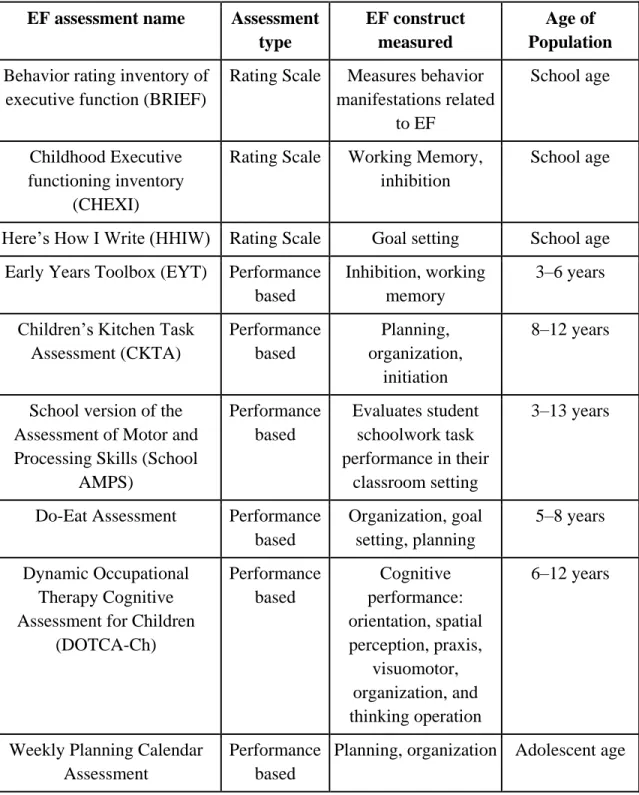
In the school setting, there are two types of evidence-based executive functioning assessments: rating scales and performance based assessments. Currently, there are nine EF assessments that are available for use with school-age children. The table below (see Table 1) outlines the EF assessments, assessment type, EF construct being measured, and assessment age population.
Table 1. Assessments of Executive Function EF assessment name Assessment
type
EF construct measured
Age of Population Behavior rating inventory of
executive function (BRIEF)
Rating Scale Measures behavior
manifestations related to EF School age Childhood Executive functioning inventory (CHEXI)
Rating Scale Working Memory,
inhibition
School age
Here’s How I Write (HHIW) Rating Scale Goal setting School age
Early Years Toolbox (EYT) Performance
based
Inhibition, working memory
3–6 years
Children’s Kitchen Task Assessment (CKTA) Performance based Planning, organization, initiation 8–12 years
School version of the Assessment of Motor and Processing Skills (School
AMPS) Performance based Evaluates student schoolwork task performance in their classroom setting 3–13 years
Do-Eat Assessment Performance
based Organization, goal setting, planning 5–8 years Dynamic Occupational Therapy Cognitive Assessment for Children
(DOTCA-Ch) Performance based Cognitive performance: orientation, spatial perception, praxis, visuomotor, organization, and thinking operation 6–12 years
Weekly Planning Calendar Assessment Performance based Planning, organization Adolescent age
The Behavior Rating Inventory of Executive Function (BRIEF) and the Childhood Executive Functioning Inventory (CHEXI), are rating scales provided to parents and teachers (Reddy, Hale, & Brodzinsky, 2011; Thorell & Nyberg, 2008). These two assessment tools are typically used to gain an initial understanding of a student’s EF skills in the school and home environment. The BRIEF and CHEXI compliment additional assessments administered to a student to obtain a comprehensive picture of a student strengths and areas for growth. Here’s How I Write (HHIW), is also a rating instrument that focuses on a student’s self-assessment of their handwriting and encourages the goal setting process (Cermak & Bissell, 2014). The existing evidence for this assessment is limited to content and construct validity and evaluating the
effectiveness of the self-assessment portion. Research has not yet examined the goal-setting component, which is an EF construct. Of the three rating scales presented, the BRIEF is widely used to measures EF in children in the school and non-school settings. The BRIEF’s validity and reliability has been researched in various studies and support the BRIEF’s ability to accurately measure EF skills in children (Reddy et al., 201l). The CHEXI and the HHIW have not been used in follow up studies within the school setting and have limited evidence of their successful administration in the school setting
(Cermak & Bissell, 2014; Thorell & Nyberg, 2008). From the presented research, school-based occupational therapists would benefit from administering the BRIEF to determine EF delays impacting school participation (Reddy et al., 2011; Toglia & Berg, 2013). The results from this assessment can direct occupational therapists to decide which
et al., 2011).
The performance-based assessments cover a wide range of the school-age
population and measure several EF constructs (Berg, Edwards, & King, 2012; Howard & Melhuish, 2016; Josman, Goffer, & Rosenblum, 2010; Katz, Golstand, Traub Bar-Ilan, & Parush, 2007; Munkholm, Berg, Löfgren, & Fisher, 2010; Toglia & Berg, 2013; Traub Bar-Ilan, & Parush, 2007). Each of these assessments has demonstrated initial evidence of their contribution to the occupational therapy evaluation process in the school setting, specifically measuring EF constructs. The presented assessments require the school-based occupational therapist to observe a student process, plan, and perform a novel task in either a natural or structured setting. This is important as EF skills are more accurately measured when a student is performing a task. A strength among the developed
assessments is the ability for the evaluator to administer more than one of the assessments to obtain a comprehensive picture of a student’s baseline EF skills (Berg et al., 2012; Katz et al., 2007; Toglia & Berg, 2013). However, current limitations to these EF-based performance assessments are the duration of testing and the limited suitability for re-evaluation due to the activities’ diminished task novelty (Berg et al., 2012; Josman et al., 2010; Munkholm et al., 2010).
There are four EF assessments that best fit the current school-based practice model. These assessments demonstrate feasibility to be administered in the school setting, determine EF skills specific to academic and classroom need, and contribute to generating a comprehensive picture of student EF skills. The four assessments are the Early Years Toolbox (EYT), School Version of the Assessment of Motor and Processing
Skills (School AMPs), Dynamic Occupational Therapy Cognitive Assessment for
Children (DOTCA-Ch), and Weekly Planning Calendar Assessment (WPCA). The EYT is a quick and engaging way to determine EF skills of inhibition, working memory, shifting (ability to control and redirect attention). It is an iPad-based assessment for students 3–6 years of age who are able to understand simple directions (Howard & Melhuish, 2016). For elementary age children, the School AMPs is an appropriate tool to evaluate a student’s performance in the classroom, specifically noting the quality of work, as well as motor processing skills. However, occupational therapists must participate in a 5-day training and a rater calibration process to ensure the accurate administration of the School AMPS. The DOTCA-Ch is another helpful tool for elementary age children; it assesses cognitive functioning, specifically cognitive strengths, that can be utilized to facilitate intervention strategies. Both of these assessments can support intervention plans, goal development, and indicate goal progress. For adolescents in junior high and high school within the general education setting, the WPCA can be administered to determine planning, organization, and working memory. Students must be able to sustain attention for at least 20 minutes, understand verbal instructions and be able to read as well as understand the presented paragraph. WCPA has three testing protocols that can be administered depending on what is most appropriate for the student (Toglia & Berg, 2013).
Is there evidence that existing EF interventions in the school setting are effective in improving EF-related delays?
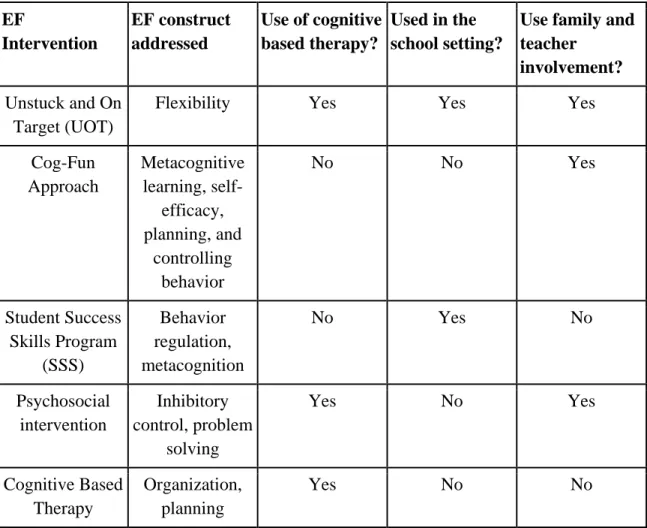
evidence of their effectiveness in the school setting (Bowers, Lemberger, Jones, & Rogers, 2015; Boyer, Geurts, & Prins, 2015; Kentworthy et al., 2014; Maeir et al., 2014; Miranda, Presentacion, Siegenthaler, & Jara, 2011). They are described in Table 2 below.
Table 2. Executive Function Interventions EF Intervention EF construct addressed Use of cognitive based therapy? Used in the school setting?
Use family and teacher
involvement? Unstuck and On
Target (UOT)
Flexibility Yes Yes Yes
Cog-Fun Approach Metacognitive learning, self-efficacy, planning, and controlling behavior No No Yes Student Success Skills Program (SSS) Behavior regulation, metacognition No Yes No Psychosocial intervention Inhibitory control, problem solving Yes No Yes Cognitive Based Therapy Organization, planning Yes No No
The administration of these interventions varies with class-wide, group, and one-on-one sessions. The interventions also vary in duration from weekly sessions to a complete school year. Two of the interventions involved an occupational therapy
et al., 2014). An occupational therapist was one of the authors that collaborated to develop the UOT curriculum. The Cog Fun approach is based on occupational therapy theories and a client- and family-centered approach. All interventions share common limitations: the need to establish further reliability and validity, to determine evidence of longitudinal gain, to incorporate the student’s perspective, and to find ways for the interventions to be incorporated in the school setting. The strengths of the interventions include a multi-modal approach, involvement of parent and teachers, and overall student engagement in the intervention sessions (Bowers et al., 2015; Boyer et al., 2015;
Kentworthy et al., 2014; Maeir et al., 2014; Miranda et al., 2011).
The UOT curriculum is an appropriate curriculum for students having difficulty with flexibility in the classroom. The curriculum is hands-on and provides verbal scripts that can be provided to school staff to reinforce lessons. The Cog-Fun approach is an occupation-based EF focused intervention for children and adolescents with ADHD. It incorporates and educates parents to be active participants in the intervention process. Currently, the School of Occupational Therapy in Jerusalem, Israel is training and certifying occupational therapists to implement the Cog-Fun Intervention. From the evidence available, it is unclear which interventions are most appropriate to use as there has not yet been follow up evidence regarding the interventions’ effectiveness in the school setting. However, researchers’ recommend the need for increased family and teacher collaboration, consistent use of EF related strategies, and opportunities for students to practice EF skills in their natural setting, either in the home or school
environment (Bowers et al., 2015; Boyer et al., 2015; Kentworthy et al., 2014; Maeir et al., 2014; Miranda et al., 2011).
Is there evidence regarding which school age population benefits (primary vs. secondary school?) most from EF intervention?
With executive function interventions and assessments emerging, a wide range of ages may be evaluated for their progress in EF skills. The evidence supports EF
intervention in early childhood, school age, and adolescence, essentially from age 3 to 19 years of age (Bowers et al., 2015; Boyer et al., 2015; Kentworthy et al., 2014; Maeir et al., 2014; Miranda et al., 2011; Toglia & Berg, 2013). Additionally, research evidence identified specific disorders traditionally impacted by EF delays. Up to 10 % of school-age children may be impacted by neurodevelopmental disorders that involve deficits in EF skills (Maeir et al., 2014). For example, students with ADHD experience
compromised EF skills, specifically initiation, attention, emotional regulation, working memory, and continued task engagement (Maeir et al., 2014). Additional studies have found similar EF delays in school-age children with autism spectrum disorder,
developmental coordination disorder, and at-risk youth from disadvantaged backgrounds (Josman et al., 2010; Kentworthy et al., 2014; Toglia & Berg, 2013). The evidence is in agreement that addressing these EF delays with OT intervention will improve access and participation in all aspects of the school setting (Bowers et al., 2015; Boyer et al., 2015; Kentworthy et al., 2014; Maeir et al., 2014; Miranda et al., 2011).
Summary of Evidence
Current brain research suggests that EF development begins at infancy and continues to early adulthood (Center on the Developing Child at Harvard University, 2011; Howard & Melhuish, 2016). The research identified the first five years of life to be a critical time for EF development (Howard & Melhuish, 2016). A solid foundation with EF skills has been directly linked to school readiness and effective learning (AOTA, 2014; Dawson & Guare, 2010). School-age children (i.e., ages 3–21 years) require natural and scaffolded opportunities in the home and school setting to develop executive functioning skills (Center on the Developing Child at Harvard University, 2011; Howard & Melhuish, 2016; Katz et al., 2007). Children with ADHD, ASD, and DCD, as well as children from at-risk backgrounds often demonstrate delays in EF, specifically with regards to initiation, attention, emotional regulation, working memory, and continued task engagement (Bowers et al., 2015; Kentworthy et al., 2014; Maeir et al., 2014).
Researchers agree that school-based occupational therapy practitioners can play a contributing role in addressing a student’s EF related needs (Kentworthy et al., 2014; Maeir et al., 2014). The research suggests that in addition to clinical observations and teacher interviews, occupational therapy practitioners can utilize a combination of rating scales (BRIEF, CHEXI, and HHIW) and performance-based assessments (WPCA, CKTA, AMPS, Do-Eat, EYT, & DOTCA-Ch) to obtain an understanding of a student’s EF skills (Cermak & Bissell, 2014; Katz et al., 2007; Miranda et al., 2011). The research does not specifically report the preferred interventions to address EF in school age
for addressing EF skills in occupational therapy practice are: school-based curriculums such as Unstuck and On Target, collaboration with the health professionals regarding cognitive-based therapies, educating school staff regarding typical school age children EF development, and utilization of assessments that can be used to address EF constructs (Bowers et al., 2015; Kentworthy et al., 2014; Maeir et al., 2014).
Overall, the available research on executive functioning is emerging yet currently limited regarding EF-related brain development, assessments, intervention, and
populations that would gain the most benefit from occupational therapy intervention, particularly in the school setting. Nevertheless, school-based occupational therapists need guidelines for (1) which assessment and intervention tools are most reliable and valid for addressing student needs in the school environment, and (2) how to best present
assessment results and develop EF-related goals. Addressing these professional needs will help occupational therapists to provide services that address a student’s EF-related needs and skills and thereby enhance their overall school participation and academic performance.
Conclusion
This chapter demonstrates the theory and evidence base utilized to understand the clinical problem and support the development of the online course educating school-based occupational therapy practitioners on executive functioning. The author applied the diffusion of innovations theory’s constructs to guide the understanding of the identified problem. An explanatory model was developed and revised to align with the evidence gathered from professional literature. Lastly, the author provided best-practice
recommendations based on the synthesis of the research literature, which were ultimately incorporated into designing the executive functioning online course.
Chapter 3- Description of the Project Introduction and Background
Occupational therapy practitioners are an integral part of the public education system for children with disabilities (Case-Smith, 2002; Clark & Polichino, 2008). In collaboration with the school team, occupational therapy practitioners are typically consulted to support academic concerns related to a student’s fine motor, visual motor, and sensory processing skills (Clark & Polichino, 2008; Schultz-Krohn & Polatajko, 2013). In order for students to successfully participate in classroom related tasks, research has determined that in addition to the aforementioned skills, executive functioning skills are directly linked to student school-readiness (Cramm, Krupa, Missiuna, Lysaght, & Parker, 2013; Josman & Rosenblum, 2011; Schultz-Krohn & Polatajko, 2013). In the school setting, weaknesses in these skills are apparent in handwriting legibility, task initiation, task completion, visual attention, and self- regulation behaviors. By addressing EF deficits and delays, occupational therapy practitioners can do more to facilitate the academic participation of students in the classroom (Cramm et al. 2013; Dawson & Guare, 2010).
This doctoral project focuses on the clinical problem that school-based
occupational therapy practitioners generally are not 1) formally evaluating EF skills in students, 2) providing interventions to address EF related delays, and 3) advocating for student EF skills to be included in the occupational therapy assessment and intervention process. The Diffusion of Innovations (DOI) theory was used to analyze the clinical problem and gain a deeper understanding as to why this problem persists in school-based