About the author
Ray Tricker (MSc, IEng, FIIE (elec), FinstM, FIQA, MIRSE) as well as being the Principal Consultant and Managing Director of Herne European Consultancy Ltd – an organisation specialising in Quality, Environment and Safety Management Systems – is also an established Butterworth-Heinemann author (see Reference section). He served with the Royal Corps of Signals (for a total of 37 years) during which time he held various managerial posts culminating in being appointed as the Chief Engineer of NATO ACE COMSEC.
Most of Ray’s work since joining Herne has centred on the European Railways. He has held a number of posts with the Union International des Chemins de fer (UIC) (e.g. Quality Manager of the European Train Control System (ETCS), European Union (EU) T500 Review Team Leader, European Rail Traffic Management System (ERTMS) Users Group Project Co-ordinator, HEROE Project Co-ordinator, ERRI Quality Consultant) and currently (as well as writing books for Butterworth-Heinemann and acting as the Technical Author for Leica Microsystems in Cambridge!) he is busy co-ordinating the establishment of a complete Quality Management System for the Association of American Railroads (AAR) Transportation Technology Centre (TTCI) in Pueblo, Colorado, that is aimed at eventually gaining them ISO 9001:2000 certification. Ray is also a member of the Notified Body for the Accreditation of Trans-European High Speed Railways.
ISO 9001:2000
Audit Procedures
Ray Tricker
Butterworth-Heinemann
Linacre House, Jordan Hill, Oxford OX2 8DP 225 Wildwood Avenue, Woburn, MA 01801-2041
A division of Reed Educational and Professional Publishing Ltd A member of the Reed Elsevier plc group
First published 2002 © Ray Tricker 2002
All rights reserved. No part of this publication may be reproduced in any material form (including photocopying or storing in any medium by electronic means and whether or not transiently or incidentally to some other use of this publication) without the written permission of the copyright holder except in accordance with the provisions of the Copyright, Designs and Patents Act 1988 or under the terms of a licence issued by the Copyright Licensing Agency Ltd, 90 Tottenham Court Road, London, England W1P 0LP. Applications for the copyright holder’s written permission to reproduce any part of this publication should be addressed to the publishers
British Library Cataloguing in Publication Data
A catalogue record for this book is available from the British Library
Library of Congress Cataloguing in Publication Data
A catalogue record for this book is available from the Library of Congress ISBN 0 7506 5436 8
For information on all Butterworth-Heinemann publications visit our website at www.bh.com
Composition by Genesis Typesetting, Laser Quay, Rochester, Kent Printed and bound in Great Britain
Contents
Foreword ix
Preface xi
1 Background to the ISO 9001:2000 standard 1
1.1 The revision process 1
1.2 The main changes 3
1.3 Key changes 5
1.3.1 Requirements 5
1.3.2 Revised title 6
1.3.3 Consistent pair of standards 6
1.3.4 Top management 7
1.3.5 The process model 8
1.4 Benefits of the revised standards 10
1.5 Other benefits 10
1.5.1 Customers 10
1.5.2 People in the organisation 11
1.5.3 Owners and investors 11
1.5.4 Suppliers and partners 11
1.5.5 Society 12
1.6 Permissible exclusions 12
1.7 Transition period 12
1.8 Cost 13
1.9 The ISO 9000:2000 family of standards 15
1.9.1 ISO 9000:2000 16
1.9.2 ISO 9001:2000 17
1.9.3 ISO 9004:2000 27
VI CONTENTS
2 Background notes for auditors 30
2.1 Purpose of an audit 31
2.2 Types of audit 31
2.3 Audit categories 32
2.3.1 First party (internal) audit 33
2.3.2 External audit 35
2.3.3 The surveillance or quality audit visit 40
2.4 Quality assurance during a product’s or service’s lifecycle 42
2.4.1 Design stage 43 2.4.2 Manufacturing stage 45 2.4.3 Acceptance stage 46 2.4.4 In-service stage 46 2.4.5 Supplier’s responsibilities 48 2.4.6 Purchaser’s responsibilities 50
2.5 The effect of ISO 9001:2000’s new requirements 51
2.5.1 Customer focus 51
2.5.2 Customer communication 51
2.5.3 Training 52
2.5.4 Legal and regulatory compliance 52
2.5.5 QMS development and improvement 52
2.5.6 Product conformity 52
2.5.7 Measurement and continual improvement 52
2.5.8 Quality Management System requirements 53
2.6 Basic requirements of a Quality Management System 53
2.6.1 Quality Management System principles 54
2.6.2 Quality Management System approach 56
2.6.3 Quality Management System reliability 58
2.6.4 Quality Management System structure 58
2.6.5 Quality Plan 62
2.6.6 Quality records 68
2.7 Quality organisational structure 69
2.7.1 Management 69
2.7.2 The Quality Manager 70
3 ISO 9001:2000 checklists 73
3.1 ISO 9001:2000 headings 75
3.2 Comparison between ISO 9001:2000 and ISO 9001:1994 77
3.3 Counter-comparison between ISO 9001:1994 and
ISO 9001:2000 81
3.4 Comparison of ISO 9001:2000 headings between CD2,
DIS, FDIS and the IS 85
3.5 Complete index for ISO 9001:2000 94
3.6 ISO 9001:2000 crosscheck to a 1994 QMS 112
3.7 ISO 9001:2000 – explanation and likely documentation 118
CONTENTS VII
3.9 Stage audit check sheets 187
3.10 Additional (general purpose) audit checks 199
3.11 A selection of HEC forms 238
3.12 ISO 9001:2000 elements covered and outstanding 245
3.13 Abbreviations and acronyms 249
3.14 Glossary of terms used in quality 251
References 260
Useful addresses 266
Foreword
One of the requirements of ISO 9001:2000 (Section 8.2.2) is that:
‘The organisation shall conduct internal audits at planned intervals to determine whether the quality management system:
a. conforms to the requirements of the ISO 9001:2000 standard and to the quality management system requirements established by the organisation and,
b. is effectively implemented and maintained.’
To meet this requirement, organisations must continually review their system to ensure its continuing suitability and success, reveal defects, danger spots or irregularities, suggest possible improvements, eliminate wastage or loss, check the effectiveness of management at all levels and be sure that managerial objectives and methods are effective and are capable of achieving the desired result. Above all, organisations must be prepared to face up to an audit of their own quality processes and procedures from potential customers and prove to them that their Quality Management System fully meets the recommendations, requirements and specifications of ISO 9001:2000 – and is capable of meeting customer requirements.
The aim of this book, with its audit checklists and explanations, is to assist auditors in completing internal, external and third party audits of
newly implemented ISO 9001:2000 QMSs, existing ISO 9001:1994, ISO 9002:1994 and ISO 9003:1994 compliant Quality Management Systems (QMSs), and transitionalQMSs.
Preface
ISO 9001:2000 and ISO 9004:2000 have been developed as a ‘consistent pair’ of Quality Management System standards, based on eight quality management principles with a common process-orientated structure and harmonised terminology. In contrast to the previous 1994 version of these standards, they are designed to meet the requirements of service industries as well as manufacturers and may be used together or as stand-alone documents. Together, they lay down requirements for incorporating the management of quality into the design, manufacture and delivery of products, services and software.
The idea of a ‘consistent pair’ of standards was the very core of the revision process and their aligned structure is aimed at encouraging organisations not only to look at their activities from a process standpoint, but also to look beyond certification to a system which will be truly beneficial in improving operational performance. In this respect, ISO 9001:2000 specifies the requirements for a QMS (that can be used by organisations for certification or contractual purposes) whilst ISO 9004:2000 provides guidance aimed at improving an organisation’s overall quality performance. ISO 9004:2000 is not, however, meant as a ‘guideline for implementing ISO 9001:2000’ nor is it intended for certification or contractual use. Supporting both of these standards is a new standard (i.e. ISO 9000:2000) which supersedes ISO 8402:1995 and describes the fundamentals of Quality Management Systems and specifies their terminology.
To achieve its main objectives, ISO 9001:2000 requires manufacturing plants and service industries to possess a fully auditable Quality Management System consisting of Quality Policies, Quality Processes, Quality Procedures and Work Instructions. It is this Quality Management System that will provide the auditable proof that the requirements of ISO 9001:2000 have been and are still being met. This book, with its audit checklists and explanations, is designed to assist auditors in completing internal, external and third party audits of ISO 9001:2000 Quality Management Systems. Its checklists may also be used to audit existing ISO 9001:1994, ISO 9002:1994 and ISO 9003:1994 compliant Quality Management Systems.
XII PREFACE
The book is divided into three parts with the first one describing the requirements of ISO 9001:2000, the second providing background information for auditors and the third containing audit checklists and detailed explanations of the likely documents that will be required by an organisation in order to meet the requirements of ISO 9001:2000.
This book describes methods for completing management reviews and quality audits. It describes how internal audits of the organisation’s system are managed, how external audits of the organisation’s suppliers are performed and how third party audits may be completed on suppliers, on behalf of an organisation, or as part of a certification requirement for ISO 9001:2000. In totality, this book describes:
the background to the ISO 9001:2000 standard;
how ISO 9001:2000 can be used to check an organisation’s QMS;
how internal and external audits should be completed (e.g. audit plan, supplier evaluation, surveillance or quality audit visits);
how quality assurance can affect the product throughout its lifecycle; the manufacturer’s, supplier’s and purchaser’s responsibilities; the benefits and costs of quality assurance;
QMS requirements, principles and determinates;
the type of documentation an organisation needs to satisfy the
requirements of ISO 9001:2000; and then in a series of separate sections: lists the headings of ISO 9001:2000;
provides a comparison between ISO 9001:2000 and ISO 9001:1994;
provides a counter-comparison between ISO 9001:1994 and ISO
9001:2000;
shows a comparison between the headings of ISO 9001:2000 and
those contained in the previous Committee Drafts (CD1 and CD2), the Draft International Standard (DIS) and the Final Draft International Standard (FDIS);
provides a complete index to ISO 9001:2000;
provides a crosscheck between the requirements of ISO 9001:2000 and that of any previous QMS certified to ISO 9001:1994;
lists the likely documentation that an organisation would need to meet the individual requirements of ISO 9001:2000;
provides an audit check sheet against ISO 9001:2000; provides stage audit check sheets;
provides additional audit checks that can be used to check existing (e.g. ISO 9001:1994) QMSs against ISO 9001:2000;
provides examples of the main audit forms required to comply with ISO 9001:2000.
PREFACE XIII
The book also provides a list of all the main acronyms and abbreviations associated with quality management together with a detailed glossary of terms used in quality.
For convenience (and in order to reduce the number of equivalent or similar terms) the following, unless otherwise stated, are considered interchangeable terms within this book:
product – hardware, software, service or processed material; organisation – manufacturer and/or service provider.
1
BACKGROUND TO THE ISO
9001:2000 STANDARD
During the last few years it had been recognised that the 1994 version of the ISO 9000 series (i.e. ISO 9001:1994, ISO 9002:1994 and ISO 9003:1994) was far too orientated towards manufacturing and that there was a need to revise the existing structure of the standard to try and suit
all organisations, no matter their type or size.
Under existing international agreement, all International Standards have to be reinspected, 5 years after publication, for their continued applicability. In accordance with this agreement, the International Stan-dards Organisation (ISO) contacted more than 1,000 users and organi-sations for their views on ISO 9000:1994 using a questionnaire covering:
problems with the existing standards; requirements for new/revised standards;
possible harmonisation and interoperability between quality manage-ment, environmental management and health and safety standards.
1.1
The revision process
The revision process was the responsibility of ISO Technical Committee (TC) 176 and was conducted on the basis of consensus among quality and industry experts nominated by ISO member bodies, and represent-ing all interested parties. Initial specifications and goals were established following extensive user surveys and these were followed by a user verification and validation process to ensure that the standards produced would actually meet the requirements of the user.
2 ISO 9001:2000 AUDITPROCEDURES
The programme of work was as follows:
4th quarter 1997 1st Working Draft (WD1) for use by TC-176
1st quarter 1998 2nd Working Draft (WD2) for use by TC-176
2nd quarter 1998 3rd Working Draft (WD3) for use by TC-176
July 1998 Committee Draft (CD1) issued for ballot
February 1999 Committee Draft (CD2) issued for ballot
November 1999 Draft International Standard (DIS) for
comment and vote by Member Countries (see note)
September 2000 Publication of Final Draft International Standard (FDIS)
December 2000 Publication of International Standard (ISO)
Note: Once Draft International Standards have been adopted by the technical committees they are then circulated to member bodies for voting. Publication as an International Standard then requires a two-thirds majority of the votes.
In the words of the International Standards Organisation (ISO) the main reason for the year 2000 revision to the ISO 9000 standards was ‘to give users the opportunity to add value to their activities and to improve their performance continually by focussing on the major processes within the organisation’.
The aims of the revision process were to:
guarantee the effectiveness (but not necessarily the efficiency) of the organisation;
make sure the standards were applicable to all types of
organisations;
make the language used in the revised standards simpler, more user-friendly, and with less manufacturing bias;
DIS
ISO
FDIS CD2 CD1 WD3 WD1 WD2 (2001) (AA-DAT) (FA-AD) (WA-UIL) (WA-MH) (IL-Y) (MD-D) (1981)DRAFT INTERNATIONAL STANDARD (Nov 1999)
INTERNATIONAL STANDARD (Dec 2000)
FINAL DRAFT INTERNATIONAL STANDARD (Sep 2000)
COMMITTEE DRAFT No 2 (Feb 1999)
COMMITTEE DRAFT No 1 (July 1998)
3rd WORKING DRAFT (1998)
1st WORKING DRAFT (1997) 2nd WORKING DRAFT (1998)
BACKGROUND TO THEISO 9001:2000 STANDARD 3
make the new standards so that they were equally appropriate to all sectors, including service providers;
produce standards that would minimize any potential costs during a smooth transition.
1.2
The main changes
The new standards have taken into account previous experience with quality management system standards such as the original BS 5750 series, the 1987 and 1994 editions of ISO 9000, as well as emerging generic management systems. This has resulted in a closer alignment of quality management systems with the needs of organisations better reflecting the way organisations run their business activities.
Virtually all of the requirements from the previous 1994 standard have been included in the revised ISO 9001:2000 standard but with clearer definition and the inclusion of a lot of ‘shalls’ as opposed to ‘coulds’ and ‘shoulds’. The main changes have been that the new standard:
is centred around a process-orientated structure with a more logical sequence of contents;
4 ISO 9001:2000 AUDITPROCEDURES
includes a requirement for the organisation to monitor information on customer satisfaction as a measure of system performance;
Note: ‘Customer satisfaction’ is recognised as one of the driving criteria for any organisation. In order to evaluate if the product meets customer needs and expectations, it is necessary to monitor the extent of customer satisfaction. Improvements can be made by taking action to address any identified issues and concerns.
gives considerable emphasis on higher management issues (such as
the need for defined (and auditable) quality targets and the need to include supporting activities within the system);
includes a continual improvement process as an important step to
enhance the quality management system;
Note: ‘Continual improvement is the process focused on continually increasing the effectiveness and/or efficiency of the organisation to fulfil its policies and objectives. Continual improvement (where ‘continual’ high-lights that an improvement process requires progressive consolidation steps) responds to the growing needs and expectations of the customers and ensures a dynamic evolution of the quality management system’ (ISO TC 176).
provides (in ISO 9004:2000) an additional concept of organisational self-assessment as a driver for improvement (further emphasising the need to monitor customer satisfaction);
establishes measurable objectives at relevant functions and levels (monitoring of information of customer satisfaction as a measure of system performance);
lays increased emphasis on the role of top management, including a commitment to the development and improvement of the quality management system, consideration of legal and regulatory require-ments, and establishment of measurable objectives at relevant func-tions and levels (see also 1.3.4);
extends measurements to include system, processes, and product; increases attention to resource availability;
emphasises the need to determine training effectiveness; considers the benefits and needs of all interested parties;
assures consistency between quality management system
require-ments and guidelines;
promotes the use of generic quality management principles by
organisations (and enhancement of their compatibility with ISO 14001);
Quality Management System continual improvement Product realisation Customer requirement Management responsibility Customer satisfaction
INPUT PROCESS OUTPUT
Plan Do
Check Act
Resource
management Measurement,analysis and improvement
BACKGROUND TO THEISO 9001:2000 STANDARD 5
includes terminology changes and improvements that allow easier
interpretation;
provides increased compatibility with the environmental management system standard;
makes specific reference to quality management principles; meets the need for more user-friendly documents;
provides measures for the analysis of collected data concerning the performance of an organisation’s quality management system.
1.3
Key changes
1.3.1
Requirements
The main difference between ISO 9001:2000 and the previous version of the standard is that the 20 elements contained in section four of ISO 9001:1994 have now been replaced by four sections covering the management of resources, the quality of the product, the maintenance of quality records and the requirement for continual improvement.
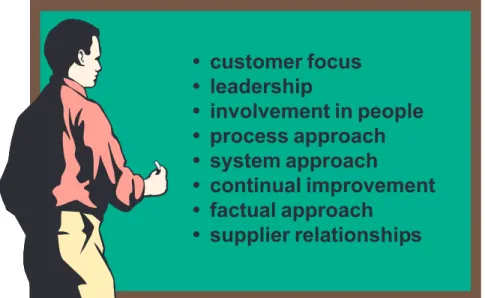
customer focus
leadership
involvement in people
process approach
system approach
continual improvement
factual approach
supplier relationships
customer focus
leadership
involvement in people
process approach
system approach
continual improvement
factual approach
supplier relationships
6 ISO 9001:2000 AUDITPROCEDURES
1.3.2
Revised title
Each of the three main standards (i.e. ISO 9000:2000, ISO 9001:2000 and ISO 9004:2000) now have a revised title, which no longer includes the term ‘quality assurance’. This has been done in order to reflect the fact that the QMS requirements specified in these standards address the quality assurance of a product as well as customer satisfaction.
1.3.3
Consistent pair of standards
ISO 9001:2000 and ISO 9004:2000 have been developed as a ‘consistent pair’ of QMS standards, based on eight quality management principles with a common process-orientated structure and harmonised terminology. They are designed to be used together, or may be used as stand-alone documents.
The idea of a ‘consistent pair’ of standards is the very core of the revision process. The aligned structure of ISO 9001:2000 and ISO 9004:2000 is aimed at encouraging organisations not only to look at their activities from a process standpoint, but also to look beyond certification to a system which will be truly beneficial in improving operational performance.
Whilst ISO 9001:2000 specifies the requirements for a QMS (that can be used by organisations for certification or contractual purposes), ISO 9004:2000 provides guidance aimed at improving an organisation’s overall quality performance. ISO 9004:2000 is not, however, meant as a
BACKGROUND TO THEISO 9001:2000 STANDARD 7
‘guideline for implementing ISO 9001:2000’ nor is it intended for certification or contractual use.
Both of the standards are based on eight quality management principles, which reflect best management practices.
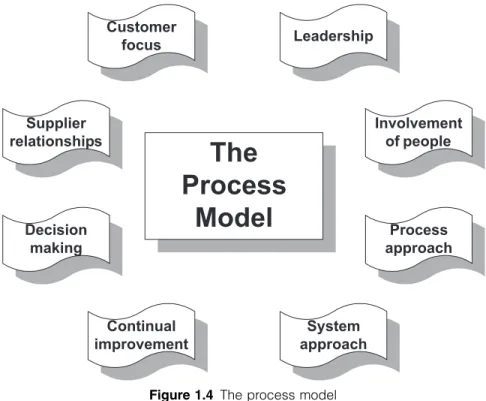
These eight principles are: customer focused organisation; leadership;
involvement of people;
process approach;
system approach to management;
continual improvement;
factual approach to decision making; mutually beneficial supplier relationship.
One specific change to ISO 9001:2000 and ISO 9004:2000 that was brought about late in the day concerned the usage of the term ‘product’. During the Committee Draft stages, it became apparent that there was a need to have a single word that described an organisation’s output as well as the service that it provided. Consequently in the new standards, ‘product’ has been defined as ‘a system of activities, which uses resources to transform inputs into outputs’ and there are four agreed generic product categories, namely:
hardware;
software;
services;
processed materials.
Note:Further details of the Transition Planning Guidance are available on BSI’s website at http://www.bsi.org.uk/iso-tc176-sc2.
1.3.4
Top management
Top management is a new term in ISO 9001:2000 and is defined as ‘a person or group of people who direct and control an organisation at the highest level’.
In essence the standard is now no longer dealing with a Quality Management System but more of a management system that is to be used by the whole organisation. However, no organisation can function effectively without direction from top management, but in order to know that direction they will need to have at their disposal a wide range of information so they can provide a vision for the future. One of the main pieces of information they will need to have readily available is the needs and expectations of their customers, as well as knowing the regulatory and
8 ISO 9001:2000 AUDITPROCEDURES
legal requirements that are applicable to the organisation. This will enable top management to know what they need to do within the organisation to achieve customer satisfaction.
Management then needs to be able to show the workforce what the purpose of the organisation is, the perceived values of the organisation and their attitude and actions towards the customers. Through the mission and policy statements, management should try to produce unity within the organisation by enabling the staff to see clearly what the organisation is striving to achieve.
In the past, an organisation’s Quality Policy was seen more as a piece of paper signed by a senior member of staff rather than an objective. Now the policy will need to show a commitment to improvement, which will be measured throughout the organisation to make sure that the policy provides a framework for the setting of the objectives, and is communi-cated and understood throughout the organisation.
Once the policies have been set, policy objectives will need to be established. These should be applicable to the various activities within the organisation, and take into account the various functions of the organisa-tion and how these fit into the strategic framework.
Top management should engender a culture within the organisation that makes sure that all staff know what their objectives are and the relevance and importance of how staff do can affect the overall objectives of the organisation. Through having a caring and open culture, the morale and motivation of the workforce will be improved and as a consequence, products and services supplied will improve as will customer satisfaction. They will also need to take into consideration the interested parties of the organisation (see also 1.5).
1.3.5
The process model
The whole concept of ISO 9001:2000 now revolves round a systematic process approach which uses eight quality management principles reflecting best practice which are designed to enable a continual improvement of the business, its overall efficiency and be capable of responding to customer needs and expectations.
The eight principles contained in ISO 9001:2000 are of primary concern to an organisation, as they will affect an organisation’s overall approach to quality. They are:
1. Customer focused organisation
Organisations depend on their customers and therefore should under-stand current and future customer needs. They should meet customer requirements and should strive to exceed customer expectations.
The
Process
Model
Decision making Customer focus System approach Continual improvement Process approach Involvement of people Leadership Supplier relationshipsBACKGROUND TO THEISO 9001:2000 STANDARD 9
2. Leadership
Leaders establish unity of purpose, direction, and the internal environment of their organisation. They create the environment in which people can become fully involved in achieving the organisation’s objectives.
3. Involvement of people
People at all levels are the essence of an organisation and their full involvement enables their abilities to be used for the organisation’s benefit.
4. Process approach
A desired result is achieved more efficiently when related resources and activities are managed as a process.
5. System approach to management
Identifying, understanding and managing a system of inter-related processes for a given objective contributes to the effectiveness and efficiency of the organisation.
6. Continual improvement
Continual improvement is a permanent objective of any organisation.
10 ISO 9001:2000 AUDITPROCEDURES
7. Factual approach to decision making
Effective decisions are based on the logical and intuitive analysis of data and information.
8. Mutually beneficial supplier relationships
Mutually beneficial relationships between an organisation and its suppliers enhance the ability of both organisations to create value.
1.4
Benefits of the revised standards
There are many, quite major benefits because of the revised quality management systems standard structure, such as:
its applicability to all product categories, in all sectors and to all sizes of organisations;
being simpler to use, clearer in language, readily translatable, and more easily understandable;
having a significant reduction in the amount of required documentation;
providing a link between quality management systems and
organisa-tional processes;
providing a natural move towards improved organisational
performance;
covering the requirement for continual improvement and customer
satisfaction;
its increased compatibility with other management systems such as ISO 14000;
providing a consistent basis to address the needs and interests of organisations in specific sectors (e.g. medical devices, telecommunica-tions, automotive, etc.);
the concept of the consistent pair (ISO 9001 covering the requirements and ISO 9004 for going beyond the requirements in order to further improve the performance of the organisation);
considering the needs of and benefits to all interested parties.
1.5
Other benefits
As shown below, the benefits of an organisation implementing an ISO 9001:2000 culture are far-reaching.
1.5.1
Customers
Customers and users will benefit by receiving products that: conform to the requirements;
Other benefits
Owners and
investors Suppliers andpartners Society People in the
organisation Customers
BACKGROUND TO THEISO 9001:2000 STANDARD 11
are available when needed;
are maintainable.
1.5.2
People in the organisation
People in the organisation will benefit by: better working conditions;
increased job satisfaction; improved health and safety;
improved morale;
improved stability of employment.
1.5.3
Owners and investors
Owners and investors will benefit by: increased return on investment; improved operational results;
increased market share;
increased profits.
1.5.4
Suppliers and partners
Suppliers and partners will benefit by: stability;
growth;
partnership and mutual understanding.
12 ISO 9001:2000 AUDITPROCEDURES
1.5.5
Society
Society will benefit by:
fulfilment of legal and regulatory requirements; improved health and safety;
reduced environmental impact;
increased security.
1.6
Permissible exclusions
The text of ISO 9001:2000 has been made more generic than the 1994 version in order to be applicable to different types of product and to organisations of different sizes. Due to this generic nature, however, it may be that some industrial or commercial sectors will identify additional requirements to attend to their specific needs.
Equally, some of the requirements may not apply to all organisations and in this respect ISO allows for the exclusion of some requirements. These exclusions are limited to Section 7 (‘Product Realisation’), and requirements can onlybe left out if it can be shown that they do not affect the organisation’s ability to provide a product which meets customer and applicable statutory/regulatory requirements.
1.7
Transition period
The 1994 ISO 9000 family of quality standards contained well over 27 standards and documents and this caused quite a lot of concern (not to mention confusion!) over the years. Thankfully the year 2000 quality management system standards now only consist of three primary standards, i.e. ISO 9000, ISO 9001 and ISO 9004 supported by a number of technical reports.
To the maximum extent possible, the key points in the other 1994 standards and documents (and sector-specific needs) have been inte-grated into the three primary standards. Then over the next few years the other standards and documents from the ISO 9000 family will either be withdrawn, transferred to other Technical Committees, or replaced by technical reports, technical specifications or brochures (with the exception of ISO 10012 ‘Quality Assurance for Measuring Equipment’, which will remain as an international standard).
Although the year 2000 publications now supersede corresponding 1994 versions of the standards, previous (i.e. accredited) certification to the 1994 editions will be recognised up to 3 years following publication of the revised standards (i.e. until December 2003). Organisations may choose to continue or even seek new certification/registration to the 1994
BACKGROUND TO THEISO 9001:2000 STANDARD 13
versions of ISO 9001, ISO 9002, and ISO 9003. But any certificates issued or renewed will only remain valid until December 2003.
Note:Although upgrading an organisation’s QMS to ISO 9001:2000 will be fairly simple if that organisation is already certified to ISO 9001:1994, the impact on organisations who are currently only registered to ISO 9002:1994 and 9003:1994 (i.e. organisations not involved in the design and manufacture of a product) will probably be more difficult!
Following consultation between ISO/TC 176, the International Accredita-tion Forum (IAF) and the ISO/Committee of Conformity Assessment (CASCO), a joint communiqu ´e has been issued which includes the following statements:
‘Accredited certificates to the new ISO 9001 shall not be granted until the publication of ISO 9001:2000 as an International Standard’. ‘Certification/registration body assessments to the latest draft of the
new standard may begin prior to the publication of the ISO 9001:2000 International Standard’.
‘ISO 9001:2000 will require auditors and other relevant certification/ registration body personnel to demonstrate new competencies’. ‘Certification/registration bodies will need to take particular care in
defining the scope of certificates issued to ISO 9001:2000, and the “permissible exclusions” to the requirements of that standard’.
‘Certificates issued to ISO 9001:1994, ISO 9002:1994 or ISO 9003:1994 shall have a maximum validity of 3 years from the date of publication of ISO 9001:2000’.
However, although organisations already registered to the 1994 standard will have up to 3 years following publication of the ISO 9001:2000 in which to re-certify, it is strongly recommended that, if you are one of these organisations, you make a start on the transition to the new standard as soon as possible!
1.8
Cost
‘An effective QMS should be designed to satisfy the purchaser’s conditions, requirements and expectations whilst serving to protect the organisation’s best interests’ (ISO 9004: 2000).
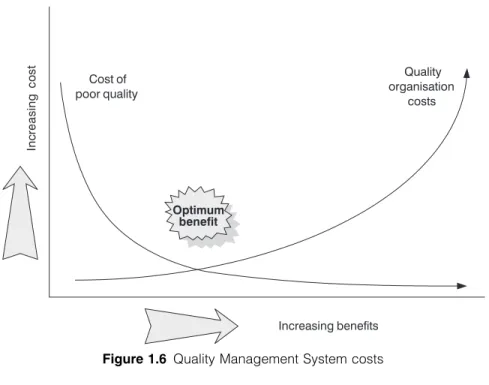
In practice, Quality Management Systems can be very expensive to install and operate, particularly if inadequate quality assurance and quality control methods were previously used. If the purchaser requires con-sistent quality he must pay for it, regardless of the specification or order which the organisation has accepted. However, against this expenditure
Increasing benefits In cr eas in g co st Cost of poor quality Quality organisation costs Optimum benefit
14 ISO 9001:2000 AUDITPROCEDURES
must always be offset the savings in rework, scrapped material and general problems arising from lack of quality.
From an organisation’s point of view there is a business requirement to obtain and maintain the desired quality at an optimum cost. The following represent some of the additional expenses that can be incurred:
implementation and maintenance of an organised document control
system throughout the organisation; training for the quality assurance team;
salaries for the quality assurance team, planners, quality supervisors, calibration/test equipment staff and Quality Managers;
visits by the quality assurance staff to other organisations, subcon-tractors and the eventual consumer, for evaluation and audit of their facilities and products;
test equipment of a recognised type, standard and quality; regularly maintained and calibrated by an accredited calibration centre;
better storage facilities.
Note:With an effective QMS in place, the supplier will achieve increased profitability and market share and the purchaser can expect reduced costs, improved product fitness for role, increased satisfaction and, above all, growth in confidence.
BACKGROUND TO THEISO 9001:2000 STANDARD 15
The cost of implementing any necessary changes in order to meet the new requirements of ISO 9001:2000 will obviously vary from one organisation to another, depending on various factors such as the actual state of implementation of the Quality Management System, the size and complexity of the organisation, the attitude and commitment of the top management, etc. It is expected that the benefits to all organisations, however, will far outweigh eventual costs associated with the transition and any additional costs should be considered as a ‘value-added investment’.
1.9
The ISO 9000:2000 family of standards
The ISO 9000:2000 family of standards consists of three primary standards supported by a number of technical reports. These are:
ISO 9000:2000
16 ISO 9001:2000 AUDITPROCEDURES
1.9.1
ISO 9000:2000
Quality Management Systems – Fundamentals and vocabulary
(superseding ISO 8402:1995 ‘Quality Management and Quality Assurance – Vocabulary’ and ISO 9000–1:1994 ‘Quality Management and Quality Assurance Standards – Guidelines for selection and use’).
ISO 9000:2000 now includes a description of the basic approach to quality management as well as including a revised vocabulary to reflect the usage of new and revised terms and associated definitions con-tained in ISO 9001:2000 and ISO 9004:2000.
The development of ISO 9000:2000 was completed in parallel with ISO 9001:2000, ISO 9004:2000, the future ISO 14001 standard for environmental management and all other existing and planned manage-ment standards so as to, hopefully, ensure a harmonised approach to standardisation.
ISO 9000:2000 also includes a revision of the current ISO 8402:1995 ‘Quality Management and Quality Assurance – Vocabulary’ standard, provides a more formal approach to the definition of terms, specifies terminology for QMSs and will assist:
those concerned with enhancing the mutual understanding of the
terminology used in quality management (e.g. suppliers, customers, regulators);
internal or external auditors, regulators, certification and/or registra-tion bodies;
developers of related standards.
Following publication of this standard, ISO 8402:1995 has been withdrawn.
ISO 9001:2000
BACKGROUND TO THEISO 9001:2000 STANDARD 17
1.9.2
ISO 9001:2000
Quality Management Systems – Requirements (superseding ISO 9001:1994 ‘Quality Systems – Model for quality assurance in design, development, production, installation and servicing’, ISO 9002:1994 ‘Quality Systems – Model for quality assurance in production, installation and servicing’ and ISO 9003:1994 ‘Quality Systems – Model for quality assurance in final inspection and test’).
The current ISO 9001:1994, ISO 9002:1994 and ISO 9003:1994 standards have now been consolidated into a single revised ISO 9001:2000 standard. Organisations that have previously used ISO 9002:1994 and ISO 9003:1994 will be allowed to be certified to ISO 9001:2000 through a ‘reduction in scope’ of the standard’s requirements by omitting requirements that do not apply to their particular organisation.
ISO 9001:2000 is focused towards ‘providing confidence, as a result of demonstration, in product conformance to established requirements’ and includes a section entitled ‘permissible exclusions’. This section allows organisations to formally ‘exclude’ certain non-applicable requirements of the standard, yet still claim conformance to it. However, only those organisations that can provethat the nature of their products, customers and/or the applicable regulatory requirements do not need to meet the full requirements of ISO 9001:2000 are allowed these exclusions. For example, organisations whose products require no design activities (and who would have previously sought ISO 9002:1994 certification) can now claim to be in compliance with ISO 9001:2000 by excluding the requirements for design and development.
With the publication of ISO 9001:2000, there is now, therefore, a single quality management ‘requirements’ standard that is applicable to all