Article
A community engaged dental curriculum: a rural Indigenous outplacement
programme
Menaka A. Abuzar, Julie Owen
Melbourne Dental School, University of Melbourne, Australia
Abstract
Background. Indigenous people worldwide suffer from poor oral health as compared to non-Indigenous citizens. One of the approaches to bring about improvement in Indigenous oral health is to enhance the service provision by implementing oral health outplacement pro-grammes. A case study of such a programme for dental students in Australia reports how an educational institution can successfully engage with an Indigenous oral health service to provide learning experiences to the students as well as deliver much needed services to the community.
Design and Methods. The assessment of this ongoing outplacement programme over the period of 2008-14, based on students’ feedback, highlights some of the key beneficial outcomes. Students agreed that the Indigenous outplacement programme improved their understand-ing of Indigenous issues (mean ± SD: 4.10±0.8; 5 refers to strongly agreeon 5-point scale) and increased the possibility that they will prac-tise in Indigenous health (3.66±1.0). They were pleased with the assistance received by clinical supervisors and clinic staff at the Indigenous dental clinic (4.28±0.8).
Conclusions. This programme has demonstrated that structured stu-dent outplacements are valuable in building relations across cultures especially with Indigenous communities. It has also shown that uni-versity engagement with the public health sector can be beneficial to both institutions.
Introduction
Indigenous people around the world have relatively low standards of oral and general health.1Oral health inequalities between Indigenous
and non-Indigenous communities in the world are markedly similar irrespective of different geographical, cultural and historical back-grounds.2 Indigenous communities face considerable barriers to
accessing oral health care since they live in rural and remote areas of
their respective countries. They are further challenged by the shortage of culturally appropriate and family focussed care. The broad approach-es adopted internationally to addrapproach-ess thapproach-ese issuapproach-es include dental clin-ical outplacements (outreach), integrated dental and primary health care services, understanding of traditional practices by health care professionals, and focussed service delivery including a team approach by oral health care professionals.3This paper describes one of these
approaches, i.e.,Indigenous outplacement programme for dental stu-dents.
According to the World Health Organisation (WHO), Indigenous people are those who identify themselves as distinct minority groups, have historical continuity with pre-colonial societies, follow distinct socioeconomic systems, and maintain distinct languages and cultures.4Many regions use different terms such as aboriginals, tribes
and first people, which are synonymous to indigenous.5In Australia,
the Indigenous people include Aboriginals and Torres Strait Islanders. They constitute approximately 3% of the nation’s population with a significant proportion of these individuals (43%) residing in regional and remote areas.6
As in other parts of the world, Indigenous Australians have a lower life expectancy with increased risk of medical illness and dental dis-ease compared to their non-Indigenous counterparts and their quality of life is much lower.7,8Therefore these communities have a unique
social profile, which requires specific approaches in the delivery of general and oral health care. It is well documented that European colonisation has brought about a complete change in the lifestyle of this group of people.7 Historically oral diseases were not reported
among this group of people. However at present the rate of caries of Aboriginal children is twice the amount reported for non-Indigenous children.9Although dental caries rates have remained low, tooth loss
and periodontal disease have been reported as a significant problem in Indigenous adults. There are many reasons for the lack of good oral health in these communities all of which have their basis in cultural and historical background. Indigenous people are reluctant to attend mainstream oral health care services due to language barriers, and access to care due to geographic locations of residency and the long distances which they need to travel. Cultural barriers such as main-stream services not accommodating friends and family members when visiting the dentist has also been reported as a barrier to accessing services.10This is especially significant since English is not the first
language for some Indigenous people. Other reasons include the diffi-culty of retention of non-Indigenous oral health care workers in rural and remote areas of Australia, and the lack of appropriate cultural competency training of these workers. This situation is exacerbated by the unavailability of Aboriginal health care workers to support the mainstream services. In an attempt to alleviate issues of access to oral health care and prepare new graduates to work comfortably with Indigenous patients some dental schools have incorporated clinical training in an Indigenous context into their curricula in recent years.11-13
Significance for public health
An oral health outreach programme is one of the suggested approaches to effectively address the endemic issues of poor oral health among Indigenous people around the world. An Indigenous dental clinical outplacement in Australia provides an example of beneficial outcomes of such an approach. It provides dental students with an opportunity to experience the health issues related to Australian Indigenous communities and prepare future graduates to work comfortably in the public health care system. Indigenous people also develop trust and feel comfortable in receiving oral health care services from non-Indigenous clinicians.
Non commercial
This paper presents the development of a structured Indigenous den-tal outplacement programme by an Australian denden-tal school and its evaluation based on students’ feedback during 2008-2014. This is one of the few dental programmes specifically designed for the Indigenous community. This programme stands out on account of its offerings to all dental students (mandatory clinical placement) instead of a selected few in the cohort; and its successful mutual cooperation and sustained partnership with an Indigenous health care organisation since 2007. The other distinctive fact is that outplacement learning is assessed as part of the final year overall assessment (formative and summative). The educational philosophy as described by Biggs and Tang14in regard
to alignment of intended learning outcomes, learning tasks and the assessments have been followed during development of this pro-gramme and is described under Designing the curriculum for learning and service delivery. This programme is important from a national per-spective since it would assist in training culturally informed oral health clinicians. This case report highlights the mutual benefits of outplace-ment programmes to students and Indigenous community. The devel-opment of the programme has been presented with reference to guide-lines published in the literature.15
Design and Methods
Designing the curriculum for learning and service
delivery
Clinical outplacements (outreach training) have specific advan-tages. The evaluation of these outplacement programmes indicates that there are benefits to dental students, dental schools, and the local communities.16,17From a students’ point of view the learning
experi-ence is different to the clinical education that they receive at a univer-sity hospital. The benefits to students from this approach to learning include the opportunities to work in a real worldsituation in their pre-graduation years, which inspires and motivates them to learn. It allows them to provide clinical services to a wide range of patients (including those from different cultural and social backgrounds), to experience a variety of clinical procedures, and learn to work as part of the team at the clinical centre (service learning). The local communities benefit through the services provided by the dental students. At present most dental schools globally provide clinical training to students at clinical outplacements, sometimes at a great distance away from the dental school, some of which are located in rural and underserviced areas. Outplacements are designed to provide students a broad range of clin-ical experience and opportunity to develop knowledge of the oral health disparities among different communities including rural and Indigenous as compared to metropolitan.
In 2007, the Melbourne Dental School (MDS) developed an outplace-ment programme, called Rural Dental Rotation (RDR), for all dental stu-dents of Doctor of Dental Surgery (DDS, graduate) and Bachelor of Oral Health (BOH, undergraduate) courses.18It is designed to develop
knowl-edge of oral health issues of rural and Indigenous communities and equip students with skills to manage oral health related problems spe-cific to these communities. Currently, groups of 14-16 final year stu-dents spend 5 weeks at a rural location (Shepparton, Victoria, Australia) engaged in clinical practice at 3 public dental clinics in the region including at an Indigenous dental clinic called Rumbalara Aboriginal Oral Health Centre(RAOHC). The MDS in partnership with Rumbalara Aboriginal Cooperation (RAC), Mooroopna (4 km south-west of Shepparton), developed the Indigenous Oral Health Outplacement
where dental students engage in learning activities related to provision of oral health care to the local Indigenous community. Thus the Indigenous oral health clinical experience is an integral part of the final
year of the DDS (formerly BDSc) and BOH programmes.
Specific learning related to Indigenous oral health issues in the DDS programme has been defined in terms of its graduate attributes, in the following statements: On graduation, DDS graduates will have devel-oped: knowledge of the determinants of a ‘healthy society’ and the eco-nomic, political, psychological, social and cultural factors that con-tribute to the development and persistence of oral health and illness; knowledge of the health of Indigenous Australians including their histo-ry and cultural development and the ongoing oral health disparities of Indigenous people.
The BOH graduate attributes include: Attuned to cultural diversity -value different cultures, be well-informed citizens able to contribute to their communities wherever they choose to live and work, have an understanding of the social and cultural diversity in our community, respect Indigenous knowledge, cultures and values.
To achieve these learning outcomes, appropriate Indigenous learn-ing contents have been incorporated from the early years of the DDS and BOH programmes (years 1 and 2 respectively). At that stage stu-dents develop knowledge about Indigenous Australians in relation to their oral health status including the disparity that still exists when compared with the rest of the Australian population and issues related to access to care and social determinants of health. For example, DDS students engage in two 1 hour lectures in the first year semester one subject Introduction to Professional Dental Practice on Cultural Competence and Indigenous Oral Health. Students are provided with further learning resources related to Indigenous oral health and cul-tures, as self-directed learning through the university Learning Management System. Students participate in an initial cultural compe-tency seminar of 2 hours in preparation for their clinical outplacement at RAOHC. This workshop is organised at the end of the 3rdand 2ndyear
of the DDS and BOH programmes respectively. The histories, the cul-ture and the beliefs of Indigenous people and how these impact on their oral health and their attitude towards accessing oral health care services are discussed with the assistance of an Aboriginal healthcare worker. It is also aimed at providing essential information to assist stu-dents to feel comfortable working in the environment at the RAOHC during their outplacement. The workshop content is designed to stim-ulate the students’ curiosity as it relates to Indigenous culture, oral health issues and barriers in relation to accessing care. This early didactic learning is followed by experiential learning at the rural Indigenous clinic during the final year.
The RAOHC is a community controlled health service located in a sizeable rural area (Greater Shepparton) which has 2082 Indigenous people equivalent to 3.4% of the population of the state of Victoria in Australia. RAOHC offers a wide range of culturally appropriate com-plete health care services including health promotion as well as emo-tional and spiritual wellbeing services to Aboriginal and Torres Strait Islander people in the Greater Shepparton Region (http://www.rum-balara.org.au/). The Indigenous people feel comfortable seeking health care in such a community managed environment. On the first day of their rural clinical outplacement each group of students participates in an orientation session at RAOHC conducted by the dental clinic staff. Students participate in clinical orientation and a cultural information session (2-3 hours) with an Elder of the community. This includes the history of the Aboriginal people in Shepparton, the specific history of Rumbalara including a tour of the premises and visit to a typical house to which Aboriginal people were allocated during the 1950s. The stories of the Aboriginal people are told by the Elder who engages the students in conversation, thus enhancing their cultural knowledge. During the clinical outplacement at RAOHC, students develop clinical skills to pro-vide oral health care tailored to the community and experience aspects of Indigenous culture. They also have the opportunity to develop knowl-edge regarding issues related to access to oral health care through dia-logue with the clients of RAOHC during their outplacement at
Non commercial
Rumbalara. It is expected that educating dental students with aware-ness of cultural perspectives will better prepare them to work with the Indigenous people on graduation.10ROAHC has provided MDS with 1-2
dental chairs and 2 students are rostered to the clinic per day. Each stu-dent experiences 2-3 days of clinical practice at RAOHC. The clinical load of the supervisor is reduced to allow effective clinical supervision of 2 dental students.
There are documented advantages of experiential learning. During their Indigenous clinical outplacement students go through the cycle of active experimentation and reflection.19They learn through
perform-ing tasks or actions and through reflective observations. These obser-vations and reflections provide new information to understand the experience which enables students to assess and solve problems. The role of clinical supervisors is vitally important in this process of expe-riential leaning where dental students build on the previously received didactic information20 and develop respect and appreciation for
Indigenous culture and enhance their skills for service provision to Indigenous communities in the future.
Students’ learning is assessed through reflective clinical logs which are required to be completed for every patient managed by the stu-dents. Students document the management of each patient including the treatments provided. They perform self-assessment using a letter grade and the criteria are as follows: N = no advice or assistance required for procedure; M = minimal advice or assistance required for procedure; A = advice or assistance required for less than half of the procedure, and/or lack of organization; U = advice or assistance required for more than half the procedure, and/or poor organization. The clinical supervisor also grades the student using these criteria. Assessment guidelines for students and clinical supervisors are as fol-lows: Did the treatment proceed as planned? Were there any unfore-seen problems? What did the student learn (improvement in skills, new information)? Did the student demonstrate appropriate level of knowl-edge required for the procedure? Students are required to document a reflective analysis of their performance, (analysis of events) and what actions they would take to improve management of their patients. Clinical supervisor feedback is provided during the clinical session and can be described as brief and/or formal feedback.21Discussions include
how students performed and how they can improve particular proce-dures.
Students are encouraged to observe, reflect and understand the over-all experience in order to learn and complete the experiential learning cycle. The Indigenous dental assistants play a key role in guiding stu-dents during gathering information from patients regarding their rea-son for presenting, and collecting information on their medical, dental
and social histories. Most adult patients visiting RAOHC are poly-mor-bid and thus treatment planning becomes more complex. Students experience cultural aspects. For example, Indigenous people visit the dentist accompanied by family and friends, and this culture has to be accommodated in the provision of oral health care. At the end of the clinical outplacement, students are assessed (group presentation, sum-mative assessment) for their knowledge and understanding of Indigenous history, and the general and oral health issues of Indigenous community. This assessment is conducted as a written report of 2000 words submitted on the 4thweek of the rotation and a
group oral presentation (60 minutes presentation and question and answersession of 20-30 minutes) on the last day of the rotation, at the
wrap-up session. This assessment component is aligned with the learning outcomes for DDS and BOH students and is weighted 10% of the overall final year DDS assessment. The clinical logs (formative assessments) are also designed to align with the learning outcomes.
Students’ feedback
On completion of each rotation students responded to a voluntary anonymous survey. This survey was conducted using a questionnaire to evaluate the effectiveness of the program using students’ feedback.22
Questions were designed to obtain feedback on their overall experi-ences and learning achievements during RDR. Ethics approval was obtained for this survey from the Human Ethics Advisory Group of the University of Melbourne (Ethics approval: 0718660.1). To ensure confi-dentiality, all questionnaires were entered into database by an inde-pendent MDS staff member before any analysis was undertaken. The solicited responses to formal structured questions were on a 5-point Likert scale. Arithmetic mean, standard deviation and median were cal-culated to interpret and qualify the overall response against individual questions. A total of 746 dental students participated in the programme during 2007-2014 (Table 1). Feedback from students was collected from 2008 onwards (Table 2).
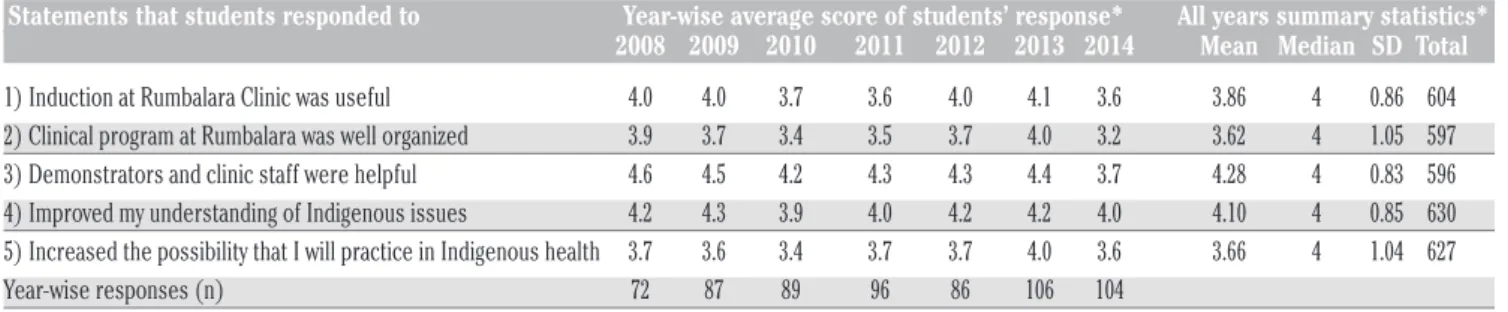
Five structured questions pertaining to RAOHC outplacement were analysed (Table 2). Questions 4 and 5 refer to knowledge and attitudes respectively. Response rate for these questions was about 89%. Students agreed that the RAOHC outplacement increased their under-standing of Indigenous issues which is a good outcome of this gramme. The student feedback indicates the benefits of the pro-gramme to the students. All students met the requirement to pass the group assessment conducted at the wrap-up sessions and thus meeting the learning outcomes set out for this programme.
The year-wise students’ feedback for the key question (4) regarding their learning had the average scores varying between 3.9-4.2 (from an
Table 1. Number of students attending Indigenous dental clinic (Rumbalara Aboriginal Oral Health Centre) in 2007-2014. Year 2007 2008 2009 2010 2011 2012 2013 2014 Total Students* 86 82 89 92 98 88 107 104 746
*Includes students of BDSc (2008-13), DDS (2014), and BOH (2007-14).
Table 2. Students’ feedback after the completion of Indigenous dental clinical outplacement at Rumbalara, 2008-2014.
Statements that students responded to Year-wise average score of students’ response* All years summary statistics* 2008 2009 2010 2011 2012 2013 2014 Mean Median SD Total 1) Induction at Rumbalara Clinic was useful 4.0 4.0 3.7 3.6 4.0 4.1 3.6 3.86 4 0.86 604 2) Clinical program at Rumbalara was well organized 3.9 3.7 3.4 3.5 3.7 4.0 3.2 3.62 4 1.05 597 3) Demonstrators and clinic staff were helpful 4.6 4.5 4.2 4.3 4.3 4.4 3.7 4.28 4 0.83 596 4) Improved my understanding of Indigenous issues 4.2 4.3 3.9 4.0 4.2 4.2 4.0 4.10 4 0.85 630 5) Increased the possibility that I will practice in Indigenous health 3.7 3.6 3.4 3.7 3.7 4.0 3.6 3.66 4 1.04 627 Year-wise responses (n) 72 87 89 96 86 106 104
*Likert scale: 1. Strongly disagree; 2. Disagree; 3. Undecided; 4. Agree; 5. Strongly agree
Non commercial
overall score of 5, where 5 refers to strongly agree) over the six-year period analysed (Table 2). It is interesting to note that on average stu-dents are more positive about the likelihood of working in Indigenous oral health (Score 3.4-4.0; Question 5). All the scores show a slight decline in 2010, which may be attributed to the changes in clinical staff and disruptions of services due to refurbishment of the clinic in that year.
The analysis of cumulative responses of students from 2008 till 2014 was also carried out (Table 2). Students found the Indigenous outplace-ment programme well organised (mean ± SD: 3.62±0.86). Students agreed that this programme improved their understanding of Indigenous issues (4.10±0.8) and increased the possibility that they will practice in Indigenous health (3.66±1.0). They were pleased with the assistance received by clinical supervisors and clinic staff at RAOHC (4.28±0.8).
The open ended questions have not been analysed in this study. However some selected comments have been presented here as exam-ples: The clinical staff has a good knowledge of the community and were able to provide us with important cultural information of the patients presenting to the clinic. This assisted us in managing patients to get good oral health outcomes. The orientation made me more aware about Aboriginal culture. Cultural sensitivity induction at Rumbalara was informative and adequate. Uncle (the Elder) did a good job, was inter-esting and helpful. It prepared us well for the rotation at Rumbalara.
Discussion
This study has provided an overview of the essential components of an Indigenous dental outplacement programme in Australian context. It has been demonstrated how the development, implementation and evaluation of such a programme can be achieved for the oral health benefits of an Indigenous community.
It is to be noted that the results presented in this paper are mainly based on the feedback from students. Feedback from community and staff members will form part of future studies.
In the words of Bainbridge et al.10Cultural competence is more than cultural awareness - it is the set of behaviours, attitudes, and policies that come together to enable a system, agency, or professionals to work effectively in cross-cultural situations. Indigenous dental outplacement programmes provide a cross-cultural setting where students have the opportunity to develop the appropriate attitudes and behaviours. It pro-vides experiential learning within an oral health care system where students apply their didactic knowledge into clinical practice and learn to work as a professional team. It increases opportunities of interdisci-plinary partnerships among health professionals and has the potential to improve the delivery of health care in underserviced areas as demon-strated by a programme in North America.23
The Indigenous oral health outplacement of the MDS has successful-ly provided oral health services at the public dental clinic at Rumbalara since 2007 while providing learning experience to students. Students’ logs indicate they have managed on average 2-3 patients per 3.5 hour clinical session and logged reflective comments which indicate they have met their learning outcomes. Similar studies have shown that inclusion of specific learning and teaching of Indigenous oral health modules into dental educational programmes assist in fostering cultur-ally informed clinician-patient relationships.11,13,24
The contribution of Indigenous health care workers including dental assistants in the training of graduates has to be acknowledged and they need to be encouraged and supported to continue to participate in these activities.
The programme allowed graduates to participate in the provision of much needed oral health care to the Australian Indigenous population in the region. However there have been some shortcomings with the programme in recent years due to the high turnover rate of clinical supervisors (shown via feedback of 2014, Table 2). As a result, students found it difficult to receive consistent feedback from clinical supervi-sors. MDS staff has provided support and advice during recruitment of clinical supervisors and currently an experienced senior dentist has taken responsibility of overseeing the student programme at RAOHC. MDS continues to provide support to the practice manager at RAOHC, and assist with education of the clinical supervisors to support student learning. In some instances the rural and Indigenous dental clinics are under-resourced as Lalloo et al.11reported the constant breakdown of
equipment at one Indigenous outplacement. In the present study, how-ever, the students were pleased to work in the new clinical facilities at RAOHC especially since they are well equipped rooms unlike the open plan clinics at the main metropolitan hospital. Similar to other reports,11non-attendance of Indigenous patients has been observed in
this study. The non-attendance of patients is recorded in the students’ clinical logs.
Overall feedback from students and the partner organisation (per-sonal communications) has been positive. This is mainly due to the positive outcomes achieved by students in oral health promotion and the provision of dental services to the community. The academic team at MDS has contributed in many ways to support the staff at Rumbalara and have remained engaged with the administration. It is hoped that the exposure to an environment such as RAOHC would encourage grad-uates to participate in provision of oral health services to Indigenous Australians upon graduation. Currently one graduate from MDS is employed as a part time clinician at the RAOHC indicating the positive results of the programme. The patients’ informal feedback of the pro-gramme is positive and the Indigenous community appreciates the services provided by the students. MDS has planned to evaluate the programme through patients’ experience of student services including the types and extent of oral health services provided by students in the future. Improved cultural awareness amongst graduates would allow them to work more effectively with Australian Indigenous communi-ties. Future research on graduate work patterns, assessment of the potential gains (health outcomes) by the Indigenous community and review of the cost effectiveness of the programme is required to fully evaluate the impact of this programme.25
Conclusions
The case study of an Indigenous clinical outplacement programme, sustained over six years, has demonstrated that mutual benefits can be achieved through student participation in the provision of services in the public health sector. The programme established by the Melbourne Dental School has shown beneficial learning outcomes for students. It provides students an opportunity to learn cultural safety and address oral health needs of the local Indigenous community.
Non commercial
References
1. Gracey M, King M. Indigenous health part 1: determinants and dis-ease patterns. The Lancet 2009;374:65-75.
2. Mejia GC, Parker EJ, Jamieson LM. An introduction to oral health inequalities among Indigenous and non-Indigenous populations. Int Dent J 2010;60:212-5.
3. Patel J, Hearn L, Gibson B, Slack-Smith LM. International approaches to indigenous dental care: what can we learn? Aust Dent J 2014;59:439-45.
4. WHO. Health of Indigenous people. Fact Sheet No 326. Geneva: World Health Organisation; 2007.
5. UN. Indigenous people, Indigenous voices: who are indigenous people? Fifth Session of UNPFII, Fact Sheet 1. New York: UN; 2006. 6. AIHW. The indigenous population. Canberra: Australian Institute of
Health and Welfare; 2015.
7. Williams S, Jamieson L, MacRae A, Gray C. Review of indigenous oral health. 2011. Available from: http://www.healthinfonet. ecu.edu.au/uploads/docs/oral_health_review_2011.pdf
8. AIHW. The health and welfare of Australia’s Aboriginal and Torres Strait Islander people: an overview. Canberra: Australian Institute of Health and Welfare; 2011.
9. Roberts-Thomson K, Australian Research Centre for Population
Oral Health, The University of Adelaide, South Australia. Oral health of Aboriginal Australians. Austral Dent J 2004;49:151-3. 10. Bainbridge R, McCalman J, Clifford A, Tsey K. Cultural competency
in the delivery of health services for Indigenous people. Issues paper no 13 produced for the Closing the Gap Clearinghouse. Canberra: Australian Institue of Health and Welfare, Australian Government; 2015.
11. Lalloo R, Evans JL, Johnson NW. Dental students’ reflections on clinical placement in a rural and indigenous community in Australia. J Dent Educ 2013;77:1193-201.
12. Bazen J, Paul D, Tennant M. An aboriginal and torres strait islander oral health curriculum framework: development experiences in Western Australia. Aust Dent J 2007;52:86-92.
13. Bazen JJ, Kruger E, Dyson K, Tennant M. An innovation in Australian dental education: rural, remote and indigenous pre-graduation placements. Rural Remote Health 2007;7:703. 14. Biggs J, Tang, C. Teaching for quality learning at university: what
the student does. 3rd ed. Berkshire: McGraw Hill; 2007.
15. Reznich CB, Anderson WA. A suggested outline for writing curricu-lum development journal articles: the IDCRD format. Teach Learn Med 2001;13:4-8.
16. Smith M, Ash P, Gilmour ASM, et al. Outreach training: the special interest group’s report. Eur J Dent Educ 2011;15:85-9.
17. Eaton KA, De Vries J, Widström E, et al. Schools without walls? Developments and challenges in dental outreach teaching – report of a recent symposium. Eur J Dent Educ 2006;10:186-91.
18. Abuzar MA, Burrow MF, Morgan M. Development of a rural outplace-ment programme for dental undergraduates: students’ perceptions. Eur J Dent Educ 2009;13:233-9.
19. Kolb DA. Experiential learning: experience as a source of learning and development. Englewood Cliff: Prentice Hall; 1984.
20. Mullins G, Wetheral, J, Robbe, I. Learning in the clinical environ-ment. In: Sweet J, Huttly, S, Taylor, I, eds. Effective Learning and teaching in medical, dental and veterinary education. London: Kogan Page Ltd; 2003. pp 169-179.
21. Branch WTJ, Paranjape A. Feedback and reflection: teaching meth-ods for clinical settings. Acad Med 2002;77:1185-8.
22. Belfield C, Thomas H, Bullock A, et al. Measuring effectiveness for best evidence medical education: a discussion. Med Teach 2001;23:164-70.
23. Ballweg R, Berg J, DeRouen T, et al. Expanding dental education partnerships beyond the four walls. J Dent Educ 2011;75:300-9. 24. Bulgarelli A, Roperto R, Mestriner S, Mestriner W. Dentistry
stu-dents’ perceptions about an extramural experience with a Brazilian indigenous community. Indian J Dent Res 2012;23:498-500.
25. Clifford A, McCalman J, Bainbridge R, Tsey K. Interventions to improve cultural competency in health care for Indigenous peoples of Australia, New Zealand, Canada and the USA: a systematic review. Int J Qual Health Care 2015;27:89-98.
Correspondence: Menaka Arundathi Abuzar, Melbourne Dental School, University of Melbourne, Victoria 3010, Australia.
Tel.: +61.9341.1495.
E-mail: [email protected]
Key words: Indigenous community; oral health; dental students; clinical out-placement.
Acknowledgements: the continued support of the staff at Rumbalara Aboriginal Oral Health Centre (RAOHC) for the outplacement programme is greatly appreciated.
Contributions: MAA has taken a key leadership role in the development of this programme and has contributed in the preparation of this manuscript; JO has contributed with the management of the programme, and has con-tributed to this manuscript.
Conflict of interest: the authors declare no potential conflict of interest. Received for publication: 15 December 2015.
Accepted for publication: 14 March 2016. ©Copyright M A. Abuzar and J. Owen, 2016 Licensee PAGEPress, Italy
Journal of Public Health Research 2016;5:668 doi:10.4081/jphr.2016.668
This work is licensed under a Creative Commons Attribution NonCommercial 4.0 License (CC BY-NC 4.0).