Maithreye Dasu*, J. Ram Naresh
*Corresponding author’s E-mail:[email protected]
Accepted on: 18-02-2013; Finalized on: 31-03-2013. ABSTRACT
Like many of you I also follow a number of articles and discussions published on various sites. The utmost topic which caught interest of mine is the “Pharmaceutical development” which is nothing but the application of knowledge gained from the scientific approaches and quality risk management to the development of the product throughout the lifecycle. The current state of the pharmaceutical products is that they are of good quality and end-product quality is not the issue. The strategy should be such that “get right for the first time and then continue to improve”. This involves the concept of Quality by Design (QbD) a systemic approach to attain the intended product quality. The various tools which assist the QbD principle are Design Space and Process Analytical Technology (PAT) of which many of the pharmaceutical industries are following since past 5 years. Now, other tool came into existence which can be accompanied with or without design space and PAT tools. This modern application is Real Time Real Testing (RTRT). This is nothing but a set of in-process controls that provide greater assurance of product quality than end- product testing under specific conditions. RTRT involves the at-line and on-line measurements of critical quality attributes where they are generated to ensure the product quality in the real time. This Real Time Release testing challenge is to perform the right measurement, at the right time and at the right location. Applications submitted to regulatory authorities involving RTRT principles and data enables the regulatory experts for a faster review and quicker approval. To conclude, RTRT improves and enhances analytical testing without affecting either product quality or the manufacturing cycle. Furthermore, Real time release testing is a QbD option but not a requirement.
Keywords: Control strategy, End product testing, PAT, Process parameters, Real time release testing, Risk assessment.
INTRODUCTION
pharmaceutical or a biological product must comply with their approved specifications before they are released into the market. Compliance with release specifications can be demonstrated by performing a complete set of tests on the active substance and/or finished product, according to the approved specifications. Under specific conditions, an alternative strategy to systematic end product testing is possible. This concept is mainly applicable to sterility testing of terminally sterilized products but now recent guidelines of ICH made it possible to apply to all products. This approach is called as Real Time Release Testing (RTRT).1
This paper mainly addresses the concept of RTRT, its applicability to different kinds of products at various stages, submissions related to the approval involving RTRT, documentation procedures, considerations in implementing, and in short the pros and cons.
BACKGROUND AND CONCEPT
In 2004, FDA published a final guidance for industry introducing the concept of process analytical technology (PAT) and this guidance also addressed a concept known as “real time release” defined as “the ability to evaluate and ensure the acceptable quality of in-process and/ or final product based on process data”. In August 2009, ICH introduced annexure to the ICH Q8 guideline which used the term “real time release testing” (RTRT). ICH defined RTRT as “the ability to evaluate and ensure the
quality of in-process and / or final product based on process data, which typically include a valid combination of measured material attributes and process controls”.2 Initially this approach has been applied to sterility testing of terminally sterilized products which is associated with parametric release applications. Parametric release is based on process data like temperature, pressure, time for terminal sterilization rather than testing of a sample for a specific attribute. EMA published a final guideline on 29 March 2012 naming “Guideline on Real Time Release Testing” to replace its former Guideline on Parametric Release. This new guideline is meant to allow for real tests beyond that of sterility testing.
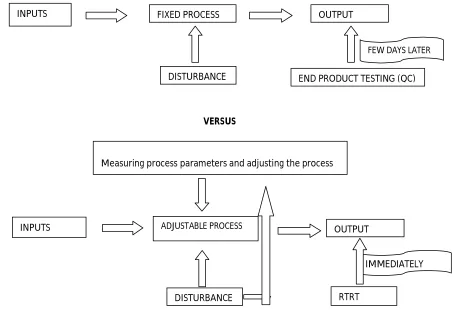
Thus EMA defined RTRT as “set of in-process controls that may provide greater assurance of product quality than end-product testing”.3 RTRT can replace end product testing but does not replace the review process to release the batch. This strategy is moving the QC lab into the process and measuring the critical quality attributes where they are generated.
BASIC CRITERIA
Control the process in real time and do what is right for an efficient manufacturing process and good product quality in short, do what makes sense economically and scientifically.
Real Time Release Testing - A New Quality Paradigm for Pharmaceutical Development
A
VERSUS
Figure 1: End product testing versus RTRT
APPLICABILITY FOR PHARMACEUTICAL PRODUCTS
Initially for applying RTRT strategy for manufacturing of a pharmaceutical or a biotechnological product there is a need to identify Critical Quality attributes, critical process parameters and material attributes, laying a control strategy and to perform a risk –assessment plan. Process monitoring may be applied to various manufacturing steps or unit operations on the basis of appropriate testing at various stages in the process. In general for most of the products, near infrared (NIR) and fluorescence techniques are efficient to measure the attributes at every unit operation during the process. Unit operations include purification, crystallization, drying, blending compressing, coating etc. The online measurement of attributes like particle size, moisture content etc., of that respective unit operation is the application of RTRT principle. The comprehensive results of all such tests will constitute sufficient grounds for replacing the conventional end product testing.
Example
In case of an oral solid dosage form the RTRT strategy will be implemented as following steps.
Identification of a critical quality attribute – content uniformity.
Identification of material attribute- Particle size distribution.
Identification of unit operations- Crystallization, drying, dispensing and blending.
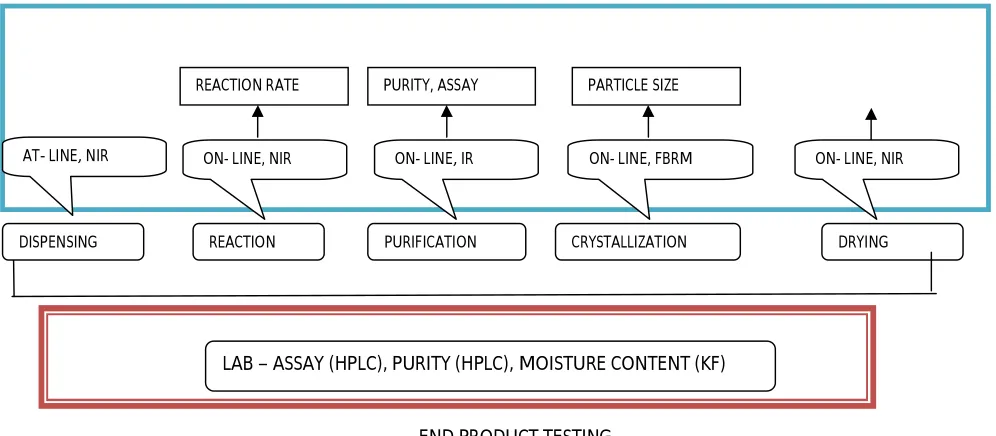
On line measurements includes use of focused beam reflectance measurement (FBRM) during crystallization and NIR during drying steps to identify the particle size.
If the particle size is meeting the acceptance criteria then one can assure the outcome of a good quality product.4
Other examples include use of NIR, colorimetry, FBRM in various unit operations to estimate particle size, porosity, surface area, bulk/tapped density in determination of critical quality attributes like dissolution, disintegration, assay, hardness, identification, water content and content uniformity. Analysis of tablet cores via transmission of light through the tablet thus ensuring that most of the material in the tablet core contributes to the spectrum collected. This RTRT tool is not only limited to tablet manufacturing but also applies to drug synthesis. For example, to monitor synthesis measurements inside the reactor is efficient that is by controlling the reaction rate, reaction end-point and yield. Therefore measurements in-situ allow for true real-time monitoring, which is significantly better than traditional grab sampling, primarily used to determine when the end point had been reached.2
INPUTS FIXED PROCESS OUTPUT
DISTURBANCE END PRODUCT TESTING (QC)
FEW DAYS LATER
INPUTS ADJUSTABLE PROCESS OUTPUT
DISTURBANCE
IMMEDIATELY
RTRT
END PRODUCT TESTING
Figure 2: Comparison study during production of drug substance
RTRT
END PRODUCT TESTING
Figure 3: Comparison study during production of drug product
APPLICABILITY FOR BIOLOGICAL /BIOTECHNOLOGICAL PRODUCTS
Same approach is followed as that of pharmaceutical products like identification of quality attributes to maintain acceptable level of final product. Product/ process understanding, in-process parametric control and attribute testing are elements to justify replacement of end product testing. To estimate the level of residual host cell DNA or host cell proteins in final product routine testing before purification step and a validation approach (use of validated
manufacturing method) are selected to replace end product testing.1
Sampling Procedures
To use RTRT, a specific approach for sampling should be present on when and where to take the sample and how much amount of the sample to be taken. As RTRT is an on –line measurement an automated sampling is done. The quantity collected is lesser and sampler preparation is simpler than that of traditional method sampling. The overview of sampling plan should be such
REACTION RATE PURITY, ASSAY PARTICLESIZE
DISPENSING REACTION PURIFICATION CRYSTALLIZATION DRYING
AT- LINE, NIR
NIR
ON- LINE, NIR
NIR
ON- LINE, IR
NIR
ON- LINE, FBRM
NIR
ON- LINE, NIR
NIR
LAB – ASSAY (HPLC), PURITY (HPLC), MOISTURE CONTENT (KF)
DISPENSING BLENDING COMPRESSION COATING
AT- LINE, NIR ON- LINE, NIR ON- LINE, NIR ON- LINE, VISION
BLEND HOMOGENITY ASSAY, CU APPEARANCE
that it should facilitate real –time control, to gain knowledge of the next manufacturing step and to measure critical material attributes. The probe or sample location, frequency should be the representative of entire batch. Sample acquisition time, sample volume and environmental factors should be constant over the entire process.5
Equipment Failures
In case of equipment failure, the manufacturer should not stop the RTRT measurements and return to conventional methods like in-process, end product testing unless there is a proven evidence of equipment failure. After provision of evidence alternative methods can be used without disturbing the acceptable level of quality. The failure should be investigated and followed up.2
Requirements to Implement RTRT
Submission requirements
To implement RTRT for a particular manufacturing operation with respect to that of a particular product, application should be submitted to the competent authority. The application would be granted only after the assessment of the product, process, and control strategy of that particular product mentioned in the submission. The competent authorities will evaluate the critical attributes selected in relation to their effect on stability and bioavailability of the product. The control strategy presented in the application should also mention the use of alternative methods in case of equipment failure while maintaining the product quality.1
Documentation requirements
The application submitted should be supported with sufficient information stating.
That the pharmaceutical development studies have identified the critical quality attributes for the finished product.
That a risk based development program has been carried out.
That a scientifically based control strategy has been developed and implemented.
That the manufacturing process is, or will be, validated adequately (as evaluated on inspection).
That in process requirements chosen for approval/rejection are decided on the basis of the acceptance criteria defined in the development studies.
The relationship between end-product testing and RTRT, including justification of acceptance criteria.
That clear, specified procedures are in place describing the reporting and actions to be taken on approval/rejection.
That the applied technologies gives an acceptable quality.
Comparative test results (parallel testing) supporting the relationship between the end-product specification and the RTRT where applicable.1
Considerations for implementing RTRT
Initially the pharmaceutical Quality system must support the control strategy. Later on a risk assessment program should be done in case of failure of RTRT. The RTRT strategy should incorporate data trending, OOS (out of specification) if any occur, and alarms. It should be able to verify or recalibrate the process when there is any change in raw materials or manufacturing equipment or measuring instrument.4
Relationship between RTRT, control strategy, PAT and QBD
RTRT is a part of the control strategy. QbD is not directly correlated to RTRT but justification of RTRT is not possible without a science based risk approach. Not all process analytical technology is accompanied with RTRT.5
Pros & Cons
Real time release testing paradigm is a double edged sword as it has both benefits and challenges.
Pros
RTRT approaches have economic benefits by reducing inventory, laboratory costs and increasing production yields by reducing rejections.
RTRT can improve process control and operational efficiency.
Reduces QC cost, cycle time, batch release time.
Identification of intermittent hardware failures.
Quality of the finished product can be measured during manufacturing.
Assist regulators for more process understanding and reduced inspections.
Cons
This is new strategy not familiar to many which requires new skills and reorganization of work.
Risks like failure in sampling, failure of instrument, failure of installation of probes may occur.
It is not always feasible or cost effective to implement direct measurement of all CQA’s.
As RTRT is not globally accepted by regulatory agencies manufacturers cannot shift from traditional testing to RTRT paradigm in the middle of marketing.
CONCLUSION
The pharmaceutical sector is moving forward by adapting the principles of RTRT but in a slow manner. FDA supports the implementation of RTRT approaches and also has reviewed and approved applications using RTRT but less in count.
REFERENCES
1. EMA, “Guideline on real time release testing (formerly Guideline on parametric release)” March 2012.
2. Angie Drakulich., Real Time Release Testing, Pharmaceutical Technology, 35, 2011, 42-49.
3. Ali Afnan, Real Time Release – It’s Time for Action, Not Debate, Pharma QbD, 2011.
4. Real Time Release Testing - PAT seminar.
5. FDA, Regulatory Perspective on Real Time Release Testing – American Association of Pharmaceutical Scientists Meeting, (Washington, DC) October 2011.