R E S E A R C H
Open Access
Apply hyperanalytic shearlet transform to
geometric separation
Shuaiqi Liu
1,2*†, Shaohai Hu
1†, Mingzhu Shi
2, Zhong Zhang
2and Shuang Liu
2Abstract
This paper first proposes a novel image separation method based on the hyperanalytic shearlet. By combining the advantages of both the hyperanalytic wavelet transform and the shear operation, hyperanalytic shearlet is easy to implement and also has a low redundancy. By using such transform and the orthonormal wavelet, a new geometric separation dictionary is obtained which can sparsely represent points and curviline singularities, respectively. In order to get the different components of image faster and more accurate, a fast alternating direction method (FADM) is used to train the dictionary. Our algorithm can greatly improve the computational efficiency without causing damage to the accuracy of image separation. Furthermore, a proper measure to evaluate the separation performance called sep-degree is defined. The experimental results have demonstrated the proposed method’s effectiveness and superiority.
Keywords: Hyperanalytic shearlet; Geometric separation; Sparse approximation; Separation degree
1 Introduction
Astronomical images of the galaxy can be modeled as a superposition of pointlike and curvelike structures. In the further analysis, astronomers typically face the problem of extracting the stars from filaments which mostly are tra-jectory of the particle and hence separating pointlike from curvelike structures. Thus, this area is greatly attracting scholars’ attention in order to find efficient methodologies for accurately conquering this task.
Although this problem seems unsolvable - the prob-lem is underdetermined, as there are two unknown (the images should be extracted) and only one known data (the given image) - experimental results using morphological component analysis (MAC) [1,2] suggest that such a prob-lem is possibly solvable when we get the prior information about the type of decomposed features and enough mor-phological difference between those features. For the sep-aration of pointlike and curvelike features, perfect results have been achieved by employing a dictionary consisting
*Correspondence: [email protected]
†Equal contributors
1Institute of Information Science, Beijing Jiaotong University, Shangyuancun 3, Haidian district, Beijing, 100044 China
2College of Electronic and Communication Engineering, Tianjin Normal University, Binshuixi Road 339, Xiqing district, Tianjin 300387, China
of wavelet and curvelet with combination with l1 mini-mization techniques [2]. We know that pointlike struc-tures can be optimally sparse representation in wavelet dictionary, and curvelike structures also can be optimally sparse representation in curvelet dictionary. Thus, the pointlike structures can be expressed by wavelet and the curvelike structures can be expressed by curvelet with applying l1 minimization to the expansion coefficients, and then the image can be separated automatically.
The current papers [3,4] give a newly combined dic-tionary of orthonormal wavelet and shearlet for sepa-rating pointlike and curvelike features. And numerical results give evidence that the shearlet-based decomposi-tion algorithms have a superior behavior than curvelet-based algorithms in [4]. In [3,4], the authors introduce a nonsubsampled shearlet transform to design a separation dictionary which greatly increase the redundancy. And they choose an old method called block coordinate relax-ation (BCR) to solve the l1 problem which is not only time-consuming but also unable to get an accurate result. Thus, in this paper, a novel approach to the separation of pointlike and curvelike features based on hyperanalytic shearlet is proposed.
Shearlet transform is a new multi-scale geometric anal-ysis algorithm which inherits the advantages of the con-tourlet and curvelet transforms. It is also an optimal
approximation presentation [5,6] for singular curve or surface that contains C2 high-dimensional signals. A shift invariant shearlet is achieved by nonsubsampled Laplace pyramid in [6]. This construction not only greatly increases the redundancy of the transform but also slows down the calculation sharply. From [7], we can know that hyperanalytic wavelet (HWT) just has limited redun-dancy to achieve multi-scale decomposition without shift sensitivity, which is similar to dual tree complex wavelet (DTCWT), but differently, this method is more easily achievable than dual tree complex wavelet. And the con-struction of hyperanalytic wavelet also greatly accelerates the computation. So we propose a new fast discrete shear-let called hyperanalytic shearshear-let transform. It is imple-mented by using hyperanalytic wavelet [3,4] to achieve multi-scale decomposition, and then shear filter bank is applied to the high-pass coefficients. This new algorithm holds the advantages of simpler structure and higher spar-sity. The hyperanalytic shearlet addresses the problem of the aliasing phenomenon and greatly reduces the redun-dancy and computing time compared to nonsubsampled shearlet transform. In our paper, we apply it to separate an image into its morphologically different contents. In order to get the different components of image faster and more accurate, we also use fast alternating direction method (FADM) instead of BCR to train dictionary. Our algo-rithm can greatly improve the computational efficiency without damage to the accuracy of image separation. To compare the performance difference between this new algorithm and the method in [4], we define a new mea-sure of the separation called sep-degree. The experiment results will demonstrate that our scheme has a better separation effect.
This paper is organized as follows. Section 2 intro-duces the construction of hyperanalytic shearlet trans-form. Section 3 describes the mathematical theory of geometric separation of pointlike and curvelike features and applies a novel algorithm to separate an image into morphologically different contents. Section 4 illustrates the numerical results. Finally, Section 5 presents some conclusions.
2 Hyperanalytic shearlet transform
Shearlet transform theory is based on composite wavelet. In dimensionn = 2, the affine systems with composite dilations are the collections of the form:
AAB(ψ)=
ψj,l,k(x)=|detA|j/2ψ
BlAjx−k:j,l∈Z,k∈Z2 (1)
whereψ ∈L2(R2),A,Bare 2×2 invertible matrices and |detB| = 1. For any f ∈ R2,AAB(ψ )forms a Parseval
frame (also called tight frame); we call the elements of
AAB(ψ )composite wavelet. LetA = A0 =
4 0 0 2
be
the anisotropic dilation matrix, and B = B0 =
1 1 0 1
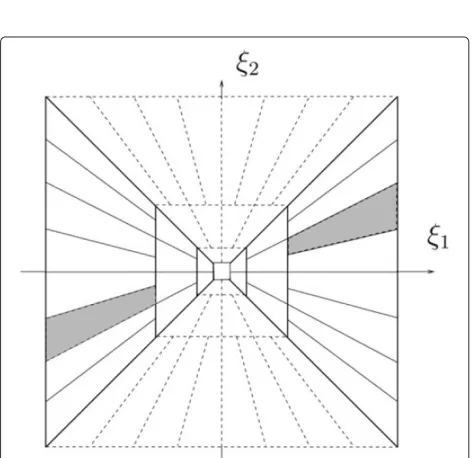
be shear matrix in (1); we can construct a tiling of the frequency as shown in Figure 1.
For anyξ =(ξ1,ξ2)∈ ˆR2,ξ1=0, letψ(0)(ξ)be given by the frequency, that is
ˆ
ψ(0)(ξ)= ˆψ(0)(ξ1,ξ2)= ˆψ1(ξ1)ψˆ2(ξ2 ξ1
) (2)
where ψˆ1,ψˆ2 ∈ C∞(Rˆ), suppψˆ1 ⊂[−12,−161]∪[161,12], suppψˆ2⊂[−1, 1]. Then, you know suppψˆ(0)⊂[−12,12]2.
From the above analysis, we can get the support range of the functionψj,l,kin the frequency domain:
suppψˆj(0),l,k⊂
(ξ1,ξ2):ξ1∈ −22j−1,−22j−4
∪ 22j−4, 22j−1,ξ2
ξ1 +l2
−j≤2−j
(3)
That is, each element ψjˆ,l,k is supported on a pair of
trapezoids, of approximate size 22j ×2j, oriented along lines of slopel2−j(see Figure 2).
Let D0 =
(ξ1,ξ2)∈ ˆR2:|ξ1| ≥ 18,ξ1
ξ2
≤1
, that means ∀(ξ1,ξ2) ∈ D0, the function group
ˆ
ψ(0)
ξA−j0 B−l0
forms a tiling of D0 as shown in Figure 1, notes thatD0is illustrated in solid line.
From [6], we know that the following set is a Parseval frame forL2(D0).
ψj,l,(0)k(x)=232jψ(0)Bl0A0jx−k:j≥0,−2j≤l≤2j−1,k∈Z2
(4)
Figure 2The frequency support ofψj,l,k.
Similarly, we can construct the other half tiling of Figure 1, which is the tiling ofD1in dashed line.D1is:
The discrete shearlet in [4] uses nonsubsampled Laplace pyramid to achieve multi-scale decomposition, which greatly increases the redundancy of the transform. Also, it greatly increases the computing time.
Due to the high redundancy and massive calculation of nonsampled wavelet, DTCWT, one that is constructed through a pair of wavelet trees, is proposed in [8]. Although DTCWT is an invertible quasi shift invariant and its 1-D case a redundancy of 2, the design of these quadrature wavelet pairs is so complicated that it can be done only through approximations. It means that the DTCWT requires special mother wavelet function. To overcome this restraint, in [7], Firoiu has proposed a new shift invariant called HWT using Hilbert transform and a two-stage mapping-based complex wavelet transform (MBCWT) in soft space [9]. And she also gives the proof that HWT is equivalent to DTCWT. That means that
HWT’s redundancy ratio is 2, the same as that of DTCWT. Moreover, HWT can be realized through classical mother wavelet function like those conceived by Daubechies. Using this method, we can get a higher degree of shift invariance and a better directional selectivity [9].
So we use HWT to achieve multi-scale decomposition and apply shear filter bank to the HWT coefficients. For short, we name this new algorithm hyperanalytic shear-let transform, which holds the advantages of a simpler structure and a higher sparseness. What is more, it has greatly improved the redundancy compared with shear-let transform and greatly reduced the computing time. We first introduce HWT and then construct hyperanalytic shearlet.
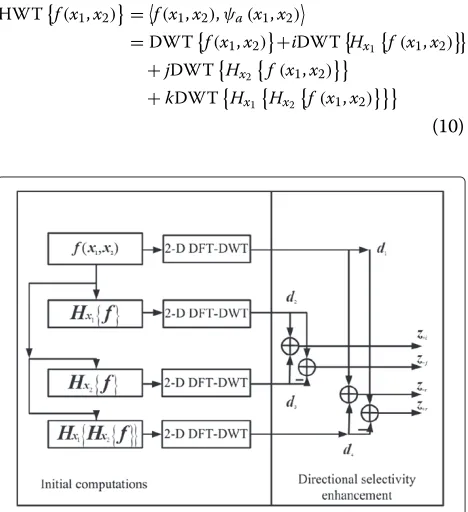
Figure 3 gives the construction of 2-D HWT. We can see thatfD4M denotes the low-pass coefficients andzk(k= ±i, ±r)denotes the high-pass coefficients.
Figure 3 shows that the 2-D HWT of the imagef(x1,x2) can be computed with the aid of the 2-D DWT and its associated hypercomplex image. To simplify the calcula-tion, the hypercomplex mother wavelet function associ-ated to the real mother waveletψ (x1,x2)is defined [7,9]
Hx2 respectively denotes the 1-D Hilbert transform of the
lines and columns of the input image. So the 2-D HWT of the imagef(x1,x2)shown in Figure 3 is as follows:
Next, we will demonstrate the construction for hyperan-alytic shearlet. Let the dilationsAjbe associated with scale transformation, and the matricesBlbe associated to area-preserving geometrical transformation. For ∀(ξ1,ξ2) ∈
ˆ
whereψ is wavelet function of hyperanalytic shearlet,W is a window function localized on a pair of trapezoid. And V2−2jξ is the Fourier coefficients of the multi-scale analysis. The 2-D discrete Fourier transform (DFT) of imagef ∈L2R2isˆf[k1,k2](−N2 k1,k2 N2). Here, we adopt the convention that brackets [,] denote arrays of indices, parentheses (,) denote function evaluations, and N×Ndenotes the image size.
At the jth scale, we utilize HWT instead of Laplace transform to compute the equation fˆ(ξ1,ξ2) V2−2jξ
1, 2−2jξ2
[6,7,9]. So we can decompose the father sub-band coefficientsfaj−1[n1,n2] into one low-pass sub-band coefficientfaj[n1,n2] whose size is half of the father sub-band size (In fact, it produces two low-pass sub-band coefficients through HWT. In order to conduct a HWT pyramids conveniently, we make two low-pass sub-band coefficients decomposed from each scale to one low-pass sub-band coefficient.) and six high-pass sub-band coef-ficients fdj(γ )[n1,n2] ,γ = 0 ∼ 6. The sizes offaj[n1,n2]
and fdj(γ )[n1,n2] are Nja = 2−j+1N and Njd = 2−jN, respectively. So we have
ˆ
To achieve the direction filter of the high frequency coefficients after decomposition of fdj(γ )[n1,n2], we should construct a shear direction filter using window function. Letδˆp represent the DFT of the delta function in the pseudo-polar grid. And ϕp is the mapping func-tion from the Cartesian grid to the pseudo-polar one [10], which can be described as a selection matrixSwith the property that its elements si,j satisfy the property s2i,j = si,j. Then, the hyperanalytic shearlet coefficients denote inverse Fourier transform ofwˆsj,l. Then, we give the
hyperanalytic shearlet transform off ∈L2R2, which is
Here,Jis the final scale.
The hyperanalytic shearlet eliminates the aliasing phe-nomenon and has better direction selectivity and lower redundancy than the nonsubsampled shearlet. Moreover, hyperanalytic shearlet realizes the multi-scale decompo-sition by using addition, subtraction, and FFT. All the analysis shows that the calculation speed of hyperana-lytic shearlet is quite fast; at the mean time, it can have a good visual effect as nonsubsampled shearlet does. Then, we apply it to separate an image into its morphologically different contents.
3 Apply hyperanalytic shearlet transform to
geometric separation
It is an important technique to separate an image into its morphologically different contents using MCA [1] from prior information about the type of features to be decomposed. Recently, Donoho and Kutyniok presented a mathematical framework in [3] for image separation and constructed geometric separation mathematical the-ory of separating pointlike from curvelike features. And Kutyniok and Lim gave a new wavelet-shearlet dictionary based on their analysis in [4]. After analyzing the advan-tages of hyperanalytic shearlet in Section 2, it is natural to construct a new combined dictionary of wavelet and hyperanalytic shearlet. In order to improve the computa-tional efficiency, we first apply the new dictionary to solve the problem about the separation of pointlike and curve-like features to an l1 optimization model. And then, we use fast alternating direction method in [11] to obtain the optimal solution. Compared with separation algorithms using wavelet and shearlet in various ways, such approach is proved superior by numerical results especially when it comes to the speed. In the following, we briefly review this theoretical approach to the geometric separation problem and present our method.
Let functionPdenote a ‘pointlike’ object and function C denote a ‘curvelike’ object. The image function f is expressed as:
f =P+C (15)
orthonormal separable Meyer wavelet and hyperanalytic shearlet to construct a dictionary to separate pointlike from curvelike structures.
LetFj
jdenote a family of filters including wavelet and hyperanalytic shearlet filters. Then, the functionf can be decomposed into piecesfjwith different scalesjbased on different sub-band filters. So we can get the equationfj= Fj∗f, and the original function can be reconstructed by usingf =
j
Fj∗fj,f ∈L2
R2.
With these conceptions above, we can solve the geomet-ric separation problem step by step. For this, the model (15) can be rewritten asfj = Pj+Cjfor every scale. Let
1and2be the basis of orthonormal separable Meyer wavelet and hyperanalytic shearlet. Then, for each scalej, we consider the optimization problem as follows:
ˆ Wj,Sˆj
=arg min Wj,Sj
T1Wj
1+
T2Sj
1 s.t. fj=Wj+Sj
(16)
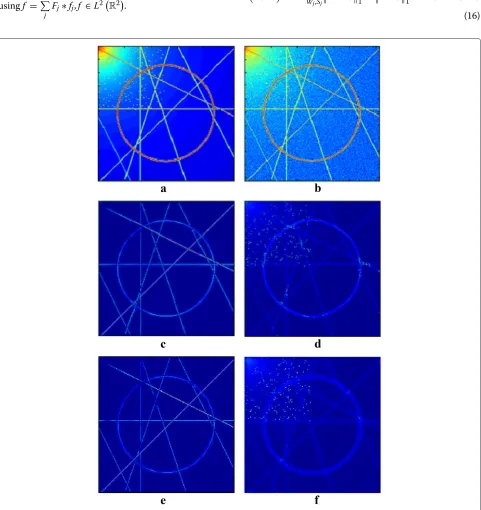
Figure 4Comparison results between W-SD and W-HSD for artificial image, computing times: 164.75 s (W-SD) and 30.43 s (W-HSD).(a)
Original image(512×512).(b)Noise image.(c)Curvelike component (W-SD).(d)Pointlike component (W-SD).(e)Curvelike component (W-HSD).
Table 1 The performance of different methods
The dictionary using for image separating W-SD W-HSD
The computing times (s) 164.75 30.43
The sep-degree 7.0835 7.3758
whereWj denotes the pointlike signal composition offj, Sj denotes the curvelike signal composition offj. T1Wj denotes the Wavelet coefficients of the signal Wj, and
T2Sj denotes hyperanalytic shearlet coefficients of Sj.
Obviously, the solution of (16) is thel1minimization prob-lem. In practice, the signal f is often contaminated by noise, and in [4], the authors have presented a new model to solve this problem adaptively. That is, for each scalej, the optimization problem can be presented through the following model:
ˆ Wj,Sˆj
=arg min Wj,Sj
T1Wj
1+
T2Sj
1+λ
fj−Wj−Sj22
(17)
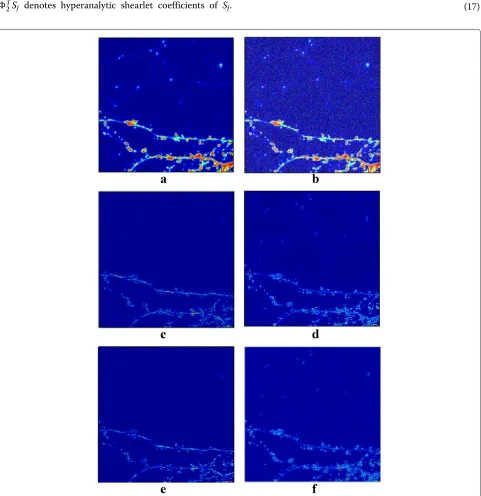
Figure 5Comparison results between W-SD and W-HSD for biological image, computing times: 167.77 s (W-SD) and 31.23 s (W-HSD).
In (17), the noise cannot be represented sparsely by either wavelet or hyperanalytic hearlet, and then it can be related with the residualfj−Wj−Sj.
It costs a lot of computational time to solve (17) for all scales. Kutyniok and Lim [4] show that it has been sufficient for separating pointlike from curvelike struc-tures with sufficiently large scalesj. So we re-weight the different scales coefficients which strengthen the high-frequency sub-band to avoid high complexity like [4]. For each scalej, we choose such a weight vectorw, and the elements ofw are all positive andwj<wi, ifj<i. Then, we can get the new signalf˜by computing
˜
From (17) and (18), we can separate pointlike from curvelike structures by solving the follow problem:
We can focus on the high frequencies by using signalf˜ which greatly improves the computational efficiency. But we do not calculate the optimization problem like in [4] because BCR method in [12] is not precise enough and also it is slow. In this paper, we use the fast numerical schemes - FADM in [11] - to solve (19) since we can get more accurate results and have a faster computing speed. Apply FADM to (19).
(a) First, fixS; then, we can get the solution ofW:
Minimization problem (20) and (21) can be uniformly written as the following minimization problem:
ˆ
v=arg min v∈RN
ρ(v)+λg−v22 (22)
whereρ(·)denotesl1 norm. Then, we can solve (22) by using two-step iterative shrinkage algorithm in [13], which is an easy and fast method, see the details in [13].
In order to verify the reliability and validity of the proposed algorithm, we introduce a measure named sep-degree to evaluate the separation performance of our transform.f denotes the noise image,fcdenotes the sepa-rated image containing curvelike features, andfpdenotes the separated image containing pointlike features. Let
μ(f)denote the mathematical expectation off. Then, we can define the sep-degree as follows:
Definition 1.The sep-degreeζ of an algorithm for sep-arating pointlike and curvelike features can be defined as the following: abs(·)denotes the absolute value of the function, and
denotes the similarity betweenfGandfSG.
The definition of sep-degree shows that the separation method’s performance is better when ς is larger. It is because that μ(f − fS) should be smaller enough for a better separating method, which means we get a most approximate image off. From Jensen’s inequality, we know
≤ 1 in (23), and the closer to 1 is, the more similar
fGandfSGare, which means that the extracted curve-like component is more perfect. For a better separation method, μ(f −fS) should be smaller and should be larger, so sep-degree ζ should be larger based on (24). In the following, ζ is used to distinguish the numerical experiments.
4 The numerical results
In this section, we compare our scheme of wavelet and hyperanalytic shearlet dictionary (W-HSD) with FADM against the separation algorithm based on wavelet and
Table 2 The performance of different methods apply to neuron image
The dictionary using for image separating W-SD W-HSD
The computing times (s) 167.77 31.23
shearlet dictionary (W-SD) with BCR in [4]. And the scale of all is four; for hyperanalytic shearlet and nonsubsam-pled shearlet, the direction vector is [2 3 3 4]. All routines were run using the Matlab R2009a which is based on an Intel 2.00GHz CPU.
The different methods for separating pointlike features and curvelike features from an artificial image are shown in Figure 4, and Table 1 shows the computing times and sep-degree of separating methods through SD and W-HSD.
In the experimental results, Figure 4a is an artificial image consisting of a composition of pointlike and curve-like structures on a smooth background, and Figure 4b is the same image added by some additive white Gaus-sian noise with variance 20. Figure 4c shows the curvelike component of image separating by W-SD, and Figure 4d shows the pointlike component of image separating by W-SD. Correspondingly, Figure 4e,f shows the curvelike and pointlike components of image separating by W-HSD. Compared with Figure 4c separated via W-SD method, Figure 4e shows that W-HSD does not keep all circle-like contents, which makes the circle of our scheme a little pale. Though the visual effect of Figure 4e is just a little worse than Figure 4c, the visual effect of Figure 4f is much better than Figure 4d. From Figure 4d, we know that the separating method W-SD can bring some visible artifacts, but our new algorithm will solve this problem. Finally, the comparison of the computing time shows that the separa-tion can be much faster performed by our scheme because hyperanalytic shearlet has a low redundancy which greatly reduces the computational complexity. Table 1 shows that our algorithm can reduce the computing time to one fifth of the time of separating image by W-SD. Table 1 also shows that our algorithm can get a higher sep-degree than separating image by W-SD. It means that our algorithm can get a better performance in separating an artificial image consisting of a composition of pointlike and curve-like structures.
Let us consider the performance of our scheme and W-SD on the real-world images. Figure 5a shows the experimental results on a test image of a neuron gener-ated by fluorescence microscopy from the research group by Roland Brandt, which is composed of ‘spines’ (point-like features) and ‘dendrites’ (curve(point-like features). Figure 5b is the noise image added by some additive white Gaussian noise. Comparing Figure 5c with Figure 5e, we see that our scheme extracts the curvelike structures much more pre-cise than W-SD. Comparing Figure 5d with Figure 5f, we can also see that our scheme extracts the pointlike struc-tures much more clearly than W-SD, and the computation time is greatly reduced, also shown in Table 2.
Table 2 shows that our algorithm gets a better perfor-mance in separating a neuron image of a composition of pointlike and curvelike structures.
5 Conclusions
This paper proposes a novel approach of separation of pointlike and curvelike features exploiting a new com-bined dictionary of wavelet and hyperanalytic shearlet and defines a new objective measure called sep-degree to evaluate the separation performance. The experimen-tal results demonstrate that the proposed method is more applicable to geometric separation. It has a better visual effect as wavelet and shearlet dictionary, and its comput-ing time decreases sharply.
Competing interests
The authors declare that they have no competing interests.
Received: 28 February 2014 Accepted: 21 April 2014 Published: 9 May 2014
References
1. JL Starck, M Elad, DL Donoho, Image decomposition via the combination of sparse representation and a variational approach. IEEE Trans. Image Process.14(2), 1570–1582 (2005)
2. DL Donoho, G Kutyniok, Microlocal analysis of the geometric separation problems. Comm. Pure Appl. Math.66(1), 1–47 (2013)
3. DL Donoho, G Kutyniok, Geometric separation using a wavelet-shearlet dictionary, inSampTA’09, Marseille, France(IEEE, 2009), pp. 1–5 4. G Kutyniok, WQ Lim, Image separation using wavelets and shearlets, in
Curves and Surfaces, Avignon, France(Springer, Heidelberg, 2010), pp. 416–430
5. WQ Lim, The discrete shearlets transform: a new directional transform and compactly supported shearlets frames. IEEE Trans. Image Process. 19(5), 1166–1180 (2010)
6. G Easley, D Labate, WQ Lim, Sparse directional image representation using the discrete shearlets transform. Appl. Comput. Harmonic Anal. 25(1), 25–46 (2008)
7. I Adam, C Nafornita, JM Boucher, A Isar, A new implementation of the hyperanalytic wavelet transform, inISSCS 2007, Iasi, Romani(IEEE, 2007), pp. 401–404
8. NG Kingsbury, Shift invariant properties of the dual-tree complex wavelet transform. IEEE Comput. Soc.47(3), 1221–1224 (1999)
9. I Firoiu, C Nafornita, JM Boucher, A Isar, Image denoising using a new implementation of the hyperanalytic wavelet transform. IEEE Trans. Instrum. Meas.58(8), 2410–2416 (2009)
10. F Colonna, GR Easley, Generalized discrete radon transforms and their use in the ridgelet transform. J. Math. Imag. Vis.23(2), 145–165 (2005) 11. M Tao, Fast alternating direction method of multipliers for
total-variation-based image restoration. J. Southeast Univ.27(4), 379–383 (2011)
12. S Sardy, AG Bruce, P Tseng, Block coordinate relaxation methods for nonparametric wavelet denoising. J. Comput. Graph. Stat.9(2), 361–379 (2000)
13. J Bioucas-Dias, M Figueiredo, A new twist: two-step iterative shrinkage/thresholding algorithms for image restoration.16(12), 2992–3004 (2007)
doi:10.1186/1687-6180-2014-63