ISSN (Print) : 2320 – 3765 ISSN (Online): 2278 – 8875
I
nternational
J
ournal of
A
dvanced
R
esearch in
E
lectrical,
E
lectronics and
I
nstrumentation
E
ngineering
(An ISO 3297: 2007 Certified Organization)
Vol. 5, Issue 3, March 2016
Improvisation of Power in Variable Speed
Wind Turbine DFIG Modeal with Adaptive
Network Based Fuzzy Logic Controller:
Review Paper
Sumeet Kumar Gupta1, Tanuja Kashyap2
M Tech Scholar, Department of ET&T, Bhilai Institute of Technology, Durg. India1 Associate Professor, Department of ET&T, Bhilai Institute of Technology, Durg. India2
ABSTRACT: Wind energy conversion system can play a crucial role as energy backup, which can be useful as a continuous electrical supply sub-system. The objective of this work is to maximize energy efficiency and the robustness of a grid which is connecting with doubly fed induction generator (DFIG). While connecting wind turbine to the grid, it is important to understand the source of disturbance that affect the power quality. Our aim is to improve quality of electric power which can be done with the help of the three ANFIS controller. Importance of the proposed approach is validated by comparing the results with some of the latest published approaches. This ANFIS controller can very helpful to provide the full load region to extract more energy from the wind. First ANFIS controller for the safety of rotor blade, so controller gets track varying wind speed to extract maximum aerodynamic efficiency from the generator. Second ANFIS controller programs the machine flux for light load efficiency improvement, and third ANFIS controller is useful as adjustable speed generators which provide robust speed control against WT oscillatory torque. This three ANFIS controller can help in the development of complete wind farm generator system, because ANFIS has better adaptability then normal fuzzy PI controller. ANFIS Controller performance’s analyzed in the Simulink toolbox of MATLAB
.
KEYWORDS: Wind power, Wind turbine (WT) Wind energy conversion system (WECS), Doubly fed induction generator (DFIG), Vector control, Active power, Reactive power, Maximum power point tracking (MPPT), Pitch control, Yaw control, Adaptive Network Fuzzy Inference system (ANFIS), Induction generator, power quality.
I. INTRODUCTION
ISSN (Print) : 2320 – 3765 ISSN (Online): 2278 – 8875
I
nternational
J
ournal of
A
dvanced
R
esearch in
E
lectrical,
E
lectronics and
I
nstrumentation
E
ngineering
(An ISO 3297: 2007 Certified Organization)
Vol. 5, Issue 3, March 2016
Figure 1: wind energy conversion system.
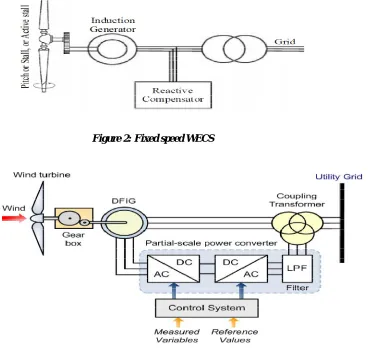
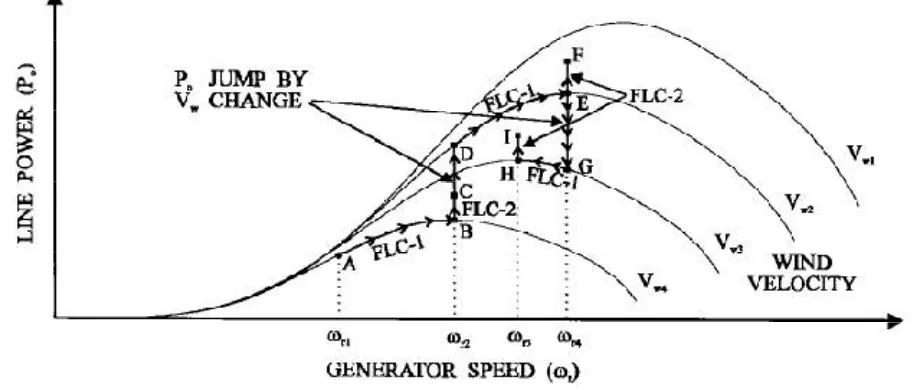
Wind turbines can be distinguished namely constant speed and variable speed turbines [2]. The induction generator is widely used in both the operation schemes, for a constant speed wind turbine system show in fig 1.2. The generator is connected to the grid directly, and the rotor speed of the generator is decided by the grid frequency. The variable speed wind turbine system allows the variation of the turbine speed and generator speed, variable speed wind turbine figure 1.3, power generation system to achieve a maximum total electric power. A variable speed wind turbine has a pitch regulation mechanism that involves turning the blades about their axes to regulate the power extracted by the rotor [3].
Figure 2: Fixed speed WECS
ISSN (Print) : 2320 – 3765 ISSN (Online): 2278 – 8875
I
nternational
J
ournal of
A
dvanced
R
esearch in
E
lectrical,
E
lectronics and
I
nstrumentation
E
ngineering
(An ISO 3297: 2007 Certified Organization)
Vol. 5, Issue 3, March 2016
Integration of wind power into the grid generally affects its power quality. The components of power quality affected by wind turbine like voltage variation due to changes in wind speed, harmonic rise because of voltage fluctuations, flickering and generation of sub harmonics associated with the pulsating torque of the induction generator [1]. In the earlier technology WT are directly disconnect as any kind of disturbance Aries on the grid, but now a day WT has necessitated fault ride through capability whereby a turbine is expected to support the grid. This paper propose a few control algorithm can provide fully optimization and power efficient methods in case of variable speed wind generation system, so it is very help full for those people who have interest in the field of wind energy system.
II. EFFECTIVE PARAMETERS
Induction generators now a day commonly use in variable wind speed scheme, as self excited induction generator has variable voltage and frequency source that’s the main reason AC-DC-AC link scheme interface with grid. It is playing very important role to maintain a power factor with the help of controller [5]. Voltage and frequency in generator vary due to following parameters.
1. Wind speed. 2. Rotor flux. 3. Generator speed.
With the design of fuzzy logic controller WT gets properly firing the rectifier and inverter, so extraction of maximum power from WECS can be achieve. The wind generators have sometimes produced oscillatory output power due to fluctuation caused by the tower shadow and disturbing effect of wind, hence result flicker cause in power quality which can result in spoiling of sensitive equipment. The performance of WT, such as tower shadow, wind velocity, turbine inertial these are the parameters which is use full for improvement of power quality, can be done with logical controller.
III.IMPROVEMENT TECHNIQUE
a. Wind speed controller
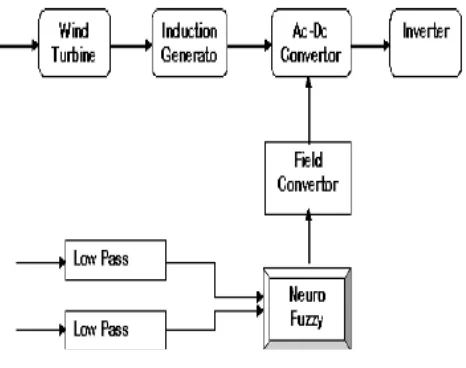
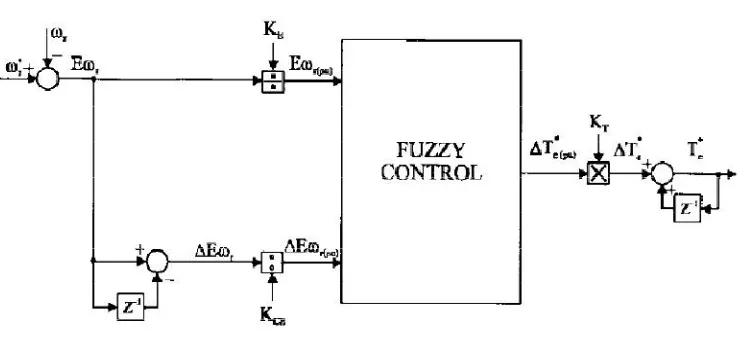
In the self excited induction generator have variation in parameter depend on wind speed, this means that, as wind speed changes, the generator speed has to track for maximum aerodynamic efficiency. This control function done by fuzzy controller, since wind speed is unknown parameter fuzzy logic search technique is use full for optimum point, accordingly increment or decrement in output power estimated. Figure indicates operation of fuzzy controller in which different-different wind velocity corresponding rated maximum power points [5].
ISSN (Print) : 2320 – 3765 ISSN (Online): 2278 – 8875
I
nternational
J
ournal of
A
dvanced
R
esearch in
E
lectrical,
E
lectronics and
I
nstrumentation
E
ngineering
(An ISO 3297: 2007 Certified Organization)
Vol. 5, Issue 3, March 2016
For controlling maximum power point tracking requires the knowledge of system specifications and mechanical sensors such as anemometer. For improving maximum power point without requiring wind speed measurement and knowledge system specifications of turbine methods are such as power signal feedback (PSF) and perturbation and observation (P&O) or hill climbing searching (HCS) measurement method has been used for maximum power point tracking in wind energy conversion system. For determination of variable pitch tracking control method based on fuzzy controller has the same reason of perturbation and observation method that uses changes of duty cycle in converter for maximum power point tracking [6].
A hybrid control technique is proposed for tracking the maximum power generation system. The hybrid technique for implementation of controller is based uses PSO algorithm along with Recurrent Neural Network is placed within the PWM inverter controller. The PSO algorithm is used for calculating the DC link reference voltage. The control signal is generated from the RNN technique are given to the inputs of the current controller which generates the controlling pulses. By using the current control law, the load current reference can adjust. So operating point of the power curve, which is based on the DC link voltage and current is provides low errors of power coefficient, DC link voltage and tip speed ratio with a high percentage of average power [7].
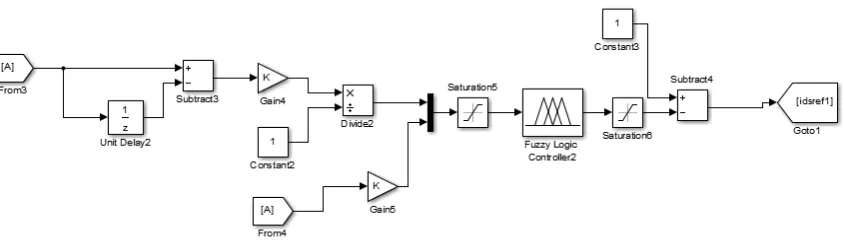
For maximum power delivery to the grid from available wind power, Neuro fuzzy controller makes the wind turbine speed to be tuned fine until it gets the error free output which the user need. For maximum power optimization, the variation of the wind speed is controlled by the pitch angle of the wind turbine. Neuro-Fuzzy control with back propagation learning algorithm well suited for searching the optimum speed at which the turbine should operate under varying wind conditions [8].
Figure 5: Neuro Fuzzy Controller
b. Fuzzy controller for generator flux.
ISSN (Print) : 2320 – 3765 ISSN (Online): 2278 – 8875
I
nternational
J
ournal of
A
dvanced
R
esearch in
E
lectrical,
E
lectronics and
I
nstrumentation
E
ngineering
(An ISO 3297: 2007 Certified Organization)
Vol. 5, Issue 3, March 2016
Figure 6: Generator flux programming controller
In order to achieve high dynamic control of active and reactive power, the active and reactive power states and stator flux position are used to determine which voltage vector is applied. The active and reactive power is calculated and the stator flux is then estimated. The rotor speed/position is measured and is used to transform the stator flux from the α–β
frame to the rotor – frame [9].
c. Fuzzy controller for robust generator speed.
Wind energy is transformed into mechanical power through wind turbines and hence it is converted into electrical power. The mechanical power is calculated by using the following equation force experienced.
F=0.5ρAV (1)
Rotor torque equation is given by
T=0.5ρAV R (2)
R=rotor radius, ρ is the air density, A is the area swept out by turbine blades, V is the wind speed (m/s), Cp is the power coefficient, which depends on two factors, the blade pitch angle βand the tip speed ratio and, λ.
The connection between the mechanical power and the wind speed passing through the turbine rotor can be given by the equation
= 0.5 × (3)
Where is the mechanical output power, 0.5 is the power contained in wind turbine
[10 11]. Generator
speed loop Fuzzy controller can provide robust performance against turbine oscillatory torque.
Turbulence associates with wind velocity and some of the other factors like wind vertex, and
pulsating torque, e
limination done with the generator speed loop controller [5, 12]. Figure 7 generally a PI controlISSN (Print) : 2320 – 3765 ISSN (Online): 2278 – 8875
I
nternational
J
ournal of
A
dvanced
R
esearch in
E
lectrical,
E
lectronics and
I
nstrumentation
E
ngineering
(An ISO 3297: 2007 Certified Organization)
Vol. 5, Issue 3, March 2016
Figure 7: Generator speed loop controller
Since a wind turbine not available in laboratory, it was simulated in real time in the DSP by solving
following turbine model equation [5]. In a WT model with wind velocity and generator speed
turbine torque can be calculated with the equation (4)
= + (4)
= turbine torque. Tm = mechanical torque.
Tosc = turbine steady state oscillatory torque.
Where
= ( ). (0.5. ) (5)
= ( cos + cos 2 + cos 4 (6)
= ,
A, B, C are the constant coefficient.
IV. FUZZY AND ANFIS LOGIC i. Fuzzy logic
ISSN (Print) : 2320 – 3765 ISSN (Online): 2278 – 8875
I
nternational
J
ournal of
A
dvanced
R
esearch in
E
lectrical,
E
lectronics and
I
nstrumentation
E
ngineering
(An ISO 3297: 2007 Certified Organization)
Vol. 5, Issue 3, March 2016
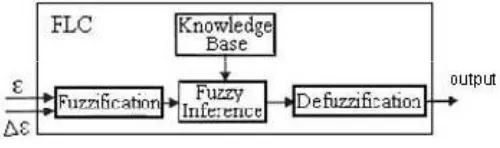
The fuzzy controller is characterized as follows:
1. Seven fuzzy sets for each input and output;
2. Fuzzification using continuous universe of discourse; 3. Implication using Mamdani's ‘min’ operator; 4. De-fuzzification using the ‘centroid’ method.
1. Fuzzification: The process of converting a numeric variable (real number) convert to a linguistic variable (fuzzy number) is called fuzzification.
2. De-fuzzification: The rules of FLC generate required output in a linguistic variable (Fuzzy Number), according to real world requirements, linguistic variables have to be transformed to crisp output (Real number).
3. Database: The Database stores the definition of the membership Function required by fuzzifier and defuzzifier.
4. Rule Base: The elements of this rule base table are determined based on the theory that in the transient state, large errors need coarse control, which requires coarse input/output variables; in the steady state, small errors need fine control, which requires fine input/output variables. Based on this the elements of the rule table are obtained as shown in fig 8.
Figure 8: Basic representation of FLC
ii. Adaptive Neuro-fuzzy inference system (ANFIS)
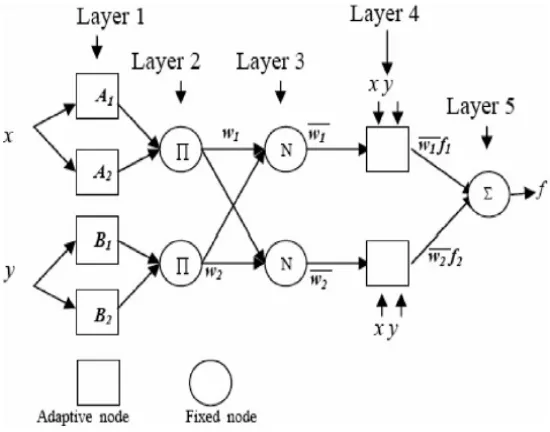
ANFIS is a simply a fuzzy inference system, prepare with the help of a neural network algorithm. ANFIS is a hybrid of two intelligent system models. It is a combination of the low level computational power of a neural network with the highest level reasoning ability of a fuzzy inference system. An adaptive neural network has, the more advantages like excellence, learning ability, good optimization and greater balancing capability. However a Fuzzy Control is one kind of Intelligent Control which is based on rules that these rules are constructed with the knowledge of experts. Fuzzy Control is one kind of artificial intelligence system and it doesn’t need an accurate, dynamic model, but control rule uses to collect control decision table, then comes up with outputs [13 16]. ANFIS serve as a basis for constructing a set of fuzzy if-then rules, with appropriate membership functions to generate the stipulated input-output pairs. ANFIS has the ability to divide the data into groups and adapt these groups to arrange a best membership function that is clustering the data and deducing the output desired with minimum epochs. With the help of given input/output data set, ANFIS constructs a fuzzy inference system whose membership function parameters are adjusted using either a backpropagation algorithm, or in combination of backpropagation with an at least square type of method [15].
Architecture and basic learning
• An adaptive network is a multi-layer feed forward network in which each node performs a particular function on the incoming signals.
• The nature and the choice of the node function depend on the overall input-output function. • No weights are associated with links and the links just indicate the flow.
ISSN (Print) : 2320 – 3765 ISSN (Online): 2278 – 8875
I
nternational
J
ournal of
A
dvanced
R
esearch in
E
lectrical,
E
lectronics and
I
nstrumentation
E
ngineering
(An ISO 3297: 2007 Certified Organization)
Vol. 5, Issue 3, March 2016
Figure 9: ANFS Architecture
V. COMPARATIVE PARAMETERS
To make logical controller a comparison between different-different techniques provided in the table form given below.
Table 1 comparative parameters
Parameters PI controller Fuzzy PI Fuzzy PID PSO-RNN
Generator type DFIG PMSG DFIG PMSG Wind velocity
(m/sec)
6-9 7-22 6-12 12-20 Generator speed
(rpm)
1200 9720 1800 1440 Rated power
(K watt)
0.5 4900 1495 1750
VI. DISCUSSION AND CONCLUSION
ISSN (Print) : 2320 – 3765 ISSN (Online): 2278 – 8875
I
nternational
J
ournal of
A
dvanced
R
esearch in
E
lectrical,
E
lectronics and
I
nstrumentation
E
ngineering
(An ISO 3297: 2007 Certified Organization)
Vol. 5, Issue 3, March 2016
REFERENCES
1. T.R. Ayodele & A.S.O. Ogunjuyigbe, “Wind energy resource, wind energy conversion system modelling and integration,” International Journal of Sustainable Energy vol. 34 No. 10 Article ID 855778, pages 657–671, 14 NOV 2013.
2. Luis Arturo Soriano, Sjoerd W.H. de Haan, R. Dubois, Johannes G. Slootweg, “Modeling and Control of Wind Turbine,” Hindawi Publishing Corporation Mathematical Problems in Engineering Volume 2013, pages 13, June 2013.
3. Ali Oudah, Izzeldin I. Mohd & A. Hameed “Wind Turbines Control: Features and Trends,” Modern Applied Science Vol. 8, No. 6; 2014) ISSN 1913-1844, Nov 2014.
4. Sanjeev K Nayak and D N Gaonkar., “performance of fuzzy logic based micro turbine generation system connected to grid/islanded mode” International Journal of Fuzzy Logic Systems (IJFLS) Vol.2, No.3, July 2012.
5. Marcelo Godoy Simoes, Bimal K. Bose, Ronald J. Spiegel, “Design and Performance Evaluation of a Fuzzy-Logic-Based Variable Speed Wind Generation System,” IEEE TRANSACTIONS on industry applications, vol. 33, no. 4, july/august 1997.
6. M. Mahdavian, N. Wattanapongsakorn, G. Shahgholian, S. H. Mozafarpoor, M. Janghorbani, S. M. Shariatmadar “Maximum Power Point Tracking in Wind Energy Conversion Systems Using Tracking Control System Based on Fuzzy Controller” ECTI-CON Nakhon Ratchasima IEEE conference page 1-5 , June 2014
7. S. Vijayalakshmi, V. Ganapathy, K. Vijayakumar and S. S. Dash, ” Maximum Power Point Tracking for Wind Power Generation System at Variable Wind Speed using a Hybrid Technique” International Journal of Control and Automation Vol. 8, No. 7 pages 357-372, 2015. 8. I. ARUL, DR.M. Karthikeyan, DR.N. Krishnan, M. Maniraj , “Extracting Maximum Power Optimization in Wind Turbine Using Neuro
fuzzy Logic Control.,” IOSR Journal of Electrical and Electronics Engineering (IOSRJEEE) ISSN: 2278-1676 Volume 1, Issue 6 PP 29-34, July-Aug. 2012.
9. Lie Xu and Phillip Cartwright, “Direct Active and Reactive Power Control of DFIG for Wind Energy Generation” IEEE Transactions On Energy conversion, VOL. 21, NO. 3, September 2006.
10. A. Ellis, R. Nelson, E. Von Engeln, R. Walling, J. MacDowell, L. Casey, E. Seymour, W. Peter, C. Barker, B. Kirby, J. R. Williams, “Reactive power performance requirements for wind and solar plants” power and energy society general meeting IEEE San Diego CA Vol. 1, pages 1-8 July – 2012.
11. Henk Polinder, Sjoerd W.H. de Haan, Maxime R. Dubois, Johannes G. Slootweg, “Basic Operation Principles and Electrical Conversion Systems of Wind Turbines,” EPE Journal volume 15-4, October - December 2005
12. M.Kranthi Kumar Reddy, Dr. G.Sreenivasulu “fuzzy logic control of variable speed induction machine wind generation system” ICCCCT IEEE International conference Ramanathapuram, pages 333-338, October 2010.
13. Rui Guo, Jinsong Du, Jinghui Wu, Yiyang Liu, “The Pitch Control Algorithm of Wind Turbine Based on Fuzzy Control and PID Control” scientific research Energy and Power Engineering journal Volume 5, pp. 6-10, May 2013.
14. K.Venkateswarlu, P.Lavanya and M.Rosaiah, “Fuzzy logic based power quality improvement of grid connected facts device on integration of wind energy system” International Journal of Recent Scientific Research Vol. 6, Issue, 8, pp.5638-5644, August, 2015. 15. A. Meharrar, M. Tioursi, M. Hatti, A. Boudghène Stambouli, “A variable speed wind generator maximum power tracking based on
adaptative neuro-fuzzy inference system” Elsevier Expert Systems with Applications Vol 38, issue 11 pp. 7659–7664, 6 June 2011. 16. Alireza Rezvani, Maziar Izadbakhsh, Majid Gandomkar “Enhancement of hybrid dynamic performance using ANFIS for fast varying
solar radiation and fuzzy logic controller in high speeds wind” journal of electrical system (2015) Vol. 11 issue 1, pp. 11-26 11 Jan 2015.
17. Azzouz TAMAARAT, Abdelhamid BENAKCHA, “Performance of PI controller for control of active and reactive power in DFIG
operating in a grid-connected variable speed wind energy conversion system” springer frontiers in Energy Vol. 8 issue 3, pp. 371-378,
September 2014.