Selection & Application of Lime Stabilizer for Soil Subgrade
Stabilization
Mr.Dipanjan Mukherjee
B.Tech West Bengal University of Technology, West Bengal,INDIA,
ABSTRACT
Lime can be used to treat soils to varying degrees, depending upon the objective of the stabilization for a specific project. The least amount of treatment is used to dry and temporarily modify soils (Sherwood, 1995). Such treatment produces a working platform for construction or temporary roads. The highest amount can be used when it is being used to improve the soil strength properties for supporting roads (Sherwood, 1995). Lime stabilization is a widely used means of chemically transforming unstable soils into structurally sound construction foundations. Lime stabilization enhances engineering properties in soils, including improved strength; improved resistance to fracture, fatigue, and permanent deformation; improved resilient properties, reduced swelling, and resistance to the damaging effects of moisture. The most substantial improvements in these properties are seen in moderately to highly plastic clays (Little, 2000). Lime has been found to react successfully with medium, moderately fine and fine grained soils causing a decrease in plasticity and swell potential of expansive soils, and an increase in their workability and strength properties. Research has proven that lime may be an effective stabilizer in soils with clay content as low as 7 percent and in soils with plasticity indices below 10. The National Lime Association recommends a plasticity index of 10 or greater in order for lime to be considered as a potential stabilizer whereas the U.S Army Corps of Engineers recommends a plasticity Index of 12 or greater for successful lime stabilization. Based on AASHTO classification, soil types A-4, A-5, A-6, A-7 and some of A-2-6 and A-2-7 are suitable for stabilization with lime. Hydrate lime (also called slaked lime) is used in combination with other admixtures, like fly ash & cement. These paper discuses about the advantages of lime stabilization of subgrade layer & make a simple computer programming to determine the most suitable admixture for lime stabilization. . A range of options are available for selecting soil stabilizers most of which are based on the soil classification following either the AASHTO or Unified classification system. A simple, but well accepted methodology by which to select the appropriate stabilizer is the Soil Stabilization Index System (SSIS). The methodology was developed by U.S Air Force, and is based on soil index properties: plasticity index and percent passing the no. 200 sieve.
1. KEY WORDS:-
2.INTRODUCTION
Lime provides an economical way of soil stabilization. Lime modification describes an increase in strength brought by cation exchange capacity rather than cementing effect brought by pozzolanic reaction (Sherwood, 1993). In soil modification, as clay particles flocculates, transforms natural plate like clays particles into needle like interlocking metalline structures. Clay soils turn drier and less susceptible to water content changes (Roger et al, 1993). Lime stabilization may refer to pozzolanic reaction in which pozzolana materials reacts with lime in presence of water to produce cementitious compounds (Sherwood, 1993, EuroSoilStab, 2002). The effect can be brought by either quicklime, CaO or hydrated lime, Ca (OH)R2R. Slurry lime also
can be used in dry soils conditions where water may be required to achieve effective compaction (Hicks, 2002). Quicklime is the most commonly used lime.
3.IMPORTANCE OF SOIL SUBGRADE STABILIZATION
.1 Subgrade
3.1.1 Definition
Subgrade can be defined as a compacted layer, generally of naturally occurring local soil, assumed to be 300 mm in thickness, just beneath the pavement crust, providing suitable foundation for the pavement. The subgrade in embankment is compacted in two layers, usually to a higher standard than the lower part of the embankment. The subgrade, whether in cutting or in embankment, should be well compacted to utilize its full strength and to economize on the overall pavement thickness. The current MORTH Specifications require that the subgrade should be compacted to 100% MDD achieved by the Modified Proctor Test (IS 2720-Part 7). For both major roads and rural roads the material used for subgrade construction should have a dry unit weight of not less than 16.5kN/m3.
3.1.2 Subgrade Soil
Soil is a gathering or deposit of earth material, derived naturally from the breakdown of rocks or decay of undergrowth that can be excavated readily with power equipment in the field or disintegrated by gentle reflex means in the laboratory. The supporting soil below pavement and its special under course is called sub grade. Without interruption soil beneath the pavement is called natural sub grade. Compacted sub grade is the soil compacted by inhibited movement of heavy compactors.
3.1.3 Desirable Property of Subgrade Soil
The advantageous properties of sub grade soil as a highway material are • Stability
• Incompressibility • Permanency of strength
• Minimum changes in volume and stability under adverse conditions of weather and ground water
• Superior drainage, and • Ease of compaction
3.2. SOIL STABILIZATION
4.ADVANTAGES OF LIME STABILIZATION
Lime has been used as a soil stabilizer for roads from olden days. Lime is produced from natural lime stone. The type of lime from is based upon the present material & production process. There are five types of lime,
High calcium quick lime CaO
Dolomite quick lime CaO + MgO Hydrate High Calcium lime Ca(OH)R2
Normal hydrate dolomite lime Ca(OH)R2R + MgO
Pressure hydrate dolomite lime Ca(OH)R2R + Mg(OH)R2
4.1The advantages of quicklime over hydrated lime (Rogers et al, 1996). - higher available free lime content per unit mass
- denser than hydrated lime (less storage space is required) and less dust
- generates heat which accelerate strength gain and large reduction in moisture content according to the reaction equation below
CaO + HR2RO = Ca(OH)R2R + Heat (65 KJ/mol)
Quicklime when mixed with wet soils, immediately takes up to 32% of its own weight of water from the surrounding soil to form hydrated lime; the generated heat accompanied by this reaction will further cause loss of water due to evaporation which in turn results into increased plastic limit of soil i.e. drying out and absorption (EuroSoilStab, 2002; Sherwood, 1993). The effect can be explained from Figure 1 for 6 soil at a moisture content of 35% and plastic limit 25%. Addition of 2% lime will change the plastic limit to 40% so that the moisture content of the soil will be 5% below plastic limit instead of 10% above plastic limit (Sherwood, 1993). Sherwood (1993) investigated the decrease in plasticity as brought about in first instance by cation exchange in which cations of sodium and hydrogen are replaced by calcium ions for which the clay mineral has a greater water affinity. Even in soils (e.g. calcareous soils) where, clay may be saturated with calcium ions, addition of lime will increase pH and hence increase the exchange capacity. Like cement, lime when reacts with wet clay minerals result into increased pH which favors solubility of siliceous and aluminous compounds. These compounds react with calcium to form calcium silica and calcium alumina hydrates, a cementitious product similar to those of cement paste. Natural pozzolanas materials containing silica and alumina (e.g. clay minerals, pulverized fly ash, PFA, blast furnace slag) have great potential to react with lime.
4.2 Construction procedure of lime stabilization
2. Pulverized the soil. 3. Spread the lime. 4. Mix lime with soil. 5. Add water up to omc. 6. Compact the mixture. 7. Shape the stabilized base.
8. Cure keep moist & allow the traffic free at least 5 days 9. Add wearing surface.
Procedures (Lime Stabilization)
1 2
3 4
7 8
9 10
11 12
1) Quick Lime is delivered and transferred to mixing (slaking tank ) 2) Lime Slurry is transferred to dispensing truck
3) Scarify Subgrade
4) Apply lime slurry to scarified subgrade 5) Mix slurry and soil to specified depth 6) Mix slurry and soil to specified depth 7) Lightly Compact
4. GUIDELINCES FOR SELECTION OF LIME STABILIZATION
Soil characteristics including mineralogy, gradation and physio-chemical properties of fine grained soils influence the soil-additive interaction. Hence stabilizer selection should be based on the effectiveness of a given stabilizer to improve the physio-chemical properties of the selected soil. The preliminary selection of the appropriate additive(s) for soil stabilization should consider:
• Soil consistency and gradation • Soil mineralogy and composition • Desired engineering properties • Purpose of treatment
• Mechanisms of stabilization
• Environmental conditions and engineering economics
. A range of options are available for selecting soil stabilizers most of which are based on the soil classification following either the AASHTO or Unified classification system. A simple, but well accepted methodology by which to select the appropriate stabilizer is the Soil Stabilization Index System (SSIS). The methodology was developed by U.S Air Force, and is based on soil index properties: plasticity index and percent passing the no. 200 sieve.
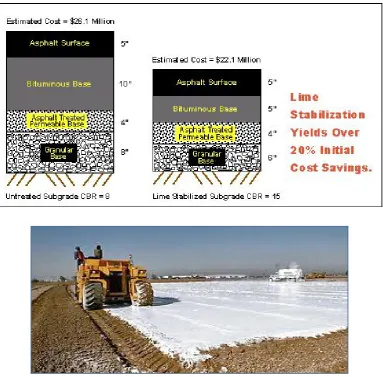
Figure 3 & 4 Lime Stabilization most common type subgrade stabilization
FLOW CHART FOR SELECTING LIME STABILIZER
NO NO NO
YES YES YES
Sieve Analysis ≥ 25% Passing No. 200
i
Determination of Atterberg Limits
Check
15 ≤ PI ≤ 35 Check
PI < 15
Check
PI ≥ 35
Cement Asphalt (PI< 6) Lime-Flyash (Class F)
Flyash (Class C)
Lime Lime - Cement Lime – Flyash (Class F)
Flyash (Class C) Cement
Lime Lime - Cement Lime-Flyash (Class F) Lime - Flyash (Class C)
Go for lime stabilization
END
5. COMPUTIONAL PROGRAMMING APPROACH FOR SELECTING
LIME STABILIZER
NO
YES
NO NO NO
YES YES YES
Check
15 ≤ PI ≤ 35 Check
PI < 15
Check
PI ≥ 35
Lime-Flyash (Class F) Lime
Lime - Cement Lime – Flyash (Class F)
Lime Lime - Cement Lime-Flyash (Class F) Lime - Flyash (Class C)
Go for lime stabilization
END
Chose other type of stabilizing material Check for
≥25% Passing No 200
Determination of
1.
CONCLUSION
Lime stabilizations technology is mostly widely used in geotechnical and environmental applications. Some of applications include encapsulation of contaminants, rendering of backfill (e.g. wet cohesive soil), highway capping, slope stabilization and foundation improvement such as in use of lime pile or lime-stabilized soil columns (Ingles and Metcalf, 1972). However, presence of sulphur and organic materials may inhibit the lime stabilization process. Sulphate (e.g. gypsum) will react with lime and swell, which may have effect on soil strength. A range of options are available for selecting soil stabilizers most of which are based on the soil classification following either the AASHTO or Unified classification system. A simple, but well accepted methodology by which to select the appropriate stabilizer is the Soil Stabilization Index System (SSIS). The methodology was developed by U.S Air Force, and is based on soil index properties: plasticity index and percent passing the no. 200 sieve. In this paper a simple computational flowchart is formed to determine admixture for lime stabilization based on the methodology based on particle size of subgrade layer which is developed by U.S Air force & shortly for lime stabilization discussed about construction procedure lime stabilization by help of figure.
2.
REFERANCES
• Chemical Stabilization of Subgrades -Section Engineers’ Meeting Lake Cumberland State Resort Park, March 5-7, 2013
• Guidelines for Modification and Stabilization of Soils and Base for Use in Pavement Structures ,Construction Division ,Materials & Pavements Section
Geotechnical, Soils & Aggregates Branch, September 2005
• SOIL STABILIZATION METHODS AND MATERIALS ,
IN ENGINEERING PRACTICE, Gregory Paul Makusa,
Department of Civil, Environmental and Natural resources engineering Division of Mining and Geotechnical Engineering
Luleå University of Technology Luleå, Sweden
• Guidelines for the Stabilization of Subgrade Soils in California,July 2010, David Jones Ashraf Rahim/Shadi Saadeh/John Harvey
• Evaluation of Subgrade Stabilization on Pavement Performance//Mark Morvant, P.E./Pavement & Geotechnical Research Administrator// Louisiana Transportation Research Center
• USING LIME FOR SOIL STABILIZATION AND MODIFICATION. A PROVEN
• LONG TERM BENEFITS OF STABILIZING SOIL SUBGRADE//KENTUCKY TRANSPORTATION CENTRE, COLLEGE OF ENGINEERING// RESEARCH REPORT- KTC-0219/SPR-196-99-1F.
• Recommended Practice for Stabilization of Subgrade Soils and Base
Materials//Dallas N. Little/Syam Nair//Texas Transportation Institute.Texas A&M University.College Station, Texas//Contractor’s Final Task Report for NCHRP Project 20-07,Submitted August 2009//National Cooperative Highway Research Program
• PAVEMENT TECHNOLOGY ADVISORY - SUBGRADE MODIFICATION AND