Available online: https://edupediapublications.org/journals/index.php/IJR/ P a g e | 1050
Productive
and
Unquestioning Data
Duplicate Detection Using
REVISE
Alluri Kranthi1, G Subrahmanyam 2
1PG Scholar, Dept of CSE, Sri Vatsavai Krishnamraju College Of Engineering And
Technology,Bheemavaram,AP.
2 Assistant Professor, Dept of CSE,Sri Vatsavai Krishnamraju College Of Engineering And
Technology,Bheemavaram,AP.
Abstract:Duplicate detection consists in detecting multiple types of representations of a same object, and every object represented in a database source. Duplicate detection is relevant data cleaning and data integration applications and has been studied extensively for relational data describing a single type of object in a single data table.New novel comparison strategy that uses graph model in terms of relationships proposed for hierarchical data. Insteadpairs of objects at any level of the hierarchy are compared in an order that depends on their relationships. We use stringer to evaluate the quality of the clusters obtained many unconstrained clustering algorithms used in concert with approximate join techniques.We present new novel iterative algorithm for duplicate detection system called REVISE. REVISE access to re-examining an object influencing neighbors turn out to be duplicates. The main aim of the project is to detect the duplicate in the structured data. Proposed system focus on a specific type of error namely fuzzy duplicates,The problem of detecting duplicate entities that describe the same real-world object is an important data cleansing task which is important to improve data quality.
Index Terms:record linkage, merge, object matching, XMLDup, Relational data, Pruning Scheme, Bayesian Network,
I.INTRODUCTION
Data mining depends on effective data collection and warehousing as well as computer processing. Most important property of a company is Data but when data change data errors such as duplicate detection occurs we want to make data cleaning for duplicate detection[ 1]. Duplicate detection model expensive due to pure size of dataset. We consider an object to depend different object if the latter helps finding duplicates of the first actors help find duplicates in movies, so movies depend
Available online: https://edupediapublications.org/journals/index.php/IJR/ P a g e | 1051 understanding what barriers remain towards
the goal of truly scalable and general purpose duplication detection algorithms [4]. Procedures developed for replicate detection in a lone relation is exactly request to XML facts and figures, due to the differences between the two facts and figures forms [5]. For examples of an identical object kind may have a different structure at the instance grade, inside relatives habitually have the identical structure [5].Recently new class of algorithms for duplicate detection is emerged. We take that class of algorithms as duplicate detection in graphs (DDG) algorithms [6]. These algorithms detect duplicates between representations of entities in a data source called candidates by using relationships we focus on those algorithms that iteratively detect duplicates when relationships form a graph [7].
Fig.1 Graph Representation
II.RELATED WORKS
We review the state of the art for replicate detection in hierarchical data which is the focus of consideration of related work, We mention readers to the publication by Naumman and Herschel [8].Many studios deal with hierarchical data we mostly find works focusing on the XML facts and figures form. The only exclusion is [9], which focuses on hierarchical benches in a facts and figures warehouse. The RCER
algorithm first introduced in [10] and further described and evaluated represents candidates and dependencies in a reference graph. The algorithm re-evaluates distances of candidate pairs at each iterative step and selects the closest pair according to the distance method Duplicates is merged together before the next iteration so effectively clusters of candidates are compared [11]. The DogmatiX structure aims at both effectiveness and effectiveness in replicate detection [12] . The structure consists: nominee delineation, replicates delineation, and replicate detection. while the first two supply the delineations essential for duplicate detection the third constituent encompasses the genuine algorithm, an elongation to XML data of the work of Ananthakrishna [13].The XMLDup system first suggested utilizes a Bayesian Network model (BN) for XML duplicate detection.
III.SYSTEM ARCHITECTURE:
Available online: https://edupediapublications.org/journals/index.php/IJR/ P a g e | 1052 nodes of the identical kind, as is the case for
the XML nodes marked ads. In this case, we desire to compare the full set of nodes, rather than of each node independently.
Fig 2.System Network Strategy
IV.PROPOSED SYSTEM
It is based on the estimated number of re-comparisons of neighboring elements that become necessary if the pair indeed were a duplicate [16]. An efficient and flexible detection scheme that supports both Progressive duplicate detection with map reduce and parallel duplicate detection. The proposed system is based on Map Reduce Algorithm. Progressive duplicate detection algorithms apply on selective input dataset (Cluster) that significantly increase the efficiency of finding duplicates if the execution time is limited. Duplicate detection is done on this phase [17] .PSNM detect duplicate records sequentially. So Execution Time is higher than PSNM.
Fig.3. Proposed System Architecture
Map Reduce Algorithm
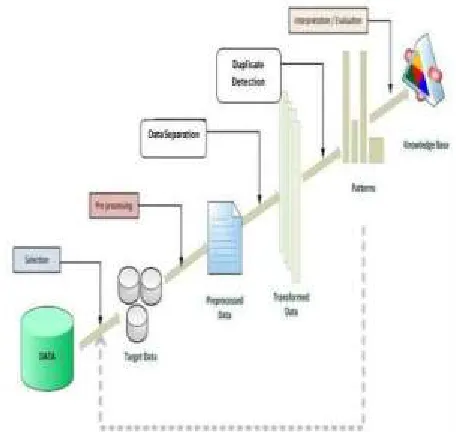
A. Training Dataset: In this Process user give the input data to the proposed system. Here training dataset loaded from company database or inserting from user.
B. Data Preprocessing:Data preprocessing is a data mining technique that involves transforming raw data into an understandable format [18].
C. Data Separation: In this process we separate the large amount of data large data cannot be fit in to main memory so it is divided into different parts each part is called as cluster.
D. Duplicate Detection: In this process we detect the duplicate records from cluster
Available online: https://edupediapublications.org/journals/index.php/IJR/ P a g e | 1053 F. MAPREDUCE: Map reduce algorithm
apply on selective input dataset(Cluster) that significantly increase the efficiency of finding duplicates if the execution time is limited than PSNM [19].
REVISE Algorithm:
REVISE Algorithm allows a pairwise comparison to be performed more than once, and the proposed comparison order reduces the number of re-comparisons [20]. It is based on the observation that detecting duplicates to an object may affect similarity and duplicate classification on other objects. It is an exact algorithm for solving the duplicate detection problem,The procedure update Open Revise (v, v’) first determines the set of dependent neighbor pairs of v and V’. Pairs in DUPS are not added back to OPEN, because they are already known to be duplicates. We distinguish two cases. In the first case the potentially added pair (n1, n2) is already in OPEN, because it has not been classified yet, and we merely update its position in the priority queue according to the newly calculated rank. This is required because the value of r(n1, n2) depends on duplicates among I(n1) and I(n2), and the neighbor pair (v, v’) has just been classified as duplicate. In case (n1, n2) is neither in OPEN, nor in DUPS, (n1, n2) is pushed into OPEN [21].
REVISE Algorithm:
1. G← data graph;
2. OPEN priority queue of candidate pairs ordered in ascending order of r;
3. DUPS←set of duplicate pairs;
4. CLOSED← set of possibly re-classified pairs;
5. θ← similarity threshold; 6. Initialize G;
7. Add all candidate pairs to OPEN; 8. while OPEN not empty do 9. (ci, cj)← OPEN.popFirst (); 10.sim ← sim(ci, cj);
11. if sim> θ then
12. DUPS ← DUPS ∪ {(ci, cj)}; 13.updateOpenRevise(ci,cj );
Updating Open in REVISE:
1. Input : Candidate c, candidates c′ 2. D(v, v′) = {(n1, n2) |n1 ∈ D(c) ∧ n2 ∈
D(c′) ∧ n1 6= n2};
3. foreach (n1, n2) ∈ D(c, c′) do 4. if (n1, n2) not ∈ DUPS then 5. rupdate := r(n1, n2);
6. if (n1, n2) ∈ OPEN then
7. OPEN.updateRank ((n1,n2),rupdate); 8. else if (n1, n2) ∈ CLOSED then 9. OPEN.push ((n1, n2),rupdate);
We observe that for large values of i, the number of re-comparisons is generally low but increases with increasing connection degree, meaning with decreasing i (as more get actors) and increasing apm [22].
Star Clustering Algorithm
Available online: https://edupediapublications.org/journals/index.php/IJR/ P a g e | 1054 1. Let each vertex in G be initially
unmarked.
2. Calculate the degree of each vertex u ∈
U.
3. Let the highest degree unmarked vertex be a star center, and construct a cluster from the center and its associated vertices. Mark each node in the newly constructed star.
4. Repeat step c until all the nodes are marked.
V.RESULT ANALYSIS
Progressive Sorted Neighborhood Method used for Detecting Duplicate Records in minimum amount of time as compare with simple Sorted Neighborhood Method. The main drawback of PSNM is Time Complexity Because it detecting duplicate records serially. The performance evaluation of the proposed PPSNM Method is based on certain performance metrics.
Fig.4 Comparison between REVISE & Map Reduce
VI.CONCLUSION
New novel duplicate detection approach for XML data is common top-down and bottom-up approaches, performs well comparison strategy we presented considers pair wise comparisons in ascending order of a rank. REVISE, given a high interdependency between entities. For low interdependency there are only few possible re-comparisons, so the difference between the orders is not significant for efficiency.We show that this quality is poor even when compared to other clustering algorithms that are as efficient. PPSNM and its utilization for duplicate record detection, and duplicate record deletion. On one hand, the extraction of PPSNM is faster than PSNM due to the Map Reduce concept. On the other hand, the improvement in detection effectiveness is consistently observed in two applications Future implementation is to develop the on different structures and complex hierarchical structures usng machine level language.
VII.REFERENCES
[1] E. Rahm and H. H. Do, “Data cleaning: Problems and current approaches,” IEEE Data Engineering Bulletin, vol. 23, pp. 3– 13, 2000.
[2] A. Doan, Y. Lu, Y. Lee, and J. Han. Object matching for information integration: A profiler-based approach. IEEE Intelligent Systems, pages 54-59, 2003.
[3] X. Dong, A. Halevy, and J. Madhavan.Reference reconciliation in complex information spaces.In International Conference on the Management of Data (SIGMOD), Baltimore, MD, 2005.
Available online: https://edupediapublications.org/journals/index.php/IJR/ P a g e | 1055 Graph.”ACMTrans.Database Systems, vol.
31, no. 2, pp. 716-767, 2006.
[5] M. Weis and F. Naumann, “Dogmatix Tracks Down Duplicates in XML,” Proc. ACM SIGMOD Conf. Management of Data, pp. 431- 442, 2005.
[6] I. Bhattachary, L. Getoor, and L. Licamele. Query-time entity resolution.In Conference on Knowledge Discovery and Data Mining (KDD), Philadelphia, PA, 2006.Poster.
[7] I. Bhattacharya and L. Getoor. Iterative record linkage for cleaning and integration.SIGMOD Workshop on Research Issues on Data Mining and Knowledge Discovery (DMKD), 2004.
[8] F. Naumann and M. Herschel, An Introduction to Duplicate Detection. Morgan and Claypool, 2010
[9] R. Ananthakrishna, S. Chaudhuri, and V. Ganti, “Eliminating Fuzzy Duplicates in Data Warehouses,” Proc. Conf. Very LargeDatabases (VLDB), pp. 586-597, 2002.
[10] I. Bhattacharya and L. Getoor. Iterative record linkage for cleaning and integration.SIGMOD Workshop on Research Issues on Data Mining and Knowledge Discovery (DMKD), 2004.
[11] I. Bhattacharya and L. Getoor. Entity resolution in graph data.Technical Report CS-TR- 4758, University of Maryland, 2006.
[12] R. Ananthakrishna, S. Chaudhuri, and V. Ganti, “Eliminating Fuzzy Duplicates in Data Warehouses,” Proc. Conf. Very
LargeDatabases (VLDB), pp. 586-597, 2002.
[13] D.V. Kalashnikov and S. Mehrotra, “Domain-Independent Data Cleaning via Analysis of Entity-Relationship Graph.”ACMTrans.Database Systems, vol. 31, no. 2, pp. 716-767, 2006.
[14] M. Weis and F. Naumann, “Dogmatix Tracks Down Duplicates in XML,” Proc. ACM SIGMOD Conf. Management of Data, pp. 431- 442, 2005
[15] D. Milano, M. Scannapieco, and T. Catarci, “Structure Aware XML Object Identification,” Proc. VLDB Workshop Clean Databases, 2006
[16] P. Calado, M. Herschel, and L. Leita˜o, “An Overview of XML Duplicate Detection Algorithms,” Soft Computing in XML DataManagement, Studies in Fuzziness and Soft Computing, vol. 255, pp. 193-224, 2010.
[17] U.Draisbach, F.Naumann, S.Szott, and O. Wonneberg, “Adaptive windows for duplicate detection,” in Proceedings of the International Conference on Data Engineering (ICDE), 2012.
[18] U.Draisbach and F. Naumann, “A generalization of blocking and windowing algorithms for duplicate detection.” in International Conference on Data and Knowledge Engineering (ICDKE), 2011.
[19] L. Kolb, A. Thor, and E. Rahm,
“Parallel sorted
Available online: https://edupediapublications.org/journals/index.php/IJR/ P a g e | 1056 [20] H. Galhardas, D. Florescu, D. Shasha,
E. Simon, and C. Saita. Declarative data cleaning: Language, model, and algorithms. In International Conference on Very Large Databases (VLDB), pages 371–380, Rome, Italy, 2001.
[21] E. Rahm and H. H. Do. Data cleaning: Problems and current approaches. IEEE Data Engineering Bulletin, Volume 23, pages 3-13, 2000.
[22] I. Bhattachary, L. Getoor, and L. Licamele. Query-time entity resolution.In Conference on Knowledge Discovery and Data Mining (KDD), Philadelphia, PA, 2006. Poster
[23] M. Filippone, F. Camastra, F. Masulli, and S. Rovetta.A Survey of Kernel and Spectral Methods for Clustering. Pattern Recognition, 41(1):176–190, 2008
Guide Details:
G SUBRAHMANYAM M.TECH ASST.PROF in CSE DEPARTMENT
SRI VATSAVAI KRISHNAMRAJU COLLEGE OF ENGINEERING AND TECHNOLOGY
,Bheemavaram,AP
EMAILID:[email protected]
Student Details:
ALLURI KRANTHI is Studying M.Tech (CSE) in SRI VATSAVAI KRISHNAMRAJU COLLEGE OF ENGINEERING AND TECHNOLOGY,
Bheemavaram,AP