Copyright 0 1989 by the Genetics Society of America
Two Genetic Elements Regulate Murine @-Glucuronidase Synthesis
Following Transcript Accumulation
Cynthia
J.
Wawrzyniak, SusanA.
Meredith and RogerE.
GanschowDivision of Basic Science Research, Children's Hospital Research Foundation, Cincinnati, Ohio 45229 Manuscript received July 13, 1988
Accepted for publication September 10, 1988
ABSTRACT
Mutant alleles of two genetic regulatory elements, which underlie a three- to sixfold reduction in /3-glucuronidase (GUS) activity levels, distinguish mice of the H haplotype from those of the other two common GUS haplotypes, A and B. Both elements are tightly linked to the GUS structural gene over which they exert control. One (Gus-u) exerts a cis-active effect upon GUS activity levels in all tissues at all times while the other (Gus-t) regulates GUS activity in trans after the 12th postnatal day in certain tissues. While previous studies show that differences in the rate of GUS synthesis account
for the combined effects of these two elements in liver of adult mice, we demonstrate the separate effects of each on GUS synthesis at times during early postnatal development when their individual expressions can be distinguished. Assessments of the relative levels of S1 nuclease protection of a
radiolabeled GUS antisense RNA probe after hybridization with total liver RNA preparations from adult mice of A and H haplotypes reveal no differences. These results argue that Gus-u and Gus-t exert their control of GUS expression subsequent to the accumulation of processed GUS transcripts.
G
ENETIC variations in &glucuronidase (GUS)expression among inbred strains of laboratory mice provide a useful model system for the study of mammalian gene regulation. Natural variants of the hormonal, developmental and systemic regulation of
GUS are associated with specific alleles of the GUS
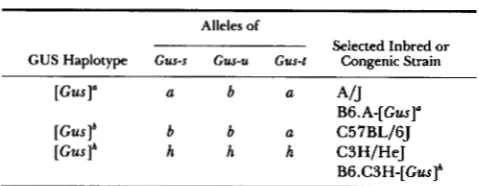
structural gene, Gus-s, and, together, define several haplotypes of the GUS gene complex, [Gus] [for a review of the genetics of murine GUS, see PAIGEN (1 979); for definitions of common GUS haplotypes, see Table 11.
A well-characterized example of this variation is found in adult mice of the [Gus]" haplotype which are distinguished from mice of the other two common haplotypes, [Gus]" and [ G u s ] ~ , by lower tissue levels of
GUS activity (LAW, MORROW and GREENSPAN 1952; PAIGEN 1961a). This reduced level of GUS activity reflects changes in both a systemic and a develop- mental component of GUS expression (PAIGEN 196 1 a; LUSIS et al. 1983; WUDL and CHAPMAN 1976). Prior to the 12th postnatal day, all tissues of [Gus]" mice exhibit a three-fold lower level of GUS activity than those of [Gus]" and [GusIb mice. Thereafter, GUS
activity levels are reduced an additional three- to fourfold in liver, such that in adult [Gus]" mice the total reduction is six- to sevenfold (PAIGEN 1961a; LUSIS et al., 1983; PFISTER et al. 1985).
Each of the two components of the reduced tissue levels of GUS activity in [GusIh mice is controlled by a separate genetic element tightly linked to the GUS
structural gene, Gus-s (PAIGEN 1961b; LUSIS et al.
1983). A cis-active systemic regulator, designated Gus-
Genetics 121: 119-124 (January, 1989)
u, uniformly regulates GUS levels in all tissues throughout development, while a trans-acting devel- opmental regulator, designated Gus-t, controls the postnatal accumulation of GUS activity in certain tis- sues at characteristic stages in development. To our knowledge, Gus-t is the only example of a trans-active cellular element which is tightly linked to the gene over which it exerts control. Alleles of Gus-u and Gus- t serve to partially define the common GUS haplo- types. Mice of the [Gus]" haplotype, which exhibit the reduced tissue levels of GUS activity, are Gus-u"/" and Gus-th"' while mice of the [Gus]" and [GusIb haplotypes are Gus-ubfb and Gus-@'.
Previous studies demonstrated that the reduced levels of liver GUS in adult mice of the [Gus]" haplo- type are directly related to reduced rates of GUS
synthesis (GANSCHOW 1975; LUSIS et al. 1983). In the study reported here, analyses of GUS synthetic rates during the developmental period when the effects of Gus-u and Gus-t can be separated reveals that each element exerts its effect by altering the rate of GUS
synthesis. Our results further demonstrate that the genetically altered synthetic rates are not the result of changes in either the transcription of Gus-s or the processing of GUS transcripts since adult levels of processed GUS transcripts are indistinguishable be- tween [Gus]" and [Gus]" mice.
MATERIALS AND METHODS
Allelic definitions of the three common &glucuronidase haplotypes and associated strains utilized in the present study"
Alleles of
GUS Haplotype Gus-s Gw-u Gus-t Congenic Strain
Selected Inbred or
[ c u s r a b a A/J
[ G U S ] * b b a C57BL/6J
[GUS]* h h h C3H/HeJ
BG.A-[Gw]"
B6.C3H-[Gwlh
Information in this table is summarized from PAICEN (1979) and from LUSH et al. (1983).
Harbor, ME). The congenic inbred strains B6.A-[Gusl0, B6.C3H-[GusIh, and (BG.A-[Gus]" X B6.C3H-[GusIh)F1 were obtained from Verne Chapman (Roswell Park Memorial Institute, Buffalo, New York). All adult mice were females of 60-90 days of age.
GUS activity assay: GUS activity was assayed by the procedure of MEISLER and PAICEN (1972) using p-nitro- phenyl-@-D-glucuronide (Cyclo Chemical Co.) as substrate. One unit of enzyme activity is defined as that amount of enzyme which releases 1 pmol of p-nitrophenol per hour at 56".
Relative rate of GUS synthesis: Rates of GUS synthesis were determined according to the method of SMITH and GANSCHQW (1 978) which measures the radioactivity present in immunoprecipitates of liver GUS at 2 hr after intraperi- toneal administration of 20-200 pCi of ~-[3,4-~H]leucine (specific radioactivity 30-60 Ci/mmol; Amersham/Searle) as a fraction of the radioactivity incorporated into total trichloroacetic acid-insoluble material. Administered
amounts of radioactivity varied as a function of the age of the mice. Mice were sacrificed in groups of three to 15 mice, depending upon age, and partially purified extracts were prepared from pooled livers of each group according to the method of SMITH and GANSCHOW (1978). Before purifica- tion, a portion of homogenate was reserved for assay of enzyme activity (see above) and for estimation of radioactiv- ity incorporated into total trichloroacetic acid-insoluble ma- terial. Partially purified extracts contained greater than 90% of the original GUS activity.
A quantity of monospecific goat anti-GUS antibody, pre- pared and characterized as described by SMITH and GAN- SCHOW (1978), was added to the final tissue extract in amounts sufficient to precipitate all of the GUS activity. The resulting immunoprecipitates were solubilized, the components separated electrophoretically according to the method of WEBER and OSBORN (1 969), and the GUS radio- activity in the gel determined by liquid scintillation spec- trometry of 2 mm gel slices as described by SMITH and GANSCHOW (1978).
RNA preparation: Total RNA was prepared by homog- enization of fresh mouse liver or kidney in guanidinium isothiocyanate followed by centrifugation through a cesium chloride cushion (CHIRCWIN et al. 1979). The RNA pellet was suspended in diethyl pyrocarbonate-treated water, and the RNA concentration determined by optical density meas- urements at 260 nm. RNA was stored at -70".
Production of complementary RNA probes (cRNA): A
1.5-kb GUS cDNA (PALMER et al. 1983), representing Gus-
s coding sequence from exon 4 through a portion of exon 12 (GALLAGHER et al. 1988; D'AMORE et al. 1988), was subcloned into a Bluescript vector (Stratagene) between the
PstI and Hind111 sites. The insert was oriented such that
transcription from the T7 RNA polymerase promoter yielded a "P-UTP labeled transcript complementary to the corresponding region of cellular GUS mRNA. Separation of the antisense RNA probe (cRNA) from the template was accomplished by agarose gel electrophoresis. The probe was purified from the gel and the specific activity determined. A 1.1-kb y-actin cDNA (GUNNING et al. 1983) was subcloned in a similar manner at the PstI and XbaI sites of Bluescript to generate a y-actin cRNA for use as an internal control.
Hybridization, SI nuclease treatment and hybrid analy- sis: The procedure by QUARLESS and HEINRICH (1 986) was modified as follows: 100 pg of total liver or kidney RNA was precipitated with ethanol and the RNA pellet resus- pended in formamide hybridization buffer (80% formam- ide, 0.4 M NaCI, 1 mM EDTA and 40 mM MOPS pH 7.0). Approximately 1-5 X lo5 cpm of each cRNA probe was added, and the volume adjusted to 20 pl, onto which 50 pl of mineral oil was layered. The sample was heated at 85" for 15 min to denature the RNA and then incubated at 65" for 3 hr to permit probe/RNA hybridization. Hybridization was followed by treatment with 400 units S 1 nuclease (Boeh- ringer Mannheim) at 37 " for 1 hr to degrade single-stranded nucleic acids. Following digestion, the reaction was ex- tracted with phenol/chloroform (1 : 1 v/v) and ethanol pre- cipitated.
Following precipitation, the pellet was resuspended in 30
pl of 10 mM Tris, 1 mM EDTA (pH 8.0). To assay for hybrid molecules, the samples were electrophoresed at 175 V on a 5% native polyacrylamide gel. The gel was dried and auto- radiography performed at -70" with an intensifying screen.
RESULTS
The differing patterns of accumulation of liver GUS
activity between mice of the [Gus]" and [Gus]* haplo- types and their F1 progeny, shown in Fig. l A , confirm the previous results of PAICEN (1961a) and of LUSIS
and co-workers (1983). The three-fold difference in liver activity levels shortly after birth represents the effect of the &active Gus-u element while the sharp decline beginning at approximately day 12 in [Gus]" mice and culminating in an additional three-to-four- fold difference in adult activity levels represents the effect of the trans-active element, Gus-t (LUSIS et al. 1983).
While previous studies demonstrate that the differ- ence in adult activity levels between the haplotypes is related to a reduction in the rates of GUS synthesis
(GANSCHOW 1975; LUSIS et al. 1983), analyses of the mechanisms by which Gus-u and Gus-t exert their effects requires examination of GUS synthesis at times when the effects of these elements can be separated. Since the effects of Gus-t are not observed until 10- 1 5 days postpartum whereas Gus-u is expressed a t all times in all tissues (LUSIS et al. 1983), we compared
GUS activity levels (Figure 1A) with GUS synthetic rates (Figure 1B) in liver during postnatal develop- ment for [GusIb and [GusIh mice and for their F1 progeny. It can be seen that the relative pattern of
Murine j3-Glucuronidase 121
30
r
-
-
-
-
-
I I I I I
0 5 IO 15 20 25 ” 80
DAYS
FIGURE 1.-Comparison of activity levels and relative rates of synthesis of liver GUS among mice of the [Gus]* and [CUS]~ haplo- types and their FI progeny during postnatal development. Activity levels and relative rates of synthesis were determined as described in M A T E R w s AND METHODS and are plotted as the mean values of at least three pools of livers +. SEM. Closed circles represent values for mice of the [Gus]* haplotype (C57BL/6J strain), open circles those for [CusIh haplotype (C3H/HeJ strain) mice, and triangles those for C57BL/6J-[GusJb X C3H/HeJ-[CusIh FI mice.
trol over the expression of Gus-s by regulating the rates of GUS synthesis.
T o determine whether Gus-u and Gus-t regulate GUS synthesis by altering levels of GUS transcripts, we assessed the extent of S1 nuclease protection of a GUS antisense RNA by liver RNA from adult mice. Previous attempts to assess the constitutive levels of GUS mRNA have been difficult using standard RNA blot hybridization procedures due to the low abun- dance of such transcripts. However, highly radioac- tive, GUS RNA probes and their use in conjunction with S1 nuclease protection analyses permit us to measure less than ten pg of GUS mRNA in 100 pg of total RNA, based upon previous estimates of the abundance of GUS transcripts in the liver (PFISTER et al. 1985).
-1448 bp
-
517
-
3961 2 3
FIGURE 2.-Comparison of levels of GUS liver transcripts be- tween strains of inbred mice representing the [Cur and [CucIh haplotypes. RNA samples were analyzed as described in MATERIALS AND METHODS for the level of their ability to protect the 1.5-kb GUS and 1. I-kb y-actin antisense RNAs. Haplotypes and strains of origin of liver RNAs are: lane 1, [Cuc]“, A/J; lane 2, [CucJh, C3H/ HeJ. Lane 3 represents total yeast RNA.
Total liver RNA preparations isolated from mice with high (Gus-u”*, -tala) and low (Gus-uhlh, -t*lh) adult levels of GUS synthesis were hybridized with a 1.5-kb radiolabeled GUS antisense RNA, digested with S1 nuclease and electrophoresed in polyacrylamide gels as described in MATERIALS AND METHODS. Autoradi-
ographic comparisons of the gel, shown in Figure 2, reveal relatively equivalent protection of the 1.5-kb GUS riboprobe by the two RNA preparations under conditions where yeast total RNA offers no protec- tion. That the relative integrity and quantities of the liver RNA preparations are equivalent is demon- strated by protection of a radiolabeled 1.1-kb mouse y-actin riboprobe included in the same reaction mix- tures. Densitometric analyses reveal that the relative levels of protection of the 1.5-kb GUS and the 1.1-kb y-actin antisense RNA are equivalent for liver RNAs from mice of each of the GUS haplotypes represented in Figure 2. Since the protected sequence observed in these experiments represents 56% of the GUS mRNA sequence and traverses splice junctions of Gus-s be- tween exons 4 and 12 (GALLAGHER et al. 1988, D’A-
MORE et al. 1988), the GUS antisense cRNA probe therefore detects processed GUS transcripts but not unprocessed or partially processed transcripts.
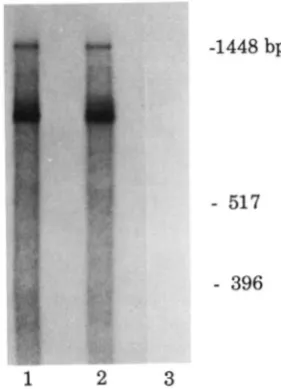
In a separate experiment, we compared congenic strains representing the two GUS haplotypes on C57BL/6 backgrounds, BG.A-[Gus]” and B6.C3H- [GusIh, and their heterozygotes, (B6.A-[Gus]” X
-1448
bp-
517
-
396
1
2
3
4
FIGURE 3.-Comparison of levels of GUS liver transcripts among congenic strains of mice representing the [Gus]" and [Gus]* haplotypes, and their FI progeny. RNA samples were analyzed as described in MATERIALS AND METHODS for thc Icvcls of their nhility to protcct the 1.5-kb GUS and 1.1-kb y-actin antisense RNAs.
Congenic strains of origin (with haplotype designation) of liver
RNAs are: lane 1, BG.C3H-[Gus]*; lane 2, (BG.C3H-[Gus]* X B6.A- [Gus]") FI; lane 3, BG.A-[Gus]". Lane 4 represents total E. coli RNA.
liver RNA is equivalent between the [Gus]" and the [Gus]" congenic strains.
It should be pointed out that the specific activities of the GUS and y-actin antisense RNAs differ between experiments as well as between one another in the experiments represented in Figures 2 and 3. In each experiment, the ratio of intensities of the protected GUS fragment is equivalent to that of the protected 7-actin fragment for the two haplotypes. Differences in the relative intensity levels of GUS and y-actin from experiment to experiment are an artifact of differ- ences in specific radioactivity of the two riboprobes and are not a measure of the relative levels of the two transcripts.
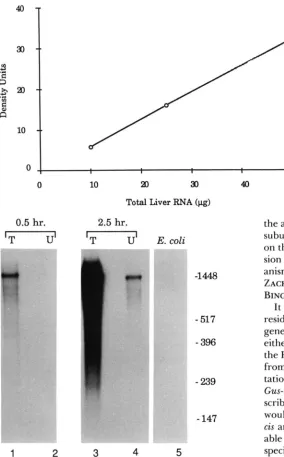
Two lines of evidence demonstrate that the nuclease protection assay is capable of discriminating differ- ences in levels of GUS mRNA. First, increasing amounts of total liver RNA added to the reaction mixture give proportional increases in the amount of protected riboprobe (Figure 4). Second, when GUS activity is stimulated by androgen to high levels in kidneys of female [Gus]" mice, we observe a dramatic increase in the levels of riboprobe protection by RNA from kidneys of treated animals when compared to that of untreated mice (Figure
5).
The extent of this difference is consistent with that of previous studies on the androgen responsiveness of kidney GUSmRNA in [Gus]" mice (PALMER et al. 1983; WATSON et al. 198 1).
DISCUSSION
Our results demonstrate that the murine 8-glucu- ronidase (GUS) regulatory elements, Gus-u and Gus- t, while exerting control over the rate of synthesis of GUS, do not influence the tissue levels of GUS
mRNA. Since the rates of synthesis of liver GUS were
measured by comparing the fraction of total radioac- tive protein present in immunoprecipitable GUS after a short in vivo pulse of radiolabeled amino acids, the effects of Gus-u and Gus-t on GUS synthetic rates must occur subsequent to the processing of GUS tran- scripts, but prior to the recognition and binding of GUS by specific antibodies.
Although not a common mode of regulation of eukaryote gene expression, translational mechanisms have been identified (MATHEWS 1986; LODISH 1976).
When operative, translational regulation usually oc- curs at initiation ( JAGUS, ANDERSON and SAFER 198 l),
with only rare examples of mechanisms involving elon- gation (THOMAS and MATHEWS 1984) or termination (YOSHIYUKI et al. 1985) of mRNA. Evaluation of the parameters rcsponsiblc for thc diffcrcntial cxprcssion
of GUS between murine tissues suggest that such differences arise primarily from alterations in trans- lational yield which is defined as the number of mature enzyme molecules formed per minute per mRNA molecule (BRACEY and PAICEN 1987). Variations in translational yield can be due to alterations in either translational efficiency, which is generally a conse- quence of initiation, or an event which promotes the maturation of GUS polypeptides to a point where they can be recognized by GUS antibodies.
A strong inference of our results is that the Gus-u regulatory element resides within exon sequences of Gus-s and specifies a recognition site either within the GUS mRNA or the GUS polypeptide. If mutant Gus- u and Gus-t alleles in H haplotype mice alter the rates of GUS synthesis without altering the level of GUS transcripts, then neither element can exert its effect through a transcriptional mechanism. Thus, the
cis-
active Gus-u element, which only regulates the expres- sion of that Gus-s allele on the same DNA molecule, must encode a recognition site in the processed GUS transcript or in GUS itself. If located within the mRNA, then this recognition site could vary between the GUS haplotypes such that transcripts derived from the wild-type Gus-ub allele are translated more effi- ciently relative to those from the Gus-u" allele. Differ- ences between transcripts involving primary se-
quences and/or secondary structure around the initi- ation codon are known to alter the rate of attachment to ribosomes and/or other stages of translation initi- ation (LODISH andJACoBsEN 1972; LEE, GUERTIN and SONENBERG 1983).
Murine 8-Glucuronidase 123
FIGURE 4.-Nuclease protection of the GUS anti- sense RNA by increasing anwuuts of total liver R N A .
Serial dilutions of total liver RNA from mice of the A/J strain were analyzed for the levels of their ability to protect the 1.5-kb GUS antisense RNA as de- scribed in MATERIALS AND METHODS. The relative intensities of the autoradiographic bands represent- ing the protected fragment were measured by scan- ning densitometry and plotted as arbitrary density units us. the relative level of input RNA for each dilution.
0 10 a0 30 40
Total Liver
RNA
(pg)0.5
hr.
2.5 hr.'T
U'
'T
U'
E. coli.-
-_--
-1448
-
517-
396-
239-
1471
2
3 4 5FIGURE 5.-Comparison of the levels of nuclease protection of the GUS antisense RNA by total RNA preparations from untreated and androgen-treated female mice of the [Gus]' haplotype. Ten adult female mice of the A/J strain were divided into two groups. A 75-mg pellet of testosterone was implanted subcutaneously into individuals of one group. Twenty-one days later all animals were sacrificed and kidneys of each treatment group pooled. Total RNAs from each pool were prepared and analyzed for the levels of their ability to protect the 1.5-kb GUS antisense RNA as described in MATERIALS AND METHODS. Autoradiographic films were exposed for either 0.5 or 2.5 hr as indicated. The source of kidney RNA is: lanes 1 and 3, testosterone-treated mice; lanes 2 and 4, untreated mice. Lane 5 represents total R N A from E. coli.
t represents an autoregulatory phenomenon. Autoreg- ulatory mechanisms have been proposed to explain the control of other eukaryotic genes. Transient DNA transfection assays of chimeric genes have identified a cytoplasmic autoregulatory mechanism that permits the level of &tubulin transcripts to be modulated by
50
the apparent concentration of unpolymerized tubulin subunits in mouse L cells (GAY et al. 1987). Studies on the regulation of suppressor-of-white-apricot expres- sion in Drosophila reveal a post-transcriptional mech- anism which also appears to be autoregulatory (CHOU, ZACHAR and BINCHAM 1987; ZACHAR, CHOU and
BINCHAM 1987).
It is therefore possible that Gus-u and Gus-t both reside within coding regions of the GUS structural gene, each serving to specify recognition sites within either GUS mRNA or its polypeptide. Furthermore, the H haplotype allele of Gus-u could be distinguished from that of other GUS haplotypes by the same mu- tation which distinguishes the H haplotype allele of Gus-t. If correct, then regulatory models which de- scribe the synthesis of GUS in mice of the H haplotype would need to account for a single mutation with both
cis and trans regulatory manifestations. It is conceiv- able that in mice of the H haplotype, recognition sites specified by Gus-u and Gus-t are encoded within exon sequences of Gus-s which surround or lie within such a mutation. As a result of changes in each recognition site imparted by the single mutation, the efficiency of translation and/or an event immediately distal to translation could be altered and thus account for the observed differences in the rates of GUS synthesis between the H haplotype and other GUS haplotypes.
We thank PATRICIA M. GALLAGHER for helpful discussions and suggestions during the course of this work and during the prepa- ration of this manuscript. We are also grateful to PETER GUNNING
and MARIANA OVNIC for the y-actin cDNA construct used in these experiments. The research reported here was supported by U. S.
Public Health Service grant DK 14770 to R. E. G .
LITERATURE CITED
BRACEY, L. T., and K. PAIGEN, 1987 Changes in translational yield regulate tissue-specific expression of &glucuronidase.
Proc. Natl. Acad. Sci. USA 8 4 9020-9024.
RUTTER, 1979 Isolation of biologically active ribonucleic acid from sources enriched in ribonuclease. Biochemistry 18: 5294- 5299.
CHOU, T., Z. ZACHAR and P. M. BINGHAM, 1987 Developmental expression of a regulatory gene is programmed at the level of splicing. EMBO J. 6 4095-4104.
D’AMORE, M. A., P. M. GALLAGHER, T. R. KORFHAGEN and R. E. GANSCHOW, 1988 The complete sequence and organization of the murine @-glucuronidase gene. Biochemistry 27: 71 31- 7 140.
GALLAGHER, P. M., M. A. D’AMORE, S. D. LUND and R. E. GAN- SCHOW, 1988 The complete nucleotide sequence of murine @-glucuronidase mRNA and its deduced polypeptide. Genomics
GANSCHOW, R. E., 1975 Simultaneous genetic control of the struc- ture and rate of synthesis of murine glucuronidase. pp. 633- 647. In: Isozymes: Genetics and Evolution, Edited by C. L. MAR- KERT. Academic Press, New York.
GAY, D. A., T. J. YEN, J. T. Y. LAU and D. W. CLEVELAND,
1987 Sequences that confer @-tubulin autoregulation through modulated mRNA stability reside within exon 1 of a @-tubulin mRNA. Cell 50: 67 1-679.
GUNNING, P., P. PONTE, H. OKAYAMA, J. ENGEL, H. BLAU and L. KEDFS, 1983 Isolation and characterization of full-length cDNA clones for human cy-, @-, and y-actin mRNAs: skeletal but not cytoplasmic actins have an amino-terminal cysteine that
is subsequently removed. Molec. and Cell. Biol. 3: 787-795.
HERRUP, K., and R. J. MULLEN, 1977 Biochemical and genetic factors in the heat inactivation of murine @-glucuronidase. Biochem. Genet. 15: 641-653.
JAGUS, R., W. F. ANDERSON and B. SAFER, 1981 The regulation of initiation of mammalian protein synthesis. Prog. Nucleic Acids Res. Mol. Biol. 25: 127-185.
LAW, L., W. G. MORROW and E. GREENSPAN, 1952 Inheritance of low liver glucuronidase activity in the mouse. JNCI 12: 909- 916.
LEE, K. A. W., D. GUERTIN and N. SONENBERG, 1983 mRNA secondary structure as a determinant in cap recognition and initiation complex formation. J. Biol. Chem. 258: 707-710.
LODISH, H. F., 1976 Translational control of protein synthesis. Annu. Rev. Biochem. 4 5 39-72.
LODISH, H. F., and M. JACOBSEN, 1972 Regulation of hemoglobin synthesis. J. Biol. Chem. 247: 3622-3629.
LUSIS, A. J., V. M. CHAPMAN, R. N. WANGENSTEIN and K. PAIGEN,
1983 Trans-acting temporal locus within the @-glucuronidase gene complex. Proc. Natl. Acad. Sci. USA 8 0 4398-4402.
MATHEWS, M. B., 1986 Current Communications in Molecular Bi-
2: 215-219.
ology. Cold Spring Harbor Laboratory, Cold Spring Harbor, N.Y.
MEISLER, M., and K. PAIGEN, 1972 Coordinated development of
@-glucuronidase and @-galactosidase in mouse organs. Science
MEREDITH, S. A,, and R. E. GANSCHOW, 1978 Apparent trans control of murine @-glucuronidase synthesis by a temporal genetic element. Genetics 9 0 725-734.
PAIGEN, K., 196 la The genetic control of enzyme activity during differentiation. Proc. Natl. Acad. Sci. USA 47: 1641-1649.
PAIGEN, K., 1961b The effect of mutation of the intracellular location of @-glucuronidase. Exp. Cell Res. 2 5 286-301.
PAIGEN, K., 1979 Acid hydrolases as models of genetic control. Annu. Rev. Genet. 13: 417-466.
PALMER, R., P. M. GALLAGHER, W. L. BOYKO and R. E. GANSCHOW,
1983 Genetic control of levels of murine kidney glucuroni- dase mRNA in response to androgen. Proc. Natl. Acad. Sci. USA 8 0 7596-7600.
PFISTER, K., V. CHAPMAN, G. WATSON and K. PAIGEN,
1985 Genetic variation for enzyme structure and systemic regulation in two new haplotypes of the &glucuronidase gene of Mus musculus castaneus. J. Biol. Chem. 2 6 0 11588-1 1594.
QUARLESS, S. A., and G. HEINRICH, 1986 The use of complemen- tary RNA and S1 nuclease for the detection and quantitation of low abundance mRNA transcripts. BioTechniques 4: 434- 438.
SMITH, K., and R. E. GANSCHOW, 1978 Turnover of murine @- glucuronidase. J. Biol. Chem. 253: 5437-5442.
THOMAS, G. P., and M. B. MATHEWS, 1984 Alterations of tran- scription and translation in HeLa cells exposed to amino acid analogs. Mol. Cell. Biol. 4: 1063-1072.
WATSON, G., R. A. DAVEY, C. LABARCA and K. PAIGEN,
1981 Genetic determination of kinetic parameters in @-glu-
curonidase induction by androgen. J. Biol. Chem. 2 5 6 3005- 301 1.
WEBER, K., and M. OSBORN, 1969 The reliability of molecular weight determinations by dodecyl sulfate-polyacrylamide gel electrophoresis. J. Biol. Chem. 244: 4406-4412.
WUDL, L., and V. CHAPMAN, 1976 The expression of 8-glucuron- idase during preimplantation development of mouse embryos. Dev. Biol. 48: 104-109.
YOSHINAKA, Y., I. KATOH, T. D. COPELAND and S. OROSZLAN,
1985 Murine leukemia virus protease is encoded by the gag- pol gene and is synthesized through suppression of an amber termination codon. Proc. Natl. Acad. Sci. USA 82: 1618-1622.
ZACHAR, Z., T. CHOU and P. M. BINGHAM, 1987 Evidence that a regulatory gene autoregulates splicing of its transcript. EMBO
177: 894-896.
J. 6: 4105-41 1 1 .
![FIGURE 3.-Comparison described in to Congenic strains among congenic strains haplotypes, and their [Gus]") RNAs of levels of GUS liver transcripts of mice representing the [Gus]" and [Gus]* FI progeny](https://thumb-us.123doks.com/thumbv2/123dok_us/1739017.1222478/4.590.83.259.75.223/figure-comparison-described-congenic-congenic-haplotypes-transcripts-representing.webp)