ABSTRACT
LUCERO, GABRIEL ANTONIO. Prompt Gamma Spectroscopic Analysis of Nuclear Fallout to Evaluate Sensitivity to Nuclear Device Characteristics. (Under the direction of John Mattingly). In the event of a nuclear attack, timely and accurate identification of the device characteristics used in the detonation would be critical to national security. Traditional methods for forensic analysis of post-detonation debris, a.k.a., nuclear fallout, rely on wet chemistry to prepare samples for mass spectroscopic analysis. Sample preparation can potentially delay the analysis by days to weeks during which time many short-lived fission products will decay away.
However, gamma spectroscopy can be performed in the field as soon as investigators arrive on site and collect fallout samples. This thesis demonstrates that some nuclear device characteristics can be identified by analyzing the gamma spectrum of nuclear fallout 3 to 18 days after
Prompt Gamma Spectroscopic Analysis of Nuclear Fallout to Evaluate Sensitivity to Nuclear Device Characteristics
by
Gabriel Antonio Lucero
A thesis submitted to the Graduate Faculty of North Carolina State University
in partial fulfillment of the requirements for the degree of
Master of Science
Nuclear Engineering
Raleigh, North Carolina 2016
APPROVED BY:
_______________________________ _______________________________
Brandon Grogan Joseph Guinness
DEDICATION
To my family, especially my wife Natalia. I would not be here without you.
BIOGRAPHY
Gabriel Lucero was born on 14 November, 1983. He grew up in Las Vegas, NM. After finishing high school he attended the United States Military Academy at West Point from 2002-2006 where he majored in Nuclear Engineering. Upon graduation from the Academy he was commissioned a Second Lieutenant of Aviation in the United States Army. He has served in several assignments including 2 tours to Afghanistan. He was admitted to North Carolina State University’s Nuclear Engineering Department in 2012 while still on active duty. Following his graduation from NCSU he will be assigned to the Physics and Nuclear Engineering Department at West Point. He is married to the former Natalia Mendoza. They have two daughters, Sofia and Sienna.
ACKNOWLEDGMENTS
I would like to sincerely thank my advisor Dr. John Mattingly. It has been a pleasure working with you. Your passion for research was contagious. The professionalism you displayed as an advisor, educator, and mentor are traits I aspire to. I would also like to thank my committee members, Dr. Guinness and Dr. Grogan, for their thoughtful feedback. I would like to thank Dr. Vincent Jodoin, Dr. David Hooper, and the team at Oak Ridge for their training and prompt assistance with any issue that I encountered during my research. Finally I would like to thanks my research group for all your help and support.
TABLE OF CONTENTS
LIST OF TABLES ……..……….. vii
LIST OF FIGURES………..…… viii
1 Introduction ... 1
1.1 Motivation/Background ... 1
1.2 Prior Work ... 3
1.3 Novel Contributions ... 6
2 Modeling Nuclear Fallout Production, Transport, and Deposition ... 8
2.1 Modeling Nuclear Fission Products ... 9
2.1.1 Neutron Energy ... 11
2.1.2 Fissile Material... 14
2.1.3 Radioactive Decay ... 15
2.1.4 Radioactive Decay in DELFIC ... 17
2.2 Fractionation... 19
2.2.1 Chemical Fractionation ... 19
2.2.2 Physical Fractionation ... 21
2.2.3 Fractionation and Particle Modeling in DELFIC... 22
2.2.4 Diffusive Transport in DELFIC ... 24
2.3 Simulation Methods and Statistical Analysis ... 28
2.3.1 Modeling Method in DELFIC ... 28
2.3.2 Statistical Modeling of Parameters ... 30
2.3.3 The F-Test ... 34
3 Results and Discussion ... 39
3.1 Conditions Affecting the Gamma Spectrum ... 39
3.1.1 Gamma Spectra from Varying Neutron Energy ... 41
3.1.2 Gamma Spectra from Varying Fuel Material ... 42
3.1.3 Gamma Spectra from Varying Sample Location ... 43
3.1.4 Gamma Spectra from Varying Collection Time ... 45
3.2 Removing Low Energy and Low Intensity Gamma Lines from the Spectrum ... 47
3.3 Varying Sample Location... 49
3.5 Varying Burst Height ... 57
3.6 Sensitivity Analysis of Gamma Photo peaks to Fission Type ... 61
4 Conclusions/Future Work ... 72
4.1 Future Work/Recommendations ... 73
5 Works Cited ... 75
LIST OF TABLES
Table 2-1: DELFIC input parameters ... 28
Table 2-2 Simulation observation conditions of gamma ray intensity ... 29
Table 2-3 Table of variables for “Fission Type” input parameter ... 29
Table 3-1 Model parameters for sample location simulation ... 49
Table 3-2 Rank of top 15 gamma intensity sources for fission energy neutrons ... 50
Table 3-3 Rank of top 15 gamma intensity sources for fusion energy neutrons ... 51
Table 3-4 Parameters used for testing gamma intensity as a function of total yield ... 53
Table 3-5 F-Test results for total yield simulation ... 56
Table 3-6 Parameters used for testing gamma intensity as a function of burst height ... 57
Table 3-7 F-Test results for burst height simulation ... 60
Table 3-8 Parameters used for testing gamma intensity while varying multiple input parameters ... 61
Table 3-9 F-Test results for vary burst height and total yield simulation ... 65
Table 3-10 Gamma lines sensitive to neutron flux at various collection times ... 67
Table 3-11 Ranking of gamma lines with the greatest standard deviation between Fission Type model parameters at various collection times ... 68
Table 3-12 Ranking of gamma lines with the maximum separation between Fission Type model parameters at various collection times ... 69
LIST OF FIGURES
Figure 2-1 Mass yield curve of fission products from 235U irradiated by fission spectrum
neutrons ... 10
Figure 2-2 Watt prompt fission neutron spectrum 239Pu and 235U ... 12
Figure 2-3 Mass yield curves of fission daughter products induced by neutrons of different energies in 235U fuel ... 13
Figure 2-4 Mass yield of fission daughter products produced from different fuel type: 235U, 238U, and 239Pu... 14
Figure 2-5 Beta-minus decay of 137Cs [18] ... 16
Figure 2-6 HPGe measurement of 137Cs [19] ... 17
Figure 2-7 Mass chains exhibiting different degrees of chemical fractionation [21] ... 20
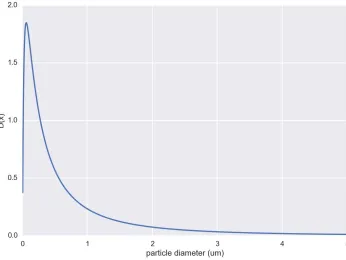
Figure 2-8 Lognormal distribution of particle diameter with mean 𝑥𝑥50 = 0.407µm and 𝑠𝑠 = 4.0(dimensionless) ... 23
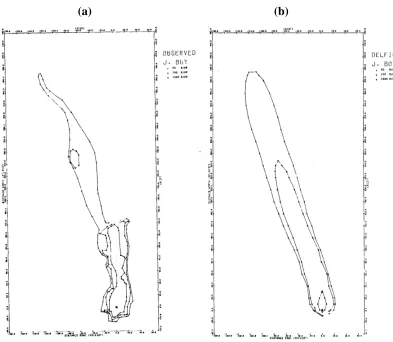
Figure 2-9 Example of cloud stem subdivision in ICRM prior to atmospheric transport [11]25 Figure 2-10 Comparison of DELFIC fallout field to observed nuclear detonation (a) observed fallout field of J. Boy nuclear test (b) DELFIC recreated J. Boy test [11] ... 26
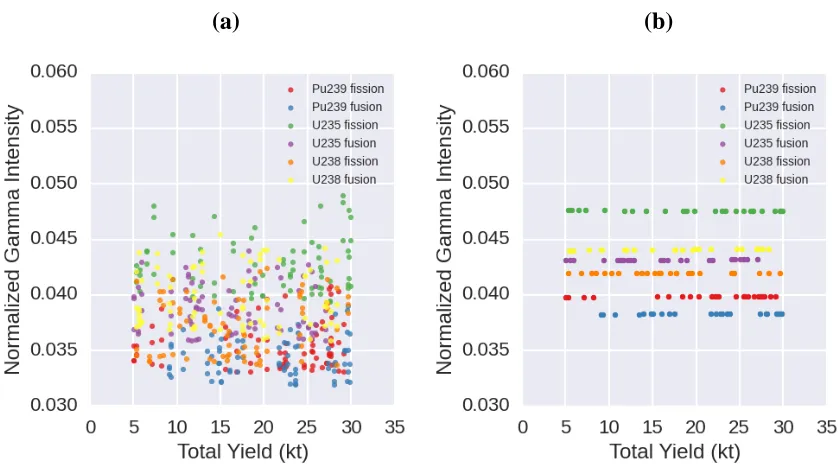
Figure 2-11 Normalized 743.4 keV gamma intensity for (a) all particle sizes in fallout (b) 490-510 µm particles ... 31
Figure 2-12 F-distribution used for ANOVA ... 38
Figure 3-1 Gamma spectrum from detonation events of differing neutron energies (a) spectra from fission neutrons energies (b) spectra resulting from fusion neutron energies ... 41
Figure 3-2 Gamma spectrum from detonation events of differing fuel types (a) device made with 239 Pu fuel (b) device made with 235U fuel ... 42
Figure 3-3 Gamma spectra from fallout collected at different locations (a) collection location 5.2 km from ground zero (b) collection location 7.3 km from ground zero ... 43
Figure 3-4 Fallout maps used to determine sample location using the intersection of dose rate and fallout density maps ... 44
Figure 3-5 Gamma spectra from fallout collected at different times (a) collection time 5 days after detonation (b) collection time 2 days after detonation ... 45
Figure 3-6 Gamma spectra removal of indistinguishable gamma lines (a) original spectrum (b) spectrum after indistinguishable lines were removed ... 48
Figure 3-7 Relative uncertainty of gamma intensity between 15 sample locations (a) measurements of all particle sizes (b) measurements of fallout particles 490-510 µm in diameter ... 52
Figure 3-8 Normalized gamma intensity of 140.5 keV (99Mo) as a function of fission type and total yield (a) all particle sizes in fallout (b) controlling particle size of fallout ... 54
Figure 3-9 Total yield regression results for the 99Mo 140.5 keV line (a) graph of data with regression fit (b) regression table with values of model parameters ... 55
Figure 3-10 Normalized gamma intensity of 140.5 keV (99Mo) as a function of fission type and burst height... 58
Figure 3-11 Burst height regression results for 140.5 keV, 99Mo (a) graph of data with regression fit (b) regression table with values of model parameters ... 59 Figure 3-12 Normalized gamma intensity of the 99Mo 140.5 keV line while varying both burst height and total yield ... 62 Figure 3-13 Final simulation regression results for the 99Mo 140.5 keV line (a) graph of data with regression fit (b) regression table with values of model parameters ... 63 Figure 3-14 Intercept parameters bar chart with error bars for the 99Mo 140.5 keV line ... 64 Figure 3-15 Normalized gamma intensity of energy peaks that are sensitive to neutron flux (a) gamma line 617.4. keV from 112Ag (b) gamma line 252.4. keV from 127Sb ... 66 Figure 3-16 Highest ranking radionuclides for distinguishing fission type (a) radionuclides sensitive to neutron flux (b) radionuclides sensitive to fissile fuel material ... 70
1 Introduction
1.1
Motivation/Background
In his 2015 National Security Strategy, President Barack Obama states, “No threat poses as grave a danger to our security and well-being as the potential use of nuclear weapons and
materials by irresponsible states or terrorists” [1]. The statement highlights the danger imposed by the potential use of nuclear weapons on domestic soil. The motivation of this thesis is to use gamma spectroscopy to advance the field of nuclear forensics. Specifically this thesis
demonstrates the application of rigorous statistical analysis to identify gamma spectroscopic features that can be used to characterize a nuclear device by the composition of the fallout. This includes examining the effects of fractionation. Fractionation is the process by which the various fallout particles leave the initial mushroom cloud through chemical or physical processes; it determines the specific radionuclide composition of the fallout at a given location relative to ground zero. The primary objectives of this research are to:
• Examine the effect of controlling fallout particle size on the nuclear fallout gamma spectrum
• Demonstrate that variance due to physical fractionation can be virtually eliminated by controlling particle size.
• Test the robustness of this effect by analyzing hundreds of nuclear simulations while varying device characteristics and observation conditions (gamma ray energy, sample location, fallout particle diameter, fallout collection time after detonation)
• Use statistical modeling and hypothesis testing to make statements of significance about the variance associated with different nuclear detonation simulation input parameters
• Provide a list of radionuclides that are most sensitive to nuclear fuel material used to create the device and/or neutron energy spectrum used to induce fission in the device
If a nuclear device was deployed against the citizens of the United States or our allies, one of the primary concerns, after caring for the injured, would be to determine the parties responsible for this act. In today’s complex international political environment, the list of possible suspects makes identification of responsible parties difficult. Similar to criminal forensics, nuclear forensics deals with the analysis of post detonation evidence in an attempt to assess culpability. Questions of interest include:
• If the weapon used Highly Enriched Uranium (HEU), then what was the enrichment of the HEU?
• If the weapon used plutonium, how long was the source of uranium irradiated in a reactor to make the plutonium?
• How long since the plutonium was last purified?
• What level of sophistication was used to make the device?
• Was the device a pure fission weapon or were fusion reactions used to increase the explosive yield [2]?
These characteristics would prove useful in identifying the origin of the device. The area of nuclear forensics explored in this thesis is the gamma spectrum analysis of nuclear fallout particles using computer simulations. Current analysis techniques employ mass spectrometry which involves chemically and physically separating the particles in laboratories, a process that can take on the order of weeks [2]. Gamma spectroscopy can be used to measure fallout particles directly and analysis can be conducted in the field as soon as investigators arrive on-site and collect fallout samples. The time frame for making determinations about device characteristics using gamma spectroscopy would be on the order of days as opposed to weeks. In addition, the presence of short lived fission products could be used to enhance the analysis prior to decaying away. This would be a significant advantage as it would provide policymakers with a fuller picture of the event to inform a responsible national response.
Since the adoption of the Comprehensive Test Ban Treaty, it has not been possible to measure the gamma spectrum of nuclear fallout using state of the art gamma spectrometers. However, computer codes that simulate nuclear detonations were developed in the 1960’s and 1970’s and have been steadily improving. Computing speeds and advances in cluster computing have also been steadily improving. These advances make simulation analysis a viable option for studying nuclear forensics. The simulation code used in this work is the Defense Land Fallout Interpretive Code (DELFIC.) The current version of DELFIC has been maintained and
developed by the Oak Ridge National Laboratory Nuclear Security Modeling Group. This version has several updates and features that make it useful for modeling nuclear detonations and the subsequent fallout that is produced by the initial explosion [3]. This includes:
• Modeling the abundance of fallout particles produced by various types of nuclear explosions
• Modeling the radionuclides contained in the particles
• Simulating the dispersion of fallout particles on the ground while factoring in meteorological conditions at the time of detonation
The prospect of having to conduct nuclear forensics in a real world scenario may hopefully never have to be used, but any research that would better prepare collection and analysis teams to perform their duties would be advantageous to our national security. This motivated the research.
1.2
Prior Work
Some of the first work done in post-detonation nuclear fallout was performed in the
1960’s. Heft examined the radionuclide composition of nuclear fallout, testing its dependence on particle size by examining the air filter sample placed around nuclear test detonations [4]. Heft found that indeed the distribution of certain radionuclides in fallout particles was dependent on
particle diameter. He was able to characterize the distribution of radionuclides in fallout for land, surface, and subsurface burst. He did this by examining the fallout produced by differing soil compositions and meteorological conditions. One important conclusion from the work was that it is possible to relate the fractionation behavior of all radionuclides by comparing a single pair of volatile/refectory radionuclides. Volatile radionuclides are distributed on the surface of fallout particles, while refractory radionuclides are distributed throughout the volume of the fallout particle. This was some of the first work which attempted to characterize the
fractionation effect by comparing volatile and refractory radionuclides. Early work conducted on the subject is especially useful because analyses of actual nuclear tests were used, and results from current simulations can be benchmarked by comparing the results.
Freiling also examined post-detonation fallout. He did not examine post-detonation fallout for the purposes of nuclear forensics but instead he wanted to accurately model the composition of fallout particles in order to predict the fallout field contamination and radiological exposure. His work further examined the effects of fractionation [5]. Freiling was also able study fallout from multiple nuclear tests. Through his study of nuclear detonations in various conditions (multiple soil types, explosive yields, and meteorological conditions, etc.), he found that the presence of most radionuclides measured in fallout was insensitive to changing environmental conditions. From this he concluded that the radionuclides present in fallout were primarily dependent on the device characteristics themselves.
Freiling also examined the dependence between radionuclide composition of fallout particles and fallout particle diameter [6]. He examined three particle diameter groups, or what he called local, intermediate, and worldwide fallout. He observed logarithmic correlations between the degree of fractionation and particle size. From this correlation he presented a means to estimate the degree of fractionation occurring in all fallout particles. He then used the degree of fractionation to estimate the unique radioactivity present in each of the three particle sizes. The work characterized the degree of fractionation present in fallout by presenting the abundance of all mass chains as a ratio of a purely refractory mass chain. A mass chain is a group of
radionuclides that undergo beta decay to convert a neutron to a proton or vice versa. Mass number is conserved in the decay, hence the name mass chain. This resulted in a more accurate prediction of the radionuclide composition. When the radionuclide composition was combined with the distribution of particles in a nuclear fallout field, his results showed a more accurate way to estimate exposure rates.
More recently, short-lived fission products have been examined by Miley et al. to monitor compliance with the Comprehensive Nuclear Test Ban Treaty [7]. Their team conducted gamma spectroscopic analysis of air filters to provide positive proof of an atmospheric explosion. The results included a list of radionuclides that were useful in identifying nuclear detonations. This paper included two experiments: one experiment replicating field detectionby the International Monitoring System (IMS), and another experiment replicating laboratory analysis of samples that would be transported to various laboratories after initial detection. The samples used in both tests were created in a research reactor thermal port and replicated historical samples collected in Richland, WA from a low yield (~20 kt) nuclear test conducted at Lop Nor, China. To simulate IMS detection, samples were irradiated then allowed to decay for 12 days to account for
atmospheric transport. For the experiment replicating laboratory analysis, samples decayed 4 additional days to replicate sample collection and shipment to laboratories. The experiment gave good insight into detectable gamma lines present in nuclear fallout a short time after detonation. A limitation in the experiment was that only fallout particles small enough to travel hundreds of kilometers were measured (as would be detected by IMS). Also, irradiated samples did not undergo the same chemical fractionation process that fallout particles formed in a nuclear blast would experience.
Experiments have also been performed to identify gamma line energies sensitive to fissile material and neutron energy by Marrs et al. Samples of 239Pu, 235U, and 238U were irradiated with a neutron beam. Two neutron energies were used in the experiment, thermal neutrons and 14-MeV neutrons. Each fuel sample underwent approximately 108 fissions. High purity germanium detectors were then used to measure the gamma spectrum of the sample from 1 minute to 14
hours after irradiation [8]. The results showed multiple gamma lines that were sensitive to fuel material and neutron energy. One important result was that all the significant mass chains identified in the experiment originated from volatile mass chains.
Work has also been done using simulations and models. Miller used DELFIC to identify gamma peak ratios that are useful for determining the fissile material of the nuclear device [9]. Miller’s work primarily focused on un-fractionated and refractory samples of nuclear fallout. The useful radionuclides identified were presented as ratios of purely refractory radionuclides to reduce sample size variation and to fix chemical fractionation. Miller also performed a
comprehensive analysis of soil solidification times and particle size modeling in DELFIC. His work illustrated how DELFIC models the fractionation changes of fallout as a function of particle radius and soil solidification time.
Smith also did research on identifying device characteristics using gamma spectroscopy from DELFIC simulations coupled to the Gamma Detector Response and Analysis Software (GADRAS), which simulates the detector response of multiple commercial gamma ray detectors. Smith was able to identify gamma ray peak energy ratios that are useful in identifying fissile material and neutron energy of a nuclear device between 6 and 48 hours after detonation [10]. Her work focused on determining device characteristic even if explosive yield was not
immediately known. The primary technique used was to identify mass chains sensitive to fuel type and fission yield and compare them to mass chains that are insensitive to fuel type and fission yield.
1.3
Novel Contributions
This thesis makes several novel contributions to application of gamma spectroscopy for the analysis of nuclear fallout:
• This thesis utilizes a code to optimize DELFIC sample location based on minimum dose received on-site and maximum desired density of fallout on the ground. This
implementation of DELFIC would assist collection teams in route planning.
• Also implemented was a scalable code suite that runs hundreds of DELFIC simulations. The results are then combined into a single data file that can then be analyzed by the user.
• DELFIC was used to determine gamma spectrum sensitivity to various nuclear fallout input parameters while controlling fallout particle size.
• Statistical analysis was applied to the results by using linear regression and the F-Test to make statements of significance about nuclear device input variables.
2 Modeling Nuclear Fallout Production,
Transport, and Deposition
The formation of post-detonation fallout is a complex process. Many factors determine the final composition and location of the fallout particles. The two primary details of nuclear fallout theory that will be discussed in this chapter are how radionuclides are formed from the fission process, and how the fallout particles that constitute them are formed. Each section will cover the theory and the modeling tools used in the simulations.
The DELFIC [11], and the Oak Ridge Isotope Generation and Depletion Code (ORIGEN-S), were the two primary computer codes used in the simulations. DELFIC is a fallout prediction code first developed by the Defense Nuclear Agency in the 1960’s. Various agencies have
worked on the code since its original development, and the version of DELFIC used in this thesis is the version updated by ORNL in 2008. DELFIC models the formation of nuclear fallout in three main modules:
• Initialization and Cloud Rise Module (ICRM)
• Diffusive Transport Module (DTM)
• Output Processor Module (OPM)
The ICRM takes the user specified inputs and models the detonation through the rise and stabilization of the nuclear cloud, including the modeling of all the radionuclides and fallout particles initially created by the blast. The DTM transports the fallout from the stabilized cloud to the ground. The OPM processes the deposited fallout in informative maps of differing fallout characteristics (dose rate, fallout mass, time of onset of fallout, etc.) [12].
The final radionuclide composition and gamma emission of the fallout is modeled using ORIGEN-S. ORIGEN-S was developed by Oak Ridge National Laboratories to perform point depletion and decay analyses to obtain radionuclide concentrations, decay heat source terms, and
radiation source spectra [14]. The component of ORIGEN-S used in this thesis was the decay database. We used it to construct fallout gamma spectra given the radionuclide composition predicted by DELFIC.
2.1
Modeling Nuclear Fission Products
This section will give a general overview of the physical phenomena that create fission products and what equations are used to model the fission products. In the early stages of nuclear detonation, neutrons induce fission in the fuel material. The result is a rapid release of energy, ~200 MeV per fission 2; sometimes 3, lower mass number nuclei called fission
“daughter” products; and neutrons [14] (other sub atomic particles and radiation are also released but they are not relevant to this thesis). These neutrons induce additional fissions of the fuel material and result in a runaway nuclear chain reaction in a nuclear detonation.
The production of fission products from neutron-induced fission constitutes a probabilistic event that has been studied and documented by numerous researchers. The yield probability tables used for this paper are drawn from the Evaluated Nuclear Data File B-VII.1 (data file used by ORIGEN-S) produced by Los Alamos National Laboratory, and the International Atomic Energy Agency’s (IAEA) Handbook of Nuclear Data. [15] [16] The yield probability of daughter products is often plotted as a function of daughter product mass number, which is referred to as the “mass yield curve.”
Figure 2-1 shows a mass yield curve. This figure comes from the fission of 235U irradiated by fission spectrum neutrons. Some features to note on the figure are the two highest points which are referred to as “peaks,” the “U” shape in the center or “saddle,” and the edges along each peak. The peaks are the result of asymmetric fission where a light and heavy daughter product is produced. The saddle region is a result of nearly symmetric fission where the daughter products have almost the same mass number. The mass yield curve can be combined with the total numbers of fissions caused by a nuclear detonation to determine the mass chain abundance of daughter products. The fuel material used and neutron flux are specified for the figure because the mass yield curve changes as a function of both those parameters.
Figure 2-1 Mass yield curve of fission products from 235U irradiated by fission spectrum neutrons
The qualitative radionuclide inventory of daughter products produced after a nuclear detonation is almost exclusively dependent on:
1. Fuel material used in the device (e.g., 235U or 239Pu)
2. The energy of the neutrons that were used to induce fission of the device (neutron flux) 3. Neutron capture by other materials (soil, buildings, inert bomb material etc.) [17]
2.1.1 Neutron Energy
The neutron energy used to induce fission in a nuclear device is divided into two
categories, prompt fission neutrons and fusion neutrons. Nuclear detonations cannot be achieved with slow neutrons. [14] Prompt fission neutrons are those that originate from previous nuclear fissions. They are “born” with a continuous energy spectrum and have a mean energy of ~2 MeV. Figure 2-2 shows the distribution of neutron energies born from 239Pu and 235U induced fission. The distribution of energies is modeled using the Watt fission spectrum. The second category of neutron is fusion neutrons. For certain types of nuclear devices, neutrons produced by fusion reactions are used to subsequently induce fission. These neutrons originate from the fusion of deuterium and tritium (D-T reaction). The D-T reaction produces a mono-energetic neutron with energy of 14.1 MeV.
Figure 2-2 Watt prompt fission neutron spectrum 239Pu and 235U
Figure 2-3 shows the mass yield of fission daughter products produced by neutrons of different energies. We can see that the saddle region of the curve of is much shallower for the fusion energy neutrons. This happens because induced fission becomes more symmetric as the neutron energy increases. The plot is on a log-y scale so daughter products in the saddle region are produced with approximately 2 orders of magnitude difference between the two neutron energies. As a result, any nuclear devices detonated using fusion energy neutrons would have a much greater amount of daughter products located in the saddle region compared to similar nuclear devices that used fast fission neutrons to induce fission.
Figure 2-3 Mass yield curves of fission daughter products induced by neutrons of different energies in 235U fuel
2.1.2 Fissile Material
Figure 2-4 shows how the shape of the mass yield curve changes as a function of different fuel material types. Here we can see that the curves are similar in shape, however there is a “shift” to the left and right between the differing fuel types. The reason for the shift is the
difference in mass numbers between the fuel materials. 239Pu has the highest mass number and as a result its mass yield curve is located to the right of 238U and 235U. Whereas the saddle of the mass yield curve was the distinguishing feature for nuclear devices made with differing incident neutron energy, the edges of the mass yield curve are the distinguishing features for nuclear devices made from differing fuel material types.
Figure 2-4 Mass yield of fission daughter products produced from different fuel type: 235U, 238
U, and 239Pu
2.1.3 Radioactive Decay
What should be noted from the previous mass yield curves is that they represent the distribution of the fission products immediately following a fission event. To determine the fission products present at a later time, the decay of daughter products must be calculated. The daughter products produced immediately following a nuclear detonation are often highly
unstable due to an excess of neutrons in the nucleus. The radionuclide then transmutes to a more favorable neutron to proton ratio by undergoing nuclear decay. The predominant decay method of fission daughter products is beta-minus (𝛽𝛽−) decay. Equation (2.1) illustrates the equation for beta-minus decay. Here the nucleus converts a neutron to a proton by releasing a beta-minus particle and an anti-neutrino.
𝑋𝑋
𝑍𝑍𝐴𝐴
→
𝑌𝑌
𝑍𝑍+1𝐴𝐴
+ 𝛽𝛽
−+ 𝜈𝜈̅
(2.1)Following the beta-minus decay, the nucleus is often left in an excited state. It then relaxes to a more stable state by emitting gamma radiation. The relaxation and emission of gamma radiation happens on the order of picoseconds for a vast majority of radionuclides and is considered instantaneous when compared to the half-life of the beta-minus decay.
Figure 2-5 Beta-minus decay of 137Cs [18]
Figure 2-5 shows an example of beta-minus decay of 137Cs and its dominant excited energy state [18]. Following the beta-minus decay 137Ba is in an excited state 93.5% of the time and emits a 662 keV gamma ray to relax to its ground state. The gamma ray emitted is called characteristic gamma radiation because observing the gamma radiation of this energy can be used to identify the radionuclide, while the intensity of the characteristic gamma ray can be used to identify the abundance of the radionuclide.
Figure 2-6 shows an example of the 137Cs gamma spectrum measured from high purity germanium, a semiconductor radiation detector used for high-resolution gamma spectroscopy. The 662 keV peak represents the full energy photopeak. There is a Compton continuum starting at approximately 500 keV. Finally, the detector used in the figure was designed to identify 90º Compton scattering as evident by the peak at 373 keV.
Figure 2-6 HPGe measurement of 137Cs [19]
Measuring characteristic gamma radiation and relating that measurement to the underlying radionuclides which produced the radiation is the basis of gamma spectroscopy.
2.1.4 Radioactive Decay in DELFIC
Often the original fission products go through multiple decays before reaching a stable state. These are called decay chains. Tracking multiple decay chains and abundance of radionuclides present at a given time is modeled in DELFIC and ORIGEN-S through the Bateman equation [11]:
𝑁𝑁𝑛𝑛(𝑡𝑡) = � � 𝑐𝑐𝑘𝑘𝑘𝑘 ∗ 𝑁𝑁𝑘𝑘𝑜𝑜∗ 𝑒𝑒−𝜆𝜆𝑘𝑘𝑡𝑡 𝑛𝑛 𝑘𝑘=1 𝑛𝑛 𝑘𝑘=1 (2.2) where:
• 𝑁𝑁𝑛𝑛(𝑡𝑡) is the number radionuclides of the nth member of the chain at time 𝑡𝑡
• 𝑁𝑁𝑘𝑘𝑜𝑜 is the number of radionuclides of the ith number of the chain (i ≤ n ) at time 0
• 𝜆𝜆𝑘𝑘 is the decay constant of the kth member of the chain (k ≤n)
The variable 𝑐𝑐𝑘𝑘𝑘𝑘 is defined as:
𝑐𝑐𝑘𝑘𝑘𝑘= ∏ 𝜆𝜆𝑗𝑗 𝑛𝑛−1 𝑗𝑗=𝑘𝑘 ∏ (𝜆𝜆𝑛𝑛𝑗𝑗=𝑘𝑘 𝑗𝑗− 𝜆𝜆𝑘𝑘) 𝑗𝑗≠𝑘𝑘 � (2.3)
This equation is applied to every radioactive daughter product produced by the initial detonation event to account for the composition of the fallout at later times. Given a
concentration of any nuclide the activity is:
𝐴𝐴𝑛𝑛(𝑡𝑡) = 𝜆𝜆𝑛𝑛𝑁𝑁𝑛𝑛(𝑡𝑡) (2.4)
where:
• 𝐴𝐴𝑛𝑛(𝑡𝑡) is the activity of the nth radionuclide at time 𝑡𝑡 (decays/sec)
• 𝜆𝜆𝑛𝑛 is the decay constant of the nth radionuclide
DELFIC uses the Bateman equation to produce a library of radionuclide inventories at various times. The radionuclide inventory is used in conjunction with ORIGEN-S’s decay library to compute the gamma emission spectrum at various times.
2.2
Fractionation
The majority of the material in nuclear fallout is glassified soil and material surrounding the blast location. Fractionation is the term used to explain how fission products are distributed in this mostly inert material. Fractionation is defined as any alteration of radionuclide
composition occurring between the time of detonation and the time of radiochemical analysis which causes the debris sample to be non-representative of the detonation products taken as a whole [5]. There are two types of fractionation: physical fractionation and chemical
fractionation. One of the major contributors to gamma intensity variance is fractionation. If fractionation did not occur then the distribution of radionuclides in any sample measurement of fallout particles should follow the fission mass yield curve adjusted for any decay between the detonation and time of measurement. The definition is intentionally broad and applies to multiple physical phenomena that occur during and after a nuclear detonation ranging from the ambient air conditions to the chemical freezing temperatures of the fission daughter products.
2.2.1 Chemical Fractionation
Chemical fractionation refers to the alteration of the radionuclide composition in fallout due to vaporizing and subsequent freezing of the radionuclides and material from the
surrounding environment. When a nuclear device detonates over land a substantial quantity of surrounding soil is lofted and vaporized. When the soil and all the surrounding material reach their freezing temperature, they condense to form fallout particles. Since the radionuclides of interest are radioactive and decaying into different elements, chemical fractionation behavior is often described in terms of isobars or “mass chains.” Mass chain refers to a parent-daughter decay chain in which the mass number remains the same i.e. beta-minus decay. Chemical fractionation refers to how a radioactive mass chain is distributed in the fallout material itself. If the mass chain’s freezing temperature is higher than the surrounding soils freezing temperature, the mass chain will be in the liquid or solid phase when the soil freezes. As a result these mass
chains tend to be volumetrically distributed in the fallout particle itself and are said to be
“refractory.” Mass chains which have a lower freezing temperature than the surrounding soil are still in the gaseous phase when the soil freezes and they condense on the surface of the fallout particles and are said to be “volatile.” For some mass chains there is a mix of refractory and volatile elements in the mass chain. Differing detonation conditions cause a change in refractory/volatile ratio of a mass chain’s distribution to change. This change is called the Freiling Ratio and is defined as the fraction of atoms that exist in the form of refractory elements at the time of soil solidification [20]. The Freiling Ratio is a way of quantifying the degree to which a mass chain undergoes chemical fractionation.
Figure 2-7 Mass chains exhibiting different degrees of chemical fractionation [21]
Figure 2-7 illustrates behavior of mass chains 89, 95, 141, and the behavior of each, for a specific soil solidification time [21]. One important note is that the mass chain behaviors illustrated are for a specific soil solidification time and can change as soil solidification time is changed.
Soil solidification time is important because it largely determines the degree of
fractionation that the fallout particles exhibit. Solidification time can change according to several conditions. Izrael, et al. used the results exhibited in multiple Russian detonations to explain the factors that determine soil solidification time. His conclusion was that the nature of the
environment where the device was detonated and the parameters of the device (the total
explosive yield and the whether the device is detonated over water or land) primarily determine the radionuclide composition of fallout. Prevailing meteorological conditions only effect the quantitative distribution of fallout on the ground [17]. One of the device parameters that determine soil solidification time is total explosive yield. Total explosive yield determines how large and hot the fireball gets during the detonation. Higher explosive yields result in longer solidification times. The same behavior is exhibited, although with a weaker dependence, with burst height. As a device is detonated at altitude, less and less soil comes in contact with the fireball. Therefore, increasing detonation altitude from the surface decreases soil solidification time. There are other factors that contribute to solidification time like the composition of the soil and the ambient temperature at the time of burst. However for modeling purposes,
environmental factors were treated as control parameters. 2.2.2 Physical Fractionation
Chemical fractionation pertains to how the radionuclide distribution changes as a function of the processes involved in vaporizing and freezing of fallout material. Physical fractionation refers to how the radionuclide composition deviates from the mass yield distribution due to the physical characteristics of the fallout. Larger diameter particles have a larger volume to surface area ratio than smaller particles. As a result, larger particles have a greater concentration of
refractory radionuclides than smaller particles. Another form of physical fractionation is the dispersion of fallout on the ground due to meteorological conditions (i.e. wind direction and speed.) Larger particles are more massive than smaller particles. As a result larger particles fall more quickly to the ground and closer to ground zero than smaller particles. This means higher concentrations of refractory radionuclides are closer to ground zero than volatile radionuclides. 2.2.3 Fractionation and Particle Modeling in DELFIC
DELFIC models the creation of particles and the degree of chemical fractionation in the initialization and cloud rise module (ICRM). The physical fractionation and the transport of particles to the ground is modeled in the Diffusive Transport Model (DTM). There are two principal assumptions used by DELFIC when modeling fallout particles. The first assumption is that fallout particles are spherical and homogenous with a lognormal distribution in size. Lognormally distributed particles are ones in which the logarithm of particle size is distributed normally. This is the default distribution used by DELFIC to determine particle size; however, there is an option to provide a custom distribution if desired. The second assumption is that the ultimate distribution of each mass chain among the particles is proportional to a power of the particle diameter [22].
The distribution of size of particles from a given simulation is given by:
𝐷𝐷(𝑥𝑥) = 1
√2𝜋𝜋 ∗ x ∗ ln 𝑠𝑠exp �− 1 2 �
ln 𝑥𝑥 − ln 𝑥𝑥50
ln 𝑠𝑠 �
2
� (2.5)
Where:
• 𝑥𝑥 is particle diameter
• 𝑠𝑠 is geometric standard deviation of particle diameter (dimensionless)
• 𝑥𝑥50 is median diameter of particles
• 𝐷𝐷(𝑥𝑥) is the distribution of particles in diameter range dx
Equation (2.5) gives the distribution of particle sizes. In DELFIC the equation is generalized for arbitrary particle size distributions.
Figure 2-8 Lognormal distribution of particle diameter with mean 𝒙𝒙𝟓𝟓𝟓𝟓 = 𝟓𝟓. 𝟒𝟒𝟓𝟓𝟒𝟒µm and
𝒔𝒔 = 𝟒𝟒. 𝟓𝟓(dimensionless)
The next part of the simulation is to determine the degree of chemical fractionation (Freiling ratio) of the radionuclides. This is done by determining the time when the soil
condenses and ceases to absorb radioactive radionuclides. Fission products that condense prior to soil solidification are distributed volumetrically through the particle. Fission products that condense after soil solidification are distributed over the surface. The formula used is semi empirical and takes into account the freezing point of the soil, total explosive yield, type of
material used, and the height of burst [11]. The radionuclide composition of fallout particles can vary widely based on any change in one of the aforementioned parameters. The sensitivity of Freiling ratio to different user inputs was examined by Miller in his dissertation [9]. He
examined multiple soil freezing temperature, fissile materials, and soil solidification times. In all cases the changes in Freiling ratios were significant for multiple mass chains. This concludes a basic overview of how fallout particle size and the degree of fractionation are modeled in the initialization and cloud rise module of DELFIC. The last aspect of the simulation is how particles are transported from the cloud to the ground in DELFIC.
2.2.4 Diffusive Transport in DELFIC
How fallout particles are transported in DELFIC is important because it determines the physical fractionation of fallout samples. DELFIC first calculates the initial cloud rise, volume, temperatures, pressures, and density of fallout material. This is done for every particle size, so in effect, there are multiple “clouds.” When each cloud reaches its stabilization point it is assumed to have uniform composition and be cylindrical in shape. It is then subdivided into “disks.” See Figure 2-9 for an illustration. The direction and velocity of each disk is determined according to particle size, and position in the cloud. The meteorological data is then used to adjust the
horizontal positions of the disks relative to ground zero. The disks are then transported to the ground in the diffusive transport module (DTM) of DELFIC. The DTM begins its calculation with the following information about the disks:
• Horizontal space coordinates of the parcel center
• Base altitude
• Stabilization time
• Vertical thickness
• Radius
• Mass
• Particle diameter
• Volume [11].
Figure 2-9 Example of cloud stem subdivision in ICRM prior to atmospheric transport [11]
The DTM combines this information with environmental conditions (atmospheric pressure, temperature, humidity, density, and viscosity) to transport the disk to their (x,y) position on the ground [11]. DELFIC allows user inputs for environmental conditions, or if a simulation for a previous date and time is desired, NOAA environmental data can be imported. Figure 2-10 shows a comparison of a measured fallout field with a fallout field recreated by DELFIC. DELFIC produced these results without a posteriori adjustment or calibration [11].
(a) (b)
Figure 2-10 Comparison of DELFIC fallout field to observed nuclear detonation (a) observed fallout field of J. Boy nuclear test (b) DELFIC recreated J. Boy test [11]
This concludes the section on theory and modeling techniques. It covered the basic physical concepts of how radioactive material is produced during nuclear explosions and how fallout particles are created. Fractionation was also covered, which describes how radionuclides present in the fallout can change based on the chemical and physical properties of the fallout material. The last topic covered was DELFIC and a general overview of how simulation data is generated for the results section of the thesis.
2.3
Simulation Methods and Statistical Analysis
Our objective was to identify how to best distinguish nuclear detonation device characteristics using gamma spectroscopic measurements of fallout. The primary device characteristics of interest were the fissile fuel material and the energy of the neutrons used to induce fission. Specifically, we want to determine if gamma spectroscopy can be used to discriminate between differing combinations of nuclear fuel and neutron energy. The fuel options explored were 239Pu, 235U, and 238U, and the two neutron energies analyzed were fast fission spectrum neutrons and high-energy neutrons (fusion neutrons).
2.3.1 Modeling Method in DELFIC
The first step was to randomly vary a single DELFIC input parameter while holding all other parameters constant. The input parameters that can be varied in DELFIC are listed in Table 2-1.
Table 2-1 DELFIC input parameters Input Parameters
Total explosive yield (total yield): kilotons TNT (kt) Fuel type: 239Pu, 235U, 238U
Neutron energy: Fission spectrum or fusion spectrum Height of Burst: meters (m)
Wind: Speed (meters/second), direction (degrees, with 0º being North)
Soil type is also an input parameter; however for the scope of this research only land detonations were examined. This was modeled in DELFIC as the default “siliceous soil” option.
DELFIC then took the input parameters and generated a radionuclide inventory of fission daughter products and activated soil products. The corresponding gamma spectrum was calculated using the ORIGEN-S gamma yield database. The results of the simulation can be viewed under the conditions listed in Table 2-2.
Table 2-2 Simulation observation conditions of gamma ray intensity Gamma ray energy (keV) /characteristic nuclide(e.g. 112Ag) Sample location relative to ground zero in kilometers (km) Fallout particle size diameter in micrometers(µm)
Fallout collection time (hours since detonation)
This gave the user a unique set of gamma spectra for every instance of the varied input parameter. The set of gamma spectra was then modeled using linear regression. Sensitivity to the input parameters was evaluated using the F-Test.
Two notable input parameters are fissile fuel material and the neutron flux energy. The combination of these two parameters result in a categorical variable referred to as “Fission Type.” Table 2-3 lists the definition of the six categorical variables that are selectable in DELFIC.
Table 2-3 Table of variables for “Fission Type” input parameter
fuel material 235
U 238U 239Pu
fission spectrum neutrons u235fi u238fi p239fi
fusion spectrum neutrons u235he u238he p239he
The focus of the research was to isolate the gamma lines (and their associated
characteristic nuclides) that gave the most information about fission type. Gamma ray intensities are derived directly from the radionuclides that are emitting them.
The first two observables examined were particle size and sample location. This was done to examine the effects of physical fractionation as discussed in section 2.2.2. The next step was to perform linear regression for every gamma line present in the spectrum. This was
accomplished in three experimental simulations. The first simulation varied total explosive yield while fixing the burst height. The next simulation varied burst height while fixing total explosive yield. The last simulation varied both burst height and total explosive yield. Useful gamma lines were then identified by ranking the gamma lines by the maximum standard deviation and
maximum/minimum separation between the normalized gamma intensity as predicted by the regression model. Finally, the same analysis was performed on a variety of fallout collection times to provide a general overview of the best gamma lines for distinguishing fission type.
2.3.2 Statistical Modeling of Parameters
Statistical modeling used normalized (the intensity of each gamma line was normalized to the total intensity of all gamma lines in the spectrum) gamma spectra as a response to multiple input variables. One finding of this thesis is that controlling particle size of fallout particles reduces the variance of the normalized gamma spectra to such a degree that linear regression is a suitable approach to modeling the simulation results. Figure 2-11 illustrates the effect controlling particle size has on normalized gamma intensity. In this case the independent variable was total
explosive yield. Both figures are from the 743.4 keV gamma decay of 97Zr, the details of which will be discussed further in the results section. It is important to note that Figure 2-11(a) is the intensity for all particle sizes, while Figure 2-11(b) is the intensity for only 490-510 µm particles. Note that controlling particle size virtually eliminates variance in composition. The remaining variance is primarily due to fission type. Figure 2-11 (b) exhibits linear behavior hence linear regression analysis was used to analyze the data. At first glance it appears that the intercept can be used to categorize fission type since the slopes of the lines are small compared to the
separation between the fission types.
(a) (b)
Figure 2-11 Normalized 743.4 keV gamma intensity for (a) all particle sizes in fallout (b) 490-510 µm particles
The response variable for our analysis is normalized gamma intensity while the regressor variables are the DELFIC input variables: total explosive yield, height of burst, and fission type. The only DELFIC input variable not modeled using linear regression was wind speed and direction. This was analyzed as sample location in the fallout field, since wind speed and direction directly affect the location of where fallout particles land. Since fission type was the primary regressor variable of interest, it was modeled during the varying total explosive yield
simulation and varying burst height simulation. All models included interaction coefficients between the regressor variables being analyzed. Equation (2.6) shows the form of the regression model used to analyze all DELFIC simulations.
𝑌𝑌𝑘𝑘 = 𝛽𝛽00+ �(𝛽𝛽0𝑗𝑗+ 𝛽𝛽1𝑗𝑗 ∗ 𝑥𝑥𝑘𝑘)𝑧𝑧𝑘𝑘𝑗𝑗 6
𝑗𝑗=1
+ 𝜖𝜖𝑘𝑘 (2.6)
where:
• 𝑖𝑖 is the simulation number
• 𝑗𝑗 is fission type
• 𝑥𝑥𝑘𝑘 is yield or burst height of i th observation
• 𝑌𝑌𝑘𝑘 is normalized gamma intensity
• 𝑧𝑧𝑘𝑘𝑗𝑗 is a delta function with values: �1 if test 𝑖𝑖 is fissiontype 𝑗𝑗
0 otherwise
• 𝛽𝛽00is the intercept model coefficient
• 𝛽𝛽0𝑗𝑗 is the fission type model coefficients
• 𝛽𝛽1𝑗𝑗is either total explosive yield or burst height model coefficients
• 𝜖𝜖𝑘𝑘 is random error in the model
Total explosive yield and burst height are treated as continuous random variables. Fission type is treated as a categorical variable with 6 possibilities called “levels.” Categorical
independent variables are modeled in regression using binary 1 or 0 in the design matrix used to estimate the mode. This is represented by 𝑧𝑧𝑘𝑘𝑗𝑗, where 𝑧𝑧𝑘𝑘𝑗𝑗 is 1 when the DELFIC simulation 𝑖𝑖 is fission type 𝑗𝑗 and 0 otherwise.
2.3.3 The F-Test
Once the regression models were constructed, a test for the significance of regressor variables was performed using the F-Test. The F-test for regression models is a statistical test used to make statements about significance of regression model parameters. To perform the test some model coefficients were assumed to be 0 and the data was fit to this model (referred to as the “reduced” model.) Then the variance introduced by changing the model is compared to the original “full” model. This is expressed as the null hypothesis.
• Null Hypothesis: 𝛽𝛽1= 0 for every level j • Alternate Hypothesis: 𝛽𝛽1 ≠ 0 for some j
Applying the hypothesis to equation (2.6) yields the following equation:
𝑌𝑌𝑘𝑘 = 𝛽𝛽00+ � 𝛽𝛽0𝑗𝑗∗ 𝑧𝑧𝑘𝑘𝑗𝑗 6
𝑗𝑗=1
+ 𝜖𝜖𝑘𝑘 (2.7)
where:
• 𝑖𝑖 is the simulation number
• 𝑗𝑗 is fission type
• 𝑥𝑥𝑘𝑘 is yield or burst height of i th observation
• 𝑌𝑌𝑘𝑘 is normalized gamma intensity
• 𝑧𝑧𝑘𝑘𝑗𝑗 is a delta function with values: �1 if test 𝑖𝑖 is fissiontype 𝑗𝑗
0 otherwise
• 𝛽𝛽00is the intercept model coefficient
• 𝛽𝛽0𝑗𝑗 is the fission type model coefficients
• 𝛽𝛽1𝑗𝑗is either total explosive yield or burst height model coefficients
• 𝜖𝜖𝑘𝑘 is random error in the model
Equation (2.7) applies the null hypothesis that the slope versus total explosive yield or burst height is zero. For all the simulations tested, Equation (2.7) is the reduced model whereas the Equation (2.6) is full model.
A different hypothesis was tested for the final simulation. This was one where total explosive yield and/or burst height is known. In an actual nuclear detonation this would represent a case where yield and burst height is calculated by means other than gamma
spectroscopy (size of crater, height of mushroom cloud, etc.). The test in this case was whether the model coefficients for fission type are the same given knowledge of burst height and total explosive yield. To model this special case let:
𝑤𝑤𝑘𝑘 = 𝑥𝑥𝑘𝑘 − 𝑥𝑥𝑜𝑜 (2.8)
Where:
• 𝑥𝑥𝑜𝑜 is the known yield or burst height
• 𝑤𝑤𝑘𝑘 is the difference between the 𝑥𝑥𝑘𝑘 observation and the known yield or burst height
The reduced model is then defined as:
𝑌𝑌𝑘𝑘 = 𝛽𝛽00′+ �(𝛽𝛽0𝑗𝑗′+ 𝛽𝛽1𝑗𝑗′∗ 𝑤𝑤𝑘𝑘)𝑧𝑧𝑘𝑘𝑗𝑗 6
𝑗𝑗=1
+ 𝜖𝜖𝑘𝑘 (2.9)
Where:
• 𝑖𝑖 is the simulation number
• 𝑗𝑗 is fission type
• 𝑤𝑤𝑘𝑘 is the difference between the 𝑥𝑥𝑘𝑘 observation and the known yield or burst height
• 𝑌𝑌𝑘𝑘 is normalized gamma intensity
• 𝑧𝑧𝑘𝑘𝑗𝑗 is a delta function with values: �1 if test 𝑖𝑖 is fissiontype 𝑗𝑗
0 otherwise
• 𝛽𝛽00′is the intercept model coefficient given 𝑤𝑤𝑘𝑘
• 𝛽𝛽0𝑗𝑗′ is the fission type model coefficients given 𝑤𝑤𝑘𝑘
• 𝛽𝛽1𝑗𝑗is either total explosive yield or burst height model coefficients
• 𝜖𝜖𝑘𝑘 is random error in the model
Here we have 𝛽𝛽00′ and 𝛽𝛽0𝑗𝑗′ as the new model coefficients. The hypotheses tested in this case then become:
• Null Hypothesis: 𝛽𝛽0𝑗𝑗 = 𝛽𝛽0𝑗𝑗′ for all j, j’ • Alternate Hypothesis: 𝛽𝛽0𝑗𝑗 ≠ 𝛽𝛽0𝑗𝑗′ for some j, j’
The F-Test is then used to compare the reduced models to the full model. The F-Statistic is as follows:
𝐹𝐹 =𝑆𝑆𝑆𝑆𝑆𝑆𝑆𝑆𝑆𝑆𝑆𝑆�𝐷𝐷𝐹𝐹𝑆𝑆 𝐷𝐷𝐹𝐹𝑆𝑆
� (2.10)
Where:
• SSR is the sum of squares for the regression
• SSE is the of squares for the residuals
• DFR is degrees of freedom for the regression
• DFR is degrees of freedom for the residuals
The F-value is a comparison of the explained variance and the unexplained variance. Equation (2.11) represents the F-value for a regression model:
𝐹𝐹 = �
𝑆𝑆𝑆𝑆𝑆𝑆𝑟𝑟𝑟𝑟𝑟𝑟− 𝑆𝑆𝑆𝑆𝑆𝑆𝑓𝑓𝑓𝑓𝑓𝑓𝑓𝑓
𝐷𝐷𝐹𝐹𝑟𝑟𝑟𝑟𝑟𝑟− 𝐷𝐷𝐹𝐹𝑓𝑓𝑓𝑓𝑓𝑓𝑓𝑓 �
�𝑆𝑆𝑆𝑆𝑆𝑆𝐷𝐷𝐹𝐹𝑓𝑓𝑓𝑓𝑓𝑓𝑓𝑓
𝑓𝑓𝑓𝑓𝑓𝑓𝑓𝑓 �
(2.11)
Where:
• 𝑆𝑆𝑆𝑆𝑆𝑆𝑟𝑟𝑟𝑟𝑟𝑟 is sum of squares for the reduced model
• 𝑆𝑆𝑆𝑆𝑆𝑆𝑓𝑓𝑓𝑓𝑓𝑓𝑓𝑓is sum of squares for the full model
• 𝐷𝐷𝐹𝐹𝑟𝑟𝑟𝑟𝑟𝑟 is degrees of freedom for the reduced model (# of observations - # of parameters)
• 𝐷𝐷𝐹𝐹𝐹𝐹𝑓𝑓𝑓𝑓𝑓𝑓 is degrees of freedom for the full model (# of observations - # of parameters)
Again we are measuring the ratio between the explained and unexplained variance. This is done by calculating the difference in sum of squares between the reduced model and the full model scaled by the change in model coefficients. This F-Value can then test for significance level α using the F(x, DF Numerator, DF Denominator)distribution.
𝐹𝐹(𝑥𝑥; 𝑑𝑑1, 𝑑𝑑2) =
� (𝑑𝑑1∗ 𝑥𝑥)𝑟𝑟1 ∗ 𝑑𝑑2𝑟𝑟2
(𝑑𝑑1∗ 𝑥𝑥 + 𝑑𝑑2)𝑟𝑟1+𝑟𝑟2
𝑥𝑥 ∗ 𝐵𝐵 �𝑑𝑑1
2 +𝑑𝑑2 �2
Where:
• 𝑑𝑑1 is the degrees of freedom in numerator of the F-Value
• 𝑑𝑑2 is the degrees of freedom in the denominator of the F-Value
• 𝐵𝐵 is the beta function
Figure 2-12 is a plot of the F-distribution probability density function with the degrees of freedom used in the simulation.
Figure 2-12 F-distribution used for ANOVA
This allows us to compute the probability that the F-value of the distribution will be larger than the observed F-value. Following the F-Test, the final analysis done was to rank how well each gamma line discriminates between each fission type.
Useful gamma lines were ranked by the maximum standard deviation and
maximum/minimum separation between the normalized gamma intensity as predicted by the regression model. For the test cases the intercept value of the regression model was used for comparison since there was such a weak dependence on total explosive yield. However if the total explosive yield was known or could be approximated by other means that value could be used in the model to rank normalized gamma intensities.
3 Results and Discussion
DELFIC simulations were performed to systematically vary the fission type categorical parameter while randomly varying the other continuous parameters, i.e. explosive yield, burst height, and fallout collection location. The intent was to identify gamma spectrum photopeaks that could be used to categorize fission type and were simultaneously insensitive to other randomly varying parameters. Similar analyses have been performed in the past; however the current results perform the analysis while controlling fallout particle diameter (particle size). All input parameters for DELFIC are:
• Fission type
• Total explosive yield
• Burst height1
The properties affecting gamma ray intensity in collected fallout particles are:
• Gamma line energy
• Sample location
• Fallout particle diameter
• Fallout collection time
3.1
Conditions Affecting the Gamma Spectrum
The following examples serve to illustrate in a broad sense how the gamma spectrum changes as a function of different input parameters in DELFIC. Listed on the x-axis in each
1 Soil type, wind direction, and wind velocity are also input parameters but were not varied in the simulation. Soil
type was assumed to be siliceous for domestic detonations. Wind speed and velocity only effects sample location of fallout and was accounted for by varying sample location.
subsequent plot is the energy of the gamma rays being released by various radionuclides in the fallout particles, these are referred to as gamma lines. Listed on the y-axis is the intensity of each gamma line, measured in gamma rays released per second. As discussed in section 2.1.4 the gamma spectrum is a direct observation of the abundance and decay properties of the radionuclide composition of the fallout.
3.1.1 Gamma Spectra from Varying Neutron Energy
Figure 3-1 shows the gamma spectra of a nuclear device in which fission is induced by neutrons from two different neutron energy distributions. Recall, fission induced by high energy neutrons produces daughter products with a more shallow “saddle” in the fission mass yield curve. In this example the fuel is 239Pu. Figure 3-1 (a) shows the gamma spectra resulting from fission events induced by neutrons in the prompt fission neutron energy spectrum. Figure 3-1 (b) shows the gamma spectrum resulting from fission events induced by neutrons from nuclear fusion. The presence of certain gamma lines as well as their ratio to other gamma lines is referred to as the shape of the spectrum. This shows how gamma spectra differ between devices
detonated using different neutron energies.
(a) (b)
Figure 3-1 Gamma spectrum from detonation events of differing neutron energies (a) spectra from fission neutrons energies (b) spectra resulting from fusion neutron energies
3.1.2 Gamma Spectra from Varying Fuel Material
Figure 3-2(a) is the spectrum from a device made with 239Pu, while (b) is from a device made with 235U. Recall, 239Pu has a higher mass number than 235U so the fission product mass yield curve is “shifted” to the right for 239Pu. Similar to spectra from different neutron energies, the spectrum is different between different types of fuel. When comparing the spectrum shapes of Figures (a) and (b) we can see that some gamma lines are present while others are not present. Another difference is that gamma line magnitudes are different at certain energies. Lastly the ratio between gamma lines is different for some gamma energies. This shows how gamma spectra differ between devices detonated using different fissile material.
(a) (b)
Figure 3-2 Gamma spectrum from detonation events of differing fuel types (a) device made with 239Pu fuel (b) device made with 235U fuel
3.1.3 Gamma Spectra from Varying Sample Location
Figure 3-3 shows gamma spectra from different sampling locations. Ground zero is defined as the location where the device is detonated. The difference in spectra is primarily because of atmospheric transport of fallout material.
(a) (b)
Figure 3-3 Gamma spectra from fallout collected at different locations (a) collection location 5.2 km from ground zero (b) collection location 7.3 km from ground zero
There are two reasons for the change in spectra between Figures (a) and (b). Larger heavier particles are concentrated closer to ground zero, while smaller lighter particles are lofted higher and carried further. Likewise, the total amount of fallout material available for collection is
generally found concentrated closer to ground-zero. As collection location moves away from ground zero, fallout generally becomes more dispersed.
Randomly varying sample location was accomplished by using DELFIC maps of exposure rate (DELFIC map type 3) and density of fallout particles (DELFIC map type 11 for all particles or 13 for select particle size). Only locations that had a dose less than 1.5 Roentgens/hour and a fallout density greater than 10 g/m2 were sampled. This allows for a collection team to identify the areas that maximize the amount of fallout collected while minimizing radiation exposure.
Figure 3-4 Fallout maps used to determine sample location using the intersection of dose rate and fallout density maps
3.1.4 Gamma Spectra from Varying Collection Time
Following a fallout event, gamma spectra change drastically as radionuclides with short half-lives decay away. Figure 3-5 is perhaps the most dramatic change in the gamma spectrum. At 2 days after detonation, radionuclides with half-lives close to the measurement time are some of the largest contributors to the spectrum. At 5 days after detonation, those same radionuclides have weak intensities since they have decayed away. Consequently, identifying the time the device is detonated is one of the most important pieces of information to have when attempting to accurately conduct gamma spectroscopy of nuclear fallout.
(a) (b)
Figure 3-5 Gamma spectra from fallout collected at different times (a) collection time 5 days after detonation (b) collection time 2 days after detonation
Fission type, collection location, and collection time are just three examples of how gamma spectra changes and a function of different input parameters and observation conditions. This section presented those changes and introduced gamma spectra results output by DELFIC and ORIGEN for different detonation events. The next step in the simulation was to refine the spectra and identify the gamma lines that are useful for analysis.
3.2
Removing Low Energy and Low Intensity Gamma Lines from the
Spectrum
Before analyzing every gamma line in the spectrum we removed lines which would be indistinguishable. Conservative removal criteria were used.
• Gamma energies less than 50 keV were removed
• Gamma intensities less than 10-6 of total intensity were removed
• Gamma lines that were overlapping by full width ten-thousandth max were removed
Figure 3-6 shows: (a) original source spectra and (b) the retained spectra after the
indistinguishable gamma lines are removed. The red lines in figure (b) are those which were removed before conducting analysis. This treatment of the gamma spectrum is used for the remainder of the paper. Any gamma lines reported are those retained after using the above removal criteria.
(a) (b)
Figure 3-6 Gamma spectra removal of indistinguishable gamma lines (a) original spectrum (b) spectrum after indistinguishable lines were removed


![Figure 2-5 Beta-minus decay of 137Cs [18]](https://thumb-us.123doks.com/thumbv2/123dok_us/1658664.1208063/27.612.205.439.96.283/figure-beta-minus-decay-of-cs.webp)
![Figure 2-6 HPGe measurement of 137Cs [19]](https://thumb-us.123doks.com/thumbv2/123dok_us/1658664.1208063/28.612.175.466.94.334/figure-hpge-measurement-of-cs.webp)
![Figure 2-7 Mass chains exhibiting different degrees of chemical fractionation [21]](https://thumb-us.123doks.com/thumbv2/123dok_us/1658664.1208063/31.612.101.517.300.587/figure-mass-chains-exhibiting-different-degrees-chemical-fractionation.webp)