ABSTRACT
DROUJKOVA, MARIA ALEXANDROVNA. Roles of Metaphor in the Growth of Mathematical Understanding. (Under the direction of Sarah B. Berenson.)
The purpose of this qualitative study was to investigate roles of metaphor in the growth of mathematical understanding in the area of proportionality. To this end, the task of designing software that would help other people learn about proportions was offered to six children ages 13 to 16 during individual interviews.
The process of software design helped to access metaphors students developed for thinking about proportionality. A conceptual framework for the study was based on enactivist perspective. Data analysis was based on the study of sources and targets of metaphors, as represented in learners’ actions. The Pirie-Kieren Model for the Growth of Mathematical Understanding, in combination with a model for proportional reasoning development that was created for the study, were used to map learners’ knowing actions.
Microworlds created by learners supported metaphoric systems, which in turn helped to coordinate the process of knowledge development in proportionality domain. The model used for mapping this process included the notions of equivalence class, relation and invariance. Findings indicate that each of these notions may be developed, during local and context-specific growth of understanding, through actions in additive, multiplicative and qualitative analogy worlds.
DEDICATION
BIOGRAPHY
Maria Alexandrovna Droujkova, daughter of Elena I. Koldertsova and Alexander Z. Rozenfeld, was born on September 25, 1972 in Simferopol, Ukraine. From early on, Maria was active in children’s science and mathematics organizations, and attended a mathematical magnet high school.
In 1989 Maria entered the Department of Mechanics and Mathematics at Moscow State University, the top mathematics department in the former Soviet Union. In the Fall of that year, she married Dmitri, also a student at the same department. During her studies at Moscow State, Maria specialized in differential equations and bifurcation theory. Her diploma “Heart-shaped asymptote polygons with two singularities” has won a Soros Foundation undergraduate studies award.
In 1994 Maria and her husband entered Tulane University in New Orleans, LA, as graduate students in the Mathematics Department. During her studies there, supported by a teaching assistantship, Maria realized that helping learners learn was the most meaningful part of her academic experience. At the same time, she started to work with young children and their parents, individually and in small groups, helping them make sense of mathematics. She also began to participate in on-line forums for education researchers, and read articles and books relevant to the issues of mathematics education.
ACKNOWLEDGMENTS
I would like to thank my family for their continuous support and encouragement during my studies. My parents Elena and Alexander were always there for me, even when an ocean separated us physically. I thank my daughter Katherine for tolerating the rigors of growing up on campus, and for agreeing to be the subject of teaching experiments that helped me to clarify theories. I especially thank my husband Dmitri for his constant emotional and intellectual support, and for his patience, dedication and interest in my work.
I would like to thank the members of my Ph.D. committee – Sarah B. Berenson, Glenda S. Carter, Hollylynne Stohl, Ron Tzur and Mladen A. Vouk for their advice and guidance in the dissertation process, and for their care throughout my studies. Dr. Carter helped me to clarify many theoretical points through discussions, bringing in more general approaches by providing a science education perspective. Dr. Stohl was an invaluable resource on computer microworlds and learner representations, as well as more general theories. Discussions with Dr. Tzur were extremely helpful in construction of my conceptual framework. Dr. Vouk’s help allowed me to refine the software design part of my
methodology. I would like to thank my advisor, Dr. Berenson, for her constant support during the years of my studies, for her ability to guide me on sometimes nontraditional paths I took, and for helping me to enter the community of mathematics education scholars.
I would like to thank researchers whose work I used in my studies and in my
I would like to thank homeschool families, children and their parents, who
TABLE OF CONTENTS
LIST OF TABLES... ix
LIST OF FIGURES ... x
CHAPTER 1. INTRODUCTION ... 1
Research Questions... 6
CHAPTER 2. LITERATURE REVIEW ... 11
Definitions of Metaphorical and Analogical Reasoning... 12
Roles of Metaphor in Learning... 18
Proportional Reasoning Studies... 23
Education Ethnographies ... 25
Laboratory Task Research ... 27
“Naturally Occurring” Variables ... 29
Formalizations of Proportionality and the Learning Paradox... 30
Microworld-Based Research... 36
Some Theoretical Considerations for Building an Integrative Conceptual Framework... 42
Metaphor and Analogy ... 45
Self-Similarity in Fractal, Leveled Structures ... 46
Cycles... 48
Types of Cycles: Recursion and Iteration... 51
CHAPTER 3. RESEARCH METHODOLOGY ... 54
Conceptual Framework... 54
Research Design and Data Collection... 56
Study Planning... 58
Participants... 60
Procedures... 61
The Initial Microworld... 63
Proportionality Tasks within the Initial Microworld ... 67
Software Design Process... 69
Data analysis ... 71
CHAPTER 4. RESULTS... 74
Growth of Understanding, Metaphors, and Proportions... 74
Microworlds... 74
Pirie-Kieren Model for the Growth of Mathematical Understanding... 79
ERI Perspective for Proportionality... 82
Metaphor... 88
Metaphor and Image Making... 99
Representations and Enhancing ... 100
Groping and Other Beginnings of Metaphor ... 111
Bricolage: Important Concepts, Nearby Objects, and Common Computer Entities. ... 113
Metaphors and Structures for Proportionality... 125
The Case of Annie ... 125
Source Fading: Property Noticing and Beyond ... 138
Multi-Part Structures... 143
Summary ... 145
CHAPTER 5. CONCLUSIONS AND RECOMMENDATIONS ... 146
Metaphor and Learning Cycles... 146
Metaphor and New Knowing... 149
Metaphor and Representations... 154
Metaphor and the ERI Perspective for Proportionality... 155
LIST OF TABLES
LIST OF FIGURES
Figure 1. A simile for cycles of synthesis and analysis. ... 3
Figure 2. A simile for enactivist epistemology... 5
Figure 3. A playful simile for the idea of theory synthesis... 43
Figure 4. A diagram for the gap-closing model... 58
Figure 5. A screenshot of the initial microworld. ... 65
Figure 6. A simile for the idea of open-ended generative elements. ... 66
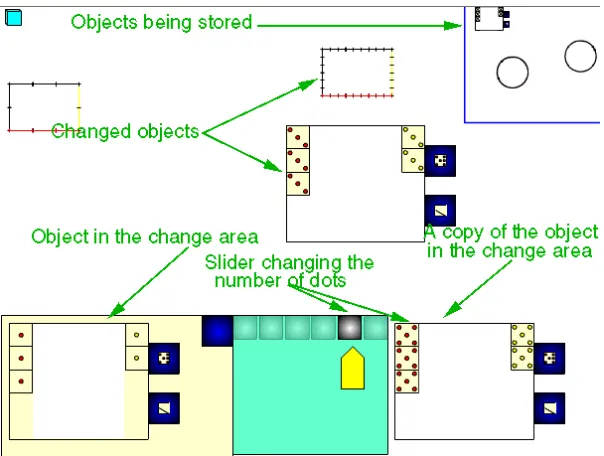
Figure 7. Microworld during the play, with some objects already modified... 68
Figure 8. A truck ready to enter the racecourse ... 75
Figure 9. Abby's table with correspondences between amounts of juggling balls for different jugglers... 76
Figure 10. Annie's sharing pattern based on multiplicative relations. ... 77
Figure 11. A fragment of Niky's screen drawing demonstrating complexity of the pop-up window structure... 78
Figure 12. Sofia's marching ants and multiplying stones. ... 79
Figure 13. Two balancing levels of Abby's game... 80
Figure 14. A representation of the relation "one more."... 83
Figure 15. Sofia's "between" relations. ... 84
Figure 16. Two of Zack's timetables... 85
Figure 17. Annie's equivalency class based on relations of difference. ... 86
Figure 18. Zack's qualitative equivalence classes... 87
Figure 20. Two additive sharing patterns. ... 94
Figure 21. The basket of never-ending apples. ... 95
Figure 22. Sharing additively (with an error, 4 instead of 3, that was corrected in dialog) and sharing multiplicatively. ... 95
Figure 23. Additive, multiplicative and exponential patterns... 97
Figure 24. A highly enhanced truck... 101
Figure 25. Words, abbreviations, and numbers: abstract representations... 101
Figure 26. Fantasy characters. ... 102
Figure 27. Weapons from Evan's game. ... 103
Figure 28. Penguin, tiger and elephant buttons... 104
Figure 29. A house surrounded by menus. ... 104
Figure 30. Detailed drawings of fruit baskets... 105
Figure 31. Enhanced stick figures... 105
Figure 32. Evolution of Annie's representations... 107
Figure 33. Evolution of Zack's representations. ... 108
Figure 34. Zack's first timetable. ... 109
Figure 35. Similarities between Abby's first level and my microworld. ... 113
Figure 36. Abby's difficulty levels... 117
Figure 37."Done!" buttons. ... 119
Figure 38. Adding and clearing buttons... 120
Figure 39. Partial change in representation types. ... 122
Figure 40. Zack's checkerboard idea... 131
Figure 42. My drawings of proportionality in response to Zack's request for a definition. . 132
Figure 43. Monster truck sizes and car obstacle sizes. ... 133
Figure 44. Zack's timetables. ... 136
Figure 45. Zack's missing values in timetables... 138
Figure 46. Possible lengths of ant columns. ... 142
Figure 47. Multi-part object structures. ... 144
Figure 48. Source and target separation... 150
CHAPTER 1. INTRODUCTION
Education research studies have, by definition, a single umbrella topic – learning. “How do we begin to unravel the nature of the learning process, a relationship between an individual and the environment that results in the individual having new understandings and capacities?” asks Schoenfeld (1999) who sees hope of answering this question in integration across the social/cognitive constructivism split (p. 7). This split, reaching deeply into the field of education research, is associated with many consequential divides on all levels, from methodology to epistemology.
Initially, these separate points of view, born of analysis, create “handles” that help researchers to tackle phenomena not investigated before. An example from epistemology is the difference in views on where knowledge is situated. In radical constructivist perspectives, researchers “see knowing and knowledge as located “in the head” (or at least the body and brain) of the person” (Kieren, Calvert, Reid, & Simmt, 1995, p. 1). In social constructivism, knowledge has an already constructed existence on a social level, and “societal level
constructions are seen as a necessary ‘cloud’ of knowledge hanging over the individuals or in another sense surrounding them” (Kieren, Calvert et al., 1995, p. 4). From the theoretical and methodological point of view, one can say that radical constructivist models focus on
sociocultural constructivists work on “general ideas about processes by which learning takes place” (p. 7). Another example of the separation in methodology is the divide between structured laboratory interview methods, such as Piagetian type tasks (Goldin, 2000; Inhelder & Piaget, 1958; Noelting, 1980; Piaget & Campbell, 2001), and contextual studies of situated activities (for example, Hoyles, Noss, & Pozzi, 2001; Lave, Murtaugh, & de la Rocha, 1984; Nunes, Schliemann, & Carraher, 1993).
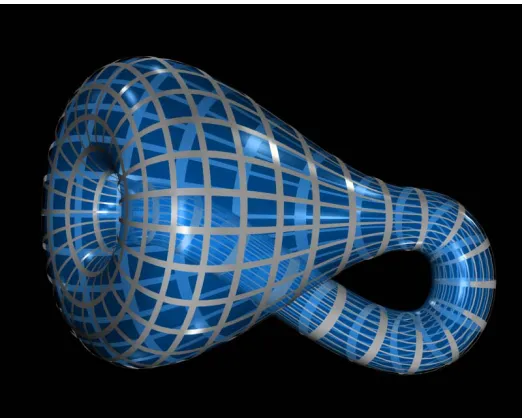
Figure 1. A simile for cycles of synthesis and analysis.
The conceptual framework for this study provides tools and mechanisms for using methods and theoretical constructs from both sides of the divides discussed above. For models of the mathematical content area of this study, proportionality, I use works done from cognitive or radical constructivist perspectives (such as Behr & Harel, 1990; Noelting, 1980; Vergnaud, 1994). On the other hand, for bridging the gap between work done by learners in particular contexts, and corresponding formal ideas and models, I used integrative research (such as Hoyles et al., 2001). The term “integrative” here refers to the fact that these researchers use laboratory-type studies and situated learning, and also context-oriented studies, in their framework. To give an example of a method used for the integration, these researchers found that they could “map” activities observed in the natural setting of the nursing practice into areas of formalized mathematical systems such as “proportionality.”
To define and to chart learners’ understanding, I used the Pirie-Kieren Dynamical Model For The Growth of Mathematical Understanding (Berenson, Cavey, Clark, & Staley, 2001; Cavey, 2002; Kieren, 2002; Kieren, Calvert et al., 1995; Kieren, Reid, & Pirie, 1995; Pirie & Kieren, 1994b; Pirie & Martin, 2000; Towers, 2001), developed within enactivism. The theoretical stance of enactivism aims at integrating sociocultural and radical
“Knowledge is not in a book or in the library, knowledge is not in our heads. Knowledge is in the inter-action!” (Kieren, Calvert et al., 1995, p. 1). Using this perspective, I study
Figure 2. A simile for enactivist epistemology.
The Pirie-Kieren Dynamical Model For The Growth of Mathematical Understanding is a leveled, non-linear, recursive construct for researching learning of a particular topic by a particular person. Each level denotes a certain way of knowing, where “knowing” is
understood as an action. The levels unfold from the innermost one of primitive knowing, in the sense of “prime” or “elemental.” Then follow the levels of image making, image having, property noticing, formalising, observing, structuring, and the outermost level of inventising.
While trajectories, or mapping onto levels, of each individual learning episode do not present a straight line from primitive knowing to inventising, the construction of each level envelops and structurally incorporates all levels that are inner to it. More formal and abstract levels, namely formalising, observing and structuring, enfold the less formal and more local levels.
content areas. For example, layers up to formalising in one content area can be considered to be “inside” of a learner’s primitive knowing layer for another area (Towers, 2001). Primitive knowing denotes understandings that took place up to the beginning of the new learning, and is composed fractally of other levels from the model that correspond to other concepts.
A trajectory that maps learning into levels corresponding to several mathematical contexts may not only be recursive, that is, going back and forth between levels
corresponding to one concept, but also nonlinear with regards to interacting understandings of several concepts. In this manner, the Pirie-Kieren model has been used to map “points” corresponding to complex “trajectories” among different modes of understanding. Yet little research has been done to explain how learners move between points on these trajectories. This study helps to promote development of tools for helping learners learn by addressing the “How?” questions that require integration of learning and pedagogical research (Cobb & Yackel, 1995; B. Davis, Sumara, & Luce-Kapler, 2000; Tzur, 1999; Tzur et al., 2001).
Research Questions
The problem I addressed in this study is: “What are roles of metaphor in the growth of mathematical understanding?” In particular, I studied roles of metaphor in the
areas for my framework. For the literature review, as well as for the data analysis, I used a perspective that is built on umbrella definitions of three notions: equivalency class, relation, and invariance. For short, I call the perspective ERI, after the first letters of its key notions. I call the definitions “umbrella” in that they can be used to map actions in additive,
multiplicative or analogy worlds, and interactions between these worlds. Relation is a binary operation on numbers or other objects, such as a multiplicative or an additive operation between numbers, or a qualitative relationship. Invariance is the preservation of a relation between objects in a group under an operation on each object. Equivalency class is a set of groups of objects that have the same system of relations between objects in each group. Curly brackets {} are used to denote equivalency classes. Some examples are in order.
• Couples such as (dog; fur), (fish; scales), and (bird; feathers) belong to the
qualitative equivalency class that can be described as {(type of animal; type of covering)}. This is an example of a traditional analogy.
• Couples such as (5; 7), (1.5; 3.5), and (100; 102) belong to the additive
equivalency class with respect to the relation between the numbers of “two more,” and can be described as {(a; a+2)}. It should be noted that I do not use the sign “:” since it usually denotes division, while statements such as
5:7=100:102, that could be considered descriptions of additive equivalence class members, are traditionally labeled “additive misconceptions”
(Abrahamson, 2003; Behr, Harel, Post, & Lesh, 1993; Kaput & West, 1994) • Couples such as (3; 6), (7; 14), and (-2; -4) belong to the multiplicative
discussion below, that the equivalency class consisting of the same members can be formalized differently, for example, as {(a:2; a)}.
Several researchers of proportional reasoning note a similarity between proportions and analogies that motivated me to include qualitative relations into the ERI perspective. For example, Piaget says: “analogies… are a sort of qualitative proportions. They are relations among relations” (Piaget & Campbell, 2001, p. 139). Piaget and neo-Piagetians such as Noelting (1980) created stage models of proportional reasoning development. In these models, the notions of equivalence, invariance and relation – all the parts required for working with proportionality – are added consequently, one by one, starting with purely qualitative analogies where equivalence is based on non-numeric relations, and ending with formal equivalence of ratios. Their theories, again, focus mostly on mathematical content rather than on mechanisms of learning (Schoenfeld, 1999). Lehrer, Strom and Confrey (2002) see analogy-based systems of scale, magnification, and classification as grounding metaphors that can serve as a basis for development of proportional reasoning.
Researchers who study analogical reasoning have noted a methodological dilemma that is based on theoretical and epistemological differences in definitions of “understanding” and “learning.” Analyzing analogical reasoning studies devoted to metaphors, Ortony (1993) divides their methodologies into “construction” and “comprehension” types. In
development of cognition and language. This methodological distinction corresponds to the epistemological difference between comparison and interaction views on metaphor (Black, 1962; Sfard, 2000). According to the interaction view, similarity between two concepts is not simply observed, as in the comparison view, but created. Seeing the similarity is not the prerequisite, but the outcome of the metaphoric projection. Such an analysis can also be applied to studies of proportional reasoning. Laboratory proportional reasoning tasks done in the Piagetian tradition access understanding in the form of solving given, strictly
pre-determined problems, while ethnographic research looks at understanding in the form of posing, and only then solving, problems.
I define metaphor as the recursive movement between a source and a target that are structurally similar, both changing in the dynamic process of learning (B. Davis, 1996; R. Davis, 1984; English, 1997a; Lakoff & Johnson, 1980; Lakoff & Nunez, 1997, 2000; Pimm, 1987; Presmeg, 1997b; Sfard, 1997). I adopt the notion that mathematical thinking is
fundamentally metaphoric (R. Davis, 1984; Lakoff & Nunez, 2000; Sfard, 1997). As
Lakoff and Nunez (2000) also argue that metaphor’s primary function is “to allow us to reason about relatively abstract domains using the inferential structure of relatively concrete domains,” (p. 42) with structures of image schemas preserved by this mapping. Hence metaphor can be considered as a mechanism for connecting informal and formal ways, or levels, of understanding (Pirie & Kieren, 1994b). The action of metaphoric projection (Sfard, 1997) is co-determined by learner-specific and context-specific factors. Thus sociocultural perspectives can promote the study of metaphor’s grounding in culture, and its
communicative, shared facets. Additionally, I follow Presmeg, who considers metaphors to be “very private, personal, and ripe with meaning for an individual” (1997b, p. 277), which means metaphors are difficult to access directly by methods such as clinical interviews and laboratory tasks, calling for more contextual, situated approaches.
Based on the above considerations, the following are my research questions: • What are the roles metaphors might play in the growth of mathematical
understanding?
• What metaphors may be involved in the growth of understanding of
CHAPTER 2. LITERATURE REVIEW
frameworks that support such integrative approaches, and the implications for my conceptual framework. Throughout the chapter, I also note questions, issues and concerns raised within each topic, in their relevancy for the study’s methodology. These issues are discussed in detail in Chapter 3.
Definitions of Metaphorical and Analogical Reasoning
I start this part by presenting several definitions of metaphor found in literature, and reviewing categorizations and analysis of metaphors done by different authors. Then I talk about possible roles of metaphors in the growth of understanding, as it is modeled within different constructivist perspectives.
Sfard (2000, p. 68) defines metaphor as “transferring templates from discourse to discourse” and notes that the metaphorical projection with use of templates is a mechanism of creating new mathematical objects. In her view, expectations about properties of newly created mathematical objects may arise, by work of metaphors connected with a signifier, around an “empty space” held by that signifier. Sfard’s work is an example of a study with the “construction” (Ortony, 1993, pp. 1-2) methodology, corresponding to the interaction theory (Black, 1962) of metaphor: here the target of the metaphoric projection is being created by the act of projection, and the source may also be modified.
An example of the “comprehension” (Ortony, 1993, pp. 1-2) methodology, based on the comparison theory (Black, 1962) of metaphor is offered by Pimm, (1987):
understand it we must decide on the latent analogy upon which it is based. Our interpretation of the metaphoric expression is dependent on this reconstruction of the underlying analogy (pp. 100-101).
In this case, the target of the metaphoric projection is not created by the projection; the metaphor, at most, transfers some features of the source onto the target, connecting the already existing target and the source. In another telling example, children who created their own analogies, such as geometric figures as different types of dinosaurs, were categorized as “least proficient reasoners” (Alexander et al., 1997, p. 141) by researchers focusing on comprehension of the pre-determined analogies.
English (1997a) defines analogical reasoning as “the transfer of structural information from one system, the base, to another system, the target” (p. 5). She notes that the transfer happens “through matching or mapping processes, which entail finding the relational
correspondences between the two systems” (p. 5), and that mathematical thinking is based on such deep, structural correspondences. English, following Lakoff and Nunez (see next) notes that metaphorical reasoning is characterized by mapping between different domains that “can change our understanding of both the source and the target” (p. 7). In a study on word
problems, English (1997b) addressed questions such as “whether children know to look for common structures” indicating emphasis on the comparison model of analogical reasoning. For example, she writes: “If learners are to make these mappings however, they need to clearly understand the structure of the base and must be able to recognize the correspondence between the base and target” (p. 199). The words “look for” and “recognize” are indicators of the comparison model.
Lakoff and Nunez (1997) see mathematics as “a product of inspired human
In their work on metaphors, researchers create categories of analysis, and the categories usually come in pairs, reflecting the dichotomizing method of analysis. Pimm (1987) talks about extra-mathematical and structural metaphors, based on their source:
There are two main sources of metaphor which may be of interest in mathematics education. The first consists of what I term extra-mathematical metaphors. These attempts to explain or interpret mathematical ideas and processes in terms of real-world events, and such metaphors can involve everyday objects and processes… The second main source, which I call structural metaphors… involves a metaphoric extension of ideas from within mathematics itself (p. 95).
Lakoff and Nunez (1997) created similar categories for analysis, calling them grounding and linking metaphors: “Grounding metaphors ground mathematical ideas in
everyday experience… Linking metaphors allow us to link one branch of mathematics to another” (p. 34). They also talk about a third kind, “concocted novel extensions of the natural grounding metaphor” that belong “to the domain of teaching” which “stand outside of
mathematics proper and are part of imaginative, and sometimes forced, methods of mathematics education” (Lakoff & Nunez, 1997, p. 39). Note that in this kind of analysis, mathematics is separated from “the rest of the life” and teaching is separated from learning and from mathematics. However, there are mechanisms that may allow synthesis, since “novel metaphors that we consciously concoct use the mechanisms of our everyday unconscious conventional metaphor system.” (Lakoff & Nunez, 1997, p. 32).
mapping images of actions. In my study such distinctions correspond to objects and actions in software children design. Thus, by analyzing how learners design and develop actions and objects in their programs, I access their structural and operational metaphors. Interviews and observations during the software design process further help me to analyze these types of metaphors: “the language of object manipulation and motion can be recruited in a systematic way to talk about arithmetic” (Lakoff & Nunez, 1997, p. 38).
Categorization of analogical thinking into conscious and unconscious is where several researchers (English, 1997a; Presmeg, 1997b; Sfard, 2000) draw the line between analogies and metaphors. “Analogy enters the scene when we become aware of a similarity between two concepts that have already been created; the act of creation itself is a matter of
metaphor” (Sfard, 2000, p. 345).
Another categorization into two types of metaphor is based on whether or not they “may be accepted into the “taken-as-shared” understandings” (Presmeg, 1997b, p. 268). Pimm (1987) calls these classes idiosyncratic and conventional:
There are, therefore, personal or idiosyncratic metaphors which perhaps one person or only a few individuals employ, and which are often invented extemporaneously, resulting from a personal insight… The way of seeing embodied in the metaphor may become institutionalized (possibly by means of being written about in books!) in which case it would then become a conventional metaphor, a standard form both of conception and expression (p. 98).
issue involves “the different manners in which hearing and sight situate us in relationships with others” (B. Davis, 1996, p. 37) and with the world, and also epistemological stances associated with visual and hearing metaphors:
Visual metaphors, such as “the mind’s eye,” suggest a camera passively recording a static reality and promote the illusion that disengagement and objectification are central to the construction of knowledge. Unlike the eye, the ear operates by
registering nearby subtle change. Unlike the eye, the ear requires closeness between subject and object. Unlike seeing, speaking and listening suggest dialogue and interaction (Belenky, McVicker Clinchy, Coldberger, & Tarule, 1986, p. 18).
A notion related to metaphor is what R. Davis (1984) calls an assimilation paradigm. It is a system, involving ideas for which most learners have strong representations, that is an “isomorphic image” of a mathematical domain. Such assimilation paradigms, for example, the turtle programming metaphor (Clements & Sarama, 1997; Papert, 1993), provide learners with tools for solving problems in the mathematical domain. In my view, assimilation
paradigms correspond to what Lakoff and Nunez (1997; 2000) call teaching metaphors. Assimilation paradigms can also be related to what Pimm (1987) and Presmeg (1997b) call shared, conventional metaphors, since most learners must have the representations
underlying assimilation paradigms. The idea of an assimilation paradigm, in my opinion, may integrate features of the comparison and interaction views on metaphor. For learners, an assimilation paradigm carries, as the metaphor from the interaction model, “a constitutive power” (Sfard, 1997, p. 344). However, people who help learners establish such an
the projections happening inside the assimilation paradigm, in this part approaching the comparison model.
To summarize, I define metaphor as the recursive movement between a source and a target, both changing in the dynamic process of learning. I relate the notion of metaphor to that of an assimilation paradigm, and note that a computer microworld may serve as a basis for an assimilation paradigm. In this study, the process of designing a microworld or a computer game about proportionality serves as an assimilation paradigm.
Roles of Metaphor in Learning
The division between new and old knowing arises from definitions of learning. The key question about this division that is relevant to this study’s goal is, “How does new knowing come to be?” Sociocultural and cognitive constructivists, as well as enactivists, believe that the answer is, “New knowing is born of old knowing”: “The idea that new knowledge germinates in old knowledge has been promoted by all the theoreticians of intellectual development, from Piaget to Vygotski to contemporary cognitive scientists” (Sfard, 1997, p. 350). However, there are differences in hypotheses about mechanisms or ways by which new knowing is born of old. I focus on the role of metaphors in answering this question postulated by researchers.
The defining theme of the interaction perspective (Black, 1962; Ortony, 1993) is that metaphors play a constitutive role in creating new knowing. Metaphors are not just
created by metaphor rather than being only used by it” (Sfard, 1997, p. 361). Lakoff and
Nunez (1997) also write on how metaphors can “add structure to a target domain” (p. 32). One particular example of a mechanism for making new knowing from old is the model of bricolage, “the process of using materials that happen to be at hand, in order to carry out some quite new process or construction that becomes possible when these old materials are combined in appropriate new ways. This suggests the image of a child’s mental representation being built up in rather the way that some children build tree houses, using whatever boards, nails, and other materials are available” (R. Davis & Maher, 1997, p. 95). The metaphor of bricolage comes from a neo-Darwinian model of evolution (B. Davis, 1996; Varela, Thompson, & Rosch, 1991) that is built on survival of the fit, rather than fittest. What is compatible with a given context, survives. In bricolage learning process, metaphors play at least two roles: one is the role of “supply lines,” or transfer tools, moving concepts into the newly emergent structure. The second role is that of “reconstruction blueprints” where metaphors change the structure of the target concept, as well as the structure of the source of the metaphoric projection. R. Davis (1984), describing a similar model, uses the terms “collage” and “assembly,” as well as a lot of italics for emphasis: “in order to “think about” abstract matters, we make use of our cognitive collages… these collages themselves must
play a major role in shaping our thinking” (p. 178). Davis and Maher (1997) underlie the
role of metaphors as “tools to think with” (p. 105), not as communication devices: “We use a metaphor in order to represent some piece of knowledge within our own mind… we use metaphors within our own minds in order to be able to think” (R. Davis, 1984, pp. 177-178).
that it can be used as a unit in a further process at a higher level of abstraction, until this process in turn becomes reified as a mathematical object, and so on” (Presmeg, 1997b, p. 275). This process corresponds to “a long chain of metaphorical projections and
transformations” (Sfard, 1997, p. 351) where primary bodily experience is repeatedly transformed in the process of forming advanced mathematical concepts. Inherent in the process of reification is the serious difficulty related to the signifier of the new mathematical process or object: “In the perceptual reality, processes and objects are two different things” (Sfard, 2000, p. 50). Yet the same signifier initially plays both the operational and the structural roles: “The expression ‘5-8’ itself could be used both operationally, as denoting and operation, and structurally, as signifying an object (the result of an operation)” (Sfard, 2000, p. 50). In the reification model of learning, metaphors play the crucial role in resolving this difficulty. During the process of reification, a new name or a signifier, which now is a noun, and a discourse template including this signifier, serves as “an act of conception rather than of baptism” (Sfard, 2000, p. 68) for the new mathematical object being reified from a process. Such templates with nouns come from the “actual reality” discourse, where perceptual mediation by material objects exists. The templates are then transferred into the mathematical discourse, the effect that is defined as metaphor. “We may say, therefore, that what we call "mathematical objects" are metaphors resulting from certain linguistic
transplants” (Sfard, 2000, p. 68).
play a part in this model in the following manner: “Like all other ‘acts of meaning,’ the metaphorical projections we perform are socially mediated… coordination of metaphors which underlies learner’s conceptual development is only made possible by his or her ongoing exchange with others” (Sfard, 1997, p. 363).
Metaphors may play a role in transitions between informal and formal understanding. English (1997a) sees metaphors as tools for creating formal concepts out of image schemas, and of restructuring these concepts in complex ways. I investigate this role of metaphor using the Pirie-Kieren model (Pirie & Kieren, 1994b), where metaphor can be considered as a mechanism for connecting informal and formal layers of knowing. Formalization may also be connected to the “death” of metaphors (Sfard, 1997), as in an example of the rational number concept: “the process of concept construction is only completed when the metaphor ‘dies’ and the learner becomes able to think about the new number as a self-sustained independent entity belonging to the abstract domain of numbers” (p. 352).
A distinction between two types of models of growth of understanding has to be made at this point. The Pirie-Kieren model presents learning as a cyclic, but not unidirectional process. For example, a learner may “fold back” (Pirie & Martin, 2000), that is, move to an inner layer from an outer layer, for example, from formalising to image making. Even though the visual representation of the layers of understanding in the Pirie-Kieren model is
of approaches can benefit, if used together for analysis of different levels of education phenomena, a study of metaphor and proportional reasoning. The Pirie-Kieren model itself, as I mentioned, shows correspondences between recursive, non-linear ways people learn on a micro-scale, or from the position of learner as observed by researchers, and a sequential model of levels of learning on a macro-scale, or from the position of pedagogy. Connecting Maturana and Varela’s (Varela et al., 1991; von Glasersfeld, 1997) idea of autopoesis with metaphor, Sfard (1997) also talks about a recursive way of metaphor’s development, where “creation of new concepts should be viewed as a zig-zag movement between relatively familiar source and the emergent target… this is the process of mutual adaptation which, with its every swing, does not only strengthen the target but also alters and adds new dimensions to the source” (p. 355). This way of modeling thinking parallels agile software design processes (Astels, Miller, & Novak, 2002; Beck, 1999) that I adopt for this study, as explained in more detail in Chapter 3. The zig-zag nature of metaphor can also be used for resolving “vicious circles” (Barwise & Moss, 1996), or the learning paradox (von
Glasersfeld, 1998), arising within cognitive constructivists’ models. I talk about it in the section on proportional reasoning, using examples from proportional reasoning literature.
Proportional Reasoning Studies
The area of proportionality attracts the interest of mathematics education researchers for many reasons, from methodological to epistemological, from historical to sociological. Theoretically, both proportionality and proportional reasoning are rich in complex
phenomena ensuring fruitful studies. The subjects of proportion and ratio are included in most mathematical curricula, and in state standards and NCTM standards (2000).
Proportional reasoning is one of the main arithmetic precursors to algebraic thinking.
Moreover, by now the community of education scholars has conducted much research in the area, allowing new studies to start at a fairly sophisticated level. All these reasons influenced my choice of proportionality as the main mathematical area for the study.
Proportional reasoning situations have been analyzed and categorized in various ways. Frameworks that give birth to categorizations of situations can, in their turn, be categorized by, first, the degree to which they treat tasks and learners “as collections of variables” and, second, the degree to which they attempt to address tasks as “authentic, situated activity” (Kaput & West, 1994, p. 235). Not coincidently, “variable” approaches tend to involve more deductive tasks and contextual approaches tend to involve more
inductive tasks. Using terminology of metaphor studies, “variable” approaches correspond to comparison theories, while contextual approaches correspond to interaction theories.
naturalistic inquiry originates in multiple theoretical, epistemological and methodological dilemmas arising from tensions between the control of variables and authenticity of the situation.
Yet excluding one of the two approaches to the study design has been only one of possible ways of resolving their contradictions. First of all, it can be argued that both
contextual and “laboratory” features are necessarily present in each study, even if the degree of conscious attention the researcher pays to one or the other varies. Every study, even a most carefully controlled laboratory task, is situated in some context. Every study, even an
ethnomathematical study, focuses on certain aspects of the situation – the aspects that would be construed as “variables” before the appearance of context-centered frameworks. Secondly, as pedagogy becomes science (Kuhn, 1970) and researchers become more conscious of epistemological and theoretical issues, they attempt to create frameworks based on complex integration of the two approaches, resolving theoretical contradictions on philosophical level, and methodological contradictions on the level of theories. An example of such integrative studies are laboratory tasks designed around “naturally occurring” phenomena. That is, contextual considerations are infused into the way “variables” are construed in variable-driven task design. Another synthetic example is the choice of a naturalistic setting where particular actions of interest to the researcher are sure to take place, and particular
In the next several parts of the chapter, studies of proportional reasoning are reviewed based on their design features. Thus descriptions of studies are grouped into categories of ethnographic methods, laboratory task designs, and “naturally occuring” variables. Next, I talk about a way definitions of proportionality from these studies can be formalized, and also the particular manner in which the learning paradox manifests itself in the area of
proportionality. Finally, I describe microworld-based research as a way to integrate other methodological approaches.
Education Ethnographies
Proportional reasoning studies of this type analyze “everyday activities in context” (Lave et al., 1984, p. 67). That is, studies involve situations that are neither pre-fabricated nor negotiable by the researcher. What constitutes mathematical activity in such contexts is defined by the activity’s formal properties, and is shaped by broader activities within which it occurs, as well as the past experiences of actors as problem solvers.
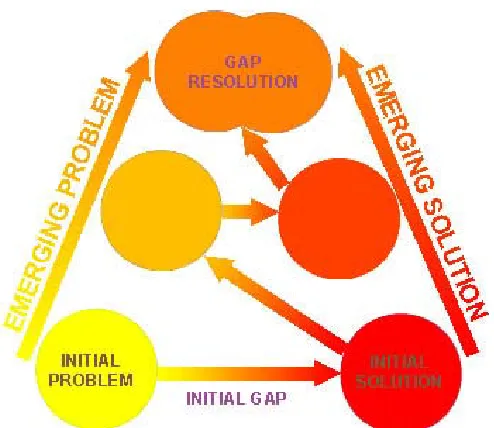
An example of such an activity is price comparison observed by Lave (1984, p. 81) during the grocery shopping study. Here, mathematical tasks have a multitude of meanings, from solving “pure” mathematical problems to symbolism of power in money or in the mathematical “objectivity.” Lave found that tasks as well as solutions are established in a recursive, “gap-closing” process that involves both qualitative and quantitative
solutions, but also tasks are flexible – there is a “dialectical movement between the expected shape of the solution and the information and calculation devices at hand, all in pursuit of a solution that is germane to the activity” that gave it the initial shape (Lave et al., 1984, p. 87). Another example of this kind of mathematical ethnography is a study of money-related activities among young street sellers (Nunes et al., 1993). Researchers in these studies follow the grounded theory tradition in allowing “variables” of the study to emerge from data. For example, they used “mapping” of activities into areas of a formalized mathematical system. Researchers did not know ahead of time into what areas, such as proportionality or
multiplication, the activities would be mapped.
Other educational ethnographies focus on actions of a somewhat pre-determined kind, allowing researchers to fix, ahead of time, some of the “variables.” It should be noted that these actions are pre-determined by an authentic context in which they are embedded, not by researchers’ creative actions. Therefore, in such research one can use frameworks that combine both situated learning and “fixed variable” features. An example of such a design is the analysis of proportional reasoning in nursing practice (Hoyles et al., 2001). More
above. It turned out that different tasks, as construed by different solution strategies, were associated with particular features of the situation. For example, particular drugs with known concentrations were associated with particular simpler ratios such as 1:2 and with doubling strategies, or with powers of ten. By choosing a setting where phenomena that can be construed as “proportional” occur naturally, the researchers could keep their study situated and, at the same time, could use relevant research even if it was conducted in school or laboratory settings. The second, follow-up study focused on differences between nurses’ behavior “in situ” and in test situations (Noss, Hoyles, & Pozzi, 2002), and found that task authenticity dimension had a large influence on whether or not the nurses solved problems correctly.
Laboratory Task Research
Researchers represented in this section use laboratory task design that “involve minimally a subject (the problems solver) and an interviewer (the clinician), interacting in relation to one or more tasks (questions, problems, or activities) introduced to the subject by the clinician in a preplanned way” (Goldin, 2000, p. 519). Such laboratory tasks devoted to proportional reasoning can be further categorized based on formal mathematical
representations of the idea of proportionality (Kaput & West, 1994, p. 236). Some of these studies were influenced by quantitative research frameworks from the mechanistic worldview (Goldhaber, 2000), where closed-ended tasks are formed around formalizations-derived variables, and “the universe of content was fixed at the beginning” (Noelting, 1980).
This classification may apply to other types of studies as well, as there is nothing that should restrict them to laboratory task research. For example, the type of task where ratios are construed as probability was used by Drier (2000) in a computer microworld study. Physical tasks involve a physical principle, for example, the idea of projection or gears. Rate problems involve ratios of “dissimilar objects,” for example, assigning patients to doctors or giving food to fish. An example of a mixture task is mixing orange juice with water and studying concentration.
Another kind of approaches to categorizing proportional reasoning problems deals with the numerical complexity of the task, or, in other words, with task’s “number structure” (Tournaire & Pulos, 1985, p. 183). For example, juice-water mixture comparison puzzles in (Noelting, 1980) study are sorted into nine structural categories, from comparing “non-mixed” pairs (0,1) and (1,0), to “equivalence classes” such as comparing (1,2) and (2,4) and to “pairs without corresponding terms multiple of one another” such as (5,7) and (3,5) (p. 228). Tournaire and Pulos (1985, p. 183) mention several “hurdles” separating problems of different numerical complexity: 1:2 ratios, 1:n ratios, non-unit ratios, and non-integer ratios. Irrational numbers, which would present the next level of numerical complexity, are not mentioned in proportional reasoning studies I have found. A distinction that relates both to the number structure and to the situation described in the task is whether the task deals with discrete (apples, pennies) or continuous (time, weight) variables (Tournaire & Pulos, 1985, p. 183), the later being less accessible to learners.
By the problem’s goal, proportional reasoning problems have been sorted into missing value problems and comparison problems (Karplus, Pulos, & Stage, 1983, p. 220).
variable.” Extensive variable is a quantitative description of an object, for example, length or time. Intensive variable is a constant ratio relationship between extensive variables. In missing value problems, the goal is to find an unknown extensive variable. In comparison problems, the goal is to compare intensive variables.
To summarize the above, task designs can be categorized based on the number structure of the task, the situation described in the task, and one of the ways the ideas of rate or ratio or proportion are formalized mathematically.
“Naturally Occurring” Variables
In this section, I review works of researchers who also study laboratory tasks with controlled variables, with a distinction from the previous section described by Kaput and West (1994) as: “our analyses are done relative to forms of reasoning that we believe are naturally occurring” (p. 236). There is a higher degree of attention to context and to learner in these studies. Researchers here use methods developed within qualitative research
frameworks. Thus, studies in this section attempt to integrate contextual and “controlled variable” approaches to research by choosing their “variables” based on contextual considerations.
to the tasks that Tournaire and Pulos (1985) called “rate tasks.” The fourth type, stretchers and shrinkers, involves scaling up or down according to a fixed ratio, for example, the
growth of trees.
A conceptualization using the terms “extensive and intensive variables” (Kaput & West, 1994, p. 239) separates particular intensive quantities and rate intensive quantities. A rate intensive quantity describes a general relationship between whole extensive quantities, for example, “four legs per every dog” refers to all dogs and all dog legs. Particular intensive quantity describes a particular instance of rate intensive quantity, such as “twelve eyes of these two dragons” – not generalizing, at least at the moment, to all dragons. The authors believe that rate intensive quantities are built from many experiences with particular intensive quantities.
Other studies create categories of proportional reasoning, focusing on different kinds of strategies for solving proportional problems. (Karplus et al., 1983) propose three
categories of reasoning in proportional tasks: within, between and other. “Within” type of reasoning deals with rates of two variables within one instance of the linear relationship, for example, with the rate of distance to time. “Between” type of reasoning deals with ratios between corresponding quantities in different instances of the linear relationship, for example, a ratio between times or distances. The rest of strategies, for example, the cross-product algorithm, are grouped under the name “other.”
Formalizations of Proportionality and the Learning Paradox
Thompson & Saldanha, 2003; Vergnaud, 1983, 1988, 1994). It should be clear that this formalization is not the way learners think about proportionality; it is a way to express, in a uniform manner, different ways researchers of proportional reasoning build their theories. This formalization employs the notions of equivalency class, relation, and invariance (ERI). Vergnaud (1994), uses “a sophisticated mathematical framework to theorize about the intuitive knowledge of learners” (p. 49), that is, he maps learner knowledge into his model, which is formalized in mathematical terms. The framework itself involves complex
relationships between four types of proportional situations, and schemes defined as “the invariant organization of action for a certain class of situations” (Vergnaud, 1994, p. 53). The four types of situations involve simple and double proportions, concatenation of simple proportions, and comparison of rates and ratios.
I adapt the formalization used by Vergnaud, applying it to different models used by other researchers. My adaptation consists of broadening the definition in such as way that it can describe not only proportions, but also equivalency classes based on non-multiplicative relations. Let ~ denote the relation, and let ≡ denote the statement of equivalence, that is,
equality for quantitative relations, or “being the same” for qualitative relations. Then the classical formalizations of proportional reasoning types, now broadened to include analogical reasoning, become:
{(c; d) such that c~d≡a~b for the given (a, b, ~)}(“within” reasoning), or
{(c; d) such that a~c≡b~d for the given (a, b, ~)} (“between” reasoning), or
{(c; d) such that c~d≡k for the given k and ~} (“ratio-based”).
c~d≡”child”}. In such formalizations, there are two operands, ~ and ≡, stating the existing
proportionality. That is, for given numbers or objects a, b, c and d, or c, d and k, the definition can be used to determine if there is proportionality. This way of defining
proportionality does not tell, explicitly, how to solve such proportional reasoning problems as missing value problems, or, in other words, how to construct all the members of the
equivalency class described in this manner.
Vergnaud and Thompson, in their models, use a definition of proportionality that emphasizes construction of proportion members, explicating linearity of the constructive operation. To do so, the definition requires three operands: the equivalence ≡, a binary
operation ~, and a linear with respect to ~ unary operation or function the authors denote f: {(k~c, f(k~c)) such that f(k~c)≡k~f(c) for any k and for given (c, f, ~, ≡)}.
For example, if ~ denotes multiplication (as a binary operation), and f denotes multiplication by 3 (as a unary operation), and c=2, the proportion turns into:
{(2k, 3*2k)}
To obtain the “traditional” definition of the same proportion, take c=1 to get:
{(k, 3*k)}
Note how the “traditional” definition implicitly includes the linearity, or in other versions invariance under an operation, while the three-operand definition explicates it, saying how all proportion members can be found, once f is established to be linear with respect to ~. The establishment of linearity f(k~c)≡k~f(c) is defined as the statement of
proportionality.
Models of proportional reasoning development can be analyzed from the ERI
invariance and relation. The relation considered in literature is most often a multiplicative operation. For example, Behr and Harel (1990) use invariance and relation to sort
proportional tasks into invariance-of-ratio and invariance-of-product categories. If the most commonly used solutions to a task are based on ratio comparison, the task is classified as invariance-of-ratio. If the most commonly used solutions are based on product comparison, the task is classified as invariance-of-product. Kaput and West (1994) see growth of
proportional reasoning as development of the notion of class of equivalence or
“homogeneity” from invariance. In their model, learners start from numerical invariance of particular intensive qualities, such as speed or price, and develop the idea of homogeneity of the intensive quantity. Vergnaud (1994) also construes proportion as an equivalence class of pairs of quantities, where the result of an operation within a pair is invariant under the corresponding operation on each quantity. In other words, the operation within pairs is invariant under the transformation between pairs.
Several researchers note tensions inherent in constructivist models of proportional reasoning. The notions of equivalence and invariance are construed in models as based on the operation(s). On the other hand, conceptualizing the operation within the domain of
switch. Understanding this property, which is a part of development of notions of operations, depends on the notion of invariance.
In the above examples, constructing ideas of operations on one hand, and invariance and equivalence on the other, form a “vicious circle” (Vergnaud, 1994). This content paradox can be considered a representation of a profound theoretical tension in radical constructivism, or the learning paradox (Tzur & Simon, 1999; von Glasersfeld, 1998), where the
development of concepts seems to rely on the learner having already developed similarly advanced concepts. It should be noted that other constructivist perspectives are also driven by such deep, paradoxical tensions. In sociocultural perspectives, there is the question of the relationships between interpersonal, contextual understanding and intra-personal
understanding, or the problem of internalization (Vygotskii, 1996). In enactivist theories, there is the problem of the relationships between understanding in action, co-created with context, and understandings brought to and from actions in the form of “objectified actions” (B. Davis et al., 2000; Kieren, Calvert et al., 1995). Development of the field of education research happens in large part by addressing such profound problems. I used the epigraph of the chapter as a simile for the idea of different ways in which problems of the creation of new knowledge are addressed in different perspectives.
thereby developing the notion of the purely qualitative equivalence based on a qualitative relation, or “correlation,” first. Using this notion, learners move to the concept of invariance or “reciprocity”, such as when they balance a lever by “placing a light weight at a great distance and a heavy weight at a small distance” (p. 317). At this stage, a qualitative operation takes its place in the development of the proportionality notion. Quantitative proportions, defined as the equality of two ratios, are denoted as formal operations, and appear as a development of qualitative invariance by includingnumerical compensations. Noelting (1980) constructed a similarly hierarchical model, where learners start from distinguishing equivalence from non-equivalence in examples such as comparing (4, 1) and (1, 4). In Noelting’s later stages learners are perceived as gradually adopting “add on” strategies involving multiplication or division of terms, developing the notion of invariance under operations.
and proportion is itself one of analogy. Thus an analogy links one relationship A:B to another C:D… While proportion is a symmetric mathematical relation, the use of analogy
customarily presumes a preferred direction of application, in that it assumes more is known about one relationship than about the other” (Pimm, 1987, p. 100). Pimm defines metaphor as solution to a sort of a missing value problem in analogy: “One way of seeing metaphor is as a condensed analogy. From the analogy codified as A is to B as C is to D, we speak, for
instance, of “the C of B” or “A is C”. Thus, “he is in the winter of his life.” If we are presented only with a metaphor, then in order to understand it we must decide on the latent analogy upon which it is based. Our interpretation of the metaphoric expression is dependent on this reconstruction of the underlying analogy” (pp. 100-101).
I investigate possible connections between learners’ growth of understanding in the area of proportionality, and analogical reasoning and metaphoric thinking. In terms of metaphor studies, much work has been done on proportional reasoning, that is, on proportionality models that can be compared with comprehension methodologies and comparison theories on metaphors. More work is needed in the area of construction methodologies and interaction theories. Also, there is a need to investigate relationships between construction and comprehension models.
Microworld-Based Research
phenomena similar to those observed in naturalistic settings: “the pupil would bump into imbedded mathematical ideas in the context of meaningful activity” (Hoyles & Noss, 1987, p. 142). On the other hand, by playing the role of demiurges the researchers have control over the rules of their microworlds. Moreover, most researchers observe not only “free play” of learners within the microworlds, but also, in the majority of studies, engagement of learners with pre-determined tasks within microworlds, “guided discovery” activities or “independent mathematical activities” with researcher-set goals.
One common theme in microworld studies is the possibility for learners to “try out their ideas and simultaneously receive feedback” (Clements, 2000a, p. 36). Тhat is, learners have opportunities to try out their ideas and to change their approaches based on the results. This feature gives a more authentic, situated activity quality to the studies. It also
complements cyclic models of learning and of metaphor described above. Mathematical thinking is implemented, and tried out, in microworld actions: “When designing the microworlds, it was our intension to create possible actions, which, when used by children with specific intension and purposes, could be implementations of their mathematical operations” (Steffe & Tzur, 1994, p. 103). Thus microworlds, by providing an open environment, allow the use of frameworks with situated learning features. However, by placing additional restrictions on goals or tools available to learners within the microworld, researchers can also use some features of laboratory task methodologies, converting
spontaneous activities into guided projects, open-ended problems, or even classical laboratory tasks.
Drier (2000) used a modified Steffe and Wiegel (1994) model to sort activities by the playful orientation of the children’s actions, the mathematical purpose of the actions, and whether the actions were initiated and sustained by children or by the teacher. The four categories are cognitive play, mathematical activity, independent mathematical activity, and mathematical play. Cognitive play and mathematical play are initiated and sustained by a child, their difference being in levels of mathematization of the playful activity. In terms used in (Lave et al., 1984), there is a more direct mapping of a child’s activity into formal
mathematics when the child is engaged in mathematical play, compared to cognitive play where actions are not intentionally mathematically oriented. Mathematical activity and mathematical independent activity are goal-oriented. Both are teacher-initiated, but the first one is sustained by teacher guidance, and the second one by the child. B. Davis (1996) sees learner and teacher as parts of the context. The context, therefore, is not a setting for the learning activity and not a place for actors such as learners and teachers.
The distinction between cognitive play and mathematical play is an example of partitions being born of the divide between formal and informal. In terms of metaphors, mathematical play may be seen as the cognitive play after the metaphor-driven formalization (English, 1997b) has occurred. In relation to the Pirie-Kieren model (1994b), mathematical play corresponds to the outer layers and cognitive play to the inner layers of the model.
vectors.” While Olive (1999) talks about a pizza-sharing task in his microworld Sticks, what learners actually see are more abstract objects, resembling the namesake of the world rather than pizzas.
Yet another dimension that can be construed as reflected off the formal-informal divide is related to the kinds of programming within the microworld. In some studies, learners cannot control features of the microworld via programming at all, but use a direct manipulate interface, that is, more visual, concrete, informal methods. For example, the tasks in the microworld Sticks (Olive, 1999) do not allow learners to program. In an example of another type of study, Harel and Papert (1990) studied a task where fourth-grade learners designed software to teach fractions to third graders in a microworld involving “symbol” programming, where each code command must be individually programmed in a more formal language. Hoyles and Noss (1989), in their study of learning of proportional strategies with Logo computer language, used “The N tasks” – constructing a sequence of N’s with given sides and given angles, where the proportionality task, embedded in the activity, was for children to determine the size of the middle part of the letter. Children constructed N’s using the Logo programming language, where the angle and the distance a turtle had to walk leaving a trace had to be determined in the program.
Moreover, several programming languages, including all newer versions of Logo, contain programming, direct manipulation and sometimes object-oriented programming features (Blaho & Kalas, 2001). “Object-oriented” means that it is possible to create objects with their own variables, procedures, and settings; build hierarchies of objects with setting-inheritance; and allow certain other objects operations such as sending messages between objects or polymorphism, that is, allowing objects to interpret the same procedure in different ways. Such versions of Logo as Turtle math, Microworlds 2.1, Imagine, or SuperLogo
(MathsNet.com, 2002) have “two-way connections between visual and symbolic
representations” (Clements, 2000a, p. 24). On the level of actions within the microworld, the same principle is expressed in actions implementing dynamic links between multiple
representations of objects, such as numerical, graphical and iconic (Drier, 2000). Different representations of functions were used as a learning tool in Function Probe, a multi-representational microworld for function exploration (Confrey, Smith, Piliero, & Rizzuti, 1991).
Borrowing role descriptions from professional software development (Astels et al., 2002), one can conclude that in iconic, non-programming microworlds learners play the role of software users, and microworld creators the roles of software designers and testers. In microworlds with accessible programming, learners may play all three types of roles. Several studies investigated the transformative function of the designer role in the student’s learning (Harel & Papert, 1990; Kafai, 1995; Papert, 1993).
mathematical development” (Cobb & Yackel, 1995, p. 176). Also, depending on researchers’ framework, one can view either social norms or individual beliefs as defining tools for roles. In an integrative stance on the issue, “social norms and beliefs are seen to be reflexively related” (Cobb & Yackel, 1995, p. 178).
Some Theoretical Considerations for Building an Integrative Conceptual Framework
Much of the proportional reasoning, analogy and metaphor research I reviewed above is focused on either content or educational theories, either cognitive or sociocultural
perspectives, and either construction or comprehension methodologies. If the development of the field of mathematics education is viewed from categorical positions, then such research may be considered to be in an analytic stage, where new categories are being created by “separating ‘this’ from ‘that’” (B. Davis, 1996, p. 2). Some work in education research is also directed toward synthesis of findings from analytic studies, where integration is achieved either by collapsing categories or by creating an extended structure encompassing the categories. Both analytic and synthetic types of research are needed for growth of understanding in education. The difficulty of synthesis is that analytic studies are rarely conducted with the purpose of future integration. Analysis can be defined as an activity directed at differentiation among theories, at underlying their differences, and even at placing them in opposition to other theories. Such analytic work is a major tool of framework
tensions between parts taken from perspectives that were originally designed as disparate have to be meaningfully addressed.
Despite the dangers and difficulties, the need for synthesis is being satisfied in a “move towards interdisciplinarity that is sweeping the social sciences and the humanities” (Ernest, 1994, p. 1). Mathematics education researchers, in particular, use tools, ideas and theories from anthropology, neurology, linguistics, biology, discourse analysis, cognitive studies and other areas of thought. In this part of the literature review, I collect tools researchers used for synthesis, creating an “epistemological toolbox” for building an
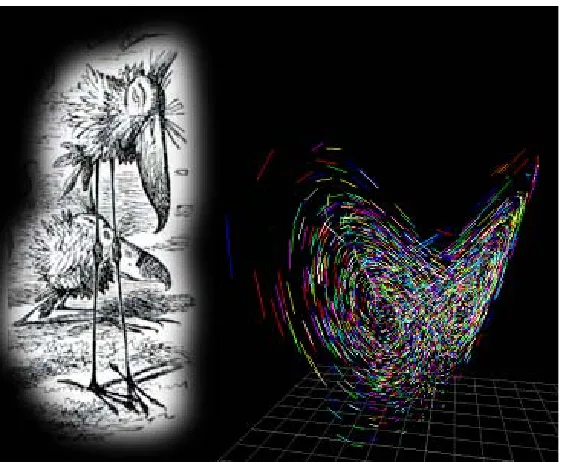
integrative conceptual framework for the present study (Figure 3). Researchers whose studies gave birth to the sociocultural and cognitive branches of constructivism are used in the visual simile for integration in Figure 3: Vygotski as Yin and Piaget as Yang.
To define and to analyze the three world views of mechanism, organicism and contextualism, Pepper, cited in (Goldhaber, 2000) uses divides between universally
generalizable and situation-specific theories, and between holistic and reductionist levels of analysis, claiming that incompatibility of sides in each divide makes the worldviews
mutually exclusive. However, some researchers attempt “not merely healing the “gaps” but side-stepping the mode of thinking (and acting) out of which they arise” (B. Davis, 1996, p. 2). The idea of co-emergence is one of the integrating principles of enactivism (B. Davis, 1996; R. Davis, 1990). This idea is used to address a group of dilemmas. For example, knowledge is not either “out there” in the world or social context, or inside the mind. Instead, it is possible to view “the knower, the knowing and the known as emerging together” (Begg, 1999, p. 8). A dichotomous question of whether knowledge in first born in the mind or in communication, that some view as separating sociocultural and radical branches of constructivism, is thus not being posed.
Cobb and Yackel (1995) take such an integrative approach to studies, using cyclic principle to integrate theory and practice, when they write, “relationship between theory and practice is reflexive” and, “theory is seen to grow out of practice and to feed back to inform and guide practice” (p. 175). “Agent-world” and similar divisions call for, and, reflexively, come from, conducting education studies focused on either learners or teachers or social contexts as objects of analysis. From another point of view, this division causes the split betweens studies that focus on mathematical content, and studies that focus on pedagogy (Schoenfeld, 1999). For example, in studies focused on learning other contextual