Weak keys of the Diffie-Hellman key exchange I
A. A. Kalele [email protected]
V. R. Sule [email protected]
Department of Electrical Engineering Indian Institute of Technology Bombay
Powai, Mumbai 400076
September 28, 2005
Abstract
This paper investigates the Diffie-Hellman key exchange scheme over the groupF∗
pm
of nonzero elements of finite fields and shows that there exist exponentsk, lsatisfying certain conditions called themodulus conditions, for which the Diffie Hellman Problem (DHP) can be solved in polynomial number of operations in m without solving the discrete logarithm problem (DLP). These special private keys of the scheme are termed
weakand depend also on the generatoraof the cyclic group. More generally the triples (a, k, l) with generator aand one of private keys k, l weak, are called weak triples. A sample of weak keys is computed and it is observed that their number may not be insignificant to be ignored in general. Next, an extension of the analysis and weak triples is carried out for the Diffie Hellman scheme over the matrix groupGLn and it is shown that for an analogous class of session triples, the DHP can be solved without solving the DLP in polynomial number of operations in the matrix sizen. A revised Diffie Hellman assumption is stated, taking into account the above exceptions.
Key Words : Discrete logarithms, Diffie Hellman key exchange, Finite fields, General linear group.
1
Introduction
In this paper we analyze the Diffie Hellman (DH) key exchange scheme [1] on two groups
F∗
pm, the group of nonzero elements of a finite field andGLnthe group ofn×nmatrices over a finite field. Since the public keys and the secret key exchanged between two parties in this scheme are obtained by integral exponentiations in a group, it is necessary for the security of this scheme that the discrete logarithms be not solvable inexpensively in the group. This condition is not sufficient to ensure security unless an assumption made by Diffie Hellman holds, according to which there is no alternative efficient way to recover the shared key other than computing the discrete logarithms. On multiplicative groups of finite fields such asF∗
operations [9, 15]. It is apparent therefore that the study of exceptions to this assumption or its proof are of great importance to secure practice of these schemes.
1.1 The Diffie Hellman problem
Consider a finite groupG and let < a >⊂Gbe a cyclic subgroup. In the DH scheme two users select positive integersk,l calledprivate keys modulo the ordernofaindependently. Then declaring the public keys b = ak, c = al results in their sharing the element s =
bl = ck = akl called the shared key. The Diffie Hellman Problem (DHP) is to determine the shared keysfrom the knowledge of the triple (a, b, c) called the public data of the DH session. We call the triple (a, k, l) the session triple. The problem of computing k (or l) given b(or c) is the Discrete Logarithm Problem (DLP).
The DH assumption (also known as the as yet unfalsified DH conjecture) above precludes solving the DHP without solving the DLP. This is stated informally in many texts as follows. Let (a, k, l) be a session triple of a DH key exchange scheme with public data (a, b, c). Then, the DHP cannot be solved (or the shared keyscannot be computed) without solving the DLP (or computing one of k or l). Such a statement is however imprecise from a computational point of view until the complexities of solving the two problems are clarified. Moreover for the DH scheme to be secure it is necessary from the complexity viewpoint that the DHP be not solvable in polynomial time. Hence we restate the DH assumption as
Conjecture 1(Diffie Hellman conjecture). Consider the public data (a, b, c) of a DH session with session triple (a, k, l) withaof ordern in a groupGand k, l inZn. Then,
1. Any algorithm which computes the shared keys=akl cannot accomplish this task in polynomial time depending on the public data and
2. Whenever an algorithm computes sthe computation also yields one ofk orl.
In the above statement the problem of efficient computation of s and computational equivalence of the two problems DHP and DLP are formulated distinctly. Precise statements of the DH conjecture are well known using complexity theoretic arguments in [2, 3, 4] and using probabilistic arguments as in [17, 13]. From a probabilistic viewpoint the DH assumption can also be stated as follows.
If s = A(a, b, c) is a an algorithm running in polynomial time with the public data as the input then the probability of its success givings as the shared key of the session is negligible
gives an alternative way to examine the DH assumption from a probabilistic viewpoint. The sample computations of the insecurity factor for small fields indicates that the probabilistic statement of the DH assumption may not hold universally. It is not only from a theoretical viewpoint that it appears worthwhile to know a characterization of these exceptions, such a characterization would be necessary to make the DH scheme provably secure. This paper initiates first steps in this direction.
In this paper we explore the above exceptions and show that there exist exceptional private keys for which the DHP can be solved in polynomial time for these special cases without solving the DLP. Such exceptional private keys are called weak keys of the DH scheme. An application of these weak keys for paring based DH schemes over elliptic curves is reported in the second part of this paper. The present part is devoted to establishing the weak keys of the DH scheme overF∗
pm and GLn and explore their implications.
Currently a complete characterization of these weak keys is not known. However a sample of computations overF∗
pm shown in this paper reveals that the density of such weak keys depends on many factors such as the field characteristic, the minimal polynomial of the generator and private key of the other user. The examples show that the percentage of weak keys can be sometimes significant among the set of all permissible keys which a user can choose. Since weakness of the private keys is interdependent, random choice of private keys by two parties in a DH scheme is not secure in the key exchange protocol. This fact is of importance in practical DH schemes wherein more constraints need to be specified in the selection of private keys in order to exclude the weak keys. We however show that detecting weakness of the private key by the second user having received the public key of the first user is inexpensive and helps to avoid choice of weak private key.
1.2 DH scheme over the matrix group
Generalization of the DLP overGLn(K) was proposed in [8]. In [6, 7] it was shown that no extra security was gained in the matrix case since the DLP for matrices could be translated in polynomial time to a DLP over an extension field of K. In this paper we analyze the DH exchange scheme overGLn and show that there exists a special class of exponents and session triples for which the DHP can be solved in time which is polynomial in the matrix size. This special class in the matrix case follows from the analogy of weak keys in the finite fields case. A full characterization weak keys in the matrix case however shall require much further analysis and should have fruitful applications. These problems shall be left for future research.
1.3 Organization of the paper
Next section of this paper develops the special cases of the DH scheme over the groupF∗
pm. These are defined in terms of sets of private keys and it is shown subsequently that the DHP for these special cases can be solved in polynomial time without solving the DLP. The section is concluded with illustrative examples of weak keys over different cases ofF∗
pm. In section 3 the definitions and analysis is extended to the matrix case over finite fields K
problems are highlighted. Finally, concluding remarks summerize the importance of results to practice of the DH scheme.
2
Modulus conditions and conjugate classes over
F
∗pmIn this section we describe weak keys of the DH scheme over the group F∗
pm of nonzero elements of the finite field Fpm. Consider a session triple (a, k, l) being used by two users where a be an element ofF∗
pm of order n. (In most casesa will be a primitive element of
F∗
pm hencen=pm−1). The private keys k,lare in Zn. Let (a, b, c) = (a, ak, al) denote the public data of the session and s=akl denote the shared key. For any ain F
pm denote by
h(a, x) the minimal polynomial of aoverFp[x] (whenais primitive degh=m). Denote
hc(x) = lcm (h(a, x), h(c, x))
hb(x) = lcm (h(a, x), h(b, x))
Following conditions define sets of private keys of central importance to this paper.
Definition 1 (Modulus conditions). A session triple (a, k, l) is said to satisfy the modulus condition C1 if
xk modh(a, x) =xkmodh
c(x) (1)
while the triple (a, k, l) is said to satisfy modulus condition C2 if
xl modh(a, x) =xlmodh
b(x) (2)
Consider next another class of session triples.
Definition 2 (Conjugate class). A session triple (a, k, l) is said to belong to theconjugate class relative tok (respectively l) if h(a, x) =h(b, x) (respectively if h(a, x) =h(c, x)).
Thus (a, k, l) is in conjugate class relative to k if the public key b and generatora are conjugates. Further, in order to describe the weak private keysk,lof the DH scheme which are associated with weak session triples (a, k, l) we define following subsets of Zn.
Definition 3. LetainFpm be fixed of ordern. Define 1. Set of keys of the Conjugate class
C(n) ={t∈Zn|t=prmodn, for some 0≤r∈Z}
2. Keys satisfying modulus condition C1. Givenl∈Zn
W1(a, l) ={k∈Zn|xk modh(a, x) =xkmodhc(x)}
3. Keys satisfying modulus condition C2. Givenl∈Zn
W2(a, l) ={k∈Zn|xl modh(a, x) =xlmodhb(x)}
We show in what follows that the above setsC(n) andWi(a, .) are weak keys of the DH scheme as the DHP can be solved in polynomial time for session triples (a, k, l) whenever eitherkorllie in any one of these sets. In short we shall show that the setW(a, l) denoting
W1(a, l)∪W2(a, l) is a set of weak keys. By definition the setsW1,W2 depend onaand l.
2.1 Conditions for solving the DHP
The following theorems give necessary and sufficient conditions under which the shared key can be computed from the public data uniquely and can be expressed as a polynomial in the public data. These conditions are also useful for individual users of a DH scheme to determine whether or not their private keys are weak by looking at the public keys of the other user.
Theorem 1. The following statements hold
1. There exists a polynomial f inFp[x] such that
(a) degf <degh(a, x)
(b) The following equations hold
b = f(a)
s = f(c) (3)
iffk belongs to W1(a, l).
Moreover,f is the unique such polynomial satisfying the above two conditions
2. There exists a polynomial gin Fp[x] such that
(a) degg <degh(a, x)
(b) The following equations hold
c = g(a)
s = g(b) (4)
iffk belongs to W2(a, l).
Moreover,g is the unique such polynomial satisfying the above two conditions.
Proof. Letf inFp[x] exists satisfying the conditions (a), (b) above. ThenF(x) =xk−f(x) belongs toFp[x] and has rootsaand c. HenceF(x) is divisible by the minimal polynomials
h(a, x) and h(c, x) hence also by hc(x) their lcm. Since degh(a, x) ≤ deghc(x), degf is less than the degrees of both of these polynomials. It follows thatf(x) =xkmodh(a, x) =
xk modh
c(x). Further,f is the unique such polynomial of required degree which must then satisfy (a),(b). This proves necessity of item 1 and uniqueness of f.
Conversely let f(x) = xk modh(a, x) = xkmodh
c(x). Then (a) and (b) hold. This proves sufficiency of item 1. Item 2 can be proved on similar lines.
Remark 1. Computation of polynomialf (respectivelyg) in the above theorem from public data is a problem of solving linear systemsb=f(a) (respectively c=g(a)) for coefficients off (resp.g) which are polynomials in Fp[x] of degree less than degree ofh(a, x). Further, ifkbelongs to one of the sets claimed then the shared keyscan be computed as eitherf(c) org(b).
Theorem 2. The following statements hold
1. There exists a polynomial f inFp[x] such that
(a) degf <degh(a, x)
(b) The following equations hold
c = f(a)
s = f(b) (5)
iffl belongs to W1(a, k).
Moreover,f is the unique such polynomial satisfying the above two conditions
2. There exists a polynomial gin Fp[x] such that
(a) degg <degh(a, x)
(b) The following equations hold
b = g(a)
s = g(c) (6)
iffl belongs to W2(a, k).
Moreover,g is the unique such polynomial satisfying the above two conditions.
We omit the proof as it follows on similar lines as that of the proof of the earlier theorem. One obvious class of keys k (respectively l) which is contained in W2(a, l) for any l
(respectively contained inW2(a, k) for anyk) are those for which the minimal polynomials
satisfyh(a, x) =h(b, x) (respectively h(a, x) =h(c, x)). Following theorem shows that this is precisely the conjugate class.
Theorem 3. h(a, x) =h(ak, x) iffkbelongs toC(n). MoreoverC(n)⊂W
2(a, k) for anyk
inZn.
Proof. Elements aand ak have the same minimal polynomial over F
p iffak is a root of the irreducible polynomial h(a, x). By the well known characterization of roots of irreducible polynomials [18], ak=apr forr = 0,1,2, . . . ,(d−1) where d= degh(a, x)≤m. However, in the splitting field Fpd of h(a, x) we have ap
d
=a. Hence ak=apr for any r >0. Hence
k=prmodn. Thus without loss of generality we can assume m =d. Other statement is obvious.
An important relationship between the conjugate class keysC(n) and the setW1defined
above is given by
Proof. Let r be in C(n). Then h(a, x) = h(ar, x). Hence any t inZ
n belongs toW1(a, r).
This proves sufficiency.
Conversely, let for some r, W1(a, r) = Zn. Since ordar ≤ orda and hence also t = degh(ar, x) ≤ h(a, x) = d ≤ n. Let h(a, x) = xd+φ(x) and h(ar, x) = xt+ψ(x). If
t = d= n then both polynomials must be equal to xn−1. Hence assume t≤ d < n. If
t < dthenxtmodh(a, x) =xtwhilextmodh(ar, x) is polynomial of degree less or equal to
t−1 which would give a contradiction. Hencet=d. On the hand,φ(x) =−xdmodh(a, x) while ψ(x) =−xdmodh(ar, x). Henceφ(x) =ψ(x). This proves necessity.
In view of the fact proved below that the set W(a, l) is a set of weak keysk, the above properties show that the set C(n) is the set of fatally weak keys since l belongs to C(n) implies all keysk inZn are weak. Further we have
Corollary 2. C(n) is a multiplicative subgroup of Z∗
n.
The proof follows from the fact that C(n) =< p >(cyclic multiplicative monoide) inZn but since nis the order ofa,nis coprime to phencep has inverse inZn. Note that the set
C(n) may not be small. For instance when pis a primitive root of the multiplicative group
Zn then everyk inZn is of the formpr modn. However when p is not primitive inZn the cardinality ofC(n) is equal to the number of conjugates ofawhich is equal tom when the generator ais primitive in Fpm. In this case C(n) has the smallest cardinality.
2.2 The scalar case
We now discuss the case of DH session where the generatorais chosen fromFp itself. Thus
m= 1 and h(a, x) = (x−a). In this case we have
Corollary 3. 1. C(n) ={1}.
2. W1(a, l) ={k|k(l−1) modn= 0}.
3. W2(a, l) ={k|l(k−1) modn= 0}.
Proof. In this case t is in C(n) iff (x−a) = (x−at) i.e. a=at. Sincet is by definition in
Zn,t= 1. Next, the modulus condition C1 holds for kgiven a fixedl iffxkmod (x−a) =
xk mod (x−c) which is equivalent toak =ck=akl. Hence k(l−1) modn= 0. Similarly
kis in W2(a, l) iffal=akl from which the claim follows.
Finally, consider a to be the generator of F∗
p i.e. a primitive element. Then the order of a equals p −1. Hence we get W1(a, l) = {k|k(l −1) mod (p −1) = 0}. Similarly
W2(a, l) = {k|l(k−1) mod (p−1) = 0} and also C(n) = {1}. Alternatively this implies
that weak keys k satisfy one of the equations ck = c or bl = b. Since the shared key is
s=ck=bl,kis weak iff s=c=b. This is the classical setting for DH key exchange with a large primep. In this setting the conjugate class is smallest. Further, if the ordernof ais prime then the only weak karel−1
modnwhich means the second user should not choose
2.3 Solving the DHP without solving DLP
We now investigate the problem of solving the DHP over F∗
pm when either k is inW(a, l) or l is in W(a, k). Theorem 1 above gives criteria in terms of equations (3), (4) for the private key k to belong to set W(a, l). Equations (3) and (4) are linear in coefficients of polynomialsf andgwhose solutions give the shared keysas eitherf(c) org(b) wheneverk
orl are members of the sets W(a, l),W(a, k) respectively. In such situations an adversary can computef(c) andg(b) from public data and succeeds in attacking the DH scheme.
Theorem 4. Consider a session triple (a, k, l) in which either k belongs to W(a, l) or l
belongs to W(a, k). Then the DHP can be solved in number of operations which grows at most as a polynomial in m over the field Fp. The shared key computed is either f(c) or
g(b). Moreover fork, l≥m this computation does not yield any of k,l.
Proof. Sincebandcboth belong to the fieldFp(a) we can assume without loss of generality that the degree of h(a, x) is equal to m and that Fpm = Fp(a). The equation (3) then is an expression ofbin the basis 1, a, a2, . . . , am−1
. The coefficients in this expression are the coefficients of the polynomial f. Hence computation of f is equivalent to change of basis expression for binFpm. This involves number of operations inFp which is a polynomial in
m. Similar conclusion holds for computation of g from the equation (4). Next the shared keysequals one or both off(c) or g(b) by theorems 1, 2. This computation involves linear combination of the basis elements ofFpm overF
p and is equivalent to a multiplication of an
m×m matrix overFp by an m-tuple. This proves the claim on number of operations. Next we show that computation of polynomialsf orgabove does not yieldkorl. Since
f is computed from the equation b =f(a) the data is independent of l. Also fork ≥ m,
f(x)6=xk being a reminder of division by h(a, x). Let q(x) be the quotient. Then
xk =q(x)h(a, x) +f(x)
The equationb=f(a) is thus identical to
b=q(a)h(a, a) +f(a)
Howeverh(a, a) = 0. Hence solution off fromb=f(a) gives no information onq(x). Since
kand q(x) are known simultaneously, this computation does not yieldk. Similar reasoning shows that computation of g also does not yield l. That the shared key s equals f(c) or
g(b) is proved above.
Remark 2. The above theorem shows that the DHP is solvable in polynomial time when-ever the session triples satisfy one of the modulus conditions without solving the DLP. We thus call the set W(a, l), W(a, k) the sets of weak keys and session triples (a, k, l) weak triples whenever one of the modulus conditions is satisfied. However the theorem gives no idea of the complexity of solving the DLP for these special class of triples. This is an open problem which shall be left for future work.
2.3.1 Weak keys, weak session triples and a computational check
We close this section with an algorithm which provides a computational check on session triple (a, k, l) to verify the conditions of the above theorem. Recall that we denote the setsW1(a, l)∪W2(a, l) simply asW(a, l). Thus by this notation, a session triple (a, k, l) is
weak (i.e. satisfies any one of the modulus conditions C1 or C2) iff either k ∈ W(a, l) or
l∈W(a, k). This algorithm builds from the criteria of theorem 1 in terms of equations (3), (4) for the private key k to belong to sets W1(a, l), W2(a, l) respectively. Consider a DH
session in which the generator aand the public key c of the second user is known i.e. the private key lis already chosen.
Algorithm 1. (This algorithm checks whether a choice of kbelongs toW1(a, l)∪W2(a, l)
for a given public keyc of the first user which leaveslfixed).
Input Generator aa primitive element in the field Fpm, order nof aand the public key c.
1. Choose kinZn randomly.
2. Compute b=ak.
3. Compute polynomials f(x), g(x) in Fp[x] of degrees less thanm such that
b = f(a)
c = g(a)
(Alternatively, compute the coefficients in the expressions of b and c in terms of the polynomial basis 1, a, a2, . . . , a(m−1)
ofFpm. These are precisely coefficients off andg. Whenh is the minimal polynomial of the extensionFpm the co-efficients are available in the presentation ofb andc).
4. Compute s=ck.
5. Set boolean variableX = 1 if (s−f(c))(s−g(b)) = 0 else X= 0.
Output k,X,s. (Key kis weak ifX = 1 and in that case sis the shared key).
Note that the above algorithm can be executed in polynomial time (in m) as already shown in the proof of the above theorem. The above algorithm computes weakness of the private keyk and the subsequent shared keys. For computing weakness of the private key
l and the corresponding shared keyswe can execute an identical algorithm given below.
Algorithm 2. (This algorithm checks whether a choice ofl belongs toW1(a, k)∪W2(a, k)
for a given public keyb of the first user which leaveskfixed).
Input Generator aa primitive element in the field Fpm, order nof aand the public key b.
1. Choose lin Zn randomly.
3. Compute polynomials f(x), g(x) in Fp[x] of degrees less thanm such that
b = f(a)
c = g(a)
(Alternatively, compute the coefficients in the expressions of c and bin terms of the polynomial basis 1, a, a2, . . . , a(m−1)
ofFpm. These are precisely coefficients off andg. Whenh is the minimal polynomial of the extensionFpm the co-efficients are available in the presentation ofb andc).
4. Compute s=bl.
5. Set boolean variableX = 1 if (s−f(c))(s−g(b)) = 0 else X= 0.
Output l,X,s. (Key lis weak if X= 1 and in that case sis the shared key).
2.4 Existence and examples of weak keys
From the above development we can legitimately call the sets W(a, r) as the sets of weak keys for given private keysrand a. The algorithm of the last section gives a computational check for these sets in terms ofaand the public key of the first user. In fact we called the set
C(n) as fatally weak. Such weak keys must necessarily be avoided in a DH scheme. There now remains the question of existence and cardinalities of the setsW(a, l) of weak keys as functions ofaand l(respectively k). Existence of weak keys inFpm is immediate since the set of conjugate class keysC(n) =< p >as shown above, where< p >is the multiplicative group of units ofZnand furtherC(n)⊂Wa,r for anyr inZn. HoweverC(n) by itself is not large for primitive elements. A complete characterization of the sets W(a, r) has not yet been found. However we provide a collection of samples of these sets in different fieldsFpm computed numerically. The number of weak keys as functions of parameters p, m, n does not appear to be negligible in general. At the same time it is difficult from these examples to quantify in general the number of weak cases with respect to the field parameters. The problem of fuller characterization ofW(a, r) shall be left for further work.
2.5 The Insecurity Factor
In the following examples, the percentages of weak k’s for each of the l in the range d≤ l < ord (a)−1 are plotted for different finite fields of approximately same orders. Let L
denote the ratioN1/N2 whereN1= number oflfor which there are approximately 10% or
higher number of weakk, andN2 = orda−(d+ 1). Percentage of weak keys of the order of
10% is practically noteworthy hence we choose this as a lower limit. On the other hand the numberLdenotes the percentage of weak cases for choice of the second private key. Let an Insecurity Factor denoted I be defined as the percentage of first key choice (say choice of
l) for which at least 10% of the the second key choice (keys k) is weak. Then in terms of the above numbersI =N2×100. In practice this means thatI% of the private keys chosen
first are likely to be insecure.
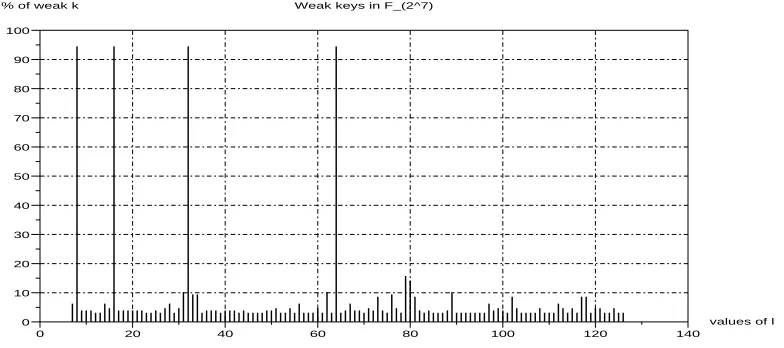
Example 1. Weak keys in the field Fpm for p= 2, m = 7. Generator polynomialh(x) =
0 20 40 60 80 100 120 140 0
10 20 30 40 50 60 70 80 90 100
Weak keys in F_(2^7)
values of l % of weak k
Figure 1: Weak keys for field characteristics p=2
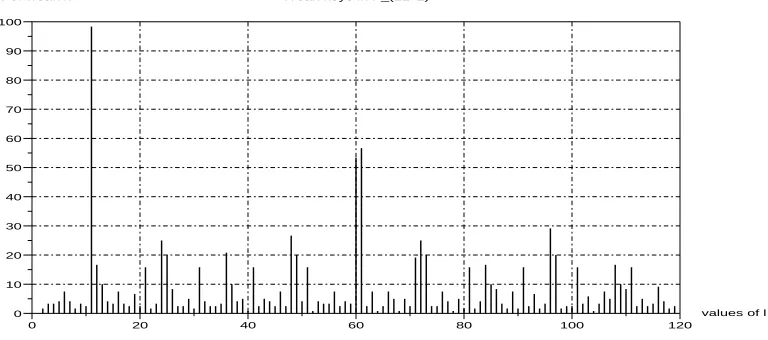
Example 2. Weak keys in the field Fpm for p= 5, m = 3. Generator polynomialh(x) =
x3+ 3x+ 2. orda= 124. L= 39/120 = 0.33. See figure 2.
0 20 40 60 80 100 120 140
0 10 20 30 40 50 60 70 80 90 100
Weak keys in F_(5^3)
values of l % of weak k
Figure 2: Weak keys for field characteristics p=5
Insecurity factor I = 33%.
Example 3. Weak keys in the fieldFpm forp= 11, m= 2. Generator polynomialh(x) =
x2 + 4x+ 7. orda = 120. L = 31/117 = 0.26. See figure 3. This plot also shows higher
0 20 40 60 80 100 120
0 10 20 30 40 50 60 70 80 90 100
Weak keys in F_(11^2)
values of l % of weak k
Figure 3: Weak keys for field characteristics p=11
average of weak keys.
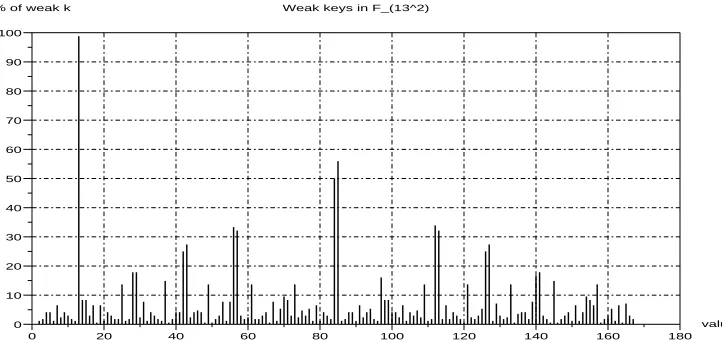
Example 4. Weak keys in the fieldFpm forp= 13, m= 2. Generator polynomialh(x) =
x2+x+ 2. orda= 168. L= 34/165 = 0.21. See figure 4.
0 20 40 60 80 100 120 140 160 180
0 10 20 30 40 50 60 70 80 90 100
Weak keys in F_(13^2)
values of l % of weak k
Figure 4: Weak keys for field characteristics p=13
Insecurity factor I = 21%.
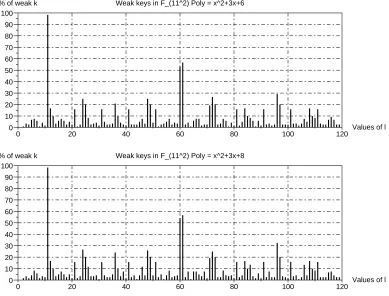
Example 5. Weak keys in the field Fpm for p = 11, m = 2, orda = 120. Generator polynomial h1(x) =x2+ 3x+ 6 withL= 28/117 = andh2(x) =x2+ 3x+ 8. L= 31/117.
See figure 5.
Insecurity factor I = 24%.
Example 6. In this example we present an instance of weak triple in a relatively large field, since a complete list by enumeration, as provided in previous examples is not feasible in reasonable time for such a large field. Let F1135 be the finite field constructed with an
irreducible polynomialf(x) =x35+ 10x10+ 3 overF
11. Letabe a root of this polynomial.
Consider a triple (a, k, l) with (k, l) = (13244084834273,10100). Now the public data (b, c) for this choice of k, l is (b, c) = (9a3, a30+ 8a25+ 6a20+ 10a15+ 2a10+ 10a5 + 5). The shared key s = akl = 9a25+ 2a20+ 7a15+ 5a10+ 3a5 + 4. Now the polynomial f such
that b=f(a) isf(x) = 9x3. The shared key scan be computed asf(c). Now we consider another triple (a, k, l) with (k, l) = (39732254502817,13567). The public data (b, c) for this choice of k, l is (b, c) = (3a7,7a32+ 9a27+a22+ 4a17+ 4a12+a7+ 7a2). The shared key
s=akl= 2a34+ 4a29+ 6a24+a19+ 10a14+a9+ 6a4. The polynomialf such that b=f(a)
isf(x) = 3x7. The shared keyscan be computed as f(c).
2.6 Justification for evaluation of weakness
0 20 40 60 80 100 120 0
10 20 30 40 50 60 70 80 90 100
Weak keys in F_(11^2) Poly = x^2+3x+6
Values of l % of weak k
0 20 40 60 80 100 120
0 10 20 30 40 50 60 70 80 90 100
Weak keys in F_(11^2) Poly = x^2+3x+8
Values of l % of weak k
Figure 5: Weak keys for field characteristicsp= 11 with different polynomials
to the conjugate class. However there are two issues here which are both relevant for secure implementation of the DH scheme.
1. The adversary can always compute the polynomials f, g from the public data and computes1 =f(c) ands2 =g(b). If one ofk, l is weak then one of these is the shared
key. In practice shared keys are seeds for encryption algorithms on which chosen plain text attacks can be mounted. Hence having a probable seed compromises the encryption process since it is not any randomly chosen seed being tried. Hence it is assumed that being able compute the shared key compromises the key exchange even if the associated DH decision problem is not solved since in this case information outside of the DH session is being utilized.
2. Whether or not the a random private key chosen by a user is weak can be determined inexpensively by the user who selects the key after the first user has declared her public key. Hence since randomly chosen private keys can turn out weak it will be safer to carry out the check for weakness rather than take the randomly chosen private key which may be weak. Hence incorporating the algorithm for verifying weakness of the private key is not only inexpensive but provides safety.
3
Modulus conditions and solution of the DHP in matrix
case
In this section we develop an extension of some of the previous results over the matrix case. We shall denote the general linear group and the algebra of n×n matrices over a finite field K as GLn(K) and Mn(K) or simply as GLn and Mn respectively, whenever the field is known from the context. The minimal polynomial of a matrix A shall be denoted as
h(A, x). This is a monic polynomialf(x) inK[x] of least degree such that f(A) = 0. For completeness we pose the DHP below in the notation of the DH scheme introduced in the beginning.
Problem 1 (DHP overGLn). A matrix A inGLn and matrices B =Ak and C =Al are given for some unknown positive integers k, l < ordA. Determine the matrix Akl =Bl =
Ck. The matrix Akl is the shared key of the DH key exchange session. The triple (A, k, l) is called the session triple while (A, B, C) the public data of the DHP
The DLP is concerned with solving k from B (or that of l from C) and is analyzed in [7]. Clearly, solution of the DLP leads to the solution of the DHP above. Following the development of the last section we propose a special class of session triples (A, k, l) for which the DHP can be solved by an inexpensive computation and without solving the logarithms. Denote
hc(x) = lcm (h(A, x), h(C, x))
hb(x) = lcm (h(A, x), h(B, x))
Proposition 1. There exist polynomials f(x), g(x) with degf < deghc, degg < deghb such that
B = f(A) (7)
Ck = f(C) (8)
and
C = g(A) (9)
Bl = g(B) (10)
Conversely if any polynomialsf,g satisfy above conditions thenf(x) =xkmodh
c(x) and
g(x) =xlmodh b(x).
Proof. Let f(x) =xkmodh
c(x) and g(x) =xlmodhb(x). Then these polynomials satisfy the above properties. Conversely, if B = f(A) and Ck = f(C) (respectively C = g(A) and Bl = g(B)) then xk−f(x) (resp. xl−g(x)) is an annihilating polynomial of both
A and C and hence is divisible by hc(x). Clearly, since degf < deghc it follows that
f(x) =xkmodh
c(x). Case forg can be proved similarly.
An adversary of a DH key exchange session does not have the private keys k, l and hence cannot computef,gabove as residues of xk,xl. However the adversary can compute
f, g from the equations (7), (9) respectively. These are linear equations in coefficients of
f, g whose solutions are not necessarily unique. A special class of session triples (A, k, l) for which these solutions are unique facilitate solution of the DHP directly. These special triples are defined by
Definition 4 (The modulus conditions). A session triple (A, k, l) with A inGLn(K) and is said to satisfy themodulus condition C1 if
xkmodh(A, x) = xk modh c(x)
while it is said satisfymodulus condition C2 if
xlmodh(A, x) = xl modh b(x)
Theorem 5. The following statements hold
1. There exists a polynomial f(x) with degf(x) < degh(A, x) which satisfies (7) and (8) iff (A, k, l) satisfies the modulus condition C1. Such a polynomial is unique.
2. There exists a polynomial g(x) with degg(x) < degh(A, x) which satisfies (9) and (10) iff (A, k, l) satisfies the modulus condition C2. Such a polynomial is unique.
Proof. Only the first item is proved as the second item follows by similar reasoning. Let (A, k, l) satisfy condition C1 and choose f(x) =xkmodh(A, x) = xkmodh
c(x). Then f satisfies the required conditions. This proves sufficiency.
Conversely, let f be a polynomial of degf <degh(A, x) which satisfies B =f(A) and
Ck = f(C). Then xk −f(x) is annihilating for both A and C, hence divisible by their minimal polynomials. Hence xk−f(x) is also divisible by h
c(x). Hence f is the unique polynomial which equals xkmodh(A, x) = xkmodh
c(x) since degf(x) < degh(A, x) ≤ deghc(x). This proves the necessity.
Remark 4. Note that the equation B = f(A) (resp. C = g(A)) always has a unique solution f (resp. g) of degree less than that of h(A, x) given any public data (A, B, C) of a DH session. These equations are linear systems over the field K and have fixed size n2
equations in d unknowns where dis the degree of h(A, x) for any k (resp. l). The shared key Ck (resp. Bl) is then obtained as f(C) (resp. g(B)) for triples (A, k, l) satisfying the modulus condition C1 (resp. C2).
The modulus conditions also hold under following restricted conditions which is stated for completeness.
Proposition 2. 1. The triple (A, k, l) satisfies the modulus condition C1 if xk mod
h(A, x) =xkmodh(C, x)
2. The triple (A, k, l) satisfies the modulus condition C2 if xlmodh(A, x) = xl mod
Proof. If (A, k, l) satisfies condition of the first item then there exist polynomials q(A, x),
q(C, x) such that forf =xkmodh(A, x),xk−f =q(A, x)h(A, x) =q(C, x)h(C, x). Hence
xk−f is a multiple of bothh(A, x) andh(C, x) hence there exists a polynomialq such that
xk−f =qh
c. Since degf <degh(A, x)≤deghc it follows thatf =xkmodhc. The second condition can be proved similarly.
It can be shown that the above conditions are equivalent to C1, C2 respectively when the fieldK has zero characteristics while in finite fields they are in general strictly sufficient. We omit further discussion of this fact.
3.1 Solution of the DHP without solving the DLP
We now show that for triples (A, k, l) satisfying the modulus conditions C1 or C2 the computation of the shared key Akl by computing eitherf orgdoes not yieldkorl. In the following we present the analysis only with respect to the modulus condition C1. The other case relating to condition C2 can be analyzed on identical lines.
Theorem 6. Let the triple (A, k, l) satisfy condition C1 and k≥degh(A, x). Then com-putation of f(x) from the equation B =f(A) such that degf(x) <degh(A, x), solves the DHP with the shared keyS =f(C) but does not yield either of korl.
Proof. Clearly the equation B=f(A) does not involvel. Hence its solution is independent of l. Next, since (A, k, l) satisfies C1, it follows from theorem 1 that S = Ck = f(C) (thereby solving the DHP) and that there exist a unique polynomial q(x) such that
xk =q(x)h(A, x) +f(x)
Since q(x) is the quotient and f the reminder when xk is divided by h(A, x), it follows that given the reminder f and divisorh(A, x), both the dividendxk and the quotient q(x) are known simultaneously i.e. knowledge of k yields that of q(x) and conversely. Since
k≥degh(A, x), f(x)6=xk. Now as h(A, x) is the minimal polynomial of A,h(A, A) = 0. The equationB =f(A) is thus identical to
Ak=q(A)h(A, A) +f(A)
Henceq(A) cannot be known from the knowledge off ash(A, A) = 0. This implies solution of f from the equation B=f(A) does not yieldk.
In general there is no unique k for a given reminder f in the above equation. For, ifk
and k′
> k both give same reminder f for quotients q,q′
then, xk′
−xk is divisible by h. Hence assuming f nonzero, xk′−k
−1 is divisible by h. This shows that k′
=k+mordh, where ordh is the order of the polynomial h in K[x]. The following example shows two such exponents. Consider the finite fieldF3. h(x) =x3+x2+ 2x+ 1, this polynomial has
order 26 equal to that of its companion matrix inGL3(F3). let f(x) = 2x2. Then for both
k= 15 andk= 41, xk−f(x) can be shown to be divisible by h(x).
This theorem shows that for triples (A, k, l) satisfying the modulus condition and with
3.2 Polynomial time solution of the DHP
For session triples satisfying either of the modulus conditions C1, C2 it is shown above that the DHP is solved by computing the polynomials f(x), g(x) respectively. Following algorithm can be used to compute the shared key.
Algorithm 3. Input: Public data (A, B, C) of a DH session and the degree m of the minimal polynomialh(A, x).
1. Compute f(x) with degf < mfrom the equation B =f(A).
2. Compute g(x) with degg < mfrom the equationC =g(A).
3. Compute S1 =f(C).
4. Compute S2 =g(B).
5. Output: Shared key S=S1 if (A, k, l) satisfies C1.
6. Output: Shared key S=S2 if (A, k, l) satisfies C2.
Note that computation ofhc(x) respectivelyhb(x) is not required for computingS1,S2.
Computation of the degree m of h(A, x) is a one time operation in the task of solving the DHP for the scheme in which the generator A is fixed. Moreover it is well known that the degree of the minimal polynomial of a matrix over a fieldK can be computed in time polynomial in the matrix size. (This is equivalent to checking linear independence of the the matrices I, A, . . ., Aq−1
for q ≤n overK in the algebra Kn×n where n is the matrix size). It is also useful for users to have an algorithm for verifying whether the keys chosen satisfy the modulus conditions. Such an algorithm is presented in the next section in the case of fields.
Theorem 7. If the session triple (A, k, l) satisfies any one of the modulus conditions C1 or C2, then givenm= degh(A, x) the DHP can be solved in number of operations in the field
K of entries of A which grows at most as a polynomial in n. However it is not clear how much complex it is to solve the DLP for such triples.
Proof. Above algorithm shows that computation of polynomials f and g solves the DHP when the triple (A, k, l) satisfies any one of the conditions C1, C2. Hence the theorem is proved if it is shown that solutions of these polynomials can be computed in time polynomial inn. The coefficients of polynomialf and g are the unique solutions of the linear systems of equations B =f(A) and C =g(A) over the field K. These systems have fixed size, n2
equations inmunknowns. Sincem≤nthe number of operations required for solving these equations inK by the Gaussian algorithm is at most 2n3.
Remark 5. Note that the theorem does not give an indication of how complex it is to solve the DLP in the special cases of triples (A, k, l) satisfying the modulus conditions.
3.3 Conjugate class session triples
Consider the public data (A, B, C) of the DH scheme. The problem to be addressed now is to decide whether or not the triple (A, k, l) satisfies the modulus condition, purely from the public data. This is possible in a special class of triples defined below.
Definition 5. A triple (A, k, l) is said to belong to the conjugate class relative to k if
h(A, x) =h(B, x) and relative tol ifh(A, x) =h(C, x).
Theorem 8. For session triples (A, k, l) belonging to the conjugate classes relative to any one of kor lthe DHP is solvable from the public data in polynomial time without solving the DLP.
Proof. Consider the public data (A, B, C) of the DHP. If the triple (A, k, l) belongs to the conjugate class relative to l, then it clearly satisfies the modulus condition C1. The knowledge that this is so is obtained only from A and C which belong to the public data. The polynomial f is now solved from the equation (7) and the shared key equals Ck =
f(C). Hence the shared key is computed purely from the public data. The computation of f moreover does not imply computation of k or l due to theorem 6. Thus the DHP is solvable without solving the DLP for these special class of triples. The statement about solvability in polynomial time is proved above. The case of conjugate class relative to k
follows similarly.
In view of the above theorem it follows that the session triples belonging to the conju-gate classes relative to either k orl must be excluded from the DH conjecture as obvious exceptions. However since for the triples satisfying the modulus conditions the DHP is solvable in polynomial time, these triples are weak cases of the DH scheme. Finally, there is also the question of existence of weak triples (A, k, l) which remains to be answered for matrices A in GLn. While such existence can be easily shown, we shall skip this question in the interest of brevity and also owing to the importance of the field case treated in the next section where we establish the existence of weak triples in detail. We conclude this section however with illustrative examples.
3.4 Examples
In this section we present examples which illustrate the above theory for solving the DHP for matrices. The parameters used in these problems are of very small sizes and by no means realistic.
Example 7. Consider the field beF53 and Ain GL2 given by
A= ·
1 51 1 1
¸
Letk= 3,l= 53 then
A3=B = ·
48 51 1 48
¸
C=A53= ·
1 2 52 1
The shared key is
A53×3
= ·
48 2 52 48
¸
The minimal polynomials are h(A, x) = h(C, x) = x2 + 51x+ 3. Now the polynomial
Solution of the linear system B =f(A) gives f(x) =x+ 47. It is easy to see thatA53×3
=
f(C). In this example the exponentl= 53 is of the form pj forj= 1. Where pis the field characteristic.
Example 8. In this example h(A, x) =h(C, x) is satisfied for exponentsk, l which are not of the formpj. Let the field beF
13. The matricesA,B and C are given respectively as
A= ·
2 0 0 7
¸
B =A3 = ·
8 0 0 5
¸
C=A11= ·
7 0 0 2
¸
The shared key Akl is given by
A3×11
= ·
5 0 0 8
¸
Now solving the linear system B =f(A) gives the polynomialf(x) = 2x+ 4. Then it can be seen thatf(C) =Akl.
Example 9. This example shows that modulus condition is satisfied even if h(A, x) 6=
h(C, x). Let the field be F7. The matrix Ais chosen as
A= ·
0 5 1 0
¸
Let k= 7 and l= 3. Then
B = · 0 2 6 0 ¸ C= · 0 4 5 0 ¸
The shared key Akl is
A7×3
= ·
0 3 2 0
¸
Solving the linear system B = f(A) gives f(x) = 6x. Then the shared key can be computed as A21= 6C. Here h(A, x) =x2+ 2 and h(C, x) = x2+ 1. Since k= 7, we get
6x=x7modh(A, x) =x7 modh(C, x).
4
Revised DH conjecture and open problems
The analysis of the DH scheme on F∗
on the non-solvability of the DHP outside the exceptional class of session triples satisfying the modulus conditions. However this also leads to an unanswered question. In view of the DH conjecture stated above we can thus make a revised conjecture as follows.
Conjecture 2 (Revised Diffie Hellman Conjecture). The Diffie Hellman conjecture stated above is true for all session triples which do not satisfy any one of modulus conditions.
If the above statement is proved to be true, then the DH scheme shall be secure for sessions triples not satisfying the modulus conditions.
It has already been remarked above that although it was possible to prove that the DHP is solvable in polynomial time for the special class of triples which satisfy modulus conditions, no conclusion could be drawn regarding complexity of solving the DLP for these triples since the solution of the DHP did not yield the exponents. We state this as an open problem
Problem 2 (Open). Determine the time complexity of solving the exponents k,l for any session triple (a, k, l) which satisfies one of the modulus conditions.
Next, it is shown above that for triples (a, k, l) satisfying one of the modulus conditions, the DHP is solvable in polynomial time. However whether polynomial time solvability characterizes the class of triples satisfying modulus conditions is not known. We state this as another open problem
Problem 3 (Open). Show that if the DHP can be solved in polynomial time for a session triple (a, k, l) then the triple satifies one of the modulus conditions.
5
Concluding remarks
Special cases of session triples of the DH scheme over groupsF∗
Acknowledgements
The authors are grateful to Professor Balwant Singh for enlightening discussions and en-couragement.
References
[1] W. Diffe and M. Hellman, “New directions in crptography”, IEEE Trans. on Infor-mation Theory, vol. 22, pp. 644-654, 1976.
[2] D. Boneh and R. Lipton, “Algorithms for black-box fields and their application to cryptography”, in Advances in Cryptology - Crypto’96, Lecture Notes in Comp. Sc., vol. 1109, pp. 283-297, Springer Verlag, 1996.
[3] B. den Boer, “Diffie Hellman is as strong as discrete logs for certain primes”, in Advances in cryptology - Crypto’88, Lecture Notes in Comp. Sc., vol. 403, pp. 530-539, Springer Verlag, 1988.
[4] U. Maurer, ”Towards the equivalence of breaking the Diffie Hellman protocol and computing discrete logarithms”, Advances in Cryptology - Crypto’94, Lecture Notes in Comp. Sc. vol. 839, pp. 271-281, 1994.
[5] A. J. Menezes, T. Okamoto and S. A. Vanstone, “Reducing elliptic curve logarithm to logarithms in finite fields”, IEEE Trans. on Information Theory, vol. 39, pp. 1639-1646, 1993.
[6] A. J. Menezes and S. Vanstone, “A note on cyclic groups, finite fields and the dis-crete logarithm problem”, Applicable Algebra in Engineering Communication and Computing, vol. 3, pp. 67-74, 1992.
[7] A. J. Menezes and Yi-Hong Wu, “The discrete logarithm problem in GLn”, ARS Combinotoria, vol. 47 pp. 23-32, 1998.
[8] R. Odoni, V. Varadharajan and R. Sanders, “Public key distribution in matrix rings”, Electronic Letters, vol. 20, pp. 386-387, 1984.
[9] A. J. Menezes, P. C. van Oorschot and S. A. Vanstone, “The Handbook of Applied Cryptography” CRC Press, 1997.
[10] N. Koblitz, ”Elliptic curve cryptosystems”, Math. Computat. vol. 48, pp. 203-209, 1987.
[11] V. Miller, “Uses of elliptic curves in cryptography”, in Advances in Cryptology -Crypto’85, Lecture Notes in Comp. Sc. vol. 218, pp. 417-426, Springer Verlag, New York, 1986.
[13] D. Stinson, ”Cryptography, Thoery and Practice”, Chapman & Hall/CRC, 2002.
[14] D. Hankerson, A. Menezes, S. Vanstone, ”Guide to elliptic curve cryptography”, Springer, 2004.
[15] L. Washington, ” Elliptic curves, number theory and cryptography”, CRC press, 2003.
[16] A. Joux, “ A one round protocol for tripartite Diffie Hellman”, Proc. ANTS 4, Lecture Notes in Comp. Sc., vol. 1838, pp. 385-394, 2000.
[17] R. Dutta, R. Barua, P. Sarkar, “Pairing based cryptographic protocols: A survey”, Cryptology ePrint Archive, 2004/64. http://eprint.iacr.org/2004/064.
[18] R. Lidl, H. Niederreiter, ”Finite Fields”, Ency. of Math. and Its Appln. Cambridge University Press, 1997.