MUTATION OF ESCHERZCHZA COLI THAT AFFECTS
THE
RNA-PROCESSING ENZYME RIBONUCLEASE PDAVID APIRION
Deprtrtmmt of Microbiology and Immunology, Division of Biology and Biomedical Sciences, Washington University Medical School, Box 8093, St. Louis, Missouri 63110
Manuscript received May 14, 1979 Revised copy received October 1, 1979
ABSTRACT
A mutant defective in the enzyme RNase P was isolated by P. SCHEDL and P. PRIMAKOFF (1973). The mutation rnpA49 found in this strain, which confers temperature sensitivity on carrier strains, was mapped by conjugation and transduction experiments and located around minute 82 of the E . coli map, with the suggested order rnpA bglB phoS rbsP ilu. As expected, the rnpA49
mutation is recessive. Even though this mutation is conditional, it is manifested at temperatures at which the carrier strains can grow.
T has become apparent in the past few years that rRNA and tRNA molecules
I
in the bacterial cell are not synthesized as the mature species, but are processed from larger transcripts (PACE 1973; ALTMAN 1975; APIRION et al. 1980; see also papers in DUNN 1974; and ABELSON, SCHIMELL and SOLL 1979). At present, three enzymes involved in the primary endonucleolytic processing of rRNA in E. coli have been identified. These are: RNase I11 (GINSBURG and STEITZ 1975; APIRION, NEIL and WATSON 1976a,b; GEGENHEIMER, WATSON and APIRION 1977), RNase E. (APIRION 1978; APIRION and LASSAR 1978; GHORA and APIRION 1978) and RNase P (GEGENHEIMER and APIRION 1978). Mutants have been isolated and characterized in these three enzymes (KINDLER,KEIL
andHOF-
SCHNEIDER 1973; SCHEDL and PRIMAKOFF 1973; APIRION and WATSON 1975; APIRION 1978). However, while the mutations affecting RNase I11 ( m c ) and RNase E ( m e ) have been mapped, the mutation rnpA49, which was isolated by SCHEDL and
PRIMAKOFF
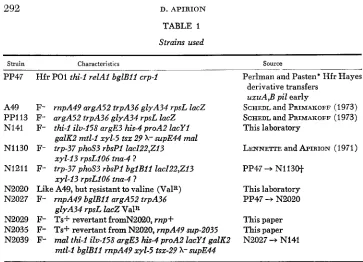
(1973), has not. In order to gain insight into the con- tributions of these three enzymes to the processing of RNA, we set out to con- struct E. coli strains that carry these three mutations in all possible combinatiom (GEGENHEIMER and APIRION 1978; APIRION et al. 1980). In order to do so, it was useful to map the mpA49 mutation. The experiments presented here describe the mapping of this mutation and its further characterization.MATERIALS A N D M E T H O D S
All procedures used are published and will be referred to at the appropriate places. All strains used are E . coli K12 derivatives, and are described in Table 1. Colonies were tested for the
TABLE 1
Strains used
Strain Characteristics Source PP47 H f r PO1 thi-I relAI bglBII crp-I
A49 F- rnpA49 argA52 trpA36 glyA34 rpsL lacZ PP1 13 F- argA52 trpA36 glyA34 rpsL lacZ NI41 F- thi-I ilv-I58 argE3 his-4 proA.2 IacYI
NI130 F- trp-37 phoS3 rbsPI lacI22,ZI3
N l 2 l l F- trp-37 phoS3 rbsPI bgIBI1 lacI22,ZI3
N2020 Like A49, but resistant to valine (ValR) N2027 F- r p A 4 9 bglBII argA52 trpA36
N2029 F- Ts+ revertant fromN2020, m p +
N2035 F- Ts+ revertant from "20, rnpA49 sup-2035 N2039 F- mal thi-I ilv-I58 argE3 his-4 proA2 lacy1 galK2
mtl-I bglBII rnpA49 xyl-5 tsx-29 1- supE44 galKZ mtld xyl-5 tsx 29 1- supE44 mal
xyl-I3 rpsLIO6 tna-4 3
zyl-I3 rpsLIO6 tna-4 ?
glyA34 rpsL lacZ ValR
Perlman and Pasten* Hfr Hayes derivative transfers
uzuA,B pi1 early
SCHEDL and PRIMAKOFF (1973) SCHEDL and PRIMAKOFF (1973) This laboratory
LBNNETTE and A ~ I R I O N (1971)
PP47 + N113W
This laboratory PP47 + "20 This paper This paper N2027 + NI41
* Strains supplied by B. J. BACHMANN, Yale University, Coli Genetic Stock Center. -f Denotes a transduction; arrow leads from donor to recipient.
ability to utilize ribose, as well as other sugars, by using either minimal medium that contained a particular sugar as the only carbon source or Macconkey agar medium (BBL), which contains I % w/v of the desired sugar. Colonies were tested for the phoS mutation by replicating colonies to a low phosphate peptone medium (10 g peptone, 5 g glucose, 18 g agar per liter) and staining them f o r alkaline phosphatase by naphtol phosphoric acid and fast violet B salt, as described by APIRION (1966). Colonies carrying the p h d mutation stain dark red, while phoS+ colonies remain unstained. Strains that are bgl can be selected for, since they can utilize salicin (0.2%) as the only carbon source, whereas bgZ+ strains cannot.
All transductions were mediated by bacteriophage P I (LENNETTE and APIRION 1971). For media used, see APIRION (1966) and LENNETTE and APIRION (1971). (I found that i n replica- tion to rich medium a t 43" or 45", strains carrying the rnpA49 mutation keep growing suffi-
ciently to obscure the scoring. Therefore, replicated plates incubated at the elevated temperature were routinely re-replicated and further incubated. This led to unambiguous scoring; see also Table 3.)
I followed the notations suggested by APIRION and WATSON (1975), which were adopted by
BACHAIANN, Low and TAYLOR (1976). Therefore, a mutation that affects the enzyme RNase P is designated rnp. Since there might be at least two genes that affect this enzyme (OZEKI et al. 1974), the gene defined by the mutation described here is designated m p A .
RESULTS
Mapping the rnpA49 mutation by conjugation and PI mediated transduction:
rnpAqg
E.
coliI n order to map the mpA49 mutation, strain N2020 (rnpA49), which is
F-,
was crossed to a number of
Hfr
strains (Low 1973; JOHNSON, WATSON andAPIRION 1976). The results of these experiments indicated that the mpA49
mutation (if the Ts- and the Rnase
P-,
Rnp- phenotypes are pleiotropic effects of the same mutation) is located between the points of origin PO46 and P018, which corresponds roughly to the area between minutes 81 and 87 on theE.
colimap (BACHMANN, Low and TAYLOR 1976).
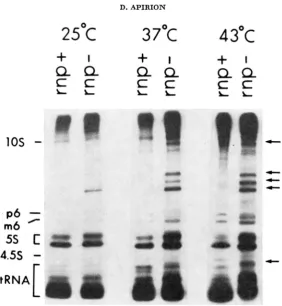
In order to pinpoint the location of mpA49 with more precision, a series of transduction experiments were performed using strain N2020 as the recipient and strains carrying mutations in this region of the chromosome as donors. Co-transduction was detected with the bglB, rbsP, phoS and ilv genes. The high- est co-transduction, about 50%, was between rnpA and bglB; the lowest, about 3%, was with an ilv gene. These genes are all located between 82 and 83.5 min on the current E. coli map. From these experiments, a number of transductants, some Ts+ and some Ts-, were tested on gels to ascertain their pattern of RNA
synthesis (see Figures 1 and 2 ) . In such experiments, cultures are grown at 30" or 37" in a low phosphate medium and transferred to 43'; 40 minutes after the shift, 32Pi is added to the culture and, 30 minutes later, the growth of the cells is terminated, cells are concentrated and opened in a sodium dodecyl sulfate containing buffer, and their content of RNA molecules is displayed in poly- acrylamide gels (GEGENHEIMER, WATSON and APIRION 1977; LEE, BAILEY and
APIRION 1978). In such experiments, the rpA49 phenotype is very distinct and
is characterized by the appearance of prominent new RNA molecules that are not seen in m p + strains (Figures 1 and 2 ) . During the past two years, we tested about 80 Ts+ and 50 Ts- transductants, where the donors were r p + and rpA49 strains, and invariably Ts- recombinants showed the Rnp- phenotype while the Ts+ transductants showed the Rnpf phenotype. This indicates that the Ts- and Rnp- phenotypes are caused by a single point mutation, or by two extremely closely linked mutations.
In order to map the mpA49 mutation more precisely, strain N1211 (Table 1 )
,
10s
-
P 6
-
m 6
5s
c
4.5s
-
2S0C
37°C
43OC
+ I + I + I
c
c c
c
c
FIGURE 1.-Patterns of RNA synthesized in a r p + and a mp strain at various temperatures. Cultures were grown in a low phosphate medium (GEGEWHEIMEII, WATSON and APIRION 1977) at 30" and at ASe0 of about 0.5 transferred to the various temperatures. Forty minutes later,
RZP, was added to the cultures (100-200 pC/ml) and, after 30 minutes, the cultures were
processed and analyzed on 5%/10% thin (1.5 mm) polyacrylamide slab gels (for further details see LEE, BAILEY and APIRION 1978). A photograph of an autoradiograph is shown. The 5%
portion of the gel was removed prior to the autoradiography in order to obtain a clearer view of the top part of the 10% gel. The arrows on the right indicate RNA molecules unique to r p A 4 9 strains. The m p + strain is PP113, and the rnp is N2020. All lanes were from the same gel.
PREY
FELTON,
Tuft University, of some new mapping data is in agreement withthe order suggested here.)
A
convenient way to transfer the mpA49 mutation is by co-transduction with thebgZB
marker. (Strain N2039 was constructed in this way; see Table 1.)Phenotypically, the strains into which the mpA49 mutation was transferred behaved exactly like the original strain A49 or N2020; their patterns of RNA synthesis were identical.
rnpA4g
E.
coli10s
-
P 6
Lm 6
5s
c
4.5s
-
tRNA[
S
Zf
RevertantsI L
7-
1-
* A i = -
I.
-
1
2
3
4
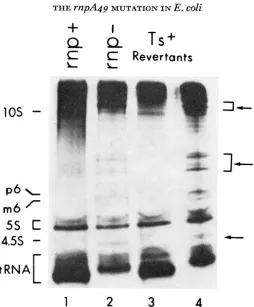
FIGURE 2.-Patterns of RNA synthesized in various strains at 43'. Cultures were grown at
30', shifted to 43" and, 40 minutes after the shift, were labeled for 30 minutes with 3*Pl (for further details see legend to Figure 1). The arrows on the right indicate RNA molecules unique to mpA49 strains. l,PP113, 2,NDXO; 3,N2029; 4,N2035. Notice the difference in patterns be-
tween Figure l and Figure 2, which were caused by minor differences in the experimental procedure and, in particular, in the distance that the various molecules migrated in the gel. All lanes were from the same gel.
ous temperatures.
As
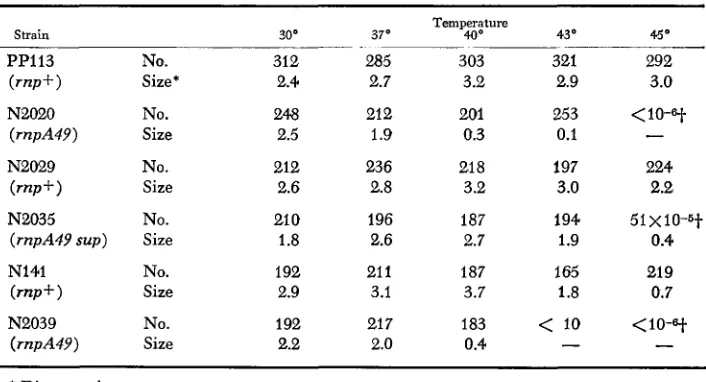
seen in Table 3, while the m p + strain PP113 and N141 can form coloniesin
rich medium at all temperatures up to 45O, strains N2020 and N2039, which carry the rnpA49 mutation, cannot. Both form colonies at30°,
37O
and 40°, but a t the higher temperatures their growth rate is slower than that of r p + strains, as judged from the size of the colonies formed. (This method of comparing growth of strains in the same medium at different temperatures was chosen, rather than the customary measuring of doubling time, since this isa much more sensitive method. Here, growth is measured after a relatively long period of time, two days, without interfering with the culture, as is the case when growth curves are measured.) These results suggested that the RNase
P
is somewhat inactivated in a physiologically meaningful way, even at tempera-
TABLE 2
Linkage of mpA49 to bglB phoS and rbsP*
Donor N1211
I I1 I11 Iv V
bglB phoS rbsP
0
-
0
0-+
0
Recipient N2020 0-
rnpA
Segregation of unselected markers p h d rbsP
+
+
+
+
+
-
+
-+
+
-
+
+
-+
-
-
-
-
-
--
-
o--op-
0-+
+
+
Minii!l necessary
No. crossing overs
60 I and I1
28 I and IV 9 I a n d V 6 I and I11
2 I, 111, IV and V
2 I, 11, Iv and V
0 I, 11, I11 and IV
0 I, 11,111, and V
* Selection was carried out for Rnp+ transductants, by plating PI-infected recipient cells in rich medium plates a t 45". Suggested order and percentage of co-transduction:
rnpA bglB phoS rbsP
0
O--0
0
--42
-TABLE 3
Plating efficiency and size of colonies
Temperature
Strain 30' 370 40' 430 450
PP113 No. 312 285 303 321 292
( r n p + ) Size* 2.4 2.7 3.2 2.9 3.0
Ne020 No. 248 212 201 253
<
10-at(rnpA49) Size 2.5 1.9 0.3 0.1
-
( m + )
Size 2.6 2.8 3.2 3.0 2.2N2029 No. 212 236 21 8 197 224
N2035 No. 21 0 196 187 194 51 x 10-6t
(rnpA49 sup) Size 1.8 2.6 2.7 1.9 0.4
NI41 No. 192 21 1 187 165 21 9
( r w + ) Size 2.9 3.1 3.7 1.8 0.7
N2039 No. 192 21 7 183
<
10(rnpA49) Size 2.2 2.0 0.4
-
<
10-9-
* Diameter in mm.
-f Calculated from plating less diluted samples.
m p A 4 9
E.
45", when the rnpA49 mutation was introduced into them, strain N2020 still grew, albeit extremely slowly, at 43", while strain N2039 failed to grow at 43". Further support for the notion that the rnpA49 mutation can be manifested at temperatures at which the strain can grow can be observed in Figure 1. In this experiment, RNA synthesis in an rnp+ strain (PPI 13) and in an rnp strain (N2020) was analyzed at 25", 37" and 43". It can be seen that some of the RNA molecules that clearly characterized the rnp mutation at 43" appear at 25" to
a limited extent and at 37" to a larger extent.
Revertants from rnpA49 strains: To find out whether the rnpA49 is a point mutation, revertants able to grow at higher temperatures were isolated from rnp strains. To avoid the isolation of possible siblings, this was carried out by replicating large colonies grown at 37" on rich medium into the same medium, and the Petri dishes were incubated at 45". A number of patches of good growth appeared. These were purified and retested. Two types of Ts+ revertants ap- peared; one class grew faster than the other at the higher temperatures (Table
3 ) . The faster-growing class behaved, in all respects, like the original strain (PP113); as can be secn in Figure 2, the pattern of RNA synthesis in the Ts+ revertant strain N2029 became normal and seems to have regained a normal RNase P. In this class of revertants, probably a true reversion event occurred. This was further supported by the fact that, in transduction experiments, we failed to recover the rnpA49 allele from such strains. The other class grew slower (Table 3, strain N2035) and, as can be seen in Figure 2, it retained the mnpA49 mutation.
The mpA49 mutation is recessive: To find out whether the m p A 4 9 mutation is recessive or dominant, an
F'
( F i l l ),
which covers the proper region of theE.
coli chromosome (Low 1972), was transferred (Low 1972) to strain N2039(i2v
argE3 rnpA49). Ilv+ Arg+ recombinants were isolated, purified and retested. Many of these strains (15 of 25) also became Ts+. Strain N2039 is particularly suitable for such an analysis since it contains two markers, argE3 and ilu158, in the vicinity of rnpA49 and many other markers (see Table 1) scattered all over the E. coli chromosome. These 15 colonies retained all the other markers of the parental strain N2039, thus indicating that they are likely to contain the F'111 factor rather than being recombinants that could have resulted from the mobilization of the donor chromosome by the F'. This was further indicated by the fact that some of the strains isolated could easily donate the ilv+ and a g + genes, but not others. RNA metabolism was analyzed in some of the Ts+ and Ts- colonies isolated from the cross; all the Ts+ colonies showed an Rnp+ phenotype. while the Ts- colonies showed an Rnp- phenotype. It is concluded, therefore, that the rnpA49 mutation is recessive.DISCUSSION
OZEKI et al. (1974) isolated a number of mutants defective in the enzyme RNase
P.
These mutants seem to fall into two groups. They suggested from studying the phenotype of RNaseI?-
strains after a series of F’ was transferred to them that one of these two groups is located between minutes 78 and 83 on theE.
coli map (BACHMANN, Low and TAYLOR 1976). It is important to note that, while it is possible that the rnpA49 mutation is allelic with the rnp mutationts-241 described by OZEKI et al. (1974) (which maps between 78 and 83 min), this cannot be firmly stated, since precise mapping for the latter mutations is unavailable, and complementation tests between these mutant strains were not carried out.
An interesting feature of the rnpA49 mutation is its manifestation at almost all the temperatures where strains carrying the mutation grow (Figure 1). The defects in RNA processing at the permissive temperatures seem to be physio- logically significant since the growth rates of rnpA49 strains are affected (see Table 3). Since RNase
P
is involved in the processing of a large number of RNA molecules (SCHEDL andPRIMAKOFF
1973; OZEKI et al. 1974; ALTMAN 1975), the slower maturation of only one of these molecules could be responsible for the physiological effects.It is interesting to compare the rnpA49 mutation to the
rm-105
and the m e -3071 mutations, since all of them affect RNA processing enzymes. The mc-105
mutation abolishes completely the enzyme RNase I11 (APIRION, NEIL and WATSON 1976a,b), and cells can survive without it. On the other hand, the me-3071 mutation is manifested only at the nonpermissive temperature (APIRION 1978; APIRION and LASSAR 1978). These unique characterizations of each of these mutations helped us build up strains that carry all the possible combina- tions of these mutations (APIRION et al. 1980).
The competent help of JOEL ANDERSON is highly appreciated. This work was supported by grants GM 25890 and GM 19821 from the Public Health Service.
Note added in proof: Another mutation that affects ribonuclease P, designated rnpB3187, was mapped near min 68 of the E. coli chromosome (APIRION and WATSON 1980).
LITERATURE CITED
ABELSON, J., P. SCHIMELL and D. S o u , Eds., 1980 Transfer RNA: Biological Aspects. Cold Spring Harbor Laboratories. (In press). New York.
ALTMAN, S., 1975 Biosynthesis of transfer RNA in Escherichia coli. Cell 4: 21-29.
APIRION, D., 1966 Altered ribosomes in a suppressor strain of Escherichia coli. J. Mol. Biol.
. 16: 285-301. -, 1978 Isolation, genetic mapping and some characterization of a mutation in Escherichia coli that affects the processing of ribonucleic acid. Genetics 90:
65 9-6 71.
APIRION, D. and N. WATSON, 1975 Mapping and characterization of a mutation in Escherichia coli that reduces the level of ribonuclease I11 specific for double-standed ribonucleic acid. J. Bacteriol. 124: 317-3W. -, 1980 A second gene which affects the RNA processing enzyme ribonuclease P of Escherichia coli. FEBS Letters 110: 161-163.
A conditional lethal mutant of Escherichia coli which APIRION, D. and A. B. LASSAR, 1978
rnpAqg
Consequences of losing ribonuclease 111 on the Escherichia coli cell. Mol. Gen. Genet. 144: 185-190.
--,
1976b Revertants from RNase I11 negative strains of Escherichia coli. Mol. Gen. Genet. 149: 201-210.APIRION, D., B. K. GHORA, G. PLAUTZ, T. K. MISRA and P. GEGENHEIMER, 1980 Processing of ribosomal and transfer RNA in Escherichia coli: cooperation between processing enzymes. pp. 139-154. In: Transfer R N A : Biological Aspects. Edited by J. ABELSON, P. SCHIMELL and D. SOLL. Cold Spring Harbor Laboratories. New York.
BACHMANN, B. J., K. B. Low and A. L. TAYLOR, 1976 Recalibrated linkage map of Escherichia coli K12. Bacteriol. Rev. 40: 116-167.
DUNN, J. J. Ed, 1974 Processing of RNA. Brookhaven Symposia in Biology. Vol. 26. Pub. Brookhaven Nat. Lab.
GEGENHEIMER, P. and D. APIRION, 1978 Processing of ribosomal RNA by RNAase P: spacer tRNAs are linked to 16s rRNA i n an RNase P RNase 111 mutant strain of E. coli. Cell
15: 527-539.
Multiple pathways for primary process- ing of ribosomal RNA in Escherichia coli. J. Biol. Chem. 252: 3064-3073.
Structural analysis and in vitro processing to p5 rRNA of a 9s RNA molecule isolated from an r e mutant of Escherichia coli. Cell 15: 1055-1066. The 30s ribosomal precursor RNA from Escherichia coli: a primary transcript containing 23S, 16s and 5 s sequences. J. Biol. Chem. 250:
5647-5654.
JOHNSON, S. C., N. WATSON and D. APIRION, 1976 A lethal mutation which affects the matura. tion of ribosomes. Mol. Gen. Genet. 147: 29-37.
KINDLER, P., T. U. KEIL and P. H. HOFSCHNEIDER, 1973 Isolation and characterization of a ribonuclease 111 deficient mutant of Escherichia coli. Mol. Gen. Genet. 126: 53-69. LEE, S. Y., S. C. BAILEY and D. APIRION, 1978 Small stable RNAs from Escherichia coli:
evidence for the existence of new molecules and for a new ribonucleoprotein particle con. taining 6 s RNA. J. Bacteriol. 133: 1015-1023.
LENNETTE, E. T. and D. APIRION, 1971 Genetic analysis of an Escherichia coli syndrome. J. Bacteriol. 1 M : 1322-1328.
LOW, K. B., 1972 Escherichia coli K12 F-prime factors, old and new. Bacteriol. Rev. 36:
587-607.
Low, K. B., 1973 Rapid mapping of conditional and auxotrophic mutations in Escherichia coli K12. J. Bacteriol. 113: 798-812.
OZEKI, H., H. SAKASO, S. YAMADA, T. IKEMURA and Y. SHIMURA, 1974 Temperature-sensitive mutants of Escherichia coli defective in tRNA biosynthesis. Brookhaven Symposia in Biol- ogy. 26: 89-105. Edited by J. J. DUNN. Brookhaven Natl. Laboratory, New York.
PACE, N. R., 1973 Structure and synthesis sf the ribosomal RNA of prokaryotes. Bacteriol. Rev. 37: 562-603.
SCHEDL, P. and P. PRIMAKOFF, 1973 Mutants of Escherichia coli thermosensitive for the synthesis of transfer RNA. Proc. Nat. Acad. Sci. U.S. 70: 2091-2095.
Corresponding editor: G. MOSIQ APIRION, D., J. NEIL and N. WATSON, 1976a
GEGENHEIMER, P., N. WATSON and D. APIRION, 1977
GHORA, B. K. and D. APIRION, 1978