Surface-Integrated Fluorescence
Correlation Spectroscopy (SI-FCS)
for the quantification of transient
membrane and surface binding
Philipp Paul Blumhardt
Surface-Integrated Fluorescence
Correlation Spectroscopy (SI-FCS)
for the quantification of transient
membrane and surface binding
Philipp Paul Blumhardt
Dissertation
an der Fakultät für Physik
der Ludwig-Maximilians-Universität
München
vorgelegt von
Philipp Paul Blumhardt
aus Villingen-Schwenningen
KURZFASSUNG
Das Verständnis der komplexen Netzwerke bio-molekularer Wechselwirkungen benötigt die korrekte und präzise Quantifizierung von Bindungskinetiken. Besonders von Bedeu-tung sind Wechselwirkungen mit Membranen oder membrangebundenen Objekten, da Membranen nicht nur Bindungskinetiken beeinflussen, sondern auch in eine große Menge entscheidender zellulärer Prozesse grundsätzlich eingebunden sind, darunter Prozesse wie Zellteilung, Signaltransduktion, Endozytose, Exozytose oder Zellmigration.
Um die korrekte und präzise Quantifizierung von Bindungskinetiken zu ermöglichen, haben wir die oberflächen-integrierte Fluoreszenzkorrelationsspektroskopie (SI-FCS, engl.
surface-integrated fluorescence correlation spectroscopy) entwickelt. Die Methode basiert
auf der Autokorrelation von zeitlichen Fluoreszenzfluktuationen in einer Sequenz von Bil-dern, die mit Totalreflexions-Fluoreszenzmikroskopie (TIRF-Mikroskopie, engl. total inter-nal reflection microscopy) aufgenommen wurden. SI-FCS kann zuverlässig die
Assoziations-und Dissoziationsraten von reversiblen Liganden-Rezeptor-Bindungen bestimmen. Die DNA-Hybridisierung kurzer Einzelstränge – bei denen einer auf der Oberfläche immo-bilisiert ist, während sich der andere, fluoreszent markierte Strang in Lösung befindet – imitierte dabei Liganden-Rezeptor-Systeme und wurde in dieser Arbeit präzise mit SI-FCS vermessen.
Systematisch haben wir das Leistungsvermögen und die Limitierungen von SI-FCS untersucht und dabei die photo-induzierte Schädigung von immobilisierten Einzelsträngen als Einschränkung für lange Messzeiten oder hohe Ligandenkonzentrationen bestimmt. Die photoinduzierte Schädigung erfolgt dabei vorwiegend durch reaktive Sauerstoffspezies. In SI-FCS und in DNA-Hybrisierungs-basierter Hochauflösungsmikroskopie (DNA-PAINT) konnten wir diesen Effekt durch das biochemische Entfernen von Sauerstoff vermeiden. In einem parallelen Ansatz zeigen wir ein verbessertes Design für den bindenden DNA-Strang mit einem erhöhten Abstand zwischen dem fluoreszenten Farbstoff und der Bindungsse-quenz.
in der TIRF-Mirkoskopie direkt bestimmt werden kann. Dabei haben wir eine tiefer in die Probe eindringende Komponente der Anregung in der Objektiv-basierten TIRF-Mikroskopie gefunden, die bisher von der entsprechenden FCS-Theorie unberücksichtigt ist.
ABSTRACT
Understanding the complex networks of biomolecular interactions requires the accurate and precise quantification of binding kinetics. Interactions with membranes or membrane-bound entities are of particular interest, as membranes do not only influence binding ki-netics, but are fundamental to a large set of key cellular processes such as cytokinesis, signalling, endocytosis, exocytosis or cell migration.
To enable the accurate and precise quantification of binding kinetics, we developed surface-integrated fluorescence correlation spectroscopy (SI-FCS). This method is based on the autocorrelation of temporal fluorescence fluctuations from a stream of total inter-nal reflection fluorescence (TIRF) images. SI-FCS reliably extracts the association and dissociation rates of reversible ligand-receptor binding. The DNA hybridization of short single-strands – one immobilized on the surface, the other fluorescently labeled in solution – mimicked ligand-receptor systems and was precisely quantified with SI-FCS within this work.
We systematically assessed the potential and limitations of SI-FCS and identified the photo-induced damage of immobilized single-strands as a constraint for longer measurement times and high ligand concentrations. The photo-induced damage was predominantly caused by reactive oxygen species (ROS). Not only did we show that this effect can be prevented in SI-FCS and DNA hybridization-based super-resolution microscopy (DNA-PAINT) with oxygen scavenging buffers, but we also presented an improved DNA handle design with increased distance between fluorescent dye and binding sequence.
Accessing binding times with SI-FCS in the millisecond range and below is ultimately limited by accurate autocorrelation models incorporating the diffusion through the evanes-cent TIRF field. Based on a fluoropolymer matching the refractive index of aqueous sam-ples, we designed a calibration slide to directly characterize the axial molecule detection function in TIRF microscopy. We found a penetrating component to the TIRF excitation in objective-type TIRF microscopy, so far unconsidered by the respective FCS theory.
Contents
Kurzfassung i
Abstract iii
List of Abbreviations xvii
I Introduction and Outline 1 II Basic Concepts: Studying Diffusion and Binding with Fluorescence
Correlation Spectroscopy 5
II.1 Fluorescence Correlation Spectroscopy . . . 5 II.1.1 Focused Laser Single-point Confocal FCS . . . 6 II.1.2 Total Internal Reflection Fluorescence Correlation Spectroscopy
(TIR-FCS) . . . 8 II.1.2.1 Camera-based TIR-FCS and Temporal Image Correlation
Spectroscopy . . . 11 II.1.3 The Autocorrelation Function in TIR-FCS . . . 12
II.1.3.1 Three-dimensional Autocorrelation Function for Diffusion in Absence of Binding and Observation Through a Square Pinhole . . . 15 II.1.3.2 Theoretical Autocorrelation Function for Binding Studies
with TIR-FCS . . . 18
III Quantifying Reversible Surface Binding via Surface-integrated FCS 23
III.1 Motivation and Summary . . . 23 III.2 Contributed Publication: Quantifying Reversible Surface Binding via
III.2.1 Supplementary Theoretical Basis: Theoretical Model for the Auto-correlation Function of a One-component Binding-unbinding
Reac-tion Without Diffusion . . . 39
III.2.2 Supplementary Table: Free Energy of DNA Hybridization . . . 43
III.2.3 Supplementary Figures . . . 44
IV Photo-Induced Depletion of Binding Sites in DNA-PAINT Microscopy 57 IV.1 Motivation and Summary . . . 57
IV.2 Contributed Publication: Photo-Induced Depletion of Binding Sites in DNA-PAINT Microscopy . . . 59
IV.2.1 Introduction . . . 59
IV.2.2 Results . . . 61
IV.2.3 Discussion . . . 73
IV.2.4 Appendix . . . 78
IV.3 Nuclease Activity of Oxygen Scavenging Systems . . . 88
V Towards the Determination of Millisecond Binding Kinetics with SI-FCS: Direct Characterization of the TIRF Excitation 91 V.1 The Influence of Solution Diffusion on Binding Studies with SI-FCS . . . 91
V.1.1 Influence of the Cross-correlations of Solution Diffusion and Binding 92 V.1.2 The Axial Autocorrelation Function in Objective-type TIR-FCS . . 94
V.2 Contributed Publication: Direct Characterization of the Evanescent Field in Objective-type Total Internal Reflection Fluorescence Microscopy . . . 95
V.2.1 Introduction . . . 95
V.2.2 Methods . . . 97
V.2.2.1 Dip Coating . . . 97
V.2.2.2 Characterization of the Polymer Height . . . 98
V.2.2.3 TIRF Imaging . . . 100
V.2.2.4 Data Analysis . . . 101
V.2.3 Results and Discussion . . . 103
V.2.3.1 Polymer Step Heights . . . 103
V.2.3.2 Characterization of the Excitation Profile . . . 103
CONTENTS
VI Quantification of Membrane Binding and Partitioning Kinetics via
SI-FCS 109
VI.1 The Need for A New Assay to Study Transient Membrane Binding and
Partitioning . . . 109
VI.1.1 Overview of Currently Available Methods to Study Reversible Mem-brane Binding and Partitioning . . . 110
VI.1.1.1 Label-free Techniques . . . 111
VI.1.1.2 Fluorescence-based Bulk Methods . . . 113
VI.1.1.3 Fluorescence-based Single-molecule Methods . . . 115
VI.1.2 Accessing Membrane Binding Rates with SI-FCS . . . 118
VI.1.2.1 Starting from SI-FCS of Surface-immobilized Binding Sites and Single-particle Tracking . . . 118
VI.1.2.2 Distinction of Binding to Sparse Membrane-associated Bind-ing Sites and Direct PartitionBind-ing of Biomolecules to Mem-branes . . . 121
VI.1.2.3 Effect of Lateral Membrane Diffusion on the SI-FCS Auto-correlation Function . . . 124
VI.1.2.4 Extracting Parameters on Binding to Fluid Lipid Bilayers with SI-FCS . . . 126
VI.1.2.5 Consequences of the Selected Autocorrelation Model for the Experimental Design . . . 130
VI.2 Quantifying the Binding to Individual Membrane-attached Binding Sites with SI-FCS . . . 135
VI.2.1 Evaluation of the Approximated Autocorrelation Model Incorporat-ing BindIncorporat-ing and Membrane Diffusion . . . 136
VI.2.2 Pseudo-infinite Detection Neglecting Contributions from Diffusion . 141 VI.2.3 Lateral Confinement of Membrane Diffusion . . . 145
VI.2.4 Combined Discussion of the Quantification of Ligand Binding to Membrane-bound Receptors . . . 151
VI.3 Quantifying Complex Membrane Partitioning of Biomolecules with SI-FCS 155 VI.3.1 Autocorrelation Function for Membrane Partitioning Below the Sat-uration Regime . . . 156
VI.3.4 Confinement of Lateral Diffusion on SLB Patches . . . 170
VI.3.4.1 Determining the Saturation Regime of MPER Binding to SLBs . . . 176
VI.3.4.2 Membrane Diffusion of MPER is Confined to SLB Patches and the Binding Contribution Shows Multiple Components 177 VI.3.4.3 Size of SLB Patches Does not Influence Decay Times . . . 180
VI.3.4.4 Dependence of the Autocorrelation Function on the Peptide Concentration . . . 181
VI.3.5 Confinement of Lateral Diffusion in Lipid Bilayer Nanodiscs . . . . 185
VI.3.5.1 Binding to Nanodiscs Results in Low-Noise SI-FCS Curves at Low Concentrations . . . 186
VI.3.6 Confinement in Micropatterned Membrane Corrals . . . 190
VI.4 Conclusion . . . 193
VII Current State of SI-FCS and Future Perspectives 197 Bibliography 203 A Appendix to Chapter II - Quantifying Reversible Surface Binding via SI-FCS 263 A.1 Supplementary Methods . . . 263
B Appendix to Chapter III - Photo-Induced Depletion of Binding Sites271 B.1 Materials and Methods . . . 271
C Appendix to Chapter V - Direct Characterization of the TIRF Ex-citation 279 C.1 Materials and Methods . . . 279
C.2 Dip Coating Setup . . . 280
C.3 Supplementary Studies on Polymer Properties . . . 281
C.4 Lateral Displacement Method . . . 284
C.5 Supplementary Studies on Evanescent and Non-evanescent Contributions 286 D Appendix to Chapter VI - Quantification of Membrane Binding 289 D.1 Materials and Methods to Section VI.2 . . . 289
Table of contents
D.1.2 Preparation of Homogeneous SLBs from SUVs . . . 291
D.1.3 Micropatterned SLB by Photolithography of Chromium on Microscopy Coverslides . . . 292
D.1.4 SI-FCS Acquisition and Analysis . . . 294
D.2 Materials and Methods to Section VI.3 . . . 295
D.2.1 Monte Carlo Simulations of Membrane Binding Without Surface Sat-uration Effects . . . 295
D.2.2 Materials . . . 297
D.2.3 SLB Patches from Bursted GUVs . . . 297
D.2.4 Preparation of Homogeneous SLBs from SUVs . . . 299
D.2.5 Lipid Bilayer Nanodiscs . . . 299
D.2.6 Membrane Corrals on Micropatterned Chromium Grids . . . 300
D.2.7 SI-FCS Acqusition and Analysis . . . 300
D.3 Supplementary Figures . . . 302
D.3.1 Binding Kinetics of MPER to Nanodiscs Are Independent of the ROI Size . . . 302
D.3.2 Binding Kinetics of MPER to Nanodiscs Are Unaltered by Addition of TCEP . . . 303
D.3.3 Bacterial Membrane Targeting Sequences . . . 305
Publications 308
List of Figures
II.1 Contributions of membrane binding to the TIR-FCS autocorrelation function 13
III.1 Application of SI-FCS to quantify DNA hybridization kinetics . . . 31
III.2 Quantification of binding kinetics by SI-FCS . . . 33
III.3 Determination of association and dissociation rates by SI-FCS . . . 35
III.4 Dependence on Excitation Power . . . 45
III.5 Reproducibility of SI-FCS measurements . . . 45
III.6 Extraction of association and dissociation rates from two measurements . 46 III.7 Effect of the measurement time . . . 47
III.8 SI-FCS is calibration-free and robust to defocused imaging . . . 49
III.9 Performance of SI-FCS at different receptor surface densities: Simulations 51 III.10 Performance of SI-FCS at different receptor surface densities: Experimen-tal data . . . 52
III.11 Super-resolution of DNA origami exposing 12 single-stranded DNA handles 53 III.12 Effect of the ROI size . . . 55
IV.1 Overview of the conditions to explore the photo-induced depletion of bind-ing sites in DNA-PAINT microscopy and kinetic measurement with SI-FCS 63 IV.2 Confocal FCS measurement of the imager concentration and diffusion co-efficient . . . 65
IV.3 Quantitative analysis of the depletion of docking strands in DNA-PAINT super-resolution microscopy . . . 67
IV.4 Depletion of docking sites investigated by SI-FCS at low irradiance . . . . 71
IV.5 With increasing measurement time, the total number of localizations per DNA origami nanostructure decreases . . . 78
IV.7 Selected DNA-PAINT super-resolved images of DNA nanostructures
show-ing the depletion of bindshow-ing sites in the five different conditions . . . 82
IV.8 Averaged super-resolved DNA-PAINT images of DNA origami nanostruc-tures . . . 83
IV.9 The observed lower number of active docking sites for the 18-mer spacer is caused by the lower association rate of the extended imager . . . 84
IV.10 The number of available docking sites per origami structures influences the dark and bright times . . . 85
IV.11 Influence of the depletion of binding sites on the autocorrelation function 87 IV.12 Influence of the time of sample preparation on the diffusion coefficient . . 89
V.1 Influence of solution diffusion on SI-FCS measurements . . . 92
V.2 Calibration slide concept and fabrication . . . 99
V.3 AFM characterization of polymer step heights . . . 102
V.4 TIR excitation profile as determined with the calibration slide . . . 106
V.5 Pixel-based determination of penetration depths . . . 107
VI.1 Extending the SI-FCS concept from surface-immobilized receptors to mem-brane binding. . . 122
VI.2 Membrane diffusion adds an additional component to the SI-FCS autocor-relation. . . 125
VI.3 Obtaining binding kinetics from the SI-FCS autocorrelation function in presence of lateral membrane diffusion . . . 127
VI.4 Accessibility of the binding kinetics depends on the diffusion decay . . . . 132
VI.5 Autocorrelation curves showing contributions from membrane diffusion and binding. . . 139
VI.6 Pseudo-infinite detection: Analyzing large ROI with a rigorously simplified fit model . . . 142
VI.7 Performance of the pseudo-infinite detection depending on the membrane diffusion coefficient and the binding decay time . . . 145
VI.8 Deposition of patterned SLB on chromium microstructures . . . 147
LIST OF FIGURES
VI.11 Monte Carlo simulation of the autocorrelation function of unspecific sur-face binding in a two-state system . . . 161 VI.12 Three state model for binding of amphipathic helices . . . 162 VI.13 Monte Carlo simulation of the autocorrelation function of a three-state
system. . . 166 VI.14 MPER binds unspecifically to glass and forms islands of peptide. . . 172 VI.15 MPER irreversibly attaches to glass upon irradiation with excitation light 175 VI.16 Determination of saturation regime of MPER binding to supported lipid
bilayers (SLBs) . . . 177 VI.17 Influence of the integrated area on the autocorrelation function on SLB
patches . . . 179 VI.18 Dependence of the autocorrelation function on the size of the SLB patch. 182 VI.19 Concentration dependence of the membrane proximal external region (MPER)
binding kinetics . . . 185 VI.20 Nanodiscs (MSP1E3) immobilized on piranha cleaned glass. . . 187 VI.21 Nanodisc integrity is compromised at high MPER concentrations . . . 188 VI.22 SI-FCS autocorrelation curves for MPER binding to surface-immobilized
nanodiscs . . . 189 VI.23 SI-FCS autocorrelation curves for MPER binding to membrane corrals
formed on a micropatterned chromium lattice . . . 192 VI.24 Schematic of the investigated approaches to confine membrane diffusion . 195
A.1 Custom-built TIRF microscope . . . 264 A.1 Direct measurement of the ligand concentration . . . 269
C.1 Dip coating setup . . . 280 C.2 Shelf-life of the calibrations slide, AFM characterization and
autofluores-cence measurement . . . 282 C.3 High-resolution AFM image of the polymer surface . . . 283 C.4 Lateral displacement method . . . 285 C.5 Look-up-table for relating TIR angle stage positionsxto the incident angle
θ. . . 285
C.6 2D Gaussians fits of spatially separating excitation field contributions . . 287
D.3 Partitioning of membrane targeting sequence (MTS) constructs. . . 306 D.4 SI-FCS autocorrelation curves for MreB binding to surface-immobilized
List of Tables
III.1 Hybridization Parameters . . . 35 III.2 Hybridization parameters for different DNA sequences with the target
se-quence 5’-CTAGATGTAT-3’ . . . 43
IV.1 Binding kinetics as measured by SI-FCS titrations of the imager concentrations 68 IV.2 Slope of the linear fit of Equation (IV.4) to the depletion rate κ(ρ) . . . 73
VI.1 Hybridization kinetics with 9 nt overlap on docking strands bound to choles-terol at the 5’-end (chol-DNA) and surface-immobilized deoxyribonucleic acid (DNA) origami nanostructures . . . 151 VI.2 Obtained binding kinetics for the three approaches to determine binding
rates in the presence of membrane diffusion. . . 154 VI.3 Comparison of the fit parameters for MPER binding to SLB patches,
nan-odiscs and microstructured membrane corrals . . . 191
List of Abbreviations
AFM atomic force microscopy
ALPS amphipathic lipid packing sensor
AOTFacousto optical tunable filter
APD avalanche photodiode
bimFCSbinned imaging FCS
BLI bio-layer interferometry
chol-DNAdocking strands bound to cholesterol at the 5’-end
CLSM confocal laser scanning microscope
DNA deoxyribonucleic acid
DNA-PAINT DNA-based point accumulation for imaging in nanoscale topography
DOPC 1,2-dioleoyl-sn-glycero-3-phosphocholine
DOPE1,2-dioleoyl-sn-glycero-3-phosphoethanolamine
DOPG 1,2-dioleoyl-sn-glycero-3-phospho-(1’-rac-glycerol)
DPPCDipalmitoyl-phosphatidylcholine
DPSS diode-pumped solid state
DSC differential scanning calorimetry
EM electron microscopy
EMCCD electron-multiplying charge-coupled device
ENTH epsin N-terminal homology
FCCS fluorescence cross-correlation spectroscopy
FCS fluorescence correlation spectroscopy
FRAP fluorescence recovery after photobleaching
FRET Förster resonance energy transfer
GLP-1glucagon-like peptide-1
gp41 HIV-1 viral envelope protein
GUV giant unilamellar vesicle
HDMSBis(trimethylsilyl)amine
ICS image correlation spectroscopy
iSCAT interferometric scattering
ITC isothermal titration calorimetry
ITIR-FCCS imaging total internal reflection fluorescence cross-correlation spectroscopy
ITO indium tin oxide
kICS k-space image correlation spectroscopy (ICS)
MIET metal induced engery transfer
MPER membrane proximal external region
MSP membrane scaffold protein
MST microscale thermophoresis
MTS membrane targeting sequence
NA numerical aperture
NMR nuclear magnetic resonance
PCD+PCA protocatcchuate-dioxygenase and 3,4-proto-catechuic acid
PHpleckstrin homology
PMT photomultiplier tube
PO+C pyranose oxidase and catalase
PSF point spread function
PtdIns(4,5)P2 phosphatidylinositol (4,5)-bisphosphate
QCM quartz crystal microbalance
QCM-D quartz crystal microbalance (QCM) with parallel monitoring of the dissipative losses
qPAINT quantitative PAINT
RICS raster image correlation spectroscopy
ROI region of interest
ROS reactive oxygen species
SAF supercritical angle fluorescence
sCMOS scientifc metal-oxide semiconductor
SI-FCS surface-integrated FCS
SLB supported lipid bilayer
List of Abbreviations
SNR signal-to-noise ratio
SPR surface plasmon resonance
SPT single particle tracking
ssDNA single-stranded DNA
STED stimulated emission depletion
STICSspatiotemporal image correlation spectroscopy
SUV small unilamellar vesicle
TCEPTris(2-carboxyethyl)phosphin
TCSPC time correlated single photon counting
TEG tetraethylene glycol
TIR total internal reflection
TIRF total internal reflection fluorescence
TIR-FCS total internal reflection fluorescence correlation spectroscopy
Trp tryptophan
I
INTRODUCTION AND OUTLINE
Biological complexity is not only based on the vast number of specialized components, but also on the inherent non-linearity of their interactions. Non-linearity is required so that small changes on the molecular level can trigger macroscopic responses on the cellular or systemic level. Many key cellular processes depend on reversible interactions of proteins with membranes of organelles or the plasma membrane [Lemmon, 2008, Di Paolo and De Camilli, 2006, Teruel and Meyer, 2000, Groves and Kuriyan, 2010]. Not only is a plethora of enzymatic reactions localized at the membrane surface [Kleinschmidt, 2013], but it is also the location where many signals from the outside of the cell are processed and trans-ferred to the inside in the form of ligand-receptor interactions [Pierce et al., 2002, Akira and Takeda, 2004]. The rates of ligand-receptor binding are influencing signalling cascades responsible for triggering cellular response [Feinerman et al., 2008, Govern et al., 2010]. Membranes are essential to the structural integrity of cells, forming not only a separator to the extracellular space, but also facilitate compartmentalizations into organelles and vesicles. Cellular membranes are increasingly appreciated for their complexity and physio-logical role [Simons and Ikonen, 1997,Loura et al., 2003,Simons and Gerl, 2010,Lingwood and Simons, 2010].
The dynamic reshaping of membranes is based on constant turnover and a large set of highly specialized proteins [McMahon and Gallop, 2005,Zimmerberg and Kozlov, 2005, McMahon and Boucrot, 2015]. Hence, the recruitment of biomolecules to membranes is a key mechanism to control the spatio-temporal organization of cells [Kretschmer and Schwille, 2016]. Similarly, the function of many membrane-related proteins can be assessed by examining their membrane interactions.
they can determine kinetics in quasi-equilibrium [Walter et al., 2008].
Following the concept of fluorescence correlation spectroscopy (FCS) [Magde et al., 1972], the autocorrelation function of the number and brightness of fluorescently labeled molecules within a small observation volume is determined by the dynamics that govern the fluorescence fluctuations. In the following years, FCS developed into an increasingly versatile tool to study not only molecular mobility [Aragón and Pecora, 1976,Koppel et al., 1976,Fahey et al., 1977], but also bi-molecular interactions [Kinjo and Rigler, 1995,Schwille et al., 1996, Rauer et al., 1996, Schwille et al., 1997]. Thus, kinetic parameters governing biochemical reactions can be extracted from the autocorrelation function. Focused laser excitation and tightly confined confocal detection allowed the study of individual molecules with FCS [Rigler et al., 1993, Eigen and Rigler, 1994]. More advanced FCS variants that scan the confocal detection in the sample [Berland et al., 1996] proved useful to elucidate not only mobility in the membrane [Benda et al., 2003, Ries and Schwille, 2006, Petrášek and Schwille, 2008], but also the partitioning into different membrane phases [Ries et al., 2009a] and the binding to membrane-localized receptors [Ries et al., 2009b]. Simultaneous to the advent of wide-field total internal reflection fluorescence (TIRF) microscopy [Ax-elrod, 1981], the pioneering works of Thompson and colleagues highlighted the potential of total internal reflection fluorescence correlation spectroscopy (TIR-FCS) to investigate surface binding [Thompson et al., 1981, Thompson, 1982, Thompson and Axelrod, 1983]. Studies on lipid mobility of the basal membrane of cells and of supported lipid bilay-ers (SLBs) [Tamm and McConnell, 1985] profited from the surface-selectivity of TIRF microscopy in combination with FCS [Thompson et al., 1993, Ohsugi et al., 2006]. Mod-ern electron-multiplying charge-coupled device (EMCCD) camera technology enabled the multiplexing of FCS acquisition in multiple detection modalities [Krieger et al., 2015], including TIRF microscopy [Burkhardt and Schwille, 2006, Kannan et al., 2006, Kannan et al., 2007, Sankaran et al., 2009]. Image correlation spectroscopy (ICS) [Petersen et al., 1993,Wiseman, 2013], a closely related method, extracts molecular mobilities and has been used to investigate the binding of membrane-diffusing receptors to larger protein complexes as well as of ligands to microtubules [Brandão et al., 2014].
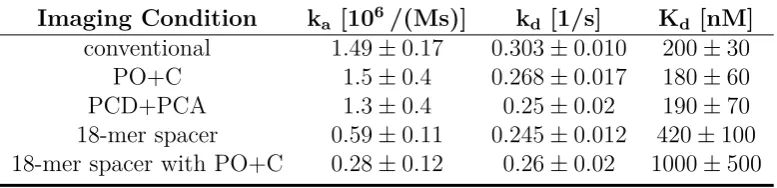
deoxyribonucleic acid (DNA) origami nanostructures. The reversible hybridization of com-plementary single-stranded DNA (ssDNA) served as a proxy for the concept of ligand-receptor binding. We did not only quantify characteristic binding times ranging from 500 ms to 100 s, but also precisely extracted association and dissociation rates of the DNA hybridization with varying nucleotide overlaps. We demonstrated the outstanding sensitiv-ity of this newly developed method and resolved the binding kinetics of individual species in mixed samples.
Working with high solution concentrations of labeled ssDNA, we found the SI-FCS autocorrelation curves to be influenced by the photo-induced depletion of the surface-immobilized DNA handles (Chapter IV). The effect appears similarly in super-resolution microscopy with DNA-based point accumulation for imaging in nanoscale topography (DNA-PAINT) [Jungmann et al., 2010]. Such light-induced sample alterations pose a significant limitation to SI-FCS and DNA-PAINT experiments. We identified reactive oxygen species (ROS) as the major cause of this depletion. We successfully reduced the depletion down to the detection threshold by identifying appropriate oxygen scavenging buffers. Our optimized acquisition procedure does not only enhance the accuracy of SI-FCS quantifications, but the quantitative super-resolution microscopy with DNA-PAINT alike [Jungmann et al., 2010, Jungmann et al., 2016, Schnitzbauer et al., 2017]. The en-hanced sample stability extends the long-term stability of the SI-FCS acquisition, enabling longer measurements and thus the study of longer binding times.
In the studies highlighted above, the contribution to the SI-FCS autocorrelation curves from solution diffusion is most critical for the quantification of fast binding molecules. An accurate modeling of the autocorrelation function for solution diffusion requires as-sumptions regarding the functional shape of the fluorescence excitation profile in TIRF microscopy. Based on the limitations of previous attempts to measure the axial excitation profile, we developed a calibration slide to directly characterize the excitation profile of our objective-type TIRF microscope. We found that the profile is most accurately described by a biexponential consisting of the evanescent field expected from theory and an additional non-evanescent contribution (Chapter V).
without further specificity for receptors or sparse lipid-headgroups. Binding of amphipathic helices to membranes is generally more complex and can in some cases be described by a three-state model [White and Wimley, 1998,Myers et al., 2012]. Assuming a weakly bound and a strongly bound state, we examined the dependence of the autocorrelation function on the governing reaction rates in simulations. Finally, using SI-FCS we characterized the partitioning of the membrane proximal external region (MPER), a short peptide de-rived from human immunodeficiency virus (HIV)-1, into three different model membrane systems.
II
BASIC CONCEPTS: STUDYING DIFFUSION AND
BINDING WITH FLUORESCENCE
CORRELATION SPECTROSCOPY
II.1 Fluorescence Correlation Spectroscopy
Fluorescence correlation spectroscopy (FCS) [Magde et al., 1972, Elson and Magde, 1974, Magde et al., 1974] is an optical method to infer a set of parameters describing the dynamics of a system from the fluorescence signal fluctuations within a small detection volume. The observed fluorescence signal depends, among other factors, on the number and the brightness of emitters contained inside the volume. Furthermore, the autocorrelation of a recorded intensity trace is governed by the statistical processes leading to changes in the fluorescence signal. Typically, the investigated fluctuations are originating from molecular mobility [Magde et al., 1974,Elson and Magde, 1974,Magde et al., 1978], binding processes [Kinjo and Rigler, 1995,Schwille et al., 1996,Schwille et al., 1997,Michelman-Ribeiro et al., 2009] or photophysics [Widengren et al., 1995,Haupts et al., 1998,Widengren and Schwille, 2000,Torres and Levitus, 2007]. The underlying physical quantities are extracted from the autocorrelation function by fitting of the experimentally obtained autocorrelation curves with an appropriate model function. In most cases, FCS is combined with a focused laser beam and a confocal pinhole in the image plane, offering a small detection volume with single-molecule sensitivity [Rigler et al., 1993,Eigen and Rigler, 1994].
2007, Nguyen et al., 2012]). A stronger focus on image-based correlation methods can be found in [Machán and Wohland, 2014,Krieger et al., 2015].
II.1.1 Focused Laser Single-point Confocal FCS
The principles of confocal microscopy are excellently described in [Pawley, 2006]. A detailed derivation of the autocorrelation function in confocal FCS is presented in [Krichevsky and Bonnet, 2002].
We define the normalized autocorrelation function based on the fluctuations δF(t) of
the fluorescence signal F(t) around the mean hF(t)i, as
δF(t) = F(t)− hF(t)i. (II.1)
The autocorrelation function of a stationary system is then given by
G(τ) = hδF(t)δF(t+τ)i
hF(t)i2 (II.2)
with the brackets h. . .i denoting the thermodynamic ensemble average andτ being the lag
time of the autocorrelation function.
Based on the underlying dynamics, a model function can be derived to relate the experimentally obtained autocorrelation function to the physical parameters governing the system under investigation. A recommended, comprehensive introduction to confocal FCS was presented by Petrov and Schwille [Petrov and Schwille, 2008], including potential pitfalls and a detailed discussion of different autocorrelation model functions in combination with diffusion, chemical reactions, triplet state contributions, flow and active transport. For the purpose of this thesis, we will limit ourselves for the confocal single-point FCS to a motivation of the employed autocorrelation models. From fitting these models to the experimental autocorrelation curves, concentrations and diffusion coefficients of fluorescent dyes and dye-conjugated biomolecules may be obtained.
For the choice of the appropriate autocorrelation model, it is important to take into account the specific sample and the employed detection scheme. For the diffusion of a fluorescent tracer in three dimensions, we use
3D diffusion: G(τ) = 1 N
1 1 + τ
τD 1
q
1 + τ S2τ
D
II.1 Fluorescence Correlation Spectroscopy
Here, τD = w2
xy
4D is the diffusion time and N the number of particles. Moreover, wxy is the
lateral extension of the detection volume, assumed as the 1/e2-width of a three-dimensional
Gaussian volume. In practice, wxy is determined by a calibration measurement with a dye
of known diffusion coefficient D. The number of particles N is linked to the average
concentration hci by the effective detection volume Veff as N = hciVeff = hci(π)3/2Sw3xy. S =wz/wxy is the structure parameter describing the enlargement along the optical axis
and is obtained experimentally from the fit of the calibration measurement. In confocal FCS, where particles are often assumed to be point-like in an ideal solution, the dependence of the autocorrelation function on the particle number N follows from Poisson statistics
[Landau and Lifshitz, 1980].
The triplet state of fluorescent molecules has an increased lifetime compared to the excited state, does not contribute to the fluorescence signal, and thus causes blinking dynamics as an additional contribution to the autocorrelation function, that can be well approximated at lower irradiances by an exponential decay [Widengren et al., 1994,Widen-gren et al., 1995,Petrov and Schwille, 2008]:
3D diffusion + triplet: G(τ) = 1 N
1 1 + τ
τD
1
q
1 + τ S2τ
D
1 + 1 T
−T exp
− τ
τT
. (II.4)
Here we additionally introduced the triplet time τT and the triplet fraction T.
In practice, the temperature and the specific detector characteristics need to be con-sidered to achieve accurate FCS results. The Stokes-Einstein-Smoluchowski equation de-scribes the temperature dependence of the diffusion coefficient D of spherical objects with
the hydrodynamic radiusRh in medium with the viscosityη(T) [Einstein, 1905,von
Smolu-chowski, 1906,Sutherland, 1905]:
D= kBT
6πη(T)Rh
. (II.5)
Accurate determinations of not only the diffusion coefficient, but also the extracted concen-tration thus critically depend on a correction of temperature differences of the respective measurement, the calibration measurement and the literature values [Petrov and Schwille, 2008].
to avalanches of detectable electric signal. A downside of this approach is the detector dead time of roughly 100 ns, limiting the linear range of fluorescence detection to typically below 1 MHz [Schätzel, 1986]. More importantly, in APDs there is a non-zero probability that that a second ghost photon is detected a short time after the actual photon event. Splitting the fluorescence signal on two independent detectors and calculating the pseudo-cross-correlation [Arecchi et al., 1971,Burstyn and Sengers, 1983], eliminates this so-called afterpulsing. Thus, we account for the afterpulsing experimentally and use Equations II.3 or II.4 as autocorrelation model. Further, the amplitude of the autocorrelation function and thus the extracted concentration are influenced by the presence of an uncorrelated background. For low concentrations or high dark counts of the APDs a background correc-tion of the autocorrelacorrec-tion amplitude should be performed (see Equacorrec-tion II.9 and Seccorrec-tion II.1.3).
II.1.2 Total Internal Reflection Fluorescence Correlation
Spec-troscopy (TIR-FCS)
Confocal FCS routinely enables the detection of dynamics on the micro- to high millisecond time scale, often from transitions through the resolution-limited confocal detection volume. Thus, biochemical reactions have been examined by following changes in the translational diffusion coefficient of a fluorescent ligand when binding a receptor with significantly larger hydrodynamic radius [Kinjo and Rigler, 1995, Schwille et al., 1996, Dorn et al., 1998, Van Craenenbroeck and Engelborghs, 1999, Wohland et al., 1999]. This arrangement is how-ever limited to large differences in hydrodynamic radius [Meseth et al., 1999]. Fluorescence cross-correlation spectroscopy (FCCS) elegantly circumvented this problem by observing both reaction partners in separate spectral channels [Schwille et al., 1997]. While both as-says give access to equlibrium properties of the binding, the accessibility of reaction kinetics is limited. If the transitions through the detection volume are faster than the reaction ki-netics (as frequently the case), the autocorrelation function will predominantly report on the fluctuations from diffusion and not on the reaction kinetics [Starr and Thompson, 2001, Michelman-Ribeiro et al., 2009]. Principally, the transit times of binding partners can be extended by enlarging the detection volume, however, this seriously restricts the accessible ligand concentration range [Laurence and Weiss, 2003].
II.1 Fluorescence Correlation Spectroscopy
of TIRF mircoscopy for the investigation of biomolecules and cells [Burghardt and Axel-rod, 1981, AxelAxel-rod, 1981], Thompson, Burghardt and Axelrod recognized the potential of the tightly confined surface-illumination to investigate binding kinetics [Thompson et al., 1981]. Total internal reflection (TIR) of a laser beam reflected from a glass-water in-terface results in an exponentially decaying evanescent field in the sample with a decay length of typically less than 100 nm [Toomre and Manstein, 2001]. The pioneering works of Thompson and colleagues combined TIR illumination with FCS analysis. In the inital concept TIR-FCS was proposed to not only extract the kinetics of surface-immobilized ligand-receptor binding, but similarly the transport rate for surface diffusion [Thompson et al., 1981,Thompson, 1982]. A first experimental realization investigated the nonspecific reversible binding of immunoglobulin G to a protein-coated silica surface [Thompson and Axelrod, 1983].
Strikingly, it was only after the breakthrough of confocal FCS [Eigen and Rigler, 1994], nearly 20 years later, that TIR-FCS was revisited in theory and experiment. Lagerholm and Thompson addressed the effect of rebinding of ligands in specific geometries [Lagerholm and Thompson, 1998]. Hansen and Harris applied TIR-FCS to study the adsorption and desorption of small molecules (rhodamine 6G) to chromatographic surfaces [Hansen and Harris, 1998a,Hansen and Harris, 1998b].
The Thompson group further advanced TIR-FCS in the following years by providing a refined theory for the rebinding of ligands [Lagerholm and Thompson, 2000] and, most importantly, a closed-form analytic solution for the combined ligand-receptor binding and axial diffusion through the evanescent field [Starr and Thompson, 2001]. Further, they addressed the accessibility of surface densities with SI-FCS and gave practically relevant approximations to the general solution. In the following, we summarize the relevant theory for quantifying surface and membrane binding with TIR-FCS, largely based on the works by Starr and Thompson (Section II.1.3). The systematic investigation of diffusion in solution very close to a membrane further contributed to the quantitative understanding of surface-binding kinetics [Starr and Thompson, 2002].
species of non-fluorescent ligands can be assessed by investigating a second labeled species competing for the same binding sites [Thompson, 1982]. Notably, this opens the possibility for TIR-FCS to quantify label-free samples in combination with some of the advantages of a highly specific fluorescent approach.
Ries and colleagues [Ries et al., 2008a] proposed an empirical extension of the autocor-relation model of Starr and Thompson [Starr and Thompson, 2001] to accurately account for the effect of lateral diffusion in a three-dimensional model in presence of fluctuations from ligand-receptor binding. Further, they contributed a refined model for the lateral diffusion for squared detection geometries.
Until then, TIR-FCS was increasingly adopted as method to study the diffusion close to surfaces [McCain et al., 2004b,Kyoung and Sheets, 2006,Kyoung and Sheets, 2008,Weger et al., 2018], flow above surfaces [Yordanov et al., 2009, Schmitz et al., 2011], binding or adsorption [McCain et al., 2004a, Sonesson et al., 2008], membrane diffusion in live cells [Ohsugi et al., 2006, Ohsugi and Kinjo, 2009], photophysics [Blom et al., 2009] and enzyme kinetics [Hassler et al., 2007].
In many of the studies mentioned above, a prism is utilized to achieve the large incident angles on the glass-water interface required for TIR. The introduction of objective-type TIRF microscopy [Stout and Axelrod, 1989] with TIR-FCS improved the compatibility with standard microscope geometries and samples [Hassler et al., 2005b,Anhut et al., 2005, Hassler et al., 2005a]. Further, the emission properties of dipoles close to dielectric surfaces [Lukosz, 1979,Enderlein, 1999] were described in their effect on the autocorrelation function [Hassler et al., 2005b,Ries et al., 2008a] and exploited for superciritical angle fluorescence correlation spectroscopy [Ries et al., 2008b]. For prism-type TIRF, the penetration depth of the evanescent TIR field was extracted from the autocorrelation function [Harlepp et al., 2004].
II.1 Fluorescence Correlation Spectroscopy
II.1.2.1 Camera-based TIR-FCS and Temporal Image Correlation Spectroscopy
Confocal FCS probes only a small volume and can therefore measure local differences of molecular dynamics, in the easiest case by sequential recording of multiple positions. Moreover, the cross-correlation of two or more spatially separated points enables not only the determination of velocity and directionality of flows, but generally enhances the spa-tiotemporal assessement of molecular mobility. Efforts to multiplex simultaneous spatial acquisitions were initially limited in the number of spots by the available instrumenta-tion [Brinkmeier et al., 1999, Wachsmuth et al., 2000, Dittrich and Schwille, 2002, Gösch et al., 2004, Takahashi et al., 2005]. However, it was shown that fluctuations in the spa-tial domain can be examined with camera detection ICS [Petersen et al., 1993, Wang and Axelrod, 1994,Huang and Thompson, 1996].
The combination of FCS and highly sensitive EMCCD cameras enabled single-molecule sensitivity in combination with a time-resolution in the millisecond range [Burkhardt and Schwille, 2006, Kannan et al., 2006]. The group of Thorsten Wohland pioneered the de-velopment of multiplexed EMCCD camera detection for camera-based TIR-FCS to study temporal dynamics [Kannan et al., 2007, Guo et al., 2008] and extended it to the spatial domain [Sankaran et al., 2009,Bag et al., 2012]. Similarly, the group of Paul Wiseman ad-vanced ICS to the temporal domain [Kolin et al., 2006a,Kolin et al., 2006b]. A number of specialized methods extended the FCS/ICS framework, all eventually based on the correla-tion of spatio-temporal fluorescence intensity fluctuacorrela-tions, e.g. spatiotemporal image cor-relation spectroscopy (STICS) [Hebert et al., 2005], raster image corcor-relation spectroscopy (RICS) [Digman et al., 2005b, Digman et al., 2005a], k-space ICS (kICS) [Kolin et al., 2006b,Brandão et al., 2014], imaging total internal reflection fluorescence cross-correlation spectroscopy (ITIR-FCCS) [Sankaran et al., 2009], binned imaging FCS (bimFCS) [Huang and Pralle, 2011,Lim et al., 2013,Huang et al., 2015] and finally SI-FCS as presented in this thesis (Chapter III). A comparison of the individual methods is presented in [Wiseman, 2013,Bag and Wohland, 2014,Wiseman, 2015,Krieger et al., 2015].
II.1.3 The Autocorrelation Function in TIR-FCS
In TIR-FCS, we define the normalized autocorrelation function as in the confocal case (Equation II.2)
G(τ) = hδF(t)δF(t+τ)i
hF(t)i2 =
g(τ)
hFi2 . (II.6)
In the presence of an uncorrelated background, the collected fluorescence signal F(t)
can be expressed as the sum of the correlated signalF0(t) and the background signalBg(t),
as
F(t) =hF(t)i+δF(t) = hF0(t)i+δF0(t)
| {z }
signal
+ hBg(t)i+δBg(t)
| {z }
uncorrelated background
. (II.7)
The measured autocorrelation is then given by
Gmeas(τ) = hδF(0)δF(τ)i
hFi2 =
hδF0(0)δF0(τ)i
(hF0i+hB
gi)2
, (II.8)
with the arbitrary start time t = 0 for ergodic systems and the simplified notation of the
averages hF(t)i = hFi. Based on the averages of background and signal contribution, a
simple correction of the amplitude can be performed by [Thompson, 1999]
G(τ) =Gmeas(τ)(hF
0i+hB
gi)2
hF0i2 =Gmeas(τ)
hFi2
(hFi − hBi)2 . (II.9)
To simplify the notation, in the following, we assume the signal free from background
F(t) = F0(t) and correct the amplitude of the autocorrelation function in the last step,
provided the background is known.
We follow the derivation developed by Ries and colleagues [Ries et al., 2008a], which itself is based on work by Starr and Thompson [Starr and Thompson, 2001]. The pioneering first derivation of the TIR-FCS autocorrelation function was presented by [Thompson et al., 1981]. The fluorescence signal can be calculated from the position- and time-dependent concentrationsCi(~r, t), the molecule detection function Ω(~ ~r) and the molecular brightness
II.1 Fluorescence Correlation Spectroscopy
Figure II.1: Contributions of membrane binding to the TIR-FCS autocorre-lation function. Fluorescently labeled molecules A diffuse in solution with the average
concentration hAi and the diffusion coefficient DA. Molecules contribute to the
autocor-relation function as long as they reside within the squared detection area with the side length a and the TIRF excitation, characterized by the penetration depth dev. Following
the reaction scheme A +B C, A binds to unoccupied binding sites B, forming the
complex C. The binding is characterized by the association and dissociation rate ka and
kd, respectively. Formed complexes diffuse laterally on the membrane with the diffusion
collected fluorescence signal is then given as the integral
F(t) =
n
X
i=1
Z
d3~r η
iΩ(~r)Ci(~r, t). (II.10)
The correlation of a two-species system with indices i, j is given as
G(τ)hFi2 =X
i
X
j
gij(τ) (II.11)
with
gij(τ) =ηjηj
Z Z
d3~rd3~r0Ω(~r)Φ
ij(~r, ~r0, τ)Ω(~r0). (II.12)
Unfortunately, Ries and colleagues handle the molecular brightness ηi inconsistently and
introduce it, what we believe incorrectly, in the concentration correlation (e.g. Equation (8) in [Ries et al., 2008a]). For convenience, we therefore set ηA =ηC = 1 in the following.
Further, we use the concentration correlation function
Φij(~r, ~r0, τ) = hδCi(~r,0)δCj(~r0, τ)i. (II.13)
The challenge is to determine the molecule detection function Ω(~r) and the concentration
correlation Φij for the specific system.
Our general case is describing fluorescent molecules diffusing freely in solution (A), non-fluorescent membrane-bound receptors diffusing laterally on the membrane (B), and bound fluorescent molecules diffusing with the receptors (C) (Figure II.1). The correlation function g(τ) is then composed of a contribution from free-diffusion gAA, surface-bound
fluorophores gCC and the cross-correlation gAC as
G(τ)hFi2 =gAA(τ) + 2gAC(τ) +gCC(τ), (II.14)
The three components of the correlation function do not generally factorize into axial and lateral part. For the one-dimensional model a closed-form analytic solution has been found, differing signficantly from the correct three dimensional model [Ries et al., 2008a]. In the specific case of a square pinhole with a side lengthaand a monoexponential TIRF field with
the penetration depth dev, the error in the extracted diffusion coefficient decreases with
II.1 Fluorescence Correlation Spectroscopy
been found describing the full three-dimensional model including binding [Thompson et al., 1981,Thompson and Axelrod, 1983,Lagerholm and Thompson, 1998,Starr and Thompson, 2001, Ries et al., 2008a]. We are therefore seeking approximations and follow the semi-empirical descriptions of the autocorrelation function for diffusion and binding dynamics presented by Ries and colleagues [Ries et al., 2008a].
II.1.3.1 Three-dimensional Autocorrelation Function for Diffusion in Absence of Binding and Observation Through a Square Pinhole
The solution for diffusion without binding has an analytic solution of special interest, as a semi-empirical solution for the case with binding can be derived from it [Ries et al., 2008a]. The diffusion coefficient is assumed to be independent from the distance to the surface [Ries et al., 2008a], which is justified for small molecules [Pero et al., 2006]. We assume a reflective surface at z = 0 with molecules diffusing only in the half-space z >0.
The concentration correlation then factorizes in lateral and axial components [Ries et al., 2008a]1
ΦAA(~r, ~r0, z, z0, τ) = hAiΦAA,xy(~r, ~r0, τ)ΦAA,z(z, z0, τ), (II.15a)
ΦAA,xy(~r, ~r0, τ) = 1
4DAπτ exp −
(~r−~r0)2
4DAτ !
, (II.15b)
ΦAA,z(z, z0, τ) =
1
√
4DAπτ exp −
(z−z0)2
4DAτ !
+ exp −(z+z
0)2
4DAτ !!
. (II.15c)
Similarly, the molecule detection function factorizes into the lateral detection profile L(x,y) and the axial TIRF profile W(z), as
Ω(x, y, z) =L(x, y)W(z), (II.16)
and so does the autocorrelation function [Ries et al., 2008a]2
G(τ)hFi2 =hAigxy(τ)gz(τ). (II.17)
1Ries and colleagues [Ries et al., 2008a] additionally multiply equation II.15a withη
A. However, ΦAA
is a concentration correlation and the brightness is accounted for by evaluating Equation II.12 in a later step. We therefore present Equation II.15a simply as the average concentration hAimultiplied with the propagators ΦAA,xy and ΦAA,z.
2In comparison with [Ries et al., 2008a], as in the case of Equation II.15a, we believe that the
autocor-relation function should obtain a pre-factorη2
Afrom evaluating Equation II.12, resulting in the
Further, we assume the axial molecule detection to be dominated by the evanescent field of the TIRF excitation
W(z) = W(0) exp(−κz) (II.18a) dev = 1
κ, (II.18b)
with dev being the penetration depth [Gingell et al., 1987]. In Chapter V (p. 91), we
will discuss the molecule detection function in the special case of objective-type TIRF microscopy in detail.
The axial TIR-FCS correlation function is calculated from Equation II.15c inserted into II.12 as
gz(τ) = s
DAτ π −
2DAτ κ2−1
2κ w
i q
DAτ κ
, (II.19a)
w(iξ) = expξ2erfc(ξ), (II.19b)
with the monotonically decaying Faddeeva function w, a complex variant of the error
function [Abramowitz and Stegun, 1965]. We neglect effects from supercritical angle fluorescence (SAF), which Ries and colleagues accounted for by an effective penetration depth [Ries et al., 2008a].
In this work, we will employ camera acquisition with the camera pixels serving as square pinholes. We will thus limit the discussion of the lateral correlation function to the case of squared detection profiles L(x, y) = Lx(x)Lx(y). The detection point spread function
(PSF), contributing a blur to the outlines of the rectangle, can be approximated by a Gaussian
PSF(x−x0) = √1
2πσexp −
(x−x0)2
2σ2 !
. (II.20)
The width of the PSF
σ=σ0 λ
NA, (II.21)
depends on the emission wavelength λ, the numerical aperture NA of the objective and
a pre-factor σ0 = 0.21 following theoretical considerations [Zhang et al., 2007, Ries et al.,
II.1 Fluorescence Correlation Spectroscopy
[Michalet et al., 2007] and experimental results [Sankaran et al., 2009, Bag et al., 2012] different values for σ0 have been proposed. The integration profile in one dimension is
given by integration along this dimension of the square with side length a, as
L(x) = 1 a
Z a
0 PSF(x−x0)dx0
= 21
a erf
a−x
√
2σ !
+ erf √x
2σ !!
. (II.22)
For large lateral extensions of the detection volume (aσ), the effect of the PSF becomes
negligible, equivalent to σ = 0 [Sankaran et al., 2009]. Notably, σ0 can be extracted from
a fit to the obtained autocorrelation functions if the pinhole size a and σ on the same
order of magnitude [Sankaran et al., 2009,Bag et al., 2012]. As also the lateral propagator factorizes
ΦAA,xy(~r, ~r0, τ) = ΦAA,x(x, x0, τ)ΦAA,x(y, y0, τ),
ΦAA,x(x, x0, τ) = √ 1
4DAπτ exp −
(x−x0)2
4DAt !
, (II.23)
so does the lateral autocorrelation function
gxy(τ) = gx(τ)2. (II.24)
Following Equation II.12 and using Equations II.22 and II.23, the lateral autocorrelation can be calculated as
gx(τ) = Z ∞
−∞dx Z ∞
−∞dx 0
Lx(x)ΦAA,x(x, x0, τ)Lx(x0),
= 2
a2√π q
σ2+DAτ exp − a
2
4(σ2+DAτ) ! −1 ! + 1 aerf a
2√σ2+DAτ !
. (II.25)
Forgxy we use a more compact notation
gxy(τ) = 1 a2
1
√
πµ
e−µ2 −1+ erf(µ) !2
, (II.26a)
µ= a
2√σ2+DAτ . (II.26b)
solu-tion and an approximasolu-tion for observasolu-tion through a circular pinhole. Circular pinholes are relevant in the case of confocal detection with APD and circular pinholes, often realized by multimode fibers [Schneider et al., 1988,Petrov and Schwille, 2008,Ries et al., 2009b,Wei-demann and Schwille, 2009,García-Sáez and Schwille, 2008,Petrášek et al., 2011]. Within this thesis, however, we limit ourselves to squared pinholes.
Notably, in the special case of lateral diffusion of molecules C on the surface and the
absence of binding kinetics or diffusion in solution, Sankaran and colleagues obtain the same functional shape as in Equation II.26 [Sankaran et al., 2009]
G(τ) = 1 N
1
√
πµ
e−µ2 −1+ erf(µ) !2
, (II.27a)
µ= a
2√σ2+DCτ . (II.27b)
Moreover, Sankaran and colleagues [Sankaran et al., 2009] give a detailed derivation of Equation II.27 including the cross-correlation of two arbitrary rectangular detection regions and the contribution of flow to the correlation functions.
II.1.3.2 Theoretical Autocorrelation Function for Binding Studies with TIR-FCS
Ries and colleagues [Ries et al., 2008a] found a semi-empirical solution based on the solution for freely diffusing particles (Section II.1.3.1) and the previous works of Starr, Thompson and colleagues [Thompson et al., 1981, Starr and Thompson, 2001]. The presented solu-tion was found to adequately describe the results of Monte Carlo simulasolu-tions [Ries et al., 2008a]. As the range of simulated parameters was limited, a careful re-evaluation within the parameter range of interest might be necessary. Here, the autocorrelation functions factor in axial and lateral parts:
G(τ)hFi2 =hAi(gAA(τ) + 2gAC(τ) +gCC(τ)) (II.28a) gAA(τ) = gAA,z(τ)gxy(τ, DA) (II.28b)
gAC(τ) = gAC,z(τ)
q
gxy(τ, DA)qgxy(τ, DC) (II.28c) gCC(τ) = gCC,z(τ)gxy(τ, DC). (II.28d)
The lateral correlation contribution gxy(τ,{DA, DC}) (Equation II.26) is identical for
replace-II.1 Fluorescence Correlation Spectroscopy
ment of the diffusion coefficient. DA and DC are the diffusion coefficients of the
three-dimensional bulk diffusion (A) and the two-three-dimensional surface diffusion (C), respectively.3
The solution assumes that the lateral dimension of the system, characterized by the pro-jected pinhole side length a, is much larger than the penetration depth of the evanescent
field dev. The average fluorescence intensity hFii for the two species i={A, C} is related
to the average particle numberNi and the average concentrations as [Starr and Thompson,
2001]:
hFii=ηiNi, (II.29)
NC =hCia2, (II.30) NA=hAia2dev. (II.31)
For the expressions for the axial terms, we use
q
R1,2 =−
Rr
2√Rt ± s
R2r
4Rt −Rr, (II.32a) q
R3,4 =
q R1,2+
q
Re, (II.32b)
with the reaction rate
Rr =kahAi+kd, (II.33)
the transport rate in solution
Rt =DA hAi β∗hCi
!2
, (II.34)
and the transport rate through the evanescent field
Re= DA
d2ev . (II.35)
3Please note that Ries and colleagues [Ries et al., 2008a] introduced a common pre-factorη
AhAi, here
Here, we denoteβ∗ = (1 +KhAi)−1.4 The equilibrium constant is K =k
a/kd and thus the
inverse of the dissociation constantKd=K−1 =kd/ka. The axial autocorrelation functions
are then given by the rather lengthy expressions [Starr and Thompson, 2001, Ries et al., 2008a] 5
gCC,z(τ) =
hCiβ∗
hAi √
R1wh−i√τ R2i−√R2wh−i√τ R1i
√
R1−√R2 , (II.36a)
gAC,z(τ) =
hCiRr
hAi √
R4wh−i√τ R1i−√R3wh−i√τ R2i+√R1−√R2wh−i√τ Rei √
R1−√R2√R3R4 ,
(II.36b)
gAA,z(τ) =dev
s τ Re
π −
dev(2τ Re−1)
2 w
−i q
τ Re
−hCi hAi
Rr
√
R1−√R2 (II.36c)
× √ R1 R3 w −i q
τ R1
+2τ q
R1Re+ 2τ Re−1
w
−i q
τ Re
−2
s τ R3
π − √ R2 R4 w
−iqτ R2
+2τqR2Re+ 2τ Re−1
w
−iqτ Re
−2
s τ R4
π .
The axial autocorrelation functionsgij,z(τ) are thus fundamentally determined by the three
rates Rr,Rt and Re. The experimentally obtained autocorrelationG(τ) (Equation II.28a)
4Please note that Ries and colleagues [Ries et al., 2008a] omitted the exponent−1 inβ∗ with otherwise
identical notation as [Starr and Thompson, 2001]. We consistently denoteβ as found in [Thompson et al., 1981, Starr and Thompson, 2001, Ries et al., 2008a] asβ∗ = 1−β. Accordingly,β∗ = [hBi/(hBi+hCi] andβ= [hCi/(hBi+hCi] as defined in [Mücksch et al., 2018].
5Please note that Equation II.28a (i.e. Equation 29 in [Ries et al., 2008a]) introduced a common
pre-factorhAi(ηAhAiin [Ries et al., 2008a]), compared to the notation of Starr and Thompson (Equation 2
in [Starr and Thompson, 2001]), whereas both denote the average concentrationhAi=A. This pre-factor requires the concentration correlation Φij (Equation 45-48 in [Ries et al., 2008a]) to be divided byhAi(or ηAhAi) compared to the solution derived by Starr and Thompson (Equations A10 in [Starr and Thompson,
2001]). Additionally, however, Ries and colleagues introduce a factorηC and omitδ(~r−~r0) in ΦCCwithout
further comment. Multiplying the δ-function, we obtain gCC,z from ΦCC,z as presented by Ries and
colleagues (Equations 1, 5 and 50 in [Ries et al., 2008a]). Removing the introduced ηC, the solution is
consistent with Starr and Thompson (Equation A11 in [Starr and Thompson, 2001]). Consequently, we believe ηC should be removed in Equations II.36a to II.36c compared to the solution presented by Ries
and colleagues. Finally, [Starr and Thompson, 2001] and [Ries et al., 2008a] inconsistently listkd or Rr
II.1 Fluorescence Correlation Spectroscopy
is finally calculated by dividing by the mean fluorescence signal hFi2 with6 hFi=FA+FC
=Z dxdy L(x, y) hAi
Z
dz W(z) +hCiW(0)
. (II.37)
Notably, the semi-empirical solution (Equation II.28) has limiting cases of special interest, depending on the ratio of the three rates (Rr,Rt, Re) with significantly simplified
expres-sions. In the reaction limit, Rr (Rt, Re) the axial autocorrelation function simplifies to
a binding term
gCC,z(τ) =
hCiβ∗
hAi exp (−Rrτ) (forRr (Rt, Re)). (II.38)
Here, we used the identity (erfc(x) + erfc(−x))/2 = 1. The reaction rate Rr is the inverse
of the characteristic decay time τc of the autocorrelation function in the reaction-limited
regime (Rr = τc−1) [Starr and Thompson, 2001]. The reaction limit is valid, if the fast
diffusion in solution leads to a separation of time scales of solution diffusion and bind-ing kinetics. Evaluatbind-ing the autocorrelation on the time scale of the bindbind-ing decay, the contribution of solution diffusion vanishes and can be treated as uncorrelated background (Equation II.9). The reaction limit benefits further from a large number of reaction-based fluctuations compared to number of diffusing molecules, or simply put, small solution con-centrations.
Neglecting solution diffusion (gAA, gAC) = const. leads to
G(τ)hFi2 =hCiβ∗ exp (−Rrτ)gxy(τ, DC) (forRr (Rt, Re)), (II.39)
depending only on the binding kinetics encoded in Rr and the lateral diffusion of bound
molecules on the membrane (Equation II.26).
In this approximation molecules A in solution contribute as uncorrelated background.
The total background intensity is therefore the sum of the solution contribution and other background sources hFAi+hBgi. For simplicity, we assume hFAi = 0 to obtain the
auto-correlation function and later correct for the uncorrelated background. Solving for G(τ)
6Please note that we omittedη
and insertinghFi (Equation II.37), we thus obtain in the reaction limit
G(τ) = β
∗
NCexp (−Rrτ)gxy(τ, DC) (for hFAi= 0). (II.40)
We will use this approximation in Chapter VI to describe the binding to sparse, laterally diffusing membrane-attached binding sites.
In case of surface-immobilized binding sites the lateral diffusion of binding sites vanishes (gxy(τ, DC) = const.) and thus we obtain similarly
G(τ) = β
∗
NC
exp (−Rrτ) (forRr(Rt, Re),and C surface-immobilized). (II.41)
This special case of the solution presented by Ries and colleagues [Ries et al., 2008a] was previously derived by Starr, Thompson and colleagues [Thompson et al., 1981, Starr and Thompson, 2001]. In Chapters III and IV this autocorrelation model describes adequately the hybridization of DNA oligonucleotides to surface-immobilized DNA origami nanostruc-tures.
Finally, taking into account the influence of the background intensity on the measured amplitude of the autocorrelation, we correct the amplitudes in Equations II.40 and II.41 to obtain accurate particle numbers.
G(τ) =Gmeas(τ)(hFAi+hFCi+hBgi)
2
hFCi2 (II.42)