ASSESSING TOURISM INDUSTRY TRAINING AND
EDUCATION: THE CASE OF THE TOUR OPERATING SECTOR
IN KENYA
BY
MELPHON MAYAKA
Presented in fulfilment of the requirements of the Degree of
Master of Business in Tourism Management
1999
VICTORIA UNIVERSITY
School of Hospitality, Tourism and Marketing
DECLARATION
I declare that the work presented here has not been submitted for any other award, and
that the sources of material have been acknowledged in the text.
MELPHON A. MAYAKA
Acknowledgements
M y greatest thanks go to m y G o d and Father, for it is H e that causes us to triumph in
Christ (II Cor. 2:14)
I thank my supervisor Professor Brian King for his guidance throughout the entire
research process. I also acknowledge the help of Dr. Nils T i m o and Dr. David Bruce
Weaver, both of Griffith University, Gold Coast C a m p u s whose earlier contributions
assisted m e in the formation of the research topic.
My most sincere gratitude goes to the Australian Government, who through the
Australian Agency for International Development (AusAID) for offering m e a
scholarship to study in Australia.
Many thanks go to all those who assisted me in various ways during my field trip to
Kenya. I wish to particularly thank M r . Fred Kaigua of K A T O and M s Charity Mbiyu
of Air Travel and Related Services Centre, Nairobi, G o d bless you.
Last, but not least, my heartfelt appreciation goes to my family for support,
To my very dear wife Esther
and
Abstract
This study examines the quality of skills in the tour operations sector of the tourism
industry in Kenya. This quality assessment is carried out within the broad context of
tourism in K e n y a and Sub-Saharan Africa and is based on an assumption of sectoral
differences in tourism training and education. T h e study employs different methods of
data collection and analysis. A n employee survey, a Delphi type study and
semi-structured interviews are used to determine where the quality gaps exist, the preferred
m o d e of provision, while at the s a m e time examining the relevance of identified key
international tourism training and education trends to Kenya's tourism systems.
The results indicate a convergence of opinion between industry and the education
providers to the effect that there are quality gaps in the development of skills in the
tour operations sector. T h e study also identifies the need to standardise tourism
training and education in Kenya. A national tourism training and education strategy is
recommended. Government policy-makers, education providers and the tourism
ABBREVIATIONS
D I T Department of Industrial Training
E A T T A East African Tourist Travel Association
F E U Further Education Unit
F L P Front Line Personnel
H L M High-level Management
IEA Institute of Economic Affairs
ITO Inbound Tour Operator
JTCA Japan International Cooperation Agency
K A T O Kenya Association of Tour Operators
KIE Kenya Institute of Education
L D C Less Developed Country
M L M High-level Management
M O T W Ministry of Tourism and Wildlife
R S O Receptive Service Operator
S A P Structural Adjustment Program
S P V Supervisors
T D R Tourist Destination Region
T E D Q U A L Tourism Education Quality
T G R
TQM
TR
TTI
W T O
Tourist Generating Region
Total Quality Management
Transit Route or Region
Travel & Tourism Intelligence
T A B L E O F C O N T E N T S
Chapter 1
Page
Introduction
1.1 Background 1
1.2 Research Objectives 3
1.3 K e y concepts 5
1.4 Chapter outline 12
Chapter 2
Literature Review
2.1 Approaches to tourism and development 14
2.2 H u m a n resource development in tourism 16
2.3 Sustainability and h u m a n resource development 17
2.4 Tourism training and education issues 18
2.5 Curriculum development 18
2.6 Training and education quality 24
2.7 Training and education modes 30
Chapter 3
Training and education in tourism, a global context
3.1 Introduction 33
Chapter 4
Tourism and Tourism Education in Sub-Saharan Africa
4.1 Socio-economic state of Sub-Saharan Africa and tourism's place 41
4.2 Tourism, a viable alternative 42
4.3 Inequitable distribution 43
4.4 Skilled labour problem 46
4.5 Tourism in Kenya 47
Chapter 5
Tourism and Tourism Education in K e n y a
5.1 Tourism trends 50
5.2 Tourism development planning and policy 52
5.3 Role of government and public education providers 54
5.4 S W O T analysis of Kenya's tourism 55
Chapter 6
T h e Inbound T o u r Operations Sector and it s Training Needs in Kenya
6.1 Tourism distribution channels 58
6.2 H o w group tour business works 59
6.3 The inbound tour operations (ITO) sector 62
6.4 Customers & functions of an inbound tour operator, a Kenyan context 64
6.5 Inbound tour operators size and distribution Kenya 66
6.6 ITO organisation structure 68
6.7 Lack of skills and inadequate tourism education 70
6.8 K e y issues 73
Chapter 7
Methodology
7.1 Measurement issues 75
7.2 Research objectives restated 81
Chapter 8
Analysis and Discussion
87
8.1 Introduction8.2 Expert opinion 87
8.3 Employee survey results 97
8.4 S u m m a r y of outcome of unstructured and semi-structured interviews 104
Chapter 9
Conclusions and Opportunities for Further Research
9.1 Review of the study 110
9.2 Quality of tourism training and education in Kenya's tour operating sector 115
9.3 Recommendations 116
9.4 Limitations of the study 118
9.5 Further research 119
A P P E N D I C E S
Appendix I M a p of sub-Saharan Africa j
Appendix II M a p of Kenya jj Appendix III Delphi Questionnaire iij
Appendix IV Employee Questionnaires iv
Appendix V S u m m a r y of Responses from Education Providers v
LIST OF TABLES
1.1 Spatial distribution of five critical industry sectors in the tourism system 9
4.1 International Tourist Arrival Trends in Regional Market Share 4 4
4.2 International Tourist Arrivals and Receipts 4 4
5.1 International Tourist Arrivals and Receipts in Kenya 1984-1996 5 0
5.2 Tourism development Policies 1969-1996 53
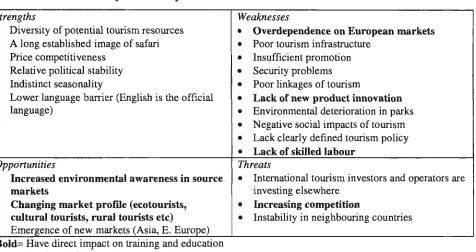
5.3 S W O T Analysis of Kenya's Tourism Source 55
5.4 European arrivals in Kenya 1990 and 1994/95 56
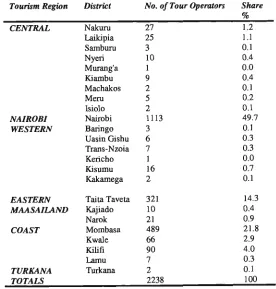
6.1 Distribution of tour operators in K e n y a 66
7.1 Panellists'profiles 83
8.1 Employer satisfaction with the skills of their employees 88
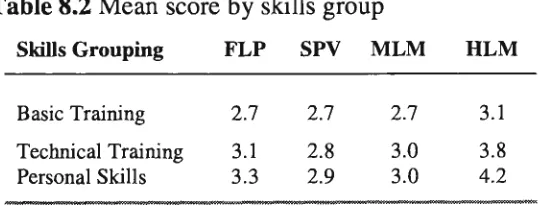
8.2 M e a n s score by skills group 89
8.3 Perceived ability of the training and education system to meet the skill needs
industry in the next 10 years 91
8.4 Ability of education system to provide required skills: the present and
future-s u m m a r y 91
8.5 Preferred training and education modes 92
8.6 Preferred employees profile by occupational level 93
8.7 Employee recruiting preferences 94
8.8 Global business trends 9 4
8.9 Trends in development of specific employee skills 95
8.10 Trends in tourism education system 96
8.11 Occupational level of respondents 97
8.12 Ages of respondents 97
8.13 Highest education qualification of respondents 97
8.14 Relevance of skills vs o w n ability to perform 99
8.15 Paired samples test results: relevance of skills vs employee self-rating 101
8.16 Formal work related course(s) attended in the last one year 102
LIST O F FIGURES
Figure Page
1.1 Geographical element in tourism system with one destination 7
2.1 Interface between training and education and employment 25
2.2 (a) The G a p model 26
2.2 (b) The continuum of customers of the tourism training &
education system 26
5.2 International tourists arrival trend 50
5.3 Tourist receipts trend 51
6.1 Tourism distribution channels 59
6.2 H o w group tour business works 60
6.3 Types of tour operators 63
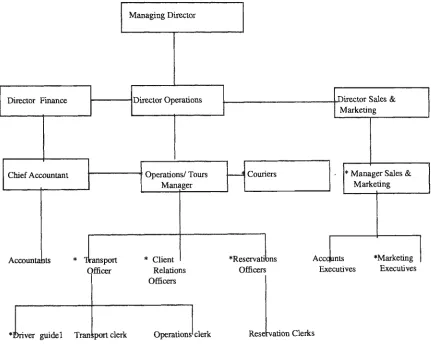
6.4 Sample Kenyan I T O organisation chart 68
Chapter 1
Introduction
1.1 B a c k g r o u n d
T h e Republic of K e n y a covers a total area of 582,650 k m , two and a half times the
size of the state of Victoria, and lies astride the Equator in East Africa. T w o thirds of
the total landmass is arid or semi-arid. T h e current population is about 28 million,
7 2 . 3 % of which is classified as rural (Weaver 1998). T h e country attained its
independence from Britain in 1963 and became a republic in 1964.
Kenya is a multiparty democracy with four main political parties and several smaller
ones. Since independence, the government has pursued economic policies that
encourage and safeguard private enterprise. Such policies and a prolonged period of
political stability laid the foundations for positive economic development. Tourism
has played an important role in this economic development.
Kenya's success as a popular long-haul destination offering a combination of wildlife
safaris and beach holidays has been well documented. Wildlife attractions include big
g a m e as well as a high level of biodiversity, with, for example, over 309 k n o w n
m a m m a l species and 1067 bird species (Weaver 1998). This biodiversity, a wide
variety of landscapes and rich cultural heritage have combined to create Kenya's
present image as a popular destination. They also offer enormous potential for future
development (Weaver 1998).
Since independence, agriculture has remained the dominant economic activity in
Kenya, accounting for 2 7 - 2 8 % of G D P . Reliance on the agricultural sector is a legacy
of Kenya's colonial past. T h e country lacks heavy industry and minerals deposits. In
recent years, the volatile demand for agricultural products and the susceptibility of
agriculture to fluctuations in weather has elevated tourism's importance as an
alternative vehicle for economic growth.
As awareness of the size and potential of international tourism grown, so has
competition from other destinations. In m a n y destinations tourism is n o w regarded as
industry is n o w confronted by increasing competition from " n e w " destinations and no
longer enjoys its previous monopoly, particularly in the nature-based tourism market.
Recent changes in the geopolitical and economic environment such as the end of the
"cold war". South Africa's independence, the emergence of Asian 'tiger' economies,
political changes in Eastern Europe and the emancipation of Latin American
economies have created a very different context to which K e n y a must be responsive.
In addition to the "external threat", there is pressure on the tourism industry to make a
tangible contribution to social development to counteract the economic and
non-economic costs associated with tourism. These, a m o n g other introspections, have
increased the search, within the industry and government, for ways and means of
improving Kenya's tourism performance. T h e answer to this search m a y perhaps lie
in Bull's proposition that tourism's socio-economic benefits are a function of, a m o n g
other factors, a country's resources (1995). This study focuses on the development of
what is, arguably, one of tourism's most vital resources—the h u m a n resource.
As is the case with other services, the tourism product is largely determined by the
competence and innovation of the workforce. A s Witt, Brooke and Buckley (1991)
have noted, h u m a n resource development should form a key part in the tourism
competitive strategy formulation. Tourism training and education has b e c o m e a major
area of both academic and non-academic inquiry. Current and potential areas of study
range from overall policy analysis, micro (company) oriented analysis, content, and
curriculum development.
Understanding human resource development at a macro level is particularly important
in tourism, given the reliance of tourism on its h u m a n capital. A s Brogan (1994) has
noted, this focus raises a number of key issues: encouraging employers to take an
interest in training and education; improving the supply and, quality of and access to
training; and enhancing the status of careers in tourism. However, there m a y be other
destination or region specific issues that also merit serious consideration. T h e study
examines these "universal" concerns as well as the specific considerations in a
For t w o reasons the thesis adopts a sectoral approach and focuses on the tour operator
sector. First, there is an apparent lack of literature on this particular sector. T h e
second reason is that whereas research has been useful in raising issues for the
industry as a whole, researchers have not done so for various component sectors such
as travel agents and tour operators. A s G u n n (1998) has observed, most of the existing
body of knowledge on tourism training and education is based on the hospitality
component, which is assumed to be representative of the entire "tourism industry".
H o w e v e r , as is suggested in this study, sector by sector analysis is vital for any
integrated national tourism training initiative. It is essential to acknowledge the whole
scope of tourism activities.
The reason for the focus of this study on the tour operations sector is the significance
of the inbound tour operators (ITO) in Kenya's tourism system. T h e importance of the
sector arises from Kenya's status as a long-haul, nature-based tourism destination.
T h e economic implications of tour operator decisions and actions in the K e n y a n
context have been dealt with in the literature (Sinclair 1991). Tour operators
constitute the second most important source of direct tourism employment sector after
hospitality.
As the majority of tourism-related training and education takes place in government
funded institutions, one might expect a positive return to society from this training. In
any destination, there is a need to assess the extent to which existing training and
education is deploying resources correctly through an examination of both the
d e m a n d and supply sides. T h e rationale for the present study is that tourism will only
succeed if employers find training provision to be useful and are willing to raise the
wages of formally trained staff w h o bring m o r e valuable skills into the workplace.
1.2. Research objectives
This study aims at detailing the current state of training and education in the inbound
tour operations sector (ITO) in K e n y a and examining the training needs. T h e strategic
implications of the current state on the direction of Kenya's tourism and
This study's main objectives are:
• T o identify the training and education quality gaps in inbound tour operations;
• T o assess the level of training required;
• Identify relevant employee training schemes;
• T o assess the views of industry experts about the most appropriate m o d e s to
deliver the skills required by tour operators; and
• T o determine the global trends likely to impact on future tourism training and
education;
The productivity of a person's work performance is affected by, among other factors,
the quality of skills this person brings to the job (Charlesworth cited in Victorian
Department of Labour 1986). Quality training and education provides the individual
with the tools to adapt constantly to technological and other macroenvironmental
changes (which need to be monitored regularly). Therefore, to ensure that the supply
of training and education (whether it is at work or at school) matches needs, there has
to be m e a n s of assessing the quality of the end product—the skills of the workforce.
Quality tourism training and education is not confined to meeting the skill
requirements of the industry, but also optimises provision in relation to requirement at
different occupational levels. Riley (1993), outlines certain measurable activities of
the labour market's participants that can be indicative of skills shortages. H e notes,
for example, that w h e n employers employ a high proportion of unqualified persons in
positions that require certain m i n i m u m qualifications, they are responding to a
shortage of trained people. Based on this argument, the necessary level of training and
education can be determined.
Given the dynamic nature of the tourism industry, not all aspects of training and
education can be catered for through the school system. Training and education that
takes place at the workplace forms part of the tourism training and education system.
S o it is also vital for employers ensure that the skills of their employees are constantly
updated. For the efficient utilisation of resources, it is necessary to determine what
aspects can be learned at work or in both places. This is the basis for the need to
determine the appropriate training and education provision modes.
The ultimate aim of the present study is to suggest ways of improving tourism training
and education in Kenya. T h e optimal situation m a y not be realised due to a variety of
reasons. It is, therefore, necessary to acknowledge the limitations in a more or less
exploratory manner and to examine ways in which they can be overcome.
1.3 Key concepts
The tourism system
Despite the fact that tourism impacts millions of lives, it is by its nature a fragmented
industry m a d e u p of m a n y parts and varied activities (Mcintosh and Goeldner 1990).
This is one explanation for the apparent lack of a unified theoretical foundation in
tourism research (Stabler 1991). Stabler has observed that most theoretical models
applied in tourism studies have been confined to specific disciplines and, thus, tend to
have a narrow perspective. In addition, Cooper, Fletcher, Gilbert, and Wanhill, (1993)
cite tourism's relative youthfulness (international mass tourism is at best only about
30 years old) as a liability in its quest for status as a discrete discipline.
No existing tourism model is sufficient to depict the complexity of the tourism
industry. It is, therefore, necessary to undertake an interdisciplinary approach in
tourism research as has been proposed by Jafari (Mcintosh and Goeldner 1990).
Considerable time can be wasted in trying to determine the value of each model.
However, as Leiper (1995) and Cooper et al (1993) have noted, it is always necessary
to have an organising framework for any study of tourism. Various concepts from
other disciplines m a y then be drawn upon as appropriate.
The current study, for its overall framework, has adopted the tourism systems model
attributed to Leiper (in Cooper et al 1993). According to Stabler's (1991) tourism
models' classification, the model is essentially geographical. O n c e this overall
framework has been established, h u m a n resource management concepts are then
Leiper (1979) has suggested that there can be several tourism systems depending on
the actual itineraries taken—in line with systems theory, which recognises that there
can be major systems and minor or subsystems (Leiper 1995). Thus, three systems are
at work throughout the three geographical regions at any time:
• domestic tourism systems--Kenyan residents touring or visiting places within the
country;
• outbound tourism .systems—residents of Kenya going abroad; and
• Inbound tourism systems—visitors coming into K e n y a from other countries or
regions.
To conceptualise these, Figure 1.1. demonstrates the link between the traveller
generating region ( T G R ) and tourist destination region ( T D R ) as the main systems in
the present study. Other linkages such as tourist movements between the T D R and the
transit route or region ( T R ) and between the T G R and T R are minor systems.
Domestic tourism systems are within any of the individual spheres and are considered
minor systems in the current context.
The discussion which follows focuses on inbound tourism systems. In the model
(Figure 1.1) the two large spheres represent the major geographical elements of
inbound tourism systems (which are of main interest in the current research). T h e
smaller sphere represents the transit component, but they have the possibility of
growth to b e c o m e major T G R s or T D R s . Domestic tourism systems take place within
each sphere and it should be remembered that "tourism in the world is dominantly
domestic" (Cooper et al 1993 p.l).
As Leiper (1990) has argued, the greatest impacts of tourism are felt at the tourist
destination (in Cooper et al 1993). Thus, the proposed research and discussions will
focus on inbound tourism systems for the simple reason that these are the systems
capable of bringing in n e w wealth as opposed to the redistribution of existing internal
wealth (as is the case with domestic tourism). It is this sector that contributes to real
A major consideration in the systems approach is that actions at any or all of the three
geographical elements have a ripple effect throughout the system. For example, the
government at the T G R issuing a travel advisory about insecurity at the T D R m a y not
only affect the tourist flow to the T D R , but also revenue at the T R . B y the same token,
it can be argued that a problem or weakness such as lack of proper education and
training within one industry sector, such as the inbound tour operations, has the
potential to d a m a g e the image of the T D R and, therefore, to deter tourist flow
throughout the system. This has been referred to as the "butterfly effect" (Faulkner
1997). This justifies even further the need for a skilled, resilient labour force.
Another important factor to be considered in the application of the systems model is
that systems tend to be unique. This, from an academic perspective, means that care
has to be taken w h e n applying certain principles so that what is good and expedient
for region "A", for example, is not necessarily applicable in region "B". It is
necessary to examine, for example, the elements that play prominent roles in each
system. Nevertheless, a systems approach proves to be a versatile tool in
understanding tourism, because it helps to locate the key players and to take into
account the roles played by each of them.
Figure l.lrGeographical element in a tourism system with one destination (modified)
Source: Cooper et al 1993 p4
Leiper's model consists of six elements, all of which are vital in the understanding of
Geographical element. These can be divided into tourist generating region ( T G R ) ;
tourist destination region ( T D R ) ; and transit region (TR). There can be several
transit regions, but for the purposes of the proposed research it is assumed there is
only one transit region for tourists, as K e n y a is primarily a primary destination.
T h e tourist generating region, according to Cooper et al (1993), provides the
"push" factor to stimulate the tourist to engage in travel. According to Leiper
(1995), it is at the tourist destination region where easily noticeable and dramatic
consequences are most likely to take place as it attracts and services tourists. T h e
inbound tour operator can contribute significantly to the "pull force", particularly
through effective itinerary/product design, promotion and exceptional ground
services provision and co-ordination.
Tourists. T h e tourist is the key element in the entire system. Without the tourist there
is n o tourism. T h e attractiveness of the destination and other extrinsic motivators
initiate the whole system by creating d e m a n d at the T G R . T h e destination,
therefore, applies the pull element in the system. In effect, inbound tour operator
actions can have substantial impacts upon the destination, as they attract and
service the tourist. T h e skills and competence levels will, for example, determine
the service and product quality and, therefore, visitor satisfaction.
Host government. T h e host government often has a stake in tourism primarily because
of the economic benefits (for example employment, balance of payments and
distribution of wealth) that tourism is seen to bring. However, it usually has the
responsibility to establish the necessary infrastructure and provide the policy
framework within which the tourism industry operates. Part of the tourism
development policy should focus on the h u m a n resource aspects of development.
In the current study, the effect of government policy on tourism training and
education will be examined, as it is crucial in the overall destination image and
product development. Only the government has the necessary resources, for
example, to provide and/or regulate nation-wide tourism training and education.
Host community. T h e host community, like the government, sees tourism from the
point of view of the economic benefits that accrue from it, although negative social
impacts m a y arise from the host/guest interaction. This latter issue must be
Origin government. T h e involvement of the origin government is often ignored,
though it can have quite a significant influence on the inbound tourism system. A n
example is the banning of U S citizens from travelling to Cuba, Libya or Iran.
Tourism industry. This is m a d e u p of the range of organisations and businesses
involved in delivering the tourism product. According to Leiper (in Leiper 1995),
industry can b e divided into at least 7 sectors): (i) marketing sector; (ii) carrier
sector (transportation); (iii) accommodation sector (iv) the attractions sector; (v)
tour operator sector; (vi) co-ordinating sector (organisations and associations that
do exist world-wide and; (vii) Miscellaneous sector.
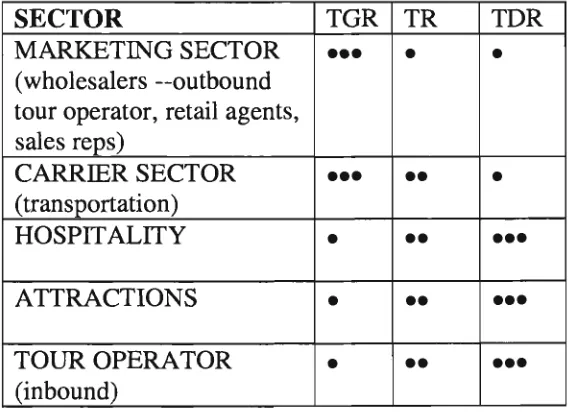
According to Leiper (1979), the marketing sector (for lack of a more appropriate
collective term) is mainly located in the generating country and is m a d e up, for
example, of the wholesalers (outbound tour operators) and retail travel agents (in
Cooper et al 1993). These travel agents and wholesalers are predominantly found in
the tourist generating region, while the attractions and hospitality components are
found in the destination region (Cooper et al 1993).
Table 1.1 Spatial distribution of five critical industry sectors in the tourism system
SECTOR
M A R K E T I N G SECTOR (wholesalers —outbound tour operator, retail agents, sales reps)
CARRIER SECTOR (transportation) HOSPITALITY
ATTRACTIONS
T O U R OPERATOR (inbound)
TGR
••• ••• • • •TR
• •• •• •• ••TDR
• • ••• ••• •••Key: ••• K e y role •• Moderate role • Minor role
It is argued here that, contrary to the common view, all of the industry sectors are
roles they play at each of the three regions (Table 1.1). This is important w h e n it
comes to the design of tourism courses, as content ought to reflect these differing
roles of various industry sectors.
Human resource management
There are m a n y definitions of h u m a n resource management ( H R M ) . Clark (1988), for
example, has defined H R M as "the management of employment relationships with
enhancing the achievement of organisational objectives" (1988: 3). However,
Schuler's (1992) definition has a wider scope as it mentions individual and society
needs as part of the broader aims of H R M :
H u m a n resources m a n a g e m e n t involves the recognition of the importance of an organisations workforce as vital h u m a n resources contributing to the goals of the organisation, and the utilisation of several functions and activities to ensure that they are used effectively and fairly for the benefit of the individual, the organisation, and society (1992 p. 16).
Thus, h u m a n resource management ( H R M ) is directed at management's need to
provide and deploy h u m a n resources to meet a desired objective. O n e of the
fundamental philosophical principles of H R M is the recognition of h u m a n resources
as the organisation's most important asset, and that their effective management is
crucial to success.
Tourism training education, competence and development
Training and education is a vital function of h u m a n resource management,
particularly in tourism. This is because the key aspect of service is the interpersonal
relationship between the customer and the service provider. This core transaction
determines the success or failure of the product (Heap 1996). A s B a u m and Conlin
have observed, "the overwhelming presence of people in the process of delivering the
hospitality product" links the quality of the [human resource] to productivity and
value adding (1996: 59). This is true for most sectors of tourism.
Bennett (1984) defines training as a process that is concerned with the acquisition and
development of specific skills necessary to undertake particular activities or jobs
(cited in Silver 1991). Thus, training is geared towards helping an individual to carry
G o (1993) sees a distinction between education and training and argues that education
is the intellectual and professional development of a person without concern for
specific responsibilities. T h e purpose of education is to provide the student with a set
of tools for interpreting, evaluating and analysing both knowledge and facts.
Education develops the critical thinking capabilities of the student. Education is thus
more general and broad based than training, yet it m a y be concerned with the
development of certain specific skills [as is often the case in university and college
education] (Silver 1991). T h e two overlap.
Competence is defined as an underlying characteristic of a person, which results in
effective and/or superior performance in a job. K l e m p (1980), Boyatzis (1982) and
Constable (1988) seem to consider competence to be that effective mix of motives,
traits, and skills, aspects of one's self-image or social role or body of knowledge by an
individual (cited in Silver 1991). Competence, therefore, is the ability to use
knowledge and skills effectively. Both education and training are necessary to raise
the competence of an individual.
Another important concept is development, which implies fitting and helping the
individual to take on jobs in different spheres, especially at higher or management
levels. This again embraces the two of concepts training and education (Silver 1991).
Because of the apparent overlap between education and training from a conceptual
and practical point of view, it serves no purpose to treat them as if they were mutually
exclusive. Such is the view held by pragmatic commentators (see for example G e e
1997, B a u m 1995). Indeed, as B a u m (1995) observes, the realities of a modern
working environment in tourism are such that employees require attributes which
according to established distinctions would be described as being derived from both
education and training. For this reason, the term training and education has been
adopted and will be used throughout this study to incorporate all skill formation
1.4 Chapter outline
Chapter 2: Literature Review examines the broad theoretical issues relevant to the
subject of tourism training and education. First it examines divergent views on the
role of tourism as a vehicle for economic development in developing countries and
then focuses on h u m a n resource development. Tourism training and education issues
are then discussed at length, albeit from a developing country perspective.
Chapter 3 : Training and education in tourism, a global context
This chapter discusses the impacts of global trends on tourism training and education.
Chapter 4: Tourism and Tourism Education in Sub-Saharan Africa In this chapter a
geographical context for the study is established including an overview of Kenya's
tourism industry. T h e chapter c o m m e n c e s with a discussion of the general problems
facing tourism development in Sub-Saharan Africa. It is noted that despite the great
tourism potential the region's performance in terms of arrivals and receipts continues
to be relatively low. T h e problem of skilled labour is highlighted.
Chapter 5: Tourism and tourism education in Kenya Kenya's tourism industry is
examined m o r e closely. T h e recent performance of the industry is analysed. T h e
policy and development of the industry and its role in economic development are
discussed. A S W O T analysis of the industry is also undertaken as this underlines the
need for development of skills.
Chapter 6: The inbound tour operations sector and its training needs in Kenya
This chapter focuses on the tour operations sector and its relevance and significance
in Kenya's inbound tourism system. T h e relevant training and education issues are
then within this context.
Chapter 7: Methodology The methodological issues are discussed. This is followed by
a detailed account of the methodology applied in this study.
Chapter 8: Data analysis and discussion The research findings are tabulated and
Chapter 9: Conclusions and opportunities for further research This final chapter
presents a review of the present study. Conclusions are then m a d e based on the
findings and in accordance with the main objectives of the study. T h e chapter also
makes various recommendations and outlines the key limitations of the study as well
Chapter 2
Literature Review
2.1 Approaches to tourism and development
T h e rapid growth of the tourism industry is well documented. In a bid to capture a
share of this growing international market and, therefore, achieve rapid economic
growth, m a n y developing countries have sought to develop their tourism industries. A
review of the literature on directions in tourism development [in developing
countries] reveals four fundamental themes: opportunities, problem areas, paradigm
shifts, and complexity of issues (De Kadt 1979; Britton 1982, 1983; Harrison 1991;
Faulkner and Russell 1997; B r o h m a n 1996; Poon 1993; Jenkins 1994; English 1986;
Lea 1986).
In the last ten years or so, concerns have been raised over tourism's inability to
deliver the benefits expected by host countries (Jenkins 1994). Criticisms raised
include claims of foreign domination; cultural alienation; loss of control by host
communities; environmental, socio-cultural costs; economic costs; the list is long
(Britton 1982, 1983; B r o h m a n 1996, A k a m a 1996; J o m m o 1987, Krippendorf 1987).
These criticisms represent the view which Lea calls the 'political economy approach,'
which sees tourism as yet another extension of the north (core) and south (periphery)
polarisation.
Despite these criticisms, there have been more positive comments about the industry.
Such (one might say more pragmatic) contributions have mainly focused on h o w to
minimise the negative effects and maximise benefits of tourism. This "functional
approach," as Lea (1988) calls it, takes an optimistic view, as it sees all tourism
related problems as capable of being solved through good management and
appropriate policy. This approach is important w h e n one considers the fact that
tourism is n o w a global phenomenon affecting millions of lives. Furthermore,
adopting such an approach is particularly relevant in the context of less developed
Firstly, m a n y small economies lack alternative development options. Secondly, some
countries have a history of embracing tourism with meagre resources already
committed to tourism development. In such a context, any major shift of focus m a y
have far reaching destabilising effects (see Mulindi 1997: 21). Moreover, it is useful
to note that even those w h o ascribe to the political economy approach still
acknowledge undeniable benefits of tourism to the less developed countries ( L D C s )
(Britton 1982, Harrison 1991). Given these benefits, and the increasing evidence that
tourism is here to stay, the present study proposes a m o r e functional approach in
dealing with various tourism related issues.
There are three possible approaches to mitigating the problems associated with
tourism development: maintain the status quo (i.e. accept them as characteristic of the
industry and do nothing about them); seek means of improving the benefits; or
undertake radical change to the existing structure and organisation (see Jenkins 1994).
The second approach m a y be deemed appropriate, given the reasons cited above,
although one can not rule out cases where radical change m a y be necessary.
The lack of skilled labour in tourism, and in particular, in less developed countries
and associated problems such as leakage are well covered within the literature (De
Kadt 1979, Jenkins and Henry 1982, J o m m o 1987, A n k o m a h 1991). T h e list of
c o m m o n problems pertaining to the subject of h u m a n resource development revolves
around popular themes such as: shortage of labour, importation of skilled labour, low
skill nature of tourism jobs, low wages, high turnover and the seasonal nature of jobs
(see for example Riley 1991,1993, A n k o m a h 1991 T i m o 1996).
These common themes on human resource issues have been repeated and reiterated to
the extent that they are taken to be universal characteristics of the industry. Such an
assumption has however been questioned. A study of tourism employment in Hawaii,
for example, revealed that the quality of tourism employment was m u c h better that is
often perceived (Choy 1995). Such findings reinforce the need for a m o r e positive
approach to tourism in order to elevate its image and status as a socio-economic
Recently, the focus in the literature has shifted to the subject of comprehensive h u m a n
resource development, either as a means of gaining a competitive advantage or as a
vital component of sustainable tourism development (Witt 1992, Heap 1996, B a u m
1993, 1995, Burns 1994, Stewart 1995, Watson 1996). These two notions underpin
any long-term h u m a n resource development policies and, therefore, need to be
examined in greater detail as they form a basis for the current study.
2.2 Human resource development in tourism
A s B a u m (1993) has observed, the tourism industry is well served with literature
where the focus is on the hospitality sector of the industry and which approach the
subject of tourism h u m a n resources from the management point of view. Put simply,
the approach within m u c h of the h u m a n resource literature starts at the level of the
company and moves towards the consideration of the wider issues that have an effect
at company level. However, as B a u m (1993) and B a u m and Conlin (1994) note, the
broader concern should be h o w a country or destination can administer quality
product through its h u m a n resource.
As has already been pointed out, many nations now pursue tourism as a means of
economic growth, the result being increased competition in the international market.
A s Nicholas (1996) notes, in such a competitive environment, achieving excellence in
quality is an increasingly important element in competitive success. However,
H a y w o o d and M a k i (1991) observe that despite the importance of tourism, and this
importance of quality, developing of quality h u m a n resource in the industry has
somewhat lagged behind (see also W T O 1997: 10).
The greatest contemporary human resource development challenge, is how companies
and educational institutions can attract the right people to the workforce, help those
employees to gain skills to enhance the visitor experience and to generate greater
on-the-job satisfaction and improve productivity, delivering quality products that are
competitive in the global marketplace. In the Kenyan context, development of the
h u m a n resource through training and education m a y be regarded as one of the key
2.3 Sustainability and h u m a n resource development
T h e concept of sustainability in the context of tourism h u m a n resources development
has gained ground in recent years (Poon 1993, B a u m 1995, Hawkins 1997). Hawkins,
in particular, points out that a commitment to sustainability can form an impetus to
educating policy-makers and managers about sustainable business practices. This
means that sustainability becomes both a driving force and a desired goal of tourism
training and education. This addition of sustainability forms a vital link between
h u m a n resource development and long-term tourism development strategies.
Sustainability is an important concept in the Kenyan context for two main reasons.
Firstly, K e n y a being a developing country whose socio-economic and cultural
circumstances differ greatly from those of m o r e developed tourist generating regions,
is likely to experience greater negative socio-cultural impacts of tourism (see Hall
1995). Secondly, Kenya's e c o n o m y is highly dependent on tourism, particularly for
foreign exchange generation. This, combined with rapid tourism development
experienced in the 80s and early 90s, means that the industry is more vulnerable to
self-destruction unless its practices and activities are sustainable.
A sustainable human resource development approach is underpinned by several
principles, a m o n g which the most relevant to this study are:
• Investment in people as a long-term commitment by all concerned parties;
• T h e need by companies to realise the impact that they have on the character and
balance of the local labour market;
• T h e ability of tourism training to provide flexible and transferable skills that are
able to adjust to changing demands, and in response to emerging opportunities;
• T h e incorporation of h u m a n resource development as an integral part of overall
tourism development planning ( B a u m 1995 p. 10).
At the core of this h u m a n resource development is education and training, whether it
is offered at the c o m p a n y level, or by public or private education providers. Quality
training and education has to be need driven and has to be well integrated within the
overall destination planning and development. Such an approach, essentially,
demands that several issues be addressed. S o m e of the key tourism training and
2.4 Tourism training a n d education issues
Tourism training and education has experienced a rapid growth, particularly in the
1980s and 1990s, largely due to the increasing in importance of tourism as a social
and economic activity. M u c h of this growth has been inspired by governments w h o
see training and education as a means to achieving competitive advantage or,
sometimes, by individual institutions that have identified gaps in training and
education provision. H o w e v e r due to the infancy of tourism as an area of study,
tourism training and education is surrounded by disputes and controversies (Cooper
2000).
Controversy, for example, still exists as to what should constitute a tourism
curriculum or, even more narrowly, the body of knowledge in tourism (Cooper 2000,
Howell and Uysal 1981, Leiper 1981, Jafari 1990). There is also controversy over the
issue of separation between vocationally-based "training" and tourism "education"
(Jenkins 1997, G u n n 1998). G u n n , for example, notes that training is still given a
pejorative connotation in the belief that it is less important than education. These and
other prevailing issues in different regions render curriculum planning in tourism
training and education difficult. Approaches taken still tend to be ad hoc in nature
and, in s o m e cases, dominated by short-term functional outcomes rather than
long-term sustainable development objectives (Collins et al 1994, WTO/Surrey 1996).
Tourism educators concerned with curriculum planning can benefit from ideas in the
mainstream education literature (Cooper 2000). A s Cooper observes, there is need to
examine h o w the definitions of curriculum have evolved. This evolution in definitions
and the different debates on the subject of curriculum have become more relevant as
tourism gains recognition and legitimacy as a distinct area of study in higher
education (Leiper 1981).
2.5 Curriculum Development
Though the basic model has not changed, the definition of curriculum has evolved
since the term w a s first used in the early 19th Century, (Cooper 2000, Tanner and
most complex processes and considerations in any educational setting. It must play an
important part in tourism training and education.
Contemporary definitions of curriculum fall into Schefler's category of
programmatic definitions, which imply a model where elements of curriculum fit
together into an integrated holistic approach (WTO/Surrey 1996, Tanner and Tanner
1980, Cooper 2000). In other words, curriculum is seen as "the totality of the learning
experience as guided and directed by the school" (in Tanner and Tanner 1980: 7).
Such definitions of curriculum do not treat curriculum as a mere course of study, but
the course as part of the curriculum. According to Cooper, it is within this
"programmatic" thinking that the context of the curriculum becomes a critical issue,
although it is an area to which tourism education research has paid little attention
(Cooper 2000).
Tourism curriculum developers must consider the stakeholders in tourism education
curriculum. Understanding the role and influence of the different groups that have an
interest in training and education is vital. These groups include: students (taking their
backgrounds into account), the industry and government. There are obviously areas of
conflict and prospects of the curriculum planning process being dominated by one
group. This can be avoided by the establishment of effective channels and
mechanisms of communication between the stakeholders and, as Cooper (2000)
warns, avoiding the possibility of curriculum becoming context bound rather than
context related. It is also important to m a k e a distinction between primary and
secondary stakeholders.
There are various models that can benefit tourism educators involved in the
curriculum design process. A m o n g the main theorists in curriculum design are: Tyler
(1949); Bligh (1975); Hirst (1978); Rowntree (1982); Manwaring and Elton (1984).
Tyler's model is the most c o m m o n l y accepted and involves sequencing the course
objectives, deciding the anticipated learning experience and organising the method of
delivery and evaluation. His ideas c a m e to be referred to as the 'Tyler Rationale' in
latter years (Tanner and Tanner 1980: 83). T h e m o r e recent models are developments
Traditionally, curriculum developers focused on what has to be learned by the student
in a prescriptive manner. This content approach is the m o r e established view of
curriculum and tends to be provider-centred (Pickup and W o l f son 1986). Knowles
(1984) describes the process approach, which is m o r e learner-centred and emphasises
the importance of meeting individual needs. T h e approach that is taken by any
institution of learning will obviously depend on, amongst other factors, various micro
and macro-environments of the institution. T h e approach should however be
determined on the basis of the desired outcome.
Curriculum outcomes
The Further Education Unit ( F E U 1989) has identified curriculum outcomes as an
important part of the learner's entitlement. T h e outcomes answer the question "for
w h o m is the curriculum intended ?" (Gunn 1994). G u n n suggests that it is appropriate
to:
• Categorise employment into occupations and determine the different levels of
employment; and
• Anticipate the different training needs of each level of personnel within each
category before development of curricula.
There are t w o w a y s in which the boundaries of the tourism workforce could be
defined namely by occupation or by the nature of the relevant job (Riley 1991, 1993,
Industry Commission 1996). O f these two methods, defining the tourism workforce
by occupation w a s considered to be most appropriate for the purposes of the present
research.
It is crucial to consider the desired outcome in course content decisions.
Tourism course content
Content is an important element of the curriculum. Content consists of: skills
(including product and process skills); knowledge (including theoretical and practical
knowledge); experience (gained both before and after a particular learning
programme); and learning support (comprising of the infrastructure surrounding the
Jafari's (1990) review of the historical development of tourism as an area of study
offers a comprehensive examination of the different philosophical foundations of the
various contributions to what constitutes most tourism courses. There are two
predominant sources for the body of knowledge in tourism courses, namely business
disciplines (particularly marketing, economics and management) and social sciences
such as geography and sociology.
The education literature can help to shed some light on the optimal ways of
approaching the issue of what should be taught in tourism. Rowntree's description of
different types of courses is perhaps one of the most elaborate (1985). H e makes a
distinction between what he calls: knowledge oriented courses, methodology courses
and mixed courses (1985). His model is a useful starting point in determining the kind
of courses that can be both practicable and acceptable in any given setting.
In knowledge-oriented courses, efforts are directed at getting the student to master the
subject-matter with the aim of applying it and for its o w n sake, not as a vehicle for
learning something else (Rowntree 1985). M o s t science courses fall into this category,
with the subject matter making up the core of the discipline. B y contrast,
methodology oriented courses emphasise the acquisition of procedures or skills
-intellectual, physical or social. T h e student learns to be a performer. Rowntree further
divides methodology oriented courses into: task-oriented courses and
discipline-oriented courses.
Task-oriented courses normally comprise clearly defined tasks or activities which can
be performed in fairly predictable situations and are mostly confined to
technical/crafts areas of education such as plumbing, bricklaying. A task oriented
course or section of a course emphasises 'how to do it' knowledge. In a
discipline-oriented course students learn methods and procedures that can be adapted to various
situations. Thus, a student of history might learn: h o w to gather and assess evidence,
h o w do draw valid conclusions and h o w to present an argument.
In most cases the distinctions between different types of courses are not as clear-cut as
suggested in the foregoing discussion. M o s t are mixed, which adds weight to the
types of mixed courses can be identified in m a n y fields. Issue-based courses focus on
an issue and provide the student with the tools to solve a specific problem. T h e
Ultimately a student m a y be required to work on a self-selected project.
The second type of mixed courses are inter-disciplinary, where two or more
disciplines are brought to bear on one topic, period or issue in such a w a y as to 'learn'
from one another in a manner that produces s o m e form of synergy. Thus, an
issue-based course can also be inter-disciplinary. T h e interdisciplinary approach is a
prevailing feature of tourism in its evolution as a n e w integrated discipline. Tourism
education however, continues to undertake multi-disciplinary studies which do not in
any w a y attempt to interrelate the contributing disciplines.
Educators who shunned the traditional knowledge based learning such as Taba (1962)
found the construct of disciplinarity or learning by inquiry quite appealing. H o w e v e r
this approach has been criticised on the basis that personal-social problem solving
requires an integrative treatment of knowledge. Moreover a disciplinary approach has
the weakness of producing scholar-specialists. Disciplinary knowledge takes
pre-eminence over the interests of the learner and the problems of society (Tanner and
Tanner 1980, W T O 1997a). According to B o d e w e s (1981), it also takes time before
mono-disciplinary teachers learn to adjust from their mother discipline approaches to
interdisciplinary ways of thinking in such integrative subjects as tourism. A united
interdisciplinary perspective is necessary.
There have been various approaches and contributions to the subject of tourism course
content, either by w a y of empirical inquiry or as commentary (Airey and Nightingale
1981; B o d e w e s 1981, Stear 1981, M u r p h y 1981, Collins, Sweeeney and G e e n 1994
and K o h 1995). Airey and Nightingale's study (1981) w a s pioneering in having
attempted to examine the links between tourism occupations, career profiles, tourism
employment by sectors and the knowledge required by individuals engaged in these
careers and occupations. It w a s possibly the earliest attempt to look at the broad scope
of tourism education in terms of its component sectors. T h e study found a distinct
T h e m o r e narrowly focused "disciplinary" approaches to the corpus of knowledge
include Murphy's (1981) description of what should be taught in tourism as a "social
science" and Stear's (1981) "destination studies" content. Koh's study is a departure
from this apparently narrow perspective in focusing is on a general content of degree
courses regardless of the disciplinary origin or inclination (1995). However, even
Koh's study seemed to ignore other tourism sectors outside hospitality.
The study by Collins, Sweeeney and Geen, on the other hand, seems to take the
narrow vocational tourism training approach (1994). All these studies and comments
m a y , thus, be criticised as either: restrictive (by paying greater attention to
diciplinarity), limited in scope, or perpetuating a not useful divide between 'tourism
training' and 'tourism education' as distinct sectors.
Given that these earlier examples of tourism education (with the exception of the
Airey and Nightingale study (1981) tended to be deficient in recognising the breath of
tourism as an area of study, there has remained a need for a more issue-oriented
integrated approach. Such a comprehensive and integrated approach w a s undertake in
the T E D Q U A L (acronym for Tourism Education and Quality) pilot study
commissioned by the World Tourism Organisation at the George Washington
University ( W T O 1997a). T h e study considered three dimensions: the geographical,
professional or occupational level and industry sectors in mapping the repertoire of
skills and knowledge required b y tourism professionals.
The strength of the TEDQUAL pilot study approach could be based on the fact that
the skills items used were a result of an iterative polling process involving 100 experts
representing 12 tourism sectors and 6 tourism regions worldwide. T h e study sought to
"determine the skills and knowledge considered most necessary for tourism industry
employees" ( W T O 1997a: 57). If the above assumption is valid, then results on the
"importance" of the T E D Q U A L skills model should be amenable to replication. It is
within such a context that the present study seeks the views of education providers
However, even the T E D Q U A L pilot study omitted the inbound tour operations sector.
A s Airey and Nightingale (1981) noted, in such general studies, there is also a danger
of not including a representative sample from each individual sector or occupation. In
this respect, the present study m a y be regarded as a contribution towards filling this
apparent gap.
2.6 Tourism training and education quality
The notion of quality of training and education is a problematic one due, largely, to
the number of stakeholders and, hence, the variety of relevant perspectives as. This
factor creates difficulties in measuring the outcomes of training and education,
particularly in a service environment.
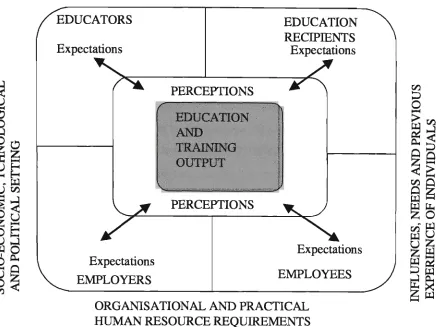
The interface between tourism education and employment could be considered as
being m a d e up of four key players: employers, employees, students, education
providers, the government department responsible for tourism training policy and
service consumers. Each of these groups has different perspectives on what
constitutes quality of training and education. T h e interaction of the first four
stakeholders has been considered in the literature (Maki and H a y w o o d 1991, W T O
N E E D S A N D PRACTICES
O F E D U C A T I O N INSTITUTIONS
u
o
o
9 o
s *
H H I—I«w
U
OHO
§
u
w
6
u
o
E D U C A T O R S
Expectations
^
PERCEPTIONS
EDUCATION
AND
TRAINING
OUTPUT
V_
ExpectationsE M P L O Y E R S
E D U C A T I O N RECIPIENTS Expectations
PERCEPTIONS
J
Expectations
E M P L O Y E E S
ORGANISATIONAL A N D PRACTICAL H U M A N R E S O U R C E REQUIREMENTS
o
is
o
^ @ %a
Figure 2.1 Interface between training and education and employment
Source: adapted from Haywood and Maki 1991 p. 106
The above model (Figure 2.1) supposes that the behaviour of a person in any of the
four groups depends on the expectations that the group or individual holds about the
outcome (Haywood and Maki 1991). This behaviour is depicted by actions such as:
developing a curriculum, job selection, recruitment and the decision to undertake
training. These actions have a significant impact on the need for, and the quality of
training and education. The expectations of each individual on the other hand, are
determined by experiences of the person, how people in the industry or education
institutions behave and operate and the socio-economic, technological and political
environments in which people and organisations live and operate.
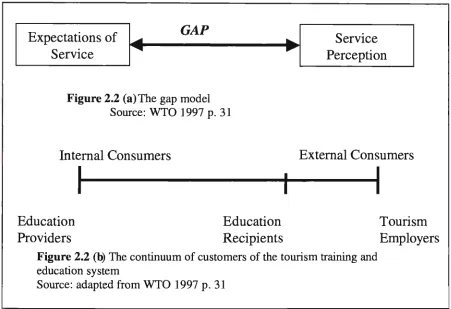
As Haywood and Maki (1991) further note, "gaps" exist between the expectations of
the four key players and the perceptions of the quality of training and education.
Using the ideas of service quality developed by Gronroos (1990) and Parasuraman et
perceptions. F r o m this basic concept of quality, the concept of using total quality
methodology to determine tourism training and education needs is derived ( W T O
1997a).
In the total quality approach all the parties are conceptualised as being consumers in
tourism training and education ( W T O 1997a). A distinction is then m a d e between
external and internal customers (Figure 2.2 b). The system consists of a continuum of
consumers in which the internal consumer receives work from someone else and
passes it on to the end consumer (employer) after adding his input, akin to a
production line. Further, from this total quality perspective, those w h o are consumers
of training and education are also suppliers. Thus, for education providers, students
are consumers as they look for knowledge and skills, while to the employers they
(students) are suppliers of the skills acquired.
Expectations of Service
GAP
Figure 2.2 (a) The gap model Source: W T O 1997 p. 31
Internal C o n s u m e r s
Service Perception
External C o n s u m e r s
Education Education Tourism Providers Recipients Employers
Figure 2.2 (b) The continuum of customers of the tourism training and education system
Source: adapted from W T O 1997 p. 31
The above model (Figure 2.2 ) is the application of the T E D Q U A L (Tourism
Education and Quality) methodology ( W T O 1997a). According to the model, a
quality chain is created from the element located closest to the internal consumer end
inability to meet the expectations and needs of the next consumer. T h e tourism
employer is the one w h o actually discovers the "gaps". It is argued that the
perceptions of the end consumer that will provide critical information about training
needs in any tourism labour market and point to any systemic shortcomings.
Thus, according to the TEDQUAL methodology, the degree to which employers are
satisfied with the skills and knowledge of their employees is, almost invariably, a
measure of the extent to which the education and training system is responding
correctly to the prior expectations of the employers. It m a y be expected that their
opinions about the skills of their employees are a good estimate of quality.
There is obviously a need to detect the tourism and training gaps from the perspective
of the student and education provider. T h e major limitation of this research approach
relates to restrictions in time and cost. In the methodology employed for the present
study, no primary investigation of student attitudes is undertaken. However, since the
study sets out to guide future development, an approach is taken that incorporates the
views of both education providers and policy makers and the employers or industry
experts, as they will n o w be called. T h e methodology is dealt with in m o r e detail in
Chapter 7.
Standardisation of curricula
O n e of the issue that has raised considerable amount of debate in tourism education
and training is that of standardisation of curricula and, in particular, content.
Arguments in favour of standardisation recognise it as a m e a n s of minimising
confusion about what qualifications involve for both students and employers. Such
arguments have s o m e validity since tourism is a n e w and growing field of
specialisation. Furthermore, in m a n y countries including K e n y a there are several
providers of tourism training and education, which m a y lead to proliferation of type of
content and presentation. T h e introduction of a m i n i m u m core curriculum m a y be a
means of ensuring quality education in such circumstances. Moreover, standardisation
at a national level can possibly help in the industry/education interface as industry can
T h e critics of standardisation see it as a w a y of stifling creativity and innovation in the
teaching of tourism. However, it has to be remembered that creativity and innovation
are only useful if employers d e m a n d the skills and, hence, graduates secure
employment. It is also interesting to note that a survey carried out in the U K achieved
8 2 % educator support for a core curriculum approach to tourism education
(WTO/Surrey 1997).
In a discussion on alternative patterns of curriculum organisation, Tanner and Tanner
(1980) explain the term core curriculum as being used in education literature to
denote those studies that are required for all students (see Maclure 1988). In this sense
it is equated with general education. However, they note that this term has long been
associated with the organisation of general education in such a w a y as to address
prevailing social problems or concerns.
A core curriculum could also be viewed as a "common framework which provides
coherence" (Further Education Unit 1989: 32). Thus, it can be treated as a distinct
m o d e of organising curriculum. It m a y be worthwhile to note that, although the term
core curriculum seems to spark s o m e amount of controversy in tourism education
circles, it has been identified as one of the curriculum principles that "have managed
to survive years of experimentation ...and have n o w achieved respectability"
(Shackleton 1989: 95).
A combination of these ideas can help organise curriculum that is widely applicable
yet contextually relevant to a given area of study or region. This does not necessarily
imply that the content ought to be static or that innovation and creativity ought to
necessarily be inhibited.
Here again the issue of context is relevant. Co-operation between industry and
education providers in curriculum development and related issues is crucial but
remains elusive. Bernthall holds the view that there ought to be co-operation between
industry and educators and warns against institutions developing courses according to
correctly observes the need for balance and compromise in developing collaborative
relationships.
In resolving these issues, an understanding of the local structures and institutions is
necessary, probably based on s o m e form of consensus between industry and education
providers concerning appropriate solutions. Before such solutions can be aimed at, the
respective concerns of industry players and education providers need to be gathered.
The case of developing countries
Inskeep (1994) and Howell and Uysal (1987: 63) raise the following issues that apply
to tourism education and training curricula in developing countries:
• T h e need for professionalism in industry practices in order to minimise the
negative effects of tourism in light of rapid tourism development;
• T h e need for such education to pay particular attention to host community
sensitivities; and
• Indigenisation of the industry as rapidly as possible to bring m a x i m u m
employment benefits to the local economy, and m a k e tourism sustainable.
Inskeep (1994) and Theuns and Rasheed (1983) have noted that tourism is c o m m o n l y
developed in job-deficient areas. In such settings, the gross number of persons
available for employment is not a constraining factor. T h e capability to provide
adequate training and education to the right n u m b e r of qualified people required is of
more immediate relevance.
One other issue worth considering in tourism training and education in developing
countries is the lack of literature and other material adapted specifically to local
conditions. This m a k e s it very difficult for the educators. Often they are unable to
prescribe textbooks for students, because the latter would find it very difficult to apply
the exotic examples based, to a large extent, on Euro-American systems. T h e lack of
context creates a difficult task for the learner. Initiatives taken to address this issue by
w a y of developing local case studies, student manuals and other materials have