Available Online atwww.ijcsmc.com
International Journal of Computer Science and Mobile Computing
A Monthly Journal of Computer Science and Information Technology
ISSN 2320–088X
IMPACT FACTOR: 5.258
IJCSMC, Vol. 5, Issue. 5, May 2016, pg.359 – 366
Face Recognition using PCA,
Deep Face Method
Gurpreet Kaur
1, Sukhvir Kaur
2, Amit Walia
3Department of CSE, I.K.G Punjab Technical University 1
[email protected]; 2 [email protected]; 3 [email protected]
Abstract- The performance process of face recognition involves the inspection study of facial features in an image, recognizing those features and comparing them to one of the many faces in the database. There are many algorithms capable of performing face recognition; such as: Principal Component Analysis, Discrete Cosine Transform, 3D recognition methods, Gabor Wavelets method etc. There were many issues to consider when choosing a face recognition method. The keys ones were: Accuracy, Time limitations, Process speed and Availability. With these in mind the PCA based method of face recognition has found to be better because: Simplest and easiest method to implement, Very fast computation time. PCA has the ability to recognizing a face with a different background is difficult.
Keywords- Feed Forward, Feature Extraction, face identification factors, Face Recognition, PCA
I. INTRODUCTION
Face detection is a computer technology that determines the locations and sizes of human faces in arbitrary (digital) images. It detects facial features and ignores other things, such as buildings, trees and bodies. Various government agencies are now actually more motivated to improve security data systems centered on body or behavioral characteristics, often called biometrics.
As many of the biometric method have an ability of high accuracy and security. But in comparison to biometric applications face recognition system have variety of applications in security of information, enforcement of law, various cards like smart cards and observations, surveillance. The biometric authentication has been drawback worked on round the world for several persons, this problem has emerged in multiple fields and sciences, particularly in applied science, others fields that are terribly inquisitive about this technology are: Mechatronic, Robotic, criminalities, etc. For this reason Face recognition system has been used.
rules with the derived information being of local nature from a particular source. The common approach helps using neural network. Face recognition is to construct a filter bank for different scales and orientations to filter which has given face image with all filters from the bank storage.
A. FACE RECOGNITION
The face area plays a significant role in carrying identity of persons. Humans have ability to acknowledge the faces. Humans can recognize 1000s of faces and identify familiar faces despite large changes in the visual stimulus as a result of viewing conditions, expression, aging, sex, and distractions such as glasses, or changes in hair .It is quite helpful for security purposes. Humans have the natural ability to acknowledge the face but developing a computer algorithm to do the same is difficult.
B. FACIAL ACKNOWLEDGEMENT
Facial acknowledgment is a sort of biometric programming application that can distinguish a particular individual in a computerized picture by examining and contrasting examples. Facial acknowledgment frameworks are normally utilized for security purposes yet are progressively being utilized as a part of a mixed bag of different applications.
Motivation Factors
Cooperative Face
Controlled pose
Controlled position
Controlled lighting
Non-Cooperative Face
Fig.1. Effects for Face Recognition [6]
C. FACE RECOGNITION SYSTEM
The face recognition system works in 5 steps. The steps are followed in a particular order:
1 Image Acquisition
The input can be recorded video or any image. It involves retrieving an image from any source.
2 Face Detection
In this step the face is detected whether the human face appears in given image or where these faces are located.
3 Facial Feature Extractions
After the face is detected the alignment is done to justify the scales and orientation of patches. In this the face is need to be turned at 360 degrees.
4 Registrations and Represent
5 Classify
The computer systems are used to classify the features respectively. A new acquired pattern is compared with stored data sets.
II. LITERATURE SURVEY
H. Josh et al. [1] observed that the human face is inherently symmetric and they wish to exploit this symmetry in face recognition. The average-half-face has been previously shown to accomplish just that for a set of 3D faces when utilizing eigenfaces for recognition. They build upon that work and present a contrast of the utilization of the average-half-face to the utilization of the initial full face with 6 different algorithms placed on two- and three-dimensional (2D and 3D) databases.
Yaniv Taigman, Lior Wolf, Ming Yang, and Marc Aurlio: Have recognized an ideal face classifier would recognize faces in accuracy that is only matched by humans. The underlying face descriptor would need to be proportional to pose, illumination, expression, and quality of image.
Wang et al. in 2008 year proposed to inspect a correlation matrix constructing a bank of Bayesian Networks with the aim of detecting such various filter parameters used in decreasing the filter bank would be as possible. The same methodology can also be used to visualization and found difference between the classical and the principal Bayesian Networks.
Ramya Srinivasan, Abhishek Nagar, Anshuman Tewari, Donato Mitrani, Amit Roy-Chowdhury in 2014 : analyzed the feasibility of a new set of face descriptors called sigma sets constructed from simple image features. Experiments show promising performance on the challenging LFW database.
Surabhi Varshney, Deepak Arya, Rashmi Chourasiya in 2014 : The artificial neural network based technology has played a main role in this inclusiveness and sustainability of intelligent and expert system to recognized & satisfy human need is concerned in this competitive arena. In present era Face recognition is widely used due to its numerous ability to cope up with various other techniques associated with it.
Yamin Taigman et al. in 2014 have presented closing the gap to human level performance in face verification which is based on conventional pipeline. The conventional pipeline consist detection, alignment, representation and classification to face images. This pipeline methodology was used for the 3D face image to fill the remaining difference for the accurate and best performance. The same methodology can also be used to visualization and found difference between the classical and the principal Bayesian Networks.
S. Mallat et al. in 2010 has presented Singularity detection and processing with wavelet a n d proposed the use of denoising and face detection. He also discussed the current status and future directions to simply the various tasks. He discussed and analysis the image features as color, texture, and shape in details. He also gives a summary of all the features with examples. For e.g. in texture recognition there are texture co-occurrence, Fourier power spectrum, Bayesian Network features and tamura features.
In the existing facial recognition algorithms have some problem while doing theAcquisition, lighting, Sensor. Lighting – simply it is a lighting effects of the given image. Like that lot of problem is there in the facial recognition in real time approach.
III. EXISTING RECOGNITION APPROACH
Recognition algorithms will be divided into 2 main approaches, geometric, that appearance at distinctive options, or measurement, that may be a applied mathematics approach that distill a picture into values and comparison the values with templates to eliminate variances.
The face is recognized using the methodology named as PCA.In which the EigenObjectRecognizer class in the application of face detection that focus on the article will remain with the new Eigen Face Recognizer. The Eigen Face Recognizer makes use PCA. This can yield preferable results to PCA based analysis favoring classification rather than representation.
The method of which PCA is done at different stages so what will be illustrated is a clear method for PCA application that can be followed. For the performance of PCA several steps are done:
Stage 1: Subtraction of the Mean of the data from each variable ﴾our adjusted data﴿ Stage 2: Calculation and formation of a covariance Matrix
Stage 3: Mathematical Determination of Eigenvectors and Eigen values from the covariance Matrix Stage 4: Selection of a Feature Vector ﴾a fancy name for a matrix of vectors﴿
Stage 5: Multiplication of the transposed Feature Vectors and the transposed adjusted data.
V. RESULTS AND DISCUSSION
The result of Face recognition using PCA and Deep Face is implemented using different stages. The framework is created for the face recognition are:
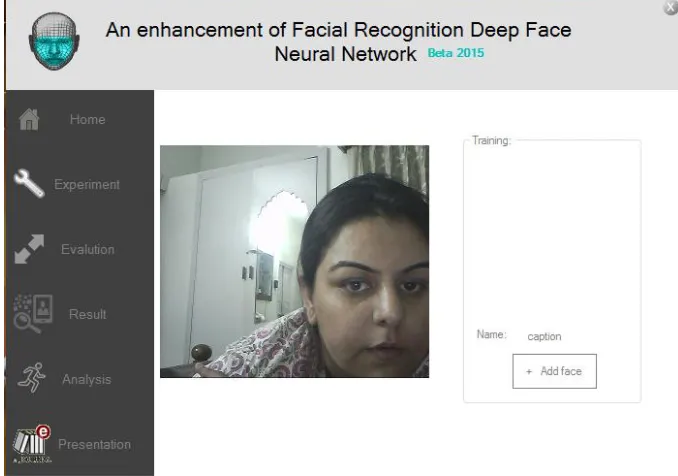
A. This is the main frame where all work will be done.
The framework uses a blend of systems in two subjects; face location and acknowledgment. The face recognition is performed on live gained pictures with no application field personality a primary concern. Forms used in the framework are white parity revision, skin like locale division, facial element extraction and face picture extraction on a face competitor. At that point a face arrangement technique that uses Feed Forward Neural Network is coordinated in the framework.
B. In this the live image is captured.
(a) By clicking on experiment the camera is opened and this interface is displayed.
Fig 3.Loading the camera to capture image
(b) In this its starts detecting the faces and red window is displayed on the face and here the image is saved by giving the name and is added by clicking in add face.
Fig 5.Window is detected on the face
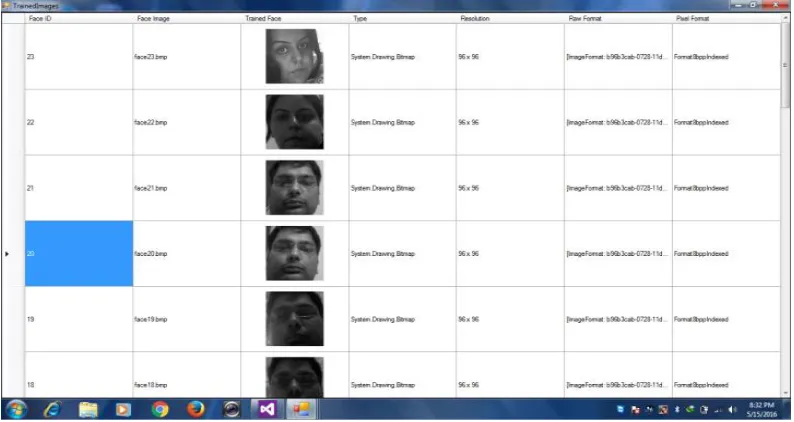
C. Trained Faces are created and stored
In this it provide the whole information of the images which are clicked.
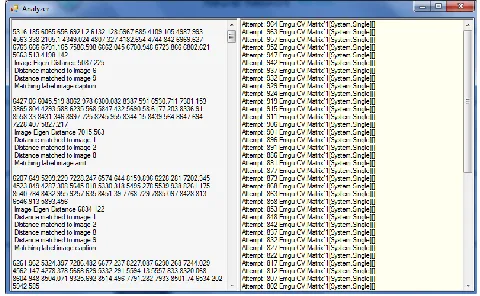
D. Eigen analysis is done
Fig 7.Eigen value and Eigen distance of the image
E. Matching of the face is done and its recognized with name.
Fig 7.Matching is done
VI. CONCLUSIONS
In this research review, Eigen vectors, covariance matrix and feature vector are found from the responses of image to neural network separately a set of weights can be assigned to these feature points and feature vectors in the face recognition to close filling gap. These measurements of these points feature and vector will be measured on the basis of previous work. In this paper, our proposed algorithm is better for the feature point detection in the face recognition scheme. The estimation stage using feature vector is followed by neural network. These would to minimize rotation effects for better visualization. This process will not create much computational complexity with other method. Therefore, we would focus to feature vectors for recognition by the help of this scheme face images would be aligned to close gap in the future analysis.
REFERENCES
[1] Harguess, Josh, and J. K. Aggarwal. "A case for the average-half-face in 2D and 3D for face recognition." In Computer Vision and Pattern Recognition Workshops, 2009. CVPR Workshops 2009. IEEE Computer Society Conference on, pp. 7-12. IEEE, 2009.
[2] Jain, Anil K., Brendan Klare, and Unsang Park. "Face recognition: Some challenges in forensics." In Automatic Face & Gesture Recognition and Workshops (FG 2011), 2011 IEEE International Conference on, pp. 726-733.
Four Individual Algorithms." In Computational Intelligence and Communication Networks (CICN), 2011 International Conference on, pp. 222-226. IEEE, 2011.
[5] Anggraini, Dian Retno. "Face Recognition Using Principal Component Analysis and Self Organizing Maps." [6] Klare, Brendan F., Mark J. Burge, Joshua C. Klontz, Richard W. Vorder Bruegge, and Anil K. Jain. "Face
recognition performance: Role of demographic information." Information Forensics and Security, IEEE Transactions on 7, no. 6 (2012): 1789-1801.
[7] Teja, G. Prabhu, and S. Ravi. "Face recognition using subspaces techniques." In Recent Trends In Information Technology (ICRTIT), 2012 International Conference on, pp. 103-107. IEEE, 2012.
[8] Horiuchi, Taketo, and Takuro Hada. "A complementary study for the evaluation of face recognition technology." In Security Technology (ICCST), 2013 47th International Carnahan Conference on, pp. 1-5. IEEE, 2013.
[9] Niinuma, Koichiro, Hu Han, and Anil K. Jain. "Automatic multi-view face recognition via 3D model based pose regularization." In Biometrics: Theory, Applications and Systems (BTAS), 2013 IEEE Sixth International Conference on, pp. 1-8. IEEE, 2013.
[10] Cai, Bangyu, Siyuan Xiao, Lei Jiang, Yiwen Wang, and Xiaoxiang Zheng. "A rapid face recognition BCI system using single-trial ERP." In Neural Engineering (NER), 2013 6th International IEEE/EMBS Conference on, pp. 89-92. IEEE, 2013.
[11] Mahalingam, Gayathri, K. Ricanek, and A. Midori. "Investigating the Periocular-Based Face Recognition across Gender Transformation." (2014).
[12] Anggraini, Dian Retno. "Face Recognition Using Principal Component Analysis and Self Organizing Maps." [13] Xu, Yong, Xiaozhao Fang, Xuelong Li, Jiang Yang, Jane You, Hong Liu, and Shaohua Teng. "Data
Uncertainty in Face Recognition." 1-1.
[14] Kafai, M., L. An, and B. Bhanu. "Reference Face Graph for Face Recognition."