80 |
P a g e
www.ijarse.com
IMPLEMENTATION OF IMAGE COMPRESSION
USING SYMLET AND BIORTHOGONAL WAVELET
BASED ON JPEG2000
Er.Ramandeep Kaur
1, Mr.Naveen Dhillon
2,Mr.Kuldip Sharma
31
PG Student,
2HoD,
3Ass. Prof. Dept. of ECE, RIET, Phagwara (Pb)
ABSTRACT
Today, image compression is a vast field, which is very easy to transmission a small amount size of digital images
over the internet. It is a very easy to kept a digital images in compressed form, it takes a less storage disk space. In
this paper, we propose an image compression techniques based on discrete wavelet transformation (DWT).The
efficiency of algorithm has been justified by some test images (Jpeg 2000) .The performance of the algorithm has
been compared with symlet and Biorthogonal wavelet The algorithm have been implemented in Matlab 2010b.In
this study we have implemented and compared two different wavelet families that is Symlet and Biorthogonal
.Different Image quality metrics is evaluated Mean square error (MSE),Peak siginal-to-noise (PSNR) ,Root mean
square error (RMSE) and subjectively using two visual image quality metrics likes universal image quality
index(UIQI) and Mean structural similarity image(MSSIM).
Keywords: JPEG2000.DWT, MSE, PSNR, RMSE, UIQI, MSSIM.
I. INTRODUCTION
In past ten years, there has been lot of technologies transformation in the world, how we communicate. This
transformation includes the fast growing of internet technologies, fast development in mobile and video
communication. In many mobile communication applications and multimedia based web applications has employed
new compression/decompression techniques. Compression is an art of science representing information in compact
form. Image compression is an essential for many applications like TV transmission, videoconferencing, facsimile
transmission of printed materials and graphics image [1].
Image compression is to reducing the larger amount of data into smaller amount required to represent in the digital
image. It is a process of representing the fewer bits compressed of image while maintaining the image quality to an
unacceptable level. The main purpose of image compression techniques is to reduce redundancy of the image data in
order to be able to store or transmit data in an efficient form. This results in the reduction of file size and allows
81 |
P a g e
www.ijarse.com
transferred or easily downloaded from websites and also reducing the transmission errors over the communication
lines.
In this research paper, we proposed a new and efficient technique based on wavelet image compression, it achieved
the high image quality. We performed the image compression techniques on Jpeg 2000 image format. Several
quality measurement metrics like peak signal to noise ratio (PSNR) , mean square error (MSE),root mean square
error (RMSE) and also used two metrics universal image quality index(UIQI ) and mean structural similarity image
(MSSIM) have been estimated to determine how well an image is reproduced with respect to the reference image.
II. WAVELET TRANSFORMS
Wavelet is a mathematical function that decomposed data into different frequency components, and then study each
component without a resolution matched to its scale. The basic idea of the wavelet transform is to represent arbitrary
functions f(x) is a linear combination of set of such wavelets or basic functions. In Fourier transform, signal is
decomposed into sine and cosine wave of different-frequency and it is very effectively to rewrites a signal into
different sine and cosine waves. The wavelet analysis is same as Fourier analysis, it takes a mother wavelet and
signal is translated into shifted and scale versions of this mother wavelet. The basic purpose of wavelet transform is
to change the data from time space domain into time frequency domain which achieved better compression results.
Discrete wavelet analysis is computed using the concept of filter banks. Filters of different cut off frequencies
analyze the signal at different scales. The filtering changes the resolution, the scale is changed by up sampling and
down sampling. If a signal is decomposed into into two filters(I) High pass filter –High frequency information is
kept, lowfrequency information is lost.(ii) Low pass filter –Low frequency information is kept, high frequency
information is lost.
Then signal is decomposed into two parts, detailed parts or high frequency and approximation part or low frequency.
Thesub signal from low filter will have highest frequency equal to half that of the original. The low frequency sub
signal can be put through a filter bank and this is repeated until final level of decomposition has been reached.
Fig.1 Level of Decomposition
Digital Image is treated as 2D signals, they is change into horizontally and vertically. 2Dwavelets used „mother wavelet‟, but it requires an extra step for each level of decomposition. In2D images, to be considered to be matrices
82 |
P a g e
www.ijarse.com
filtered out from columns. In every level of decomposition four sub-images are produced, approximation detail,
horizontal detail, verticaldetail, diagonal detail.
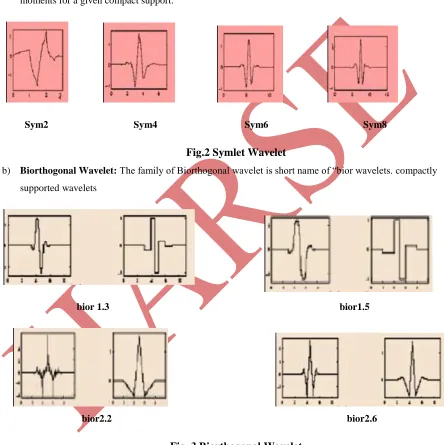
a) Symlets: The family of symlet wavelet is short of “symmetrical wavelets. symlets are “symmetrical wavelets”. They are designed so that they have the least asymmetry and maximum number of vanishing
moments for a given compact support.
Sym2 Sym4 Sym6 Sym8
Fig.2 Symlet Wavelet
b) Biorthogonal Wavelet: The family of Biorthogonal wavelet is short name of “bior wavelets. compactly
supported wavelets
bior 1.3 bior1.5
bior2.2 bior2.6
Fig. 3 Biorthogonal Wavelet
III. IMAGE COMPRESSION AND IMAGE QUALITY METRICS
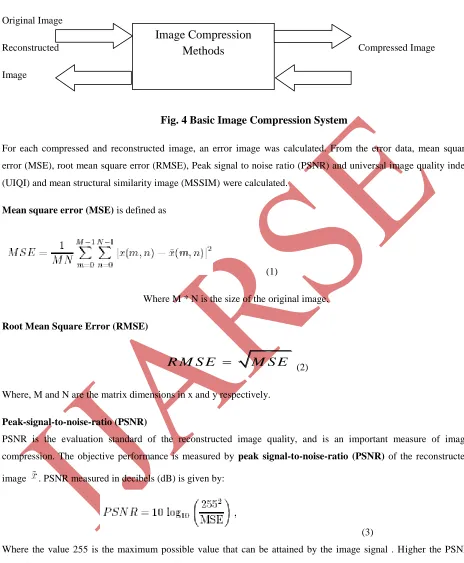
First, takean original image and generates the compressed image by image compression methods. The amount of
compressed image size is less compared to that the original image. The reverse process is decompression which
83 |
P a g e
www.ijarse.com
Original Image
Reconstructed Compressed Image
Image
Fig. 4 Basic Image Compression System
For each compressed and reconstructed image, an error image was calculated. From the error data, mean square
error (MSE), root mean square error (RMSE), Peak signal to noise ratio (PSNR) and universal image quality index
(UIQI) and mean structural similarity image (MSSIM) were calculated.
Mean square error (MSE) is defined as
(1)
Where M * N is the size of the original image.
Root Mean Square Error (RMSE)
(2)
Where, M and N are the matrix dimensions in x and y respectively.
Peak-signal-to-noise-ratio (PSNR)
PSNR is the evaluation standard of the reconstructed image quality, and is an important measure of image
compression. The objective performance is measured by peak signal-to-noise-ratio (PSNR) of the reconstructed
image . PSNR measured in decibels (dB) is given by:
(3)
Where the value 255 is the maximum possible value that can be attained by the image signal . Higher the PSNR
value is, the better the reconstructed image is.
Universal image quality index (UIQI)
R M S E
M S E
84 |
P a g e
www.ijarse.com
In 2002, Instead of using traditional error summation methods, Wang and Bovik proposed a method to model any
image distortion via a combination of three factors: loss of correlation, luminance distortion, and contrast distortion
and named it as Universal Quality Index (UQI) [9].If
x
is the mean of x,
X2 the variance of x,
XY is covarianceof x, y, then UQI is given by:
(4)
(4)
Also, standard deviation given as
Covariance given by
The dynamic range of UQI is [0, 1].
Mean structural similarity image (MSSIM)
Then, Structural Similarity (SSIM) Index between two image signals x & y will be given as:
(5)
Constants C1, C2, are used in equations 5 to avoid instability when denominators
(
X2
y2)
and2 2
(
X
Y)
approach to zero.Where, C1=(K1L)2,C2=(K2L)2, L = dynamic range of the pixel values (255 for 8-bit gray scale
image) and K1,K2 are very small positive constants such that K<<1.The overall image quality is obtained by
computing the average of SSIM values over all the windows. If M is total number of windows then mean structural
similarity index is given as:
85 |
P a g e
www.ijarse.com
The dynamic range of MSSIM is [-1,1]
IV. WAVELET IMAGE COMPRESSION ALGORITHM
The basic steps of the proposed compression algorithm based on DWT are described below:
1. Decompose: - choose a level N (level of decomposition), choose a wavelet .Compute the wavelet.
Decompose a signal into N level.
2. Threshold details coefficients: - For each level from 1 to N, a threshold is selected .First extract the level 1
coefficient and then extracts the level 2 coefficients. Thresholding is applied to the detail coefficients.
3. Compressed: -xcof original input signal x (original image) obtained by wavelet coefficients thresholding
using global positive threshold. [cxc,lxc] are the output arguments of wavelet of decomposition structure of
xc.
4. Reconstruct: - Compute wavelet reconstruction using the original approximation coefficients of level N and
the modified detail coefficients of levels from 1 to N.Reconstruct the image from [cxc.lxc] are output
arguments.
V. EXPERIMENTAL RESULTS AND DISCUSSION
In this research, efficient wavelet image compression techniques are developed and proposed from algorithm. We
have been implemented our algorithm in Matlab 2010b.we have taken test image fruit (Jpeg 2000 format) whose
size 256 x 256. Fig.5 shows a GUI for Wavelet image compression.
86 |
P a g e
www.ijarse.com
The experimental results with the wavelet based image compression methods to compare the differentSymlet
wavelet in Table 1 and different Bi-orthogonal wavelet in Table 2.From both table , we find out
MSE,PSNR,RMSE,UIQI and MSSIM experimental results demonstrate that Bior1.5 and Bior2.2 gives better
performance compared to Bior1.3,Bior2.6 and Symlets wavelet based image compression methods.
Table 1.Comparsion between Different Symlets Wavelet Based on Image Compression Results
Wavelet name MSE PSNR RMSE UIQI MSSIM
Sym2 0.4590 51.5124 0.6775 0.9855 0.9965
Sym4 0.4624 51.4803 0.6800 0.9856 0.9964
Sym6 0.4658 51.4490 0.6825 0.9849 0.9964
Sym8 0.4702 51.4083 0.6857 0.9853 0.9963
Table 2.Comparsion between Different biorthogonal based on Image Compression Results
Wavelet name MSE PSNR RMSE UIQI MSSIM
Bior1.3 0.4752 51.3621 0.6893 0.9819 0.9959
Bior1.5 0.3093 53.2264 0.5562 0.9886 0.9976
Bior2.2 0.3674 52.4796 0.6061 0.9885 0.9973
Bior2.6 0.4745 51.3684 0.6888 0.9862 0.9965
V.CONCLUSION
The image compression methods based on discrete wavelet transform is proposed in this research which provides
sufficient high PSNR,UIQI and MSSIM quality metrics means less degradation of image quality.The effectiveness
and robustness of wavelet image compression algorithm has been justified using a set of test image.The fruits image
of Jpeg2000 image format is taken for implementation.To demonstrate the wavelet based image compression
methods,a comparison between the different two techniques, the Symlets&Biorthogonal of DWT based image
compression has been revealed.From the experimental results that wavelet based image compression methods gives
better performance to the other traditional image compression methods.Also Jpeg 2000 gives better results than
traditional jpeg image formats.Wavelet based image methods maintains better image quality by reducing the
errors.As a results,wavelet image compression has a vast field with better results.
REFERENCES
[1] Nasser.N.Nasarbadi,Member IEEE and Robert.A.King, “ Image codingusing vector quantization,AReview”,IEEE Transactions in communications,vol 36,No.8,pp. 957-971Augest 1988.
[2] S. Bhavani, K. Thanushkodi, “A Survey on Coding Algorithms in Medical Image Compression”, International
87 |
P a g e
www.ijarse.com
[3] K. Kharate, V. H. Pati, “Color Image Compression Based On Wavelet Packet Best Tree”, International Journal
of Computer Science, Vol. 7, No.3, March 2010.
[4] M. R. Haque and F. Ahmed, “Image data compression with JPEG and JPEG2000”, 8th International Confrrence
on Computer and Information Technology, pp. 1064-1069, 2005.
[5] M. Antonini, M. Barland, P. Mathien and I. Daubechies, “Image coding using wavelet transform”, IEEE Trans.
Image Processing, vol. 1, pp.205-220,April 1992.
[6] Rafael C. Gonzalez and Richard E. Woods, “Digital Image Processing”, 2nd Edition, Prentice Hall Inc, 2002.
[7] Madhuri A. Joshi, “Digital Image Processing”, an Algorithmic Approach”, PHI, New Delhi, pp. 175-217, 2006.
[8] M. MozammelHoqueChowdhury and AminaKhatun “Image Compression Using Discrete Wavelet
Transform”IJCSI International Journal of Computer Science Issues, Vol. 9, Issue 4, No 1, July 2012 ISSN (Online):
1694-0814.
[9] Z. Wang and A. C. Bovik, 2002 A universal imagequality index,” IEEE Signal ProcessingLetters, vol. 9,pp. 81–
84.
[10] Niveditta Thakur, Swapna Devi, “A New Method for Color Image Quality Assessment”, International Journal