Non-Interactive Zero-Knowledge Proofs of Non-Membership
Olivier Blazy1and Céline Chevalier2and Damien Vergnaud3 1
Université de Limoges, XLim, France
2 Université Paris II, France 3
ENS, Paris, France†
Abstract. Often, in privacy-sensitive cryptographic protocols, a party commits to a secret messagemand later needs to prove thatmbelongs to a languageLor thatmdoesnotbelong toL(but does not want to reveal any further information). We present a method to prove in a non-interactive way that a committed value does not belong to a given languageL. Our construction is generic and relies on the corresponding proof of membership toL. We present an efficient realization of our proof system by combining smooth projective hash functions and Groth-Sahai proof system.
In 2009, Kiayias and Zhou introduced zero-knowledge proofs with witness elimination which enable to prove that a committed messagembelongs to a setLin such a way that the verifier accepts the interaction only ifmdoes not belong to a set determined by a public relationQand someprivateinputm0of the verifier. We show that the protocol they proposed is flawed and that a dishonest prover can actually make a verifier accept a proof for any messagem ∈ L even if(m, m0) ∈ Q. Using our non-interactive proof of non-membership of committed values, we are able to fix their protocol and improve its efficiency. Our approach finds also efficient applications in other settings, e.g. in anonymous credential systems and privacy-preserving authenticated identification and key exchange protocols.
Keywords.Zero Knowledge, Witness Elimination, Smooth Projective Hash Function, Groth-Sahai Proof System
1 Introduction
In cryptography, when designing privacy-sensitive applications, the use of commitments and corresponding zero-knowledge proofs is often indispensable. They allow a prover to convince a verifier that a digitally committed value is a member of a given language (without revealing any further information beyond this membership). An important instance of this problem consists in showing that the committed value lies in a given finite set (e.g. in e-auctions or e-voting protocols, a bidder or voter has to prove that his secret bid or vote is chosen from a list of candidates, see [CCs08] and references therein). However one usually wants to demonstrate more complex properties about committed values. For instance in anonymous credentials systems and privacy-preserving authenticated identification or key exchange protocols, a participant must usually prove the possession of a credential issued by an authority (without revealing it).
For the latter primitives, it is often necessary to prove combination of simple statements about several credentials issued by the authority (OR, AND, and NOT connectives) [CG08,ILV11]. For instance, a crucial requirement is that credentials issued can be later revoked. In principle, revocation lists can be used for anonymous credentials by having the user to prove in zero-knowledge that his credential isnotcontained in the list. However, this is usually inefficient since the computational and communication costs grow with the number of entries in the list. Recently, Bayer and Groth [BG13] proposed an efficient interactive solution for blacklisting anonymous users (with logarithmic growth) but their elegant technique does not generalize readily to prove the non-membership to arbitrary languages.
In these scenarios, it is usually desired that the zero-knowledge proofs are non-interactive. For example, in the e-voting scenario, the membership proof is a part of the vote validity proof that is verified by various parties without any active participation of the voter. In this paper, we present a generic method to prove in a non-interactive way that a committed value does not belong to a given language. Our approach finds efficient applications in various settings, e.g. in zero-knowledge with witness elimination [KZ09] or language authenticated key exchange [BBC+13a].
†
1.1 Related work
A commitment scheme allows a user to commit to a messagemby publishing a commitmentC, and this commitment can be opened at a later point in time. It can be seen as the digital analogue of a “sealed envelope”: the security proper-ties required are called thehidingproperty (one cannot learn anything about the messagemfrom the commitmentC) andbindingproperty (one cannot open the commitmentCto a different messagem0 6=m). Zero-knowledge proofs of knowledge are two party protocols, which allow a prover to convince a verifier that he knows some secret piece of information, without the verifier being able to learn anything about the secret value (except for what is revealed by the claim itself). Often in cryptographic protocols, a party chooses a messagemand then commits to it. He keeps the message secret and publishes the commitment. He later needs to prove thatmbelongs to a finite setLor thatmdoes notbelong toL, but cannot reveal anything aboutm.
For a finite setLwith no additional structure, the most efficient combination of commitment and zero-knowledge proof was recently proposed by Bayer and Groth [BG13]. The interactive proof system is quite efficient: it has
O(log(#L))communication and computational complexity and significantly improves the previous proposals with
O(√#L)complexity [Pen11]. It can be made non-interactive in the random oracle model by using the Fiat-Shamir heuristic1.
There also exist efficient membership proofs for families of very large setsLequipped with an “algebraic struc-ture” (e.g. the set of valid message/digital signatures pairs for a given public key whose cardinal is exponential in the security parameter). Most of them also admit efficient non-membership proof systems. However, up to now there is no generic construction and these zero-knowledge proofs of non-membership of committed values require specific security analysis.
1.2 Contributions of the paper
The first contribution of the paper is to present an efficient non-interactive technique to prove (in zero-knowledge) that a committed message does not belong to a setL. The proof is generic and relies on a proof of membership toL with specific mild properties. In particular, it is independent of the size of L and if there exists an efficient proof of membership for committed values, one gets readily an efficient proof of non-membership. Instantiated with a combination ofsmooth projective hash functionsand Groth-Sahai proof system, we obtain very efficient realization for non-interactive proof of non-membership of committed values.
In 2009, Kiayias and Zhou [KZ09] introduced zero-knowledge proofs with witness elimination. This primitive enables to prove that a committed messagem belongs to a setL(with a witness w) in such a way that the verifier accepts the interaction only ifwdoes not belong to a set determined by a public relationQand someprivateinput
w0of the verifier. The verifier does not learn anything aboutw(except thatm ∈ Land(w, w0)∈/ Q) and the prover does not learn anything aboutw0. The primitive can obviously be used to handle revocation lists. It was motivated in [KZ09] by privacy-preserving identification schemes when a user wishes to authenticate himself to a verifier while preserving his anonymity and the verifier makes sure the prover does not match the identity of a suspect user that is tracked by the authorities (without leaking any information about the suspect identity).
We show that the original proposal of zero-knowledge proofs with witness elimination from [KZ09] is flawed and that a dishonest prover can actually make a verifier accept a proof for any messagem ∈ Leven if(w, w0) ∈ Q. In particular, in the suspect tracking scenario, a dishonest prover can identify himself even if he is on the suspect list. Therefore, their protocol does not achieve the claimed security. However we explain how to apply our proof of non-membership to fix it. We obtain a proof system that achieves the security goal and is more efficient than the original (insecure) solution.
Eventually, we briefly present applications of our proof of non-membership to other settings such as anonymous credentials and privacy-preserving authenticated key exchange.
1
2 Preliminaries
In this section we recall various classical definitions, tools used throughout this paper. We use classical definitions and notations and the familiar reader may skip this section.
2.1 Definitions
Encryption An encryption schemeEis described through four algorithms(Setup,KeyGen,Encrypt,Decrypt):
– Setup(1K), whereKis the security parameter, generates the global parametersparamof the scheme; – KeyGen(param)outputs a pair of keys, a (public) encryption keyekand a (private) decryption keydk;
– Encrypt(ek, M;ρ)outputs a ciphertextC, on the messageM, under the encryption keyek, with randomnessρ; – Decrypt(dk,C)outputs the plaintextM, encrypted in the ciphertextCor⊥.
Such encryption scheme is required to have the classical properties,Correctness andIndistinguishability under Chosen Plaintext Attack [GM84]:
– Correctness: For every pair of keys(ek,dk)generated byKeyGen, every messagesM, and every randomρ, we should haveDecrypt(dk,Encrypt(ek, M;ρ)) =M.
– Indistinguishability under Chosen Plaintext At-tack [GM84]: This notion (IND-CPA), formalized by the adjacent game, states that an adversary should not be able to efficiently guess which message has been encrypted even if he chooses the two original plaintexts.
The advantages are:
AdvEind,A(K) =|Pr[ExpEind−,A1(K) = 1]−Pr[Exp ind−0
E,A (K) = 1]|
AdvindE (K, t) = max A≤tAdv
ind E,A(K).
Expind−E,Ab(K)
1.param←Setup(1K) 2.(ek,dk)←KeyGen(param) 3.(M0, M1)← A(FIND:ek)
4.c∗←Encrypt(ek, Mb)
5.b0← A(GUESS:c∗) 6.RETURN b0
Zero-Knowledge Proofs Classical definitions and notations for non-interactivezero-knowledge proof systems are given in appendix A.
2.2 Classical Hypotheses
A bilinear group is a tuple(p,G1,G2,GT, e, g1, g2)whereG1,G2andGT are cyclic groups of prime orderp,
gener-ated respectively byg1,g2ande(g1, g2)ande:G1×G2→GT is a non-degenerated bilinear form,i.e.:
∀X∈G1,∀Y ∈G2,∀λ, µ∈Zp :e(Xλ, Yµ) =e(X, Y)λµ
ande(g1, g2)does indeed generate the prime order groupGT. In the following we will suppose there exists a
polyno-mial time algorithm which outputs such bilinear groups.
In this paper, we will present concrete instantiation based on standard problems on groups:
Decisional Diffie Hellman (DDH)[Bon98]: The Decisional Diffie-Hellman hypothesis states that in a group(p,G, g)
(written in multiplicative notation), given(gµ, gν, gψ)for unknownµ, ν $
←Zp, it is hard to decide whetherψ=µν.
Symmetric External Diffie Hellman (SXDH)[ACHdM05]: this variant used in bilinear groups(p,G1,G2,GT, e, g1, g2),
2.3 Classical Tools
Smooth Projective Hash Functions [CS02] Smooth projective hash functions (SPHF) were introduced by Cramer and Shoup [CS02]. A projective hashing family is a family of hash functions that can be evaluated in two ways: using the (secret) hashing key, one can compute the function on every point in its domain, whereas using the (public)projected key one can only compute the function on a special subset of its domain. Such a family is deemedsmoothif the value of the hash function on any point outside the special subset is independent of the projected key. The notion ofSPHF
has found applications in various contexts in cryptography (e.g.[GL03,Kal05,ACP09,BPV12]).
Smooth Projective Hashing System: A Smooth Projective Hash Function over a languageL⊂X, onto a setG, is
defined by five algorithms(Setup,HashKG,ProjKG,Hash,ProjHash):
– Setup(1K) where K is the security parameter, generates the global parameters param of the scheme, and the description of anN P languageL;
– HashKG(L,param), outputs a hashing keyhkfor the languageL;
– ProjKG(hk,(L,param), W), derives the projection keyhp, possibly depending on the wordW [GL03,ACP09] thanks to the hashing keyhk.
– Hash(hk,(L,param), W), outputs a hash valuev∈G, thanks to the hashing keyhk, andW
– ProjHash(hp,(L,param), W, w), outputs the hash valuev0 ∈G, thanks to the projection keyhpand the witness wthatW ∈L.
In the following, we considerLas a hard-partitioned subset ofX,i.e.it is computationally hard to distinguish a random element inLfrom a random element inX\L.
A Smooth Projective Hash FunctionSPHFshould satisfy the following properties:
– Correctness: Let W ∈ L and w a witness of this membership. Then, for all hashing keys hk and associated projection keyshpwe haveHash(hk,(L,param), W) =ProjHash(hp,(L,param), W, w).
– Smoothness: For allW ∈X\Lthe following distributions are statistically indistinguishable:
(L,param, W,hp, v)
param=Setup(1K), hk=HashKG(L,param), hp=ProjKG(hk,(L,param), W), v=Hash(hk,(L,param), W)
'
(L,param, W,hp, v)
param=Setup(1K), hk=HashKG(L,param), hp=ProjKG(hk,(L,param), W), v←$ G
.
– Pseudo-Randomness: If W ∈ L, then without a witness of membership the two previous distributions should remain computationally indistinguishable.
The article [BBC+13b] introduced a new notation forSPHF: For a languageL, we assume there exist a function
Γ and a family of functionsΘ, such thatu∈L, if and only if,Θ(u)is a linear combination of the rows ofΓ(u). We furthermore require that a user, who knows a witnesswof the membershipu∈L, can efficiently compute the linear combinationλ.
With the above notations, the hashing key is a vectorhk = α, while the projection key is, for a wordu,hp =
γ(u) = Γ(u)α(where denotes the Hadamard product, i.e. the entry-wise product). Then, the hash value is:
Hash(hk,u)def=Θ(u)α=λγ(u)def=ProjHash(hp,u, w).
Groth-Sahai Proof System. Groth and Sahai [GS08] proposed non-interactive zero-knowledge proofs of satisfiability of certain equations over bilinear groups, calledpairing product equations. Using as witness group elements (and scalars) which satisfy the equation, the prover starts with making commitments on them. The commitment key is of the formu1 = (u1,1, u1,2),u2 = (u2,1, u2,2)∈G12 andv1 = (v1,1, v1,2),v2 = (v2,1, v2,2)∈G22. We write
u= u1 u2 =
u1,1u1,2 u2,1u2,2
and v=
v1 v2 =
v1,1v1,2 v2,1v2,2
The Setup algorithm initializes the parameters as follows: u1 = (g1, u) with u = g1λ and u2 = u1µ with λ, µ←$ Z∗p, which means thatuis a Diffie-Hellman tuple inG1, sinceu1= (g1, g1λ)andu2 = (gµ1, gλµ1 ). TheTSetup
algorithm will use insteadu2 =u1µ(1, g1)−1:u1 = (g1, gλ1)andu2 = (gµ1, g λµ−1
1 ). And it is the same inG2for
v. Depending on the definition ofu2,v2, this commitment can be either perfectly hiding or perfectly binding. The
two parameter initializations are indistinguishable under theSXDHassumption.
To commit toX ∈ G1, one chooses randomness s1, s2 ∈ Zp and sets C(X) = (1, X)us11 u s2
2 = (u s1
1,1 · us2
2,1, X·u s1
1,2·u s2
2,2). Similarly, one can commit to element inG2 and scalars inZp. The committed group elements
can be extracted ifu2 is linearly dependant of u1 by knowing the discrete logarithm x1 between u1,1 andu2,2: c2/(cx11) =X.
To prove satisfiability of an equation (which is the statement of the proof), a Groth-Sahai proof uses these com-mitments and shows that the committed values satisfy the equation. The proof consists again of group elements and is verified by a pairing equation derived from the statement.
We refer to [GS08] for details of the Groth-Sahai proof system.
3 Proof of No-Statement
3.1 Generic Technique
In this section, we are going to present a way to prove exclusion statement, following a Commit and Prove approach ([CLOS02]).
The underlying idea is that, we are going to try to build a proof of validity for the statement (which is supposed to not be verified), and prove that we are failing to do so while being completely honest. Hence once we prove that the proof is correctly generated, the fact that the verification fails means that the initial statement did not hold (under the completeness of the proof).
Let us consider a languageL. We assume that it is easy to test whether a wordwbelongs toL (in probabilistic polynomial time).
LetE= (Setup,KeyGen,Encrypt,Decrypt)be an encryption scheme and let(ek,dk)be a pair of keys output by
KeyGen(param)(whereparamare global parameters output bySetup(1K)). We assume that the encryption scheme iswithout redundancy[PP03]:i.e.all ciphertexts are valid (which means here “reachable”), the encryption function is not only a probabilistic injection, but also a surjection. A prover possesses a wordwnot in a languageLwhich is encrypted in C using some randomness r, C = Encrypt(ek, w;r). The prover wants to prove that C encrypts a word that doesnotbelong toL in zero-knowledge. To construct our proof system, we are going to follow a generic approach by combining two different proof systems (in our following instantiations the first proof will be aSPHF, while the second one will be a Groth Sahai NIZK).
Formally, we assume there is a sound and correct non-interactive (NI) proof systemΠafor the language defined
by the binary relationR={(C,(w, r)), C =Encrypt(ek, w;r)∧w∈ L}and we will construct a NI zero-knowledge proof system for the language defined by the binary relationRˆ ={(C,(w, r)), C =Encrypt(ek, w;r)∧w /∈ L}.
We assume thatΠasatisfies the following properties:
– there exists a randomization algorithm that takes a proofπaoutput byΠa.Prove(C,(w, r))and some
random-nessr0, ρ0 and outputs a properly distributed proofπa0 on the same wordw encrypted in the ciphertextC0 using randomnessr02.
2
– Πa verifies theindistinguishability of proofs property: given a pair (C,(w, r)) ∈ Rˆ where C is an encryption
of a wordw 6∈ Lusing randomness r, it should be hard to distinguish an invalid proof generating honestlyas
Πa.Prove(C,(w, r))from a random value.3
– there exists a NI zero-knowledge proof systemΠb where given an outputπaproves that it is indeed the correct
result fromΠa.Prove(C,(w, r);ρ) even ifw 6∈ L. We also require the extra property, that eitherΠb has perfect
soundness or possesses a trapdoor allowing to recoverρ.
Assuming these three properties, our NI zero-knowledge proof system for the language defined by the binary relationRˆ,Π= (no.Setup,no.TSetup,no.Prove,no.Verify,no.Simulate), is defined as follows:
no.Setup(1K): runsE.Setup(1K)to compute the global parametersparamandKeyGen(param)to obtain a key pair (ek,dk). It also runsΠa.Setup(1K)to obtaincrsaandΠb.Setup(1K)to obtaincrsb. It outputs the common
refer-ence stringcrs= (crsa,crsb,param,ek).
no.TSetup(1K): runsE.Setup(1K)to compute the global parametersparamandKeyGen(param)to obtain a key pair (ek,dk). It also runsΠa.Setup(1K)to obtaincrsaandΠb.TSetup(1K)to obtain(crsb, τb). It outputs the common
reference stringcrs= (crsa,crsb,param,ek)and the trapdoorτ = (dk, τb).
no.Prove(C, w, s,crs;ρ): Computesπa :=Πa.Prove(C,(w, r);ρ), and a proofπb := Πb.Prove(πa,C,(w, r), ρ;ρ0),
and outputs(πa, πb)
no.Verify(C, πa, πb): returns 1 if and only ifπais invalid forΠa andπb is valid forΠb((i.e.Πa.Verify(C, πa) = 0
andΠb.Verify(πb, πa,C) = 1).
no.Simulate(C, τ): picks uniformly at randomπaand uses the trapdoorτbto runΠb.Simulate(τb, πa,C)to getπb. It
outputs(πa, πb).
The correctness follows immediately from the correctness of the two proofs. Indeed if (πa, πb) is output by
no.Prove(C, w, s,crs;ρ),πaoutput should not verify (i.e.Πa.Verify(C, πa) = 0) as the input(C,(w, s))∈ R/ .
Theorem 1. The proof systemΠis sound ifΠais correct andΠbis sound.
Proof. We assume there exists an adversary against the soundness of our proof system, we will show there exists an adversaryBthat can use this adversary to break the soundness ofΠb. An adversary against the soundness of our
scheme outputs(C, πa, πb)such that whileno.Verify(C, πa, πb)holds, the plaintext inCdoes indeed belong toL.
We will distinguish two kind of adversaries, those who computeπahonestly, and those who does not. This means
that eitherπais invalid for a valid wordwand some randomnessρ, or that the adversary gives an incorrect outputπa
and managed to build a proofπbstating that it is computed correctly.
The adversaryBnow decrypts the ciphertextCto recover the wordw, picks some freshr0and encrypts it into a
C0 (this is a randomization of the first ciphertext) and tries to computeΠa.Prove(C0, w, r0;ρ0). Either with advantage
greater thanε/2this proof does not hold, and soBmanaged to break the correctness of the proof systemΠa. Either
with advantage greater thanε/2 this proof holds, this means that theπa output by the adversary was not correctly
computed, hence this lead to breaking the soundness ofΠb. (As the second proof given by the adversary is valid while
proving an incorrect statement). ut
Theorem 2. The proof system Π is zero-knowledge assuming the zero-knowledge property of Πb and the
indistin-guishability of proofs ofΠa.
Proof. It is easy to see that the output ofno.TSetupandno.Setupare indistinguishable (by the zero-knowledge prop-erty ofΠb). We assume there exists an adversary against the Zero-Knowledge property of our scheme with advantage ε, we are going to follow a sequence of games to give an upper bound on this value. We have to prove that the distri-butions{Prove(crs,C,(w, r))}and{Simulate(crs,C)} are indistinguishable for a ciphertextC = Encrypt(ek, w;r) withw /∈ Lgenerated by the adversary.
3
This property does not hold for Groth Sahai proofs, given a correctly computed invalid proof for an equation likeX = A, when in fact
G0 We start from the real game (i.e.π
$
←Prove(crs,C,(w, r))).
G1 In this game, the simulator uses the Zero-Knowledge trapdoor τb fromΠb to simulate the proofs on the valid
statementπa(i.e.it outputsπa:=Πa.Prove(C,(w, r);ρ)andπb:=Πb.Simulate(πa,C,(w, r);ρ0).
Here the adversary has advantageε1 ≤ε+AdvZK,
G2 In this game, the simulator outputs a random value instead ofπaand simulatesπb. Under the indistinguishability
of the proofs onπa, this game is similar to the previous one.
Here the adversary has advantageε2 ≤ε1+Advindπ,
In this last game, one obtains the algorithmno.Simulate(C, τ)and we getε≤AdvZK+Advind. ut
3.2 Concrete Examples
In order to instantiate the previous proposition, we need some techniques to prove that a statement is invalid. To do so, we propose the approach consisting in generating a proof as if the statement was valid, and show that while this proof does not hold it was honestly generated.
As we show in our application to zero-knowledge with witness elimination in Section 4, Kiayias and Zhou aimed to do so in [KZ09], but incompletely. Additionally, they did it using an external proof system, that adds several rounds of interaction. (i.e.they use a sigma protocol to prove the (partial-)validity of a proof based on smooth projective hash functions.)
In the following we propose new techniques to do so via classical proof systems, first by proving the validity of a
SPHF-proof via anotherSPHF, and then by mixing Groth-Sahai methodology withSPHF. Our generic approach from Section 3.1, requires the second proof to be zero-knowledge, and the first one to be homomorphicly randomizable and to achieve the indistinguishability on the proof. Groth Sahai provides the zero-knowledge while smooth projective hashing provides the indistinguishability via its pseudo-randomness.
We are going to work onSPHF-friendly languages. Recent works have drastically increased the range of languages manageable withSPHF(e.g. [BBC+13a,BBC+13b]), to every kind of pairing product equations over graded rings, so this will not really limit applications of theses techniques in concrete protocols.
We assume that languagesLhave additional parametersLp,Lu, the first part is a public description of a specificity
of the language needed to build a smooth projective hash function on it, while the other one is private and is needed for verification purpose. (In case of a revocation languageL,Lpis a commitment to the revocation list, whileLu is the randomness from the commitment.)
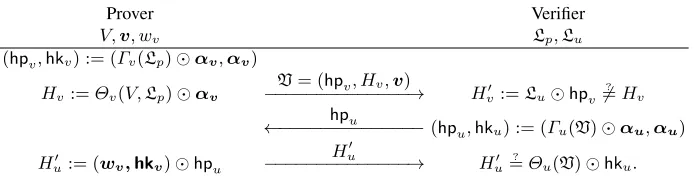
Non-Zero-Knowledge Proofs, Using Smooth Projective Hash Functions. To show that a word committed intov
is not in a language described byLp, one ends up doing the following (cf Figure 1):
Prover Verifier
V,v, wv Lp,Lu
(hpv,hkv) := (Γv(Lp)αv,αv)
Hv:=Θv(V,Lp)αv
V= (hpv, Hv,v)
−−−−−−−−−−−−−−→ Hv0 :=Luhpv6 ? =Hv
hpu
←−−−−−−−−−−−−−−(hpu,hku) := (Γu(V)αu,αu)
Hu0 := (wv,hkv)hpu
Hu0
−−−−−−−−−−−−−−→ Hu0 ?
=Θu(V)hku.
Fig. 1.GenericSPHF-based proof of exclusion
Where the firstSPHFis on the language described byLpwhile the other one is based on the language of a correct
A more concrete example. In order to explain the previous formalism, let us now give a more concrete example, with a language described by an ElGamal encryption of a wordU. The prover possesses a wordV, the verifier the wordU
and publishes an ElGamal ciphertext ofU:Lp = (hsU, gs). The prover encrypts his wordV using ElGamal encryption scheme and proves to the verifier thatV is not the plaintext encrypted inLp. Following the previous technique we can achieve a 3-round proof as described on Figure 2. The secondSPHFis smooth if and only ifV =U, this means
Prover Verifier
V, hrV, gr, r Lp= (hsU, gs), U, s
(hpv,hkv) := (hλgµ,(λ, µ))
V0= (hpv, hrV, gr)
−−−−−−−−−−−−−−→ Hv0 :=hpsv
hpu,Lp
←−−−−−−−−−−−−−−hpu:= (h δ
(hsU/(hrV))β, gδ(gs/gr)β,hpβvg γ
), hku:= (δ, β, γ)
Hu0 :=hpλu,1hp µ u,2hp
r u,3
Hu0, Hv
−−−−−−−−−−−−−−→ Hv0 6 ?
=Hv∧Hu0 ? =hpδ
vH β v(gr)γ.
Hv:= (hsU/V)λ(gs)µ
Fig. 2.Tweaked ElGamal basedSPHFproof of inequality
that technically an adversary can break the soundness of the verification of the valid computation ofhpv, Hvwhen the
wordV is different fromU. However in this case, the protocol should already return yes so he cannot gain anything from doing so. The proof requires overall 10 group elements: 2 for the initial commit ofU, 2 for the one of V, 2 overall forhpv, Hvand 4 forhpu, Hu0.
We stress that, this construction differs from the generic approach in the sense thatLp instead of being known
before the protocol like in the generic construction from Figure 1, can be set on the fly and postpone to the second flow. While this proof is not zero-knowledge in any way, it will find some use in our LAKE (Language-Authenticated Key Exchange) application in Appendix C.2.
Zero-Knowledge Proofs, Using Groth-Sahai Non-Interactive Proof Technique.
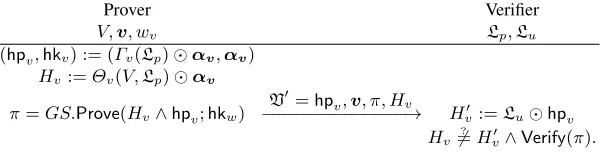
We now want to supersede the last proof with a zero-knowledge proof. So once again we do a smooth projective hash function for the first language, and then prove using a Groth Sahai proof that we indeed know the associated hash key, such that the hash value and the projection key are consistent, that way we can reduce the protocol interactivity to one flow as explained in Figure 3.
Prover Verifier
V,v, wv Lp,Lu
(hpv,hkv) := (Γv(Lp)αv,αv)
Hv:=Θv(V,Lp)αv
π=GS.Prove(Hv∧hpv;hkw)
V0=hpv,v, π, Hv
−−−−−−−−−−−−−−→ Hv0 :=Luhpv
Hv6=? Hv0 ∧Verify(π).
Fig. 3.GenericSPHF+ NIZK proof of inequality
A more concrete example. If we consider our former example with a Groth Sahai proof instead of the secondSPHFwe end up with a one-round protocol. Overall this would require 4 elements inG1for the hash proof, 6 other inG1for the
additional commitments, 4 in each group for the quadratic proof, 1 inG1 for one of the multi scalar exponentiation
3.3 Transformation from a NIZK to a SS-NIZK
In one of the following applications, we will need our proof of exclusion to be simulation-sound ([Sah99]). There is a generic transformation from Groth Sahai based NIZK proofs to Simulation-Sound.
To construct a Simulation-Sound proof that some wordwdoes not belong to a languageL, one uses the following roadmap, assuming the common reference stringcrscontains a common reference string for the Groth-Sahai proof systemcrsGS, a verification keypkfor a Structure-Preserving Signature scheme [AFG+10], and the prover already
possesses a pair of primary keys(psk,ppk)for a one-time two-tier signature scheme [BS07]4:
1. generates a secondary signing/verification key pair(ssk,spk)for the one-time two-tier signature. 2. commits to a random tuple of elementsRcorresponding to a signature.
3. generates, using Groth Sahai and our exclusion proof, a proofπ that eitherwdoes not belong toL, or thatRis a valid signature of the verification keyspkof the one-time signature, under the public keypkcontained in the CRS
crs.
4. sends this proof π, the verification key of the one-time signature, and the corresponding one-time signature of everything under(psk,ssk).
Referring to [HJ12], it can be shown that this scheme is Zero-Knowledge under the Indistinguishability of the two types of Groth-Sahai common reference strings, and that both the simulation-soundness and the soundness come from the unforgeability of the two involved signatures.
4 Application to Zero-Knowledge with Witness Elimination
In [KZ09], Kiayias and Zhou introduced the notion of zero-knowledge proofs with witness elimination. They de-scribed it through a universally composable ideal functionality, directly giving strong guideline as how to achieve a generic construction.
Ideal Functionality for Zero-Knowledge with Witness Elimination In the universal composability (UC) frame-work, once a protocol is proved secure, it can be used in arbitrary contexts retaining its security properties (i.e.when composed with other instances of the same or other protocols). The security in this framework is defined in the sense of protocol emulation (i.e. a protocolP emulates some protocolP0, if P does not affect the security of anything else thanP0 would have). To prove security in the UC framework, we define an ideal functionalityF which can be thought of as an incorruptible trusted party that takes inputs from all parties and hands back outputs to the parties. The functionalityF is a formal specification of a cryptographic task and is secure by definition. Hence, if a protocol
PemulatesF, one can infer that it securely realizes the given task in arbitrary contexts.
The ideal functionality for Zero-Knowledge with Witness Elimination FZKW ER,Q proposed by Kiayias and Zhou builds upon that of Zero-Knowledge (proposed in 2001 by Canetti [Can01]) , with the extra requirement that the prover shows that it did not use some eliminated witnesses to prove the statement. We recall it on Figure 4.
It is parametrized by two binary relationsRand Q. The proverP is given an inputhx, wi (Prove query) and the verifierV is given an inputw0 (Verifyquery). The verifier should only accept if R(x, w)and¬Q(w, w0)hold. Furthermore, it should not learn anything from the protocol except the valuexand the existence of such a witnessw. Following the authors of [KZ09], we do not deal here with adaptive corruptions. The functionality proceeds in three steps:
– Upon receiving a(Prove,sid,hx, wi)query from the proverP: While blocking the secret inputs from the adver-sary, it leaks a bit through the(LeakProve,sid,hx, ϕi,P)answer to tell the adversary whetherR(x, w)holds. As explained in [KZ09], this does not affect the security properties of the protocol as long as the elimination relation 4
Qis such that theFZKW ER,Q functionality emulates theFR
ZK functionality (the prover can easily learn whether the
witness is valid or not). The requirement onQ is that given a witnessw, one can sample a witnessw0 such that
Q(w, w0)happens with negligible probability. This is in particular the case for the substring equality considered in their article and for the more general membership to the languages considered here (see Section 5).
– Upon receiving a(Verify,sid, w0) query from party V: While blocking the secret inputs from the adversary, it leaks the information thatVsent his witness through the(LeakVerify,sid,V)answer.
– Upon receiving a(InflVerify,sid)query from the adversary: it leaks a last bit through the(RetVerify,sid, b)answer to tell the adversary whetherQ(w, w0)holds. The queryInflVerify can be asked only once, capturing a similar property to the resistance to offline dictionary attacks in the case of password-based protocols.
FR,Q
ZKW Eis parametrized with the ZK relationRand the elimination relationQ.
– Upon receiving(Prove,sid,hx, wi)from partyPwheresid= (P,V,sid0), recordhP, x, wi, send(LeakProve,sid,hx, ϕi,P)to the adversary, whereϕ= 1ifR(x, w)holds, andϕ= 0otherwise. Ignore future(Prove, . . .)inputs.
– Upon receiving(Verify,sid, w0)from partyVwheresid= (P,V,sid0), recordhT, w0i, send(LeakVerify,sid,V)to the adversary. Ignore future(Verify, . . .)inputs.
– Upon receiving(InflVerify,sid)from the adversary, ifR(x, w)and¬Q(w, w0)hold, then send(RetVerify,sid,1)to partyV. Else if¬R(x, w)holds orQ(w, w0)holds, then send(RetVerify,sid,0)to partyV.
Fig. 4.FunctionalityFZKW ER,Q
Generic Approach. After receiving the witnessw0 eliminated by the verifier, the construction of a zero-knowledge proof with witness elimination as presented by Kiayias and Zhou in [KZ09] requires two main parts by the prover. First, in a regular zero-knowledge proof, he starts by proving that the statementR(x, w)is indeed fulfilled, and then, in another part a little bit trickier, he has to prove that the witness he used does not belong to the elimination list, which is¬Q(w, w0). We recall on Figure 5 their original generic construction. In a nutshell, they proceed in three steps:
– In a first step, the verifier sends an encryptionC0of the eliminated witnessw0to the prover.
– In a second step, the prover computes an encryption C of his witnessw, generates a hash key hk = HashKG, computes a projection keyhp=ProjKG(hk)and computes the hash valueκ=Hash(C0,(C, w),hk). He sendshp
andκto the verifier. The aim of this smooth projective hash function is to ensure thatw6=w0.
– In a last step, both players engage in a zero-knowledge proof of membership (ZKPM) subprotocol to show that
R(x, w)holds.
A Flaw in the Original Approach. In the protocol presented in [KZ09] that we recalled in the previous section, Kiayias and Zhou propose to prove that¬Q(w, w0) by doing an implicit proof of equality (i.e.Q(w, w0)) using a smooth projective hash function. They make the prover send the hash valueκ, and ask the verifier to check whether it is equal to the projected hash valueκ0. If those values are different, then the relationQ(w, w0)does not stand, which proves that the witness is not eliminated.
Common reference string: crs = (pk, ρ), wherepkis a public key of an encryption schemeE , andρis a reference string of a Zero-Knowledge Proof of Membership (ZKPM) scheme.
Protocol steps: Upon receiving (Verify,sid, w0) from the environment, party V selects r0 ←$ U and computes C0
=
Encrypt(pk, w0;r0), and sends(move1,C0)to partyP.
Upon receiving(Prove,sid, x, w)from the environment, partyPfirst checks if(x, w)∈ Rand waits for amove1message from party V. After receivingmove1message:
– if¬R(x, w)holds, then partyPsends partyVa message(move2,“no valid proof”),
– else ifR(x, w)holds, then partyPcomputesC =Encrypt(pk, w;r), and then partyPsends partyVa message(move2,hp, κ),
wherehk =HashKG,hp =ProjKG(hk),κ =Hash(C0,(C, w),hk). Now, partiesPandVplay the roles of prover and verifier respectively to run a ZKPM subprotocol, to show thatx,C0
, κis consistent:
∃(w, r),(x, w)∈R∧ C=Encrypt(pk, w;r)∧κ=Hash(C0,(C, w),hk).
Upon receiving (move2,“no valid proof”) from party P, party V returns (RetVerify,sid,0) to the environment. Else if receiving (move2,hp, κ), partyVcomputesκ0=ProjHash(C,(C0, w0, r0),hp)and ifκ6=κ0party andVaccepts the ZKPM proof in the
subpro-tocol above, then partyVreturns(RetVerify,sid,1)to the environment; otherwise returns(RetVerify,sid,0)to the environment.
Fig. 5.Initial Generic construction of the protocol for Zero-Knowledge Proofs with Witness Elimination
This issue comes from the fact that the validity of the projection keyhpis nowhere verified in the generic descrip-tion. Intuitively, this verification should be part of the following ZKPM subprotocol. In their description, the latter does not involve the computation ofhpin any way, so that there is the possibility for the prover to send a bogus one in order to avoid collision for words in the elimination list. This way, the prover is able to get its ZKPM proof for
R(x, w)accepted while using a witness of the elimination list, without being caught by the verifier.
5 A Generic Fix and Several Concrete Instantiations
Improvement. Before fixing Kiayias and Zhou’s protocol, we start by giving some other improvements. First, the authors only considered equalities or substring equalities for the relationQ. We improve this by allowingQ to be a more general relation of membership to a language specified byw0:Q(w, w0) ⇔ w ∈ Lw0. More precisely,
follow-ing 3.1, we assume that the description of the language is public, meanfollow-ing that givenw0, one learnsLw0automatically.
We also assume that givenw, one can easily and publicly check whetherw∈ Lw0 orw /∈ Lw0.
Furthermore, in order to be able to satisfy FZKW ER,Q , we assume that given Lw0, the simulator will be able to
generatew1 ∈ Lw0 andw2 ∈ L/ w0. This is a natural assumption and can be achieved in different ways: either, this is
publicly achievable by anybody; Or the languageLw0 is randomizable andw0includes a witness included inLw0 from
which it is possible to generatew ∈ Lw0; Or we assume thatS possesses a trapdoor (stored into the CRS). In most
applications, we will be in the second case, where the languageLw0 is randomizable.
Our second improvement is to replace most of the interactive proofs by possiblynon-interactiveproofs of knowl-edge, using the proofs of non-membership given in Section 3. More details follow in the next section.
A Generic Fix. As already explained in Section 4, the problem of the initial generic protocol given by the authors of [KZ09] lies in the Sigma protocol, which does not involve the computation ofhpin any way. To avoid this issue, we now include in the Zero-Knowledge proof a new proof that the projection keyhpwas correctly generated.
Our new generic protocol is presented on Figure 6. From a high point of view, the proofπ1is the same as in [KZ09]
and proves the validity of the statementxunder the witnessw, namely thatR(x, w)holds.
The non-interactive proofπ2 replaces their interactive ZKPM subprotocol, and ensures thatQ(w, w0) does not
a ciphertextC ofwand a proofπ2 of non-membership. This latter proof is divided into a proofπa of membership
ofwin the language defined by w0 (which should not hold), and a second proofπb showing that, while the proof πadoes not hold, it has been honestly generated, so there exists some randomness used to proveπ1, and some extra
randomness, such that the expected proof of equality is indeedπa. By completeness of the proof, this proves thatwis
indeed not included in the language defined byw0.
Common Reference String: crs= (pk, ρ1, ρ2), wherepkis a public key of an encryption schemeE(bothEncryptandno.Encrypt
useE),ρ1 is a reference string of a zero-knowledge proof of membership (for the relationR), andρ2 is a reference string of a
zero-knowledge proof of non-membership (for the relationQ).
Protocol steps: Upon receiving (Verify,sid, w0) from the environment, party V selects a random r0 and computes C0
=
Encrypt(pk, w0;r0), and sends(move1,C0)to partyP.
Upon receiving(Prove,sid, x, w)from the environment, partyPfirst checks ifR(x, w)holds and waits for amove1message from party V. After receivingmove1message:
– if¬R(x, w)holds, then partyPsends partyVa message(move2,“no valid proof”),
– else ifR(x, w)holds, then partyPselects three random valuesr,r1andr2and sends partyVa message(move2, π1,(C, π2)), where
π1=ZK.Prove(x, w,R;r1)and(C, π2) =SS.no.Prove(w, w0,Q,r1;r2), meaning in particular thatC=Encrypt(pk, w;r).
Upon receiving (move2,“no valid proof”) from party P, party V returns (RetVerify,sid,0) to the environment. Else if
receiv-ing (move2, π1,(C, π2)), party V checks both proofs and returns (RetVerify,sid,1) to the environment if they are correct, and (RetVerify,sid,0)otherwise.
Fig. 6.Generic Construction of Zero Knowledge proof with Witness Elimination
Theorem 3. This generic construction fulfils the Zero-Knowledge with Witness-Elimination FunctionalityFZKW ER,Q
under the assumption thatπ1is a zero-knowledge proof of membership for the relationR, andπ2is a zero-knowledge
proof of non-membership for the relationQ, as defined in section 3.
Due to lack of space, the proof of Theorem 3 is provided in Appendix B =
Concrete Instantiation of the Fixed and Improved Protocol. In their original article [KZ09], Kiayias and Zhou present a concrete instantiation of the protocol, where a user proves being in a possession of a valid pair(m, σ)of a Boneh Boyen [BB04] signatureσ, on a messagem. To show the potency of our approach, we propose to instantiate their original scheme more efficiently, in a round-optimal way, without the initial flaw described in Section 4. In order to have an easy message recovery, we are going to do a naive bit per bit commitment. While this is not necessarily the most efficient approach in practice, asymptotically this is already more efficient than their use of Paillier encryption (a quadratic cost instead of a cubic one using Paillier encryption).
The scheme is described on Figure 7. The proof consists of a commitment toσ, λ, µ, θ(i.e.12 group elements), and a proof of two linear multi-scalar exponentiation equations (2 elements each), one of a quadratic (9 group elements), and` quadratic scalar equations. Overall,31 + 9` group elements are exchanged 5 in two flows. For a concrete security parameter, the initial (flawed) scheme was more efficient but required 2 additional rounds. However, as many elements live in a RSA modulus space, asymptotically our scheme has a better efficiency, both in number of rounds and communication size.
5
Prover Verifier
(m, σ) σ0
r0, s0←$ Zp
Cv:=Encrypt(σ;t, z) c
0
←−−−−−−−−−−−−−− c0:=Encrypt(σ0;r0, s0)
hpv:= (uλgµ, vθgµ)
hkv:= (λ, θ, µ)
Hv:= (c03/σ)µ(c01)λ(c02)θ
π=GS.Prove(hpv, Hv;hkv, Cv;
(hpv, Cv, π)
−−−−−−−−−−−−−−→Hv0 :=hp (r0,s0) v = (u
λ
gµ)r0(vθgµ)s0
σ, t, z,hkv) Hv0 6
?
=Hv∧Verify(π).
The proofπconsiders the language:
∃t, z, m, λ, θ, µ, σ,
Cv=Encrypt(σ;t, z)
hpv= (uλgµ, vθgµ)
Hs= (c03/σ)µ(c
0
1)λ(c
0
2)θ
e(σ,vkgm) = 1T
Fig. 7.Concrete Construction of zero-knowledge with witness elimination
References
ACHdM05. Giuseppe Ateniese, Jan Camenisch, Susan Hohenberger, and Breno de Medeiros. Practical group signatures without random oracles. Cryptology ePrint Archive, Report 2005/385, 2005.http://eprint.iacr.org/2005/385.
ACP09. Michel Abdalla, Céline Chevalier, and David Pointcheval. Smooth projective hashing for conditionally extractable commitments. In Shai Halevi, editor,Advances in Cryptology – CRYPTO 2009, volume 5677 ofLecture Notes in Computer Science, pages 671–689. Springer, August 2009.
AFG+10. Masayuki Abe, Georg Fuchsbauer, Jens Groth, Kristiyan Haralambiev, and Miyako Ohkubo. Structure-preserving signatures and
commitments to group elements. In Tal Rabin, editor,Advances in Cryptology – CRYPTO 2010, volume 6223 ofLecture Notes in Computer Science, pages 209–236. Springer, August 2010.
BB04. Dan Boneh and Xavier Boyen. Short signatures without random oracles. In Christian Cachin and Jan Camenisch, editors,
Advances in Cryptology – EUROCRYPT 2004, volume 3027 ofLecture Notes in Computer Science, pages 56–73. Springer, May 2004.
BBC+13a. Fabrice Ben Hamouda, Olivier Blazy, Céline Chevalier, David Pointcheval, and Damien Vergnaud. Efficient UC-secure authenti-cated key-exchange for algebraic languages. In Kaoru Kurosawa and Goichiro Hanaoka, editors,PKC 2013: 16th International Workshop on Theory and Practice in Public Key Cryptography, volume 7778 ofLecture Notes in Computer Science, pages 272– 291. Springer, February / March 2013.
BBC+13b. Fabrice Benhamouda, Olivier Blazy, Céline Chevalier, David Pointcheval, and Damien Vergnaud. New techniques for SPHFs and
efficient one-round PAKE protocols. In Ran Canetti and Juan A. Garay, editors,Advances in Cryptology – CRYPTO 2013, Part I, volume 8042 ofLecture Notes in Computer Science, pages 449–475. Springer, August 2013.
BCKL08. Mira Belenkiy, Melissa Chase, Markulf Kohlweiss, and Anna Lysyanskaya. P-signatures and noninteractive anonymous creden-tials. In Ran Canetti, editor,TCC 2008: 5th Theory of Cryptography Conference, volume 4948 ofLecture Notes in Computer Science, pages 356–374. Springer, March 2008.
BG13. Stephanie Bayer and Jens Groth. Zero-knowledge argument for polynomial evaluation with application to blacklists. In Thomas Johansson and Phong Q. Nguyen, editors,Advances in Cryptology – EUROCRYPT 2013, volume 7881 ofLecture Notes in Computer Science, pages 646–663. Springer, May 2013.
BNF13. Nasima Begum, Toru Nakanishi, and Nobuo Funabiki. Efficient proofs for CNF formulas on attributes in pairing-based anonymous credential system. In Taekyoung Kwon, Mun-Kyu Lee, and Daesung Kwon, editors,Information Security and Cryptology - ICISC 2012, volume 7839 ofLecture Notes in Computer Science, pages 495–509. Springer Berlin Heidelberg, 2013.
Bon98. Dan Boneh. The decision Diffie-Hellman problem. InThird Algorithmic Number Theory Symposium (ANTS), volume 1423 of
Lecture Notes in Computer Science. Springer, 1998. Invited paper.
BPV12. Olivier Blazy, David Pointcheval, and Damien Vergnaud. Round-optimal privacy-preserving protocols with smooth projective hash functions. In Ronald Cramer, editor,TCC 2012: 9th Theory of Cryptography Conference, volume 7194 ofLecture Notes in Computer Science, pages 94–111. Springer, March 2012.
BS07. Mihir Bellare and Sarah Shoup. Two-tier signatures, strongly unforgeable signatures, and Fiat-Shamir without random oracles. In Tatsuaki Okamoto and Xiaoyun Wang, editors,PKC 2007: 10th International Conference on Theory and Practice of Public Key Cryptography, volume 4450 ofLecture Notes in Computer Science, pages 201–216. Springer, April 2007.
CCs08. Jan Camenisch, Rafik Chaabouni, and abhi shelat. Efficient protocols for set membership and range proofs. In Josef Pieprzyk, editor,Advances in Cryptology – ASIACRYPT 2008, volume 5350 ofLecture Notes in Computer Science, pages 234–252. Springer, December 2008.
CG08. Jan Camenisch and Thomas Groß. Efficient attributes for anonymous credentials. In Peng Ning, Paul F. Syverson, and Somesh Jha, editors,ACM CCS 08: 15th Conference on Computer and Communications Security, pages 345–356. ACM Press, October 2008.
CGH04. Ran Canetti, Oded Goldreich, and Shai Halevi. The random oracle methodology, revisited.J. ACM, 51(4):557–594, 2004. Cha85. David Chaum. Security without identification: Transaction systems to make big brother obsolete.Commun. ACM, 28(10):1030–
1044, 1985.
CL01. Jan Camenisch and Anna Lysyanskaya. An efficient system for non-transferable anonymous credentials with optional anonymity revocation. In Birgit Pfitzmann, editor,Advances in Cryptology – EUROCRYPT 2001, volume 2045 ofLecture Notes in Computer Science, pages 93–118. Springer, May 2001.
CLOS02. Ran Canetti, Yehuda Lindell, Rafail Ostrovsky, and Amit Sahai. Universally composable two-party and multi-party secure com-putation. In34th Annual ACM Symposium on Theory of Computing, pages 494–503. ACM Press, May 2002.
CS02. Ronald Cramer and Victor Shoup. Universal hash proofs and a paradigm for adaptive chosen ciphertext secure public-key en-cryption. In Lars R. Knudsen, editor,Advances in Cryptology – EUROCRYPT 2002, volume 2332 ofLecture Notes in Computer Science, pages 45–64. Springer, April / May 2002.
Dam88. Ivan Damgård. Payment systems and credential mechanisms with provable security against abuse by individuals. In Shafi Goldwasser, editor,Advances in Cryptology – CRYPTO’88, volume 403 ofLecture Notes in Computer Science, pages 328–335. Springer, August 1988.
GL03. Rosario Gennaro and Yehuda Lindell. A framework for password-based authenticated key exchange. In Eli Biham, editor,
Advances in Cryptology – EUROCRYPT 2003, volume 2656 ofLecture Notes in Computer Science, pages 524–543. Springer, May 2003.http://eprint.iacr.org/2003/032.ps.gz.
GM84. Shafi Goldwasser and Silvio Micali. Probabilistic encryption.Journal of Computer and System Sciences, 28(2):270–299, 1984. GS08. Jens Groth and Amit Sahai. Efficient non-interactive proof systems for bilinear groups. In Nigel P. Smart, editor,Advances in
Cryptology – EUROCRYPT 2008, volume 4965 ofLecture Notes in Computer Science, pages 415–432. Springer, April 2008. HJ12. Dennis Hofheinz and Tibor Jager. Tightly secure signatures and public-key encryption. In Reihaneh Safavi-Naini and Ran Canetti,
editors,Advances in Cryptology – CRYPTO 2012, volume 7417 ofLecture Notes in Computer Science, pages 590–607. Springer, August 2012.
ILV11. Malika Izabachène, Benoît Libert, and Damien Vergnaud. Block-wise p-signatures and non-interactive anonymous credentials with efficient attributes. In Liqun Chen, editor,IMA Int. Conf., volume 7089 ofLecture Notes in Computer Science, pages 431– 450. Springer, 2011.
Kal05. Yael Tauman Kalai. Smooth projective hashing and two-message oblivious transfer. In Ronald Cramer, editor,Advances in Cryptology – EUROCRYPT 2005, volume 3494 ofLecture Notes in Computer Science, pages 78–95. Springer, May 2005. KZ09. Aggelos Kiayias and Hong-Sheng Zhou. Zero-knowledge proofs with witness elimination. In Stanislaw Jarecki and Gene Tsudik,
editors,PKC 2009: 12th International Conference on Theory and Practice of Public Key Cryptography, volume 5443 ofLecture Notes in Computer Science, pages 124–138. Springer, March 2009.
LRSW99. Anna Lysyanskaya, Ronald L. Rivest, Amit Sahai, and Stefan Wolf. Pseudonym systems. In Howard M. Heys and Carlisle M. Adams, editors,SAC 1999: 6th Annual International Workshop on Selected Areas in Cryptography, volume 1758 ofLecture Notes in Computer Science, pages 184–199. Springer, August 1999.
Pen11. Kun Peng. A general, flexible and efficient proof of inclusion and exclusion. In Aggelos Kiayias, editor,Topics in Cryptology – CT-RSA 2011, volume 6558 ofLecture Notes in Computer Science, pages 33–48. Springer, February 2011.
PP03. Duong Hieu Phan and David Pointcheval. Chosen-ciphertext security without redundancy. In Chi-Sung Laih, editor,Advances in Cryptology – ASIACRYPT 2003, volume 2894 ofLecture Notes in Computer Science, pages 1–18. Springer, November / December 2003.
Sah99. Amit Sahai. Non-malleable non-interactive zero knowledge and adaptive chosen-ciphertext security. In40th Annual Symposium on Foundations of Computer Science, pages 543–553. IEEE Computer Society Press, October 1999.
A Zero-Knowledge Definitions
A.1 General definitions
LetRbe an efficiently computable binary relation. For pairs(x, w)∈R, we callxthestatementandwthe witness. LetLbe the language consisting of statements inR.
– Completeness: for all(x, w) ∈ R, on input x, Verifyalways outputs1when interacting withProvewith input (x, w)
hProve(x, w)↔Verify(x)i 1
(i.e.if the statement is true, the honest verifier will be convinced of this fact by an honest prover).
– Soundness: for allx /∈ L, for any (interactive) Turing machineProve∗, on inputx,Verifyoutputs0with over-whelming probability when interacting withProve∗ with inputx
hProve∗(x)↔Verify(x)i 0
(i.e.if the statement is false, no cheating prover can convince the honest verifier that it is true, except with some small probability).
– Zero-knowledge: for any probabilistic polynomial time Turing machineVerify∗, there exists a probabilistic poly-nomial time Turing machineSimulate such that for all (x, w) ∈ R and allz ∈ {0,1}∗, the transcript of the interaction of ProveandVerify∗ on respective inputs (x, w) and (x, z) is indistinguishable from the output of
Simulate(x, z)
hProve(x, w)↔Verify∗(x, z)i ≈Simulate(x, z)
(i.e.if the statement is true, no cheating verifier learns anything other than this fact).
Definition 5. Anon-interactivezero-knowledge proof system for a languageLis a tuple
(Setup,TSetup,Prove,Verify,Simulate)
of probabilistic polynomial time Turing machines, with the following three properties:
– Completeness: givencrsoutput by Setup, a pair (x, w) ∈ R, and a proofπ output by Prove(crs, x, w),Verify
always outputs1on input(crs, x, π)(i.e.if the statement is true, the honest verifier will be convinced of this fact by an honest prover).
– Soundness: givencrs output bySetup, givenx /∈ L, for any bit-stringπ∗, Verifyoutputs0 with overwhelming probability on input(crs, x, π∗)(i.e.if the statement is false, no cheating prover can convince the honest verifier that it is true, except with some small probability).
– Zero-knowledge: for all probabilistic polynomial-time adversariesAwe have
Pr[crs←$ Setup(1k) :A(crs) = 1]≈Pr[(crs, τ)←$ TSetup(1k) :A(crs) = 1]
and
Pr[(crs, τ)←$ TSetup(1k),(x, w)← A$ (crs), π←$ Prove(crs, x, w) :A(π) = 1]
≈Pr[(crs, τ)←$ TSetup(1k),(x, w)← A$ (crs), π←$ Simulate(crs, x, τ) :A(π) = 1]
B Proof of Theorem 3
We prove the protocol by showing that, for any adversaryA, one can construct a simulatorS such that, for every environmentZ, the interaction between, for one hand the environment, the players and the adversary (the real world), and for the other hand the environment, the ideal functionality and the simulator (the ideal world), are indistinguishable for the environment.
algorithms. More details follow. Recall that we only deal with static adversaries, which means that we know in advance which user is corrupted, and that the adversary cannot corrupt any player during an execution of the protocol. Setup.The simulator generates the parameters, knowing the encryption scheme trapdoor (i.e.the decryption key) and the trapdoors for the reference strings of the proof schemes. It enables him to be able to use the simulation algorithms
ZK.SimulateandSS.no.Simulateinstead of the proving algorithmsZK.ProveandSS.no.Prove. WhenP andVare honest.
VERIFY STAGE: After receiving(LeakVerify,sid,V)from the functionality, the simulatorS chooses a random wit-nesswe0, computes honestly the ciphertextC0 =Encrypt(pk,we0;r0)and sends it toP in amove1message on behalf
ofV.
PROVE STAGE: We consider two cases.
After receiving(LeakProve,sid,hx,0i,P)from the functionality and anymove1message fromV, thenS sends
(move2,“no valid proof”)toV on behalf ofP.
After receiving(LeakProve,sid,hx,1i,P)from the functionality and a message(move1,C0)fromVcontaining a
ciphertextC0, the simulator uses a randomly chosen
e
wto computeC, and uses the simulation algorithmsZK.Simulate
andSS.no.Simulateto computeπ1andπ2. It then sends partyV a message(move2, π1,(C, π2))on behalf ofP.
INFLUENCED VERIFY STAGE: After receiving the move2 message from party P, S sends (InflVerify,sid) to the
functionality.
This simulation is computationally indistinguishable from the real game due to the zero-knowledge property of the proof systems, and the indistinguishability property of the ciphertext.
WhenP is corrupted.
VERIFY STAGE: After receiving(LeakVerify,sid,V)from the functionality, the simulatorS chooses a random wit-nesswe0, computes honestly a ciphertextC0 =Encrypt(pk,we0;r0)and sends it toPin a(move1,C0)message on behalf
ofV.
PROVE STAGE: IfSreceives a(move2,“no valid proof”)message from the corruptedP, the simulator sends(Prove,sid,hx,⊥i)
to the functionality on behalf ofP, with¬R(x,⊥).
IfS receives a(move2, π1,(C, π2))message from a corrupted partyP,Sexecutes honestly the verification
pro-tocolsZK.VerifyandSS.no.Verifyof the zero-knowledge proofs. If these verifications succeed, the simulator uses its trapdoor for the encryption schemeno.Encryptto decryptC and recoverw. It then sends(Prove,sid,hx, wi)to the functionality on behalf ofP. If these verifications fail, it sends(Prove,sid,hx,⊥i)to the functionality on behalf of
P, with¬R(x,⊥).
INFLUENCED VERIFY STAGE: After receiving a message(LeakProve,sid,hx, ϕi,P)from the functionality,Ssends (InflVerify,sid)to the functionality.
The perfect bindness of the encryption scheme ensures the correctness of the decryption and thus of the recovery of the witnesswsent by the adversary.
If the adversary uses an input hx, wisuch that R(x, w)and¬Q(w, w0)hold, then the correctness of the proof systems ensure that the verification made by the simulator will succeed.
On the contrary, if it uses an input such that at least one of the two relations does not hold, then the simulation-soundness of the proof systems ensure that the verification made by the simulator will fail. Recall that the simulator is likely to make false zero-knowledge proofs while simulating an honest prover, so that the adversary will most certainly have seen false proofs. This explains the need for simulation-soundness.
Due to these reasons, this simulation is thus computationally indistinguishable to the real world. WhenV is corrupted.
VERIFY STAGE: After receiving(LeakProve,sid,hx, ϕi,P)from the functionality and a(move1,C0)message from
INFLUENCED VERIFY STAGE: After receiving (LeakVerify,sid,V) from the functionality, the simulatorS sends a query(InflVerify,sid)to the functionality.
PROVE STAGE: Ifϕ= 0, thenS sends(move2,“no valid proof”)toVon behalf ofP.
Ifϕ= 1, we face two cases. If the functionality returns(RetVerify,sid,0), this means thatw∈ Lw0. The simulator
Sthen generates a witnessw∈ Lw0 and uses it to generate honestly a message(move2, π1,(C, π2)), usingZK.Prove
andSS.no.Prove, that it sends to V on behalf of P. If the functionality returns a message (RetVerify,sid,1), this means thatw /∈ Lw0. The simulatorSthen generates a witnessw /∈ Lw0 and uses it to generate honestly a ciphertext
C = no.Encrypt(pk, w;r). It then uses the simulation algorithms ZK.Simulate andSS.no.Simulateto compute π1
andπ2and sends partyVa message(move2, π1,(C, π2))on behalf ofP.
The encryption scheme being perfectly binding ensures the correctness of the decryption and thus of the recovery of the witnesswsent by the adversary. This simulation is then computationally indistinguishable from the real game due to the zero-knowledge property of the proof systems.
C Other Applications
C.1 Anonymous Credentials not Verifying a Property
Anonymous Credentials were introduced by Chaum in [Cha85], and were widely used ever since as a means for users to authenticate themselves while protecting their privacy (see, e.g. [Dam88,LRSW99,CL01,BCKL08]).
Most constructions consist in a first interaction, where a user obtains a signature on some message which cor-responds to “his credentials”. When this user wants to authenticate, he then proves that he knows a signature on a message he does not want to leak but that fulfils some property.
Camenisch and Groß[CG08] proposed a way to build anonymous credentials with efficient attributes, and more recently Izabachène et al. proposed in [ILV11] a nearly non-interactive instantiation of this protocol. Their protocol requires an interaction to prove the AND of several credentials. Interestingly, their technique for proving the NAND of credentials is non-interactive, so combining this technique with our proof of No-Statement we can non-interactively prove the AND of several credentials by doing a NOT(NAND). Similarly, we can transform their non-interactive NOR into the non-interactive OR they were lacking, rendering their protocol completely non-interactive. Another transformation to achieve non-interactivity was recently sketched in [BNF13], however it requires an accumulator and so induces stronger and non-standard hypotheses.
Another application of our technique allows to conceive non-interactive anonymous credentials where an individ-ual may require information but at the time of the proof may not necessarily know if he possesses the appropriate credential (like for example if the server revokes some secret credential). Once again our proof technique leads to such instantiation.
C.2 Language Authenticated Key Exchange
In [BBC+13a], the authors introduced the notion of Language Authenticated Key Exchange which allows two users to agree on a shared session key if and only if they each possess a word in a language chosen secretly by the other.
Interestingly, the construction requires their languages to be “randomizable” which fits well with our description. In [BBC+13a], they handle AND connectives of languages (i.e.intersection of languages) and limited form of OR connectives (i.e. union of languages). However, there was no known way to handle exclusion languages, but our technique allows to solve this and so extend the range of advanced languages manageable by those LAKE. We can also remove the limitation on the union of languages by using the connective NOT(AND(NOT)).
We now present our 3-round No-Proof, in order to prove that a wordxis not in a languageL:
– Prove(x,L): This algorithm is interactive betweenPi andPj:
1. Pi initiates the protocol by computingC=Encrypt(w;r)and(hp,hk, H)no(C,L, r).PisendsC,hptoPj. Pj generateshkj,hpj =SPHF.Gen(L2, Hno,hpno), andhpj.
Pi computesH0 =SPHF.ProjHash(L2,hpj,hkno, x)and sendsH0.
2. Pj accepts if and only ifH 6=SPHF.ProjHash(L,C)andH0 =SPHF.Hash(L2, Hno,hpno,hkj).