Characterizing overstretched NTRU attacks
Gabrielle De Micheli, Nadia Heninger and Barak Shani University of Pennsylvania
Abstract
Overstretched NTRU, an NTRU variant with a large modulus, has been used as a building block for several cryptographic schemes in recent years. Recently, two latticesubfield attacksand asubring attack were proposed that broke some suggested parameters for overstretched NTRU. These attacks work by decreasing the dimension of the lattice to be reduced, which improves the performance of the lattice basis reduction algorithm. However, there are a number of conflicting claims in the literature over which of these attacks has the best performance. These claims are typically based on experiments more than analysis. Furthermore, the metric for comparison has been unclear in some prior work. In this paper, we argue that the correct metric should be the lattice dimension. We show both analytically and experimentally that the subring attack succeeds on a smaller dimension lattice than the subfield attack for the same problem parameters, and also succeeds with a smaller modulus when the lattice dimension is fixed.
Keywords: overstretched NTRU, subfield attack, subring attack
1
Introduction
NTRU is a public key cryptosystem introduced by Hoffstein, Pipher and Silverman [HPS96, HPS98]. NTRU serves as a basis for many cryptographic protocols (e.g. [HHGP+03, LATV12, GGH13]) and
is believed to remain secure in the presence of quantum computers. See the survey [Ste14] for a complete description of the NTRU cryptosystem and its applications.
In this paper, we consider NTRU in the cyclotomic fieldK =Q[x]/(xn+ 1), withna power of 2. LetR=Z[x]/(xn+1) be the ring of integers inK, and letR
q=Zq[x]/(xn+1) for some integerq. The
private key consists of two polynomialsf,g∈Rq, withf invertible, and the public keyh is defined
byh :=gf−1. The coefficients of fand g are chosen to be small, and follow a given distribution. The uniform distribution over {−1,0,1} is most common in practice. When the coefficients of f
and g are drawn from a Gaussian distribution with standard deviation σ≈√q, the distribution of the public key is statistically indistinguishable from a uniformly sampled element [SS11]. The NTRU key recovery problem is to recover the private key (f,g) given h=g/f∈Rq.
coefficients such that h=ba−1, and so we relax key recovery to the problem of finding any such polynomialsa,b∈Rq.1
Cryptanalyses of NTRU A lattice attack on NTRU was first given by Coppersmith and Shamir [CS97]. This attack takes place over the full fieldK, and the resulting lattice is of dimension 2n. The lattice dimension affects the performance of lattice basis reduction algorithms in two ways. First, the approximation factor achieved by short vectors grows with the dimension, so we would expect a higher-dimension lattice to reduce to a “worse” basis than a lower-dimension lattice. Second, the running time of basis reduction algorithms depends on the dimension. It is desirable for both of these reasons to develop attacks that use lattices of smaller dimension. May [May99] slightly modified the Coppersmith-Shamir lattice attack using projection; however the resulting dimension is not significantly lower than the original dimension.
Overstretched NTRU gives attackers greater flexibility in the lattice construction, as was first pointed out by Gentry and Szydlo [GS02], and rigorously developed in the following works. The first cryptanalysis of overstretched NTRU was given independently by Albrecht et al. [ABD16] and Cheon et al. [CJL16]. These works present subfield attacks that exploit the presence of subfields inK. The main result presented in these works is the fact that if q is chosen to be exponentially large in the security parameter, whilenis polynomial in it, then the attack runs in polynomial time. This is due to the fact the resulting lattice dimension is significantly smaller than n.
Kirchner and Fouque [KF17] developed a new attack against overstretched NTRU called a
subring attack. The subring attack allows more flexibility in choosing different (larger) dimensions that cannot be achieved in the subfield attacks. In addition, using the Pataki-Tural lemma [PT08], they proved a very strong result showing that, despite the larger dimension, the “full field” attack does not perform worse than the subfield and subring attacks. Roughly speaking, the result shows that lattice reduction algorithms in the full field attack already exploit the existing subfields. From the complexity point of view, this means that asymptotically, both attacks run in polynomial time for the same set of parameters. We remark that this result relies on some technical conditions that are not known to hold in general.
From the asymptotic point of view, if one accepts these technical conditions, there is no benefit in using the new attacks. On the other hand, since the full field attack is currently impractical for modest parameter sizes (e.g. forn >212), it remains of interest to study dimension reduction attacks.
Our experiments, as well as those of previous works, show that the running time of the attack in subfields is significantly shorter than in the full field. In [KF17], the authors experimentally compare the subring attack to similar experiments for the subfield attacks from [ABD16], and conclude from experiments that the subring attack “performs better” than the subfield attack if one wishes to minimize the ratio betweenn andq. In a subsequent work, Duong et al. [DYT17] experimentally compare different subfields and observe that the subfield attack of [ABD16] sometimes “performs better” than, and sometimes is equivalent to, the subring attack. These comparisons are mainly experimental and not analytical.
A deeper look into these comparisons shows that they happen between lattices of different
dimensions, where attacks on larger-dimension lattices seem to produce better results, that is, that the attack succeeds on a smaller modulus q for a given degreen. We give concrete examples in the end of Section 3.2. The benefit of this comparison is questionable, as it follows from [KF17] that among these lattice attacks, the full field, which has the largest dimension, is expected to achieve the lowest ratio between nandq. Furthermore, we remark that the point of the subfield and subring attacks is to decrease the dimension, so increasing the dimension is in opposition to the goal of the attack construction. It should be noted that in general the lattice dimension is not the only parameter that affects the running time or approximation factor of lattice basis reduction algorithms. However, in all of our experiments, as in the reported experiments of previous works, decreasing the lattice dimension reduces the running time (see Table 3).
Our results The main goal of our work is to analyze the relative performance of the different lattice attacks and thus resolve the conflicting claims in previous work. In contrast to prior work, we focus on analysis and use experiments to validate our analysis. Our analysis focuses on the lattice dimension, following our claim that this is the correct metric for comparison, as we explain above.
Our contributions include:
1. We give formal justification for the projection technique of May [May99] and May and Silverman [MS01], which is key to the subring attack. We formalize the condition under which this technique works, and explain its relation with some standard assumptions on NTRU. This analysis is missing in previous work, and thus we fill a theoretical gap in the subring attack.
2. We show that the subring attack is expected to perform better than the subfield attack. This result resolves the incompatible claims in previous works. In short, for fixed parameters n andq, it is possible to obtain a lower dimension lattice in the subring attack by discarding more equations from the lattice using the projection technique. As a consequence, for a given degreenand fixed dimension lattice, the subring attack is expected to succeed for a smaller modulusq.
We summarize our results in the following informal theorem statements.
Main Result (Informal). Consider the NTRU problem with polynomial degree n and modulus q. Let L be a subfield of K such that [K :L] =r, and letn0 =n/r. Then, for sufficiently large n, we have the following.
1. Consider the subfield and subring lattice constructions in dimension 2n0. The subring lattice
is expected to contain shorter vectors than the subfield lattice, and thus can also solve the NTRU problem with smaller modulus. The ratio between the Euclidean norm of the desired lattice vectors in the subfield and subring lattices is approximately p2r/(r+ 1). If these are the shortest vectors, then the ratio between the feasible moduli for which each attack works approaches 2 as r increases.
2. Furthermore, if we use the projection technique to decrease the lattice dimension below 2n0, the
subfield attack, and using a smaller block size for the BKZ algorithm, by finding a non-zero integral multiple of the desired vectors.
Our analysis does not show that these desired vectors are the shortest vectors in the corresponding lattices. Thus, our bounds may not be tight. We present experimental evidence suggesting that these bounds are conservative.
Our result focuses on the structure of the lattices more than actual implementations of the attacks. In particular, we fix the subfield index and analyze the asymptotics of the length of short vectors in the lattices. Implementations of the attacks would try to optimize the choice of the subfield with respect to the degree of the field. An analysis of such an optimization seems challenging.
2
Preliminaries
We introduce definitions and results from algebraic number theory (see [Sam70] for more details) and background on lattices. Throughout the paper, we distinguish between representations of elements and denote the ring representation by a ∈R, and the vector representation by a∈Zn q.
The Euclidean norm ||f|| is taken to be the norm of the corresponding vector consisting of the polynomial coefficients, i.e. ||f||. Also, we use the notation [x]q to indicate thatx is taken modq.
2.1 Background in number theory and lattices
Number fields Anumber field is a finite field extension ofQ. Its degree is [K:Q]. The ring of integers O of a number fieldK is the set of algebraic integers contained in K. For any fieldK and subfieldL of K, we define r= [K:L] to be the index of the subfield we consider. If n0 = [L:Q] and n= [K :Q], then r =n/n0.
Cyclotomic fields Let ζm be a primitive mth root of unity. We define the mth cyclotomic field
to be K=Q(ζm). In this paper, as in most applications, we are interested in the case where m is a
power of two. Then, themth cyclotomic polynomial isxn+ 1, where n=φ(m) andφ is Euler’s phi
function, and it holds thatK ∼=Q[x]/(xn+ 1).
Relative norm and trace Let K be a number field and L a subfield of K. For any element a∈K, we consider the mapma:x7→ax, forx∈L. The trace of a∈K, denotedT rK/L(a), is the
trace ofma, and the relative norm ofa∈K, denoted NK/L(a), is the determinant ofma. The trace
is additive, T r(x+x0) =T r(x) +T r(x0), and the norm is multiplicative,N(xx0) =N(x)N(x0) for
anyx, x0 ∈K. More specifically, if K is a Galois extension of Qand we define G=Gal(K/L), we have
T rK/L(a) =
X
σ∈G
σ(a) and NK/L(a) =
Y
σ∈G
σ(a).
In the paper, we will consider a number field K and a subfieldLof index r. We generally write NK/L=
Q
σ∈Gσ for the relative norm, as above. However, we sometimes enumerate the embeddings.
Specifically, as one of the embeddings is the identity function, we setσ1= Id. To prevent confusion,
we clarify that while the canonical embeddings are used, the norms are taken with respect to the coefficients.
Lattices Alattice is a discrete additive subgroup ofRn. For any full-rank latticeLof dimensionn there exists a basis B ={b1, b2, . . . , bn}, consisting of linearly independant vectorsbi. Whenn≥2,
there are infinitely many such bases. We will represent an n-dimensional lattice as ann×nmatrix where the rows are given by the basis vectors bi, and write L(B) for the lattice generated by basis
matrixB. We denote by λ1 the shortest non-zero vector of the lattice, i.e.,λ1(L) = minv∈L\{0}||v||.
More generally, we writeλi to denote the ith successive minimum of the lattice.
3
Characterization of NTRU attacks
In this section we present the lattice attacks on NTRU and overstretched NTRU. We begin with an attack on NTRU in the full field, and present ideas to reduce the dimension of the resulting lattice. We find it helpful to view the new attacks on overstretched NTRU as a modification of this lattice in light of these ideas.
3.1 The full field attack
We first present the NTRU lattice in the “full field”, which is the attack of Coppersmith and Shamir [CS97]. Consider the equation
f·h=g, (1)
which relates the private and public keys in NTRU. It is well known (see for example [LN97, Section 2.3]) that each coefficientgj of the polynomialgis ann-dimensional linear function in the coefficients
fi of the polynomialf. One can therefore represent Equation (1) as a system ofnlinear equations in
the unknownsfi, gi. This linearity, along with the fact that the coefficients off andg are relatively
small, suggests using the structure of a lattice when trying to solve the NTRU problem. This was noted by Coppersmith and Shamir [CS97], who considered the lattice generated by the rows of the following 2n×2n matrix
Af ull =
In Mh
0 qIn
,
where In is the n-dimensional identity matrix and Mh represents multiplication in R by the
public key h. The lattice generated by Af ull, which we call L(Af ull), contains the vector (f, g) =
(f0, . . . , fn−1, g0, . . . , gn−1), because (f0, . . . , fn−1)Mh (modq) ≡ (g0, . . . , gn−1). In the following
descriptions, for any lattice vector, we use the term “f part” for the part of the vector corresponding to the identity matrix, and “g part” for the part corresponding to multiplication by h (or by NK/L(h) in the subfield lattice).
Shamir [CS97] note that one can derive useful information to recover the secret key even when a multiple of (f,g) is found, for multiples of relatively small norm (yet larger than (f,g)). See [CS97] for more details.
Dimension reduction methods It follows that the NTRU problem can be reduced to computing short vectors in the lattice L(Af ull). The main obstacle to this approach is the lattice dimension,
which is too large to run a practical attack for realistic parameters. May, in an unpublished work [May99], and later with Silverman [MS01] describe some methods to reduce the dimension of a certain class of lattices. Their work can be applied to the NTRU lattice. We give a short description of these methods.
First, we observe that Equation (1) holds when the polynomialsf andg are replaced byfxi,gxi,
asfxi·h=gxi. In NTRU, multiplying polynomials byxi rotates the polynomial’s coefficients in
the originally suggested ring Z[x]/(xn−1). The vectorfxi is called a rotation, orshift, of f. In the
ring Z[x]/(xn+ 1) each shift off also changes the sign of some of the coefficients. However, the Euclidean norms of fand any of its shifts are equal. Hence, the NTRU lattice does not contain a unique shortest vector in general.
Zero forcing: In order to increase the ratioλ2(L(Af ull))/λ1(L(Af ull)), note that if one knows
some zero coefficients in f, then multiplying the corresponding rows in the matrix block In by
a sufficiently large scaling factor θ (that is, if fj = 0, we multiply the j-th row of In by θ) will
“eliminate” the shifts whosej-th coordinate is non-zero from the resulting lattice. In [MS01, Section 7], the authors claim that this technique, calledzero forcing, helps reduce the “effective dimension” of the latticeL(Af ull) by a factor proportional to the number of known zeros. To increase the ratio
λ2(L(Af ull))/λ1(L(Af ull)), one has to eliminate all the shifts from L(Af ull). Note that instead of
multiplying the rows by θ, one can remove these rows fromL(Af ull) to achieve an actual dimension
reduction. However, this does not help in eliminating all shifts.
Projection: When the polynomials f and g have coefficients chosen from {−1,0,1}, or other sets with small values compared to q, the system of n equations coming from (1) is likely to be overdetermined. Thus, even if some equations are discarded, it is still likely that the only solution in {−1,0,1}is the original solution (and its shifts). This observation suggests that one can “throw away” some of the columns inMh (and the corresponding ones inqIn) to reduce the dimension of L(Af ull). We present a concrete analysis of this method, calledprojection, in Section 4.1.
3.2 Variants of the Coppersmith–Shamir attack
We now describe the subfield attacks of [ABD16, CJL16] and subring attack of [KF17] in light of the dimension reduction methods presented above. These attacks are variants of the Coppersmith– Shamir attack that exploit the fact that it suffices to find relatively small multiples of the private key. When the modulus q is large, as in overstretched NTRU, these multiples can be quite large as well. In this case, the ring structure aids in reducing the lattice dimension. We restrict the following discussion tona power of two. We focus on finding a small multiple off, as once we find a multiple
The three attacks apply the same method in reducing the f part of vectors in L(Af ull), but
differ in their construction of the gpart. We start by explaining the reduction of the f part, and then present for each attack its g part reduction.
The main observation in these attacks is the existence of elements with known zero polynomial coefficients. Focusing only on these elements allows one to modify the matrixAf ull to have lower
rank and thus it spans a lattice L of lower dimension. The attacks exploit the following three properties:
• The images underNK/L and T rK/L are sparse polynomials in K. This holds because elements
of a proper subfieldL⊂K, when represented as polynomials, are sparse (i.e. have few non-zero coefficients). The number of non-zero coefficients is bounded by the degree ofL as a number field. This property follows from the fact that the norm NK/L and the trace T rK/L are mappings into L.
• NK/L(f) is a multiple off. We have thatNK/L(f) =
Q
σ∈Gσ(f). Since one of these embeddings
is the identity map, we have NK/L(f) =f·Q
σ∈G\{Id}σ(f).
• ||NK/L(f)|| is relatively small if ||f|| is small. Recall that ||σ(f)|| = ||f||. Thus, an upper
bound on the product Q
σ∈Gσ(f) can be given, for example, by iteratively applying the
Cauchy–Schwarz inequality as done in [CJL16, Lemma 1]. For example, when [K :L] = 2 thenNK/L(f) =fσ(f), and so||NK/L(f)|| ≤ ||f|| ||σ(f)||
√
n=||f||2√n.
These facts allow us to reduce the search space for multiples of f to those that lie in some subfield of K. That is, the subfield attack restricts the space to multiples ofNK/L(f), which are
also multiples of f. These multiples will not be as small as f in general. However, working in a subfield allows one to greatly reduce the lattice dimension in the following way. Since NK/L(f)∈L
we know the positions of its zero coefficients. In this case, we can use the zero forcing technique and remove2 the rows (and subsequently zero columns) that correspond to known zero coefficients of
NK/L(f) from the matrix Af ull. The result is a modified lattice whose f part only contains vectors
that correspond to elements in the subfieldL. We give an example:
Example 1. Consider a subfieldL such that [K :L] = 2. Then all coefficients of x2i+1 in N K/L(f)
are zero. Instead of searching for a multiple of (f, g) = (f0, . . . , fn−1, g0, . . . , gn−1) in the original
lattice L, we restrict to vectors whose f parts are multiples of NK/L(f). The first n coordinates of
such vectors are of the form (u0,0, u2,0, . . . ,0, un−2,0). Thus, one can remove every second row in
the top half ofA and the corresponding zero columns. This results in a lattice of dimension 3n/2
instead of 2n.
For a subfieldL of degree n0, this step gives the following (n0+n)×(n0+n) matrix
Asubring =
In0 M0 h
0 qIn
,
that generates the (full) subring lattice, where M0
h is the modified matrix3. This lattice contains
the (n+n0)-dimensional vector
NK/L(f), NK/L(f)h
=
Y
σ∈G\{Id}
σ(f)·f, Y
σ∈G\{Id}
σ(f)·g
.
As mentioned above all attacks reduce the f part in this way. We now explain how each attack modify theg part to achieve further dimension reduction.
The subfield attacks [ABD16, CJL16] We focus on thenorm attack of [ABD16], because it performs slightly better when the polynomials are balanced (that is, the polynomialsf and g have approximately the same number of non-zero coefficients), which is our case of interest. From the multiplicity of the norm function we have NK/L(f)NK/L(h) = NK/L(fh) = NK/L(g). The latter is sparse and of small size, and is suitable as a g part if one replaces the matrix block Mh by MNK/L(h) in Af ull.4 As above, the polynomialNK/L(h) is sparse, and so there are zero columns in MNK/L(h). These columns can be removed along with the corresponding rows in the bottom-right block. This result is a similar dimension reduction as above. The resulting lattice is generated by the rows of the 2n0×2n0 matrix
Asubf ield=
In0 M0
NK/L(h)
0 qIn0
!
,
wheren0is the degree of the subfieldLandM0
NK/L(h)is ann
0×n0matrix representing multiplication
byNK/L(h) inL. Note that this lattice contains the short vector NK/L(f), NK/L(g)
∈Z2n
0
q . As
mentioned above, it is sufficient to find a short multiple of this vector. Finally, once a multiple of the vector
NK/L(f), NK/L(g)
= Y
σ∈G
σ(f),Y
σ∈G
σ(g) !
is found, then specifically a short multiple αNK/L(f) of f is found. We then “lift” αNK/L(f)
back to the full field using the canonical inclusion map of L ⊂ K, and as explained above, computeαQ
σ∈G\{Id}σ(f)g=αNK/L(f)h in the full field. The resulting pair of elements inRq is
αQ
σ∈G\{Id}σ(f)·f,α
Q
σ∈G\{Id}σ(f)·g
, which is a relatively small multiple of (f,g).
The subring attack [KF17] The subring attack uses the projection technique on theg part in Asubring, that is removing columns of M0h in Asubring, to reduce the lattice dimension. For rigorous
analysis, the columns should be chosen independently. This results in the following (n0+m)×(n0+m) matrix
Aprojsubring =
In0 M
0 h
0 qIm
,
3Then0
×nmatrixM0hcan be thought of as multiplication byhinL.
4The
where M0h is the projected matrix of dimension n0×m, that is, the number of removed columns is
n−m. This lattice contains the vector (NK/L(f), NK/L(f)h), whereNK/L(f)his the corresponding projected vector. Once a small vector in this lattice is found, the lifting is done as in the subfield attack.
For this vector to be the shortest vector in the lattice we need the system of equations coming from (1) to be overdetermined, such that after removingn−m equations it is still determined. We give an analysis below on the number of columns that can be kept while the system remains fully determined, but in general one can experiment as there are at mostnpossibilities.
It is natural to set m =n0 in order to have equal dimension in both attacks. We show below
that if the system is determined withn0 equations in the subfield, then it is also determined withn0 equations in the subring. In this case, the subring lattice is denser than the subfield lattice (because the matrix entries are smaller), and thus we expect it to contain shorter vectors. We will quantify this in Section 4.2. Note that the subring attack offers more flexibility than the subfield attack, as one can keep more than 2n0 columns of A
subring. It is worth noting that one could keep fewer than
2n0 columns, assuming the system of equations still remains determined, but this is not specific to the subring attack, and also applies in the subfield case.
Previous comparison of the attacks We now discuss the comparison between the attacks in previous works, and explain why it is problematic. The initial experimental results of [ABD16] for the subfield attack focused on finding the minimal modulusq for which the NTRU problem can be solved with the subfield attack on a fixedn using the LLL algorithm. The attacker has a choice of different subfields that could be used in this attack, which would result in different dimensions for the lattice. For the subring attack, [KF17] directly compared against these experiments and demonstrated that the subring attack, over the same subfield L, succeeded for a smaller choice of modulusq. In response, [DYT17] ran experiments over subfields of smaller index demonstrating recovery for a smaller modulus using the subfield attack. However, we observe that by [KF17, Theorem 9] we already know that, under some conditions, working over a subfield of smaller index (including the full field) will not give worse results despite the increase in dimension (however, see
our experimental results for the full field compared to the other attacks in Table 2).
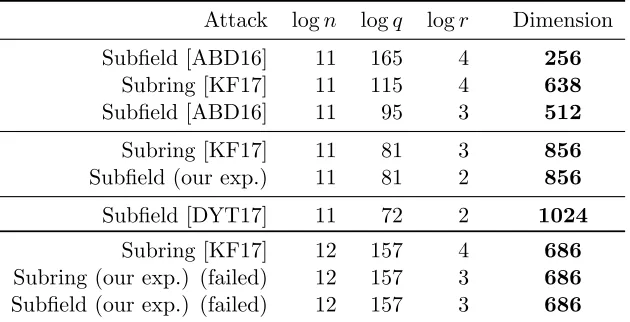
In a direct comparison of experiments, both [KF17] and [DYT17] use lattices of larger dimension compared to [ABD16]. Thus, it is not clear whether the experiments remain comparable. Table 1 presents one example, forn= 211, that demonstrates these comparisons. We observe that [KF17]
applied the subring attack in dimension 638, but the subfield attack achieves a smaller q with dimension 512. It is possible that the former running time might be shorter, but this was not claimed by [KF17], and our experiments have shown a close relationship between the dimension and running time. More examples can be found in the previous work. Table 1 presents some additional comparisons we have made: forn= 211and log(q) = 81, the two attacks are both successful, in spite
of the fact that it was claimed as an improvement in [KF17] for a fixed subfield index. On the other hand, for n= 212 and log(q) = 157 our experiments could not succeed by taking a smaller-index
Attack logn logq logr Dimension
Subfield [ABD16] 11 165 4 256
Subring [KF17] 11 115 4 638
Subfield [ABD16] 11 95 3 512
Subring [KF17] 11 81 3 856
Subfield (our exp.) 11 81 2 856
Subfield [DYT17] 11 72 2 1024
Subring [KF17] 12 157 4 686
Subring (our exp.) (failed) 12 157 3 686
Subfield (our exp.) (failed) 12 157 3 686
Table 1: Experimental comparisons between the subfield and subring attacks, from prior work and our own experiments. Some claimed improvements from prior work (smaller q) for the subring and subfield attacks have used larger dimension lattices. For log(n) = 11, we show that the modulusq leading to a successful subring attack also leads to a successful subfield attack on a lattice of the same (or smaller) dimension. For log(n) = 12 on the other hand, this is not always the case.
As explained above, the main feature of the subfield and subring attacks is that they allow the attacker to decrease the lattice dimension, bringing larger parameters into feasible range in practice. Since at the limit, by the aforementioned result of Kirchner and Fouque, the full field attack will work for a given nandq if the subfield attack does (using LLL or a fixed block size in BKZ), we claim that comparing results using lattices of larger dimension is not a fair method. We propose that a better metric is to first fix the lattice dimension, and then evaluate which attack succeeds with a smaller modulus q. (One should also compare the running times, but they appear to be similar as the lattices are very similar; for fixed parameters they have the same volume. See Table 3 for some timings of the lattice reduction of both attacks.) An alternative approach would be to first fix the modulus, and compare the smallest dimension, using the projection technique, for which each attack succeeds. We present our own experimental results for these two comparisons in Tables 3 and 2. In the following section we show analytically that the subring attack is expected to perform better than the subfield attacks under this metric.
4
Main results
4.1 The projection technique
The key to the projection technique is the assumption that the system of equations corresponding to Equation (1) is overdetermined, and therefore some of the equations can be discarded without introducing undesirable solutions. The aim of this section is to formalize this assumption, explain its relation to standard assumptions on NTRU and derive concrete results using it. Some of these details are missing in the results presented in [KF17, Section 3.2]. Indeed, they simply assume, backed up by experimental evidence, that a sufficiently short vector in the lattice must be a short multiple of the key.
In the following, the matrix Ais any of the matrices in the attacks above and L(A) is the lattice generated by A. Let L0 be the projected matrix, as explained in Section 3.2, of dimensionn0+d.
The matrix Mis the corresponding matrix at the upper right quadrant of A.
We introduce the notion ofdiscrepancy [KN74, DT97], which measures how close the distribution of a sequence of points is to being equidistributed. Formally, the discrepancyD(Γ) of a sequence of points Γ ={γ1, . . . , γn} in the interval [0,1] is defined as
D(Γ) = sup
J⊆[0,1]
T(J, n) n − |J|
,
where the supremum is taken over all subintervals J of [0,1] (the length of J is |J|) and T(J, n) is the number of points γi in J (for 1≤i≤n). ConsiderZn with the dot product, and let T be a sequence of elements inZn. We say that the sequenceT is ∆-homogenously distributed modulo q if for any a∈ Zn, with at least one coordinate coprime toq, the discrepancy of the sequence {[a·t]q/q}t∈T is at most ∆.
We would like to consider the columns of Mas a set of elements inT. However, this sequence is not ∆-homogenously distributed moduloq for small ∆: in the caseM=Mh, for example, by
construction we have that h·f = g does not distribute homogenously. We therefore define the following weaker notion.
Definition 1 (Weak homogenous distribution). Let u ∈ O, B > 0, and let T be a sequence of elements inZn. We say that T is (B, u)-weakly ∆-homogenously distributed moduloq if for any a /∈ Ou such that||a||< B, with at least one coordinate coprime toq, the discrepancy of the sequence
{[a·t]q/q}t∈T is at most∆.
Theorem 1. For f,g∈Rq let h= g/f. Suppose that the set of columns of Mh is (B,f)-weakly ∆-homogenously distributed modulo q. Let L0 be an (n+d)-dimensional lattice constructed as above. Then with probability at least 1−(2B−1)n((2B+ 1)/q+ ∆)d over the columns ofM
h, any vector (x, y)∈ L0 such that ||(x, y)||< B satisfies(x,[xh]q) = (αf, αg) for some α∈ O. The result follows
for the (n0+d)-dimensional subring lattice L0 where the assumption is taken over O
L:=O ∩L.
Proof. Suppose 0 6= (x, y) ∈ L0 such that x /∈ Of. Denote by (xh)
i the i-th coefficient of [xh]q,
where 0 ≤ i < n. Suppose also that ||(x, y)|| < B, which implies that |xi| < B and |(xh)i|< B.
Denote by P the probability that|(xh)i|< B for somei. By the assumption on h we get that
P < 2B+ 1
Recall that the d≤nrightmost columns in L0 correspond to (a subset of) the coefficients of
multiplication byh. Thus, the probability that |(xh)i|< B for all the corresponding columns inL0
isPd<((2B+ 1)/q+ ∆)d, where the probability is taken over the choice of the dcolumns, which
are assumed to be chosen independently.
There are (2B−1)n different possibilities for x such that|x
i|< B, with 0≤i < n. Hence, the
probability over the chosen columns ofMh in L0 that there exists a lattice point||(x, y)||< B with
x /∈ Of is at most
(2B−1)nPd<(2B−1)n
2B+ 1
q + ∆
d .
Theorem 1 considersMh, and thus alsoM0
h, as these are the cases of interest in [May99, KF17]
respectively. However, it can be generalized to the other matricesMdescribed above. In general, it is not known that the columns ofMh are (B,f)-weakly homogenously distributed for sufficiently small B. Understanding the distribution ofh is extremely important as it underlies the security of NTRU. In general,h is not uniformly distributed in Rq, as can be seen from a simple information-theoretic
argument. Hence, understanding the distribution of f−1 is important in order to understand the distribution of h. Banks and Shparlinski [BS01] studied how “well spread” the coefficients of f−1
are, that is, whether they “look and behave like random polynomials”. We remark that the desired property on h may follow from the behaviour off−1, but this property is not well formed.
Moreover, it is standard to assume that h = g/f is indistinguishable from random in Rq,
see [LATV12]. We remark that this assumption has a strong relation with the weakly homogenous distribution of Mh. Indeed, if the latter is not true, then one can pick a set of small polynomials aand analyze the distribution of {[a·t]q/q}t∈Mh to distinguish it from from a random h. Thus,
under the indistinguishability assumption, this set of polynomials has to be negligibly small. We ran experiments with ternary f,g and verified that the coefficients of [f−1]q equidistribute in
Zq and thatMh is (B,f)-weakly homogenously distributed for sufficiently smallB.5 For the rest of
the paper, we rely on the following assumption.
Assumption 1. The set of columns Mh is (B,f)-weaklyO(q−1)-homogenously distributed modulo q for B q.
Corollary 1. Let f,g∈Rq andh=g/fbe NTRU private and public keys. Let L0 be the projected
NTRU lattice of dimension n+d as above, whered≥(nlog(2B+ 1) + 1)/log (q/(2B+ 1)). Under Assumption 1, any vector (x, y)∈ L0 such that ||(x, y)||< B satisfies(x,[xh]q) = (αf, αg) for some
α∈ O with probability at least 1/2 +O(q−1) over the chosen columns ofM
h. The result follows for
the (n0+d)-dimensional subring lattice L0 where the assumption is taken over OL:=O ∩L.
Proof. Using notation from Theorem 1, the probability that there exists a lattice point||(x, y)||< B
with x /∈ Of is at most
(2B+ 1)n+d
qd +O(q
−1) = 2(n+d)(log(2B+1))
2dlog(q) +O(q −1).
Settingd≥(nlog(2B+ 1) + 1)/log (q/(2B+ 1)) gives the result.
Setting d as required in Corollary 1, observe that the dimension of L0 is n+d ≥(nlog(q) + 1)/(log (q/(2B+ 1))). This is similar to the subring lattice in [KF17, Theorem 6]. Thus, Corollary 1 completes the missing details on the validity of the subring attack and, along with [KF17, Theorem 6], gives a complete analysis of the subring attack under Assumption 1. We formalize this result in the following theorem. For the rest of the paper, β denotes the block size in the BKZ [Sch87] algorithm.
Theorem 2 (Adapted from Theorem 6 in [KF17]). Let f,g∈Rq and h=g/f be NTRU private
and public keys satisfying Assumption 1. Let B = ||v|| where v = (f,g) in the full field, v = (NK/L(f), NK/L(g))in the subfield and v= (NK/L(f), NK/L(f)h) in the subring. Then for
β logβ =
2n0logq
log(q/B)2
one can find a multiple αv for a non-zero α ∈ O with probability at least 1/2 +O(q−1) over the
chosen columns of M.
4.2 Comparing ||NK/L(g)|| and ||NK/L(f)h||
In this section, we show that when the subring and subfield lattices are fixed to the same dimension via the projection technique, the subring lattice contains smaller vectors. This leads to two main results. For a particular block sizeβ in the BKZ algorithm, a first result is that one can solve a degree-noverstretched NTRU problem in a 2n0-dimension lattice with a smaller modulusq using the subring attack. A second result is that for fixed parametersnand q, by further projection, one can solve an overstretched NTRU problem over a smaller lattice dimension using the subring attack.
In Section 3.2 we showed that a small vector in the subfield lattice, most likely the smallest, is of the form (NK/L(f), NK/L(g)), while in the subring lattice, there is a small vector of the form (NK/L(f), NK/L(f)h). Thef part of these vectors is the same. Our interest is therefore in thegpart.
Moreover, we know thatNK/L(g) is ann0-dimensional vector and thatN
K/L(f)his ann-dimensional
vector. Our main objective is to show that these two elements have the same Euclidean norm. It then follows that on average the coefficients ofNK/L(g) are larger than the coefficients ofNK/L(f)h
(since n > n0). When we truncate the latter to n0 coordinates, its norm becomes smaller than the norm ofNK/L(g). Using an assumption on the distribution of the coefficients ofNK/L(g), we
quantify the difference in size.
More precisely, Theorem 3 shows, with no further assumptions, that when [K :L] = 2, the average size of the coefficients ofNK/L(g) is expected to be
√
that the ratio of the coefficients is√r under Assumption 2, which we state below. The two main results introduced at the beginning of this section are proven in Corollaries 2 and 3.
We start by stating a simple claim which allows us to obtain the ratio of the coefficients once we assume that the ratio of the Euclidean norms is 1.
Claim 1. Let f, g be two polynomials with coefficients chosen uniformly at random from the same set. We set f = (u1, . . . , um) and g = (w1, . . . , wn). Then, E[||f||2] = E[||g||2] if and only if the
expectation of the square of the coefficients satisfies E[u2
i] = mn E[w 2 i].
Proof. We have E[||f||2] =mE[u2
i] and E[||g||2] =nE[w2i]. We set these equal and rearrange.
In light of this result, our aim is to show that the ratio between ||NK/L(g)||and ||NK/L(f)h||
tends to 1 asnincreases. Then, we can conclude that the subring lattice of dimension 2n0is expected
to contain shorter vectors than the subfield lattice of the same dimension.
We use random walks to model the coefficients of a product of two polynomials. A first case is for polynomials whose coefficients are drawn independently and uniformly from the set{−1,0,1}. A one-dimensional random walk over Zstarts at 0 and at each step moves either +1 or −1 with equal probability. Let ai, fori= 1, . . . , n, denote independent random variables with value either
+1 or−1 with uniform probability, and let w0 = 0 andwn=Pni=1ai. The series {wn} defines a
random walk overZ. The expected distance after nsteps is on the order of
√
n. Asnincreases, the distribution of the serieswn approaches the normal distribution. A second case is for polynomials
whose coefficients are drawn from a Gaussian distribution: in a Gaussian random walk, we let ai
follow the Gaussian distribution with standard deviation σ and mean zero. The expected distance after nsteps is then on the order ofσ√n. For further background, see [LL10].
Recall that NK/L(g) = Q
σ∈Gσ(g) and NK/L(f)h = g
Q
σ∈G\{Id}σ(f) for G = Gal(K/L).
Moreover, we haveσ1:= Id. We now consider the specific case of subfieldL⊆K of index 2.
Theorem 3. Let f,g ∈ Rq be two polynomials whose coefficients are drawn independently and
uniformly from the set {−1,0,1}, and let NK/L(g) = (u1, . . . , un) andgσ2(f) = (w1, . . . , wn). Then
E[u2
i |ui 6= 0] = 8n/9−4/9and E[wi2] = 4n/9. Thus, asngoes to infinity the expected ratio between
the non-zero coefficients of NK/L(g) and gσ2(f) tends to √
2 in absolute value. In addition, the ratio of the expected squared Euclidean norms E[||NK/L(g)||2]/E[||gσ2(f)||2] tends to 1 as n goes to
infinity.
Proof. We start by comparing the size of the coefficients of NK/L(g) to those of gσ2(f). Let
ai∈ {−1,0,1}and consider the polynomial
g=an−1xn−1+an−2xn−2+· · ·+a1x+a0∈Rq.
Thenσ2(g) =−an−1xn−1+an−2xn−2+· · · −a1x+a0.Observe that each coefficientukofNK/L(g) =
gσ2(g) is a sum ofnterms. For k odd,uk = 0, because each of the termsaiaj in this sum appears
twice with opposite signs. Forkeven,uk= 2
P
i<j,i+j≡kmodn±aiaj+a2k/2+a 2
(n+k)/2, since each term
at random, we have that E[aiaj |i6=j] = 0, E[a2i] = E[a4i] = 2/3, and E[(aiaj)2] = 4/9. Thus fork
even we have
E[u2
k] = E[(2
X
i<j,i+j≡kmodn
±aiaj+a2k/2+a2(n+k)/2)2] = 4
X
i<j,i+j≡kmodn
E[(aiaj)2] + E[a4k/2] + E[a4(n+k)/2]
= 4(n/2−1)(4/9) + 4/3 = 8n/9−4/9.
Now, let us repeat a very similar argument for gσ2(f), where σ2(f) is a polynomial of the form
σ2(f) =bn−1xn−1+bn−2xn−2+· · ·+b1x+b0,
with bi ∈ {−1,0,1}uniformly and independently at random. Again, each coefficientwk of gσ2(f) is
a sum ofnterms. However, unlike the case above, there are no similar terms in this sum, and we have E[aibj] = 0 and E[(aibj)2] = 4/9. As above, we compute
E[wk2] = E[(X
i+j≡kmodn
aibj)2] =
X
i+j≡kmodn
E[(aibj)2] = 4n/9.
Thus we can compute the expected square of the Euclidean norms
E[||NK/L(g)||2] = E[
X
i
u2i] =X
i
E[u2i] = (n/2)(8n/9−4/9) = 4n2/9−2n/9
E[||gσ2(f)||2] = E[
X
i
wi2] =X
i
E[w2i] =n(4n/9) = 4n2/9.
The result follows.
We would like to generalize this result to r >2. While the coefficients of gσ2(g) andgσ2(f) can
be expressed as random walks, and thus follow a Gaussian distribution, they may not be independent. To generalize Theorem 3 we state the following assumption.
Assumption 2. For[K :L]>1, the coefficients ofNK/L(g), NK/L(f) and NK/L(f)hbehave as if
they were independently chosen from a Gaussian distribution.
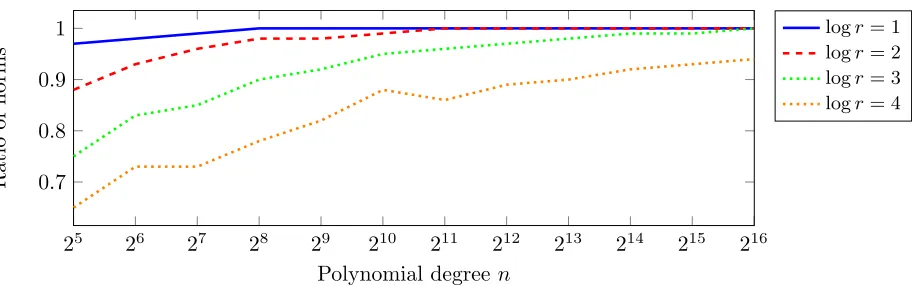
This assumption seems natural and allows us to prove Theorem 4, a generalisation of Theorem 3 to any r >0. We remark that the results on the attacks given in Corollaries 2 and 3 rely on the result stated in Theorem 4 and not on Assumption 2. We experimentally verified that as ngrows, the ratio of the norms tends to 1, as in Theorem 4, and the ratio of the coefficients tends to √r. See Figure 1.
Theorem 4. Let f,g∈Rq and h=g/fbe NTRU private and public keys satisfying Assumption 2.
For a subfield L ⊆ K, let NK/L(g) = (u1, . . . , un) and NK/L(f)h = (w1, . . . , wn). Then, as n
goes to infinity the expected ratio between the non-zero coefficients of NK/L(g) and NK/L(f)h
tends to √r in absolute value. In addition, the ratio of the expected squared Euclidean norms
Proof. We give a proof by induction on the index r. The base case is proven in Theorem 3. The general case is a straightforward generalization. Suppose the claim holds for index r, we show that it holds for [K:L] = 2r.
First note that for a tower of fields L⊆E⊆K we have NK/L(a) =NE/L(NK/E(a)) for every
a ∈ K (see [LN97, Theorem 2.29]). Consider the case [K : E] = r,[E : L] = 2, and denote
G:=NK/E(g) and F:=NK/E(f). Then,
NK/L(g) =NE/L(G) =Gσ02(G) and NK/L(f)h=NE/L(F)h=Fσ20(F)h=G0σ02(F),
where σ20 ∈Gal(E/L) andG’=Fh=NK/E(f)h.
The previous case of the construction, i.e. [K:E] =r, shows that each (non-zero) coefficient of
F,Gand G0 follow a Gaussian distribution. Under Assumption 2 the coefficients can be considered to be independent. We can now repeat the process of Theorem 3, which we briefly explain.
While G0 ∈ K, note that F,G ∈ E so they have n/r non-zero coefficients. Thus, similarly to Theorem 3, each non-zero coefficient of Gσ20(G) is approximately 2 multiplied by a Gaussian random walk withn/2r steps, while each coefficient ofG0σ20(F) is a random walk withn/r steps. By the induction hypothesis, a coefficient of G is expected to be larger than the coefficients of
G0 by a factor that approaches√r for sufficiently largen. The result on the coefficients follows from evaluating the expected size of the random walks. Then, the claim on the norms follows from Claim 1.
As a corollary, we obtain the following result that shows that if we compare subfield and subring attack lattices of the same dimension, then the subring lattice contains smaller vectors.
Corollary 2. Let Bsubf ield = ||(NK/L(f), NK/L(g))|| where [K : L] = r = n/n0. Let B proj subring = ||(NK/L(f), NK/L(f)h)|| where the projection keeps 2n0 coordinates. Under Assumptions 1 and 2,
for sufficiently large n we expect to have
B2 subf ield
Bsubringproj 2
≈ 2r
r+ 1.
Moreover, suppose that Bsubf ield is the norm of the shortest vector in the subfield lattice, and denote
by qsubf ield and qsubring the modulus in the subfield and subfield attacks, respectively, that the BKZ
algorithm can solve NTRU with a fixed block sizeβ. Then
qsubf ield
qsubring
≥ 2r
r+ 1.
Proof. To simplify notations, we will write coeff(f) to denote the coefficients of a polynomialf. We have B2
subf ield= (n/r)(coeff(NK/L(f))2+ coeff(NK/L(g))2), and
Bsubringproj 2= (n/r)(coeff(NK/L(f))2+ coeff(NK/L(f)h)2).
We know that coeff(NK/L(f))2 ≈coeff(NK/L(g))2 and from Theorem 4, we know that
BKZ is guaranteed to output a vector bounded by β2n0/β
λ1(L). The second result follows from
bounding this value by√q in both lattices.
It follows from the corollary that taking the same lattice dimension in the subring and subfield attacks, the subring lattice contains vectors of smaller size. Therefore one can solve the NTRU problem using the subring attack with a smallerq. As mentioned in [ABD16, Section 6] we remark that it is not known thatBsubf ieldis indeed the norm of the shortest vector (see also [KF17, Theorem
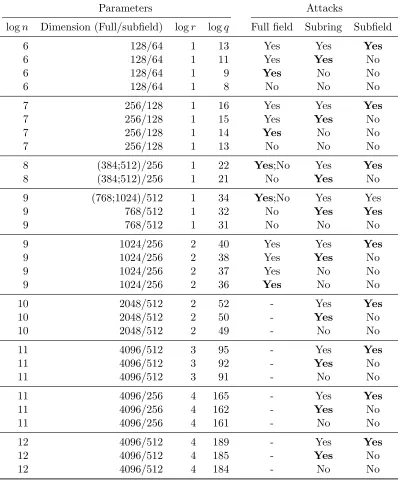
5]). Moreover, our experiments in Table 2 show that the ratio between qsubf ield and qsubring grows
with r. A possible explanation is the following: the vector (NK/L(f), NK/L(f)h) is unbalanced, as
itsf part is shown to be much larger than the g part. Therefore, if there exists an integral multiple of this vector that decreases the size of the f part and increases the size of theg part so that the vector becomes balanced, then the ratio between the feasibleqs would increase.
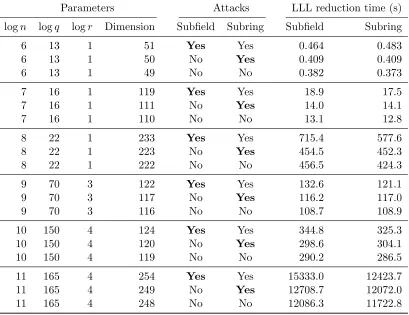
If the systems of equations derived from the lattices given in Corollary 2 are overdetermined, it is possible to project and obtain lower dimensional lattices. Since the g part in the subring lattice is smaller than the subfield lattice, the system in the subring attack is more determined than the system in the subfield attack. That is, the subring lattice will contain solutions of smaller size. Thus, one can discard more equations in the subring attack and achieve a lower dimension. See Table 3 for this comparison. Following Theorem 2, this result gives a better performance for the subring attack as we now show in Corollary 3. Observe that one can get a tighter bound by decreasing the boundB as we project.
Corollary 3. With the notation from Theorem 2 and Corollary 2, set B := Bsubf ield. Under
Assumptions 1 and 2, for sufficiently largen, we can find a multiple αv for some non-zero α∈ O
such that using BKZ with block size β on the lattice L0 of dimension n0+d,
1. if L0 is the subfield lattice, then
n0+d≥ n
0log(q) + 1
log(q/(2B+ 1)) and β logβ =
2n0logq (log(q/B))2,
2. if L0 is the subring lattice, then
n0+d≥ n
0log(q) + 1
log(q√r/(√2r+ 2B+√r) and β logβ =
2n0logq
(log(√2rq/√r+ 1B)2.
4.2.1 Experimental results
We implemented the full field, subfield, and subring attacks in Sage and experimentally compared them using Sage’s default LLL implementation. We defined a success in our experiments as recovering a vector v satisfying ||v|| < q3/4. As already noted by [KF17], we either get vectors which are
roughly of sizeq, or vectors of size√q that are short integral multiples of the private key.
25 26 27 28 29 210 211 212 213 214 215 216
0.7 0.8 0.9 1
Polynomial degreen
Ratio
of
norms
logr= 1 logr= 2 logr= 3 logr= 4
Figure 1: Experimentally verifying that the ratio of the norms converges to 1. We experimentally computed the ratio||NK/L(g)||/||NK/L(f)h||fornincreasing and for various subfields
of index r. The ratio converges experimentally to 1 as n→ ∞ for each index r we experimented with. The speed of the convergence is proportional to r.
subring attack for logn= 12 took 276 hours of wall clock time and the 1024-dimensional lattice reduction for the full field attack with logn= 9 took 182 hours of wall clock time on a single core of our experimental machine.
We then compared the subring and subfield attacks by fixing (n, q, r) and comparing the smallest dimension that succeeded using LLL. For some of the lattices we used the projection technique by deleting the right-most columns until we reached the desired dimension. For n∈[26,211] and
r ∈ [2,24], the subring attack succeeded with a smaller dimension than the subfield attack. In
Table 3, we give detailed experimental results. We also report timings for lattice reduction done with LLL. The longest computations in the table were the last few rows; lattice reduction took 4.2 hours of wall clock time for the 254-dimensional lattice on a single core of an Intel Xeon E5-2699 v3 running at 2.30GHz, with 128 GB of RAM. We note that in most cases, for a given dimension, the lattice reduction for the subring attack seems to be slightly more efficient than for the subfield attack.
5
Open questions
In this paper we give a comparison between the subfield and subring attacks on overstretched NTRU. We argue that the correct method for comparison should be the resulting lattice dimension, contrary to the comparisons made in previous work. Our analysis shows that for a fixed dimension, the subring lattice using the projection method contains shorter vectors, and this can be used to solve the NTRU problem with the subring attack on a lattice of smaller dimension than the subfield attack.
it is theoretically possible that a balanced multiple of it exists. Proving this claim would give insights about the results of our experiments. It also of great interest to explain our experimental observations of cases where the full field attack only succeeds after projection and is outperformed by the other attacks.
The subfield attack in [CJL16] uses the trace function and theg part of the desired lattice vector in this attack appears to be somewhat larger than in the subfield attack that uses the norm. It is not immediately clear what is the ratio between theseg parts. The g part in the trace attack is given byNK/L(f)T rK/L(h) =
P
iσi(g)
Q
j6=iσj(f). It seems that our analysis can be used to analyze
this case, which we leave to future work.
An interesting question revolves around the existence of shifts in the NTRU lattice. On the one hand, their existence is fundamental for Kirchner and Fouque’s analysis of the attack in the full field [KF17, Theorem 9]. On the other hand, the goal of the zero forcing method is to eliminate them. We ran some experiments to check whether eliminating the shifts is a better approach than removing the corresponding rows, and observe that both methods lead to the same result. The only benefit of removing some rows would be the slight improvement in the runtime due to a smaller lattice dimension. We note that some other related interesting open questions are given in [MS01].
Acknowledgements We thank Shi Bai for some helpful discussions on the topic. This material is based upon work supported by the National Science Foundation under Grants No. CNS-1513671 and CNS-1651344 and by the ONR SynCrypt project. We are grateful to Cisco for donating the Cisco UCS servers that we used for our experiments.
References
[ABD16] Martin Albrecht, Shi Bai, and L´eo Ducas. A Subfield Lattice Attack on Overstretched NTRU Assumptions. In Matthew Robshaw and Jonathan Katz, editors,Advances in Cryptology – CRYPTO 2016, pages 153–178, Berlin, Heidelberg, 2016. Springer Berlin
Heidelberg.
[BLLN13] Joppe W. Bos, Kristin Lauter, Jake Loftus, and Michael Naehrig. Improved security for a ring-based fully homomorphic encryption scheme. In Martijn Stam, editor,
Cryptography and Coding, pages 45–64, Berlin, Heidelberg, 2013. Springer Berlin Heidelberg.
[BS01] William D. Banks and Igor E. Shparlinski. Distribution of Inverses in Polynomial Rings. Indagationes Mathematicae, 12(3), 2001.
[CS97] Don Coppersmith and Adi Shamir. Lattice Attacks on NTRU. In Walter Fumy, editor,
Advances in Cryptology — EUROCRYPT ’97, pages 52–61, Berlin, Heidelberg, 1997. Springer Berlin Heidelberg.
[DT97] M. Drmota and R. Tichy. Discrepancies and Applications. Springer-Verlag, Berlin, 1997.
[DYT17] Dung Hoang Duong, Masaya Yasuda, and Tsuyoshi Takagi. Choosing Parameters for the Subfield Lattice Attack Against Overstretched NTRU. In Phong Q. Nguyen and Jianying Zhou, editors,Information Security, pages 79–91, Cham, 2017. Springer International Publishing.
[GGH13] Sanjam Garg, Craig Gentry, and Shai Halevi. Candidate Multilinear Maps from Ideal Lattices. In Thomas Johansson and Phong Q. Nguyen, editors,Advances in Cryptology – EUROCRYPT 2013, pages 1–17, Berlin, Heidelberg, 2013. Springer Berlin Heidelberg.
[GS02] Craig Gentry and Mike Szydlo. Cryptanalysis of the revised ntru signature scheme. In Lars R. Knudsen, editor, Advances in Cryptology — EUROCRYPT 2002, pages 299–320, Berlin, Heidelberg, 2002. Springer Berlin Heidelberg.
[HHGP+03] Jeffrey Hoffstein, Nick Howgrave-Graham, Jill Pipher, Joseph H. Silverman, and
William Whyte. NTRUSign: Digital Signatures Using the NTRU Lattice. In Marc Joye, editor,Topics in Cryptology — CT-RSA 2003, pages 122–140, Berlin, Heidelberg, 2003. Springer Berlin Heidelberg.
[HPS96] Jeffrey Hoffstein, Jill Pipher, and Joseph H. Silverman. NTRU: A New High Speed Public Key Cryptosystem, 1996.
[HPS98] Jeffrey Hoffstein, Jill Pipher, and Joseph H. Silverman. NTRU: A Ring-based Public Key Cryptosystem. In Joe P. Buhler, editor, Algorithmic Number Theory, pages 267–288, Berlin, Heidelberg, 1998. Springer Berlin Heidelberg.
[KF17] Paul Kirchner and Pierre-Alain Fouque. Revisiting Lattice Attacks on Overstretched NTRU Parameters. In Jean-S´ebastien Coron and Jesper Buus Nielsen, editors,Advances in Cryptology – EUROCRYPT 2017, pages 3–26, Cham, 2017. Springer International Publishing.
[KN74] R. Kuipers and H. Niederreiter. Uniform Distribution of Sequences. Wiley-Interscience, New York, NY, USA, 1974.
[LATV12] Adriana L´opez-Alt, Eran Tromer, and Vinod Vaikuntanathan. On-the-fly Multiparty Computation on the Cloud via Multikey Fully Homomorphic Encryption. InProceedings of the Forty-fourth Annual ACM Symposium on Theory of Computing, STOC ’12,
[LL10] Gregory F. Lawler and Vlada Limic.Random Walk: A Modern Introduction. Cambridge University Press, New York, NY, USA, 2010.
[LN97] R. Lidl and H. Niederreiter. Finite Fields. Cambridge University Press, 1997.
[May99] Alexander May. Cryptanalysis of NTRU, 1999. Preprint.
[MS01] Alexander May and Joseph H. Silverman. Dimension Reduction Methods for Convo-lution Modular Lattices. In Joseph H. Silverman, editor,Cryptography and Lattices, pages 110–125, Berlin, Heidelberg, 2001. Springer Berlin Heidelberg.
[PT08] G´abor Pataki and Mustafa Tural. On Sublattice Determinants in Reduced Bases, 2008.
[Sam70] P. Samuel. Algebraic Theory of Numbers. Hermann, 1970.
[Sch87] C. P. Schnorr. A Hierarchy of Polynomial Time Lattice Basis Reduction Algorithms.
Theor. Comput. Sci., 53(2-3):201–224, August 1987.
[SS11] Damien Stehl´e and Ron Steinfeld. Making NTRU as Secure as Worst-Case Prob-lems over Ideal Lattices. In Kenneth G. Paterson, editor, Advances in Cryptology – EUROCRYPT 2011, pages 27–47, Berlin, Heidelberg, 2011. Springer Berlin Heidelberg.
Parameters Attacks
logn Dimension (Full/subfield) logr logq Full field Subring Subfield
6 128/64 1 13 Yes Yes Yes
6 128/64 1 11 Yes Yes No
6 128/64 1 9 Yes No No
6 128/64 1 8 No No No
7 256/128 1 16 Yes Yes Yes
7 256/128 1 15 Yes Yes No
7 256/128 1 14 Yes No No
7 256/128 1 13 No No No
8 (384;512)/256 1 22 Yes;No Yes Yes
8 (384;512)/256 1 21 No Yes No
9 (768;1024)/512 1 34 Yes;No Yes Yes
9 768/512 1 32 No Yes Yes
9 768/512 1 31 No No No
9 1024/256 2 40 Yes Yes Yes
9 1024/256 2 38 Yes Yes No
9 1024/256 2 37 Yes No No
9 1024/256 2 36 Yes No No
10 2048/512 2 52 - Yes Yes
10 2048/512 2 50 - Yes No
10 2048/512 2 49 - No No
11 4096/512 3 95 - Yes Yes
11 4096/512 3 92 - Yes No
11 4096/512 3 91 - No No
11 4096/256 4 165 - Yes Yes
11 4096/256 4 162 - Yes No
11 4096/256 4 161 - No No
12 4096/512 4 189 - Yes Yes
12 4096/512 4 185 - Yes No
12 4096/512 4 184 - No No
Parameters Attacks LLL reduction time (s)
logn logq logr Dimension Subfield Subring Subfield Subring
6 13 1 51 Yes Yes 0.464 0.483
6 13 1 50 No Yes 0.409 0.409
6 13 1 49 No No 0.382 0.373
7 16 1 119 Yes Yes 18.9 17.5
7 16 1 111 No Yes 14.0 14.1
7 16 1 110 No No 13.1 12.8
8 22 1 233 Yes Yes 715.4 577.6
8 22 1 223 No Yes 454.5 452.3
8 22 1 222 No No 456.5 424.3
9 70 3 122 Yes Yes 132.6 121.1
9 70 3 117 No Yes 116.2 117.0
9 70 3 116 No No 108.7 108.9
10 150 4 124 Yes Yes 344.8 325.3
10 150 4 120 No Yes 298.6 304.1
10 150 4 119 No No 290.2 286.5
11 165 4 254 Yes Yes 15333.0 12423.7
11 165 4 249 No Yes 12708.7 12072.0
11 165 4 248 No No 12086.3 11722.8
Table 3: Experimentally determining the minimal dimension for each attack. For a fixed modulus q, we compare the subfield and the subring attacks applied to a lattice of the same