A preliminary version of this paper is published in the proceedings of the 16th International Conference on Applied Cryptography and Network Security—ACNS 2018. This is the full version.
Continuously Non-Malleable Codes
with Split-State Refresh
Antonio Faonio1, Jesper Buus Nielsen2, Mark Simkin2, and Daniele Venturi3
1IMDEA Software Institute, Madrid, Spain 2Aarhus University, Aarhus, Denmark
3Sapienza University of Rome, Rome, Italy
June 15, 2018
Abstract
Non-malleable codes for the split-state model allow to encode a message into two parts, such that arbitrary independent tampering on each part, and subsequent decoding of the corresponding modified codeword, yields either the same as the original message, or a com-pletely unrelated value. Continuously non-malleable codes further allow to tolerate an un-bounded (polynomial) number of tampering attempts, until a decoding error happens. The drawback is that, after an error happens, the system must self-destruct and stop working, otherwise generic attacks become possible.
In this paper we propose a solution to this limitation, by leveraging a split-state refreshing procedure. Namely, whenever a decoding error happens, the two parts of an encoding can be locally refreshed (i.e., without any interaction), which allows to avoid the self-destruct mechanism in some applications. Additionally, the refreshing procedure can be exploited in order to obtain security against continual leakage attacks. We give an abstract framework for building refreshable continuously non-malleable codes in the common reference string model, and provide a concrete instantiation based on the external Diffie-Hellman assumption.
Finally, we explore applications in which our notion turns out to be essential. The first application is a signature scheme tolerating an arbitrary polynomial number of split-state tampering attempts, without requiring a self-destruct capability, and in a model where re-freshing of the memory happens only after an invalid output is produced. This circumvents an impossibility result from a recent work by Fuijisaki and Xagawa (Asiacrypt 2016). The second application is a compiler for tamper-resilient read-only RAM programs. In compar-ison to other tamper-resilient RAM compilers, ours has several advantages, among which the fact that, in some cases, it does not rely on the self-destruct feature.
Contents
1 Introduction 1
1.1 Our Contributions . . . 2
1.2 Code Construction . . . 3
1.3 Limitations of the Refresh Paradigm . . . 4
1.4 Further Related Work . . . 5 2 Preliminaries and Building Blocks 5 2.1 Basic Notation . . . 5
2.2 Non-Interactive Zero-Knowledge 6
2.3 Public-Key Encryption . . . 8
2.4 Commitment Schemes . . . 9
2.5 Signature Schemes . . . 10
2.6 Authenticated Encryption . . . . 11 3 Non-Malleability with Refresh 12 3.1 Split-State Codes . . . 12
3.2 The Definition . . . 12
4 Code Construction 14
4.1 Proof Intuition . . . 15
4.2 Description of the Simulator. . . 17
4.3 Hybrids . . . 19
4.4 Indistinguishability of the Hybrids 21
5 Concrete Instantiations 30
5.1 The PKE Scheme . . . 31
5.2 The Commitment Scheme . . . . 32
5.3 The Label-Malleable NIZK . . . 32
6 Applications 34
6.1 Tamper-Resilient Signatures . . . 34
6.2 Tamper-Resilient RAM . . . 37
7 Conclusion 47
1
Introduction
Tampering attacks are subtle attacks that undermine the security of cryptographic implemen-tations by exploiting physical phenomena that allow to modify the underlying secrets. Indeed, a long line of works (see, e.g., [12,10,42,53]) has established that black-box interaction with a tampered implementation can potentially expose the entire content of the secret memory. Given this state of affairs, protecting cryptographic schemes against tampering attacks has become an important goal for modern cryptographers.
An elegant solution to the threat of tampering attacks against the memory comes from the notion of non-malleable codes (NMCs), put forward by Dziembowski, Pietrzak, and Wichs [32]. Intuitively, a non-malleable encoding (Encode,Decode) allows to encode a valueM into a code-word C ← Encode(M), with the guarantee that a modified codeword Ce = f(C) w.r.t. a tampering function f ∈ F, when decoded, yields either M itself, or a completely unrelated value. An important parameter for characterizing the security guarantee offered by NMCs is the class of modifications F that are supported by the scheme. Since non-malleability is im-possible to obtain for arbitrary (albeit efficient) modifications,1 research on NMCs has focused on constructing such schemes in somewhat restricted, yet interesting, models. One such model that has been the focus of intensive research (see, e.g., [50,36, 3,2]) is the split-state model, where the codeword C consists of two parts (C0, C1) that can be modified independently (yet arbitrarily). This setting is also the focus of this paper.
Unfortunately, standard NMCs protect only against a single tampering attack.2 To over-come this limitation, Faustet al.[36] introducedcontinuouslynon-malleable codes (CNMCs for short), where the attacker can tamper for an unbounded (polynomial) number of times with 1As it can be seen by considering the tampering function that first decodes the codeword, flips one bit of the
message, and then encodes the result.
2
the codeword, until a decoding error happens which triggers the self-destruction of the device. As argued in [36], the self-destruct capability is necessary, as each decoding error might be used to signal one bit of information about the target codeword.
Another desirable feature of non-malleable codes is their ability to additionally tolerate leakage attacks, by which the adversary can obtain partial information on the codeword while performing a tampering attack. Note that in the split-state model this means that the adversary can leak independently from the two parts C0 and C1. All previous constructions of leakage-resilient NMCs either achieve security in the so-called bounded-leakage model [50,36,4], where the total amount of leakage (from each part) is upper-bounded by a value`that is a parameter of the scheme, or only satisfy non-continuous non-malleability [33].
1.1 Our Contributions
We introduce a new form of CNMCs (dubbed R-CNMCs) that include a split-state algorithm for refreshing a valid codeword. The refresh procedure is invoked either after a decoding error happens, or in order to amplify resilience to leakage, and takes place directly on the memory and without the need of a central unit. Our new model has two main attractive features, which we emphasize below.
• It captures security in the so-called continual noisy-leakage model, where between each refresh the adversary can leak an arbitrary (yet independent) amount of information on the two parts C0, C1, as long as the leakage does not reveal (information-theoretically) more than ` bits of information. Importantly, this restriction is well-known to better capture realistic leakage attacks.
• It avoids the need for the self-destruct capability in some applications. Besides mitigating simple denial-of-service attacks, this feature is useful in situations where a device (storing an encoding of the secret state) is not in the hands of the adversary (e.g., because it has been infected by a malware), as it still allows to (non-interactively) refresh the secret state and continue to safely use the device in the wild.
Our first contribution is an abstract framework for constructing R-CNMCs, which we are able to instantiate under the external Diffie-Hellman assumption. This constitutes the first NMC that achieves at the same time continuous non-malleability and security under continual noisy leakage, in the split-state model (assuming an untamperable common reference string).
Next, we explore applications of R-CNMCs. As second contribution, we show how to con-struct a split-state3 signature scheme resilient to continuous tampering and leakage attacks, without relying on the self-destruct capability, and where the memory content is refreshed in case a decoding error is triggered. Interestingly, Fujisaki and Xagawa [40] recently showed that such a notion is impossible to achieve for standard (i.e., non split-state) signature schemes, even if the self-destruct capability is available; hence, our approach can be interpreted as a possible way to circumvent the impossibility result in [40].
Our third contribution consists of two generic compilers for protecting random access ma-chine (RAM) computations against tampering attacks [24,37]. Here, we build on the important work of Dachman-Soled et al. [24], who showed how to compile any RAM to be resilient to continual tampering and leakage attacks, by relying both on an update and a self-destruct mech-anism. We refer the reader to Section6.2 for further details on our RAM compilers. Below, we highlight the main technical ideas behind our code construction.
3
1.2 Code Construction
The starting point of our code construction is the recent work of Faonio and Nielsen [33]. The scheme built in [33] follows a template that originates in the work of Liu and Lysyanskaya [50], in which the left side of the encoding stores the secret keysk of a public-key encryption (PKE) scheme, whereas the right side of the encoding stores a ciphertext c, encrypting the encoded message M, plus a non-interactive zero-knowledge (NIZK) argument that proves knowledge of the secret key under the label c; the PKE scheme is chosen to be a continual-leakage resilient storage friendly PKE (CLRS friendly PKE for short) scheme (see Dodiset al.[29]), whereas the NIZK is chosen to be a malleable NIZK argument of knowledge (see Chase et al. [15]). Such a code was shown to admit a split-state refresh procedure, and, at the same time, to achieve bounded-timenon-malleability.
The NM code of [33] does not satisfy security against continuous attacks. In fact, an attacker can create two valid codewords (C0, C1) and (C0, C10) such that Decode(C0, C1) 6= Decode(C0, C10). Given this, the adversary can tamper the left side to C0 and the right side to eitherC1orC10 according to the bits of the right side of the target encoding. This way, assuming tampering is non-persistent, the adversary can leak all the bits of C1 without activating the self-destruct mechanism. More in general, for any CNMC it should be hard to find two valid codewords (C0, C1) and (C0, C10) such that Decode(C0, C1) 6= Decode(C0, C10). This property, called “message uniqueness”, was originally defined in [36].4
Going back to the described code construction, an attacker can sample a secret key sk and create two ciphertexts,c0forM andc0forM0, whereM 6=M0, together with the corresponding honestly computed NIZKs, and thus break message uniqueness. We fix this issue by further binding the right and the left side of an encoding. To do so, while still being able to refresh the two parts independently, we keep untouched the structure of the right side of the codeword, but we change the message that it carries. Specifically, the ciphertext c in our code encrypts the message M concatenated with the randomness r for a commitment γ that is stored in the left side of the codeword together with the secret key for the PKE scheme. Observe that “message uniqueness” is now guaranteed by the binding property of the commitment scheme. Our construction additionally includes another NIZK for proving knowledge of the committed value under the label sk, in order to further link together the left and the right side of the codeword.
Proof strategy. Although our construction shares similarities with previous work, our proof techniques diverge significantly from the ones in [33, 36]. The main trick of [36] is to show that given one half of the codeword it is possible to fully simulate the view of the adversary in the tampering experiment, until a decoding error happens. To catch when a decoding error happens, [36] carries on two independent simulators in an interleaved fashion; as they prove, a decoding error happens exactly when the outputs of the two simulations diverge. The main obstacle they faced is how to succinctly compute the index where the two simulations diverge, so that non-malleability can be reduced to the security of the inner leakage-resilient storage scheme (see Dav´ıet al. [27]) they rely on. To solve this, [36] employs an elegant dichotomous search-by-hash strategy over the partial views produced by the two simulators. At this point the experiment can terminate, and thanks to a specific property of the leakage-resilient storage scheme, the simulator can “extract” the decoded value corresponding to a tampered codeword.
4
Faustet al. also consider “codeword uniqueness”, where the fact thatDecode(C0, C1)6=Decode(C0, C10) is
not required (as long asC16=C10). However, this flavor of uniqueness only allows to rule out so-called continuous
supernon-malleability, where one asks that not only the decoded value, but the entire modified codeword, be independent of the message. It is easy to see that no R-CNMC can satisfy “codeword uniqueness”, as for instance
Unfortunately, we cannot generalize the above proof strategy to multiple rounds. Indeed, Faustet al. exploit the fact that the leakage-resilient storage scheme remains secure even when the adversary is allowed to obtain one half of the encoding in full. Clearly, after that, the adversary is not allowed to leak further from the other half of the codeword. In our case, we would need to repeat the above trick again and again, in particular after each decoding error (and subsequent refresh of the target encoding) happens; however, once the reduction obtains one half of the codeword it cannot ask leakage queries anymore, so that it is unclear how to complete the proof. We give a solution to this problem by relying on a simple information-theoretic observation.
Let (X0, X1) be two random variables, and consider a process that interleaves the com-putation of a sequence of leakage functions g1, g2, g3, . . . from X0 and from X1. The pro-cess continues until, for some index i ∈ N, we have that gi(X0) 6= gi(X1). We claim that
¯
gi(X0) := g1(X0), g2(X0),· · ·, gi−1(X0) do not reveal more information about X0 than what X1 and the index ialready reveal. To see this, considerHe∞(X0 |¯gi(X0)), i.e. the average con-ditional min-entropy ofX0, which is, roughly speaking, the amount (on average) of uncertainty of X0 given ¯gi(X0) as side information. (See Section2.1 for the formal definition.) Now, since ¯
gi(X0) and ¯gi(X1) are exactly the same random variables we can derive5: e
H∞(X0 |g¯i(X0)) =He∞(X0 |¯gi(X1))≥He∞(X0 |X1, i).
The latter implies that the size of the view of the adversary, although potentially much larger than the leakage bound, might reveal only little information.
One can use the above observation in order to give an alternative proof of security for the scheme in [36], where the reduction to the leakage-resilient storage scheme loses only a factor O(κ) in the leakage bound (instead of O(κlogκ)). Briefly, the idea is to carry on two independent simulators in an interleaved fashion (as in [36]) and, at each invocation, outputting first the hashes6 of the simulated tampered codeword, and then, if the hashes match, leak the full simulated tampered codeword. This allows to avoid the dichotomous search-by-hash strategy, and thus to limit the total amount of leakage to O(κ).
1.3 Limitations of the Refresh Paradigm
The original motivation behind the concept of CNMCs, as discussed in [36], was to make the standard tampering application of NMCs more realistic, in the following sense. Imagine that the device we want to protect, besides storing an encoding of the secret key, also contains other non-encoded data. For example the device could be a laptop, and tampering attacks could be launched by a virus with read and write access to the memory. The virus could exploit the space available on the device to make multiple copies of the original codeword, which thus can be tampered continuously. However, since the underlying NMC is resilient to continuous attacks, the privacy of the secret key is still preserved. Intuitively, this works because the adversary, to gather information about the codeword, needs to trigger a decoding error, however, once such an event happens the device self-destructs and the game is over.
While our notion of R-CNMCs allows for the very same application as considered in [36] (as any R-CNMC is in particular a CNMC), the straight-forward extension of the above scenario to a setting where the self-destruct is not available, but the encoding of the key is refreshed after a decoding error happens, does not work. To make the attack even harder, suppose that all the locations in the memory are encoded using a R-CNMC, and whenever a decoding error happens,
5In the last equation, we also use that the output of a function is at most as informative as the input. 6
the full memory is refreshed. An adversary could perform the following tampering attack. In case the i-th bit of the attacked codeword is equal to 1, the i-th location of the memory is corrupted (i.e., it is replaced with an invalid codeword), otherwise it is left untouched. Thus, the adversary reads sequentially all the memory locations. Very soon a decoding error will be triggered and all the codewords refreshed, however the information of the original codeword is still present in the memory (as the untouched codewords will be refreshed to valid codewords, while the corrupted codewords will still trigger a decoding error). This means that eventually the adversary is able to fully retrieve the original codeword (even if it has been refreshed many times), which leads to a clear breach of non-malleability.
1.4 Further Related Work
Several constructions of non-malleable codes in the split-state model appeared in the literature, both for the information-theoretic [32, 31, 3, 20, 4, 2, 14, 5, 48, 49, 17] and computational setting [50, 36, 24, 1, 46, 52, 23]. Non-malleable codes exist also for several other models besides split-state tampering, including bit-wise independent tampering and permutations [20,
6,7,22,21], circuits of polynomial size [32,19,38,39], constant-state tampering [18], block-wise tampering [13], space-bounded algorithms [35, 9], bounded-depth circuits [8, 16], and partial functions [47].
The concept of non-malleable codes with split-state refresh was recently proposed in [33]. The main difference with our work is that in [33] the refresh mechanism essentially allows to only tolerate continual leakage, but the codeword needs to be refreshed at each invocation in order to achieve security against continuous tampering attacks. In contrast, R-CNMCs satisfy both resilience to continual leakage and to continuous tampering without invoking a refresh at each invocation.
Security against tampering attacks against the memory can also be obtained without relying on non-malleable codes. See, e.g., [45, 25, 40, 34, 26] (and the references therein) for some examples.
2
Preliminaries and Building Blocks
2.1 Basic Notation
We let N denote the naturals and R denote the reals. For a, b ∈ R, we define [a, b] = {x ∈ R: a≤x ≤ b}; fora ∈N we let [a] = {0,1, . . . , a}. If x is a bit-string, we denote its length
by |x|, and, for any i ≤ |x|, we let x[i] be the i-th bit of x. If X is a set, |X | represents the number of elements in X. Whenx is chosen randomly in X, we write x ← X. When A is an algorithm, we writey←A(x) to denote a run ofAon inputx and outputy; ifAis randomized, theny is a random variable andA(x;r) denotes a run ofAon inputx and random coinsr. An algorithmAisprobabilistic polynomial-time (PPT) ifAis allowed to make random choices, and the computation ofA(x;r) terminates in at most a polynomial number of steps (in|x|), for any input x∈ {0,1}∗ and randomnessr∈ {0,1}∗.
Indistinguishability and min-entropy. We let κ∈N be a security parameter. A function
ν : N → [0,1] is called negligible in κ (or simply negligible) if it vanishes faster than the
inverse of any polynomial in κ. For two ensembles X = {Xκ}κ∈N and Y ={Yκ}κ∈N, we write
X ≈cY, meaning that every PPT distinguisher D has negligible advantage in distinguishing
X and Y, i.e., |P[D(Xκ) = 1] −P[D(Yκ) = 1]| ≤ ν(κ) where ν(κ) is a negligible function.
the above indistinguishability holds for all (even computationally unbounded) distinguishers (or, equivalently, that the statistical distance betweenX and Y is negligible).
The min-entropy of a random variable X, defined over a set X, is denoted as H∞(X) :=
−log maxx∈XP[X=x] and represents the best chance of guessing X by an unbounded
adver-sary. Conditional average min-entropy captures how hard it is to guess X on average, given some side information Z ∈ Z (possibly related to X), and it is denoted as He∞(X|Z) := −logEz∈Zmaxx∈XP[X =x|Z =z]. We rely on the following lemmata [30].
Lemma 1. Let X and Z be possibly correlated random variables, and let f be any (possibly randomized) function. Then, He∞(X|f(Z))≥He∞(X|Z).
Lemma 2. Let X, Z1, Z2 be possibly correlated random variables, where Z2 takes at most 2` values. Then, He∞(X|Z1, Z2)≥He∞(X|Z1)−`.
Following [28], we define a notion of a function being `-leaky.
Definition 1 (`-leaky function). A (possibly randomized) function g : {0,1}∗ → {0,1}∗ is `-leaky, if for allX distributed over {0,1}∗ we have thatHe∞(X|g(X))≥H∞(X)−`.
As shown in [28, Lemma L.3] the above notion composes nicely, meaning that if two functions are respectively `1-leaky and`2-leaky, their concatenation is (`1+`2)-leaky.
Oracle machines. Given a pair of stringsX= (X0, X1)∈({0,1}∗)2 define the oracleO∞(X)
to be thesplit-state leakage oracle that takes as input tuples of the form (β, g), whereβ∈ {0,1} is an index andg is a function described as a circuit, and outputsg(Xβ). An adversaryAwith
oracle access to O∞(X) is called `-valid, for some`∈N, if for allβ ∈ {0,1} the concatenation
of the leakage functions sent byAis an `-leaky function of Xβ.
Given two PPT interactive algorithms A and B we write (yA;yB) ← (A(xA) B(xB)) to
denote the execution of algorithm A (with input xA) and algorithm B (with input xB). The
string yA (resp. yB) is the output of A (resp. B) at the end of such interaction. In particular,
we write A O∞(X) to denote A having oracle access to the leakage oracle with input X.
Moreover, we writeAB,Cto denoteAinteracting in an interleaved fashion both withBand withC.
2.2 Non-Interactive Zero-Knowledge
Let R ⊆ {0,1}∗ × {0,1}∗ be an NP-relation; the language associated with R is LR := {x :
∃w s.t. (x, w) ∈ R}. We typically assume that given a pair (x, w) it is possible to efficiently verify whether (x, w)∈ Ror not. Roughly, a non-interactive argument (NIA) for an NP-relation Rallows to create non-interactive proofs for statements x∈ L, when additionally given a valid witness w corresponding to x. More formally, a NIA N IA := (CRSGen,Prove,Ver) for R, with label space Λ, is a tuple of PPT algorithms specified as follows: (1) The (randomized) initialization algorithmCRSGentakes as input the security parameter 1κ, and creates a common reference string (CRS)ω ∈ {0,1}∗; (2) The (randomized) prover algorithmProvetakes as input
the CRS ω, a label λ ∈ Λ, and a pair (x, w) such that (x, w) ∈ R, and produces a proof π ← Proveλ(ω, x, w); (3) The (deterministic) verifier algorithm Ver takes as input the CRS ω, a labelλ∈Λ, and a pair (x, π), and outputs a decision bitVerλ(ω, x, π).
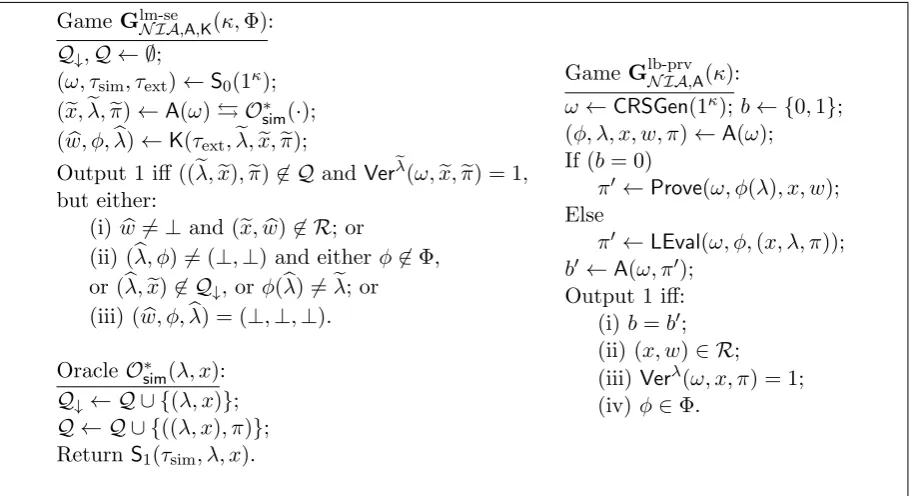
Game Glm-seN IA,A,K(κ,Φ): Q↓,Q ← ∅;
(ω, τsim, τext)←S0(1κ); (ex,λ,e π)e ←A(ω)O∗sim(·); (w, φ,b bλ)←K(τext,eλ,ex,π);e Output 1 iff ((λ,e
e
x),π)e 6∈ Qand Vereλ
(ω,x,e eπ) = 1, but either:
(i) wb6=⊥and (x,e w)b 6∈ R; or
(ii) (bλ, φ)6= (⊥,⊥) and eitherφ6∈Φ, or (λ,b x)e 6∈ Q↓, orφ(bλ)6=eλ; or (iii) (w, φ,b bλ) = (⊥,⊥,⊥). Oracle O∗
sim(λ, x):
Q↓← Q ∪ {(λ, x)};
Q ← Q ∪ {((λ, x), π)}; Return S1(τsim, λ, x).
GameGlb-prvN IA,A(κ):
ω←CRSGen(1κ);b← {0,1}; (φ, λ, x, w, π)←A(ω);
If (b= 0)
π0 ←Prove(ω, φ(λ), x, w); Else
π0 ←LEval(ω, φ,(x, λ, π)); b0 ←A(ω, π0);
Output 1 iff: (i)b=b0; (ii) (x, w)∈ R; (iii)Verλ(ω, x, π) = 1; (iv)φ∈Φ.
Figure 1: Games defining Φ-malleable label simulation extractability, and label simulation privacy, of a NIA N IA.
Definition 2 (Adaptive multi-theorem zero-knowledge). Let N IAbe a NIA for a relation R. We say that N IAsatisfies adaptive multi-theorem zero-knowledge if the following holds:
(i) There exists a PPT algorithm S0 that outputs a CRSω, and a simulation trapdoor τsim. (ii) There exist a PPT simulatorS1 and a negligible function ν :N→[0,1] such that, for all
PPT adversariesA, we have
P[A(ω)Oprv(ω,·) = 1 : ω←CRSGen(1
κ)]
−P[A(ω)Osim(τsim,·) = 1 : (ω, τsim)←S0(1κ)]
≤ν(κ).
In the above equation, both oraclesOprvandOsimtake as input a tuple (λ, x, w) and check
if (x, w)∈ R: If this is the case,Oprv returnsProveλ(ω, x, w), whereas Osimignoresw and
outputs a simulated argumentS1(τsim, λ, x); otherwise, both oracles return⊥.
Definition 3 (Φ-Malleable label simulation extractability). LetN IA be a NIA for a relation R, with label set Λ, and let Φ be a set of label transformations. We say thatN IAis Φ-malleable label simulation extractable (Φ-ml-SE for short) if the following holds.
(i) There exists a PPT algorithm S0 that outputs a CRS ω, a simulation trapdoorτsim, and an extraction trapdoor τext.
(ii) There exists a PPT algorithmK and a negligible functionν:N→[0,1] such that, for all
PPT adversariesA, we have
P
h
Glm-seN IA,A,K(κ,Φ)i≤ν(κ), where the gameGlm-seN IA,A,K(κ,Φ) is described in Fig.1.
The last property, called label derivation privacy, says that it is hard to distinguish a fresh proof for some statement x (with witness w) under label λ, from a proof re-randomized using algorithmLEvalw.r.t. some functionφ∈Φ; moreover, the latter should hold even if (x, w, λ, φ) are chosen adversarially (possibly depending on the CRS).
Definition 4 (Label derivation privacy). LetN IA be a NIA for a relationR, and let Φ be a set of label transformations. We say that N IA has label derivation privacy if for all PPT A there exists a negligible functionν :N→[0,1] such that
P
h
Glb-prvN IA,A(κ) = 1i− 1 2
≤ν(κ),
where gameGlb-prvN IA,A(κ) is described in Fig.1. 2.3 Public-Key Encryption
A public-key encryption (PKE) scheme is a tuple of algorithmsPKE = (Setup,KGen,Enc,Dec) defined as follows. (1) The (randomized) algorithmSetuptakes as input the security parameter 1κ and outputs public parameters ρ ∈ {0,1}∗; all algorithms are implicitly given ρ as input.
(2) The (randomized) algorithm KGen takes as input the public parameters ρ and outputs a public/secret key pair (pk,sk); the set of all secret keys is denoted by SK, and the set of all public keys byPK. Additionally, we require the existence of a (randomized) functionPKwhich, upon inputsk ∈ SK, produces a valid public keypk ∈ PK. (3) The (randomized) algorithmEnc takes as input the public keypk, a messagem∈ M, and randomnessr∈ {0,1}∗, and outputs a
ciphertext c=Enc(pk, m;r); the set of all ciphertexts is denoted by C. (4) The (deterministic) algorithm Dec takes as input the secret keysk and a ciphertext c, and outputsm=Dec(sk, c) which is either equal to some message m ∈ M, or to an error symbol ⊥. We will require two additional algorithms, the first one to re-randomize a given ciphertext, and the second one for re-randomizing the secret key (without changing the public key). More formally: (5) The (randomized) algorithm UpdateC takes as input a ciphertext c, and outputs a new ciphertext c0. (6) The (randomized) algorithmUpdateS takes as input a secret keysk, and outputs a new secret keysk0.
We say thatPKE satisfiescorrectnessif for allρ←Setup(1κ) and for all (pk,sk)←KGen(ρ), we have that P[Dec(UpdateS(sk),UpdateC(Enc(pk, m))) = m] = 1, where the randomness is
GameGclrsPKE,A(κ, `): b← {0,1};
ρ←Setup(1κ); (pk,sk)←KGen(ρ); (m0, m1)←A(ρ,pk); If (|m0| 6=|m1|)
m0 ←m1; c←Enc(pk, mb);
S0 ←sk;S1←c;
b0 ←(A(ρ,pk)Update(·),O∞((S0, S1),·)) Return (b0 =b).
Oracle Update(β): If (β = 0)
sk ←S0;
sk0 ←UpdateS(sk); S0 ←sk0;
If (β = 1) c←S1;
c0 ←UpdateC(c); S1 ←c0.
Figure 2: Game defining CLRS security of a PKE scheme.
We now turn to define continual leakage-resilient storage (CLRS) friendly PKE. Consider the gameGclrsPKE,A(κ, `) as defined in Fig.2. The definition below roughly say that a PKE scheme satisfies semantic security against all `-valid efficient adversaries that can observe independent leakage from S0=sk and S1=c(where cis the challenge ciphertext).
Definition 5 (CLRS friendly PKE). Forκ∈N, let`=`(κ) be the leakage parameter. We say that PKE = (Setup,KGen,Enc,Dec,UpdateC,UpdateS) is `-noisy CLRS friendly if for all PPT `-valid adversaries Athere exists a negligible function ν:N→[0,1] such that
P
h
GclrsPKE,A(κ, `) = 1
i −1
2
≤ν(κ),
where the gameGclrsPKE,A(κ, `) is described in Fig.2.
We observe that Definition5 is slightly different w.r.t. the definition of Dodiset al. [29]. In fact, on the one hand, our definition does not consider leakage from the update process, but, on the other hand, we consider noisy leakage and not just bounded leakage as in [29].
Finally, we introduce two extra properties relative to the algorithmsUpdateCandUpdateSof a PKE scheme. The first property says that the distributions of fresh and updated ciphertexts are the same. The second property formalizes a similar requirement for fresh and updated keys.
Definition 6 (Ciphertext-update privacy). We say that PKE is perfectly chipertext-update private if for all κ ∈ N, all ρ ← Setup(1κ), all (pk,sk) ← KGen(ρ), and any m ∈ M, c ∈ C such that c = Enc(pk, m;r) for some r ∈ {0,1}∗, the distributions {pk,Enc(pk, m)} and {pk,UpdateC(c)} are equivalent.
Definition 7 (Secret-key-update privacy). We say thatPKE isperfectly secret-key-update pri-vate if for all κ ∈ N, all ρ ← Setup(1κ), and all (pk,sk) ← KGen(ρ), the distributions {pk, UpdateS(sk)} and {(pk0,sk0)←KGen(ρ) : pk0 =pk}are equivalent.
2.4 Commitment Schemes
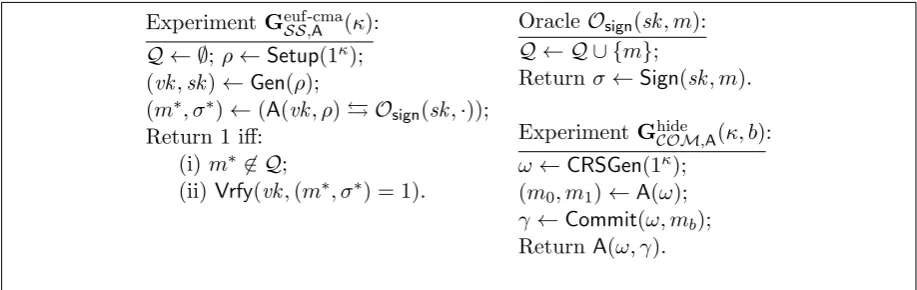
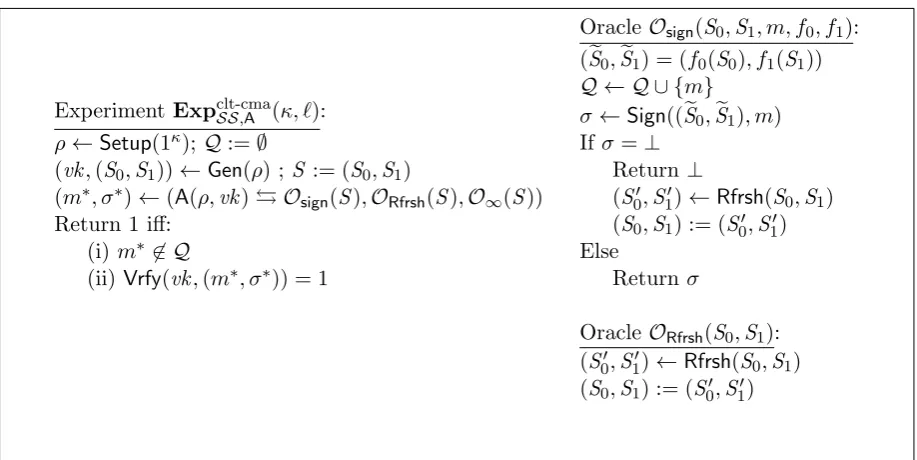
Experiment Geuf-cmaSS,A (κ): Q ← ∅;ρ←Setup(1κ); (vk,sk)←Gen(ρ);
(m∗, σ∗)←(A(vk, ρ)Osign(sk,·));
Return 1 iff: (i) m∗ 6∈ Q;
(ii)Vrfy(vk,(m∗, σ∗) = 1).
Oracle Osign(sk, m): Q ← Q ∪ {m};
Return σ←Sign(sk, m). Experiment GhideCOM,A(κ, b): ω ←CRSGen(1κ);
(m0, m1)←A(ω); γ ←Commit(ω, mb);
Return A(ω, γ).
Figure 3: Games defining computational hiding of a commitment scheme, and universal un-forgeability against chosen-message attacks of a signature scheme.
Commit takes as input the commitment keyω, a messagem∈ M, and randomnessr ∈ {0,1}∗, and outputs a commitment γ.
Intuitively a commitment scheme satisfies two properties. The first property, called the hiding property, says that the commitment hides the message; the second property, called the binding propertysays that it is hard to open a valid commitment in two different ways. Below, we define these properties directly in the flavor we need for our application.
Definition 8 (Hiding and binding). LetCOM= (CRSGen,Commit) be a commitment scheme. We say that COMis:
• Computationally hiding, if for all PPT adversaries A there exists a negligible function ν :N→[0,1] such that
|P
h
GhideCOM,A(κ,0) = 1i−PhGhideCOM,A(κ,1) = 1i
≤ν(κ),
where the gameGhideCOM,A is described in Fig.3.
• Statistically binding if for all even unbounded adversariesAthere exists a negligible func-tion ν:N→[0,1] such that:
P
Commit(ω, m;r) =Commit(ω, m0;r0)∧m6=m0 : ω←CRSGen(1
κ);
(m, r, m0, r0)←A(ω)
≤ν(κ).
2.5 Signature Schemes
A signature scheme is a tuple of algorithms SS = (Setup,KGen,Sign,Vrfy) defined as follow: (1) The (randomized) algorithm Setup takes as input the security parameter 1κ and outputs
public parameters ρ∈ {0,1}∗; all algorithms are implicitly givenρ as input. (2) The (random-ized) algorithm KGen takes as input the public parameters and outputs a verification/signing key pair (vk,sk). (3) The (randomized) algorithm Signtakes as input the secret key sk and a message m, and outputs a signature σ. (4) The (deterministic) algorithm Vrfy takes as input the verification keyvk and a pair (m, σ) and outputs a decision bit.
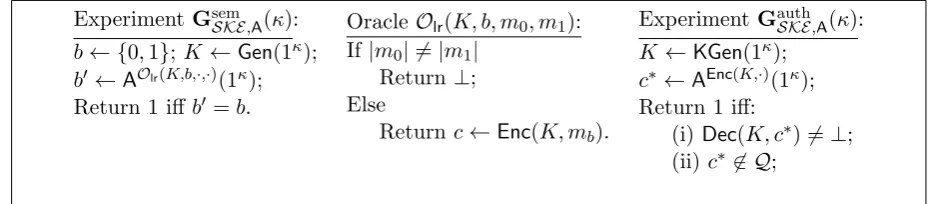
Experiment GsemSKE,A(κ): b← {0,1};K ←Gen(1κ); b0←AOlr(K,b,·,·)(1κ); Return 1 iff b0=b.
Oracle Olr(K, b, m0, m1): If|m0| 6=|m1|
Return ⊥; Else
Return c←Enc(K, mb).
Experiment GauthSKE,A(κ): K ←KGen(1κ);
c∗ ←AEnc(K,·)(1κ); Return 1 iff:
(i)Dec(K, c∗)6=⊥; (ii)c∗ 6∈ Q;
Figure 4: Games defining semantic security and authenticity of an SKE scheme; the set Q in the last game contains all ciphertexts returned by oracle Enc(K,·).
Definition 9 (EUF-CMA security). LetSS= (Setup,KGen,Sign,Vrfy) be a signature scheme. We say thatSS is existentially unforgeable against chosen-message attacks (EUF-CMA) if for all PPT adversariesA there exists a negligible functionν :N→[0,1] such that
P
h
Geuf-cmaSS,A (κ) = 1i≤ν(κ), where the gameGeuf-cmaSS,A (κ) is described in Fig.3.
2.6 Authenticated Encryption
A secret key encryption (SKE) scheme consists of three PPT algorithmsSKE := (KGen,Enc,Dec) specified as follows. (1) The (randomized) key generation algorithm KGen takes as input the security parameter 1κ, and outputs a key K; (2) The (randomized) encryption algorithm Enc takes as input a key K, a message m ∈ {0,1}∗, random coins r ∈ {0,1}∗, and outputs a ci-phertext c; (3) The (deterministic) decryption algorithm Dec takes as input a key K and a ciphertext c, and outputs a messagem or a special symbol⊥(indicating an error).
An SKE scheme meets correctness if for all keysKoutput byKGen(1κ), and for all messages
m ∈ {0,1}∗, we have that Dec(K,Enc(K, m)) =m with probability one over the random coin tosses of the encryption algorithm. As for security, we define two properties that make SKE a so-calledauthenticated encryption scheme.
Let Olr(K, b) be an oracle that, upon input two message m0, m1 ∈ {0,1}∗, returns c ← Enc(K, mb) if |m0| = |m1| (and ⊥ otherwise). The first property says that it is hard to dis-tinguish the encryption of two messages, even when given access to such an encryption oracle.
Definition 10. (Semantic security) An SKE scheme SKE = (KGen,Enc,Dec) is semantically secure if for all PPT adversariesA there is a negligible function ν:N→[0,1] such that
P
GsemSKE,A(κ) = 1− 1 2
≤ν(κ),
where the gameGsemSKE,A(κ) is described in Fig.4.
The second property says that SKE has an elusive range, meaning that, without knowing the secret key, it is hard to produce a valid ciphertext.
Definition 11. (Authenticity) An SKE scheme SKE = (KGen,Enc,Dec) satisfies authenticity if for all PPT adversariesA there is a negligible functionν :N→[0,1] such that
P
h
GauthSKE,A(κ) = 1
i
3
Non-Malleability with Refresh
3.1 Split-State Codes
A coding scheme in the CRS model is a tuple of polynomial-time algorithmsCS = (Init,Encode, Decode) with the following syntax: (1) The (randomized) initialization algorithm Init takes as input the security parameter 1κ, and outputs a CRS ω ∈ {0,1}∗; (2) The (randomized) encoding algorithm Encode takes as input the CRS ω and a message M ∈ M, and outputs a codeword C ∈ C; (3) The (deterministic) decoding algorithm Decode takes as input the CRS ω and a codeword C ∈ C, and outputs a value M ∈ M ∪ {⊥} (where ⊥ denotes an invalid codeword). A coding scheme is correct if for allωoutput byInit(1κ), and anyM ∈ M, we have
P[Decode(ω,Encode(ω, M)) = M] = 1, where the probability is taken over the randomness of
the encoding algorithm.
We consider coding schemes with an efficientrefreshing algorithm. Specifically, for a coding scheme CS we assume there exists a randomized algorithm Rfrsh that, upon input the CRS ω and a codeword C ∈ C, outputs a codeword C0 ∈ C. For correctness we require that for all ω output by Init(1κ), we have P[Decode(ω,Rfrsh(ω, C)) = Decode(ω, C)] = 1, where the
probability is over the randomness used by the encoding and refreshing algorithms.
Split-state model. In this paper we are interested in coding schemes in the split-state model, where a codeword consists of two parts that can be refreshed independently and without the need of any interaction. More precisely, given a codewordC:= (C0, C1), the refresh procedure Rfrsh(ω,(β, Cβ)), forβ ∈ {0,1}, takes as input either the left or the right part of the codeword,
and updates it. Sometimes we also write Rfrsh(ω, C) as a shorthand for the algorithm that independently executesRfrsh(ω,(0, C0)) andRfrsh(ω,(1, C1)).
Correctness here means that for all ω output by Init(1κ), for all C ∈ C, and for any β ∈
{0,1}, if we let C0 = (C00, C10) be such that Cβ0 ← Rfrsh(ω,(β, Cβ)) and C10−β = C1−β, then P[Decode(ω, C0) =Decode(ω, C)] = 1.
3.2 The Definition
We give the security definition for continuously non-malleable codes with split-state refresh (R-CNMCs for short). Our notion compares two experiments, which we denote by Tamper
andSimTamper(cf. Fig.5). Intuitively, in the experimentTamperwe consider an adversary continuously tampering with, and leaking from, a target encoding C = (C0, C1) of a message M ∈ M (the message can be chosen adaptively, depending on the CRS). For each tampering attempt (f0, f1), the adversary gets to see the output Mf of the decoding corresponding to the modified codeword Ce = (f0(C0), f1(C1)). Tampering is non-persistent, meaning that each tampering function is applied to the original codeword C, until, eventually, a decoding error happens; after that, the target encodingC is refreshed, and the adversary can start tampering with, and leaking from, the refreshed codeword.
In the experiment SimTamper, we consider a simulatorS = (S0,S1), where S0 outputs a simulated CRS, whileS1’s goal is to simulate the view of the adversary in the real experiment; the simulator S1, in faking a tampering query (f0, f1), is allowed to output a special value , signaling that (it believes) the adversary did not change the encoded message, in which case the experiment replaces with M. We stress that the simulator S is stateful; in particular algorithmsS0,S1 implicitly share a state.
TamperCS,A(κ, `, q):
i←0; err,stop←0 ω ←Init(1κ)
(M, s0)←A0(ω)
C0 := (C00, C10)←Encode(ω, M) For alli∈[0, q]:
si+1←(A1(si)O∞(Ci),Otamp(Ci))
Ci+1←Rfrsh(ω, Ci)
i←i+ 1;err,stop←0 Return A2(sq).
SimTamperA,S(κ, `, q): i←0
ω ←S0(1κ) (M, s0)←A0(ω) For alli∈[0, q]:
si+1←(A1(si)S1(Leak,·),OSsim tamp1,M (·))
i←i+ 1 Return A2(sq).
Oracle Otamp(Ci,(f0, f1)):
Upon (Tamp, f0, f1): f
M =Decode(ω, f0(C0i), f1(C1i)) If (Mf=⊥)
err←1
If ((err= 1)∨(stop= 1)) f
M ← ⊥ ReturnMf
Upon (Final, f0∗, f1∗):
stop←1 e
C∗= (f0∗(C0i), f1∗(C1i)) f
M∗ =Decode(ω,Ce∗) If (Mf∗ ∈ {⊥, M})
e
C0 ←Mf∗
Else,Ce0 ←Rfrsh(ω,Ce∗) ReturnCe0.
Oracle OS1,M
sim tamp(·):
Upon (Tamp, f0, f1): f
M ←S1(Tamp, f0, f1) If (Mf=)
f M ←M ReturnMf
Upon (Final, f0∗, f1∗): e
C0←S1(Final, f0∗, f1∗)
If ((Ce0=)∨(Decode(ω,Ce0) =M)) e
C0 ←M ReturnCe0
Figure 5: Experiments defining continuously non-malleable codes with split-state refresh.
corresponding tampered codeword Ce∗ is valid and is not an encoding of the original message M, the attacker receives a refreshing ofCe∗; otherwise it obtains either M (in the former case) or⊥ (in the latter case). Unfortunately, it is impossible to further generalize our definition to handle the refreshing of invalid codewords.7
Definition 12 (Continuous non-malleability with split-state refresh). Forκ ∈N, let `=`(κ) be a parameter. We say that a coding scheme CS is an `-leakage-resilient and continuously non-malleable code with split-state refresh (R-CNMC for short) if for all adversaries A := (A0,A1,A2), whereA0 and A2 are PPT algorithms and A1 is an`-valid (cf. Section 2.1) deter-ministic polynomial-time algorithm, there exists a PPT simulatorS= (S0,S1) and a negligible
7
This can be seen by the following attack. Consider an adversary that computes offline a valid codeword (C0, C1), and then makes two extra tampering queries (at the end of two subsequent rounds, say,iandi+ 1)
such that the first query overwrites (C0i, C1i) with (C0i, C1), and the second query overwrites (C0i+1, C
i+1 1 ) with
(C0, C1i+1); by combining the refreshed codewords obtained as output, the adversary gets a refreshing of the
functionν :N→[0,1] such that, for any polynomial q(κ), the following holds:
P
TamperCS,A(κ, `, q) = 1 −P
SimTamperA,S(κ, `, q) = 1
≤ν(κ),
where the experimentsTamperCS,A(κ, `, q) and SimTamperA,S(κ, `, q) are defined in Fig.5.
We note that in theTamper security game the adversary does not have “direct” access to a refreshing oracle (namely, an oracle that, upon request, would refresh the codeword). This choice is without loss of any generality, as a call to the refreshing oracle can always be simulated by a tampering query yielding an invalid codeword (which indeed triggers a refreshing in our experiment).
4
Code Construction
Let PKE = (Setup,KGen,Enc,Dec,UpdateC,UpdateS) be a CLRS friendly PKE scheme, with secret-key space SK. Let COM = (CRSGen,Commit) be a commitment scheme in the CRS model. Consider the following NP-relations, parameterized by the PKE and the commitment scheme, respectively:
R0 :={(pk,sk) : pk =PK(sk),sk ∈ SK}, R1 :={((ω, γ),(M, r)) : γ =Commit(ω, M;r)}. Let Φ0 and Φ1 be two sets of label transformations defined below:
Φ0 :={φ: ∃pk,sk s.t. (∀m, r) Dec(sk, φ(Enc(pk, m;r))) =m,pk =PK(sk)} Φ1 :={φ: (∀sk) PK(sk) =PK(φ(sk))}.
Notice thatR0,R1,Φ0and Φ1are implicitly parameterized by the public parametersρ∈ {0,1}∗ of the PKE scheme. Finally, letU0 andU
1 be the following sets of label transformations: U0 :={UpdateC( ·;ru) : ru ∈ {0,1}∗}
U1 :={UpdateS(·;ru) : ru ∈ {0,1}∗}.
It is easy to verify thatUβ ⊆Φβ, forβ ∈ {0,1}. In fact, forβ = 0, by the correctness of the PKE
scheme, there exists sk such that P[Dec(sk,UpdateC(Enc(pk, m))) =m] = 1 andpk =PK(sk);
similarly, for β= 1, again by correctness of the PKE scheme, for anysk0 ←UpdateS(pk,sk) we have thatPK(sk) =PK(sk0).
Scheme description. LetN IA0 = (CRSGen0,Prove0,Vrfy0,LEval0) andN IA1 = (CRSGen1, Prove1,Vrfy1,LEval1) be NIAs for the above defined relations R0 and R1. Our code CS = (Init,Encode,Decode) works as follows.
• Init(1κ): Forβ ∈ {0,1}, sampleω
β ←CRSGenβ(1κ),ω←CRSGen(1κ), andρ←Setup(1κ).
Return ω= (ω0, ω1, ω, ρ).
• Encode(ω, M): Parse ω := (ω0, ω1, ω, ρ), sample (pk,sk) ← KGen(ρ), and r ← {0,1}∗. Compute c ← Enc(pk, M||r), γ = Commit(ω, M;r), and π0 ← Provec0(ω0,pk,sk), and π1 ← Provesk1 (ω1,(ω, γ),(M, r)). Set C0 := (pk, c, π0) and C1 := (sk, γ, π1), and return C:= (C0, C1).
I. Left check: Verc0(ω0,pk, π0) = 1. II. Right check: Versk1 (ω1,(ω, γ), π1) = 1. III. Cross check: Commit(ω, M;r) =γ.
• Rfrsh(ω,(β, Cβ)): Parseω := (ω0, ω1, ω, ρ), C0:= (pk, c, π0), andC1 = (sk, γ, π1). Hence:
– For β = 0, pick r0upd ← {0,1}∗, let c0 := UpdateC(c;r0upd) and π00 ← LEval0(ω0, UpdateC(·;r0
upd),(pk, c, π0)), and returnC
0
0 := (pk, c0, π00).
– For β = 1, pick rupd1 ← {0,1}∗, let sk0 := UpdateS(sk;r1
upd), and π01 ← LEval1(ω1, UpdateS(·;rupd1 ),((γ, ω),sk, π1)), and returnC10 := (γ,sk0, π10).
Theorem 1. Let PKE be a PKE scheme with message space Mpke and public-key space PK, let COM be a commitment scheme with message space M, and let N IA0 (resp. N IA1) be a NIA w.r.t. the relations R0 (resp. R1). Define µ(κ) := log|M|, µpke(κ) := log|Mpke|, and δ(κ) := log|PK|.
For any `∈N, assuming that PKE is an(`+ 3µ+ 2κ+ max{δ, µpke})-noisy CLRS-friendly PKE scheme (cf. Definition5), thatCOMis a non-interactive statistically binding commitment scheme, and thatN IA0 (resp.N IA1) satisfies adaptive multi-theorem zero-knowledge (cf. Def-inition 2), Φ0-malleable (resp. Φ1-malleable) label simulation extractability (cf. Definition 3), and label derivation privacy (cf. Definition4), then the coding schemeCS described above is an `-leakage-resilient continuously non-malleable code with split-state refresh.
4.1 Proof Intuition
The proof of the above theorem is quite involved. We provide some highlights here. Consider a simulator (S0,S1), whereS0 simulates a fake CRSω= (ω0, ω1, ω, ρ) by additionally sampling the corresponding zero-knowledge and extraction trapdoors for the NIAs (which are then passed to S1). At the core of our simulation strategy are two algorithms T0 and T1, whose goal is essentially to emulate the outcome of the real tampering experiment, with the important difference thatT0 is only given the left part of a (simulated) codewordC0 and the left tampering functionf0, whereas T1 is given (C1, f1).
The simulatorS1 then works as follows. Initially, it samples a fresh encoding (C0, C1) of 0µ. More in details, the fresh encoding comes from the (computationally close) distribution where the proofsπ0 andπ1 are simulated proofs. At the beginning of each round, it runs a simulated refresh procedure in which the ciphertextcis updated viaUpdateC(and the simulated proofπ0 is re-computed using fresh randomness), and similarly the secret keysk is updated viaUpdateS (and the simulated proofπ1is re-computed using fresh randomness). Hence, for each tampering query (f0, f1), the simulator S1 runs M0f :=T0(C0, f0), M1f :=T1(C1, f1), and it returns M0f as long as⊥ 6=M0f =M1f 6=⊥(and⊥otherwise). The extra tampering query (f0∗, f1∗) is simulated similarly, based on the outcome of the tampering simulators (T0,T1). We briefly describe the tampering simulators T0 and T1:
• AlgorithmT0 letsf0(C0) := (fpk, e
c,eπ0). If the proofπ0e does not verify, it returns⊥. Else, if (fpk,ec,eπ0) = (pk, c, π0), it returns . Else, it extracts the proof eπ0, this leads to two possible outcomes:8
(a) The extractor outputs a secret keyskb which is used to decrypt ec, and the tampering simulator returns the corresponding plaintextMf.
8The above description is simplified, in that extraction could potentially fail, however, this happens only with
(b) The extractor outputs a transformationφwhich maps the label of the simulated proof π0, namely the encryption of 0µ, to ec. In this case the tampering function f0 has modified the original ciphertextc to the mauled ciphertextecwhich is an encryption of the same message, so the tampering simulator returns.
• AlgorithmT1 letsf1(C1) := (γ,e ske,πe1). If the proofeπ1 does not verify, it returns ⊥. Else, if (eγ,ske,eπ1) = (γ,sk, π1), it returns. Else, it extracts the proofπ1, again, this leads toe two possible outcomes:
(a) The extractor outputs the committed messageMf(along with the randomness of the commitment), so the tampering simulator can simply return M.f
(b) The extractor outputs a transformation φ which maps the label of the simulated proofπ1, namely the original secret keysk, to the mauled secret keyske. In this case, the mauled proofπe1 must be a valid proof whose instance is the original commitment, and so, once again, the tampering simulator returns .
To show that the above simulator indeed works, we use a hybrid argument where we incremen-tally change the distribution of the ideal tampering experiment until we reach the distribution of the real tampering experiment. Each step introduces a negligible error, thanks to the security properties of the underlying building blocks. Perhaps, the most interesting step is the one where we switch the ciphertext cfrom an encryption of zero to an encryption of the real message (to which we always have to append the randomness of the commitment); in order to show that this change is unnoticeable, we rely on the CLRS storage friendly security of the PKE scheme. In particular, this step of the proof is based on the following observations:
• The reduction can perfectly emulate the distribution of the CRS ω, and of all the ele-ments (pk, π0, γ, π1), except for (c,sk). However, by outputting (0µ||r, M||r) as challenge plaintexts—where r ∈ {0,1}∗ is the randomness for the commitment—the reduction can obtain independent leakages from C0 and C1 with the right distribution.
• Refresh of codewords can also be emulated by exploiting the fact that the reduction is allowed to update the challenge secret key and ciphertext.
• The reduction can answer tampering queries from the adversary by using T0 and T1 as leakage functions. The main obstacle is to ensure thatT0 andT1 are`-leaky, where`∈N is the leakage bound tolerated by the PKE scheme. In particular, between each refresh, the reduction needs to interleave the executions ofT0 and T1 until their outputs diverge. Leti∗ be the number of tampering queries that the simulator performs until triggering a decoding error. The leakage that the reduction needs to perform during this stage (namely, between two consecutive refreshes) is T0(C0, f00),T1(C1, f10), . . . ,T0(C0, f0i∗),T1(C1, f1i∗) where (f00, f10), . . . ,(f0i∗, f1i∗) is the list of tampering functions chosen by the adversary. We have:
e
H∞(C0|T0(C0, f00), . . . ,T0(C0, fi
∗
0 )) = e
H∞(C0|T1(C1, f10), . . . ,T1(C1, fi
∗−1
1 ),T0(C0, fi
∗
0 )).
In fact, the output ofT0(C0, f0i) andT0(C0, f0i) is, by definition, exactly the same whenever i < i∗. Moreover, since the output of a function cannot be more informative than its own inputs,
e
H∞(C0|T1(C1, f10), . . . ,T1(C1, fi
∗−1
1 ),T0(C0, fi
∗
0 ))≥ e
H∞(C0|C1, i∗,T0(C0, fi
∗
Lastly, we will use the fact thatC1 reveals only little information aboutC0(a requirement met by known schemes), and further thati∗ andT0(C
0, fi
∗
0 ) can decrease the min-entropy of C0 of at most their size, which is O(κ). The reduction, therefore, defines a valid adversary in the CLRS storage-friendly security experiment of the PKE.
Remark 1 (On the refreshing procedure). The feature of split-state refresh does not require that a refreshed codeword be indistinguishable from a freshly sampled one. And, indeed, this is not the case in our construction, as the public key pk (resp. the commitment γ) do not change after the refreshing algorithms are executed. However, the latter property is not required for our proof, as the only thing that matters is that the information about the target codeword that an adversary gathers before a refresh takes place will not be useful after the refresh. Put differently, the adversary could potentially leak the entire values pk and γ, but this information would not be useful for breaking the security of our scheme.
4.2 Description of the Simulator
LetS0 := (S00,S01) andS1 := (S10,S11) be the zero-knowledge simulators for the NIAsN IA0 and N IA1, respectively. We start by defining the simulatorS0, whose goal is to simulate the CRS generation for the encoding scheme. Briefly, S0 samples the keys for the PKE scheme and the commitment scheme, and generates an encoding of a dummy message by using simulated proofs in place of real proofs.
SimulatorS0(1κ):
• Forβ ∈ {0,1} sample (ωβ, τsimβ , τextβ )←S
β
0(1κ). • Pick ω←CRSGen(1κ) and ρ←Setup(1κ). • Define τ∗:= (τsim0 , τext0 , τsim1 , τext1 ).
• Sample r ← {0,1}∗, let γ := Commit(ω,0µ;r), and compute c ← Enc(pk,0µkr), where µ∈Nis the bit-length associated to the message space Mfor the commitment scheme. • LetC:= ((pk, c, π0),(γ,sk, π1)) := (C0, C1), whereπ0←S01(τsim0 , c,pk) andπ1 ←S11(τsim1 ,
sk,(γ, ω)).
• Outputω:= (ω0, ω1, ω, ρ) and auxiliary information α:= (τ∗,(C0, C1)).
We also define a simulated refresh algorithm, which will be used in the simulation in place of the original refresh mechanism.
Algorithm Rfrsh∗((τsim0 , τsim1 ),(β, Cβ)):
• For β = 0, parse C0 := (c,pk, π0), compute c0 ← UpdateC(c) and π00 ← S01(τsim0 , c0,pk), and return C00 := (pk, c0, π00).
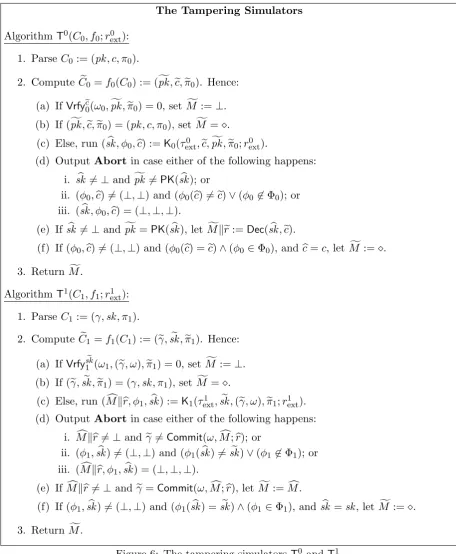
The Tampering Simulators
Algorithm T0(C0, f0;rext0 ): 1. ParseC0 := (pk, c, π0).
2. Compute C0e =f0(C0) := (fpk,ec,eπ0). Hence: (a) IfVrfyec
0(ω0,pkf,eπ0) = 0, set Mf:=⊥. (b) If (fpk,ec,eπ0) = (pk, c, π0), set Mf=.
(c) Else, run (skb, φ0,bc) :=K0(τext0 ,ec,fpk,π0;e r0ext).
(d) OutputAbortin case either of the following happens: i. skb 6=⊥and pkf 6=PK(skb); or
ii. (φ0,bc)6= (⊥,⊥) and (φ0(bc)6=ec)∨(φ06∈Φ0); or iii. (skb, φ0,bc) = (⊥,⊥,⊥).
(e) Ifskb 6=⊥and pkf=PK(skb), letMkf e
r:=Dec(skb, e c).
(f) If (φ0,bc)6= (⊥,⊥) and (φ0(bc) =ec)∧(φ0 ∈Φ0), andbc=c, letMf:=. 3. Return M.f
Algorithm T1(C1, f1;rext1 ): 1. ParseC1 := (γ,sk, π1).
2. Compute C1e =f1(C1) := (eγ,ske,eπ1). Hence: (a) IfVrfyske
1 (ω1,(eγ, ω),eπ1) = 0, set Mf:=⊥. (b) If (eγ,ske,
e
π1) = (γ,sk, π1), set Mf=. (c) Else, run (Mkc br, φ1,skb) :=K1(τext1 ,ske,(
e
γ, ω),πe1;r1ext). (d) OutputAbortin case either of the following happens:
i. Mkc rb6=⊥and eγ 6=Commit(ω,Mc;br); or
ii. (φ1,skb)6= (⊥,⊥) and (φ1(skb)6=ske)∨(φ1 6∈Φ1); or iii. (Mckbr, φ1,skb) = (⊥,⊥,⊥).
(e) IfMckbr6=⊥and eγ =Commit(ω,M;c br), letMf:=M.c
(f) If (φ1,skb)6= (⊥,⊥) and (φ1(skb) =ske)∧(φ1 ∈Φ1), andskb =sk, let Mf:=. 3. Return M.f
Figure 6: The tampering simulators T0 and T1.
The tampering simulators. We now turn to defining the simulator S1. To facilitate the description, in Fig.6, we formalize two algorithms that we call the tampering simulators. Intu-itively, forβ ∈ {0,1}, algorithmTβ simulates the outcome corresponding to a tampering query (f0, f1) from the adversary, by using onlyCβ (i.e., one piece of the simulated codeword). On a
very high level, as long as both T0 and T1 return the same message Mf, the simulator S1 uses f
it emulates a decoding error. SimulatorS1:
1. Parse α := ((τsim0 , τext0 , τsim1 , τext1 ),(C0, C1)) := (τ∗, C), and run Rfrsh∗((τsim0 , τsim1 ), C). Set the flagerr←0.
2. Hence, upon a command from the adversary, behave as follows.
(a) Upon input a leakage query (Leak, β, gβ), forβ ∈ {0,1}, returny :=gβ(Cβ).
(b) Upon input a tampering query (Tamp,(f0, f1)), if err = 1 return ⊥. Otherwise, let M0f ← T0(C0, f0) and M1f := T1(C1, f1). If either of the tampering simulators returnedAbort, abort the simulation outputting the special valueAbort. If either
f
M0=⊥, orMf1 =⊥, return⊥and set err←1; else, return Mf:=Mf0=Mf1. (c) Upon input the extra tampering query (Final,(f0∗, f1∗)), let Mf0∗ := T0(C0, f0∗;r0ext)
andMf1∗ :=T1(C1, f1∗;r1ext), for randomrext0 , r1ext ← {0,1}∗. If either of the tampering simulators returnedAbort, abort the simulation outputting the special valueAbort. If either Mf0∗ 6=Mf1∗, orMf0∗=⊥, orMf1∗ =⊥, return⊥. Otherwise, if Mf0∗=Mf1∗ =, return. Else, proceed as follows:
i. Let Ce0∗:=f0∗(C0) := (pkf,ec,eπ0) and Ce1∗ :=f1∗(C1) := (eγ,ske,eπ1).
ii. Extract the values (skb0, φ0,bc0) :=K0(τext0 ,ec,pkf,π0e ;rext0 ), and letsk0 =UpdateS(skb0). iii. Extract the values ((M ,c r), φ1,b skb1) := K1(τext1 ,ske,(eγ, ω),eπ1;r1ext), and compute
c0←Enc(pkf,Mckbr).9 iv. Runπe
0
0←S01(τsim0 , c0,pkf) and eπ10 ←S11(τsim1 ,sk0,(eγ, ω)). v. Output Ce0:= ((fpk, c0,πe00),(eγ,sk0,eπ10)).
3. Go back to step1 until the adversary is done with its queries. 4.3 Hybrids
We define a sequence of games, starting with the simulated experimentSimTamperA,S(κ, `, q) for the above defined simulatorS= (S0,S1). The games are described in an incremental manner, meaning that for each game we only highlight the differences with the previous game, implicitly assuming that all other steps are unchanged. Each game is parameterized by the adversary A and, implicitly, by a simulator that is typically derived by the original simulatorS.
Game G0A(κ). This game is identical toSimTamperA,S(κ, `, q), for the above defined simula-torS= (S0,S1).
Game G1
A(κ). The simulator S0 is additionally givenM as input, and computes the
commit-ment in the simulated codeword (C0, C1) as γ =Commit(ω, M;r), for r← {0,1}∗.
Game G2A(κ). The simulator S0 computes the ciphertext in the simulated codeword (C0, C1) asc←Enc(pk, Mkr).
Game G3A(κ). The simulatorS1 keeps track of all the ciphertexts and secret keys contained in each dummy encoding computed in step1. Namely, for eachi∈[q], it letsα ←αk(ci,ski),
whereci,ski are, respectively, the ciphertext and the secret key as obtained by refreshing
the initial encodingC using procedure Rfrsh∗. 9Note that the extractorsK
0andK1are run, respectively, using the same random coins on which the tampering
Game G4A(κ). For each round i ∈ [q], the tampering simulators T0 and T1 are modified as follows (cf. Fig. 6):
T0 = (C0, f0):
• The check at step 2(d)iibecomes (φ0,bc)6= (⊥,⊥) and (φ0(bc)6=ec)∨(φ0 6∈Φ0)∨(bc6∈ {c1, . . . , ci−1}).
• The simulator additionally setsMf= at step2b ifec∈ {c1, . . . , ci−1}. T1 = (C1, f1):
• The check at step 2(d)ii becomes (φ1,skb) 6= (⊥,⊥) and (φ1(skb) 6= ske)∨ (φ1 6∈ Φ1)∨(skb 6∈ {sk1, . . . ,ski−1}).
• The simulator additionally setsMf= at step2b ifske ∈ {sk1, . . . ,ski−1}.
Game G5A(κ). We change the way tampering queries for which the simulator returns are treated. In particular,
• For each query (Tamp,(f0, f1)) such that S1 outputs Mf = , we treat this query exactly as in the real experiment (i.e., we apply (f0, f1) to the target encoding and decode the resulting codeword).
• For each query (Final,(f0∗, f1∗)) such that S1 outputs, we treat this query exactly as in the real experiment (i.e., we apply (f0∗, f1∗) to the target encoding and decode the resulting codeword).
Game G6A(κ). We change the way tampering queries for which the simulator returns a value which is not in{⊥,}are treated. In particular,
• For each query (Tamp,(f0, f1)) such that S1 outputs Mf = Mf0 =Mf1, we treat this query exactly as in the real experiment (i.e., we apply (f0, f1) to the target encoding and decode the resulting codeword).
• For each query (Final,(f0∗, f1∗)) such thatS1outputs a codewordCe0 that is valid but does not decode toM, we treat this query exactly as in the real experiment (i.e., we apply (f0∗, f1∗) to the target encoding and decode the resulting codeword).
Game G7
A(κ). This game is identical to the previous one, except that the tampering simulators
T0andT1do not perform the check in step2d, i.e. in gameG7A(κ) the tampering simulators never outputAbort(and so does S1).
Game G8A(κ). We change the way tampering queries for which the simulator returns ⊥ are treated. In particular,
• For each query (Tamp,(f0, f1)) such that S1 outputs Mf = ⊥, we treat this query exactly as in the real experiment (i.e., we apply (f0, f1) to the target encoding and decode the resulting codeword).
• For each query (Final,(f0∗, f1∗)) such thatS1 outputs⊥, we treat this query exactly as in the real experiment (i.e., we apply (f0∗, f1∗) to the target encoding and decode the resulting codeword).
Game G10A (κ). We change the way the codeword Ce1∗ corresponding to the extra tampering query is computed in each round. Namely, instead of running the extractorK1 and letting c0 ← Enc(pk,Mkc r) (whereb Mckbr is the extracted message/randomness), we directly let c0 ←UpdateC(ec).
Game G11A (κ). We setup the CRS differently. Namely, we change the distribution of ω0 as in ω0 ← CRSGen0(1κ). Moreover, the simulator S1 always runs the prover algorithm Prove0 instead of the zero-knowledge simulator S01. (Observe that this happens in three different steps: (i) When the original codeword (C0, C1) is computed; (ii) Whenever S1 runs algorithmRfrsh∗ at the beginning of each round; (iii) WheneverS1 needs to answer the extra tampering query.)
Game G12A (κ). We setup the CRS differently. Namely, we change the distribution of ω1 as in ω1 ←CRSGen1(1κ). Moreover, the simulator S1 always runs the prover algorithm Prove1 instead of the zero-knowledge simulatorS11. (Once again, this happens in the exact same cases as in the previous game.)
Game G13A (κ). We change the way a codeword is refreshed. Namely, instead of computing π00 ← Provec00(ω0,pk,sk) via the prover algorithm, we now run the label evaluation pro-cedure as done by the real refresh algorithm. The same modification affects the way the proof π00 is computed during each of the extra tampering queries (f0∗, f1∗).
Game G14A (κ). We change the way a codeword is refreshed. Namely, instead of computing π10 ←Provesk1 0(ω1,(ω, γ),(M, r)) via the prover algorithm, we now run the label evaluation procedure as done by the real refresh algorithm. The same modification affects the way the proofπ10 is computed during each of the extra tampering queries (f0∗, f1∗).
Notice that in game G14A(κ), the “simulator” S1 computes an encoding of the message M. Moreover, tampering queries are always answered by decoding the modified codeword, and code-words are refreshed exactly as in the real experiment. Thus, G14A (κ) and TamperCS,A(κ, `, q)
are identically distributed.
4.4 Indistinguishability of the Hybrids
We now prove that the above defined games are computationally indistinguishable. Together with the fact that the last game is identically distributed to the real tampering experiment, this implies Theorem 1.
Lemma 3. For all PPT adversaries A there exists a negligible function ν0,1 :N→ [0,1] such
thatP
G0A(κ) = 1−PG1A(κ) = 1≤ν0,1(κ).
Proof sketch. The proof is down to the hiding property of the commitment scheme (cf. Defini-tion8). Since the reduction is straightforward, we only highlight the main ideas here and leave the details to the reader.
Assume there exists a PPT adversary A and a polynomial p0,1(·) such that, for infinitely many values of κ ∈ N, we have P
G0A(κ) = 1−P
G1A(κ) = 1 ≥ 1/p0,1(κ). We construct a PPT adversary B (with black-box access to A), that is playing either GhideCOM,B(κ,0) or
GhideCOM,B(κ,1). Roughly,B works as follows:
• Run A0(ω), obtaining a message M. Forward (0µ, M) to the challenger, receiving back a commitmentγ.
• Sample the simulated codeword (C0, C1) exactly as S0 would do it, except that the com-mitment is set to be equal toγ from the game.
• Continue running Aand answer its queries exactly as S1 would do it. • Return the same output as that of A.
It is immediate to see that ifBis playing GhideCOM,B(κ,0), then the view ofAwhen running as a sub-routine ofBis identical to the view in gameG0A(κ); similarly, ifBis playingGhideCOM,B(κ,1), then the view of Awhen running as a sub-routine ofBis identical to the view in game G1A(κ). Hence,B retains the same advantage ofA, concluding the proof of the lemma.
Lemma 4. For all PPT adversaries A there exists a negligible function ν1,2 :N→ [0,1] such
thatP
G1A(κ) = 1−PG2A(κ) = 1≤ν1,2(κ).
Proof. The proof is down to the fact that PKE is an `-noisy CLRS friendly PKE scheme. By contradiction, assume there exists a PPT adversary A and a polynomial p1,2(·) such that, for
infinitely many values of κ ∈ N, we have P
G1A(κ) = 1 −P
G2A(κ) = 1
≥ 1/p1,2(κ). We construct a PPT adversaryB(with black-box access toA), that is playing gameGclrs
PKE,B(κ, `
00),
with`00:=`0−2κ, and `0 as in the statement of Theorem1. A formal description of Bfollows. AdversaryB:
1. Receive (ρ,pk) from the challenger. For all β ∈ {0,1}, sample (ωβ, τsimβ , τextβ ) ← S
β
0(1κ), and ω←CRSGen(1κ). Let ω= (ω0, ω1, ω, ρ) and τ∗ = (τsim0 , τext0 , τsim1 , τext1 ).
2. Run A0(ω), obtaining a message M ∈ M. Forward (0µkr, Mkr) to the challenger, for
r← {0,1}∗, and let γ :=Commit(ω, M;r).
3. Repeat the following, until Ais done with its queries.
(a) Query Update(0) andUpdate(1), sample uniform coins r0, r1 ← {0,1}∗, and set the flag err←0.
(b) Upon input (Leak, β, gβ), forward (β, gβ) to the target leakage oracle, receiving back
a value y; send y toA.
(c) Upon input (Tamp,(f0, f1)), answer this query exactly as S1 would do, except that the valuesM0f andM1f are obtained, respectively, via queries (0, g0) and (1, g1) to the target leakage oracle, where the functions g0, g1 are defined as follows:
g0(·) :=T0((pk,·,S01(τsim0 ,·,pk;r0), f0) (1) g1(·) :=T1((γ,·,S11(τsim1 ,·,(γ, ω);r1), f1). (2) (Notice that the above might eventually lead to set the flag err←1.)
(d) Upon input (Final,(f0∗, f1∗)), answer this query exactly as S1 would do, except for the following differences.