Available Online atwww.ijcsmc.com
International Journal of Computer Science and Mobile Computing
A Monthly Journal of Computer Science and Information Technology
ISSN 2320–088X
IMPACT FACTOR: 6.017
IJCSMC, Vol. 7, Issue. 7, July 2018, pg.105 – 111
Improved Fish Swarm Algorithm for Path
Establishment in Vehicular Ad hoc Networks
Gaganpreet Kaur Chahal
1, Manpreet Singh
21
North West Institute of Engineering and Technology, Dhudike, Moga, Punjab, India
2
North West Institute of Engineering and Technology, Dhudike, Moga, Punjab, India
1
[email protected]; 2 [email protected]
Abstract- The vehicular ad hoc network is the type of ad hoc network in which vehicles move freely and communicate with each other. In vehicular ad hoc networks two type of communication is possible, i.e.: vehicle to vehicle and vehicle to infrastructure communication. In vehicle to infrastructure communication, vehicles communicate with road side units and in V2V communication vehicles communicate with each other. As vehicle nodes have higher mobility due which some prediction based technique are proposed in previous times for path establishment. Among proposed prediction based techniques, location audit routing is proposed which is based location is estimated and routing can be done in the network. In this work, improvement will be proposed in fish swarm technique for efficient path establishment between source and destination. This will leads to reduce delay and improve network throughput.
Keywords: Fish Swarm, Multicasting, Path Establishment
I. INTRODUCTION
dynamic networks are however, not fulfilled by these standard because they are general purpose standards. VANET is a highly dynamic network and so these standards are of no much use to it due to their small sizes. The DSRC (Dedicated short-range communication) is all set to be introduced in this type of network which works as a communication standard in VANETs. It is only used at the platforms where there is involvement of short or medium range of communication services and they also have low latency and high data rate. There is a fixed restricted area for the purpose of communication of vehicles in VANETs by using the IEEE 802.11 standard. However, the new standards provide an aim to increase the successful data packet exchange and also provide reduction in the transmission time. The network usage here is also reduced too much extent [2]. The sub-class of the mobile ad hoc networks is the vehicular ad hoc networks which differentiate the approach which hold the transport system. Each vehicle has to have this important facility. There are large numbers of low-cost small sized devices known as nodes deployed in the sensor networks. The base station is sent the information from all the nodes in the network. In a sensor network, there are large numbers of small, inexpensive, self powered devices deployed. These devices have the properties of sensing, figuring and communicating with various devices and aim to collect information from the network.For the purpose of ensuring the delivery of packets from the sender to destination, the routing protocol is made to run through the network. Within the memory of the network a routing table is maintained. There are three broader categories of the routing table which are the proactive, reactive and the hybrid. In the reactive protocol additionally called an on demand routing protocol. In the reactive protocol, topology data is given only when required [3]. A route request message is flood to the network when the node has to acknowledge the route to destination node in the network. There is a proper control of the traffic along with the message bursts during the packet routing. The route is not immediately accessible so there is an additional delay seen in the network.There is a periodic exchange of the topology control messages of the network in the proactive protocol usage. The routing tables are designed again and the traffic control needs more routes accessing due to all such reasons. Hybrid protocol has the both properties of reactive and proactive in nature. Network divide into various regions like inside it's near neighborhood regions and outside this region. There are two types ZRP (zone routing protocol) and CBRP (cluster based routing protocol). The vehicular communications are made to be more challenging due to the fact that there are various characteristics of the location based routing protocols [4]. The networks are divided into three broad categories which are cellular, ad hoc and hybrid. Infotainment which includes latest new, or the information of the locality, is supported by the cellular network. The vehicle to infrastructure model is the basis of this category. A wide range of vehicular applications are supported by the present infrastructure. There is however, still a need of a fixed infrastructure deployment due eliminate the drawbacks found. The ad hoc networks which do not require any prior infrastructure help in reducing the drawbacks identified. This is more prominent in the vehicle to vehicle communication. However, due to the network partitioning, routing link failures as well as the rapid topology changes, the network faces many challenges. The access points are deployed along the road in the network as a solution to the problems notified [5]. In networks where there is no issue regarding the energy consumption also, this solution is opted. In the case of hybrid communication, there is a centralized architecture based cellular network in which the traffic information is gathered from the road with the help of access points. The acquired information is processed by the access points and is used by the drivers as per the requirement. In the traditional routing protocols, the performance of the network is degraded by the dynamic nature of the vehicular communication, the high speed of the vehicles as well as their mobility. The issues of the mobile ad hoc network are highlighted by the traditional ad hoc routing protocols [6]. These are applicable for the MANETs due to the fact that they lack the high mobility and dynamic nature which is present in vehicular communication. The position-based routing protocols have proved to be more prominent for the highly dynamic and mobile networks.
II. LITERATURE REVIEW
Rakesh Kumar and Mayank Dav (2012) represent a paper based on the VANET vehicular ad-hoc networks are upcoming
Rakesh Kumar, Mayank Dave represents a paper in (2011) on vehicular ad-hoc network is subclass of mobile ad-hoc network which provide a distinguished for intelligent transport system (ITS). According to the survey it is very necessary to use the ITS with the help of VANET routing protocol. In paper also discuss the advantage and disadvantages, applications of different routing protocols for vehicular ad-hoc networks. This paper also explores the motivation behind the designed and traces the evolution of this routing protocol. At last this paper also show the tabular comparison with various routing protocols for VANET [8].
Aswathy M and Tripti represent a paper in (2012) on vehicular ad-hoc network are special kind of mobile ad-hoc network (MANET). This paper defines the vehicles on road as nodes of network. With the help of VANET give us many applications as an intelligent transportation system. In the dynamic network architectures and node movement characteristics differentiates VANETs from other kind of ad-hoc networks. AODV (ad-hoc on demand distance vector) mostly used in the topology based routing protocol for VANET. During the process of route discovery process AODV broadcast route message (RREQ). This paper main aim to improving the performance of AODV by enhancing the existing protocol by creating stable clusters and performing routing by cluster head and gateway nodes [9].
Patil V.P (2012) represent a paper on vehicular ad-hoc network is a type of mobile ad-hoc network where nodes are constrained to move along the road. In the VANET all the devices communicate with the help of radio devices with each other and along with the road side units called the base stations. Vehicular networks aims to make the driving experience safe, efficient and enjoyable. This system is developed and tested using the AODV protocol od ad-hoc mobile network to deal with the problem of vehicle traffic congestion in vehicular network. Traffic congestion can be measured on following patterns like packets broadcast, percentage of packet delivered and percentage of traffic diverted and overhead to manage the problem of data traffic in the network. In the main simulation shows the domain of vehicle traffic congestion in VANET is demonstrated [10].
Reena Dadhich (2011) represents a paper in on VANETs vehicular ad-hoc networks have been recently attracting an increasing attention from both research and industry communities. VANET technology is distinguished from mobile ad hoc networks (MANET) and wireless sensor networks (WSN) by large scale deployed autonomous nodes with abundant exterior assisted information. This paper also introduces the realistic vehicular mobility model and evaluates the performance of following routing protocols: AODV, DSR and TORA. It also introduce the different highway scenarios, characterized by the mobility, load and size of the network also be simulated. Result indicates that the reactive routing protocol performance which is suitable for VANET scenarios in term of packet delivery ratio, routing load and end to end delay [11].
Salim M.Zaki (2012) proposed the technique of vehicular quorum prediction based on location service protocol which was mainly
designed for urban area topology and which utilized nodes information such as distance to intersection centre point and speed in selecting stable location servers. Formation of quorum of location servers was done by main location server by nominating some other nodes located at the intersection based on their moving directions. GP-ABGF mitigated effects of VANET nodes acceleration and irregular update time interval on gray prediction model accuracy. Prediction algorithm also filtered the noise data and produced accurate location of destination and overcome the problem of outdated location with other protocols in reducing overhead of control packets and high delivery of packets to destination and it reduce the end to end delay for routing packets [12].
III. RESEARCH METHODOLOGY
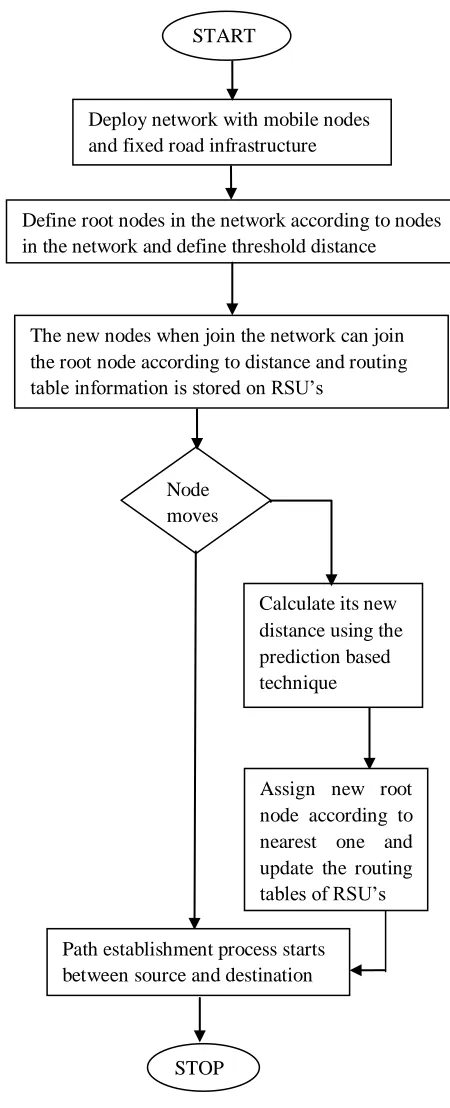
Figure 1: Proposed Flowchart
START
Deploy network with mobile nodes and fixed road infrastructure
Define root nodes in the network according to nodes in the network and define threshold distance
Node moves
The new nodes when join the network can join the root node according to distance and routing table information is stored on RSU’s
Calculate its new distance using the prediction based technique
Assign new root node according to nearest one and update the routing tables of RSU’s
Path establishment process starts between source and destination
IV. EXPERIMENTAL RESULTS
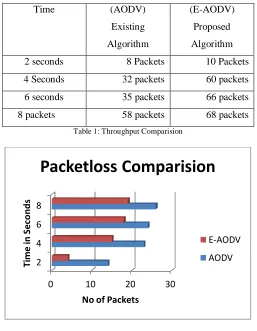
Fig 2: Throughput
As shown in figure 2, for the purpose of establishing a path the broadcasting technique is used. Also the multicasting technique is applied by the proposed algorithm in the network. Due to this reason, the throughput of the network is increased.
Time (AODV)
Existing
Algorithm
(E-AODV)
Proposed
Algorithm
2 seconds 8 Packets 10 Packets
4 Seconds 32 packets 60 packets
6 seconds 35 packets 66 packets
8 packets 58 packets 68 packets
Table 1: Throughput Comparision
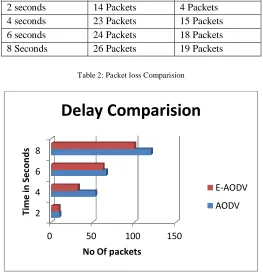
Fig 3: Packet loss Comparison
0 50 100
2 4 6 8
No of Packets
Ti
m
e
in
S
ec
o
n
d
s
Throughput Comparision
E-AODV
AODV
0 10 20 30
2 4 6 8
No of Packets
T
im
e
in
S
ec
o
n
d
s
Packetloss Comparision
E-AODV
As shown in the figure 3, packetloss criteria are used to compare the old as well as the new proposed technique. The packetloss is found to be less in the new proposed technique than the already existing technique.
Table 2: Packet loss Comparision
Fig 4: Delay comparison
As shown in figure 4, the delay criteria are used for comparing the proposed and the already existing techniques. There is a reduction in the delay in the new proposed technique when compared to already existing technique. This is due to the use of multicasting approach which is used for path establishment.
Table 3: Delay Comparision
0 50 100 150
2 4 6 8
No Of packets
Ti
m
e
in
S
e
co
n
d
s
Delay Comparision
E-AODV
AODV
Time (AODV) Existing Algorithm
(E-AODV) Proposed Algorithm 2 seconds 14 Packets 4 Packets 4 seconds 23 Packets 15 Packets 6 seconds 24 Packets 18 Packets 8 Seconds 26 Packets 19 Packets
Time (AODV)
Existing Algorithm
(E-AODV)
Proposed Algorithm
2 Seconds 10 Packets 9 Packets
4 Seconds 53 Packets 32 Packets
6 Seconds 66 Packets 68 Packets
V. CONCLUSION
In this work, Vehicular Ad hoc network is the decentralized type of network due to which routing is the major issue of the network. In the previous research work, fish swarm algorithm is applied for the path establishment which uses broadcasting approach to search best path from source to destination. In this research work, multicasting technique is used for the path establishment from source to destination. The proposed and existing algorithms are implemented in NS2. The proposed performs well in terms of throughput, packet loss and delay.
REFERENCES
[1] AMIOUR MED TAHAR, BILAMI AZEDDINE Computer Science Department - University of Batna – Algeria, “AODV Extension Using Multi Point Relayfor High Performance Routing in VANETS”, 2007, p1-7
[2] Muddassar Farooq and Gianni A. Di Caro, “Routing Protocols for Next Generation Networks Inspired by Collective Behaviors of Insect Societies: An Overview”, 2008, Next Generation Intelligent Networks Research Center National University of Computer and Emerging Sciences (NUCES) Islamabad, Pakistan p1-60
[3] Jerome HaerriInstitutEur´ecomz,” Performance Comparison of AODV and OLSR in VANETs Urban Environments under Realistic Mobility Patterns”, 2005, Department of Mobile Communications B.P. 193 06904, Sophia Antipolis, France, p1-8 [4] Josiane Nzouonta, Neeraj Rajgure, Guiling Wang, and Cristian Borcea,” VANET Routing on City Roads using Real-Time
Vehicular Traffic Information”, 2008, IEEE, p1-18
[5] Vishnu Kumar Sharma1 and Dr. Sarita Singh Bhadauria, “Congestion and Power Control Technique Based on Mobile Agent and Effect of Varying Rates in MANET”, 2011, Department of CSE, JUET, India
[6] Cristina Rico Garcia, Andreas Lehner, Thomas Strang German Aerospace, “A Reliable MAC Protocol for Broadcast VANETs”, 2006, Center Institute of Communications and Navigation 82234 Wessling Germany, p1-8
[7] Rakesh Kumar and Mayank Dave Department of Information Technology, M. M. University, Mullana, Haryana, India Department of Computer Engineering, N. I. T. Kurukshetra, Haryana, India, “A Review of Various VANET Data Dissemination Protocols”, 2012, p1-8
[8] Rakesh Kumar, Mayank Dave, “A Comparative Study of Various Routing Protocols in VANET”, 2011, department of IT, M. M. University, Mullana, Haryana, India, p643-648
[9] Aswathy M and Tripti, “A CLUSTER BASED ENHANCEMENT TO AODV FOR INTER-VEHICULAR COMMUNICATION IN VANET”, 2012, Department of Computer Science & Engineering, Rajagiri School of Engineering & Technology, Rajagiri valley, Cochin, India p41-50
[10] PATIL V.P.Smt., “Vanet Based Traffic Management System Development And Testing Using Aodv Routing Protocol”, 2012, Indira Gandhi college of Engineering, New Mumbai, INDIA 1682-1689
[11] Reena Dadhich, “Mobility Simulation of Reactive Routing Protocols for Vehicular Ad-hoc Networks”, 2011, Department of MCA, Govt. College of Engineering, Ajmer, India