c
Owned by the authors, published by EDP Sciences, 2016
Electromagnetic effects as a new source of information on the
space-time evolution of heavy ion collisions
Nikolaos Davis1,a, Andrzej Rybicki1, and Antoni Szczurek1,2
1H. Niewodnicza´nski Institute of Nuclear Physics, Polish Academy of Sciences, Radzikowskiego 152,
31-342 Kraków, Poland
2University of Rzeszów, Rejtana 16, 35-959 Rzeszów, Poland
Abstract.We review our studies of spectator-induced electromagnetic (EM) effects on
charged pion emission in ultrarelativistic heavy ion collisions. These effects are found
to consist in the electromagnetic charge splitting of pion directed flow as well as very large distortions in spectra and ratios of produced charged particles. As it emerges from our analysis, they offer sensitivity to the actual distance,dE, between the pion formation zone at freeze-out and the spectator matter. As a result, this offers a new possibility of
studying the space-time evolution of dense and hot matter created in the course of the collision. Having established thatdEtraces the longitudinal evolution of the system and therefore rapidly decreases as a function of pion rapidity, we investigate the latter finding in view of pion feed-over from intermediate resonance production. As a result, we obtain a first estimate of the pion decoupling time from EM effects which we compare to existing
HBT data. We conclude that spectator-induced EM interactions can serve as a new tool for studying the space-time characteristics and longitudinal evolution of the system. We discuss the future perspectives for this activity on the basis of existing and future data from the NA61/SHINE experiment.
1 Introduction
In the present work, we review various aspects of the final state electromagnetic (EM) interactions between the charged pions produced during an ultrarelativistic heavy-ion collision and the positively charged nuclear remnant (“spectator system”) of the colliding nuclei, which does not participate di-rectly in the collision. We argue that the study of the induced EM effects provides a useful new source of information on the space-time evolution of the system, valid in a broad range of collision centrality.
2 EM effects in heavy ion collisions
It is well established that charged spectator systems in non-central heavy ion collisions are the source of EM fields of considerable strength, which have a significant effect on the final state distributions of positively and negatively charged pions produced during freeze-out, as well as influence a variety of other observable quantities, such as theπ+/π−ratios and directed flow as a function of the longitudinal
momentum of pions [1, 2]. Below, we will review specific aspects of these phenomena, focusing mainly on the applicability of EM effects as a new source of information on the space-time evolution of the system.
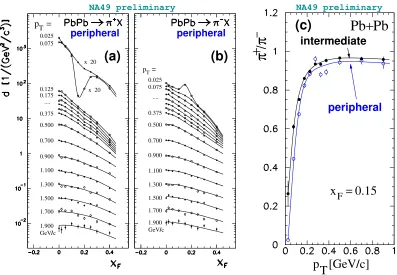
The effect of spectator EM fields on the phase-space distributions of produced pions is evident in Fig. 1. The measurements were performed by the NA49 experiment (CERN SPS) in peripheral and intermediate centrality Pb+Pb collisions at √sNN =17.3 GeV. In panel 1a (1b), we see that the
invariant double differential spectra of positive (negative) pions reveal a suppression (enhancement) of produced pions for low values of transverse momentum,pT, in the vicinity of longitudinal momentum
corresponding to pions comoving with the spectator system, xF = 0.15 = mπ/mp. This isospin
symmetry-breaking distortion of pion spectra becomes even more apparent if we examine theπ+/π− ratios as a function of transverse momentum forxF =0.15, Fig. 1(c). We notice that the distortion
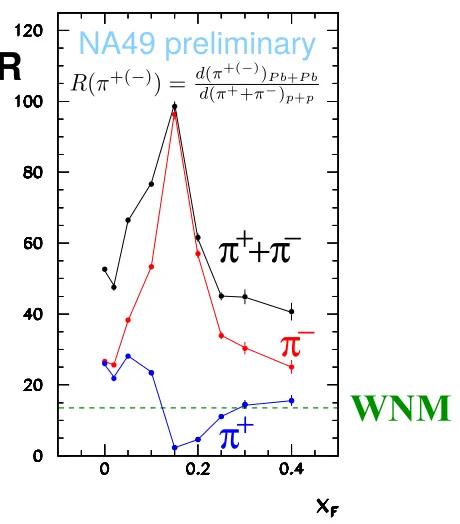
of ratios is very similar for peripheral and intermediate centrality collisions. The weak centrality dependence of this effect may at first seem surprising, however it can be explained as a consequence of the reduced charge of spectators partially compensated by the decrease of impact parameterbwith increasing collision centrality. Another noteworthy effect observed in NA49 data is the significant enhancement, for lowpT values, of the ratioRof invariant particle densities of positive and negative
pions produced in Pb+Pb collisions, compared to the same quantity in p+p collisions, as a function of longitudinal pion momenta, Fig. 2. As can be seen, the effect actually consists of a strong enhancement forπ−alone and a suppression forπ+, indicating a strong isospin symmetry-breaking effect, possibly of largely EM origin.
The influence of EM effects can also be detected in the behavior of collective azimuthal anisotropies (directed flow) of emitted charged pions with regards to the reaction plane, as detailed in [4]. In Fig. 3, directed flowv1 is plotted as a function of the ratio of pion to beam rapidity in the c.m.s., for peripheral collisions recorded by the STAR and WA98 experiments.
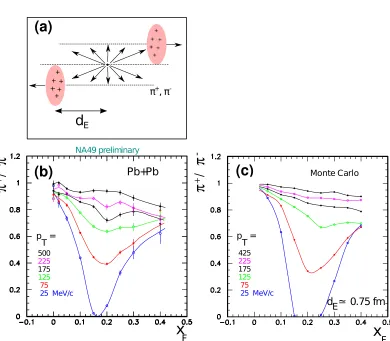
By combining the results of the above measurements, we can obtain information on the depen-dence of EM effects of spectators on the rapidity of pions produced during freeze-out. Results were interpreted by means of a simplified one-point pion emission model, where the propagation of charged pions through the spectator EM field was numerically computed using classical relativistic equations of motion [1], while the spectators were represented as Lorentz-contracted homogeneously charged spheres, Fig. 4(a). The crucial free parameter in this model was the “pion emission distance”dE
be-tween the pion emission point and the spectator system. As an example, Fig. 4(c) shows Monte Carlo results for theπ+/π− ratio for a specific choice ofdE. It is evident that by fine-tuningdE, we can obtain a fairly good agreement with the measured NA49 ratios, Fig. 4(b). Similarly, Fig. 3(b) shows the values ofdEfurnished by the MC for different pion rapidities,y/ybeam.
3 Sensitivity of EM effects to the space-time evolution of the system
The final state distributions of pions measured in the detector are a direct result of the distortions induced by the spectator EM field on the trajectories of pions produced during the freeze-out. It is therefore not surprising that final state spectra appear sensitive to the space-time evolution of the par-ticle production process. As was demonstrated in [1, 2], the general features of the distortions of pion spectra, as well as charge-dependent effects on directed flow, are sensitive to the distancedE between
momentum of pions [1, 2]. Below, we will review specific aspects of these phenomena, focusing mainly on the applicability of EM effects as a new source of information on the space-time evolution of the system.
The effect of spectator EM fields on the phase-space distributions of produced pions is evident in Fig. 1. The measurements were performed by the NA49 experiment (CERN SPS) in peripheral and intermediate centrality Pb+Pb collisions at √sNN =17.3 GeV. In panel 1a (1b), we see that the
invariant double differential spectra of positive (negative) pions reveal a suppression (enhancement) of produced pions for low values of transverse momentum,pT, in the vicinity of longitudinal momentum
corresponding to pions comoving with the spectator system, xF = 0.15 = mπ/mp. This isospin
symmetry-breaking distortion of pion spectra becomes even more apparent if we examine theπ+/π− ratios as a function of transverse momentum forxF =0.15, Fig. 1(c). We notice that the distortion
of ratios is very similar for peripheral and intermediate centrality collisions. The weak centrality dependence of this effect may at first seem surprising, however it can be explained as a consequence of the reduced charge of spectators partially compensated by the decrease of impact parameterbwith increasing collision centrality. Another noteworthy effect observed in NA49 data is the significant enhancement, for lowpT values, of the ratioRof invariant particle densities of positive and negative
pions produced in Pb+Pb collisions, compared to the same quantity in p+p collisions, as a function of longitudinal pion momenta, Fig. 2. As can be seen, the effect actually consists of a strong enhancement forπ−alone and a suppression forπ+, indicating a strong isospin symmetry-breaking effect, possibly of largely EM origin.
The influence of EM effects can also be detected in the behavior of collective azimuthal anisotropies (directed flow) of emitted charged pions with regards to the reaction plane, as detailed in [4]. In Fig. 3, directed flowv1 is plotted as a function of the ratio of pion to beam rapidity in the c.m.s., for peripheral collisions recorded by the STAR and WA98 experiments.
By combining the results of the above measurements, we can obtain information on the depen-dence of EM effects of spectators on the rapidity of pions produced during freeze-out. Results were interpreted by means of a simplified one-point pion emission model, where the propagation of charged pions through the spectator EM field was numerically computed using classical relativistic equations of motion [1], while the spectators were represented as Lorentz-contracted homogeneously charged spheres, Fig. 4(a). The crucial free parameter in this model was the “pion emission distance”dE
be-tween the pion emission point and the spectator system. As an example, Fig. 4(c) shows Monte Carlo results for theπ+/π− ratio for a specific choice ofdE. It is evident that by fine-tuningdE, we can obtain a fairly good agreement with the measured NA49 ratios, Fig. 4(b). Similarly, Fig. 3(b) shows the values ofdE furnished by the MC for different pion rapidities,y/ybeam.
3 Sensitivity of EM effects to the space-time evolution of the system
The final state distributions of pions measured in the detector are a direct result of the distortions induced by the spectator EM field on the trajectories of pions produced during the freeze-out. It is therefore not surprising that final state spectra appear sensitive to the space-time evolution of the par-ticle production process. As was demonstrated in [1, 2], the general features of the distortions of pion spectra, as well as charge-dependent effects on directed flow, are sensitive to the distancedE between
the longitudinal position of the pion formation zone at freeze-out and the longitudinal position of the spectator system at the same moment in time (in the c.m.s. reference frame), as schematically illus-trated in Fig. 5 (a). Results furnished by our one-point pion emission model simulations indicate that theπ+/π−ratio distortions shown in Fig. 4 correspond to a pion formation zone of pions comoving with spectators (y≈ybeam) being aboutdE ≈0.75 fm behind the spectator system in the longitudinal
p T
x 0.15
FT
p [GeV/c]
π /π
p T
1.700 0.375 1.500 1.300 1.100 0.900 1.900 GeV/c 1.700 1.500 1.300 1.100 0.900 0.700 0.500 0.375 0.175 0.075 1.900 0.125 0.075 .... ....
x 20
x 20
0.700 0.500
NA49 preliminary
Pb Pb
(c)
GeV/c 0.025 0.025 peripheral peripheralperipheral
intermediate
(a)
(b)
NA49 preliminaryFigure 1. Spectator-induced EM effects on final state charged πmeson spectra andπ+/π−ratios in Pb+Pb
collisions at√sNN=17.3 GeV. Double differentiald=Eddp3N3 distributions of (a) positive and (b) negative pions
drawn as a function ofxF = √2spL
NN and transverse momentumpT(both quantities in the collision c.m.s.), and (c)
ratio ofπ+overπ−distributions atx
F=0.15. Plot from [3].
direction. Similarly, the charge-splitting of directed flow observed in STAR Collaboration Au+Au collisions at √sNN = 7.7 GeV [5], Fig. 3(a), corresponds to approximatelydE ≈ 3 fm for pions
produced at low c.m.s. rapidities, whereas WA98 experiment [7] measurements of very largeπ+ di-rected flow seen in target vicinity in Pb+Pb collisions at the top SPS energy, Fig. 3(b), would suggest dE ≈0.5 fm at still higher rapidities. In Fig. 5 (d), these results are summarized, and we clearly notice
a trend of decreasingdEwith increasing pion rapidity.
In order to further investigate this result, a Monte-Carlo model was constructed incorporating existing knowledge about the production and decay properties of baryonic (∆) and mesonic (ρ) res-onances, as described in [9]. In Fig. 5(b), a sketch of the model is given where the simplifying assumption is made that resonances are produced at the interaction pointinstantly, that is atτ=0. As is evident from Fig. 5(d), this fails to reproduce the observed values ofdE obtained from EM effects.
In Fig. 5(c), a different model is sketched, for which the intermediate system is given a proper lifetime τ, which can be adjusted to fit the observeddE curve. This suggests that quantitative information
_
2
1
π
+
+
π
−
π
+
−
π
R
WNM
NA49 preliminary
Figure 2.The ratios R(π+) of positive , R(π−) of negative and R(π++π−) of summed invariant particle densities
for charged pions produced in Pb+Pb peripheral versus p+p collisions in the NA49 experiment, as a function
ofxF. The dashed line indicates the Wounded Nucleon Model prediction forR(π+)=R(π−), neglecting isospin effects.
associated with our presentdEestimations, and can further be reduced by future experimental and
the-oretical investigation. We therefore expect that the study of EM effects can improve our knowledge of the space-time evolution of the system up to very high rapidities (where the latter is apparently least known).
At the present moment, the space-time characteristics of this system, tentatively established from these effects in the collision energy range √sNN = 7.7−17.3 GeV discussed here and shown in
Figs 5(d) and 5(c), can give an independent estimate for the time of pion emission as a function of its rapidity. At midrapidity this time being equal todE(y/ybeam = 0)/β, where βis the spectator velocity, our preliminary estimate gives 5.3±2.2 fm/c for the time of pion emission in this region. For comparison, the pion decoupling times compiled in the published HBT analysis by the ALICE Collaboration [10] would indicate a value of approximatelyτf ≈6 fm/c for the same range of collision
energies.
4 Conclusions and outlook
On the basis of the above analysis, we can conclude that spectator-induced EM interactions can serve as a useful tool for studying the space-time evolution of heavy-ion collision systems, and in particular the longitudinal evolution from “hot” QGP matter aty≈0 to “cold” hadronic/nuclear matter aty ≈
_
2
1
π
+
+
π
−
π
+
−
π
R
WNM
NA49 preliminary
Figure 2.The ratios R(π+) of positive , R(π−) of negative and R(π++π−) of summed invariant particle densities
for charged pions produced in Pb+Pb peripheral versus p+p collisions in the NA49 experiment, as a function
ofxF. The dashed line indicates the Wounded Nucleon Model prediction forR(π+)=R(π−), neglecting isospin effects.
associated with our presentdEestimations, and can further be reduced by future experimental and
the-oretical investigation. We therefore expect that the study of EM effects can improve our knowledge of the space-time evolution of the system up to very high rapidities (where the latter is apparently least known).
At the present moment, the space-time characteristics of this system, tentatively established from these effects in the collision energy range √sNN = 7.7−17.3 GeV discussed here and shown in
Figs 5(d) and 5(c), can give an independent estimate for the time of pion emission as a function of its rapidity. At midrapidity this time being equal to dE(y/ybeam = 0)/β, where βis the spectator velocity, our preliminary estimate gives 5.3±2.2 fm/c for the time of pion emission in this region. For comparison, the pion decoupling times compiled in the published HBT analysis by the ALICE Collaboration [10] would indicate a value of approximatelyτf ≈6 fm/c for the same range of collision
energies.
4 Conclusions and outlook
On the basis of the above analysis, we can conclude that spectator-induced EM interactions can serve as a useful tool for studying the space-time evolution of heavy-ion collision systems, and in particular the longitudinal evolution from “hot” QGP matter aty≈0 to “cold” hadronic/nuclear matter aty≈
ybeam. Our MC simulations of the production and decay of baryonic and mesonic resonances indicate
y/y
beam
π
_
π
+
v
1
7.7 GeV
STAR
Au+Au
y/y
beam
WA98
Pb+Pb
17.3 GeV
π
+
d = 0 fm d = 0.5 fm d = 1 fm
E E E
(a)
(b)
Figure 3.Directed flowv1ofπ+,π−as a function of the ratio of pion to beam rapidity in the c.m.s.,y/ybeam, for (a) Au+Au collisions at√sNN=7.7 GeV (STAR Collaboration [5]), plot from [6] (see also [4]), and (b) Pb+Pb collisions at√sNN=17.3 GeV (WA98 Collaboration [7]), plot from [2].
that the space-time evolution of pion production aty = ybeam, i.e. non-zero dE, can be understood
as resulting from the space-time evolution of resonance decay. Further analysis of new experimental data on EM effects, on flow as well asπ+/π−ratios, augmented by MC simulations, would improve our phenomenological knowledge and reduce the estimated uncertainties of the dependence ofdEon pion
rapidityy/ybeam, and possiblypT. What is needed is precise data on the dependence of EM effects on
such variables as collision geometry, reaction type, centrality, energy, particle type, rapidity andpT.
To this end, we are actively seeking to further our analysis and MC simulation on EM spectator effects as members of the NA61/SHINE Collaboration [11], a heavy ion fixed target collision experi-ment and the successor to the NA49 experiexperi-ment. The NA61/SHINE scan program includes collisions of heavy and intermediate size nuclei in the √sNN=6.3−16.8 GeV energy range; a systematic
anal-ysis of EM effects on non-central collision data would cast new light on the behavior ofdEwith pion
rapidity and transverse momentum, and hence on the space-time evolution of heavy ion collisions. Acknowledgments: This work was supported by the National Science Centre, Poland (grant no. 2014/14/E/ST2/00018).
References
[1] A. Rybicki, A. Szczurek,Phys. Rev. C75, 054903 (2007) [2] A. Rybicki and A. Szczurek,Phys. Rev. C87, 054909 (2013)
[3] A. Rybicki, A. Szczurek, M. Klusek-Gawenda, N. Davis, V. Ozvenchuk and M. Kielbowicz, to appear in EPJ Web of Conf.
[4] A. Rybicki, A. Szczurek and M. Kłusek-Gawenda,Acta Phys. Polon. B46, no. 3, 737 (2015), and references therein
[6] A. Rybicki, A. Szczurek and M. Klusek-Gawenda, EPJ Web Conf. 81 (2014) 05024. doi:10.1051/epjconf/20148105024
[7] WA98 Collab., H. Schlagheck,Nucl. Phys. A663, 725 (2000) [8] A. Rybicki,Acta Phys. Polon.B42, 867 (2011).
[9] A. Rybicki, A. Szczurek, M. Kiełbowicz, N. Davis and V. Ozvenchuk,Acta Phys. Polon. Supp.
9, 303 (2016), and references therein
[10] ALICE Collab., K. Aamodtet al.,Phys. Lett. B696, 328 (2011)
[11] NA61 Collab., N. Abgrallet al., CERN-SPSC-2015-038; SPSC-P-330-ADD-8
+ + ++
+
+
d
E+,
-p = T
500 225 175
125
75 25 MeV/c
p = T
425 225 175
125
25 MeV/c 75
F
x
Monte CarloPb+Pb
F
x
(b)
(c)
(a)
NA49 preliminary
d 0.75 fm E
π
/
π
+
-π
/
π
+
-Figure 4.(a) Schematic representation of one-point emission model for spectator EM effects. (b) ratio ofπ+over π−distributions as a function ofxFfor variouspTvalues, for Pb+Pb collisions recorded in the NA49 experiment
[6] A. Rybicki, A. Szczurek and M. Klusek-Gawenda, EPJ Web Conf. 81 (2014) 05024. doi:10.1051/epjconf/20148105024
[7] WA98 Collab., H. Schlagheck,Nucl. Phys. A663, 725 (2000) [8] A. Rybicki,Acta Phys. Polon.B42, 867 (2011).
[9] A. Rybicki, A. Szczurek, M. Kiełbowicz, N. Davis and V. Ozvenchuk,Acta Phys. Polon. Supp.
9, 303 (2016), and references therein
[10] ALICE Collab., K. Aamodtet al.,Phys. Lett. B696, 328 (2011)
[11] NA61 Collab., N. Abgrallet al., CERN-SPSC-2015-038; SPSC-P-330-ADD-8
+ + ++
+
+
d
E+,
-p = T
500 225 175
125
75 25 MeV/c
p = T
425 225 175
125
25 MeV/c 75
F
x
Monte CarloPb+Pb
F
x
(b)
(c)
(a)
NA49 preliminary
d 0.75 fm E
π
/
π
+
-π
/
π
+
-Figure 4.(a) Schematic representation of one-point emission model for spectator EM effects. (b) ratio ofπ+over π−distributions as a function ofxFfor variouspTvalues, for Pb+Pb collisions recorded in the NA49 experiment
at√sNN=17.3 GeV. (c) ratio ofπ+overπ−distributions for pions simulated by one-point emission model MC, fordE≈0.75 fm. Panels (b),(c) originally from [8].
y/y
y/y
beam
beam
τ = 0
τ = 2.4
π
π
(d)
(e)
AA
A
(alone)
(alone)
T
different y, p
parent
spectra
d [fm]
E
d
Ed [fm]
E
fm/c
(a)
(b)
(c)
fm/c
∆
ρ
τ = 0
preliminary
preliminary
τ = 2.4
Figure 5.Information obtained on the basis of EM effects described in section 2: (a) schematic definition ofdE, (b) simulation of resonances produced instantly at the moment of the collision (τ=0) and (c) produced from an
intermediate system characterized by a given proper lifetimeτ, (d) dependence ofdEon pion rapidity, deduced from EM effects (data points), compared to the results of our Monte Carlo simulation illustrated in panels (b)
![Figure 3.√ v collisions at Directed flow1 of π+, π− as a function of the ratio of pion to beam rapidity in the c.m.s., y/ybeam, for(a) Au+Au collisions at √sNN = 7.7 GeV (STAR Collaboration [5]), plot from [6] (see also [4]), and (b) Pb+PbsNN = 17.3 GeV (WA98 Collaboration [7]), plot from [2].](https://thumb-us.123doks.com/thumbv2/123dok_us/8069561.1345760/5.482.42.442.80.277/figure-collisions-directed-function-rapidity-collisions-collaboration-collaboration.webp)