© 2014, IJCSMC All Rights Reserved
591
Available Online atwww.ijcsmc.comInternational Journal of Computer Science and Mobile Computing
A Monthly Journal of Computer Science and Information Technology
ISSN 2320–088X
IJCSMC, Vol. 3, Issue. 6, June 2014, pg.591 – 597
RESEARCH ARTICLE
A NOVEL METHOD FOR DOWNLINK
RESOURCE ALLOCATION FOR NEXT
GENERATION WIRELESS NETWORKS
#1
Praveenkumar Pujar,
#2Shoaib Kamal
1
Department of Electronics and Communication
1
[email protected]
2
Assistant Professor of Telecommunication Department
#
P.A.College of Engineering Mangalore, Karnataka, India
2
[email protected]
Abstract - Cellular systems such as 802.16e (Wi-max) and 3GPP Long Term Evolution (LTE) and all other currently emerging technologies are based on orthogonal frequency division multiple access (OFDMA). OFDMA is basically a combination of FDM and TDM. OFDMA suffers from heavy inter cell interference from the neighboring base stations because they use the same frequency range, especially those who are in edge suffer from heavy inter cell interference. The proposed scheme consists of ICIC management and fine PRB allocation by using simple and effective graph based framework. Given the solution of radio resource allocation, a novel distributed power allocation is then performed to optimize the performance of cell-edge users under the condition that desirable performance for cell-center users must be maintained. Simulation results show that the proposed algorithm can achieve utilization of spectrum efficiently and effectively while maintaining balanced performance between cell edge and cell center users in multi cell networks. Therefore realize the goal of future wireless networks in terms of providing high performance to anyone from anywhere.
Index terms- OFDMA, LTE, inter cell interference coordination (ICIC) management, physical resource blocks (PRB)
I. INTRODUCTION
© 2014, IJCSMC All Rights Reserved
592
Due to its promising features, OFDMA is adopted in many emerging cellular systems such as the Long Term Evolution (LTE) and IEEE 802.16m for achieving those ambitious objectives of next generation networks. In order to realize the flexibility on access of radio resources, OFDMA poses a new challenge for radio resource management. RRM is the system level control of co channel interference and other radio transmission characteristics in wireless communication system. Mainly a good RRM scheme including subcarrier allocation, scheduling and power control is crucial to guarantee high spectrum performance for OFDMA based networks. On traditional design of RRM, most published work concentrate on the single-cell scenario where resources are allocated to deliver a local performance optimization. In future wireless networks however, denser cellular deployment with a lower frequency reuse factor is demanded.
In the multi-cell context, inter-cell interference (ICI) has become a major issue of concern since the frequency reuse-1 is agreed as the preferred frequency planning deployment for modern OFDMA-based cellular networks. Due to the same spectral usage in adjacent cells, ICI can result in severe performance degradation to users of reuse-1 OFDMA networks, particularly those at the cell edge users.
The proposed scheme consists of two steps. The first step aims at developing interference graph by evaluation of the system .Once we get the graph ICIC technique is used to mitigate major inter cell interference (ICI).
In the second step PRB assignment is conducted which is dependent on graph based framework. Here instantaneous channel condition is considered.
II. SYSTEM MODEL AND INTERFERENCE EVALUATION
A. System Model
In order to show the inter cell interference from the neighboring base stations, we consider one example of the network layout with seven hexagonal cell as shown in figure 1. Here Omni directional antenna is placed at the center of each cell to serve users who are randomly distributed in the cell. Some assumptions are made throughout this paper and they are given below.
Figure1.System model Edge
user
center user Base station
Signal
© 2014, IJCSMC All Rights Reserved
593
1. Based on the current geographic location we have classified users as either cell center or cell edge users. The uplink control channels are helps to report to BS about geographic location from users.
2. In every transmission time interval (TTI) each BS has to make a decision on PRB assignment to its served users. Here PRB is a group of subcarriers that can be coherently allocated to users in a given time.
3.To any cell, due to same spectral usage or if neighboring cells use the same frequency then edge users affect by heavy interference as shown in above figure 1.
B. Interference Evaluation
Inter cell Interference can be evaluated by using signal to interference and noise ratio instead of signal to noise ratio.
III. PROPOSED RADIO RESOURCE ALLOCATION SCHEME
In this proposed method is divided into two steps in order to reduce complexity. They are Coarse Inter cell interference coordination (ICIC) and Fine PRB assignment.
1. Inter-cell Interference coordination management (ICIC).
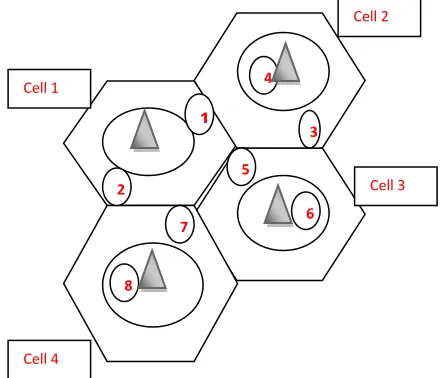
Inter cell interference management was proposed to effectively reduce ICI in cell edge regions. This ICIC management is accomplished using graph based frame work algorithm. Here our objective is to construct a graph that reflects major interference occurring in the real time environment. According to the graph theory the corresponding interference graph is denoted by G = (V, E) Where V denotes set of nodes representing a mobile users and E denotes edges connecting users that cause heavy mutual interference when they are allocated the same PRB. Construction of graph based frame work first we consider 4 cell scenario is shown below.
Figure 2(a).4- Cell scenario
1
2
3 4
5
6 7
8
Cell 1
Cell 4
© 2014, IJCSMC All Rights Reserved
594
For the above scenario the interference graph construction is shown below. The rules for interference graph construction are as follows.
1. Users within the same cell are mutually connected.
2. For any edge user the connection will be established pair wise with other edge user of its dominant interfering cells.
Figure 2(b). Interference graph construction.
2. Fine PRB assignment
Once construction of interference graph is over the next step is to allocate the frequency based on the edge connection.
STEPS FOR ALLOCATING PRB
STEP 1: First we construct the interference graph from graph based framework.
STEP 2: If we consider a, b are the two nodes means if E(a,b)=1 means connection established. Then we should not use same frequency for that both users.
STEP 3:If E(a, b)=0 means connection is not established then we can use same frequency as we used in earlier.
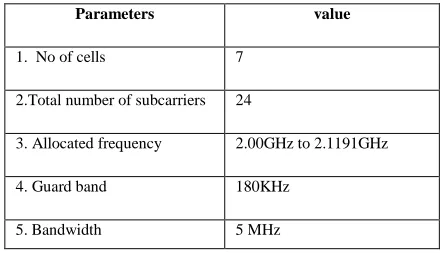
The below table shows the simulation parameters which are used in allocating PRB.
Parameters value
1. No of cells 7 2.Total number of subcarriers 24
3. Allocated frequency 2.00GHz to 2.1191GHz
4. Guard band 180KHz
5.Bandwidth 5 MHz
Table1. Specifications used for allocating frequency.
2
8
7
6
3
© 2014, IJCSMC All Rights Reserved
595
IV. PROPOSED POWER ALLOCATION APPROACH
Total Power Distribution
We first divide the overall transmission power of each cell into two parts:
1. total power for cell-edge users
2. total power for cell-center users
Let and denote the total power allocated to celledge users and cell-center users in cell j
respectively, and = Pmax.
The determinations of and are based on following rules:
Relatively high power is given to cell-edge users in order to compensate the experienced larger
distance-dependent path loss; and is proportional to the number of PRBs occupied by cell-edge (cell-center) user in cell j.
V. RESULTS
Figure3. shows the spectrum distribution achieved by the proposed scheme for both cell-edge and cell-center users in the system as a function of SINR. Here in this proposed scheme all the available subcarriers are utilized effectively and efficiently by the both center and edge users.
Figure3. Spectrum distribution
© 2014, IJCSMC All Rights Reserved
596
Figure4. User connection matrix
As seen in Fig.5(a) shows, the proposed schemes can consistently improve performance of cell-edge users and at the same time maintain desirable performance for cell-center users regardless of the user deployment density
compared to the dynamic SFR scheme. In particular, the proposed scheme with [ = 4, = 1, α = 0.5] achieves
nearly balanced performance improvement between cell-edge and cell-center users. Fig.5(b) shows that the proposed schemes perform Slightly worse or even better in terms of average throughput for cell-center users when the user density increases. This observation indicates that our scheme can provide not only consistent performance improvement to cell-edge users but also better performance protection for cell-center users especially when high ICI is experienced in the network.
(a)
(b)
© 2014, IJCSMC All Rights Reserved
597
VI. CONCLUSION
Simulation results show that the proposed algorithm can achieve utilization of spectrum efficiently and effectively with maintaining balance performance between cell edge and cell center users in multi cell networks. Therefore this proposed scheme helps to minimize the inter cell interference and allow to use spectrum in an efficient manner. Due to its simplicity the proposed scheme can be used in next generation cellular systems.
REFERENCES
[1] G. Li and H. Liu, “Downlink radio resource allocation for multi-cell OFDMA system,” IEEE Trans. Wireless
Communication, vol. 5, no. 12, pp. 3451–3459, 2006.
[2] M. Sternad, T. Ottosson, A. Ahlen, and A. Svensson, “Attaining both coverage and high spectral efficiency with adaptive OFDM downlinks,” in Proc. 58th IEEE Vehicular Technology Conference (VTC 2003-Fall), vol. 4, October 2003, pp. 2486–2490.
[3]D.Astély et al., “A Future Radio-Access Framework,” IEEE JSAC, vol. 24, no. 3, Mar. 2006.
[4] W. Rhee and J. M. Cioffi, “Increasing in capacity of multiuser OFDM system using dynamic sub channel allocation,” in Proc. IEEE Int. VehicularTech. Conf., Tokyo, Japan, May 2000, vol. 2, pp. 1085–1089.
[5] G. Li and H. Liu, “Downlink radio resource allocation for multi-cell OFDMA system,” IEEE Trans. Wireless
Commun., vol. 5, no. 12, pp. 3451–3459, 2006.