Cryptanalysis of the Legendre PRF and
Generalizations
?Ward Beullens1, Tim Beyne1, Aleksei Udovenko2, and Giuseppe Vitto2
1 imec-COSIC, ESAT, KU Leuven, Belgium
[email protected], [email protected]
2 SnT, University of Luxembourg, Luxembourg
[email protected], [email protected]
Keywords: Cryptanalysis·Legendre PRF·MPC-friendly primitives·Collision
attack
Abstract. The Legendre PRF relies on the conjectured pseudorandom-ness properties of the Legendre symbol with a hidden shift. Originally proposed as a PRG by Damgård at CRYPTO 1988, it was recently suggested as an ecient PRF for multiparty computation purposes by Grassi et al. at CCS 2016. Moreover, the Legendre PRF is being consid-ered for usage in the Ethereum 2.0 blockchain.
This paper improves previous attacks on the Legendre PRF and its higher-degree variant due to Khovratovich by reducing the time com-plexity from O(plogp/M) to O(plog2p/M2) Legendre symbol
evalua-tions whenM ≤p4
plog2pqueries are available. The practical relevance
of our improved attack is demonstrated by breaking three concrete in-stances of the PRF proposed by the Ethereum foundation. Furthermore, we generalize our attack in a nontrivial way to the higher-degree variant of the Legendre PRF and we point out a large class of weak keys for this construction.
Lastly, we provide the rst security analysis of two additional generaliza-tions of the Legendre PRF originally proposed by Damgård in the PRG setting, namely the Jacobi PRF and the power residue PRF.
1 Introduction
The Legendre symbol is a multiplicative function modulo an odd prime number
pthat assigns to an elementa∈Fp the value1,0 or−1 depending on whether ?The work of Ward Beullens and Tim Beyne was supported by a PhD Fellowship
or notais a square. Specically, a p =
1 ifa=b2 for someb∈
F×p ,
0 ifa= 0,
−1 otherwise.
The distribution of Legendre symbols has been a subject of study for number theorists at least since the early 1900s [Ala96, vS98, Jac06, Dav31, Dav39]. In particular, it follows from the Weil bound [Wei48] that the number of occurrences of a xed pattern oflnonzero Legendre symbols among the integers1,2, . . . , p−1
modulopis
p
2l+O(
√
p),
asp→ ∞. In other words, the distribution of xed length substrings of Legendre
symbols converges to the uniform distribution.
In 1988, Damgård [Dam90] conjectured pseudorandom properties of the sequence
k p ,
k+ 1
p
,
k+ 2
p
, . . . ,
where k has been sampled from Fp uniformly at random. He proposed to use this construction as a pseudorandom number generator. More recently, Grassi et al. [GRR+16] have proposed the same construction as a candidate pseudoran-dom function and have shown that it can be evaluated very eciently in the secure multiparty computation setting. Concretely, the Legendre pseudorandom function Lk(x)is dened by mapping the Legendre symbol with a secret shiftk to{0,1}:
Lk(x) =
1
2
1−
k+x
p
,
wherepis a public prime number.
Damgård's work additionally considers several generalizations of the Legendre PRG that could be more ecient and/or more secure. One of these is to replace the Legendre symbols above by Jacobi symbols. In this case, the public modulus
n is taken to be a productQ
ipi of odd primes. Recall that the Jacobi symbol ofa∈Fp is dened as
a n =Y i a pi .
residue symbol a7→a(p−1)/r modp. This potentially increases the throughput of the PRF, because we now obtain log2r bits of output per PRF call rather
than a single bit.
Very recently, the Legendre PRF was proposed to be used in the Ethereum 2.0 proof-of-custody mechanism [Fei19b]. In this context, several cryptanalysis bounties were announced by the Ethereum foundation during the CRYPTO 2019 rump session [Fei19a]. Among the proposed challenges, there are concrete instances of the Legendre PRF with expected security levels ranging from 44 to 128 bits of security. For each instance, 220 sequential output bits are given and
the goal is to recover the secret key.
Despite the longevity of Damgård's pseudorandomness conjecture and the re-cent surge of application-oriented interest in the Legendre PRF, relatively few cryptanalytic results are available. It is known that, given quantum query access to Lk, the key k can be recovered with a single query to Lk and in quantum polynomial time [vDH00]. No subexponential attacks are known in the classical setting or the setting where a quantum adversary is only allowed to query Lk classically.
The best cryptanalytic results in the classical setting are due to Khovratovich [Kho19], who gives a memoryless birthday-bound attack. His attack recovers the key with a computational cost ofO(√plogp)Legendre symbol evaluations when
given√plogpqueries toLk. Khovratovich also considers a higher-degree variant
of the Legendre PRF, where the output is computed as the Legendre symbol of a secret polynomial in the input. Similar to the Jacobi symbol generalization, the higher-degree Legendre PRF potentially oers security and eciency benets.
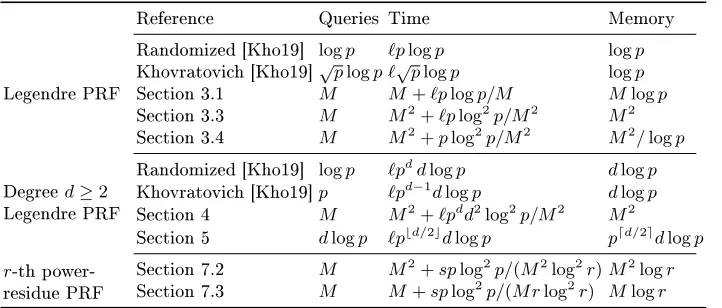
Contributions. This paper aims to advance the state-of-the-art in the crypt-analysis of the Legendre PRF by improving upon Khovratovich's attacks on the one hand, and by providing the rst security analysis of the Jacobi and power residue symbol generalizations on the other hand. Table 1 provides a summary of our main results. The main improvement stems from the fact that, unlike earlier work, we manage to exploit the multiplicative property of the Legendre symbol. The practical relevance of our attacks is demonstrated by our solution of the rst three concrete Legendre PRF challenges proposed by the Ethereum foundation [Fei19b]. These were expected to correspond to a security level of
44 and 54 bits, but our attacks imply that the actual security levels for these
challenges are signicantly lower.
we gain a factor of p in time-complexity compared to Khovratovich's results.
Furthermore, in Section 4, a large class of weak keys for the higher-degree Leg-endre PRF is shown to exist. For keys in this class, key-recovery requires roughly
O(pbd/2cdlogp) Legendre symbol evaluations with only ddlogpe queries to the PRF. This attack requires O(pdd/2edlogp)memory, but trade-os are available using Van Oorschot-Wiener golden collision search. We also give a reduction to the uniquek-XOR problem, which results in further time-memory trade-os.
The rst of Damgård's generalizations is discussed in Section 6. Specically, it will be shown that the Jacobi PRF can be broken with cost proportional to the cost of breaking the Legendre PRF for each of the prime factors of the modulus separately. The power residue symbol generalization is analyzed in Section 7. Besides the straightforward generalization of the attack from Section 3 to the
r-th power residue symbol PRF, we additionally provide a more ecient attack
for the case where ris large.
Finally, concrete implementation results are provided in Section 8. We report on the specic amount of time and memory that was necessary to solve the rst three Legendre PRF challenges of the Ethereum foundation. These results showcase the practical relevance of our attacks.
Concurrent work. Days after this work rst appeared on ePrint, Kaluerovi¢ et al. [KKK20] solved the next Legendre PRF challenge. Their attack uses sim-ilar ideas to our attack, but with an improved complexity of O(M2/logp+
plogplog logp/M2)operations on a machine with word sizeΘ(logp).
2 Preliminaries
After introducing the Legendre PRF and some related notation in Section 2.1, Section 2.2 recalls how Legendre and power residue symbols can be computed eciently. Finally, Sections 2.3 and 2.4 discuss Khovratovich's attacks on the Legendre PRF and its higher degree variant.
2.1 Legendre PRF
Denition 1 (Legendre function). For a given odd primep, we consider the
function
l:Fp → F2
x 7→
1
2
1−
x
p
Table 1. Query, time and memory requirements of previous and new attacks on the Legendre PRF. The reported time and memory values are asymptotic upper bounds (O-notation) and assume a machine with word sizeΘ(logp),`andsdenote the
time-complexity of computing a Legendre and power residue symbol respectively. The attack strategy for composite moduli from Section 6 can be combined with any of the attacks in this table.
Reference Queries Time Memory
Legendre PRF
Randomized [Kho19] logp `plogp logp
Khovratovich [Kho19]√plogp `√plogp logp
Section 3.1 M M+`plogp/M Mlogp
Section 3.3 M M2+`plog2p/M2 M2
Section 3.4 M M2+plog2p/M2 M2/logp
Degreed≥2
Legendre PRF
Randomized [Kho19] logp `pddlogp dlogp
Khovratovich [Kho19]p `pd−1dlogp dlogp
Section 4 M M2+`pdd2log2p/M2 M2
Section 5 dlogp `pbd/2cdlogp pdd/2edlogp
r-th
power-residue PRF
Section 7.2 M M2+splog2p/(M2log2r)M2logr
Section 7.3 M M+splog2p/(M rlog2r) Mlogr
Denition 2 (Legendre PRF). Letpbe an odd prime andda positive integer.
The degreed-Legendre PRF overFp is a family of functionsLk :Fp→F2 such that for eachk∈Fdp,
Lk(x) =l xd+Pi=0d−1ki+1xi.
Remark 1. For any given eldFp, the Legendre symbol is multiplicative, i.e.
ab
p
=
a
p b p
for alla, b∈Fp.
In terms of the Legendre function l, multiplication of inputs corresponds to
addition in F2of the respective images. Indeed
l(ab) =l(a)⊕l(b) for alla, b∈F×p,
where⊕denotes addition inF2.
In our analysis, we will often consider sequential evaluations of a given degree
d Legendre PRFLk starting from a point a with an additive or multiplicative stepb. We call such vectorsL-sequences.
mwith starting pointaand stridebas theFm 2 -vector
Lk(a+b[m]) := (Lk(a), Lk(a+b), . . . , Lk(a+ (m−1)b) ).
Similarly, we dene the geometricL-sequence of lengthmwith starting pointa
and common ratiobas theFm 2 -vector
Lk(a·b[m]) := (Lk(a), Lk(a·b), . . . , Lk(a·bm−1)).
To justify the correctness of our attack, the following property of Lk will be assumed.
Assumption 1 Letpbe an odd prime andda positive integer. Letm=ddlogpe.
For all k∈Fdp, then asp→ ∞, there exist at most O(1) keysk0 ∈Fdp such that
Lk0([m]) =Lk([m]).
2.2 Evaluating Legendre and Power Residue Symbols
Using the law of quadratic reciprocity, i.e. for odd coprime integerspandq
p
q q p
= (−1)p−21 q−1
2 ,
Legendre symbols (and more generally Jacobi symbols) can be computed at es-sentially the same cost as a GCD computation. Using the Euclidean algorithm, the cost of a Legendre symbol computation isO(logp)arithmetic operations, or
O(log2plog logp)bit operations. Brent and Zimmerman [BZ10] give an
asymp-totically better algorithm with complexityO(logplog2logp). Power residue
sym-bols can be computed via modular exponentiation in timeO(logplog(p/r) log logp).
In the remainder of this paper, we will often refer to the cost of an algorithm in terms of the number of Legendre symbol computations or power residue symbol computations.
2.3 Attacks on the Linear Legendre PRF
Khovratovich [Kho19] describes a chosen plaintext attack for the linear Legendre PRFLkthat recoversk∈FpwithO(
√
plogp)queries toLk. The attack is based
on a memoryless collision search between two specic functions and can be briey summarized as follows.
Letm=dlogpeand consider the functionsx7→Lk(x+[m])andx7→L0(x+[m]). Note that theL-sequenceLk(x+[m])is available by querying the Legendre PRF, whereasL0(x+ [m])does not depend onk. By Assumption 1, a collision between
x7→Lk(x+ [m])and x7→L0(x+ [m]) yieldsk with high probability. Indeed, leta, b∈Fp be such thatLk(a+ [m]) =L0(b+ [m]). We have
In accordance with Assumption 1, the number of superuous candidates for k
satisfying the above equality is expected to be at mostO(1).
Collisions between x7→Lk(x+ [m])andx7→L0(x+ [m])can be found with a generic memoryless collision search method [MOM92,vOW94] inO(√p)
evalua-tions of both funcevalua-tions. Since computing eachL-sequence requiresm=O(logp)
calls toLk, the overall complexity sums up toO(√plogp)queries toLkandL0. More generally, if only M queries to Lk are allowed, a collision can be found withO(plog2p/M)queries toL0. This will be discussed in detail in Section 3.1.
We note that Khovratovich's original attack builds sequences of lengthmusing
arbitrary evaluations of the Legendre functionLk rather than consecutive ones. This dierence does not aect the overall attack complexity, but by using L
-sequences we will be able to reduce the data complexity in Section 3.
2.4 Attacks on the Higher-Degree Legendre PRF
Khovratovich [Kho19] also presents a generalization of the chosen plaintext at-tack from Section 2.3 to the quadratic case and, ultimately, to arbitrary degrees. Letk= (k1, k2)∈F2p and consider the associated quadratic Legendre PRFLk. Choose any r ∈F×p. From the multiplicative property of the Legendre symbol we get that for any a∈Fp andj∈Z,
L(r2jk1,rjk2)(a) =l(r2j)⊕L(k1,k2)(ar−j) =Lk(ar−j),3
sincer2j is clearly a quadratic residue modulop. Letm= 2dlogpe. If we nd a
k0 ∈F2p and aj ∈Zsuch that
Lk0(r·r[m]) =Lk(r1−j·r[m]),
then we successfully recoverkby lettingk1=k10r−2j andk2=k02r−j. As for the linear case, such a collision can be found memorylessly withO(p)queries toLk andO(p)Legendre symbol computations.
For the general case, consider the degree-dLegendre PRFLk. Similarly to the quadratic case, we have for eacha∈Fp andj∈Zthat
Lk1rdj,k2r(d−1)j,...,kdrj(a) =l(rdj)⊕Lk(ar−j).
By guessing the coecients k3, . . . , kd, it is possible to attack the remaining coecientsk1 and k2 using geometricL-sequences of lengthddlogpesimilar to the quadratic case. It follows thatkcan be recovered usingO(pd−2·p·dlogp) =
O(pd−1dlogp)Legendre symbol evaluations, given O(p)queries toLk.
3 Improved Attack on the Linear Legendre PRF
In this section, we show how Khovratovich's attack (Section 2.3) on the Legendre PRF can be improved when the total number of available queries is less than
√
p. Although, in its simplest form, our method requires additional memory,
we discuss several techniques to reduce memory requirements while keeping the same overall time complexity.
3.1 Table-Based Collision Search
We rst transform the attack by Khovratovich into a table-based collision search. LetM be the allowed number of queries to the oracleLk, wherelogpM <√p.
Letm=dlogpeand letM˜ =M −m+ 1. The attack proceeds as follows:
1. Store in a table T the pairs(Lk(a+ [m]), a)for alla∈
n
0, . . . ,M˜ −1o.
2. Sample b uniformly at random fromFp until (L0(b+ [m]), a)∈ T for some
a∈ {0, . . . ,M˜ −1}. For eachacorresponding to such a collision, a candidate
key˜kis recovered ask˜=b−a. By Assumption 1, the number of candidate
keys is at most O(1). Candidate keys ˜k can be tested by comparing one
or more entries of T with the corresponding arithmetic L-sequences with
starting pointk˜.
Regarding the time and memory complexity of this attack, we note that the rst step requiresM queries toLk, from which we obtainM˜ arithmeticL-sequences that are stored usingO(Mlogp)memory. The second step requiresO(plogp/M)
evaluations of the Legendre symbol and no additional memory is needed. Hence, the overall computational cost of the attack isO(M+plogp/M).
Note that this variant of the attack already reduces the query and time com-plexities by alogpfactor compared to the memoryless collision search, although
a signicant amount of memory is employed.
Remark 2. The above attack can be made deterministic by choosingb∈ {0, . . .,
bp/M˜c} and considering the sequences v = L0(bM˜ + [m]) in the second step of the attack. Indeed, it is easy to see that for any k ∈ Fp, the arithmetic L
-sequence at oset M˜ lk/M˜mwill be computed in both steps of the attack and
the correct key is guaranteed to be recovered after at mostO(M +plogp/M)
Legendre symbol evaluations.
3.2 Expanding the Number of L-Sequences
We now show that the table can be expanded without increasing the number of queriesM. The key idea is to exploit the multiplicative property of the Legendre
Lemma 1. Let mbe a positive integer and k∈Fp. For anyb∈F×
p anda∈Fp it holds that
Lk/b(a/b+ [m]) = (l(b), . . . , l(b))⊕Lk(a+b[m]).
Proof. Immediate by the multiplicative property ofl.
Lemma 2. Let k∈Fp andm≤M positive integers. Then from the arithmetic
L-sequenceLk([M]), it is possible to extract∼M2/marithmeticL-sequences of the formLk/b(a/b+ [m])for distinct pairs (a, b)∈Fp×F×p.
Proof. Letba positive integer such thatb≤ bM/mc. By Lemma 1, we get
Lk(a+b[m]) = (l(b), . . . , l(b))⊕Lk/b(a/b+ [m])
for any a ∈ [0, M −bm+ 1), thus each b yields a total of M −bm+ 1 L
-sequences of length m. Moreover, since Lk(a−b[m]) is equal to the sequence
Lk(a−b(m−1) +b[m]) =Lk(a0+b[m])written in reverse order, we can consider negative values forb too, thus doubling the total number of sequences. Hence,
the total number of arithmetic L-sequences of length m that can be extracted
fromLk([M])equals
2
bM/mc
X
b=1
(M −bm+ 1)∼ 2M
2
m −m
M/m
X
b=1
b∼ 2M
2
m − M2
m = M2
m .ut
3.3 An Improved Table-Based Collision Search
The observations from Section 3.2 will now be used to improve the table-based collision search from Section 3.1.
As before, let M be the allowed number of queries to the oracle Lk, where
logpM <√p. Letm=dlogpe. The attack proceeds as follows:
1. Query the sequence Lk([M]) and extract ∼ M2/m sequences of the form
Lk/b(a/b+ [m])from it. This is possible by Lemma 2. Store all of the triples
(Lk/b(a/b+ [m]), a, b)in a tableT.
2. Samplecuniformly at random fromFpuntil(L0(c+ [m]), a, b)∈ T for some
aand b. For each pair (a, b) corresponding to such a collision, a candidate
keyk˜is recovered ask˜=bc−a. By Assumption 1, the number of candidate
keys is at most O(1). As before, the correctness of candidate keys k˜ can
easily be veried.
phase, an average of ∼ mp/M2 samples must be tested before a collision is found. Hence, the computational cost of this step is dominated byO(pm2/M2) Legendre symbol evaluations.
It follows that the overall cost of the attack is dominated by the extraction of
O(M2/m)sequences, the evaluation ofO(M/m+plog2
p/M2)Legendre symbols and a memory requirement ofO(M2). ForM <√p, this is always an improve-ment over the attack from Section 3.1 possibly after discarding some of the data.
3.4 Additional Optimizations
This section describes a number of additional optimizations that allow a further reduction of both the time and the memory complexity of the attack by a factor
Ω(logp).
Using Consecutive Values ofc The second step of the attack from Section 3.3 can be optimized by choosing consecutive values of c rather than uniform
ran-dom samples. This approach allows us to reuse most of the Legendre symbol computations since, for example, L0(c+ [m]) and L0(c+ 1 + [m]) overlap al-most completely. A priori, this allows reducing the number of Legendre symbol computations by a factor ofΩ(m). However, there is an important caveat: since
the guesses forc are not independent, the expected number of iterations of the
second step is no longerpm/M2. To see why this is the case, recall that for any
c, the algorithm will output the correct keyk if there exists (∗, a, b)∈ T such
thatk=bc−a. Since the table contains an entry(∗, a, b)for all suciently small
values ofaandb, it is clear that if the table contains(∗, a, b)such thatk=bc−a
it is likely to also contain(∗, a0 =a+b, b)such thatk=b(c+ 1)−a0. Therefore,
ifc is a good guess, thenc+ 1is also likely to be a good guess. Since the good
values ofcare clustered together in groups of sizeO(m), we expect the required
number of iterations to beO(pm2/M2), which means that the factorΩ(m)that
we saved by using consecutive guesses for c is lost again. However, we can still
use this idea to reduce the memory complexity of the algorithm: by only stor-ing one entry(∗, a, b) for each cluster of goodc's, i.e. we only store the triples
(∗, a, b) such that|a| <|b|, the size of the table can be reduced by a factor of
Ω(m)without impacting the time complexity of the attack.
Expanding the Number of L-Sequences in the Second Step The idea outlined in Section 3.2 can be used to create newL-sequences from those
com-puted during the second step of the attack. Indeed, after computing a large number ofw=Ω(m)consecutive Legendre symbolsL0(c+ [w]), it is possible to extract Ω(w2/m2) arithmetic subsequences of the formL
property that
L0(c+c0+d[m]) =L0((c+c0)/d+ [m])⊕L0(d)
we can then do Ω(w2/m2)table lookups. Asymptotically, this allows to amor-tize away the cost of computing Legendre symbols, so the time complexity is dominated by the extraction of O(pm2/M2) subsequences rather than by the computation ofO(pm2/M2)Legendre symbols.
Not Storing Reverse Sequences Since the sequencea+b[m]is just the reverse
of the sequence a+b(m−1)−b[m], there is some redundancy in the lookup
table. Indeed, for each entry(s, a, b)∈ T, the reverse sequence corresponding to
the entry(s0, a+b(m−1),−b)is also stored. If, instead, we only store either the
sequence or its reverse (e.g. by storing the lexicographically smallest sequence), then the memory requirements are reduced by a factor of two without aecting the overall time-complexity just by looking up either the sequenceL0(c+ [m]) or its reverse inT, depending which comes rst lexicographically.
4 Application to the Higher-Degree Legendre PRF
In this section we generalize the attack described in Section 3 to Legendre PRFs of degree d > 1. In Section 4.1 it is shown how to expand the number of L
-sequences in the higher-degree setting. The resulting attack is detailed in Sec-tion 4.2.
4.1 Expanding the Number of L-Sequences
In order to generalize Lemma 2, we need to extend Lemma 1 to the higher-degree case. This is the object of Lemma 3.
Lemma 3. For any positive integer m, b ∈ F×
p and a ∈ Fp, there exists an invertible ane transformationTa,b such that for anyk∈Fdp,
LTa,b(k)([m]) = (l(b
d), . . . , l(bd))⊕L
k(a+b[m]).
Moreover, for any choice of (a, b) ∈ Fp×F×p, the transformation Ta,b can be eciently computed.
Proof. Leff be the monic degreedpolynomial with coecient vectork, and let Ta,b(k)be the coecient vector of the monic polynomialf(a+bx)/bd. Then, by the multiplicative property of the Legendre symbol, we have that
LTa,b(k)([m]) = (l(b
d), . . . , l(bd))⊕L
k(a+b[m]).
Lemma 4. Let k∈Fd
p andm≤M positive integers. Then from the arithmetic
L-sequence Lk([M]), it is possible to extract ∼ M2/m arithmetic L-sequences of the form Lk0([m]) with k0 as dened in Lemma 3 for distinct pairs (a, b) ∈ Fp×F×p.
Proof. The proof is completely analogous to that of Lemma 2.
4.2 An Improved Table-Based Collision Search
The attack proceeds in essentially the same way as described in Section 3.3 for the linear case. LetM be the allowed number of consecutive queries to the oracle Lk. Letm=ddlogpe. The attack comprises the following steps:
1. Query the sequence Lk([M]) and extract ∼ M2/m sequences of the form
Lk0([m]) from it. This is possible by Lemma 4. Store all of the triples (Lk0([m]), a, b)in a table T.
2. Sample k0 uniformly at random from Fdp until (Lk0([m]), a, b)∈ T for some
aand b. For each pair (a, b) corresponding to such a collision, a candidate
keyk˜ can be recovered from k, aand b as in Lemma 3. By Assumption 1,
the number of candidate keys is at mostO(1). As before, the correctness of
candidate keys can easily be veried.
As in Section 3.3, the computational cost of the rst step is dominated by the ex-traction ofO(M2/m)sequences. For the second step, at mostO(pdm2/M2) Leg-endre symbols are expected to be evaluated. Hence, the total computational cost of the attack consists ofO(M2/m)sequence extractions andO(pdd2log2p/M2)
Legendre symbol evaluations. The attack requiresO(M2)memory.
Ford≥3, the time-complexity is minimized forM =p. The time complexity is
then O(pd−2d2log2p)Legendre symbol computations. Hence, we gain a factor
ofpin time relative to the attacks by Khovratovich [Kho19].
5 Weak Keys in the Higher-Degree Legendre PRF
In this section, we exhibit a large class of weak keys for the higher-degree Leg-endre PRF. Our attacks are based on the observation that for some keys, the corresponding monic polynomial factors as a product of polynomials of lower degree.
5.1 A Birthday-Bound Attack for Some Keys
xd+Pd−1
i=0ki+1xi∈Fp[x]. The attack in this section is based on the observation that, with high probability, the polynomialf has a factor of degreet=bd/2c.
In this case, there exist two monic polynomialsg, h∈Fp[x] withdegg =t and
degh=d−tsuch thatf =gh.
Assume that we are given the outputs of the PRF on m = ddlogpe arbitrary
inputs, for example the sequenceLk([m]). Then, by the multiplicative property of the Legendre symbol4,
Lk([m]) =l(g([m]))⊕l(h([m])). Hence, the problem of nding the secret keyk∈Fd
p reduces to a simple collision search:
1. Query the sequenceLk([m])from the PRF. For each monic polynomialg of degreet, store the pair (Lk([m])⊕l(g([m])), g)in a tableT.
2. Sample monic polynomialshof degreed−tuntil(l(f([m])), g)∈ T for some
monic polynomialg of degree t. For each such g, recover a candidate key
from the coecients ofgh. By Assumption 1, the number of candidate keys
will be at mostO(1).
For t =dd/2e, this attack requiresO(pdd/2edlogp)memory and its time
com-plexity is dominated by O(pbd/2cdlogp) Legendre symbol computations. The
attack requires onlym=O(dlogp)queries to the PRF.
Using Van Oorschot-Wiener golden collision search [vOW94], an improved time-memory trade-o can be obtained: given M bits of memory, the key can be
recovered with a time-complexity ofO(dlogppp3d/2/M)Legendre symbol eval-uations.
Even if the polynomialf does not have a factor of degree exactlydd/2e, it might
still have a factor of large degree t < dd/2e. In this case, the same strategy
results in an attack with time complexityO(pd−tdlogp)and memory complexity
O(ptdlogp). This gives a trade-o between more ecient attacks on a smaller fraction of keys (whentis large) or less ecient attacks on a larger fraction of the
keys (whentis small). This trade-o is illustrated in Figure 1. The gure shows
the time-complexity of the attack for a desired fraction of attackable keys. The construction of Figure 1 is based on the following fact [Tao15]: the fraction of monic degree-dpolynomials whose factorization has exactlyci monic irreducible factors of degree i is 1/Qd
i=1ci!ici as p→ ∞. By summing these probabilities over all integer partitions ofdthat allow a(t, d−t)split, we obtain the probability
that a uniformly random key is weak.
We conclude that if the key is chosen uniformly at random, the higher-degree Legendre PRF has security only up to the birthday bound. To completely prevent this class of attacks, one can choose the key k such that the corresponding
polynomialf is irreducible.
0
5
10
15
20
25
30
degree
0
5
10
15
20
25
30
att
ac
k c
om
ple
xit
y
Fraction of keys
20%
50%
70%
90%
100%
Fig. 1. The complexity of the attack, measured as a power ofp, as a function of the
degree off and the desired fraction of keys we want to attack.
5.2 Reduction to the Unique k-XOR Problem
More generally, the secret polynomial could factor intokpolynomials of degree
roughly d/k. For example, ifdis divisible by k andf =Qk
i=1fi with degfi =
d/k, we have
Lk([m]) = k
M
i=1
l(fi([m])).
That is, it suces to nd a solution to a variant of thek-XOR problem.
Specif-ically, since each list has lengthpd/k, a unique solution is expected. This makes
Wagner's approach [Wag02] inapplicable, but some improvements over the attack in Section 5.1 are nevertheless possible.
In particular, for k = 4, the algorithm of Chose, Joux and Mitton [CJM02]
leads to a time complexity O˜(pd/2) with onlyO˜(pd/4)memory. Corresponding time-memory trade-os can also be obtained.
Finally, we mention that there exist asymptotically better quantum algorithms for the unique k-XOR problem. Bernstein et al. [BJLM13] give an Oe(p0.3d)
al-gorithm requiringOe(p0.2n)quantum-accessible quantum memory for k= 4. For
anyk≥3, Naya-Plasencia and Schrottenloher [NPS19] give algorithms running
in timeOe(pβkd)whereβk = (k+dk/5e)/(4k)usingOe(p0.2n)quantum-accessible
quantum memory. For k = 3, there is an algorithm using Oe(pd/3) time and e
O(pd/3)quantum-accessible classical memory.
6 Jacobi Symbol PRF
po-tentially more ecient because it can be computed as the exclusive-or of several Legendre PRGs with a relatively small modulus. In addition, Damgård showed that if the Legendre generator is weakly unpredictable, then the Jacobi genera-tor is strongly unpredictable. A generagenera-tor is dened to be weakly unpredictable if, for all polynomialsf, there exist only nitely many integersm≥0such that
the next output bit in a sequence of lengthmcan be predicted with probability
greater than 1−1/f(m). Similarly, the generator is said to be strongly
unpre-dictable if the probability of successful prediction exceeds1/2 + 1/f(m)for only
nitely many m. For a more formal denition, see [Dam90, 3] and references
therein.
This section investigates the security of the Jacobi PRF in the chosen-plaintext setting. Whereas the unpredictability result of Damgård could be regarded as a positive result related to the security of the Jacobi PRF, it remains inconclu-sive concerning its concrete security. Indeed, strong unpredictability is a weaker property than PRF-security and, in addition, it is only an asymptotic notion of security.
Clearly, the cost of a key-recovery attack on the Jacobi PRF is at least the cost of attacking a Legendre PRF corresponding to a prime factor of the modulus. Below, a chosen-plaintext key-recovery attack on the Jacobi PRF is given which nearly attains this lower bound. Hence, for most purposes, the Jacobi PRF oers little benet over the Legendre PRF.
Let n= Qm
i=1pi withp1, . . . , pm distinct odd primes. Note that it may be as-sumed that the prime factors ofnare distinct, since
x+k
n
=
x+k
Qm i=1p ei i = m Y i=1 eiodd
x+k
pi
.
Letλj=Qmi=1 i6=j
pi and denote the inverse ofλj modulopj byλ0j. Then
λ
jx+k
n = m Y i=1 λ
jx+k
pi = λ j pj k n/pj
x+λ0jk pj
.
Hence, in the chosen-plaintext setting, the key-recovery attack on the Legen-dre PRF from Section 3 can be used to recover the key modulopj. The factor
k n/pj
is not known to the attacker, but it is constant so the cost of the at-tack is increased by a factor of at most two. Given the value of the key mod-ulo each prime factor of n, the Chinese remainder theorem yields the value of
the key modulo n. Hence, key recovery for the Jacobi symbol costs at most
O(mM2+Pm
7 Attacks on the Power Residue PRF
The MPC protocol of Grassi et al. [GRR+16] for computing the Legendre PRF requires only three rounds of communication, which makes the Legendre PRF superior among the PRF constructions investigated by Grassi et al. in terms of latency. However, since the Legendre PRF only produces one bit of output, it compares less favorably in terms of throughput than e.g. MiMC [AGR+16], a block cipher that outputs full eld elements.
To mitigate this limitation of the Legendre PRF we can, as proposed by Damgård [Dam90], consider higher power residue symbols rather than quadratic residue symbols. Ifrdividesp−1, ther-th power residue symbol ofx∈Fp is dened as
x p
r
:=xp−r1 modp.
Jointly computingr-th power residue symbols in the MPC setting can be done
at essentially the same cost as computing Legendre symbols with the advantage that logr bit outputs are produced instead. Therefore, this modication has
the potential to signicantly increase the throughput of the Legendre PRF at essentially no cost keeping in mind that r should not be too large, since the
corresponding power residue PRF might lose its security (e.g.r=p−1). In this
section we provide the rst security analysis of the power residue PRF. We show that there exists an attack with time complexity O(plog2p/(M rlog2r)), given
M ≤√pqueries to the PRF.
7.1 Power Residue PRF
By generalising the Legendre function and the Legendre PRF to higher power residues, we obtain the following denitions:
Denition 4 (r-th power residue function). Letpbe a prime congruent to
1modrandga generator ofF×p. Then we dene ther-th power residue function
l(r):
Fp →Zr as
l(r)(a) = (
k if a6≡0 modpanda/gk is anr-th power modp
0 if a≡0 modp
Denition 5 (r-th power residue PRF). Let p be a prime congruent to 1
modulor. The power residue PRF overFpis a family of functionsL (r)
k :Fp→Zr such that for eachk∈Fp,
7.2 Generalising our Attack to the Power Residue PRF
The attacks described in Section 3 and Section 4 do not use any properties of the Legendre symbol other than its multiplicativity. Therefore, they trivially generalize to any multiplicative function with a hidden shift, including the r-th
power residue function.
Unlike the quadratic case, the r-th power residue function can take r distinct
values, so it suces to consider L-sequences of length logp/logr. It follows
that a straightforward generalization of our attack tor-th power residue
Legen-dre PRFs requiresO(plog2p/(M2log2
r))power residue symbol evaluations and
O(M2logr)memory. However, for large values ofr, there exists a better attack
which is detailed in the next section.
7.3 Attacks for Large r
We rst describe a very simple attack on the linearr-th power residue Legendre
PRF that requires O(p/r)power residue symbol evaluations. In the following,
denote the subgroup of(p−1)/r-th roots of unity ofF×p byG. That is,
G={x∈F×p | x
(p−1)/r= 1}.
Remark thatGis generated bygr, whereg is any generator ofF×p.
By querying L(r)k (0), the attacker immediately learnsl(r)(k), the power residue
symbol of k ∈ Fp. We observe that this single query already narrows down
the set of possible values for k to at most (p−1)/r elements of Fp. Indeed,
from Denition 4,k is contained in the cosetgsG, whereg is any generator of F×p and s is equal to l(r)(k). Therefore, an attacker can just go through all of these elements and check each candidate. Since, on average, only O(1) power
residue symbols must be computed to check the validity of a candidate key, the attack requires O(p/r) power residue symbols evaluations. The attack requires
a generator g, which can be precomputed in probabilistic subexponential time
by factoring p−1.
We now explain a more general attack that requires O(plog2p/(M rlog2r))
power residue symbol evaluations andO(Mlogr)memory. The attack is similar
to the table-based collision search from Section 3.1. A speed-up of a factorr is
obtained by querying the PRF at more carefully chosen arithmeticL-sequences.
Letm=dlogp/logreand M < p/r. The attack proceeds as follows:
1. ForM/mdistinct valuesa∈G, store each pair(Lk(r)(a[m]), a)in a tableT. Furthermore, query the PRF to get the values=L(r)k (0).
2. Samplexuniformly at random from the cosetgs
such a collision, a candidate key is recovered as ˜k = xa. By a variant of
Assumption 1, the number of such candidate keys will be at mostO(1).
The rst step of the above attack usesM =m·(M/m)queries toL(r)k and needs
O(Mlogr)memory to store the tableT. The keykis found when, in the second
step, the attacker samples an xsuch that k/x is one of the a-values stored in
the table. On average,|G|/(M/m) =O(pm/(M r))iterations of the second step
are required in order to nd a candidate key. Since each iteration requires m
power residue symbol computations to evaluate L(r)0 (x+ [m]), it follows that
the total time-complexity of the attack consists ofO(M)storage operations and
O(pm2/(M r)) =O(plog2p/(M rlog2r))power residue symbol evaluations.
8 Implementation Results
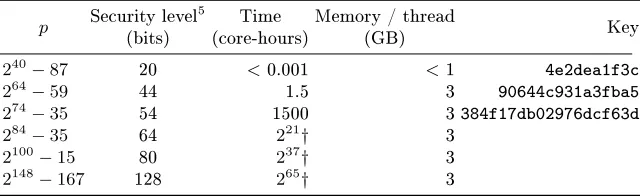
This section discusses several aspects of our implementation of the attack from Section 3.3 that we applied to the key recovery puzzles proposed by the Ethereum foundation [Fei19b]. Using the attack from Section 3, we managed to solve three out of six challenges (including the test instance with a 40-bit prime). A summary of the instance parameters and the time and memory requirements of the attack is given in Table 2.
The source code of our implementation is publicly available at
https://github.com/cryptolu/LegendrePRF
Table 2. Parameters of the concrete challenges proposed by the Ethereum founda-tion [Fei19b]. For all instances, the rstM = 220consecutive PRF outputs were given.
For the rst three instances, the running time and peak memory usage is given, for the three hardest instances an estimation of time is provided (marked by †). All experi-ments were performed on a Dell C6420 server with two Intel Xeon Gold 6132 CPUs clocked at 2.6 GHz and 128 GB of RAM.
p Security level
5
(bits) (core-hours)Time Memory / thread(GB) Key
240−87 20 <0.001 <1 4e2dea1f3c
264−59 44 1.5 3 90644c931a3fba5
274−35 54 1500 3 384f17db02976dcf63d
284−35 64 221† 3
2100−15 80 237† 3
We compiled our C++ implementation of the attack using Clang 6.0.0 and ex-ecuted it on a Dell C6420 server with two Intel Xeon Gold 6132 CPUs clocked at 2.6 GHz (28 cores) and 128 GB of RAM. The optimizations described in Sec-tion 3.4 allow to signicantly reduce the required memory and the number of evaluations of the Legendre symbol. As a result, the table lookups are the bot-tleneck in our implementation. On average, a single thread required 0.08µs to
compute and check a single 64-bit sequence. As discussed below, we expect to computep/228 sequences on average before the key is recovered. Hence, the re-quired core time to solve a challenge with a primepand220bits of PRF output
can be estimated as p/228×0.08µs. The required memory is 1 GB per server
and an additional 3 GB per thread. The parameters can be modied to reduce the memory without signicantly decreasing the performance.
For the rst three instances we successfully recovered the secret key of the PRF in a timespan close to our estimation. The corresponding keys are given in Table 2. The third instance was solved in under two hours using a cluster of 40 nodes with the described conguration. Further details about the main steps of the attack are provided below.
Step 1: Processing the PRF Output As a rst step we compute the set
T consisting of all arithmetic sequences extracted from the sequenceLk([220]) given in the challenge. We chose to store sequences of lengthm= 64since this
length provides an acceptable rate of false-positives and enables to eciently process sequences as 64-bit words. As a result, the setT contains approximately
M2/(2m2) = 227of such words-sequences.
A straightforward way to implement a set is by using a hash table, which has a constant amortized time-complexity for membership testing. However, this constant time may be quite large in practice, especially in the case of large tables. Random memory accesses are often the main bottleneck. In our case, the set T is never modied after its creation. To exploit this fact, we sort the
elements of T and we store them in an array. Then, we compute membership
queries in batches. First, we collect a large amount of membership queries and we sort them. Then, we scan through the two sorted arrays checking for collisions. The bottleneck in this approach is represented by the sorting step of each batch of membership queries. The described set T contains227 64-bit words and the corresponding sorted array requires 1 GB of memory. An extra 1 GB of memory is used to store information required for the key recovery. Note that the setT and
the extra information are shared among all threads that are used to parallelize the workload of the next step.
Step 2: Random Sampling The second and main step of the attack consists of sampling sequences L0(c+ [m])for randomly chosen c and checking if they
collide with an entry ofT. Note that the reversed sequenceL0(c+[m])is checked if it is lexicographically smaller.
For a uniformly chosen c ∈ Fp we compute a long sequence L0(c+ [t]) and we extract a large amount of m-bit sequences from it. More precisely, for all b∈ {1,2, . . . ,28}anda∈ {0,1, . . . , t−1−b(m−1)}, we extractL
0(c+a+b[m]). The upper-bound forbis chosen as28 since it is enough to make the time spent on computing Legendre symbols negligible. Furthermore, all these sequences can be computed on the y by storing only the last sequence per pair(b, a). Indeed,
for a large enoughi∈Z, after expanding the computed sequenceL0(c+[i−1])by one Legendre symbolL0(c+i)we obtain a new sequenceL0(c+i−b(m−1)+b[m]) for eachb. In other words, we obtain28 sequences from each single consequent
Legendre symbol computation.
As described above, the computed sequences are accumulated and checked in batches for a collision with the set T. Each batch is sorted using base-28 radix sort and collisions are checked using a linear scan through the sorted batch and the sorted array ofT. In the case of a collision, a key candidate is recovered and
checked against extra bits from the given PRF output.
Note that this step can be eciently parallelized. Each thread starts with a uni-formly random a∈Fp and proceeds as described above. After a predetermined amount of steps, a new value foracan be chosen to ensure a suciently uniform
coverage of the possible osets of the sequences.
9 Conclusions
In Section 3, a new attack on the Legendre PRF was presented. It is of particular interest in the low-data setting. Specically, givenM ≤√4pqueries, our attack recovers the key using O(plog2p/M2)Legendre symbol evaluations. The prac-tical relevance of this result was demonstrated by solving the rst two Legendre PRF challenges set out by the Ethereum foundation [Fei19b]. Several aspects of our implementation of the attack were discussed in Section 8.
In Section 4, it was shown how the technique from Section 3 yields improved at-tacks on the higher-degree generalization of the Legendre PRF. Further atat-tacks on the higher-degree case were given in Section 5, where a large class of weak keys was revealed. Keys from this class can be recovered usingO(pbd/2cdlogp)
Leg-endre symbol evaluations and O(pdd/2edlogp) memory. Further improvements
to the memory usage, based on a reduction to the uniquek-XOR problem, were
also discussed. These weak key attacks can be prevented by choosing the key such that the corresponding monic polynomial is irreducible.
PRF can be recovered with time-complexity proportional to the time-complexity of key-recovery on the Legendre PRF for each of the prime factors of the modu-lus separately. This result eliminates the potential eciency benets oered by Jacobi symbols.
Power residue symbols were considered in Section 7. The low-data attack from Section 3 equally applies in this setting, but we provide an additional attack that preforms better for large power residue symbols. Specically, forr-th power
residue symbols and given M ≤ √p queries, our key-recovery attack requires
O(plog2p/(rMlog2r))power residue evaluations andO(M)memory.
References
AGR+16. Martin R. Albrecht, Lorenzo Grassi, Christian Rechberger, Arnab Roy, and
Tyge Tiessen. MiMC: Ecient encryption and cryptographic hashing with minimal multiplicative complexity. In Jung Hee Cheon and Tsuyoshi Takagi, editors, ASIACRYPT 2016, Part I, volume 10031 of LNCS, pages 191219. Springer, Heidelberg, December 2016.
Ala96. N. Aladov. Sur la distribution des résidus quadratiques et non-quadratiques d'un nombre premierpdans la suite1,2, . . . , p−1. Matematicheskii Sbornik,
18(1):6175, 1896.
BJLM13. Daniel J Bernstein, Stacey Jeery, Tanja Lange, and Alexander Meurer. Quantum algorithms for the subset-sum problem. In International Workshop on Post-Quantum Cryptography, pages 1633. Springer, 2013.
BZ10. Richard P Brent and Paul Zimmermann. An O(M(n) logn) algorithm for
the Jacobi symbol. In International Algorithmic Number Theory Sympo-sium, pages 8395. Springer, 2010.
CJM02. Philippe Chose, Antoine Joux, and Michel Mitton. Fast correlation at-tacks: An algorithmic point of view. In Lars R. Knudsen, editor, EURO-CRYPT 2002, volume 2332 of LNCS, pages 209221. Springer, Heidelberg, April / May 2002.
Dam90. Ivan Damgård. On the randomness of legendre and jacobi sequences. In Sha Goldwasser, editor, CRYPTO'88, volume 403 of LNCS, pages 163 172. Springer, Heidelberg, August 1990.
Dav31. Harold Davenport. On the distribution of quadratic residues (modp).
Jour-nal of the London Mathematical Society, 1(1):4954, 1931.
Dav39. Harold Davenport. On character sums in nite elds. Acta Mathematica, 71(1):99121, 1939.
Fei19a. Dankrad Feist. Cryptanalyzing the Legendre PRF. CRYPTO rump session talk, August 2019.
Fei19b. Dankrad Feist. Legendre pseudo-random function. https://legendreprf. org, 2019. Accessed: 2019-11-18.
GRR+16. Lorenzo Grassi, Christian Rechberger, Dragos Rotaru, Peter Scholl, and
Jac06. Ernst Erich Jacobsthal. Anwendungen einer Formel aus der Theorie der quadratischen Reste. PhD thesis, Friedrich-Wilhelms Universität zu Berlin, 1906.
Kho19. Dmitry Khovratovich. Key recovery attacks on the Legendre PRFs within the birthday bound. Cryptology ePrint Archive, Report 2019/862, 2019. https://eprint.iacr.org/2019/862.
KKK20. Novak Kaluerovi¢, Thorsten Kleinjung, and Du²an Kosti¢. Improved key recovery on the legendre prf. Cryptology ePrint Archive, Report 2020/098, 2020. https://eprint.iacr.org/2020/098.
MOM92. Hikaru Morita, Kazuo Ohta, and Shoji Miyaguchi. A switching closure test to analyze cryptosystems. In Joan Feigenbaum, editor, CRYPTO'91, volume 576 of LNCS, pages 183193. Springer, Heidelberg, August 1992.
NPS19. María Naya-Plasencia and André Schrottenloher. Optimal merging in quantum k-xor and k-sum algorithms. Cryptology ePrint Archive, Report 2019/501, 2019. https://eprint.iacr.org/2019/501.
Tao15. Terence Tao. Cycles of a random permutation and irreducible factors of a random polynomial. https://terrytao.wordpress.com/2015/07/15/cy cles-of-a-random-permutation-and-irreducible-factors-of-a-rando m-polynomial/, 2015. Accessed: 2019-11-18.
VBCG14. S. Varrette, P. Bouvry, H. Cartiaux, and F. Georgatos. Management of an academic HPC cluster: The UL experience. In Proc. of the 2014 Intl. Conf. on High Performance Computing & Simulation (HPCS 2014), pages 959967, Bologna, Italy, July 2014. IEEE.
vDH00. Wim van Dam and Sean Hallgren. Ecient quantum algorithms for shifted quadratic character problems. arXiv preprint quant-ph/0011067, 2000. vOW94. Paul C. van Oorschot and Michael J. Wiener. Parallel collision search with
application to hash functions and discrete logarithms. In Dorothy E. Den-ning, Raymond Pyle, Ravi Ganesan, and Ravi S. Sandhu, editors, ACM CCS 94, pages 210218. ACM Press, November 1994.
vS98. R. von Sterneck. Sur la distribution des résidus et des non-résidus quadra-tiques d'un nombre premier. Matematicheskii Sbornik, 20(2):269284, 1898. Wag02. David Wagner. A generalized birthday problem. In Moti Yung, editor, CRYPTO 2002, volume 2442 of LNCS, pages 288303. Springer, Heidelberg, August 2002.