Adaptively Secure and Succinct Functional Encryption:
Improving Security and Efficiency, Simultaneously
Fuyuki Kitagawa1 Ryo Nishimaki2 Keisuke Tanaka1 Takashi Yamakawa21Tokyo Institute of Technology, Japan
{kitagaw1,keisuke}@is.titech.ac.jp
2NTT Secure Platform Laboratories, Japan
{ryo.nishimaki.zk,takashi.yamakawa.ga}@hco.ntt.co.jp
Abstract
Functional encryption (FE) is advanced encryption that enables us to issue functional decryption keys where functions are hardwired. When we decrypt a ciphertext of a messagemby a functional decryption key where a functionf is hardwired, we can obtainf(m)and nothing else. We say FE is selectively or adaptively secure when target messages are chosen at the beginning or after function queries are sent, respectively. In the weakly-selective setting, function queries are also chosen at the beginning. We say FE is single-key/collusion-resistant when it is secure against adversaries that are given only-one/polynomially-many functional decryption keys, respectively. We say FE is sublinearly-succinct/succinct when the running time of an encryption algorithm is sublinear/poly-logarithmic in the function description size, respectively.
In this study, we propose a generic transformation from weakly-selectively secure, single-key, and sublinearly-succinct (we call “building block”) PKFE for circuits into adaptively secure, collusion-resistant, and succinct (we call “fully-equipped”) one for circuits. We assume only the existence of the building block PKFE for circuits. That is, our transformation relies on neitherconcrete assumptions such as learning with errorsnorindistinguishability obfuscation (IO). This is the first generic construction of fully-equipped PKFE that does not rely on IO.
As side-benefits of our results, we obtain the following primitives from the building block PKFE for circuits: (1) laconic oblivious transfer (2) succinct garbling scheme for Turing machines (3) selectively secure, collusion-resistant, and succinct PKFE for Turing machines (4) low-overhead adaptively secure traitor tracing (5) key-dependent-message secure and leakage-resilient public-key encryption. We also obtain a generic transformation from simulation-based adaptively secure garbling schemes that satisfy a natural decomposability property into adaptively indistinguishable garbling schemes whose online complexity does not depend on the output length.
Contents
1 Introduction 1
1.1 Background . . . 1
1.2 Our Contributions. . . 3
2 Technical Overview 5 2.1 Laconic OT from Succinct PKFE. . . 5
2.2 Adaptive Garbling from Selective-Database Updatable Laconic OT. . . 8
2.3 From Single-Bit to Multi-Bit Succinct FE by Leveraging Collusion-Resistance. . . 10
2.4 Adaptively Indistinguishable Garbling with Near-Optimal Online Complexity . . . 10
3 Preliminaries 12 3.1 Notations . . . 12
3.2 Basic Tools . . . 13
3.3 Identity-Based Encryption . . . 14
3.4 Garbling Schemes. . . 15
3.5 Functional Encryption . . . 17
3.6 Indistinguishability Obfuscation . . . 19
3.7 Somewhere Equivocal Encryption . . . 20
4 Selective-Database Laconic OT from PKFE 21 4.1 Definition of Selective-Database Laconic OT . . . 21
4.2 Selective-Database Laconic OT with Compression Factor2from IO . . . 23
4.3 Replacing IO with sublinearly Succinct PKFE . . . 26
4.4 From Non-Updatable to Updatable . . . 27
5 Adaptive Garbling from Selective-Database Laconic OT 27 5.1 Description of Our Adaptive Garbling Scheme. . . 28
5.2 Security Proof of Adaptive Garbling from Selective-Database Laconic OT . . . 31
5.3 Secret-Key FE from Our Adaptive Garbling . . . 39
6 Adaptively Secure, Collusion-Resistant, and Succinct FE 41 6.1 From Single-bit to Multi-bit Succinct FE by Leveraging Collusion-Resistance . . . 42
6.2 Fully-Equipped PKFE. . . 42
7 Adaptively Indistinguishable Garbling with Near-Optimal Online Complexity 43 7.1 Roadmap . . . 43
7.2 Secret-Key Non-Committing Encryption for Receiver . . . 44
7.3 Additional Definitions for Adaptive Garbling. . . 46
7.4 SKFE from Quasi-Decomposable Garbling . . . 48
7.5 From 1-Bit to Multi-Bit SKFE . . . 52
7.6 Adaptively Indistinguishable Garbling from 1-Bounded Key-Adaptive SKFE. . . 53
7.7 Adaptively Indistinguishable Garbling with Near-Optimal Online Complexity . . . 54
1
Introduction
1.1 Background
Achieving stronger cryptographic primitives by using weaker ones is one of the central and fundamental tasks in cryptography. We would like to minimize assumptions to achieve more secure and advanced cryptography. A typical example is how to achieve IND-CCA secure public-key encryption from IND-CPA secure one [NY90,DDN00,Sah99]. The objective of this study is showing how to achieve more secure and efficientfunctional encryption(FE) from less secure and efficient one in a generic way.
FE [BSW11] is encryption that enables us to issue functional decryption keysskf where a functionf is hardwired. We can decrypt a ciphertextctmof a messagemby usingskf. A notable feature of FE is that we obtainf(m)and nothing else when we decryptctmbyskf. If we can encrypt messages by a public-key
(resp. a master secret key), then we call public-key (resp. secret-key) FE (PKFE and SKFE for short). FE can control what information of messages can be given to owners of functional decryption keys by using various functions. Moreover, FE is a versatile tool to achieve useful cryptographic primitives such as trapdoor permutations, universal samplers, non-interactive multi-party key-exchange [GPSZ17]. The most prominent application of FE is achieving indistinguishability obfuscation (IO) [BGI+12,GGH+16]
from FE [AJ15,BV15,BNPW16,KS17,KNT18a].
There are three main performance measures of FE. One is the number of issuable functional decryption keys. Another is the level of security. The other is the size of an encryption circuit. If an FE scheme can securely release one/polynomially-many functional decryption key/s, we call it a single-key/collusion-resistant scheme. Roughly speaking, an FE scheme is secure if adversaries cannot distinguish whether a target ciphertext is an encryption ofm0orm1chosen by them. In the security game, adversaries can send
functional decryption key queries and receivesskffor queriedfas long asf(m0) =f(m1). If adversaries
are required to commit target messages(m0,m1)(resp. and queriesf1, . . . , fq) at the beginning of the game, we call itselective(resp. weakly selective) security. If adversaries can decide target messages after they send functional decryption key queries1, then we call itadaptivesecurity. The size of an encryption circuit must depend on the length of messages to be encrypted. Moreover, the size might depend on the size of functions supported by the scheme as several known FE schemes do [SS10,GVW12]. The dependence on the size of functions should be as low as possible to achieve better efficiency. FE is called
succinct/sublinearly-succinctif the dependence is logarithmic/sublinear.
It is desirable to achieve the best properties of all performance measures simultaneously. Therefore, the following question is natural.
Can we achieve adaptively secure, collusion-resistant, and succinct PKFE for circuits by using only weakly-selectively secure, single-key, and sublinearly-succinct one?
This question has been extensively studied [ABSV15,BV15,AJS15,GS16,LM16,HJO+16,JSW17, GS18], but all previous studies gave only partial answers. In this study, we give an affirmative answer to the open question above, which was clearly stated by Garg and Srinivasan [GS16]. We sometimes call the building-block and goal-primitive in the question aboveobf-minimum2andfully-equippedPKFE, respectively in this paper.
One might wonder why we do not start with weakly-selectively secure, single-key, andnon-succinctFE. This is because there is a huge gap between non-succinct FE and sublinearly-succinct one. We know that sub-exponentially-secure sublinearly-succinct FE implies IO for circuits [AJ15,BV15,GS16,KNT17a, KNT17b,KNT18b,KNT18a]. We also know that non-succinct PKFE (resp. SKFE) is achieved byplain public-key encryption (resp. one-way function)[SS10,GVW12]. It is unlikely that we can achieve IO from plain public-key encryption.Thus, we start with sublinearly-succinct FE. We also emphasize that
we focus on transformations withpolynomial security lossin this study. If sub-exponential security loss is allowed, we can achieve IO from obf-minimum SKFE/PKFE. We rely on neither sub-exponential security nor IO in this study. We stress that avoiding sub-exponential security loss is one of big issues in cryptography. Sub-exponential security loss significantly degrades security and efficiency of cryptographic schemes in general. In particular, in the area of obfuscation-based (or FE-based) cryptography, avoiding sub-exponential security loss has been actively studied [GS16,GPS16,GPSZ17,LZ17,ACH18].
Hereafter, we use the following notations. Relationships between different notions of PKFE and SKFE are parameterized by (#ct,#key,sec,eff). Here, #ct ∈ {1ct,unbct},#key ∈ {1key,unbkey}
denote the number of ciphertexts/functional-decryption-keys: unbmeans unbounded polynomially many, sec∈ {w-sel,sel,ada}denotes weakly-selective, selective or adaptive security,eff ∈ {ns,sls,fs}denotes
the efficiency: ns,sls, andfsdenote non-succinct, sublinearly-succinct, and succinct, respectively. In the case of PKFE, we omit#ct3.
Known Transformations for Better Security and Efficiency. There are several techniques to strengthen security and/or improve the efficiency of FE. Ananth, Brakerski, Segev, and Vaikuntanathan [ABSV15] presented a transformation from selectively secure FE to adaptively secure FE. Unfortunately, this transformation does not preserve (sublinear-)succinctness. This is because the transformation uses a
(unbkey,1ct,ada,ns)-SKFE scheme4[GVW12] as a key building block. Garg and Srinivasan [GS16],
and Li and Micciancio [LM16] presented transformations from single-key and sublinearly-succinct PKFE to collusion-resistant one. More specifically, the transformation by Garg and Srinivasan [GS16] is from(1key,w-sel,sls)-PKFE to(unbkey,sel,fs)-PKFE. However, these transformations do not preserve
adaptive security. Ananth, Jain, and Sahai [AJS15] and Bitansky and Vaikuntanathan [BV15] presented a transformation from(unbkey,sel,ns)-PKFE to(unbkey,sel,fs)-PKFE. This transformation also does
not preserve adaptive security. Ananth and Sahai [AS16] presented a transformation (denoted by AS16 transformation) from(unbkey,sel,fs)-PKFE for circuits to(unbkey,ada,fs)-PKFE for Turing machines
(TMs) by using(1key,1ct,ada,fs)-SKFE for TMs. If the building block(1key,1ct,ada,fs)-SKFE is for circuits, then the transformation also works and we obtain the resulting PKFE forcircuits. The difference from the transformation by Ananth et al. [ABSV15] is that we can start with(1key,1ct,ada,fs)-SKFE.
AS16 transformation is the closest to what we want, but not satisfactory since it uses IO (that is,
sub-exponentially secureFE). All these transformations sacrifice either adaptive security or succinctness or rely on IO. Thus, the transformation in the question above has been a famous open problem in the area of FE.
Crucial Ingredient: Adaptive Garbling. As we saw above, if we can obtain(1key,1ct,ada,fs)-SKFE
for circuits from(1key,w-sel,sls)-PKFE, then we resolve the open question above by using the
transforma-tions of Garg and Srinivasan [GS16] and Ananth and Sahai [AS16]. In fact,(1key,1ct,ada,fs)-SKFE for
circuits is essentially the same asadaptively indistinguishable garbling schemes (indistinguishability-based definition [JSW17]) whose online computational complexity ispoly(log|C|, n, λ)whereCis a circuit to
be garbled,nis the input length ofC, andλis the security parameter5. We call garbling schemes whose online computational complexity ispoly(log|C|, n, λ)circuit-succinctgarbling schemes.6 Thus, we
focus on adaptive and circuit-succinct garbling schemes.
3In the case of PKFE,#ctis triviallyunb.
4In the setting of SKFE, only an entity that has a master secret-key can generate ciphertexts. Thus, adversaries is allowed to
send messages as queries and receives ciphertexts in its security game. When adversaries can send one/polynomially-many message(s), we say one/many-ciphertext SKFE.
5In fact, there are subtle issues to transform a garbling scheme into a single-key and single-ciphertext SKFE (the opposite is
easy). See Section5.3for more details.
6Note that this is different from succinct garbling schemes [AL18,BCG+18] since ours is for circuits while succinct garbling
Several adaptively secure garbling schemes have been proposed [BHR12,HJO+16,JW16,JSW17, JKK+17,GS18]. The garbling scheme of Bellare, Hoang, and Rogaway is not circuit-succinct, that is,
the online computational complexity ispoly(|C|, λ). The garbling scheme of Hemenway, Jafargholi,
Ostrovsky, Scafuro, and Wichs [HJO+16] achieves online computational complexity(n+m+w)poly(λ)
wheren,m, andware the input length, output length, and width of a circuit to be garbled, respectively
(they also presented a garbling scheme forNC1circuits whose complexity is(n+m)poly(λ)). Jafargholi,
Scafuro, and Wichs [JSW17] presented an adaptively indistinguishable garbling scheme whose online computational complexity is(n+w)poly(λ). The garbling scheme of Garg and Srinivasan [GS18] (we
call GS18 scheme in this paper) achieved online computational complexityO(n+m) + poly(log|C|, λ).
Others [JW16,JKK+17] are garbling scheme forNC1circuits. None of these is satisfactory for our goal
since the complexity depends on a polynomial of|C|,w,d, orm.
GS18 scheme is closest to what we want. However, there are two issues as follows.
1. GS18 scheme is based on a concrete assumption (the CDH, LWE, or factoring assumptions). More specifically, the scheme is based on updatable laconic oblivious transfer (LOT) [CDG+17], which
is achieved by the CDH, LWE, or factoring assumptions [CDG+17,BLSV18,DGHM18].
2. GS18 scheme is simulation-based secure. Therefore, the online computational complexity must be at least linear inmsince Applebaum, Ishai, Kushilevitz, and Waters [AIKW15] showed the lower
bound of online complexity for simulation-based secure garbled circuits.
Getting Rid of the Dependence on Output Length. If we can generically transform a simulation-based adaptively secure garbling scheme whose online computational complexity ispoly(n, m, g(|C|), λ)where
g(·)is some function (such aslog(·)) into an adaptivelyindistinguishablegarbling scheme whose online
computational complexity ispoly0(n, g(|C|), λ), then we can solve the second issue explained above by
using GS18 scheme [GS18] as a building block. In fact, Jafargholi et al. left such a transformation as an open problem [JSW17]. We quote their sentence in a footnote.7 This open question is related to our main question since(1key,1ct,ada,fs)-SKFE is the crucial ingredient as explained above.
1.2 Our Contributions
We solved the open problem explained in the previous section. In particular, we prove the following theorem.
Theorem 1.1 (Main theorem).Assume that there exists weakly-selectively secure, single-key, and
sublinearly-succinct PKFE for circuits, then there exists adaptively secure, collusion-resistant, and succinct PKFE for circuits.
Note that all our constructions and transformations in this study incur only polynomial security loss. To obtain our crucial ingredient,(1key,1ct,ada,fs)-SKFE, we will prove the (informal) theorems below,
which are of independent interests, and construct an adaptively secure garbling scheme whose online computational complexity ispoly(log|C|, n, λ)by combining (a variant of) GS18 scheme.
Theorem 1.2 (Informal, see Theorem4.8).Assume that there exists(1key,w-sel,sls)-PKFE for circuits,
then there exists updatable laconic oblivious transfer.
That is, we can generically construct updatable LOT from obf-minimum FE. This solves the first issue of GS18 scheme. This itself is interesting since this is the first construction of LOT that relies on
neitherspecific number theoretic assumptionsnorIO.8Therefore, we obtain an adaptively secure garbling scheme whose online computational complexity isO(n+m) + poly(log|C|, λ)from obf-minimum
PKFE via GS18 scheme. Note that, to achieve this, we need some tweaks for the garbling scheme since the security level of our updatable LOT is slightly weaker than that used in GS18 scheme. In fact, we prove that such a weaker LOT is sufficient to achieve an adaptively secure garbling scheme that we need. However, for simplicity, we give only informal theorems here. See Section2for more details.
We propose two solutions for the second issue of GS18 scheme. One is proposing an extension of AS16 transformation [AS16] in the following theorem.
Theorem 1.3 (Informal, see Theorem6.1).If there exists(unbkey,sec,eff)-PKFE for boolean circuits, then there exists(unbkey,sec,eff)-PKFE for circuits wheresec∈ {w-sel,sel,ada}andeff ∈ {ns,sls,fs}. This transformation preserves adaptive security and succinctness.
If we set m = 1 (that is, single-bit output) in adaptively secure garbling scheme whose online
computational complexity is O(n, m,log|C|, λ), then we obtain adaptively secure circuit-succinct
garbling scheme for boolean circuits. We plug this into AS16 transformation, and then we obtain
(unbkey,ada,fs)-PKFE for booleancircuits. Lastly, by applying the informal theorem above, we can
obtain fully-equipped PKFE. See the next section for more details. Note that it is easy to transform our variant of GS18 scheme into(1key,1ct,ada,fs)-SKFE for boolean circuits. See Section5.3for details.
The other is using the transformation in the following theorem.
Theorem 1.4 (Informal, see Theorem 7.8).Assume that there exists a simulation-based adaptively
secure garbling scheme whose online computational complexity depends on the output length of circuits and that satisfies a natural decomposability property, then there exists an indistinguishability-based adaptively secure garbling scheme whose online computational complexity does not depend on the output length of circuits. The overhead of the transformation is not large, that is, the online complexity affected by other parameters (|C|,n, andλ) do not change in an asymptotic sense.
Known adaptive garbling schemes satisfy the natural decomposability property. That is, we solve the open question by Jafargholi et al. [JSW17]. Note that the first solution is much simpler than the second one. However, the technique used in the transformation in Theorem1.4is related to other our techniques in this study, and adaptively secure circuit-succinct garbling schemes are closely related to our goal as we explained so far. Moreover, Theorem1.4solves the open problem presented by Jafargholi et al. [JSW17] (We think this is of an independent interest). Therefore, we also include the second solution in this paper.
More Implications of Our Results. Ananth and Lombardi [AL18] proved that if there exists single-key and succinct PKFE for circuits and one of CDH/LWE/factoring assumptions holds, then there exists succinct garbling scheme for TMs. The concrete assumptions come from that they use LOT. We can replace their LOT with our LOT based on FE9. Thus, we obtain the following corollary.
Corollary 1.5.If there exists(1key,w-sel,sls)-PKFE for circuits, then there exists a succinct garbling
scheme for TMs.
We also obtain the following corollary by combining with the known results [AS16,GS16].
Corollary 1.6.If there exists(1key,w-sel,sls)-PKFE for circuits, then there exists(unbkey,sel,fs)-PKFE for TMs.
That is, we remove the concrete assumptions from the theorems of Ananth and Lombardi.10 Agrawal and Maitra [AM18] also proved that if there exists succinct PKFE for circuits, then there exists PKFE for TMs. However, their PKFE for TMs supports only single/constant-bit output TMs. That is, our corollary above improves their result since ours supports multi-bit output TMs.11
Nishimaki, Wichs, and Zhandry [NWZ16] presented a traitor tracing scheme that supports an exponentially large identity space and whose ciphertext overhead isO(logn)wherenis the length of
identities. Their scheme is based on fully-equipped PKFE that was instantiated by IO previously. Thus, we obtain the following corollary.
Corollary 1.7.If there exists(1key,w-sel,sls)-PKFE for circuits, there exists an adaptively secure traitor
tracing scheme whose master key size ispoly(logn), secret key size ispoly(n), and ciphertext size is |m|+ poly(logn)where|m|is the message length.
Brakerski, Lombardi, Segev, and Vaikuntanathan [BLSV18] presented a key-dependent-message (KDM) secure and leakage-resilient PKE scheme based on batch encryption, which is essentially the same as LOT. Thus, we obtain the following corollary (See the reference [BLSV18] for the details of parameters in the statement).
Corollary 1.8.If there exists(1key,w-sel,sls)-PKFE for circuits, then there exists a PKE scheme that
satisfies (1) KDM security with respect to affine functions of the secret key and (2) leakage-resilience with leakage rate1−o(1).
To the best of our knowledge, except constructions based on IO [DGL+16, MPs16], all existing
generic constructions of PKE satisfying KDM security or leakage resilience of1−o(1)rate assume some
algebraic property such as homomorphism to the underlying primitive. Our construction is a generic construction of PKE satisfying the above security notions based on a polynomially secure primitive without such algebraic properties.
2
Technical Overview
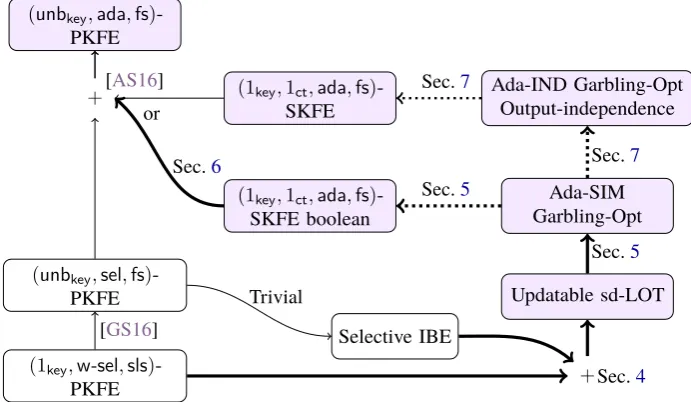
In this section, we give high level overviews of our techniques. We briefly summarize how to arrive at fully-equipped PKFE from obf-minimum PKFE in Figure1.
2.1 Laconic OT from Succinct PKFE
We first show an overview of our LOT protocol based on sublinearly succinct PKFE. More precisely, we construct updatable LOT with arbitrary compression factor based on(1,w-sel,sls)-PKFE.
By the transformation of Cho et al. [CDG+17] and an observation by Ananth and Lombardi [AL18]12,
we can transform non-updatable LOT with compression factor 2 into updatable one with arbitrary
compression factor using Merkle tree. Thus, to achieve our goal, we can focus on constructing non-updatable LOT with compression factor2. Our first observation is that we might construct such LOT
based on IBE. In this overview, let the length of a databaseDbes, that isD∈ {0,1}s, andD[i]denotes thei-th bit ofD.
10Note that we cannot obtain an adaptively secure scheme in Corollary1.6since the succinct garbling for TMs by Ananth and
Lombardi is not adaptively secure.
11Note that their FE for TMs satisfies a stronger security notion called distributional indistinguishability than standard
indistinguishability.
12Cho et al.’s bootstrapping method is not sufficient for LOT whose security holds only when an adversary declares the
(1key,w-sel,sls) -PKFE (unbkey,sel,fs)
-PKFE
Selective IBE
Ada-SIM Garbling-Opt (1key,1ct,ada,fs)
-SKFE boolean
Ada-IND Garbling-Opt Output-independence (1key,1ct,ada,fs)
-SKFE
Updatable sd-LOT (unbkey,ada,fs)
-PKFE
+
+Sec.4 Sec.5 Sec.7 Sec.7
Sec.6
Sec.5
Trivial [AS16]
or
[GS16]
Figure 1:Illustration of the path from our starting point to the goal: In this figure, “SKFE boolean” denotes SKFE for boolean circuits. “Updatable sd-LOT” denotes selective-database updatable laconic OT. Regarding garbling scheme, “Garbling-Opt” denotes garbling schemes with nearly optimal online complexity and “Output-independence” denotes the online complexity does not depends on output-length (See Sections5and7for more details). Ada-SIM/Ada-IND denote simulation-/indistinguishability-based adaptively secure garbling schemes, respectively. Solid thin arrows denote known or trivial implications. Thick solid and dotted arrows denote implications that we prove in this study. Here, in the case of dotted lines, we assume specific properties of underlying tools. See each section for details.
Laconic OT Based on IBE and Its Problem. We first review the definition of LOT. An LOT consists of four algorithmsGen,Hash,Send, andReceive. We generate a CRScrsusingGen. Hash, givencrs and a databaseD, outputs a short digestdand private stateDb. The algorithmSend, givend, a database
locationL, and two messagesm0andm1, outputs LOT’s ciphertexte. By usingReceive, a receiver who
has the secret stateDb can decrypteand obtainmD[L]. For security, we require that an honest receiver
cannot obtain the other messagem1−D[L]even if he hasDb.
Our basic idea for how to construct LOT is as follows. When hashing a databaseD, we first generate
a master public-key and master secret-key(MPK,MSK)ofIBEandski,D[i] ← KG(MSK, ikD[i])for
every i ∈ [s]. Then, we set MPK as a digest of D and {ski,D[i]}i∈[s] as a secret state Db. When
generating LOT’s ciphertext e for location L ∈ [s] and two messages m0 and m1, we generate
e= (Enc(MPK, Lk0, m0),Enc(MPK, Lk1, m1)). We see that a receiver who hasDb ={ski,D[i]}i∈[s]
can obtainmD[L]. If the receiver honestly generatesDb and deletesMSK, he cannot obtainmD[L]based
on the security ofIBE. Moreover, if the size of a master public-key ofIBEis independent of the identity length, the size of a digest is also independent of the database size. This construction resembles the one-time signature with encryption from IBE by Döttling and Garg [DG17].
The above construction seems to satisfy the syntactic and security requirement of LOT. However, the construction has a problem that the hash procedure is randomized. Though the definition of LOT by Cho et al. does not explicitly require that the hash algorithm be deterministic, we observe that the hash algorithm needs to be deterministic for the security notion defined by Cho et al. [CDG+17] to be
meaningful. In fact, the above basic construction has a crucial problem that if a receiver computes a hash value by himself, he obtains a master secret-key of IBE and can decrypt any ciphertext.
Moreover, it is not clear whether we can apply the bootstrap method proposed by Cho et al [CDG+17]
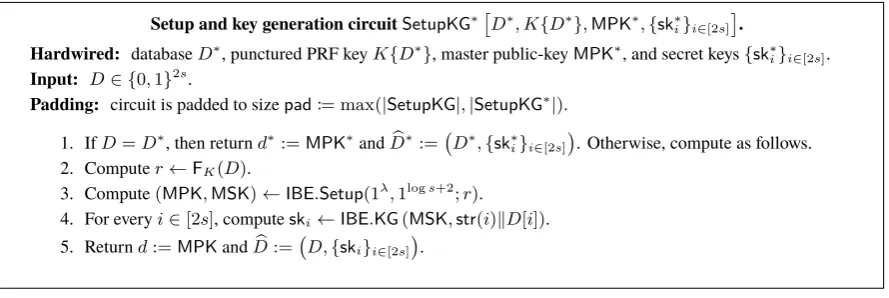
Derandomization Using IO. For the above reasons, we need to derandomize the hash algorithm of the above construction. We can make the hash procedure of the above construction deterministic by using IO and puncturable pseudorandom function (PRF) as follows.
In a modified construction, we generate a CRS by obfuscating a circuit that, given a databaseD, first
generates a random coin by usingDand a puncturable PRF key and then perform the hash procedure of
the basic construction using the random coin. This circuit outputs a digest that is a master public-key of IBE and secret state that is secret-keys of IBE corresponding toD, but not master secret-key.
We can prove the security of the modified construction based on the punctured programming technique proposed by Sahai and Waters [SW14]. However, to complete the proof, we need to require an adversary to declare the challenge database before seeing a CRS. This is because, in the security proof, we need to generate a CRS as an obfuscated circuit that has the challenge database hardwired. This security notion for LOT is weaker than that used by Garg and Srinivasan [GS18] to construct adaptive garbling scheme.
Selective-Database Security. In this work, we show that we can construct an adaptive garbling scheme based on LOT whose security holds only when the challenge database is selectively determined. We call an LOT scheme satisfying such a security notionselective-databaseLOT. Note that we allow an adversary for LOT to adaptively choose the challenge location and messages. In fact, in our construction of adaptive garbling scheme, we need LOT whose security holds even if the challenge messages are adaptively chosen. In contrast, the security notion defined by Cho et al. [CDG+17] that requires an adversary to declare all
challenge instances before seeing CRS is not sufficient for our adaptive garbling scheme. In Section2.2, we explain this issue in more detail.
By weakening the required security notion to selective-database security, LOT no longer imply collision-resistant hash function while the LOT satisfying an adaptive security notion used by Garg and Srinivasan does. This weakening seems to be necessary to achieve LOT from IO due to the substantial barrier that was shown by Asharov and Segev [AS15].
Replacing IO with Sublinearly Succinct PKFE. We can replace IO in the above construction with sublinearly succinct PKFE by relying on the result shown by Liu and Zhandry [LZ17].
Liu and Zhandry generalized previous works [GPS16,GPSZ17,GS16], and showed we can replace IO withdecomposable obfuscation (dO)that can be based on polynomially secure(1,w-sel,sls)-PKFE if
the circuit pair to be obfuscated satisfies some condition. Roughly speaking, they showed that if there is a polynomial size “witness” for the functional equivalence of a circuit pair to be obfuscated, IO can be replaced with dO. One particular situation where this condition is satisfied is that in the security proof we modify a circuit to be obfuscated so that it outputs a hardwired value fora single inputand otherwise it runs in the same way as the original one.
Using the terminology by Liu and Zhandry, hardwiring a single output for an input into a circuit corresponds todecomposethe circuit to the input. We explain this in more detail. LetCbe a circuit of
3-bit input. For a bit stringxof length less than 3, letCxbe a circuitC(xk·), that is,C in whichxis hardwired as the first|x|bit of the input. We call such a circuit partial evaluation ofC. When decomposing Cto the input say100, we representCas the tuple of partial evaluations(C0, C11, C100, C101). When
consideringCas a complete binary tree,(C0, C11, C100, C101)corresponds to the cover of minimum size
that contains100. We see that computation ofCon any input can be done using(C0, C11, C100, C101).
This is essentially the same as hardwiring a single outputC(100)on input100intoC.
Liu and Zhandry showed ifC is obfuscated by dO, we can replace it with an obfuscated circuit
that is constructed from partial evaluations(C0, C11, C100, C101)without affecting the behavior of an
adversary. At a high level, this change can be done by removingCand embedding(C0, C11, C100, C101)
Consider a circuit of the form C(x) = C0(x;FK(x)), where C0 is a circuit, F is a PRF, andK is a PRF key. For simplicity, letC be a circuit of3bit input as above. We show how to change the
distribution ofC(100). By obfuscatingCwith dO, we can decomposeCto100, that is, we can replace
obfuscatedCwith obfuscated circuit constructed from(C0, C11, C100, C101). Next, we changeFK(100) with a truly random string. To accomplish this step, we require thatFK(100)is pseudorandom even if partial evaluations ofFK(·)for0,11, and101are given. Liu and Zhandry call such PRFdecomposing
compatible PRFand the construction of PRF by Goldreich, Goldwasser, and Micali [GGM86] satisfies such a property. Once we can replaceFK(100)with a truly random string, we can change the distribution ofC(100). Thus, we can complete the security proof.
Instantiating Our Construction with Sublinearly Succinct PKFE. The circuit to be obfuscated in our construction is of the formC(x) =C0(x;FK(x)), whereC0 is a circuit executes a setup and key generation algorithm of IBE. In a similar manner as above, we can change the security game so that the master public-key and secret-keys related to the challenge database are generated using a truly random string. Then, we can prove the selective-database security of our LOT based on the selective security of IBE. Note that in the reduction, the challenge identity in the security game of IBE isL∗k1−D∗[L∗], where
D∗andL∗are challenge database and position in the security game of LOT. The identityL∗k1−D∗[L∗]
depends on the choice ofL∗by an adversary for LOT. However, the reduction algorithm can guess the
location with the probability at least 1
s+1, which is inverse polynomial. Thus, a selectively secure IBE is
sufficient for this construction.
Therefore, we can replace IO in our construction with dO, which can be based on(1key,w-sel,sls)
-PKFE. Moreover, selectively secure IBE can be constructed from(1key,w-sel,sls)-PKFE based on the
result by Garg and Srinivasan [GS16]. Their collusion-resistant PKFE based on(1key,w-sel,sls)-PKFE
can be used as an identity-based key encapsulation mechanism the size of whose master public-key is independent of the length of identities.13 Thus, we can construct selective-database LOT based only on
(1key,w-sel,sls)-PKFE.
Comparison with the Construction by Ananth and Lombardi [AL18]. Ananth and Lombardi showed a construction of LOT based on IO. As they noted, it seems difficult to replace IO in their construction with polynomially secure PKFE. The reason why they need IO is that they constructed LOT based onwitness encryption[GGSW13] by modifying the construction proposed by Cho et al. [CDG+17].
Witness encryption based on IO is outside of the framework by Liu and Zhandry. Thus, we cannot construct witness encryption from sublinearly succinct PKFE using the result by Liu and Zhandry. In fact, it is believed to be hard to construct witness encryption based on some polynomially secure primitive including PKFE [GGSW13].
2.2 Adaptive Garbling from Selective-Database Updatable Laconic OT
The adaptive garbling scheme by Garg and Srinivasan (we write GS18 scheme for short) is based on adaptively secure updatable LOT [GS18], where adversaries can select a database after they see a CRS. However, our LOT achieves only selective-database updatable LOT, where adversaries must commit a database before a CRS is given. In fact, we prove that we can achieve an adaptive garbling scheme by using aselective-databaseupdatable LOT.
Where is the Adaptive Property of LOT Used in GS18 Scheme? In GS18 scheme, a database of an updatable LOT is determined by an inputx. More specifically, the current database is determined byx,
each intermediate wire values determined byxand each gate, and output values. A CRScrsof updatable
13To achieve1
2 compression in our construction, it is sufficient that the size of a master public-key is logarithmic in the length
LOT is generated at the offline phase (i.e., when we generate a garbled circuitCe) andcrsis hardwired in
circuits to be garbled by selectively secure garbling. At this point,xmight not be determined yet since we
consider theadaptivesetting. Thus, a simulator must havecrsbeforex(and a database) is fixed. This is
why Garg and Srinivasan used the adaptive security of LOT.
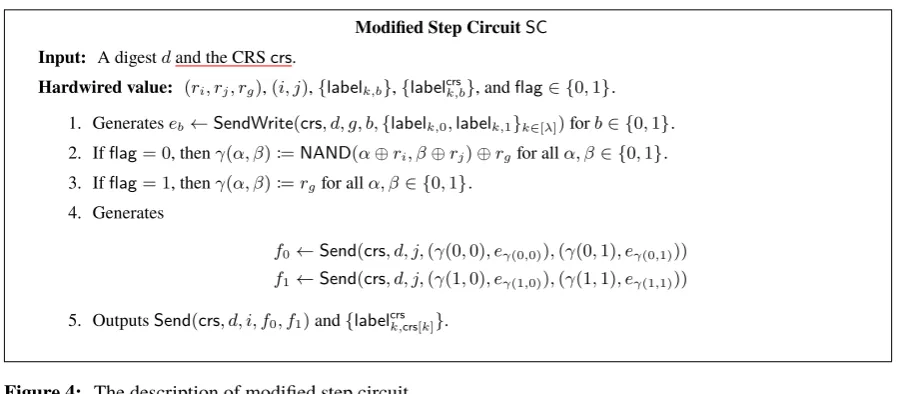
Overcoming the Issue. The issues is that we needcrsat the offline phase. Our idea is deferring using crsuntil we generate a garbled input (i.e., online phase). To look closer at our idea, we need to explain more on GS18 scheme. In GS18 scheme, “step circuits” are garbled by selectively secure garbling. Each step circuit has the description of each gate of the circuitCto be garbled by the adaptive garbling scheme.
Roughly speaking, a step circuit takes as input a digestdof updatable LOT and does the following two
procedures.
• Updating the database according to the output wire value of the gate computed from inputx.
• Outputting encrypted labels of selectively secure garbling for the next gate via updatable LOT. The important point is that crs of updatable LOT is hardwired in each step circuit to run Send and SendWritealgorithms, which was explained in Section2.1. This is the problem since we do not fixcrsat the offline phase. Here our idea comes in.
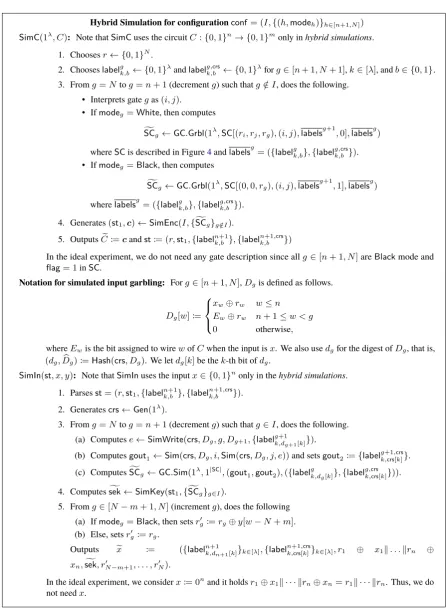
Instead of hardwiringcrsin each step circuit, we define modified step circuits that take as input not only digestdbut alsocrs. Nowcrsis an input for step circuits. By this change, to generate (simulated) garbled modified step circuits, we do not needcrs. As a result,crsneed not be determined at the offline phase. In the construction, we putcrsin the state information though we generatecrsat the offline phase in the construction. In the proof, a simulator can adaptively set the state information when the simulator needs it since the state information is not revealed.
The CRScrsmust be fixed when a garbled inputxeis generated. However, at this point, inputxand a
database were already determined. Therefore, we can use the selective-database security of updatable LOT because, in the simulation, an adversary of updatable LOT can simulate garbled step circuits without crs, and whenxis fixed, the adversary fixes a database based onxand can receivecrsin the reduction. This is the main idea behind our adaptive garbling scheme based on selective-database updatable LOT.
Although we can generatecrsat the online phase, we select that we putcrsin the state information for better online complexity and compatibility with the transformation given in Section7.
Note that, to make our proof work, reduction algorithms attacking updatable LOT need to set the challenge messages as values computed by using CRS. That is, we allow the challenge messages to depend on the CRS. This is why we introduce a new security notion selective-database security for LOT. Our LOT satisfies this security.
From Adaptive Garbling to Adaptively Secure 1-key 1-ciphertext SKFE. By combining two trans-formations explained in this section and the previous section, we obtain an adaptive garbling scheme whose online complexity isO(n+m) + poly(log|C|, λ)based on(1key,w-sel,sls)-PKFE. Especially,
by restricting circuits supported by garbling schemes to boolean circuits (circuits of single-bit output), we obtain an adaptive garbling scheme whose online complexity isO(n) + poly(log|C|, λ)based on the
same assumption.
In the next step, we use the transformation proposed by Ananth and Sahai [AS16]. In order to use their transformation, we have to transform the constructed adaptive garbling scheme into(1key,1ct,ada,fs)
-SKFE. Although adaptive garbling scheme with succinct online encoding and(1key,1ct,ada,fs)-SKFE are
essentially the same primitives, there is a difference between them. The security game for(1key,1ct,ada,fs)
2.3 From Single-Bit to Multi-Bit Succinct FE by Leveraging Collusion-Resistance
As explained in the previous section, we obtained(1key,1ct,ada,fs)-SKFE for boolean functions from
(1key,w-sel,sls)-PKFE. By using(1key,1ct,ada,fs)-SKFE for boolean functions in the transformation by
Ananth and Sahai [AS16], we obtain(unbkey,ada,fs)-PKFE for boolean functions. Here, we show that
we can transform(unbkey,ada,fs)-PKFE for boolean functions to one for functions with multi-bit outputs.
The transformation is very simple. We construct a PKFE scheme MultiPKFEfor functions with multi-bit outputs from a PKFE schemeOnePKFEfor boolean functions as follows. The encryption algorithm ofMultiPKFEworks completely in the same manner as that ofOnePKFE. The key generation algorithm ofMultiPKFE, given a functionfwithm-bit output, first decomposes the function to{fi}i∈[m]
where fi is a function that computes the i-th bit of f(m) on inputm. Then it generates decryption keys skfi for the functionfi fori ∈ [m]by the key generation algorithm of OnePKFE, and outputs skf :={skfi}i∈[m]. The decryption algorithm ofMultiPKFE, given a ciphertextCTof a messagemand
a decryption keyskf ={skfi}i∈[m], computesfi(m)fori∈[m]by using the decryption algorithm of OnePKFE, and outputsf(m) =f1(m)k · · · kfm(m).
In the above construction, if OnePKFEis adaptively collusion-resistant, thenMultiPKFE is also adaptively collusion-resistant since a decryption key ofMultiPKFEconsists of a polynomial number of decryption keys ofOnePKFE. Moreover, the transformation also preserves the succinctness of a ciphertext since a ciphertext ofMultiPKFEconsists of a ciphertext ofOnePKFE.
We note that this transformation has not been explicitly pointed out before despite its simplicity. Although researchers in this filed might already observe this transformation, we explicitly write it since to the best of our knowledge, nobody explicitly claims.
By combining the transformation with the results of previous sections, we obtain fully-equipped PKFE for all polynomial-size functions from(1,w-sel,sls)-PKFE.
2.4 Adaptively Indistinguishable Garbling with Near-Optimal Online Complexity
We explained how to construct fully-equipped PKFE for all polynomial-size functions from(1key,w-sel,sls)
-PKFE through Section2.1,2.2, and2.3. As mentioned in Section1, we have another option to achieve it.
In the option, after constructing adaptive garbling scheme as explained in Section2.2, we transform it into adaptivelyindistinguishablegarbling with near-optimal online complexity. More specifically, we construct an adaptively indistinguishable garbling scheme whose online complexity only logarithmically depends on the size of a circuit being garbled, and does not depend on the output length of the circuit. Similarly to adaptive garbling scheme, adaptively indistinguishable garbling with such online complexity can be easily transformed into(1key,1ct,ada,fs)-SKFE for (multi-bit output) circuits using one-time pad.
Thus, by using the transformation by Ananth and Sahai [AS16] with the resulting(1key,1ct,ada,fs)-SKFE,
we obtain fully equipped PKFE for circuits.
We can generalize the transformation from adaptive garbling scheme into adaptively indistinguishable garbling that removes the dependence on the output-length of online encoding so that it captures not only our (and GS18) adaptive garbling scheme but also those proposed by Hemenway et al. [HJO+16] and Jafargholi
and Wichs [JW16]. Thus, this transformation solves the open question posed by Jafargholi et al. [JSW17]. Here, we give an overview of the transformation.
Basic Idea. Our starting point is the simulation-based adaptive garbling given in Section 5 (or in [GS18]), which we denote byadGC0gs. Recall that the online communication complexity ofadGC0gs is n+m+ poly(λ,log|C|)whereC is the circuit being garbled withn-bit input andm-bit output.
Especially, we remark that if we only consider circuits of1-bit output, then the online communication
complexity isn+ poly(λ,log|C|). Our first attempt is to decompose a circuit ofm-bit output to circuits
output, we garbleCi, which is a circuit that outputs thei-th bit of an output ofC, for eachi∈[m]. For an inputx, the input garbling algorithm generates a single garbled inputxebyadGC0gs.
At first glance, this idea would lead to a garbling scheme with online communication complexity
n+ poly(λ,log|C|)since we only garble circuits of1-bit input. However, this idea does not work since
a garbling scheme is defined so that1 garbled input is associated with1garbled circuit whereas we
need a variant of garbling scheme where1garbled input is associated with multiple garbled circuits.
Here, we notice that such a variant of garbling scheme can be seen as a single-key SKFE (with function privacy14) by interpreting garbled circuits and garbled inputs as ciphertexts and decryption keys of SKFE, respectively. By this interpretation, the online communication and computational complexity as garbling are translated into the secret key length and running time of key generation, and the size of a circuit being garbled is translated into the message length. Based on this observation, we can see that what we need to construct an adaptively indistinguishable garbling with succinct online complexity is an adaptively secure single-key SKFE scheme with succinct decryption key and key generation in the sense that they only logarithmically depend on the message-length.
Single-Key SKFE with Succinct Decryption Key and Key Generation. Our idea to construct such an SKFE scheme is to plugadGC0gsinto the construction of adaptively secure single-key SKFE by Gorbunov, Vaikuntanathan and Wee [GVW12].15 We first briefly review their construction. In their construction, for a messagem, the encryption algorithm garbles the universal circuitU(m,·), which is given a description
of a functionf as input and outputs f(m), by Yao’s garbling scheme to generate a garbled circuitUe
along with labels that are needed to evaluate the garbled circuit. Then it encryptsUe and labels by a
secret-key non-committing encryption for receiver (SK-NCER) to generate a ciphertext of the SKFE scheme.16 Here, SK-NCER is a special type of SKE in which we can generate a “fake” ciphertext that can be opened to any message that is later chosen along with a corresponding “fake” decryption key. We note that we can construct an SK-NCER scheme whose decryption-key-length is proportional to the message-length from any SKE scheme by “double-encryption” construction similarly to some previous works [CHK05,HPW15]. A decryption key of the SKFE scheme for a functionf consists of secret
keys of SK-NCER that enable one to recover labels corresponding tof. By using the decryption key,
one first recovers labels corresponding tofand then evaluate the garbled circuitUe with these labels to
obtainU(m, f) =f(m). Intuitively, the security of the SKFE scheme holds since an adversary who
has a decryption key forf cannot obtain labels that do not correspond tof, and thusUe does not reveal
information ofmbeyond the value ofU(m, f) =f(m)by the security of Yao’s garbling. We note that it
is essential to encryptUe by SK-NCER for achieving the adaptive security since Yao’s garbling only has
the selective security and thus we cannot simulateUe before an input is determined.17 Since the size ofUe
is proportional to the message-length of the SKFE scheme and the decryption-key-length of SK-NCER depends on its message-length, the decryption-key-length of their SKFE scheme is proportional to the message-length of the SKFE scheme.
Here, we observe that if we use an adaptive garbling scheme instead of Yao’s garbling, then we need not encryptUe since we can simulateUe before an input is determined by the adaptive security, and we only
need to encrypt labels by SK-NCER. Since the number of labels corresponds to the online communication complexity of the underlying garbling scheme, we expect that we could obtain an SKFE scheme with
14We say that an SKFE scheme is function private if a decryption key does not reveal the associated function. As shown by
Brakerski and Segev [BS15], we can generically add the function privacy to any SKFE scheme. Thus we do not care about function privacy in this overview.
15Though Gorbunov et al. [GVW12] presented their construction in the public key setting, the same construction works in the
secret key setting.
16Though Gorbunov et al. [GVW12] does not use an abstraction as NCER, we observe that their construction can be seen like
this.
17Though Jafargholi and Wichs [JW16] showed that Yao’s garbling scheme is adaptively secure for certain class of circuits
succinct decryption key by pluggingadGC0gsinto this construction. However, there is a problem that adGC0gsdoes not have thedecomposability, which means that a garbled input is obtained by choosing labels according to each bit of the input whereas the above construction requires the garbling scheme to have the decomposability. Nonetheless, we observe thatadGC0gs has a similar property to the decomposability called thequasi-decomposability, which we introduce in this paper. The quasi-decomposability roughly means that there exists a hash functionHsuch that a garbled input for an inputxis generated by choosing
labels according to each bit ofH(x)instead ofx. We prove that the quasi-decomposability is sufficient to
realize the above idea. See Section7for the details.
Now, we obtained adaptively secure single-key SKFE with succinct decryption key.18 We can also see that the key generation algorithm of the scheme is also succinct. As discussed in the previous paragraph, such an SKFE scheme yields an adaptively indistinguishable garbling scheme with succinct online communication/computational complexity.
Other Instantiations. The above construction gives a generic construction of an adaptively indistin-guishable garbling scheme whose online complexity does not depend on the output length of the circuit being garbled based on any (quasi-)decomposable adaptive garbling scheme. For example, we can also instantiate the construction with adaptive garbling schemes proposed by Hemenway et al. [HJO+16] and
Jafargholi and Wichs [JW16] (the latter is Yao’s garbling itself) since they are decomposable. As a result, we obtain adaptively indistinguishable garbling schemes for corresponding circuit classes whose online complexity do not depend on output-length. Previously, such garbling schemes are constructed in an ad hoc manner by Jafargholi et al. [JSW17]. On the other hand, our construction is generic, and thus resolves the open question posed by Jafargholi et al. [JSW17].
Alternative Ad-hoc Way. Knowledgeable readers might think that we can achieve an adaptively indistinguishable garbling scheme that we need by replacing selectively secure garbling schemes in the somewhere adaptive garbling scheme by Garg, Miao, and Srinivasan [GMS18] with GS18 scheme. This idea might work. However, the idea is an ad-hoc solution. Moreover, to formally prove its security, we must use the specific property (and internal structure) of Yao’s garbling scheme [Yao86,LP09] and GS18 scheme at least. We cannot use those schemes in a black-box way.19 To avoid this issue, prove security in a modular way, and achieve a general transformation, we selected the design explained above.
3
Preliminaries
3.1 Notations
We writex ←−r X to denote that an elementxis chosen from a finite setXuniformly at random and y←A(x;r)to denote that the output of an algorithmAon an inputxand a randomnessris assigned to y. When there is no need to write the randomness explicitly, we omit it and simply writey←A(x). For
stringsxandy,xkydenotes the concatenation ofxandy. Throughout this paper,λdenotes a security
parameter. We denote byx[i]i-th bit of a stringx∈ {0,1}∗. polydenotes an unspecified polynomial. A
functionf(λ)is a negligible function iff(λ)tends to0faster thanλ1c for every constantc >0. We write
f(λ) =negl(λ)to denote thatf(λ)is a negligible function. PPT stands for probabilistic polynomial time.
Let[`]denote the set of integers{1,· · ·, `}.
18Strictly speaking, the SKFE scheme achieves a security notion called key-adaptive security slightly weaker than the adaptive
security, in which an adversary cannot make any encryption queries after making the key query. We note that this is sufficient for constructing an adaptively indistinguishable garbling scheme since the adaptive security of a garbling scheme only considers the case where a garbled input is generated after a garbled circuit is generated.
19We can formally prove adaptive security of the somewhere adaptive garbling scheme by Garg et al [GMS18] by using the
3.2 Basic Tools
We review basic cryptographic tools.
Pseudorandom Functions.
Definition 3.1 (Pseudorandom Functions [GGM86]).For sets DandR, let{FK(·) : D → R|K ∈ {0,1}λ}be a family of polynomially computable functions. We say thatFis pseudorandom if for any
PPT adversaryA, it holds that
AdvprfF,A(λ) =|Pr[AFK(·)(1λ) = 1|K←− {r 0,1}λ]−Pr[AR(·)(1λ) = 1|R←− Ur ]|=negl(λ) ,
whereU is the set of all functions fromDtoR.
Definition 3.2 (Puncturable Pseudorandom Function [BW13,KPTZ13,BGI14,SW14]).For setsD
andR, a puncturable pseudorandom functionPPRFconsists of a tuple of algorithms(F,Punc)that
satisfies the following two conditions.
Functionality Preserving under Puncturing: For all polynomial size subset{xi}i∈[k]ofD, and for all
x∈ D \ {xi}i∈[k], we havePr[FK(x) =FK∗(x) :K ← {0,1}λ, K∗←Punc(K,{xi}i∈[k])] = 1.
Pseudorandomness at Punctured Points: For all polynomial size subset{xi}i∈[k]ofD, and any PPT
adversaryA, it holds that
Pr[A(K∗,{FK(xi)}i∈[k]) = 1]−Pr[A(K∗, Uk) = 1] =negl(λ) ,
whereK←− {r 0,1}λ,K∗ ←Punc(K,{x
i}i∈[k]), andU denotes the uniform distribution overR.
Secret Key Encryption.
Definition 3.3 (Secret Key Encryption).A SKE schemeSKEis a two tuple(Enc,Dec)of PPT algorithms.
• The encryption algorithm Enc, given a key K ∈ {0,1}λ and a message m ∈ M, outputs a
ciphertextc, whereMis the plaintext space ofSKE.
• The decryption algorithmDec, given a keyKand a ciphertextc, outputs a messagem˜ ∈ {⊥} ∪ M.
This algorithm is deterministic.
Correctness We requireDec(K,Enc(K, m)) =mfor everym∈ Mand keyK.
Security LetSKEbe an SKE scheme whose message space isM. We define the security game between a
challenger and an adversaryAas follows. Below, letnbe a fixed polynomial ofλ.
Initialization First the challenger selects a challenge bit coin ←− {r 0,1}. Next the challenger
generatesnkeysKj ←− {r 0,1}λfor everyj ∈[n]and sends1λ toA. Amay make polynomially many encryption queries adaptively.
Encryption Query Asends(j, m0, m1)∈[n]× M × Mto the challenger. Then, the challenger
returnsc←Enc(Kj, mcoin).
Final Phase Aoutputscoin0∈ {0,1}.
In this game, we define the advantage of the adversaryAas
AdvcpaSKE,n,A(λ) =|Pr[coin0 = 1|coin= 0]−Pr[coin0 = 1|coin= 1]|.
Definition 3.4 (SKE with Pseudorandom Ciphertext).Let AdvprSKE,n,A is the same as AdvcpaSKE,n,A
except thatM={0,1}`andAsends(j, m)∈[n]× Mto the challenger as an encryption query and
receivescwherec←Enc(Kj, m)ifcoin= 0, otherwisec←− {r 0,1}`. We say thatSKEis pseudorandom
if for any PPTA, we haveAdvprSKE,n,A(λ)<negl(λ).
Theorem 3.5 ([Gol04]).Assuming the existence of one-way functions, then there exists SKE with
pseudorandom ciphertext.
The construction above is based on pseudorandom functions. More specifically,SKE.Enc(K,m) := (r,PRFK(r)⊕m)whereK
r
←− {0,1}λ,PRF:{0,1}λ → {0,1}`m, andr ←− {r 0,1}λ. See the textbook by Goldreich [Gol04, Construction 5.3.9] for more details.
3.3 Identity-Based Encryption
We define identity-based encryption (IBE).
Definition 3.6 (Identity-Based Encryption).An IBE schemeIBEis a four tuple(Setup,KG,Enc,Dec)
of PPT algorithms. Below, letIDandMbe the identity space and message space ofIBE, respectively.
• The setup algorithmSetup, given a security parameter1λand the length of identities1n, outputs a
public parameterMPKand a master secret keyMSK.
• The key generation algorithmKG, given a master secret keyMSKand identityid∈ {0,1}n, outputs
a user secret keyskid.
• The encryption algorithmEnc, given a public parameterMPK, identityid∈ {0,1}n, and message
m∈ M, outputs a ciphertextCT.
• The decryption algorithmDec, given a user secret keyskidand ciphertextCT, outputs a message
˜
m∈ {⊥} ∪ M.
Correctness We requireDec(KG(MSK,id),Enc(MPK,id, m)) =mfor everym ∈ M,id ∈ {0,1}n,
and(MPK,MSK)←Setup(1λ,1n).
We define indistinguishability against selective ID attacks for IBE.
Definition 3.7 (Selective Security for IBE).Letnbe a polynomial ofλdenoting the length of identities.
LetIBEbe an IBE scheme whose message space isM. We define the selective security game between a
challenger and an adversaryAas follows.
1. At the beginning of the game, Adeclares the challenge identityid∗ ∈ {0,1}n. The challenger
chooses a challenge bitcoin←− {r 0,1}and generates(MPK,MSK)←Setup(1λ,1n). Then, the
challenger sendsMPKtoA.
Throughout the game,Acan make key extraction queries.
Extraction Queries A sends id ∈ {0,1}n to the challenger. The challenger returns sk
id ←
KG(MSK,id)toAifid6=id∗. Otherwise, the challenger returns⊥toA.
2. Asends(m0, m1) ∈ M × Mto the challenger. We require that|m0|=|m1|. The challenger
generatesCT←Enc(MPK,id∗, mcoin)and sendsCTtoA. 3. Aoutputsb0 ∈ {0,1}.
In this game, we define the advantage of the adversaryAas
AdvselIBE,A(λ) =|Pr[coin=coin0]− 1
2|=|Pr[coin 0
= 1|coin= 0]−Pr[coin0= 1|coin= 1]| .
3.4 Garbling Schemes
Definition 3.8 (Garbling Scheme).A garbling schemeYaoGCfor circuits is a tuple(Grbl,Eval)of two
PPT algorithms.
• A garbling algorithmGrbl, given a security parameter1λ, a circuitCwithn-bit input, and input
labels{labelk,b}k∈[n],b∈{0,1}. This algorithm outputs a garbled circuitCe. In general, labelslabelk,b
for allk∈[n]andb∈ {0,1}are uniformly and randomly chosen from{0,1}λ.
• The evaluation algorithm, given a garbled circuitCeandnlabels{labelk}k∈[n], outputsy.
Correctness: We requireEval(C,e {labelk,x
k}k∈[n]) = C(x)for everyλ ∈ N, a circuit C withn-bit
input, andx∈ {0,1}n, where
e
C←Grbl(1λ, C,{labelk,b}k∈[n],b∈{0,1})andxkis thek-th bit ofx
for everyk∈[n].
Security: Let Simbe a PPT algorithm. We define the following game between a challenger and an
adversaryAas follows.
1. The challenger chooses the challenge bitcoin←− {r 0,1}and sends security parameter1λto A.
2. Asends a circuitCwithn-bit input and an inputx∈ {0,1}nto the challenger.
• Ifcoin= 0, then the challenger chooseslabelk,b← {0,1}λfor allk∈[n], b∈ {0,1}and
computesCe ←Grbl(1λ, C,{labelk,b}k∈[n],b∈{0,1})and returns(C,e {labelk,x[k]}k∈[n])to A.
• Ifcoin= 1, then it chooseslabelk,b← {0,1}λfor allk∈[n], b∈ {0,1}and computes
e
C←Sim(1λ,1|C|, C(x),{labelk,x[k]}), and returns(C,e {labelk,x[k]}k∈[n])toA.
3. Aoutputscoin0 ∈ {0,1}.
In this game, we define the advantage ofAas
AdvselYaoGC,A,Sim(λ) = 2|Pr[coin=coin
0 ]−1
2|=|Pr[coin 0
= 1|coin= 0]−Pr[coin0 = 1|coin= 1]| .
We say thatYaoGCis selectively secure if there exists PPTSimsuch that for any PPTA, we have AdvselYaoGC,A,Sim(λ) =negl(λ).
Theorem 3.9 ([Yao86]).If there exists one-way function, there exists a selectively secure garbling scheme
for all poly-size circuits.
Definition 3.10 (Adaptive Garbling Scheme).A garbling schemeAdaGCis a three tuple(GbCkt,GbInp,GbEval)
of PPT algorithms.
• The circuit garbling algorithmGbCkt, given a security parameter1λand a circuitC, outputs a
garbled circuitCe and a statest.
• The input garbling algorithmGbInp, given a statestand an inputx, and outputs a garbled inputxe.
• The evaluation algorithmGbEval, given a garbled circuitCeand a garbled inputxe, and outputs a
valuey.
Correctness: We require Eval(C,e xe) = C(x) for every λ ∈ N, a circuit C with n-bit input, and
x∈ {0,1}n, where(
e
Security: LetSim= (SimC,SimIn)be a tuple PPT algorithms. We define the following game between a
challenger and an adversaryAas follows.
1. The challenger chooses the challenge bitcoin←− {r 0,1}and sends security parameter1λto A.
2. Asends a circuitCwithn-bit input to the challenger, and the challenger returnsCegenerated
as follows:
• Ifcoin= 0, then it computes(C,e st)←GbCkt(1λ, C).
• Ifcoin= 1, then it computes(C,e st)←SimC(1λ,1|C|).
3. Asends an inputx∈ {0,1}nto the challenger, and the challenger returns
e
xgenerated as
follows:
• Ifcoin= 0, then it computesxe←GbInp(st, x).
• Ifcoin= 1, then it computesxe←SimIn(st, C(x)).
4. Aoutputscoin0 ∈ {0,1}.
In this game, we define the advantage ofAas
AdvadpAdaGC,A,Sim(λ) = 2|Pr[coin=coin0]−1
2|=|Pr[coin 0
= 1|coin= 0]−Pr[coin0 = 1|coin= 1]| .
We say thatAdaGCis adaptively secure if there exists PPTSimsuch that for any PPTA, we have AdvadpAdaGC,A,Sim(λ) =negl(λ).
We also define a weaker indistinguishability-based security for adaptive garbling.
Definition 3.11 (Adaptive Indistinguishability [JSW17]).We define the following game between a
challenger and an adversaryAas follows.
1. The challenger chooses the challenge bitcoin←− {r 0,1}and sends security parameter1λ toA.
2. Asends two circuits (C0, C1)withn-bit input to the challenger, and the challenger computes (C,e st)←GbCkt(1λ, Ccoin), and returnsCetoA.
3. A sends two inputs (x0, x1) ∈ {0,1}n to the challenger, and the challenger computes xe ←
GbInp(st, xcoin), and returnsxe.
4. Aoutputscoin0 ∈ {0,1}.
In this game, we define the advantage ofAas
AdvindAdaGC-adp,A(λ) = 2|Pr[coin=coin0]−1
2|=|Pr[coin 0
= 1|coin= 0]−Pr[coin0= 1|coin= 1]| .
We say that a PPT A is valid if we have C0(x0) = C1(x1). We say that AdaGC is adaptively