Journal of
Volume 1 I, Number 2 March, 1958RANGEMANAGEMENT
Report of the President, ‘1957
Presidential Address-Eleventh Annual Meeting, Ameri- can Society of Range Management, Phoenix, Arizona, January 27-February 2, 1958
E. W. TISDALE
University of Idaho, Moscow, Idaho
Here in this wonderful setting for our 11th annual meeting, it is hard to realize that it is a full year since your present officers assumed positions of responsi- bility in the Society. Now it is our obligation to give an ac- counting of what we have accom- plished during this time. I say “we” advisedly, for although this presentation is called “the Presi- dent’s report,” it obviously rep- resents the work and accomplish-
ments of many persons. The Ex- ecutive Secretary, the Vice Pres- ident and Directors, the National Committees, the Editor and Edi- torial Board, the Section officers and many others have all con- tributed. To all who have helped so well during the past year I give thanks. It has been an honor and a pleasure to work with such a fine group of people and to be your presiding officer for the year.
The year just ended has seen the start of our second decade as a Society. The first youthful stage of initial establishment and rapid development is being suc- ceeded by one of greater maturi- ty and increasing responsibilities. We have become, rather rapidly, a recognized Society, taking our place along with many older and larger groups. We are now an acknowledged spokesman for the range resources and their man-
agement. Our publications, our meetings and other activities are now a part of the accustomed scene in the range areas of this continent. To our 18 sections has just been added a new member, the first section from our good neighbor to the south, the great country of Mexico. I am sure that I speak for all in extending a hearty welcome to Martin Gon- zales and all of the group from Mexico whose efforts during the past year have built up member-
E. W. TISDALE
ship and made this new Section a reality.
This latest addition gives us 2 Sections which are located en- tirely in other countries than the United States, and 3 others which have a substantial part of their membership in another country-Canada. This interna- tional flavor is something to be valued, and presents a great op- portunity to help with the devel- opment of range resources in many parts of the world. As one contribution in this direction, we have recently entered into an agreement with the Internation- al Cooperation Administration whereby membership in our So- ciety is provided at nominal cost for a S-year period to persons from other countries who have trained here under the I.C.A. Technical Assistance Program.
New Responsibiliiies
Growth and recognition bring responsibilities, and with in- creasing frequency the Society is being called upon to measure up to its position. One aspect of this position involves cooperation with other organizations con- cerned with grazing and forage problems. Last fall, in connec- tion with the American Institute of Biological Sciences meetings at Stanford, the Joint Committee on Grassland Farming partici- pated in the program. This Joint Committee (recently renamed the American Grassland Coun- cil) is a coordinating group com- posed of about twenty societies interested in grasslands. As a member of the Joint Committee, our Society took part in the pro- gram at Stanford, and a commit- tee headed by Dr. Harold Heady brought range into the picture
58 E. W. TISDALE
along with cultivated pastures and forage crops.
More recently we have been invited to take part in a sym- posium on methods of forage evaluation to be held in connec- tion with the next annual meet- ing of the American Society of Agronomy. Other groups in- volved in this symposium include the American Society of Animal Production and the American Dairy Association. In the near future, probably at the Tulsa meeting, our Society plans to act as host for some or all of these groups in a joint session with the American Grassland Council. Additional projects, planned or already initiated, involve work- ing cooperatively with other na- tional organizations.
I am certain that you are all well aware of the tremendous part played by the Sections in Society affairs. They constitute the real mainspring of the or- ganization, and are the’means by which most of our members, along with many other persons, are reached. As our Sections con- tinue to grow in the strength and variety of their programs, so will the Society grow. It has been a pleasure over the past two years to read the Section newsletters and realize the fine programs of meetings, field tours, youth pro- grams and other activities which have been developed. These Section activities are conducted on a scale and in a manner that is building recognition and pres- tige for our organization.
Commiffee Work ’
There is another important phase of the Society’s activities which may not be so fully appre- ciated, namely the work of the National Committees. There are 17 of them at present, covering a wide range of activities. These committees are set up to handle specific items of Society business and considerable effort is given to making them broadly repre- sentative both area and occupa- tion-wise. The largest group con- sists of committees essential for
the normal functioning of our Society. These include the Pro- gram, Local Arrangements, Dis- plays and Contests, Nominations, Membership and many others without which we could not op- erate. The fine program we are enjoying here, and the excellent arrangements are good examples of the work done by these com- mittees, and of the many hours of work contributed by their members.
Another type of committee deals with special problems. We have 4 of these at present, work- ing on range research methods, a national inventory of range re- search, cooperation with youth organizations and a brochure on careers in range management. Each of these committees has been working for more than this past year, but because of the im- portance of their jobs I would like to report briefly on their overall progress to date.
A comprehensive publication on range methods is being pre- pared by the Committee on Range Research Methods, under the chairmanship of Dr. Wayne Cook. This relatively small com- mittee is being helped by many other persons, with the various chapters assigned to different authorities. Publication in book form will be financed by the Na- tional Research Council. Good progress is being made, but this is a tremendous job, and not something to be tossed off in a hurry. When complete, this work will mark a major step in re- viewing and presenting in one volume the many methods now being used in various phases of range research.
The work on a national inven- tory of range research is still in the preliminary stages. The idea is to conduct a nation-wide sur- vey of range research now in progress and of additional re- search needs. Many partial sur- veys have been made, but noth- ing really comprehensive. The ground work is now being laid for a full-scale survey similar to that conducted 3 years ago by
the Society of American Forest- ers. Like the Foresters, we hope to enlist the support of one of the Foundations to finance this project on the scale required for a satisfactory job. The present committee, headed by Royale Pierson, includes representatives of the major research and land management agencies and of the universities.
Another project of major im- portance is that of the Commit- tee on Cooperation with Youth Organizations, headed by Karl Parker, and composed mainly of men in the range extension field. The principal task of this com- mittee is the preparation of teaching materials on range management suitable for the use of high school and other youth groups. There has been a dearth of material which is at once factual and attractive. Al- ready this committee has a manual prepared in draft form which, when adapted for each major range region, should go far toward supplying the present needs. There is probably no phase of land management with which the general public is less acquainted than that of range. The opportunity for disseminat- ing such knowledge is particular- ly good among young people, provided that we have the right sort of materials as a base. This we can expect to have in the near future, and the project is one which our Society is proud to support.
REPORT OF THE PRESIDENT, 1957 59
professions have such publica- tions, and it is time we did like- wise. It is hoped that this first brochure will be published this summer, in time to be effective with students starting college or electing their major field this fall.
Apart from the “project” com- mittees, there are a couple of others which have a continuing and important function. One of these is the Committee on the Program of the Future, whose job it is to look ahead and sug- gest ways in which our Society can grow stronger and keep in tune with changing conditions. Already Harold Cooper and his committee have come up with a number of instructive ideas, and this study is continuing.
Salaries and Standards A group which has an impor- tant task on its hand just now is the Civil Service Committee, under chairman Joe Wagner. It is the responsibility of this com- mittee to keep us informed as to the employment and salary poli- cies of the public agencies who hire professional range manage- ment people. There are many problems in this area. At this time last year we w.ere con- cerned over the discrepancy in entrance salaries at the GS-5 and GS-7 grades for range graduates as compared to for- esters. A resolution protesting this situation, was sent to the Federal Civil Service Commis- sion and the principal employing agencies. This situation has now been rectified for the Range Con- servationist and Range Manager positions.
A current problem in this field is that of entrance standards for professional jobs in range man- agement. For several years there has been a shortage of well- qualified graduates, which has made it difficult for the employ- ing agencies to fill available posi- tions. As a result, pressures have developed which could lead to a permanent lowering of stand- ards. Protests have already been
made by your Executive, and continued vigorous action is needed to guard against any downgrading of educational re- quirements.
Your Society has not endorsed the idea of accredited curricula in range management. It has, however, expressed its opinion definitely as to the minimum training which can qualify a per- son for entering this field of work. Details of the recom- mended curriculum was pub- lished in the September, 1952, issue of the Journal of Range Management, and have formed the basis for the GS-5 Range Conservationist rating which has been used for the past few years. To depart basically from the de- sirable standards set in this Range Conservationist rating for any technical position in the field of range management would be a step backward in a profession which still needs fur- ther strengthening. There are now some 16 or 17 schools equipped to offer full-fledged training in range management. If these range departments re- ceive the full support of employ- ment agencies, they should be able to supply all the personnel needed, with no need for re- course to students with little or no training in range, or those without college training.
New Developments
Following discussion at Great Falls last year, the idea of a summer meeting of the Society was tried out for the first time. For a beginning, it was decided
to combine a regular Section meeting with the summer meet- ing of the Board of Directors, and to invite all Society mem- bers to attend. The place chosen was Jackson, where the Wyo- ming Section played host in fine style. While the attendance did not approach that of our winter meetings, the program did at- tract members from many parts of the country. There are some real advantages to a summer meeting, even though many
members are unable to attend at this season. Perhaps the greatest advantage is the opportunity to see the range resources and prob-
lems of the host area in a much more satisfactory manner than is possible in most areas in the win- ter time. This summer meeting idea is one that deserves full support, and could develop into a regular feature of great inter- est and value.
There are many other matters which could be reported here, but most of them are already familiar to you. Our financial situation presents some prob- lems, as has been indicated in a special report by our Executive Secretary in the November issue of the Journal, and at the general business session. It does not ap- pear to be a problem that need slow down any of our activities. In these days of rising prices, our annual dues are remarkably low for the services rendered. They will have to be increased soon to put us on a sound business basis, and I see no reason to anticipate any appreciable loss of members through such action. In finances, as in membership and related problems, our past record gives us no reason to fear for the fu- ture. As long as our Society is growing in its activities and in- fluence, so will its membership and financial support.
60 MESSAGE FRO1 d THE NE W PRESIDENT
Robert S. Campbell
1958 President, American Society of Range Management
Chief, Division of Range and Watershed Management Research, Southern Forest Ex- periment Station, New Orleans, La. Reared on farms in west and central Texas. Obtained B.S. degree University of Chicago, 1925; M.S., 1929; Ph.D., 1932. Engaged in range research, U. S. Forest Service Jornada Experimental Range, New Mexico, 1925-1932. Assistant Chief, Division of Range Research, U. S. For- est Service, Washington, D. C., 1933-1943; in charge western range utilization standards study, 1936-1937. In charge, forest grazing studies, Southern Forest Experiment Station, 1943-1955. Appointed to present position in 1955.
Author of numerous articles and bulletins on range management, range ecology, and range livestock management. Charter mem- ber of the American Society of Range Man- agement. Member Board of Directors, 1949; Editor, Journal of Range Management, 1950- 1952. Chairman, Southern Section, 1954. Vice President of the Society, 1957.
A Message from the New President:
Greetings to grassland manag- ers everywhere!
Our Annual Meeting at Phoe- nix, Arizona provided a great stimulus for the work ahead. And there is work a plenty for all of us, both as individuals and as a Society. It is through the Society that each of us can make his greatest contribution to grassland conservation and man- agement.
Innumerable details require attention to keep the Society running smoothly and efficient- ly. We plan to cooperate with other societies in discussions of grazing problems and research techniques. We must maintain the outstanding quality of our Journal, by giving it increased financial support to meet higher printing costs. We must find ways to lighten the contributed time load of the Editor. We must find means to finance other So- ciety publications which are nearing completion. Inevitably
these activities necessitate high- er dues to keep up with increas- ing costs.
The Society, through active committees and Sections, must continue to strive for more inter- change of ideas between ranch- ers and range workers in the public agencies. We must help maintain high standards in the education, employment, and ad- vancement of technical range men.
We are looking forward to the Annual Meeting at Tulsa next January. Start making your plans now to attend. But even more important than the Society Annual Meeting is active partici- pation by each member in his Section activities. It is through our Sections that we reach the greatest number of range men, increase our membership, and enlarge our usefulness as a Society.
Beyond our responsibility to the American Society of Range Management is our duty to all
human society. There is urgent need for each of us to think and work for better human under- standing, tolerance, and ultimate World peace. Such peace will be brought about by men who work with plants, with animals, and with the soil. A dedicated men- tal attitude is necessary to make the right decisions and do the right things in each crowded day. As Isaac Watts has said: “Though reading and conversation may furnish us with many ideas of men and things, yet it is our meditation must form our judge- ment.”
I sincerely appreciate the op- portunity to serve as President of the Society in 1958. I am grate- ful for the fine work done by President Tisdale, Executive- Secretary John Clouston, and other officers and members last year. With your help, I am con- fident this will be another good year.
Effects on Associated Species of Burning,
Rotobeating, Spraying, and Railing Sagebrush
WALTER F. MUEGGLER AND JAMES P. BLAISDELL
Range Conservationists, Intermountain Forest and Range Experiment Station, Forest Service, U. S. Department of Agriculture, Ogden, Utah.
Control of big sagebrush (Artemisia tridentata) on heav- ily infested areas has long been recognized as an effective range improvement practice. By kill- ing this one undesirable species the grazing capacity of range- lands can often be increased manyf old.
During the past 20 years sev- eral methods have been devel- oped to reduce sagebrush num- bers and bring about such range improvement (Pechanec et al., 1954). Generally these methods can be divided into two main categories: those that destroy all existing vegetation, and selective methods that destroy sagebrush without complete destruction of the herbaceous understory. When there are few plants of desirable species, consideration in the selection of a control method generally need” be given only to effectiveness of sage- brush removal, relative cost, and development of a satisfactory seedbed. Establishment of for- age species will be dependent upon artificial seeding. On the other hand, if a good stand of desirable species is present, it is upon these that increased pro- duction should depend; selection of the eradication method should not only consider degree of sage- brush kill and cost but also the effect of treatment upon these associated plants. It is with this question of the effect of treat- ment on associiated fbrage species that this paper is con- cerned.
Considerable information has already been obtained on the
effect of various selective methods of sagebrush control. Blaisdell (1953) reported in de- tail the effect of sagebrush burn- ing on residual vegetation on the Upper Snake River Plains of Idaho. Bohmont (1954), Hyder and Sneva (1956)) and Blaisdell and Mueggler (1956) are among those who have studied the effect of the sagebrush-killing 2,4-D sprays on associated vege- tation. Burning, spraying, roto- beating, and railing as well as other methods were described by Pechanec et al. (1954)) but only general information was pre- sented on the relative effects of these methods on associated veg- etation. Evidently little infor- mation is available on direct comparisions of various meth- ods of sagebrush removal under carefully controlled conditions.
A comparison of four methods of sagebrush control that main- tained the native herbaceous understory-burning, rotob,eat- ing, railing, and spraying with 2, 4-D-was started in 1952 on the Upper Snake River Plains in southeastern Idaho. The study area is in a fairly homogeneous, dense stand of big sagebrush be- tween 2 and 3 feet in height, on the spring-fall range of the U. S. Sheep Experiment Station near Dubois, Idaho. The topography has only slight relief with little surface drainage; the sandy- loam soil is underlain by basal- tic lava. Precipiation averages about 13 inches annually.
A good understory of native perennial species was present throughout. This herbaceous
61
understory consisted predomin- antly of bluebunch wheatgrass (Agrcpyron spicutum) , thick- spike wheatgrass (A. dusystuch- yum), Idaho fescue (Festucu ida-
hoensis), plains reedgrass (Culumugrostis montunensis), subalpine needlegrass (Stipu columbiuna), blue grasses (Poa spp.) , threadleaf sedge (Curex filifoliu), fleabane (Erigeron corymbosus) , lupines (Lupinus spp.), and minor amounts of other grasses and forbs. Besides the dominant big sagebrush, the shrubby vegetation included spmeless gray horsebrush (Te- trad ymiu cunescens) , down y rabbitbrush (Chrysothumnus puberulus) , and antelope bitter- brush (Purshiu tridentutu) . A more detailed listing of species and relative amounts can be found in Table 2.
Methods
A 54-acre area was divided roughly into quarters, and a dif- ferent treatment was imposed upon each. An untreated check was reserved adjacent to the treated areas. Field-scale treat- ments were used and cost data were kept.
One-quarter was sprayed in early June 1952 using a ground spray unit with a 16-foot boom mounted on a truck. The 2,4-D ethyl ester (Weedone 48) was applied in a water carrier at the rate of 2 pounds of acid and ap- proximately 20 gallons of water per acre. Unfortunately it was necessary to spray the area when winds were fairly high. Spray drift, combined with unexpected rockiness of the area, resulted in poor spray coverage with the ground vehicle. For this reason the sagebrush kill on the experi- mental area was much lower than would ordinarily be ex- pected. Similar treatments on nearby areas have caused almost complete eradication of big sage- brush.
62 ’ WALTER F. MUEGGLER AND JAMES P. BLAISDELL standard Case rotobeater with
chain flails was run over the area only once to shred the brush. The machine was ad- justed so that the flails just cleared the ground surface. Ample power was supplied by a wheeled tractor.
Railing was also done in early August. The rail used was con- structed of three 11-foot sections of heavy railroad rail loosely bolted together at the ends to make a semiflexible 33-foot length of rail. The center section was of double weight. Drags were attached to the rear to keep the rails upright. A deisel motor patrol pulled this rail over the area twice, once each way.
The fourth area was burned in late August. Prior to burning, a standard fire line was con- structed, consisting of a double grader line and a lOO-foot back- fired strip on the leeward sides and a single grader line on the
900
windward. The fire was set si- multaneously along both wind- ward edges and a hot, clean burn was obtained.
The entire study area was de- ferred from grazing the year of treatment and the year follow- ing. Moderate grazing by sheep was permitted thereafter.
Each area, including the un- treated check, was sampled by 20 permanent, 48-square-foot circular plots spaced in a regular pattern. The weight estimate method (Pechanec and Pickford, 1937) was used to obtain herbage production by species prior to treatment (1952)) 1 year after treatment (1953)) and 3 years after treatment (1955). Esti- mates were also made of the per- centage of herbage available to sheep, that is, the percentage that was not obstructed by brush.
In order to obtain pretreat- ment data, the 1952 inventory
was of necessity made prior to the early June spraying and con- sequently before plant maturity. At this time it was difficult to segregate individual grass spe- cies rapidly; therefore all grasses were handled as one unit in the 1952 inventory. The 1953 and 1955 inventories were made later in the growing season, and grasses were segregated by indi- vidual species with the exception of two pairs, Agropyron dasysta- chyum-Calamagrostis montanen- sis and Carex filifolia - Festuca idahoensis. Because of similarity of vegetative appearances, grouping in these two pairs was necessary for rapid field identi- fication.
Results And Discussion Eff ecfs of Treatments All four treatments caused sizable reductions in sagebrush and increases in herbaceous spe- cies (Fig. 1). Burning and roto-
others sagebrush
cl
GRASS .I’ .q
.,.:j::. F 0 R B SSHRUBS
‘52 ‘53 /55 UNTREATED
‘52 ‘53 ‘55 BURNED
‘52 ‘53 ‘55 ROTOBEATEN
‘52 ‘53 ‘55 SPRAYED
‘52 ‘53 ‘55 RAILED
EFFECTS OF SAGEBRUSH TREATMENTS ON ASSOCIATED SPECIES 63
beating reduced sagebrush con- siderably more than spraying and railing. Burning brought about a much greater increase in forbs than any of the other treat- ments, and rotobeating and spraying a greater increase in grasses. Railing caused inter- mediate increases in both grasses and forbs. Despite general in- creases in grasses, forbs, and shrubs other than sagebrush on all treated areas, total vegetal production 3 years after treat- ment was still considerably less than on the untreated area. The inability of a predominantly her- baceous cover to produce as much foliage dry matter as a shrub-herb complex has been previously observed by Blaisdell
(1953).
It should be noted that there were differences in herbage pro- duction on the various areas prior to treatment as well as natural year-to-year fluctuations on the untreated area (Fig. 1). Therefore, to determine accur- ately the effect of treatment up- on vegetation it is necessary to compare relative rather than absolute vegetal changes over the S-year period.
As compared with production on the untreated area, grasses decreased slightly on the burn the first year, remained about the same on the rotobeaten and railed areas, and increased mark- edly on the sprayed area. Three years after treatment the delet- erious effect of burning on total grass production had been over- come, but there still had been no increase attributable to burning. Blaisdell (1953) found similar injury to grasses the first year after burning, but reported that rhizomatous species generally recover fully within 3 years after burning, and that losses incurred by most other grasses are re- covered in 12 to 15 years. Roto- beating resulted in a 50-percent gain in grass production over what it would have been by the end of the third year had there been no treatment, spraying
caused better than a one-third increase, and railing resulted in approximately a one-fifth in- crease of grass. Apparently burning was the only treatment that actually injured the grasses.
Although other treatments caused no injury, only on the sprayed area were grasses able to take immediate advantage of the release from sagebrush com- petition. During the first grow- ing season after treatment grasses were noticeably more vigorous on the sprayed range than on adjacent areas, and herb- age production was greatly in- creased. Substantial gains in grass production the first year after spraying with 2,4-D is ap- parently the rule (Bohmont, 1954; Hurd, 1955; Hyder and Sneva, 1956). However, the rea- son for such increase on the sprayed area and not on the roto- beaten or railed area is not clear. This may have resulted from re- duced evaporation and a greater
accumulation of snow among sagebrush skeletons. A compar- ison of March 1 snow accumula- tion showed 0.9 inch more mois- ture in the form of snow on the sprayed than on the rotobeaten area, about 7 percent of the aver- age annual precipitation. It is also possible that the vigorous grass production may have re- sulted from an actual stimulus by the 2,4-D.
Production of forbs increased on the burned, rotobeaten, and railed areas during the first sea- son, but decreased on the sprayed area in relation to the untreated area. By the third year relative forb production on all treated areas was slightly less than the first year after treatment. However, burning was still considered responsible for a 61-percent increase in total forb production, rotobeating a 50-percent increase, and railing a 20-percent increase, and railing it would have been with no treatment. During this same period spraying had caused a 39- percent loss in forbs. Such forb
damage from 2,4-D is common (Bohmont, 1954; Hurd, 1955; Blaisdell and Mueggler, 1956).
Very pronounced reductions of shrubs occurred with all treatments. This reduction re- flects the effect of treatment upon sagebrush which composed almost 95 percent of before- treatment shrub production. Greatest reductions in sagebrush were apparent the first year after treatment; thereafter pro- duction increased slightly. After 3 years sagebrush production on the burned area was still only 11 percent and on the rotobeaten area only 14 percent of what it would have been with no treat- ment; production on the sprayed and railed areas was 50 and 43 percent, respectively. Produc- tion of the shrub group exclud- ing sagebrush was increased by all treatments with the excep- tion of an initial reduction on the burn. By the third year pro- duction of associated shrubs, as a group, had doubled and tripled on treated areas. Such increases are attributed to the sprouting habit of most of these species.
64 WALTER F. MUEGGLER AND JAMES P. BLAISDELL
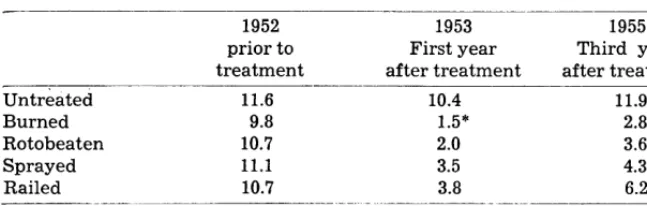
Table 1. Average numbers of sagebrush plants per 48-square-foot sample plot on five different areas before, 1 year after, and 3 years after using different methods fo kill sagebrush.
1952 prior to treatment Untreated
Burned Rotobeaten Sprayed Railed -_--.
11.6 9.8 10.7 11.1 10.7
*Seedlings
low kills of sagebrush from the 2,4-D treatment in this test, it should be recognized that spray- ing is an effective method for sagebrush eradication; kills of more than 90 percent are not un- common (Blaisdell and Mueg- gler, 1956).
Species Herbage Yields Herbage yields of individual species prior to treatment and 3 years afterward are shown in Table 2. The data are grouped into arbitrary desirability classes for sheep in order to ob- tain a better understanding of changes in amount and type of forage. The classif ication is based upon sheep preferences in this particular spring-fall range area; the same species may of course be rated differently else- where. Although pretreatment estimates were not made for in- dividual grasses, the effect of each treatment is indicated by comparison of subsequent yields with those on the other areas. Caution must be exercised in de- ducing treatment effects by di- rect comparison with the un- treated area. This is especially true in the case of the grasses where no before-treatment fig- ures are available for individual species. An attempt has been made to avoid erroneous inter- pretations by utilizing supple- mentary information to indicate inequalities in original produc- tion.
Of all the treatments, burning caused some of the most pro- nounced changes in individual
1953 First year after treatment
10.4 1.5” 2.0 3.5 3.8 ___- .-_
1955 Third year after treatment
11.9 2.8 3.6 4.3 6.2
species. Species other than sage- brush that were harmed by burning were Agropyron spica- turn, Antennaria microphylla, Penstemon radicosus, and espe- cially Carex-Festuca and Pur- shia. Although Stipa corn&a may have suffered a loss, it was probably not as severe as the figures indicate; frequency data suggest that there was less of this species on the burned area originally than on the untreated. Burning appeared to benefit most Agrop yron-Calamogrostis, St ip a columbiana, Astragalus convaZZarius, Lupinus, Erigeron, Chrysothamnus, and Tetradymia. These observations agree essen- tially with long-term observa- tions by Blaisdell (1953)) who found, however, that initial de- creases in many of these species, with the exception of Festuca and Purshia, were only tempo- rary and that they eventually regained or exceeded their orig- inal production.
None of the species on the rotobeaten area, other than sage- brush, was seriously injured by this treatment; all appear to have responded favorably. The apparent decrease in Agropyron spicatum is deceptive, for fre- quency data indicate a mark- edly greater occurrence of this species in 1953 on the untreated area than on any of the treated plots, suggesting an inequality of original production. What seems a slight decrease on the rotobeaten area, and on the sprayed and railed areas as well, may actually be a slight in-
crease. As pointed out previ- ously, there was a lag in re- sponse of grasses to release by rotobeating the first year as compared to the forbs. This is illustrated by relative produc- tion figures between the two groups over the entire period (Fig. 1). Before treatment pro- duction of grasses was almost six times that of the forbs; 1 year after it was less than twice as great; and in 3 years, by which time grasses had taken advantage of reduced brush competition, it was over three times as great as the forbs.
The most pronounced effects of spraying were reductions in Lupinus and Erigeron, besides sagebrush, and increases in most grasses, especially Stipa colum- biana. The indicated increase of Stipa corn&a is of doubtful va- lidity because of the erratic oc- currence of this species on the sample plots. Both Purshia and Tetradymia benefited by spray- ing. Production of other species was not appreciably changed.
With greater sagebrush kill from spraying, which might or- dinarily be expected, grasses that increased under this limited reduction in competition would probably show greater gains, and forbs would probably be damaged more severely. Blais- dell and Mueggler (1956) found that such species as Penstemon, Arnica fulgens, Comandra um- bell&a, Eriogonum heracleoides, and Chrysothamnus, not obvi- ously affected in this study, were lightly damaged by spraying with 2,4-D.
EFFECTS OF SAGEBRUSH TREATMENTS ON ASSOCIATED SPECIES 65
Table 2. Herbage production before treatment (1952) and 3 years after (1955) on comparable areas subjected to different meihods of sagebrush removal.
Total Grass Total Forbs Total Shrubs Desirable Species
Agropyron spicatum Agropyron dasystachyum-
Calamagrostis montanensis Carex filifolia-
Festuca idahoensis Koeleria cristata Poa spp. Stipa comata Stipa columbiana Astragalus miser Astragalus convallarius Lupinus spp.
Penstemon radicosus Purshia tridentata Others
Total Desirable Moderately Desirable
Achilles lanulosa Antennaria microphylla Arnica fulgens
Comandra umbellata Erigeron corymbosus Eriogonum heracleoides Chrysothamnus puberulus Others
Total Mod. Desirable Undesirable Species
Artemisia tridentata Tetradymia canescens’ Others
Total Undesirable Total Production
Untreated Burned
1952 1955
207 268 229 295 250 490 245 430 200 310
49 114 82 307 43 150 65 92 80 223
367 481 361 137 368 102 281 219 267 184
41 18 33 29 30
31 68 68 46 30
* 106
3 18 13 51 7 1 1 6 8 8 294
* 36
8 35 4 123 3 10 148 3 Trace 26 482
* 204
7 66 20 91 8 5 26 4
* 146
5 25 40 138 4 2 4 7 13 2 461 *
1 - Trace 1
- - 3 8 1 220 - 41 5 14 6 295 1 - 3 2 - - 6 5 143 9 34 1 63 6 4 51 9 - 256 - Trace 532 - 15 5 5 2 272 - -
5 8
217 388
1 2 3 9 1 1 - Trace - 1
4 18 4 4 1 17 5 18 7 39
8 9 1 2 4 7 5 6 23 20
Trace 1 3 2 1 3 5 3 1 1
26 40 9 38 21 49 14 13 21 44
3 7 8 13 4 14 8 17 2 10
4 11 5 68 4 16 3 12 3 20
6 3 2 3 4 4 4 3 5 4
52 91 35 139 40 111 44 72 62 139
346 452 337 47 360 67 269 178 257 144
5 8 5 21 4 20 4 17 6 20
Trace 18 - 50 1 12 2 13 5 26
351 478 ,342 118 365 99 275 208 268 190
623 863 672 739 661 742 591 741 547 717
Rotobeaten
- Sprayed Railed
(Air-dry pounds per acre)
*1952 production for total grasses given above.
remaining species showed little change that can be directly at- tributed to railing. The apparent reduction in Stipa comata ’ is probably not real, since frequen- cy data suggest very erratic dis- tribution of this species.
Changes in amount and type of forage are indicated by class totals of desirable and moder- ately desirable species in Table 2. Three years after treatment total air-dry production of desirable and moderately desirable species was 621, 643, 533, and 527 pounds per acre on burned, rotobeaten, sprayed, and railed areas, respec- tively, as compared to 385
pounds per acre on the untreated range. Production of the desir- able class alone was 482, 532, 461, and 388 pounds per acre for the respective treatments, while that for the untreated range was only 294 pounds. Such changes were not immediate but occurred gradually over the 3-year period. The rotobeaten area especially was slow to respond with an in- crease in forage production.
areas, respectively. It is appar- ent, then, that all treatments produced sizable increases in available forage and that in- creases were greatest on burned and rotobeaten range. It can be expected that availability of for- age on the sprayed area will in- crease as the sagebrush skeletons decay.
66 WALTER F. MUEGGLER AND JAMES P. BLAISDELL
costs. The cost of burning, which includes construction of ade- quate fire lines, actual burning, and the loss of grazing because of l-year mandatory deferment, is about $0.70 per acre. Roto- beating costs vary from $3.00 to $6.00, spraying with 2 pounds acid equivalent 2,4-D, $2.50 to $3.00, and railing twice over, $2.00 to $2.50 per acre. It is readily apparent that despite the l-year grazing deferment, burn- ing is by far the least expensive method of sagebrush eradication. More specific information on burning procedure and costs is given by Pechanec, et al. (1954a).
When selecting a method best suited for a particular area, it is necessary to consider not only effect upon existing vegetation and cost but also adaptability of the method to the site and effect upon erosion hazard. Rotobeat- ing and railing leave a good litter cover and do not increase the erosion hazard, but both methods are restricted to fairly rock-free areas. Rotobeating should not be attempted where rocks protrude more than 3 inches above the soil surf ace or excessive equipment breakage may result. Spraying does not increase the erosion hazard appreciably and is suit- able for any terrain where air- planes can be used, but may be highly undesirable on sheep ranges which have a high per- centage of susceptible forbs. Burning is suited to any terrain where the fire can be kept under control; however this method should not be used on readily erodible soils or on slopes steep- er than about 30 percent, for burning destroys all litter and exposes the soil to erosion.
Summary
Four different methods of se- lective sagebrush control were studied on sagebrush-bunchgrass
range at the U. S. Sheep Experi- ment Station near Dubois, Idaho. Burning, rotobeating, spraying with 2,4-D, and railing were com- pared on adjacent areas to obtain a better understanding of rela- tive effects upon associated na- tive species and forage produc- tion.
Burning was the only treat- ment that injured any grasses. The Carex filifolia-Festuca ida- hoensis group was most severely reduced by burning. Other grasses, though set back tempo- rarily, soon recovered. Grasses as a group were greatly favored by the other treatments. There was a lag in increased grass pro- duction the first year after roto- beating and railing, but grass production increased immediate- ly with spraying.
Although burning brought about the greatest increase in total forbs, Antennaria micro- phylla and Penstemon radicosus were injured; Astragalus conval- Zarius, Erigeron corymbosus, and Lupinus spp. were most bene- fited. Rotobeating and railing tended to favor all forbs, perhaps Lupinus spp. more than the others. Spraying caused a pro- nounced reduction in forbs, with Lupinus spp. and Erigeron co- rymbosus being most severely affected.
Sagebrush was greatly re- duced by all treatments. By the third year after treatment sage- brush production on the burned area was only 11 percent of what it would have been with no treatment, 14 percent on the rotobeaten area, 50 percent on the sprayed area, and 43 percent on the railed area. Sagebrush plants were reduced to 28, 33, 39, and 58 percent of their former numbers under the respective treatments. Purshia trident&a was severely injured by burning; it was favored by spraying.
Chrysothamnus puberuZus and
Tetrad ymnia canescens, which sprout readily, increased under all treatments.
All treatments produced siz- able increases in available for- age. Three years after treatment total production of desirable and moderately desirable species was approximately two-thirds great- er on the burned and rotobeaten areas, and better than one-third greater on the sprayed and railed areas, than on the untreated range. Only 75 percent of the grass and forbs was available to livestock on the untreated range, but 98,98,88, and 90 percent was available on the burned, roto- beaten, sprayed, and railed areas, respectively.
LITERATURE CITED BLAISDELL, JAMES P. 1953. Ecological
effects of planned burning of sage- brush-grass range on the Upper Snake River Plains. U. S. Dept. Agr. Tech. Bull. 1075, 39 pp.
AND W. F. MUEGGLER. 1956. Effect of 2,4-D on forbs and shrubs associated with big sage- brush. Jour. Range Mangt. 9: 38- 40.
BOHMONT, DALE W. 1954. Chemical sagebrush control-good and bad. Wyoming Agr. Exp. Sta. Cir. 54, 7 PP.
HURD, RICHARD M. 1955. Effect of 2,4-D on some herbaceous range plants. Jour. Range Mangt. 8: 126- 128.
HYDER, D. N. AND F. A. SNEVA. 1956. Herbage response to sagebrush spraying. Jour. Range Mangt. 9: 34-38.
PECHANEC, J. F. AND G. D. PICKFORD. 1937. A weight estimate method for the determination of range or pasture production. Jour. Amer. Sot. Agron. 29: 894-904.
--, et al. 1954. Control- ling sagebrush on range lands. U. S. Dept. Agr. Farmers’ Bull. 2072, 36 pp.
,et al. 1954a. Sage- brush burning -good and bad.
Quantitative Effects of Twenty-three Years of
Controlled Use on Mountain Range
F. A. BRANSON AND THOMAS LOMMASSON
Plant Ecologist, U. S. Geological Survey, Denver, Colo- rado, Senior Range Examiner (Retired), Forest Service,
U. S. Department of Agriculture, Missoula, Montana
In 1926 a forest allotment which had been heavily used was made available to the Montana Agricultural Experiment Sta- tion. At that time-“vegetation on many of the steep, non-tim- bered slopes had largely disap- peared as a result of overuse. Ac- celerated erosion had developed on these slopes and in the drain- age channels extending from them. Bed grounds were barren except for a scattered cover of mustard, knotweed, niggerhead, and other weeds of low value. The vegetation surrounding the bed grounds was greatly reduced as a result of grazing and tram- pling by the band as it left and returned on successive days.”
(Heady et al., 1947).
In 1929 the following manage- ment practices were put into ef- fect on the allotment:
Grazing was delayed until July 1 each year to permit the forage plants to reach a stage that would minimize damage from grazing. The range was divided into camp units that permitted efficient use of the avail- able forage and regulation of time of grazing with plant development at dif- f erent elevations.
Once-over and twice-over grazing systems were tried and the twice-over system abandoned in 1936.
Open herding was used at all times.
The one-night bed-ground
1 Formerly Assistant Professor of Range Management, Montana State College, Bozeman, Montana.
system of grazing with sheep was used.
The following is a report on some of the effects of these man- agement practices on vegetation.
Description of Area The area, known as the “Col- lege Allotment”, consists of 3,788 acres of which about 2,900 are usable for grazing. The allot- ment is on the east slope of the Bridger Mountains about 15 miles northeast of Bozeman, Montana. The range is rolling to steep with an elevation of about 6,000 feet at the eastern edge to about 8,500 feet at the western edge. The range is characterized by alternating grassland parks and timber. Timber, mostly lodgepole pine and douglas fir, is most abundant on north-facing slopes, with the area dominated by timber being far greater than that occupied by herbaceous vegetation (Fig. 1).
Climatic data from a station a few miles from the allotment
(elevation 5,980 feet, with four years of complete records) show an average annual precipitation of 30.7 inches. There was an av- erage of 63 days with tempera- tures above freezing during the year and an average annual tem- perature of 39 degrees Fahren- heit. Extremes of temperature were 39 degrees below zero to 90 degrees above zero.
Unfortunately, climatic data were not recorded at the weather station near the College Allot- ment during the years previous to or immediately following 1932 when the study was initiated. In an attempt to estimate the pre- cipitation pattern immediately preceding 1932 (Table 1), data for the five years at the weather station near the College Allot- ment were compared with sev- eral stations in southwestern Montana. The precipitation data of Loweth, Montana, were most nearly correlated with the sta- tion near the College Allotment.
By graphing the data for the two stations for the years 1951 through 1955 it was possible to estimate precipitation on the College Allotment for earlier years from the available Loweth record. The graph was used to estimate the precipitation for the five years (1928 through 1932) preceeding the initiation of the study. June, the month of great- est precipitation and probably the segment of the annual pre-
” _ ..--_ . -_-_.-..
68 F. A. BRANSON AND THOMAS LOMMASSON
Table 1. Precipitation for fhe monfh of June at the weather station near the study area and af Lowefh, Montana.
Estimated
College College
Year Allotment* Loweth Year Loweth Allotment
1951 3.13 1.10 1928 3.21 6.7
1952 3.97** 1.97 1929 2.40 5.3
1953 6.49 3.10 1930 0.40 1.6
1954 7.78 3.46 1931 1.54 3.6
1955 6.29 3.02 1932 1.94 4.4
Total 27.66 12.65 9.49 21.6
Average 5.53 2.53 1.90 4.3
* Data from weather station 12 miles northeast of Bozeman or about 3 miles from the College Allotment.
** Estimated value entered in U. S. Weather Bureau records.
cipitation having the most effect on yearly plant production on the study area, was selected for the analysis. The estimated pre- cipitation for the College Allot- ment for the years preceding the 1932 sampling was somewhat lower than that which occurred previous to the 1955 vegetational sampling.
Meihods
In 1932 four study plots were established on the College Allot- ment. One of these was estab- lished at the lower edge of the allotment at about 6,100 feet, one at the upper edge at 7,500 feet, and two at intermediate eleva- tions on the allotment (at 6,500 and 7,000 feet). All four areas were in grassland or in grass- forb types. At each location two l/640 acre plots were clipped, dried, and the amounts of each species present determined by weight. In 1955 the same pro- cedure was followed except that 10 plots, each containing 9.6 square feet, were clipped and species bagged separately at each location.
Exclosures made with poles and woven wire were con- structed in 1932. These deterio- rated over the years. To avoid effect of protection and of the scattered poles and fence, the temporary exclosures in 1955 were placed outside the old ex- closures. Snow fences were used to exclude sheep from plots
sampled in 1955. Samples in 1932 and 1955 were collected during the month of August. Samples were air-dried in 1932 and oven- dried in 1955. The 1955 yields were increased by 5 percent to give data more comparable with the 1932 air-dry weights.
Results and Discussion
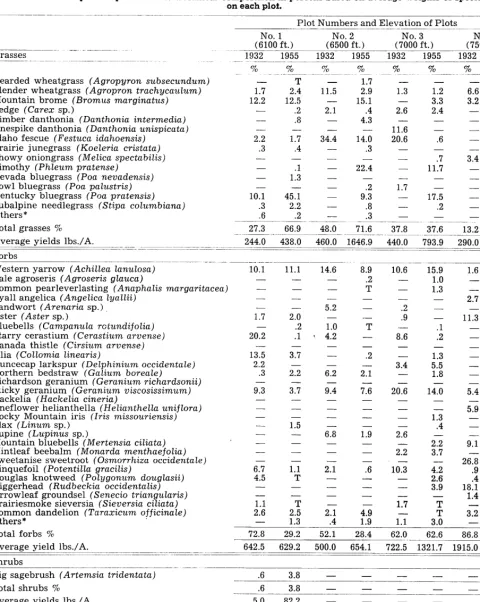
Total yields on the three plots at lower elevations increased greatly during the 23 years but yields decreased slightly on the plot at 7,500 feet (Table 2). The plot at 7,500 feet was on rela- tively unstable soil, and near a spring used by the herder when the sheep were on that camp unit. Yields of the plots at 6,100 and 6,500 feet were more than
twice as great in 1955 as in 1932. Total yields on the plots at 7,000 feet in 1955 were about 182 per- cent of the 1932 yield. A part of this increase in yield should be attributed to the more favorable moisture conditions during and preceding 1955 (Table 1). Un- doubtedly much of the increase in plant production was due to the improved range management practices used during the 23 years.
Grasses increased greatly on the three plots at lower eleva- tions during the 23 years. On the highest plot, grasses and forbs contributed about the same per- centages to the total yield in both 1932 and 1955 (Fig. 2). These results indicate that vege- tation at the higher elevations was a forb-grass type while that at lower elevations undoubtedly was originally grassland.
The only grass that occurred on all plots in substantial amounts was slender wheatgrass. Yields of slender wheatgrass de- creased on all plots except the one at 6,500 feet elevation. Moun- tain brome increased on all plots except the one at 6,100 feet. On the lowest plot (6,100 feet) Ken- tucky bluegrass showed a marked increase over the 23 years. Idaho fescue was abun- dant on all plots except the plot at 7,500 feet elevation. Idaho
EFFECTS OF CONTROLLED USE ON MOUNTAIN RANGE
Table 2. Yields in pounds per acre and botanical composition in percent based on average weights of species found on each plot.
Plot Numbers and Elevation of Plots
Grasses ______ ~~_~
Bearded wheatgrass (Agropyron subsecundum) Slender wheatgrass (Agropron trachycaulum) Mountain brome (Bromus margin&us) Sedge (Carex sp.)
Timber danthonia (Danthonia intermedia) Onespike danthonia (Danthonia unispicata) Idaho fescue (Festuca idahoensis)
Prairie junegrass (Koeleria cristata) Showy oniongrass (Melica spectabilis) Timothy (Phleum pratense)
Nevada bluegrass (Poa nevadensis) Fowl bluegrass (Poa palustris) Kentucky bluegrass (Poa pratensis) Subalpine needlegrass (Stipa columbiana) Others +
Total grasses % Average yields lbs./A.
No. 1 No. 2 No. 3 No. 4
(6100 ft.) (6500 ft.) (7000 ft.) (7500 ft.) 1932 1955 1932 1955 1932 1955 1932 1955
% % % % % % % %
_
- T - 1.7 - - - .2
1.7 2.4 11.5 2.9 1.3 1.2 6.6 .4
12.2 12.5 - 15.1 - 3.3 3.2 6.1
- .2 2.1 .4 2.6 2.4 - -
- .a - 4.3 - - - -
- -
-
34< 14.0 11.6 - - -
2.2 1.7 20.6
.3 .4 - *3 - -6 z -
- - -
1 22.4 1 .7 3.4 6.3
- .l 11.7 - .2
- 1.3 - - - - -
- - - .2 1: - - -
10.1 45.1 - 9.3 - 17.5 - -
.3 2.2 - .8 - .2 - -
.6 .2 - ___ .3 - - - -
27.3 66.9 48.0 71.6 37.8 37.6 13.2 13.2 244.0 438.0 460.0 1646.9 440.0 793.9 290.0 267.3 Forbs
Western yarrow (AchiZZea Zanulosa) Pale agroseris (Agroseris glauca)
Common pearleverlasting (Anaphalis margaritacea) Lyall angelica (Angelica ZyaZZii)
Sandwort (Arenaria sp.) . Aster (Aster sp.)
Bluebells (Campanula rotundifolia) Starry cerastium (Cerastium arvense) Canada thistle (Cirsium arvense) Glia (CoZZomia linear-is)
Duncecap larkspur (Delphinium occidentale) Northern bedstraw (Galium boreale)
Richardson geranium (Geranium richardsonii) Sticky geranium (Geranium viscosissimum) Hackelia (Hackelia cineria)
Oneflower helianthella (HeZiantheZZa uniflora) Rocky Mountain iris (Iris missouriensis) Flax (Linum sp. )
Lupine (Lupinus sp. )
Mountain bluebells (Mertensia ciliata) Mintleaf beebalm (Monarda menthaefolia) Sweetanise sweetroot (Osmorrhiza occidentale) Cinquefoil (PotentiZZa gracilis)
Douglas knotweed (Polygonurn douglasii) Niggerhead (Rudbeckia occidentalis) Arrowleaf groundsel (Senecio triangularis) Prairiesmoke sieversia (Sieversia ciliata) Common dandelion (Taraxicum officinale )
10.1 - - - 1; - 20.2 -- 13.5 2.2 .3 9.3 - - - - - - - - 6.7 4.5 - fi 2.6
Others* We -
11.1 14.6
- - - 5.2
2.0 -
.2 1.0
.l t 4.2
3; 1
2< 6y
3.7 9.4
- -
12
q
- 6.8
1: 2.1
T -
r
1
2.5 2.1
1.3 .4
8.9 10.6 .2 -
T -
-
- Y2
- .9
T
- 8;
_2 1
27 3.4 - 72 20.6
- -
- -
- -
1.9 22 -
- 2?
-
.6 10;
- -
- -
-
- 1:
::9” 1; - - .l .2 - 1.3 5.5 1.8 14.0 - 1.3 .4 2.2 3.7 - 24.5 3:9 r 3; 1.6 - 2; - 11.3 - - - - - - 52 5< - - 9.1 26T :: 18.1 1.4 3.2 - - - - - - 2.4 - 11: 3.5 4.6 :+ 1:7 - - - 7.6 227 :: 19.9 3.7 - a:;
Total forbs % 72.8 29.2 52.1 28.4 62.0 62.6 86.8 86.8
Average yield lbs./A. 642.5 629.2 500.0 654.1 722.5 1321.7 1915.0 1759.6
Shrubs
Big sagebrush (Artemsia trident&a) .6 3.8 - - - - - -
Total shrubs % .6 3.8 - - - _ _ i
Average yields lbs./A. 5.0 82.2 - - - - _ -
Average total yields lbs./plot/acre 891.5 2149.7 960.0 2301.0 1162.5 2115.6 2205.0 2026.9 * Includes species contributing less than 1 percent to any plot average: Bromus ciliata, Danthonia californica,
Phleum alpinum, Poa ampla.
** Includes species contributing less than 1 percent to any plot average: Arabis drummondii, Arnica sororia, As- tragalus sp., Brodiaea grandiflora, Capsella bursa pastoris, Carum gardneri, Castelleja cervina, Epilobium angustifolium, Equisetum sp., Frageria virginiana, Frasera speciosa, GaiZZardia aristata, Hieracleum Zanatum, Hiracium gracile, Myosotis alpestris, Orthocarpus Zuteus, Pediluclaris sp.,
70 F. A. BRANSON AND THOMAS LOMMASSON
fescue was the most prominent species on the plot at 6,500 feet in 1932 but produced less of the total yield in 1955 than timothy. Prairie Junegrass was found only on the two lower plots, while showy oniongrass occurred only on the two plots at higher elevations.
The increase in timothy over the 23 years was most striking. This introduced grass was not found on the plots in 1932, but occurred on all plots in 1955. Timothy was most abundant on the plot at 6,500 feet elevation. Kentucky bluegrass, another in- troduced grass, occurred only on the plot at 6,100 feet in 1932, but was also present in considerable quantities on the plots at 6,500 and 7,000 feet in 1955. On the lowest plot (6,100 feet) Ken- tucky bluegrass showed a marked increase over the 23 years.
The total yield of forbs did not change greatly during the 23 years. There was a slight de- crease on the lowest and highest plots; a slight increase on the plot at 6,500 feet, and a marked increase on the plot at 7,000 feet.
Western yarrow was abundant on all plots except the one at 7,500 feet. There was no apparent trend in the abundance of this species due to management prac- tices. Starry cerastium, a plant listed as poor forage by the U. S. Forest Service (Heady et al., 1947)) decreased considerably during the 23 years of controlled management. However, Canada thistle, an introduced weed was present in appreciable quantities in 1955 on the plot at 7,500 feet, where it had not occurred in
1932. Gilia, a plant of little for- age value, showed a marked de- crease on the plot at 6,100 feet but increased slightly on the two plots at intermediate elevations. Tall larkspur, a plant poisonous to cattle but seldom affecting sheep, decreased at lower eleva- tions but increased on the higher plots. Sticky geranium, a plant frequently grazed by sheep, de- creased on all plots. Lupine de- creased on the two plots at 6,500 feet and 7,000 feet and did not occur on the lowest and highest plots. A study by Teigen (1949) indicated that sheep show a high degree of preference for lupines of this area. Mountain bluebells, choice feed for sheep, increased slightly on the plot at 7,000 feet but decreased slightly on the plot at 7,500 feet. Cinquefoil occurred on all plots and decreased on all plots. Sheep preferentially graze cinquefoil (Teigen, 1949) . Ar- rowleaf groundsel occurred only on the highest plot. It is con- sidered choice sheep feed but showed a slight increase over the 23-year period. Common dande- lion occurred on all plots but trends in abundance of this plant apparently were not related to grazing management or eleva- tion.
The only shrub of importance found on the plots was big sage- brush. Its odcurrence was limited to the plot at 6,100 feet. Its aver- age yield increased from 5 pounds per acre in 1932 to 78 pounds per acre in 1955. This plot was located near the north- east corner of the College Allot- ment where it is grazed by sheep and by cattle from the adjacent cattle range.
Summary
Yields of species (determined by clipping and weighing sepa- rately for each plot) were deter- mined on a mountain range near Bozeman, Montana in 1932 and in 1955. Previous to 1926 this range had been heavily grazed by sheep and cattle. In 1928 con- trolled use including proper stocking, open herding, one-night bed grounds, and uniform dis- tribution of grazing, was started on the forest allotment and con- tinued through 1955.
Yields increased greatly on the lowest plot and the two at inter- mediate elevations but decreased. slightly on the highest of the study area. These higher areas where slopes are steep and soils are relatively unstable need care- ful management to bring about desired improvement in produc- tion. The data clearly show that over most of the area, forage pro- duction had increased. High pre- cipitation in the years previous to 1955 and low precipitation in years previous to 1932 partially explain this marked increase in total yields, but some of the in- crease must be attributed to better management practices.
Species that increased, de- creased, or invaded the range during the 23-year period are discussed.
LITERATURE CITED
HEADY, H. F., R. T. CLARK, AND THOMAS LOMMASSON. 1947. Range management and sheep production in the Bridger Mountains, Mon- tana. Mont. Agr. Exp. Sta. Bull. 444. 30 pp.
TEIGEN, M. L. 1949. Forage Prefer- ences of range sheep. Montana State College, unpublshed M. S. thesis.
Special to the Editor: