dictionary attacks
P. ARUN BABU,
Robert Bosch Center for Cyber-physical Systems, Indian Institute of Science, IndiaJITHIN JOSE THOMAS,
Department of Electrical and Computer Engineering, Texas A&M University, USAThis paper introducesFreestyle, a randomized, and variable round version of the ChaCha cipher. Freestyle demonstrates the concept ofhash based halting condition, where a decryption attempt with an incorrect key is likely to take longer time to halt. This makes it resistant to key-guessing attacks i.e. brute-force and dictionary based attacks. Freestyle uses a novel approach for ciphertext randomization by using random number of rounds for each block of message, where the exact number of rounds are unknown to the receiver in advance. Due to its inherent random behavior, Freestyle provides the possibility of generating up to 2256different ciphertexts for a given key, nonce, and message; thus resisting key and nonce reuse attacks. This also makes cryptanalysis through known-plaintext, chosen-plaintext, and chosen-ciphertext attacks difficult in practice. Freestyle is highly customizable, which makes it suitable for both low-powered devices as well as security-critical applications. It is ideal for: (i) applications that favor ciphertext randomization and resistance to key-guessing and key reuse attacks; and (ii) situations where ciphertext is in full control of an adversary for carrying out an offline key-guessing attack.
CCS Concepts: •Security and privacy→Block and stream ciphers; •Theory of computation→Cryptographic primitives;
Additional Key Words and Phrases: Brute-force resistant ciphers, Dictionary based attacks, Key-guessing penalty, Probabilistic encryption, Freestyle, ChaCha
P. Arun Babu and Jithin Jose Thomas. 2018. Freestyle, a randomized version of ChaCha for resisting offline brute-force and dictionary attacks..9, 4, Article 39 (March 2018),30pages.https://doi.org/0000001.0000001
1 INTRODUCTION
A randomized (akaprobabilistic) encryption scheme involves a cipher that uses randomness to generate different ciphertexts for a givenkey,nonce(a.k.a.initial vector), andmessaдe. The goal of randomization is to make cryptanalysis difficult and a time consuming process. This paper presents the design and analysis ofFreestyle, a highly customizable, randomized, and variable-round version of ChaCha cipher[Bernstein 2008a]. ChaCha20 (i.e. ChaCha with 20 rounds) is one of the modern, popular (for TLS [Langley et al. 2016] and SSH [Miller 2018;Miller and Josefsson 2018]), and faster symmetric stream cipher on most machines[cha 2017;Bursztein 2014]. Even on lightweight ciphers, realistic brute-force attacks withkeysizes≥128 bits is not feasible with current computational power. However, algorithms and
applications that have lower key-space due to: (i) generation of keys from a poor (pseudo-)random number generator [cve 2017;Bello et al. 2008;Heninger et al. 2012;Kim et al. 2013;Lenstra et al. 2012;Yilek et al. 2009]; (ii) weak passwords [Lorente et al. 2015] and poor implementations of password based key derivation [Ruddick and Yan 2016;Visconti et al. 2015]; and, (iii) poor protocol or cryptographic implementations [Adrian et al. 2015;Beurdouche et al. 2015;Vanhoef
Authors’ addresses: P. Arun Babu, Robert Bosch Center for Cyber-physical Systems, Indian Institute of Science, CV Raman road, Bengaluru, Karnataka, 560012, India, [email protected]; Jithin Jose Thomas, Department of Electrical and Computer Engineering, Texas A&M University, College Station, Texas, USA, [email protected].
© 2018 Manuscript
and Piessens 2017] are prone to key-guessing attacks (brute-force and dictionary based attacks). Such attacks are also becoming increasingly feasible due to steady advances in the areas of GPUs [Agosta et al. 2013;Chiriaco et al. 2017;Gu et al. 2017], specialized hardware for cryptography [Gürkaynak et al. 2017;Javeed et al. 2016;Khalid et al. 2017;Liu et al. 2017;Malvoni et al. 2014;Wiemer and Zimmermann 2014], and memories in terms of storage size and in-memory computations [Jain et al. 2017;Kim et al. 2016;Reis et al. 2018;Sebastian et al. 2017].
Techniques such as introducing a delay between incorrect key/password attempts, multi-factor authentication, and CAPTCHAs (Completely Automated Public Turing test to tell Computers and Humans Apart) are being used to resist brute-force attacks over the network (i.e. on-line brute-force attack). However, such techniques cannot be used if the ciphertext is in full control of the adversary (i.e. offline brute-force attack); for example: encrypted data gathered from a wireless channel, or lost/stolen encrypted files/disks. To resist offline brute-force attacks, key-stretching and slower algorithms[Buchanan 2015] are preferred. Although, such techniques are useful, they are much slower on low-powered devices, and also slow down genuine users.
1.1 Our contribution
This paper makesthreemain contributions: (i) We demonstrate the use of boundedhash based halting condition, which makes key-guessing attacks less effective by slowing down the adversary, but remaining relatively computationally light-weight for genuine users. We introduce thekey guessing penalty, which acts as a measure for a cipher’s resistance to key-guessing attacks. The physical significance of KGP is that the adversary would require at least KGP times computational power than a genuine user to launch an effective key-guessing attack; (ii) We demonstrate a novel approach for ciphertext randomization by using random number of rounds for each block of message; where the exact number of rounds are unknown to the receiver in advance; (iii) We introduce the concept ofnon-deterministic CTR modeof operation and demonstrate the possibility of using the random round numbers to generate up to 2256different ciphertexts - even though thekey,nonce, andmessaдeare the same. The randomization makes the cipher resistant to key re-installation attacks such as KRACK [Vanhoef and Piessens 2017] and cryptanalysis by XOR of ciphertexts in the event of thekeyandnoncebeing reused.
The interesting feature of Freestyle’s decryption algorithm is: that it is designed to be computationally light-weight for a user with acorrect key; but, for an adversary with anincorrect key, the decryption algorithm is likely to take longer time to halt. Thus, each key-guessing attempt is likely to be computationally expensive and time consuming.
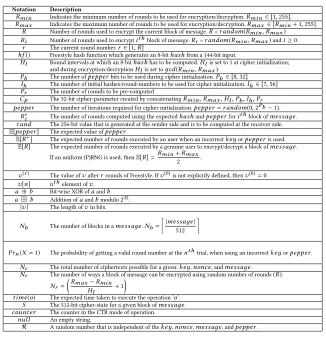
The rest of the paper is structured as follows: Table1lists the notations used in the paper; section2presents the background information on ChaCha cipher and its variants; section3describes the Freestyle cipher; section4presents results and cryptanalysis of Freestyle cipher; section5presents related work; and section6concludes the paper.
2 CHACHA CIPHER AND VARIANTS
ChaCha20[Bernstein 2008a] is a variant of Salsa20[Bernstein 2005a,2008b], a stream cipher. It uses 128-bitconstant, 256-bitkey, 64-bitcounter, and 64-bitnonceto form an initial cipher-state denoted byS(0), as:
constant[0], constant[1], constant[2], constant[3] key[0], key[1], key[2], key[3] key[4], key[5], key[6], key[7] counter[0], counter[1], nonce[0], nonce[1]
Table 1. List of symbols
Notation Description
Rmi n Indicates the minimum number of rounds to be used for encryption/decryption.Rmi n∈ [1,255].
Rmax Indicates the maximum number of rounds to be used for encryption/decryption.Rmax∈ [Rmi n+1,255].
R Number of rounds used to encrypt the current block of message.R=r andom(Rmi n,Rmax) Ri Number of rounds used to encryptit hblock of message.Ri=r andom(Rmi n,Rmax)andi≥0.
r The current round number.r∈ [1,R]
hf() Freestyle hash function which generates an 8-bithashfrom a 144-bit input.
HI Round intervals at which an 8-bithashhas to be computed.HIis set to 1 at cipher initialization;
and during encryption/decryptionHIis set toдcd(Rmi n,Rmax).
Pb The number ofpepperbits to be used during cipher initialization.Pb∈ [8,32]
Ih The number of initial hashes/round-numbers to be used for cipher initialization.Ih∈ [7,56]
Pr The number of rounds to be pre-computed
Cp The 32-bit cipher-parameter created by concatenatingRmi n,Rmax,HI,Pb,Ih,Pr
pepper The number of iterations required for cipher initialization.pepper=r andom(0,2Pb−1).
R∗
i The number of rounds computed using the expectedhashandpepperforit hblock ofmessaдe.
r and The 256-bit value that is generated at the sender side and is to be computed at the receiver side. E[pepper] The expected value ofpepper.
E[R+] The expected number of rounds executed by an user when an incorrectkeyorpepperis used. E[R] The expected number of rounds executed by a genuine user to encrypt/decrypt a block ofmessaдe.
If an uniform (P)RNG is used, thenE[R]=Rmi n+2Rmax.
v(r) The value ofvafterrrounds of Freestyle. Ifv(0)is not explicitly defined, thenv(0)=0.
v[n] nt helement ofv.
a ⊕b Bit-wise XOR ofaandb.
a⊞b Addition ofaandbmodulo232.
|v| The length ofvin bits.
Nb The number of blocks in amessaдe.Nb=
|messaдe|
512
Prn(X=1) The probability of getting a valid round number at thent htrial, when using an incorrectkeyorpepper.
Nc The total number of ciphertexts possible for a given:key,nonce, andmessaдe.
Nr The number of ways a block of message can be encrypted using random number of rounds(R).
Nr=
Rmax−Rmi n
HI +1
time(o) The expected time taken to execute the operation ’o’.
S The 512-bit cipher-state for a given block ofmessaдe.
counter The counter in the CTR mode of operation.
null An empty string.
R A random number that is independent of thekey,nonce,messaдe, andpepper.
ChaCha20 uses 10 double-rounds (or 20 rounds) onS(0); where each of the double-round consists of 8 quarter rounds (QR) defined as:
Odd round Even round
QR(S[0],S[4],S[8],S[12]) QR(S[0],S[5],S[10],S[15])
QR(S[1],S[5],S[9],S[13]) QR(S[1],S[6],S[11],S[12])
QR(S[2],S[6],S[10],S[14]) QR(S[2],S[7],S[8],S[13])
QR(S[3],S[7],S[11],S[15]) QR(S[3],S[4],S[9],S[14])
(1)
where the 16 elements of the cipher-state matrix are denoted in row-wise fashion, using an index in the range [0,15]. And the quarter-roundQR(a,b,c,d)is defined as:
a←a⊞b; d←d⊕a; d←d≪16; c←c⊞d; b←b⊕c; b←b≪12; a←a⊞b; d←d⊕a; d←d≪ 8; c←c⊞d; b←b⊕c; b←b≪ 7;
After 20 rounds, the initial state(S(0))is added to the current state(S(20))to generate the final state. The final state is
then serialized in the little-endian format to form the 512-bit key-stream, which is then XOR-ed with a block (512 bits) of plaintext/ciphertext to generate a block of ciphertext/plaintext. The above operations are performed for each block ofmessaдeto be encrypted/decrypted.
ChaCha is a simple and efficient ARX (Add-Rotate-XOR) cipher, and is not sensitive to timing attacks. ChaCha has two main flavors with reduced number of rounds i.e. with 8 and 12 rounds. ChaCha12 is considered secure enough as there are no known attacks against it yet [Choudhuri and Maitra 2016]. ChaCha20 has two main variants: (i) IETF’s version of ChaCha20 [Langley et al. 2016;Nir and Langley 2015] which uses a 32-bitcounter(instead of 64-bit) and 96-bitnonce(instead of 64-bit); and (ii) XChaCha20 [Denis 2018], which uses 192-bitnonce(instead of 64-bit), where a randomly generatednonceis considered safe enough [lib 2017]. The largernoncein XChaCha20 makes the probability ofnoncereuse low.
3 THE FREESTYLE CIPHER
The Freestyle’s core is similar to the IETF’s version of ChaCha, but useshash based halting condition. Traditionally ciphers are designed to use fixed number of rounds in the encryption and decryption process. Even in variable round ciphers, the number of rounds is well known in advance. This makes the cipher to take nearly the same amount of time to execute the decryption function, irrespective of thekeybeing correct or incorrect. This is advantageous for an adversary if the cipher is lightweight and parallelizable. To resist such attacks, Freestyle uses the concept of hash based halting condition.
It works on the following principle: a sender encrypts a block of message using a random number of round (R), which is never shared with the receiver. However, the sender along with the ciphertext shares thehashof the cipher state (or partial cipher-state) after executingRrounds. Thehashis sent in cleartext; and the receiver can computeR
using the correctkey, and the receivedhash. This expectedhashacts as a halting condition for the decryption process; i.e. the receiver has to keep executing the decryption algorithm till the computedhashmatches the expectedhash. For an adversary using brute-force or dictionary based attack, since thekeyis incorrect, during the decryption process, the
hashis expected to take longer time to match. This asymmetry makes offline brute-force and dictionary based attacks less efficient.
The proposed approach makes the assumption that: (i) the hash function is secure enough, that from thehashit is computationally infeasible to compute the number of rounds,key, or any other secret information; (ii) the round number (R) is generated using a good uniform (P)RNG like hardware random number generator or cryptographically secure pseudo-random number generator (CPRNG) (e.g.arc4random[De Raadt 2014]).
To achieve hash based halting condition and ciphertext randomization, Freestyle uses the following 5 parameters:
(1) Rmin ∈ [1,255], indicating the minimum number of rounds to be used for encryption/decryption.Rmin is
recommended to be≥8; however for security-critical applications:Rmin ≥12 is preferred.
(2) Rmax ∈ [Rmin+1,255], indicating the maximum number of rounds to be used for encryption/decryption. Using RminandRmax, for each block ofmessaдe, a round number (R) is generated randomly by the sender which will be used to encrypt the current block of message.
(3) Pb ∈ [8,32], indicating the number ofpepper bits to be used during cipher initialization.Pb determines the
Rmin Rmax Pb Ih Pr
(8 bits) (8 bits) (6 bits) (6 bits) (4 bits)
Fig. 1. The 32-bit cipher-parameter (Cp)
however it may not be stored along with the hash or ciphertext (i.e. can be forgotten by the sender after use) [Forler et al. 2013;Kedem and Ishihara 1999].Pb≥16 is recommended for security-critical applications.
(4) Ih∈ [7,56], indicates the number of initial random-rounds to be used for cipher initialization.Ihdetermines the
number of possible ciphertexts that can be generated for a givenkey,nonce, andmessaдe.Ih ≥28 is recommended
for security-critical applications.
(5) Pr ∈ [0,15]andPr ≤ (Rmin−4), indicates the number of Freestyle rounds to be pre-computed.
Using the values ofRmin andRmax, a hash interval denoted byHI ∈ [1,Rmin]is computed.HI indicates the
round intervals at which an 8-bithashof partial cipher-state must be computed. The value ofHI is set to 1 during
cipher-initialization and is set toдcd(Rmin,Rmax)during encryption and decryption. For a givenRminandRmax, the дcd(Rmin,Rmax)is the optimal value of hash interval possible for performance. At the time of encryption, the sender
computes thehashafter everyHI rounds; and at the end ofRrounds thehashis sent to the receiver. On the other hand,
while decrypting a block of message, the receiver computes thehashafter everyHIrounds; and decryption is stopped only if it matches with the receivedhash. While decrypting a block of message, if the computedhashdoes not match the expectedhasheven after executingRmax rounds, then either thekey,nonce, or one of the parameters provided by the receiver is incorrect.
Remark 1 It must be noted thathashes are computed only after executingRmin rounds. This avoids accidentally
terminating after executing fewer than expected number of rounds.
Remark 2 The performance of Freestyle is∝ HI ×Pr
Rmin×Rmax×Pb×Ih. Thus the parameters must be carefully chosen
based on the required security level and performance.
3.1 The initial cipher-state (S(0))
The initial cipher-state of Freestyle, denoted byS(0)(equation3) is a 4×4 matrix of 32-bit words consisting of: 128-bit constant, 256-bitkey, 32-bitcounter, and 96-bitnonce. Unlike ChaCha[Bernstein 2008a], thecounter size has been reduced to 32-bit as in practice most of the protocols such as the SSH transport protocol [Ylonen and Lonvick 2006] recommend re-keying after 1GB of data sent/received.
Freestyle’s initial cipher-state is similar to the IETF’s version of ChaCha, except that theconstants are modified using the cipher-parameter (Cp).Cpis formed by concatenating all the 5 parameters i.e.Rmin,Rmax,Pb,Ih, andPr
to generate a unique 32-bit string as shown in the figure1. TheCpis then XOR-ed with theconstant[0](equation3).
S(0)= © «
constant[0] ⊕ Cp ª ® ® ® ¬
, constant[1], constant[2], constant[3]
key[0], key[1], key[2], key[3]
key[4], key[5], key[6], key[7]
counter, nonce[0], nonce[1], nonce[2]
(3)
3.2 Initialization for encryption
After the initial cipher-state (S(0)) is computed, the following temporary configuration is set irrespective of the cipher-parameter (Cp):
Rmin =8,Rmax =32, HI =1, andPr =4 (4)
This is done to ensure there is enough entropy even if weaker values ofRminandRmax are set by the user. This step
also helps in cases where the parameters can be downgraded in Man in the middle (MiTM) attacks such as Logjam [Adrian et al. 2015].
As the number of pre-computed rounds (Pr) is now set to 4; 4 rounds of Freestyle are pre-computed using 0 as the
counter; which results inS(4). After which, a randompepper from[0,2Pb)is generated by the sender and added to S(4)[0]to form the intermediate cipher-state (S∗) as shown in equation5.
S∗=
© «
S(4)[0]
⊞ pepper ª ® ® ® ¬
, S(4)[1], S(4)[2] S(4)[3]
S(4)[4], S(4)[5], S(4)[6] S(4)[7] S(4)[8], S(4)[9], S(4)[10] S(4)[11] S(4)[12], S(4)[13], S(4)[14] S(4)[15]
(5)
After which,S∗[12]is used as thecounterin CTR mode to generateI
hnumber of cipher states. Here, as 4 rounds
have been already been pre-computed, each of theIhblocks will now only require(Ri−4)additional rounds (where, Ri =random(8,32),∀i∈ [0,Ih)). Then, from each of theIhnumber of cipher states,Ihnumber of expectedhashes are
computed using Freestyle’s hash function (figure2, code in Appendix -A).
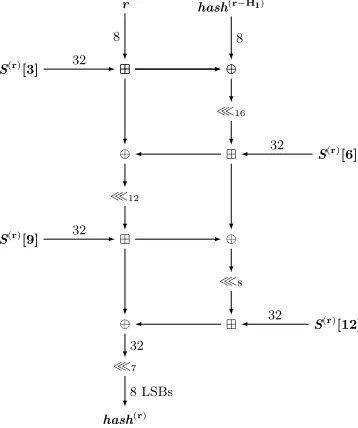
The abovehashes are used for the hash based halting condition described earlier in section3. Freestyle’s hash function generates an 8-bithashusing: (i) the 8-bit current round number (r), (ii) the 128 bits from the anti-diagonal elements of the current cipher-state (S(r)), and (iii) the 8-bit previoushash(i.e.hash(r−HI)).
It must be noted that at this point onlyIhnumber ofhashes are generated, and no encryption is performed yet.
The sender then using theIhnumber of random round numbers:{R0,R1, ...,RIh−1}, a 256-bitrandis computed using
r hash(r−HI)
⊕
S(r)[3] 32
8 8
⊕
≪16
32 S(r)[6]
⊕
≪12
S(r)[9]
32
⊕
≪8
32 S(r)[12]
⊕
≪7
32
hash(r)
8 LSBs
Fig. 2. The Freestyle hash function -hf(), for the roundr(the size of variables are in bits). Note thathash(Rmi n−HI)=0.
IfIh=7, Freestyle can generate 232possible values ofrand; where as ifIh=56, Freestyle can generate 2256possible
values ofrand. Therandvalue is then used to modify the current cipher-state (S∗) as shown in equation6. This makes Freestyle resistant to chosen IV attacks [Maitra 2016] and cryptanalysis due to potential biases and Probabilistic Neutral Bits (PNBs) [Choudhuri and Maitra 2016].
S∗←
S∗[0], ©
«
S∗[1] ⊕ rand[1]
ª ® ® ® ¬ , © «
S∗[2] ⊕ rand[2]
ª ® ® ® ¬ , © «
S∗[3] ⊕ rand[3]
ª ® ® ® ¬ © «
S∗[4] ⊕ rand[4]
ª ® ® ® ¬ , © «
S∗[5] ⊕ rand[5]
ª ® ® ® ¬ , © «
S∗[6] ⊕ rand[6]
ª ® ® ® ¬ , © «
S∗[7] ⊕ rand[7]
ª ® ® ®
¬
S∗[8], S∗[9], S∗[10], S∗[11]
S∗[12], S∗[13], S∗[14], S∗[15]
(6)
After which, the values ofRmin,Rmax,HI, andPr are set back to its original values; and the current cipher-state
(S∗) is used as an input to pre-computeP
r number of rounds usingS∗[12]as thecounter(equation7).
R7i
≪16
R7i+1
32
⊕
32
≪12
R7i+2
32
⊕
≪8
R7i+3
32
⊕
≪7
⊕
R7i+4
≪16
⊕
≪12
R7i+6 32
32 R7i+5
⊕
≪8
R7i
32
⊕
≪7
rand[i]
32
Fig. 3. Generation ofr and[i], wherei∈ [0,7](the size of variables are in bits)
From now on, the new cipher-state (S∗) will be used as an input to generate the key-stream for encryption. It is to be noted that sincePr rounds have been pre-computed, for encrypting theithblock of a message, only(Ri−Pr)rounds
are required.
3.3 Encryption
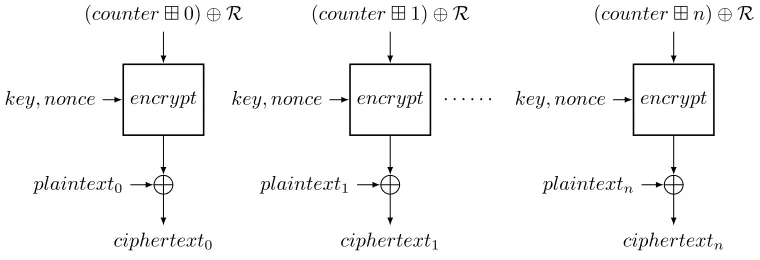
As described earlier in section3.2, for initialization, Freestyle uses plain CTR mode of operation for the firstIhblocks.
However for encryption, Freestyle usesnon-deterministic CTR mode(figure4). Here, we introduce the concept of non-deterministic CTR modeof operation: in this mode, thecounteris XOR-ed with a secret random number (R) that is
encrypt
(counter0)⊕ R
ciphertext0
key, nonce
plaintext0
encrypt
(counter1)⊕ R
ciphertext1
key, nonce
plaintext1
· · · encrypt
(countern)⊕ R
ciphertextn
key, nonce
plaintextn
Fig. 4. Non-deterministic CTR mode of operation, where thecounteris XOR-ed with a random number (R) that is independent of
thekey,nonce,messaдe, andpepper. In case of Freestyle,counterisS(4)[12]andRisr and[0].
In Freestyle, the random number (R) to be XOR-ed with thecounter(i.e.S∗[12]) isrand[0]. The rationale behind
choosingrand[0]to be XOR-ed with the counter is: the minimum possible value ofIhis 7, which can only generate
a 32-bit random number i.e.rand[0]. The values ofrand[i],∀i∈ [1,7]will be 0 in this case. Hence, in the worst-case
scenario, thecounters are always random and unknown to an adversary.
Remark 3 The deterministic CTR mode may appear similar to key-whitening technique. However, in the
non-deterministic CTR mode, thecounteris XOR-ed with a random number independent of thekey,nonce,pepper, or the
messaдe. And the random number is likely to change for each initialization even ifkey,nonce,pepper, andmessaдeare reused. Also, unlike key-whitening schemes, non-deterministic CTR mode in Freestyle does not require extrakeybits
to resist key-guessing attacks. ■
Using theS∗from the equation7, the key-stream for a block of plaintext is computed by running random number of round (Ri−Pr) onS∗. TheSi∗is then added toS∗to generate the keystream (equation9). The keystream is then is
XOR-ed with a block of plaintext to generate a block of ciphertext. For a givenithblock of a message,∀i∈ [0,Nb)the
ciphertext is generated as shown in equations8,9, and10.
S∗
i =(S∗)(Ri−Pr) (8)
keystreami =S∗
i ⊞S∗ (9)
ciphertexti =plaintexti⊕keystreami (10)
WhereRi =random(Rmin,Rmax),∀i∈ [0,Nb); andNbis the total number of blocks in a message.
3.4 Initialization for decryption
For initializing the cipher for decryption, the receiver like the sender first computes cipher-parameter (Cp) and sets the following temporary configuration:
and computesS(4)using thekeyandnonce. Then the receiver iteratespepper from 0 to(2Pb−1)using equation5, untilIhnumber of valid round numbers are found, corresponding to each of the receivedIhnumber ofhashes. Once successful, the receiver computes the 256-bitrandvalue using the valid round numbers:{R0,R1, ...,RI
h−1}, as shown
in figure3.
Using therand, the new cipher-state (S∗) is computed as shown in equation6. The original values ofRmin,Rmax,H I,
andPrprovided by the user are restored; andPr number of rounds are pre-computed (equation7).
3.5 Decryption
Similar to the encryption (section3.3), non-deterministic CTR mode is used to decrypt all the blocks of message. And, key-stream is generated usingS∗ (equations8and9). The plaintext is generated by XOR-ing the ciphertext with key-stream (equation12).
plaintexti =ciphertexti⊕keystreami (12)
Similar to encryption, sincePr rounds have been pre-computed, for decrypting theithblock of a message, only
(Ri−Pr)rounds are required.
4 RESULTS AND DISCUSSIONS 4.1 Number of possible ciphertexts
For a givenmessaдeof length|messaдe|bits, themessaдeis divided intoNb =l|messaдe512 |mblocks. Since, each block
can be encrypted with a random number (R) of rounds in the range[Rmin,Rmax]; the total number of ways a given
block ofmessaдecan be encrypted using random number of rounds is denoted byNr, given as:
Nr =дcdRmax(Rmin−,RRmaxmin ) +1 (13)
And since all theNbblocks of themessaдeuse thePbbits ofpepper, and32×7Ih-bitrandas inputs; the total number
of possible ciphertexts are:
Nc =2Pb ×2(327×Ih) × (Nr)Nb (14)
From equation14, as the number ofpepperbits, number of initialhashes, or the number of blocks in amessaдeincreases, the number of possible ciphertexts for a givenkey,messaдe, andnonceincreases exponentially.
4.2 Resistance to cryptanalysis
This section presents some of the results on Freestyle’s resistance to cryptanalysis. Here we restrict our analysis to the additional benefits offered by Freestyle; as ChaCha with 12 rounds is known to be secure [Choudhuri and Maitra 2016]. And the detailed cryptanalysis of ChaCha can be found in [ch- 2017;Aumasson et al. 2008;Choudhuri and Maitra 2016; Ishiguro 2012;Maitra 2016;Procter 2014].
Freestyle’s hash function uses 128-bits of the cipher-state (S(R)), at least 6-bits of current round number (r), and 8 bits of previous hash (hash(r−HI)). Hence, to generate all possible partial cipher-states that may collide with a given
hash(figure2) will require 2142operations. Also, assuming the 8-bithashes are equally spread over 256 buckets, there are likely to be 2134collisions.
The hash function uses Add-Rotate-XOR (ARX) operations, the same set of operations used by ChaCha/Freestyle’s quarter-round (QR) (equation1); hence are not sensitive to timing attacks by design.
4.2.2 Known-plaintext attacks (KPA), Chosen-plaintext attacks (CPA), and differential cryptanalysis.For a known or chosen plaintext, due to the random behavior of Freestyle, even if thenonceis controlled by the adversary, there areNc
possible ciphertexts. Hence, the effort required in cryptanalysis using known plaintext, chosen plaintext, differential analysis increasesNctimes.
4.2.3 Chosen-ciphertext attacks (CCA).In chosen-ciphertext attacks we consider two cases based on the adversary’s ability to control thenonce.
(i) Ifnoncecannot be controlled by the adversary.To generate an arbitrary ciphertext, an adversary while initializing the cipher (section3.4) has to provideIhvalidhashes, and at least one validhashfor sending block(s) of ciphertext. As a
random round is chosen between [8,32] to initialize therand(equation13), there are only 25 validhashvalues possible for a given block. Hence, at the time of decryption, the total possiblehashes that can be accepted by the receiver for a block of ciphertext isNr =Rmax−Rmi n
HI +1
. And as there are 256 possible values forhash, to send a valid ciphertext, the adversary has to send (Ih+Nb) validhashes. By brute-force approach, the probability of such an event occurring is:
=
25
256
Ih
×
Nr
256
Nb
<
2−23 forI h= 7,
2−26 forI h= 8,
.. .
2−67 forI h= 20,
.. .
2−187 forI h= 56
(15)
Assuming a constant time cryptographic implementation to check the validity of (Ih+Nb)hashes, forIh ≥20, it is hard
in practice to generate an arbitrary ciphertext (CCA) that can be accepted by a receiver ifnoncecannot be controlled by the adversary.
(ii) Ifnoncecan be controlled by the adversary. In this case, the adversary can launch CPA which can reveal (Ih+Nb)
validhashes. And, the adversary can replay them to make the receiver accept arbitrary ciphertext ofNbblocks.
In either of the two cases, after successfully sending a valid ciphertext, the adversary still has to guess the 128-bit
rand(in case ofIh=28). It is computationally infeasible to know which combination ofkeyandrandtheIhhashes
map to.
Remark 4 It must be noted that Freestyle’s hash function does not useplaintext/ciphertextas an input. Hence, cannot
4.2.4 XOR of ciphertexts whenkey andnonce are reused.Let us consider twomessaдes M1andM2which when
encrypted, produce ciphertextsC1andC2. In the event ofkeyandnoncebeing reused, in a deterministic stream cipher,
C1⊕C2=M1⊕M2. Whereas in Freestyle, for|M1|and|M2| ≥loд2(Nc):
Pr(C1⊕C2=M1⊕M2)= 1
Nc (16)
The equation16indicates that Freestyle is resistant to key re-installation attacks like KRACK [Vanhoef and Piessens 2017]. Also, in existing approaches of ciphertext randomization, in case ofkeyandnoncebeing reused, the random bytes that are shared with the receiver are prone to XOR attacks. However, such attacks are not possible in Freestyle, as onlyhashes are sent to the receiver.
4.3 Resisting brute-force and dictionary attacks
Freestyle by design resists brute-force and dictionary attacks by: (i) Restricting pre-computation of stream, and (ii) Wasting adversary’s time and computational power.
4.3.1 Restricting pre-computation of key-stream.In ChaCha, the key-stream can be pre-computed for variouskeys if
nonceis known. Pre-computation of stream is advantageous for a genuine receiver, as there is no need to wait for the message. However, for an adversary, pre-computation of streams with variouskeys is ideal to perform brute-force and dictionary attacks.
In Freestyle, since the key-stream depends on therandandhash, the exact key-stream cannot be pre-computed unless the sender sends the entire expectedhashes. This however, also restricts pre-computation of key-stream even for a genuine receiver.
4.3.2 Wasting adversary’s time and computational resources.For an adversary attempting key-guessing attack, during the cipher initialization, for a given attempt, after executing theRminrounds the attacker checks if thehashmeets the expectedhashafter everyHI rounds. If thehashdoes not match, the attacker does not know if: (i) thekeyis wrong,
or (ii) thepepperis wrong, or (iii) the number of rounds is wrong. The only way to confirm that thekeyorpepperis wrong is to execute untilRmaxrounds and find that the computedhashdoes not match with the expectedhash. In
case thehashmatches for a round number in range[Rmin,Rmax], the attacker will execute more number of rounds to
compute the round number for the next block of message. This has to be performed until all theIhnumber of valid rounds are found. Thus, paying penalty for each brute-force attempt. To quantify the penalty an adversary has to pay in terms of computational power, we introduce the Key-guessing penalty (KGP) metric.
Definition : Key-guessing penalty (KGP)- The ratio of expected time taken to attempt decryption of amessaдe
using an incorrectkey, and the expected time taken to decrypt amessaдeusing the correctkey(equation17).
KGP=time(attempt decryption of atime(decrypt themessaдemessaдeusing the correctusing an incorrectkey key)
) (17)
KGP is the measure of a cipher’s resistance to brute-force and dictionary attacks. Based on KGP, a cipher can be classified in to two categories (i) Ciphers with KGP≤1, which are not resistant to brute-force and dictionary attacks; and (ii)
low powered RFID/IoT device). Such ciphers forces the adversary to use a machine that is at least KGP times faster than the victim’s system to launch an effective attack.
Remark 5 KGP>1 is a bare minimum criteria necessary to for an algorithm to be brute-force resistant. In the later
sections of the paper we will show that in Freestyle, KGP can be as high as 109. ■
Remark 6 KGP>1 may also be achieved by using delays and CAPTCHAs for each incorrectkeyattempt. However,
this this not due to the property of the cipher itself. Also, such techniques are not useful in resisting offline brute-force
and dictionary attacks. ■
As mentioned in section3.2, Freestyle usespepper to achieveKGP >1. If the sender uses a uniform (P)RNG to generate thepeppervalue, theE[pepper]will be 2(Pb−1); however, for an adversary, since thehashes are unlikely to match, would require 2Pb attempts in the worst-case scenario. Hence, the maximum KGP one can expect using a
uniform (P)RNG is 2. To improve KGP, the sender must use a right-skewed distribution which is kept secret and need not be shared with the receiver. Not that a right-skewed (P)RNG is the one which tends to generate smaller values for
pepper.
Remark 7 Irrespective of the distribution used to generate thepepperand number of rounds for encryption/decryption,
to generate therand, a secure (P)RNG with uniform distribution must be used. ■
The probability of an 8-bithashcolliding at thenthtrial when an incorrectkeyorpepper is used (denoted by
Prn(X =1)) is given as:
Prn(X =1)= n−1
Ö
i=1
256−i
257−i
!
| {z }
(n−1)failures
× 1
257−n
!
| {z }
1 success
(18)
Then, the expected number of rounds a user with an incorrectkeyorpepperwill execute is denoted byE[R+]can be computed as given in equation19.
E[R+] ≈
Ih
Õ
h=1 Nr
Õ
n=1
Prn(X =1)
!h−1" N
r
Õ
n=1
(Rmin+nHI) ×Prn(X =1)
!
+ Rmax× 1−
Nr
Õ
n=1
Prn(X =1)
! #
(19)
E[R+] ≈34.2727 (20)
During the cipher initialization, for a correctkeyandpepper, the expected number of rounds a user will execute is E[R]=20 (i.e. average of 8 and 32). After initialization,Rmin,Rmax, andHI are set to their original values, and while
10-2 10-1 100 101 102 103 104 105 106
100 101 102 103 104 105 106
KGP
E[pepper]
Pb = 20
Message size in bytes 26 27 28 29 210 211 212 213 214 215 216 217 218 219 220 221 222 223 224 225 226 227 228 229 230 231 232 10-1 100 101 102 103 104 105 106 107
100 101 102 103 104 105 106 107
KGP
E[pepper]
Pb = 24
Message size in bytes 26 27 28 29 210 211 212 213 214 215 216 217 218 219 220 221 222 223 224 225 226 227 228 229 230 231 232 10-1 100 101 102 103 104 105 106 107 108 100 101 102 103 104 105 106 107 108 KGP E[pepper]
Pb = 28
Message size in bytes 26 27 28 29 210 211 212 213 214 215 216 217 218 219 220 221 222 223 224 225 226 227 228 229 230 231 232 100 102 104 106 108 100 101 102 103 104 105 106 107 108 109 KGP E[pepper]
Pb = 32
Message size in bytes 26 27 28 29 210 211 212 213 214 215 216 217 218 219 220 221 222 223 224 225 226 227 228 229 230 231 232
Fig. 5. KGP vsE[pepper]forRmi n=8,Rmax=32,HI =1,Ih=7,E[R]=20,Pb ∈ {20,24,28,32}, and various message sizes (64
bytes to 4GB).
from theIhexpectedhashes, and attempting to decrypt the first block ofmessaдeusing an incorrectkeyis:
=
Nr
Õ
n=1
Prn(X =1)
!Ih
<
2−23 forI h= 7,
2−26 forI h= 8,
.. .
2−67 forI h= 20,
.. .
2−187 forI h= 56
(21)
which is very low forIh ≥20. On the other hand, a genuine user executesE[pepper] ×E[R+]rounds during the
initialization, andIh×E[R]rounds when using the correctpepper, andNb×E[R]rounds to decrypt amessaдeofNb
blocks. Then, the KGP using equation17is:
KGP≈ 2
Pb×E[R+]
100 101 102
103 104 105
106 107
0 100 200 300 400 500 600 700 800 900 1000
Number of brute force attempts per second (median of 101 runs)
Samples Threefish-256 ChaCha20 Trivium Speck-256-CTR RC4-256 Simon-256-CTR AES-256-CTR Freestyle (Rmin = 8, Rmax = 32, Pb = 8, Ih = 7, Pr = 4)
Freestyle (Rmin = 8, Rmax = 32, Pb = 12, Ih = 7, Pr = 4) Freestyle (Rmin = 8, Rmax = 32, Pb = 16, Ih = 7, Pr = 4)
Freestyle (Rmin = 8, Rmax = 32, Pb = 20, Ih = 7, Pr = 4)
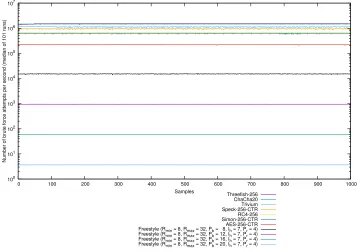
Fig. 6. Number of brute-force attempts possible for various ciphers on a single core of i5-6440HQ processor for a 64 byte message
The figure5shows the result of KGP vs.E[pepper]forRmin=8,Rmax=32,Ih =7,E[R]=20,Pb∈ {20,24,28,32},
and for various message sizes 64 bytes to 4GB. The results indicate that KGP∝ 1
|messaдe|; and can be as large as 109by using a right-skewed probability distribution for generating thepeppervalue.
To demonstrate the effectiveness of the KGP, we compare the number of brute-force attempts per second possible on a single core of i5-6440HQ processor. The results (figure6) indicate that Freestyle even with the lowest possible values of pepper bits (i.e.Pb=8) and initial hashes (i.e.Ih=7) outperforms most of the commonly used ciphers by a wide margin.
4.4 Better security for smaller keys
Though, not recommended, ChaCha supports 128-bitkeys by concatenating thekeywith itself to form a 256-bit
key. In Freestyle,randis used to modify the initial state of cipher to provide an additional 128-bit random secret (in case ofIh =28). Therandis statistically independent of thekey,nonce,pepper, andmessaдe(equation3); hence, for applications where 128-bitkeys have to be used, Freestyle offers better security than ChaCha.
Also, some applications may have lower key-space due to poor (P)RNG. In such cases, Freestyle can resist up to
loд2(KGP)bits ofkeybeing leaked. It is to be noted that the source of (P)RNG to generatekeymay be different from
the (P)RNG available with the sender. Here we assume that the (P)RNG at the sender for generatingpepperand initial
260 280 300 320 340 360 380 400 420 440 460
0 200000 400000 600000 800000 1x10⁶ 1.2x10⁶
Encryption speed in MB/second (median of 101 samples)
Plaintext size in bytes ChaCha20 Freestyle (Rmin = 8, Rmax = 32, Pr = 4)
260 280 300 320 340 360 380 400 420 440 460
0 200000 400000 600000 800000 1x10⁶ 1.2x10⁶
Decryption speed in MB/second (median of 101 samples)
Ciphertext size in bytes ChaCha20 Freestyle (Rmin = 8, Rmax = 32, Pr = 4)
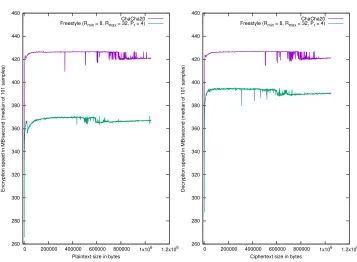
Fig. 7. Performance comparison of Freestyle vs. ChaCha20 on a single core of Intel i5-6440HQ processor usingrandenand
arc4random()as the PRNG. Note that the result does not account for the time taken for cipher initialization.
4.5 Overheads
4.5.1 Computational overhead.Freestyle has two main overheads when compared to ChaCha: (i) Overhead in generating a random number for each block ofmessaдe; (ii) Computation of ahashafter everyHI rounds, which uses 1 quarter rounds of Freestyle. Hence for encryption the computational overhead is:
= time(to generateNbrandom numbers)+ Nb
Õ
i=1
Ri−Rmin
HI +1
×time(1 QR of Freestyle) (23)
Note that the equation23does not account for the time taken for cipher initialization. And the worst case performance overhead is whenRi =Rmax,∀i. The figure7shows the comparison of performance between optimized versions of Freestyle and ChaCha201and Freestyle2with various configurations, without accounting for the time taken for initialization. The results were obtained by running the benchmarks on a single core of Intel i5-6440HQ processor using
arc4random[De Raadt 2014] (during cipher initialization) andranden[Wassenberg et al. 2018]3(during encryption)
and as the CPRNG. For the performance comparison test,Rmin =8,Rmax =32 has been used to make the cipher
performance comparable to ChaCha20, as an uniformly distributed random number generator is used. The results indicate that Freestyle could be 1.13 to 1.60 times slower than ChaCha20 (figure7). The difference between the
performance of encryption and decryption in Freestyle (figure7) is mostly due to the delay in generating a random round number during encryption.
4.5.2 Bandwidth overhead. Freestyle algorithm requires a sender to send the final round’s 8-bithash; i.e. requiring to send extra 8 bits for each block ofmessaдeto be sent. Also, for initialization ofrand, it requires extra 8×Ihbits. Hence,
the total bandwidth overhead in bits is(8Ih+8Nb), i.e.
Bandwidth overhead (in %)=800|messaдe× (Ih+N|b) ≈1.5625% (for a block of message) (24)
5 RELATED WORK
5.1 Randomized encryption schemes
Use of randomized encryption schemes have been in practice for many years, and a taxonomy of randomized ciphers is presented in [Rivest and Sherman 1983]. Also, some approaches to randomized encryption for public-key cryptography was proposed in [Cramer and Shoup 1998;ElGamal 1985;Goldwasser and Micali 1984]. Approaches based on chaotic systems for probabilistic encryption were also proposed [Papadimitriou et al. 2001]. However, the main concern with some of the existing approaches are high bandwidth expansion factor and computational overhead [Li et al. 2003;Rivest and Sherman 1983].
One of the approaches in practice is to generate random bytes and sending it in the encrypted form. The random bytes along with thekeywill be used for encryption/decryption [Rivest and Sherman 1983]. Though such approaches are capable of generating large number of ciphertexts for a givenmessaдeand akey; they do not provide the possibility of KGP>1. Also, for stream-ciphers, if thekeyandnonceare reused, there is a possibility of cryptanalysis by XOR-ing ciphertexts. Also, in Freestyle, the random bytes are never sent to the receiver in plain nor in the encrypted form. The random bytes must be computed by the receiver from the initialIhhashes. The initialIhhashes also serve the purpose
of preventing an adversary from sending arbitrary ciphertext, thus resisting CCA if thenoncecannot be controlled by the adversary. Also, Freestyle offers the possibility of generating up to 2256different ciphertexts even ifkey,nonce, and
other cipher parameters are reused. Also unlike some of the existing randomized ciphers, Freestyle has a low bandwidth overhead of≈1.5625%.
5.2 Approaches based on difficulty and proof of work
Several algorithms have been proposed in literature to increase the difficulty in key and password guessing using an CPU intensive key-streaching[Kelsey et al. 1997] or key-setup phase [Provos and Mazieres 1999] using a cost-factor. Also approaches that consume large amount of memory have also been proposed [Forler et al. 2013;Percival and Josefsson 2016]. Another related area is use of client puzzles [Boyen 2007] and proof-of-work (e.g. Bitcoin [Nakamoto 2008]) to delay cryptographic operations.
Thehash based halting conditiondescribed in section3, on a high-level uses similar principle as the Halting Key Derivation Function (HKDF) proposed in [Boyen 2007]. In HKDF, a sender with a password and random bytes, uses the key derivation function tillniterations (or based on certain amount of time) to generate akeyand a publicly verifiable
hash. On the other hand, the receiver uses the random bytes and password to generate thekeytill the verifiablehash
matches.
for genuine user during encryption/decryption. It also ensures that an adversary executes at least the minimum number of iterations. The maximum iterations ensures that a genuine user cannot run more than specified iterations; thus preventing the possibility of DoS attacks or getting stuck in an infinite loop due to human errors; (ii) Freestyle does not require a complex collision resistant hash function, ashashcollisions are handled simply incrementing thehashif a collision occurs. Also, the hash function uses ARX instructions to resist any side-channel cryptanalysis; (iii) In Freestyle, the security of the cipher is not dependent on amount of time taken or number of iterations for cipher initialization, but on the length ofpepperbits; (iv) Freestyle usesIhnumber of 8-bithashes for initialization and an 8-bithashfor every
block of message being sent, thus the total size ofhashis not fixed and is∝ |messaдe|; (v) Freestyle does not require hashcomputation at every iteration, instead a hash interval (HI) parameter is used to determine round intervals at
whichhashmust be computed, thus offering flexibility to adjust performance and security; and (vi) Freestyle forces the cipher initialization withRmin =8 andRmax =32, thus ensures enough randomness even in cases where user
provides insecure parameters for cipher initialization; and (vii) Freestyle offers the possibility of much higher KGP by allowing the sender to choose a right-skewed distribution to generatepepperandRi.
5.3 FreestylevsChaCha
When compared to ChaCha, Freestyle offers better security for 128-bit keys (section4.4). It also provides the possibility of generating 2256ciphertexts for a givenmessaдeeven ifnonceandkeyis reused (section4.1). This makes Freestyle
resistant to XOR of ciphertext attacks ifkeyandnonceis reused. Randomization also makes Freestyle resistant to KPA, CPA, and CCA (section4.2.2). Freestyle offers the possibility of KGP>1, which makes it resistant to brute-force and dictionary based attacks (section4.3). Also, due to the KGP, Freestyle can resist against attacks which can leak upto
loд2(KGP)keybits. In ChaCha20,S(0)is added withS(20)to generate keystream; which would leak the values ofS(20)[i],
fori∈ {0,1,2,3,12,13,14,15}in case of CPA or CCA attacks. Although, there are no known attacks yet to extract any
key bits from the above leaked values; Freestyle is not prone to such leaks as none of the elements ofS∗in equation8is known to an adversary.
On the other hand, Freestyle was found to be 1.13 to 1.60 times slower than ChaCha20 (section4.5), and also has a higher cost of initialization (sections3.2,3.4). In terms of bandwidth overhead, Freestyle generates≈1.5625% larger
ciphertext. In implementation overhead, Freestyle’s encryption and decryption logic differ slightly. ChaCha is a simple constant time algorithm, where as Freestyle is a randomized algorithm and adds complexity to make cryptanalysis difficult in practice. Finally, Freestyle assumes that the sender has a cryptographically secure PRNG.
6 CONCLUSION
In this paper we have introduced Freestyle, a novel randomized cipher capable of generating up to 2256different ciphertexts for a givenkey,nonce, andmessaдe; making known-plaintext (KPA), plaintext(CPA) and chosen-ciphertext (CCA) attacks difficult in practice. We have introduced the concepts of boundedhash based halting condition andkey-guessing penalty(KGP), which are helpful in development and analysis of ciphers resistant to key-guessing attacks. Freestyle has demonstrated KGP>1 which makes it run faster on a low-powered machine having the correct
The possibility of forcing an adversary to solve a NP-hard problem for every decryption attempt with an incorrectkey
could be an attractive topic of research. The key challenge however is to make the time taken for decryption attempt with an incorrectkey, greater than the time taken to detect if the problem is NP-hard.
REFERENCES
2017. eBACS: ECRYPT Benchmarking of Cryptographic Systems. https://bench.cr.yp.to/results-stream.html Last accessed 10.5.2018.
2017. Libsodium v1.0.12 and v1.0.13 Security Assessment. Technical Report. https://www.privateinternetaccess.com/blog/wp-content/uploads/2017/08/libsodium.pdf.
2017. Security Analysis of ChaCha20-Poly1305 AEAD. Technical Report. KDDI Research, Inc. CRYPTREC-EX-2601-2016, http://www.cryptrec.go.jp/estimation/cryptrec-ex-2601-2016.pdf.
2017. Vulnerability Note VU#307015, Infineon RSA library does not properly generate RSA key pairs. CVE-2017-15361, https://www.kb.cert.org/vuls/id/307015.
David Adrian, Karthikeyan Bhargavan, Zakir Durumeric, Pierrick Gaudry, Matthew Green, J Alex Halderman, Nadia Heninger, Drew Springall, Emmanuel Thomé, Luke Valenta, et al. 2015. Imperfect forward secrecy: How Diffie-Hellman fails in practice. InProceedings of the 22nd ACM SIGSAC Conference on Computer and Communications Security. ACM, 5–17.
Giovanni Agosta, Alessandro Barenghi, and Gerardo Pelosi. 2013. High speed cipher cracking: the case of Keeloq on CUDA. (2013).
Jean-Philippe Aumasson, Simon Fischer, Shahram Khazaei, Willi Meier, and Christian Rechberger. 2008. New features of Latin dances: analysis of Salsa, ChaCha, and Rumba. InInternational Workshop on Fast Software Encryption. Springer, 470–488.
Luciano Bello, Maximiliano Bertacchini, and Black Hat. 2008. Predictable PRNG in the vulnerable Debian OpenSSL package: the what and the how. Inthe 2nd DEF CON Hacking Conference.
Daniel J Bernstein. 2005a. Salsa20 specification.eSTREAM Project algorithm description, http://www. ecrypt. eu. org/stream/salsa20pf. html(2005).
Daniel J Bernstein. 2005b. The Poly1305-AES Message-Authentication Code.. InFSE, Vol. 3557. Springer, 32–49. Daniel J Bernstein. 2008a. ChaCha, a variant of Salsa20. InWorkshop Record of SASC, Vol. 8. 3–5.
Daniel J Bernstein. 2008b. The Salsa20 family of stream ciphers.Lecture Notes in Computer Science4986 (2008), 84–97.
Benjamin Beurdouche, Karthikeyan Bhargavan, Antoine Delignat-Lavaud, Cédric Fournet, Markulf Kohlweiss, Alfredo Pironti, Pierre-Yves Strub, and Jean Karim Zinzindohoue. 2015. A messy state of the union: Taming the composite state machines of TLS. InSecurity and Privacy (SP), 2015 IEEE Symposium on. IEEE, 535–552.
Xavier Boyen. 2007. Halting password puzzles. InProc. Usenix Security.
William Buchanan. 2015. When Slow Is Good - The Great Slowcoach: Bcrypt. https://www.linkedin.com/pulse/when-slow-good-great-slowcoach-bcrypt-william-buchanan.
Elie Bursztein. 2014. Speeding up and strengthening HTTPS connections for Chrome on Android. Google security blog, https://security.googleblog.com/2014/04/speeding-up-and-strengthening-https.html.
Vincent Chiriaco, Aubrey Franzen, Rebecca Thayil, and Xiaowen Zhang. 2017. Finding partial hash collisions by brute force parallel programming. In
Systems, Applications and Technology Conference (LISAT), 2017 IEEE Long Island. IEEE, 1–6.
Arka Rai Choudhuri and Subhamoy Maitra. 2016. Differential Cryptanalysis of Salsa and ChaCha-An Evaluation with a Hybrid Model.IACR Cryptology ePrint Archive2016 (2016), 377.
Ronald Cramer and Victor Shoup. 1998. A practical public key cryptosystem provably secure against adaptive chosen ciphertext attack. InAnnual International Cryptology Conference. Springer, 13–25.
Theo De Raadt. 2014. arc4random - randomization for all occasions. http://www.openbsd.org/papers/hackfest2014-arc4random/index.html
F Denis. 2018. The XChaCha20-Poly1305 construction. https://download.libsodium.org/doc/secret-key_cryptography/xchacha20-poly1305_construction.html.
Taher ElGamal. 1985. A public key cryptosystem and a signature scheme based on discrete logarithms.IEEE transactions on information theory31, 4 (1985), 469–472.
Christian Forler, Stefan Lucks, and Jakob Wenzel. 2013.Catena: A memory-consuming password-scrambling framework. Technical Report. Citeseer. Shafi Goldwasser and Silvio Micali. 1984. Probabilistic encryption.Journal of computer and system sciences28, 2 (1984), 270–299.
Weikai Gu, Yingzhen Huang, Rongxin Qian, Zheyuan Liu, and Rongjie Gu. 2017. Attacking Crypto-1 Cipher Based on Parallel Computing Using GPU. In
International Conference on Applications and Techniques in Cyber Security and Intelligence. Springer, 293–303.
Frank K Gürkaynak, Robert Schilling, Michael Muehlberghuber, Francesco Conti, Stefan Mangard, and Luca Benini. 2017. Multi-core data analytics SoC with a flexible 1.76 Gbit/s AES-XTS cryptographic accelerator in 65 nm CMOS. InProceedings of the Fourth Workshop on Cryptography and Security in Computing Systems. ACM, 19–24.
Nadia Heninger, Zakir Durumeric, Eric Wustrow, and J Alex Halderman. 2012. Mining Your Ps and Qs: Detection of Widespread Weak Keys in Network Devices.. InUSENIX Security Symposium, Vol. 8.
Tsukasa Ishiguro. 2012. Modified version of" Latin Dances Revisited: New Analytic Results of Salsa20 and ChaCha".IACR Cryptology ePrint Archive2012
Shubham Jain, Ashish Ranjan, Kaushik Roy, and Anand Raghunathan. 2017. Computing in Memory with Spin-Transfer Torque Magnetic RAM.arXiv preprint arXiv:1703.02118(2017).
Khalid Javeed, Xiaojun Wang, and Mike Scott. 2016. High performance hardware support for elliptic curve cryptography over general prime field.
Microprocessors and Microsystems(2016).
Gershon Kedem and Yuriko Ishihara. 1999. Brute force attack on UNIX passwords with SIMD computer. (1999).
John Kelsey, Bruce Schneier, Chris Hall, and David Wagner. 1997. Secure applications of low-entropy keys. InInternational Workshop on Information Security. Springer, 121–134.
Ayesha Khalid, Goutam Paul, and Anupam Chattopadhyay. 2017. RC4-AccSuite: A Hardware Acceleration Suite for RC4-Like Stream Ciphers.IEEE Transactions on Very Large Scale Integration (VLSI) Systems25, 3 (2017), 1072–1084.
Soo Hyeon Kim, Daewan Han, and Dong Hoon Lee. 2013. Predictability of Android OpenSSL’s pseudo random number generator. InProceedings of the 2013 ACM SIGSAC conference on Computer & communications security. ACM, 659–668.
Wonjoo Kim, Anupam Chattopadhyay, Anne Siemon, Eike Linn, Rainer Waser, and Vikas Rana. 2016. Multistate memristive tantalum oxide devices for ternary arithmetic.Scientific reports6 (2016).
A Langley, W Chang, N Mavrogiannopoulos, J Strombergson, and S Josefsson. 2016.ChaCha20-Poly1305 cipher suites for transport layer security (TLS). Technical Report.
Arjen Lenstra, James P Hughes, Maxime Augier, Joppe Willem Bos, Thorsten Kleinjung, and Christophe Wachter. 2012.Ron was wrong, Whit is right. Technical Report. IACR.
Shujun Li, Xuanqin Mou, Boliya L Yang, Zhen Ji, and Jihong Zhang. 2003. Problems with a probabilistic encryption scheme based on chaotic systems.
International Journal of Bifurcation and Chaos13, 10 (2003), 3063–3077.
Zhe Liu, Johann Großschädl, Zhi Hu, Kimmo Järvinen, Husen Wang, and Ingrid Verbauwhede. 2017. Elliptic curve cryptography with efficiently computable endomorphisms and its hardware implementations for the internet of things.IEEE Trans. Comput.66, 5 (2017), 773–785.
Eduardo Novella Lorente, Carlo Meijer, and Roel Verdult. 2015. Scrutinizing WPA2 Password Generating Algorithms in Wireless Routers.. InWOOT.
Subhamoy Maitra. 2016. Chosen IV cryptanalysis on reduced round ChaCha and Salsa.Discrete Applied Mathematics208 (2016), 88–97.
Katja Malvoni, Designer Solar, and Josip Knezović. 2014. Are your passwords safe: Energy-efficient bcrypt cracking with low-cost parallel hardware. In
WOOT’14 8th Usenix Workshop on Offensive Technologies Proceedings 23rd USENIX Security Symposium.
Damien Miller. 2018. chacha20poly1305 protocol. https://cvsweb.openbsd.org/cgi-bin/cvsweb/src/usr.bin/ssh/PROTOCOL.chacha20poly1305?annotate=HEAD, Last accessed 1.12.2018.
Damien Miller and S Josefsson. 2018. The [email protected] authenticated encryption cipher draft-josefsson-ssh-chacha20-poly1305-openssh-00. Network Working Group Internet-Draft, https://tools.ietf.org/html/draft-josefsson-ssh-chacha20-poly1305-openssh-00, Last accessed 1.12.2018.
Satoshi Nakamoto. 2008. Bitcoin: A peer-to-peer electronic cash system. (2008).
Yoav Nir and Adam Langley. 2015.ChaCha20 and Poly1305 for IETF Protocols. Technical Report.
Stergios Papadimitriou, Tassos Bountis, Seferina Mavroudi, and Anastasios Bezerianos. 2001. A probabilistic symmetric encryption scheme for very fast secure communication based on chaotic systems of difference equations.International Journal of Bifurcation and Chaos11, 12 (2001), 3107–3115. Colin Percival and Simon Josefsson. 2016.The scrypt password-based key derivation function. Technical Report.
Gordon Procter. 2014. A Security Analysis of the Composition of ChaCha20 and Poly1305.IACR Cryptology ePrint Archive2014 (2014), 613. Niels Provos and David Mazieres. 1999. Bcrypt algorithm. USENIX.
Dayane Reis, Michael Niemier, and X Sharon Hu. 2018. Computing in memory with FeFETs. InProceedings of the International Symposium on Low Power Electronics and Design. ACM, 24.
Ronald L Rivest and Alan T Sherman. 1983. Randomized encryption techniques. InAdvances in Cryptology. Springer, 145–163.
Andrew Ruddick and Jeff Yan. 2016. Acceleration attacks on PBKDF2: or, what is inside the black-box of oclHashcat?. InWOOT.
Abu Sebastian, Tomas Tuma, Nikolaos Papandreou, Manuel Le Gallo, Lukas Kull, Thomas Parnell, and Evangelos Eleftheriou. 2017. Temporal correlation detection using computational phase-change memory.Nature Communications(2017). https://doi.org/10.1038/s41467-017-01481-9
Mathy Vanhoef and Frank Piessens. 2017. Key Reinstallation Attacks: Forcing Nonce Reuse in WPA2. InProceedings of the 24th ACM Conference on Computer and Communications Security (CCS). ACM.
Andrea Visconti, Simone Bossi, Hany Ragab, and Alexandro Calò. 2015. On the weaknesses of PBKDF2. InInternational Conference on Cryptology and Network Security. Springer, 119–126.
Jan Wassenberg, Robert Obryk, Jyrki Alakuijala, and Emmanuel Mogenet. 2018. Randen-fast backtracking-resistant random generator with AES+ Feistel+ Reverie.arXiv preprint arXiv:1810.02227(2018).
Friedrich Wiemer and Ralf Zimmermann. 2014. High-speed implementation of bcrypt password search using special-purpose hardware. InReConFigurable Computing and FPGAs (ReConFig), 2014 International Conference on. IEEE, 1–6.
Scott Yilek, Eric Rescorla, Hovav Shacham, Brandon Enright, and Stefan Savage. 2009. When private keys are public: Results from the 2008 Debian OpenSSL vulnerability. InProceedings of the 9th ACM SIGCOMM conference on Internet measurement conference. ACM, 15–27.
Appendix A REFERENCE CODE - FREESTYLE HASH FUNCTION
1 # d e f i n e AXR (a ,b ,c , r ) { a = PLUS ( a , b ); c = R O T A T E ( XOR ( c , a ) , r );}
2 3
u8 f r e e s t y l e _ h a s h (
4 co nst u32 c i p h e r _ s t a t e [16] ,
5 co nst u8 p r e v i o u s _ h a s h ,
6 co nst u8 r o u n d s )
7 {
8
u8 hash ;
9 10
u32 t emp 1 = r o u n d s ;
11
u32 t emp 2 = p r e v i o u s _ h a s h ;
12 13 AXR ( temp1 , c i p h e r _ s t a t e [ 3] , temp2 , 16);
14 AXR ( temp2 , c i p h e r _ s t a t e [ 6] , temp1 , 12);
15 AXR ( temp1 , c i p h e r _ s t a t e [ 9] , temp2 , 8);
16 AXR ( temp2 , c i p h e r _ s t a t e [12] , temp1 , 7);
17 18 hash = t emp 1 & 0 xFF ;
19 20 r e t u r n hash ;
21 }
Appendix B REFERENCE CODE - INITIALIZATION FOR ENCRYPTION
1 # d e f i n e M A X _ I N I T _ H A S H E S (56)
2 3 void f r e e s t y l e _ r a n d o m s e t u p _ e n c r y p t ( f r e e s t y l e _ c t x * x )
4 {
5
u32 i ;
6 7
u8 R [ M A X _ I N I T _ H A S H E S ]; /* a c t u a l r a n d o m r o u n d s */
8
u8 CR [ M A X _ I N I T _ H A S H E S ]; /* c o l l i d e d r a n d o m r o u n d s */
9 10
u32 t emp 1 ;
11
u32 t emp 2 ;
12 13 co nst u32 s a v e d _ m i n _ r o u n d s = x - > m i n _ r o u n d s ;
14 co nst u32 s a v e d _ m a x _ r o u n d s = x - > m a x _ r o u n d s ;
15 co nst u32 s a v e d _ h a s h _ i n t e r v a l = x - > h a s h _ i n t e r v a l ;
16 co nst u8 s a v e d _ n u m _ p r e c o m p u t e d _ r o u n d s = x - > n u m _ p r e c o m p u t e d _ r o u n d s ;
18
u32 p ;
19 20 if (! x - > i s _ p e p p e r _ s e t )
21 {
22 x - > p e p p e r = a r c 4 r a n d o m _ u n i f o r m (
23 x - > p e p p e r _ b i t s == 32 ? -1 : (1 << x - > p e p p e r _ b i t s )
24 );
25 }
26 27 /* set sane v a l u e s for i n i t a l i z a t i o n */
28 x - > m i n _ r o u n d s = 8;
29 x - > m a x _ r o u n d s = 32;
30 x - > h a s h _ i n t e r v a l = 1;
31 x - > n u m _ p r e c o m p u t e d _ r o u n d s = 4;
32 33 for ( i = 0; i < M A X _ I N I T _ H A S H E S ; ++ i ) {
34 R [ i ] = CR [ i ] = 0;
35 }
36 37 /* i n i t i a l pre - c o m p u t e d r o u n d s */
38 f r e e s t y l e _ p r e c o m p u t e _ r o u n d s ( x );
39 40 /* add a r a n d o m / user - set p e p p e r to c o n s t a n t [0] */
41 x - > in put [ C O N S T A N T 0 ] = PLUS (x - > i npu t [ C O N S T A N T 0 ] , x - > p e p p e r );
42 43 for ( i = 0; i < x - > n u m _ i n i t _ h a s h e s ; ++ i )
44 {
45 R [ i ] = f r e e s t y l e _ e n c r y p t _ b l o c k (
46 x ,
47 NULL ,
48 NULL ,
49 0 ,
50 &x - > i n i t _ h a s h [ i ]
51 );
52 53 f r e e s t y l e _ i n c r e m e n t _ c o u n t e r ( x );
54 }
55 56 if (! x - > i s _ p e p p e r _ s e t )
57 {
59 x - > in put [ C O N S T A N T 0 ] = M INU S (x - > i npu t [ C O N S T A N T 0 ] , x - > p e p p e r );
60 61 /* che ck for any c o l l i s i o n s b e t w e e n 0 and p e p p e r */
62 for ( p = 0; p < x - > p e p p e r ; ++ p )
63 {
64 x - > in put [ C O U N T E R ] = x - > i n i t i a l _ c o u n t e r ;
65 66 for ( i = 0; i < x - > n u m _ i n i t _ h a s h e s ; ++ i )
67 {
68 CR [ i ] = f r e e s t y l e _ d e c r y p t _ b l o c k (
69 x ,
70 NULL ,
71 NULL ,
72 0 ,
73 &x - > i n i t _ h a s h [ i ]
74 );
75 76 if ( CR [ i ] == 0) {
77 goto r etr y ;
78 }
79 80 f r e e s t y l e _ i n c r e m e n t _ c o u n t e r ( x );
81 }
82 83 /* fou nd a c o l l i s i o n ; use the c o l l i d e d r o u n d s */
84 m e m c p y ( R , CR , s i z e o f( R ));
85 br eak;
86 87 re try :
88 x - > in put [ C O N S T A N T 0 ] = P L U S O N E (x - > i npu t [ C O N S T A N T 0 ]);
89 }
90 }
91 92 for ( i = 0; i < 8; ++ i )
93 {
94 te mp1 = 0;
95 te mp2 = 0;
96 97 AXR ( temp1 , R [7* i + 0] , temp2 , 16);
98 AXR ( temp2 , R [7* i + 1] , temp1 , 12);
100 AXR ( temp2 , R [7* i + 3] , temp1 , 7);
101 102 AXR ( temp1 , R [7* i + 4] , temp2 , 16);
103 AXR ( temp2 , R [7* i + 5] , temp1 , 12);
104 AXR ( temp1 , R [7* i + 6] , temp2 , 8);
105 AXR ( temp2 , R [7* i + 0] , temp1 , 7);
106 107 x - > rand [ i ] = te mp1 ;
108 }
109 110 /* set user p a r a m e t e r s back */
111 x - > m i n _ r o u n d s = s a v e d _ m i n _ r o u n d s ;
112 x - > m a x _ r o u n d s = s a v e d _ m a x _ r o u n d s ;
113 x - > h a s h _ i n t e r v a l = s a v e d _ h a s h _ i n t e r v a l ;
114 x - > n u m _ p r e c o m p u t e d _ r o u n d s = s a v e d _ n u m _ p r e c o m p u t e d _ r o u n d s ;
115 116 /* set c o u n t e r to the va lue that was af ter pre - c o m p u t e d r o u n d s */
117 x - > in put [ C O U N T E R ] = x - > i n i t i a l _ c o u n t e r ;
118 119 /* m o d i f y c o n s t a n t [1] , c o n s t a n t [2] , and c o n s t a n t [3] */
120 x - > in put [ C O N S T A N T 1 ] ^= x - > rand [1];
121 x - > in put [ C O N S T A N T 2 ] ^= x - > rand [2];
122 x - > in put [ C O N S T A N T 3 ] ^= x - > rand [3];
123 124 /* m o d i f y key [0] , key [1] , key [2] , and key [3] */
125 x - > in put [ KEY0 ] ^= x - > rand [4];
126 x - > in put [ KEY1 ] ^= x - > rand [5];
127 x - > in put [ KEY2 ] ^= x - > rand [6];
128 x - > in put [ KEY3 ] ^= x - > rand [7];
129 130 /* Do pre - c o m p u t a t i o n as s p e c i f i e d by the user */
131 f r e e s t y l e _ p r e c o m p u t e _ r o u n d s ( x );
132 }
Appendix C REFERENCE CODE - INITIALIZATION FOR DECRYPTION
1 void f r e e s t y l e _ r a n d o m s e t u p _ d e c r y p t ( f r e e s t y l e _ c t x * x )
2 {
3
u32 i ;
4 5
u8 R [ M A X _ I N I T _ H A S H E S ]; /* r a n d o m r o u n d s */
7
u32 t emp 1 ;
8
u32 t emp 2 ;
9 10 co nst u8 s a v e d _ m i n _ r o u n d s = x - > m i n _ r o u n d s ;
11 co nst u8 s a v e d _ m a x _ r o u n d s = x - > m a x _ r o u n d s ;
12 co nst u8 s a v e d _ h a s h _ i n t e r v a l = x - > h a s h _ i n t e r v a l ;
13 co nst u8 s a v e d _ n u m _ p r e c o m p u t e d _ r o u n d s = x - > n u m _ p r e c o m p u t e d _ r o u n d s ;
14 15
u32 p e p p e r ;
16 17
u32 m a x _ p e p p e r = x - > p e p p e r _ b i t s == 32 ?
18 U I N T 3 2 _ M A X : (u32) ((1 << x - > p e p p e r _ b i t s ) - 1);
19 20 /* set sane v a l u e s for i n i t a l i z a t i o n */
21 x - > m i n _ r o u n d s = 8;
22 x - > m a x _ r o u n d s = 32;
23 x - > h a s h _ i n t e r v a l = 1;
24 x - > n u m _ p r e c o m p u t e d _ r o u n d s = 4;
25 26 for ( i = 0; i < M A X _ I N I T _ H A S H E S ; ++ i ) {
27 R [ i ] = 0;
28 }
29 30 /* i n i t i a l pre - c o m p u t e d r o u n d s */
31 f r e e s t y l e _ p r e c o m p u t e _ r o u n d s ( x );
32 33 /* if i n i t i a l p e p p e r is set , then add it to c o n s t a n t [3] */
34 x - > in put [ C O N S T A N T 0 ] = PLUS (x - > i npu t [ C O N S T A N T 0 ] , x - > p e p p e r );
35 36 for ( p e p p e r = x - > p e p p e r ; p e p p e r <= m a x _ p e p p e r ; ++ p e p p e r )
37 {
38 x - > in put [ C O U N T E R ] = x - > i n i t i a l _ c o u n t e r ;
39 40 for ( i = 0; i < x - > n u m _ i n i t _ h a s h e s ; ++ i )
41 {
42 R [ i ] = f r e e s t y l e _ d e c r y p t _ b l o c k (
43 x ,
44 NULL ,
45 NULL ,
46 0 ,
48 );
49 50 if ( R [ i ] == 0) {
51 goto r etr y ;
52 }
53 54 f r e e s t y l e _ i n c r e m e n t _ c o u n t e r ( x );
55 }
56 57 /* fou nd all val id R [ i ] s */
58 br eak;
59 60 re try :
61 x - > in put [ C O N S T A N T 0 ] = P L U S O N E (x - > i npu t [ C O N S T A N T 0 ]);
62 }
63 64 for ( i = 0; i < 8; ++ i )
65 {
66 te mp1 = 0;
67 te mp2 = 0;
68 69 AXR ( temp1 , R [7* i + 0] , temp2 , 16);
70 AXR ( temp2 , R [7* i + 1] , temp1 , 12);
71 AXR ( temp1 , R [7* i + 2] , temp2 , 8);
72 AXR ( temp2 , R [7* i + 3] , temp1 , 7);
73 74 AXR ( temp1 , R [7* i + 4] , temp2 , 16);
75 AXR ( temp2 , R [7* i + 5] , temp1 , 12);
76 AXR ( temp1 , R [7* i + 6] , temp2 , 8);
77 AXR ( temp2 , R [7* i + 0] , temp1 , 7);
78 79 x - > rand [ i ] = te mp1 ;
80 }
81 82 /* set user p a r a m e t e r s back */
83 x - > m i n _ r o u n d s = s a v e d _ m i n _ r o u n d s ;
84 x - > m a x _ r o u n d s = s a v e d _ m a x _ r o u n d s ;
85 x - > h a s h _ i n t e r v a l = s a v e d _ h a s h _ i n t e r v a l ;
86 x - > n u m _ p r e c o m p u t e d _ r o u n d s = s a v e d _ n u m _ p r e c o m p u t e d _ r o u n d s ;
![Fig. 3. Generation of rand[i], where i ∈ [0, 7] (the size of variables are in bits)](https://thumb-us.123doks.com/thumbv2/123dok_us/7966584.1321345/8.612.253.398.89.449/fig-generation-rand-i-i-size-variables-bits.webp)
![Fig. 5. KGP vs E[pepper] for Rmin = 8, Rmax = 32, HI = 1, Ih = 7, E[R] = 20, Pb ∈ {20, 24, 28, 32}, and various message sizes (64bytes to 4GB).](https://thumb-us.123doks.com/thumbv2/123dok_us/7966584.1321345/14.612.118.533.89.389/fig-pepper-rmin-rmax-various-message-sizes-bytes.webp)