META-SYNTACTIC THERAPY USING VISUAL CODING FOR
CHILDREN WITH SEVERE PERSISTENT SLI
Susan Ebbels1,2 and Heather van der Lely2
Moor House School, Mill Lane, Hurst Green,
Oxted, Surrey, RH8 9AQ1 andDepartment of Psychology, Birkbeck College,
University of London, Malet Street, London WC1E 7HX2
email: [email protected]
The results of a pilot study into meta-syntactic therapy using visual coding for four children (age 11-13 years) with severe receptive and expressive specific language impairment (SLI) are presented. The coding system uses shapes, colours and a system of arrows to teach grammatical rules. A time-series design established baseline pre-therapy measures of comprehension and production of both passives and ‘wh’ questions. All participants made progress with passives and this was significant in three cases of the four. Comprehension and production of ‘wh’ questions also improved in all participants, although this did not always reach statistical significance. The results indicate that meta-syntactic therapy of grammatical rules, capitalising on visual strengths, can improve both comprehension and production in secondary age children with severe persistent SLI.
Introduction
Recent work investigating both the expression and comprehension of grammar indicates that a core deficit in some children (with ‘grammatical-SLI’) can be characterised by a deficit in syntactic ‘movement’, i.e. forming dependent relations between lexical items which are needed for grammatical interpretation or production of sentences (van der Lely 1998). In this study we evaluate a remedial programme which focuses on making explicit grammatical relations between words. The therapy procedure uses a visual coding scheme which amalgamates and extends the approaches of Bryan’s (1997) ‘Colourful Semantics’ and Lea’s (1965, 1970) ‘Colour Pattern Scheme’. It codes thematic roles (agent, theme), syntactic dependant relations (subject-verb), grammatical categories (nouns, verbs) and morphological inflections (-ing, -ed). Unlike Bryan’s and Lea’s schemes, it is able to represent the hierarchical nature of language by showing embedding and can be used for teaching both comprehension and expression. This pilot study is an initial step in the evaluation of this procedure. The structures targeted were both the production and comprehension of passive sentences and ‘wh’ questions, which have been found to present particular difficulties for children with SLI (van der Lely 1996, van der Lely and Battell 1998).
Participants
Four children with severe persistent SLI participated (three boys and one girl, aged 11;08-12;09 years at initial testing). Their language scores as assessed on the Clinical
Evaluation of Language Fundamentals (CELF-R UK) (Semel et al. 1994) fell at least
vocabulary as assessed on the British Picture Vocabulary Scales (BPVS-II) (Dunn et al.
1997)ranged from -2 to -3.3 standard deviations (group mean z = -2.67, SS = 59.5). On
the Test of Reception of Grammar (TROG) (Bishop 1983) a test of sentence comprehension, their scores ranged between –1.65 and more than -2.3 standard deviations below the mean. Their visual perceptual skills as tested on the Test of Visual-Perceptual
Skills (Gardener 1988) fell within the normal range (group mean z = 0.16, SS = 102.5)
(with three of them above average).
Initial Testing
Design and method
The participants’ ability to correctly assign thematic roles was assessed by investigating their comprehension and production of active and passive sentences and ‘wh’ questions. Two procedures were used for testing comprehension: a) baseline testing using an acting out procedure and b) a picture selection task. Active and passive sentences were elicited using the same materials with specific prompts. Baseline testing was repeated once per week for four weeks. ‘Wh’ questions were elicited using a ‘whodunnit’ game.
The passive baseline tests used twelve semantically reversible active and passive
sentences. The children acted these out (comprehension) or responded to a prompt, ‘tell me about the ___’, which focused on the either the actor or patient (expression). The picture selection task used the Test of Active and Passive Sentences (TAPS) (van der Lely 1996). The target sentence types were active (the man eats the fish), long passive (the fish is eaten by the man) and short verbal passive (the fish is being eaten). An adjectival picture (of an eaten fish) is also provided. This test was modified to test expression, using prompts as before.
Baseline comprehension of subject and object questions focused on semantically
reversible ‘who’ and ‘which’ questions. For example, ‘who is following the cow?’ (subject) or ‘which pig is the cow following?’ (object). Production of subject and object questions used a modified game of Cluedo (van der Lely and Battell 1998). The child asks questions to get clues as to ‘whodunnit’. There are six subject and six object questions for each target ‘wh’ word, ‘who’, ‘what’ and ‘which’.
Results
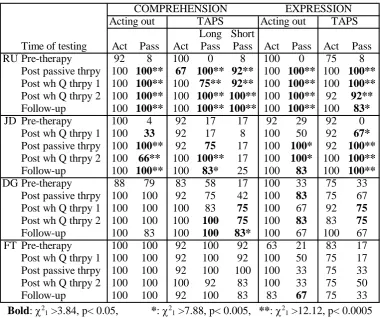
The percentages correct for these initial tests are shown in the first line for each participant of Tables 1 and 2. For the baseline tests, the mean of the four scores is shown. Although the participants had similar scores on the standardised tests, their responses to these targeted tests varied greatly. Considering passive comprehension first: RU and JD interpreted virtually all passive forms as active. DG improved on the acting out task during baseline testing, from 67% to 100% by the last test. He had particular difficulty with short passives on the TAPS, choosing the adjectival picture. FT made very few errors on all sentence types. Passive expression was difficult for all the participants. None achieved a mean of more than 33% correct. DG and FT failed to convert the verb into the past participle. RU and JD made few attempts to use the passive and used active sentences to try to express the content, e.g. ‘the horse doesn’t like it’, ‘the horse is cross cos the cow’s hitting him’.
Expression of subject and object questions in the past tense was difficult for all the participants, particularly object questions. The highest total score was 16/36 (JD) the other three scored only 3 or 8. The most common errors were: maintenance of past tense; ‘do support’ (both addition of ‘do/did’ in subject questions and more frequently omission in object questions); tense agreement, e.g. ‘who did she saw?’ and missing argument or verb, e.g. ‘who did someone in the lounge?’. RU and DG also made many errors of
‘gap-filling’, e.g. ‘who did Mrs Peacock see someone in the library?’ RU additionally made
errors by not moving the whole of the ‘which’ phrase, e.g. ‘which did the telephone rang?’ All the children exhibited difficulties producing simple object questions that are generally mastered by 3 to 4 years of age, e.g. in response to the clue ‘Mrs Peacock saw someone in the lounge, ask me who’, they asked: ‘who saw in the lounge’ (JD), ‘who it was in the lounge’ (FT), ‘who did Mrs Peacock saw someone in the lounge’ (DG) and ‘who did someone in the lounge’ (RU).
These children were still struggling with these basic areas of grammar at the age of 11-13 years despite years of special education and intensive therapy input. We therefore hypothesised that they were unable to learn these rules subconsciously by extracting them from the language they heard around them and that they might benefit from learning these consciously as a second language learner might learn a language. Building on their strong visual skills, a visual coding system was used to facilitate understanding and retention of the rules underlying passive sentences and ‘wh’ question formation.
Therapeutic intervention
Design and method
A brief description of some features of the visual coding system follows. The system uses shapes to group words in phrases, each shape indicating a particular thematic role. The shapes can be embedded inside each other and moved leaving behind traces; black arrows show the chain between a moved constituent and its trace. Colours represent the grammatical categories of individual words. The basic colours (with a few minor modifications) are those used by Lea (1970) in his ‘Colour Pattern Scheme’. A system of arrows indicates inflections of tense and aspect.
The comprehension therapy taught the children to recognise and use syntactic cues necessary for correct interpretation of ‘wh’ questions and passives. They were taught to identify gaps in object questions and passives, to link these with the moved constituent (or ‘wh’ word) and assign the correct thematic roles. Expressive therapy taught rules about, for example, ‘do’ support and movement of tense and aspect inflections in ‘wh’ questions or passives. An example of an active and its related passive sentence follows:
The boy kicked the ball , The ball was kicked by the boy
line) moves from the main verb to a new (marked by radiating lines) auxiliary (diamond) that is inserted to carry the tense because the main verb converts to a past participle (marked by a horizontal arrow on the left of the yellow line). The application of this method involved several other aspects not described here.
Each participant received 13 half-hour sessions introduction to the coding system. Then two received ‘wh’ and two passive therapy for a ten week block (approximately 7-8 hours therapy), before swapping for a second block. All participants received a further block of ‘wh’ therapy, as it had become clear this required more teaching. A period of no therapy followed. Re-testing took place after each block of therapy and at follow-up (after ten weeks without therapy) to establish maintenance of new skills.
Results
Tables 1 and 2 show the participants’ scores on the tests at various stages of therapy. The significance levels of changes in score since pre-therapy were computed using the chi-square test.
Table 1. Percentage correct for passives pre- and post-therapy
COMPREHENSION EXPRESSION
Acting out TAPS Acting out TAPS
Long Short
Time of testing Act Pass Act Pass Pass Act Pass Act Pass
RU Pre-therapy 92 8 100 0 8 100 0 75 8
Post passive thrpy 100 100** 67 100** 92** 100 100** 100 100**
Post wh Q thrpy 1 100 100** 100 75** 92** 100 100** 100 100**
Post wh Q thrpy 2 100 100** 100 100** 100** 100 100** 92 92**
Follow-up 100 100** 100 100** 100** 100 100** 100 83*
JD Pre-therapy 100 4 92 17 17 92 29 92 0
Post wh Q thrpy 1 100 33 92 17 8 100 50 92 67*
Post passive thrpy 100 100** 92 75 17 100 100* 92 100**
Post wh Q thrpy 2 100 66** 100 100** 17 100 100* 100 100**
Follow-up 100 100** 100 83* 25 100 83 100 100**
DG Pre-therapy 88 79 83 58 17 100 33 75 33
Post passive thrpy 100 100 92 75 42 100 83 75 67
Post wh Q thrpy 1 100 100 100 83 75 100 67 92 75
Post wh Q thrpy 2 100 100 100 100 75 100 83 83 75
Follow-up 100 83 100 100 83* 100 67 100 67
FT Pre-therapy 100 100 92 100 92 63 21 83 17
Post wh Q thrpy 1 100 100 92 100 92 100 50 75 17
Post passive thrpy 100 100 92 100 100 100 33 75 33
Post wh Q thrpy 2 100 100 100 92 83 100 33 75 50
Follow-up 100 100 92 100 83 83 67 75 33
Bold: 2
1 >3.84, p< 0.05, *: 21 >7.88, p< 0.005, **: 21 >12.12, p< 0.0005
RU and JD improved significantly on ‘which’ comprehension after targeted therapy. Progress on expression of ‘wh’ questions was limited for all the participants. RU, JD and FT made significant progress on subject questions with therapy, which was not maintained, whereas DG maintained the progress he made. RU and DG improved on object questions, but this was not maintained.
Table 2. Percentage correct for ‘wh’ questions pre- and post-therapy
Comprehension Expression
"Who" "Which" Subject Object
Time of testing Subj Obj Subj Obj Who What Which TOT Who What Which TOT
RU Mean 88 88 88 38 50 0 0 17 0 0 0 0
Post pass thrpy 100 83 100 50 67 0 0 22 0 0 17 6
Post wh thrpy1 100 100 100100* 100 0 67 56 0 33 0 11
Post wh thrpy2 100 100 100100* 83 33 67 61 17 33 50 33
Follow-up 100 100 100 83 83 0 50 44 0 33 17 17
JD Mean 100 100 92 38 100 50 33 61 17 33 33 28
Post wh thrpy1 100 100 100 67 83 67 50 67 33 33 83 50
Post pass thrpy 100 100 100 50 100 100 67 89 33 33 50 39
Post wh thrpy2 100 100 100100* 100 100 100 100* 33 17 33 28
Follow-up 83 100 100 100* 100 83 83 89 17 33 67 39
DG Mean 100 100 100 71 33 33 50 39 0 0 17 6
Post pass thrpy 100 100 100 83 67 50 33 50 17 17 50 28
Post wh thrpy1 100 67 100 67 100 83 83 89* 33 50 67 50*
Post wh thrpy2 100 100 100 83 100 67 67 78 0 50 83 44
Follow-up 100 100 100 83 100 83 50 78 17 33 33 28
FT Mean 100 100 100 83 50 0 67 39 0 0 17 6
Post wh thrpy1 100 100 100 100 83 83 33 67 0 17 17 11
Post pass thrpy 100 100 100 83 83 67 67 72 0 0 0 0
Post wh thrpy2 100 100 100 100 100 67 67 78 0 0 0 0
Follow-up 100 100 100 100 83 50 67 67 0 33 0 11
Bold: 2
1 >3.84, p< 0.05, *: 21 >7.88, p< 0.005
Discussion
The participants all showed progress although the significance and maintenance of their progress varied between individuals. Considering first the timing of progress, the greatest progress was made by all participants during targeted therapy. However, note DG showed some progress during baseline testing for comprehension of ‘which’ questions and expression of passives, and JD made some inconsistent progress with passives prior to targeted therapy.
The reasons contributing to the variable nature of the children’s response to this kind of therapy need to be considered. FT responded least well. However, she had the lowest standard score on the Test of Visual-Perceptual Skills and therefore may not have benefited from the visual method of presentation. She also had good comprehension but great difficulties producing the targeted structures pre-therapy. The source of her difficulties therefore, may have been different to that of the other participants and perhaps was not best addressed by this type of therapy.
pattern. He made no progress until receiving targeted therapy; progress was then gradual and continued after therapy, indicating that he needed a period of consolidation. Pre-therapy he made fewer errors on passives and his comprehension of ‘which’ questions was unreliable but improved with testing. He may have been aware of differences between passives versus actives and subject versus object questions and developed his own inaccurate strategies to respond to these. With therapy he learnt more reliable strategies and may have needed time to reject his old strategies in favour of the new, thus showing more gradual progress. RU and JD on the other hand appeared to have no awareness of the differences between these structures and no strategies of their own prior to therapy. These did not therefore have to be rejected and they could begin to use the strategies taught, leading to a dramatic increase in scores.
The method of therapy used in this study was effective in improving the performance of at least three out of four participants. It was particularly effective in teaching the participants to comprehend grammatical structures which involve ‘movement’ involving dependent structural knowledge between sentence constituents. We aim to extend this method to a wider range of structures and refine the coding system further to maximise the potential benefits to the children. Further work is needed on a larger group of subjects in order to establish which children may benefit from this kind of approach and which factors may render children less likely to benefit. It is hoped that this will provide further insights in the future into the possible existence of subgroups of SLI and their differing responses to different types of therapy.
References
Bishop, D.V.M., 1983, The Test for Reception of Grammar. Available from the author at
MRC APU, 15 Chaucer Road, Cambridge, CB2 2EF.
Bryan, A., 1997, Colourful semantics. In Language Disorders in Children and Adults:
Psycholinguistic Approaches to Therapy,edited by S. Chiat, J. Law and J. Marshall
(London: Whurr).
Dunn, L.M., Dunn, L.M., Whetton, C. and Burley, J. 1997, British Picture Vocabulary
Scales (second edition) (Windsor: NFER-Nelson).
Gardner, M.F., 1988, Test of Visual-Perceptual Skills (Non-motor) (**place:
Psychological and Educational Publications Inc.).
Lea, J., 1965, A language system for children suffering from receptive aphasia. Speech
Pathology and Therapy, 8, 58-68.
Lea, J., 1970, The Colour Pattern Scheme: a Method of Remedial Language Teaching
(Oxted, Surrey: Moor House School).
Semel, E., Siig, E.H. and Secord, S., 1994, Clinical Evaluation of Language
Fundamentals – Revised (The Psychological Corporation).
van der Lely, H.K.J., 1996, Specifically language impaired and normally developing
children: Verbal passive vs. adjectival passive sentence interpretation, Lingua, 98,
243-272.
van der Lely, H.K.J., 1998, SLI in children: movement, economy, and deficits in the
computational-syntactic system. Language Acquisition, 7, 161-192.
van der Lely, H.K.J. and Battell, J.S., 1998, Wh-movement in specifically language
impaired children. Paper presented at the 23rd Boston University Conference on
Language Development, Boston.
van der Lely, H.K.J., 1996, Test of Active and Passive Sentences, available from author at