Volume 3, No. 3, May-June 2012
International Journal of Advanced Research in Computer Science
RESEARCH PAPER
Available Online at www.ijarcs.info
ISSN No. 0976-5697
Simulation Based Performance Comparison of AODV and OLSR Routing Protocols in
MANET
Naveen Bilandi*
Dept. of Computer Science &Engineering National Institute of Technology
Jalandhar, India [email protected]
Harsh K Verma
Dept. of Computer Science &Engineering National Institute of Technology
Jalandhar, India [email protected]
Abstract: This paper aims to compare performance of two routing protocols for Mobile Ad-Hoc networks (MANET’s). A Mobile Ad-Hoc Network (MANET) is a collection of wireless mobile nodes forming a temporary network without using any centralized access point, infrastructure, or centralized. In present study, a comparison of reactive routing protocols i.e. Ad Hoc On-Demand Distance Vector Routing (AODV) and proactive routing protocols i.e. Optimized Link State Routing (OLSR) has been made on the basis of throughput, retransmission and data dropped, by increasing number of nodes in the network. We have used OPNET Simulator from Scalable Networks to perform the simulations. Two routing protocols are being analyzed on the above mentioned parameters and had been concluded that OLSR performs remarkably better than AODV on prevailing node increasing in the network.
Keywords: MANET, AODV, OLSR, OPNET, Routing Protocols.
I. INTRODUCTION
MANET [1] stands for Mobile Ad hoc Network. It is a decentralized autonomous wireless system which consists of free nodes. Nodes communicate with each other without the use of predefined infrastructure. it is a self-configuring network of mobile routers (and associated hosts) connected by wireless links the union of which forms an arbitrary topology.
In these networks nodes also work as a router that is they also route packet for other nodes. Nodes are free to move, independent of each other.
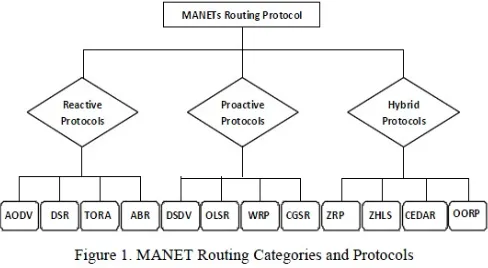
MANET is wide network so different node may communicate over the same limited bandwidth. So there may be the problem of congestion, so to cover such problem appropriate routing is required to be done. Good routing can be done by different routing protocols which find out the path between two nodes. There are many type of routing protocols are shows in the figure 1.
MANET routing protocols are traditionally divided into three categories which are Proactive Routing Protocols, Reactive Routing Protocols, Hybrid.
The most popular routing protocols [2] [3] in MANET are AODV (reactive) [4] [5], DSR (reactive) [6], OLSR [7] [8] (proactive) and GRP (hybrid) [9]. Reactive protocols find the routes when they are needed. Proactive protocols are table driven protocols and find routes before they need it. And finally hybrid routing protocols offer an efficient framework that can simultaneously draw on the strengths of proactive and reactive routing protocols. Proactive Routing protocol, a node is immediately able to route (or drop) a packet. Examples of proactive protocols include the Optimized Link State Routing Protocol OLSR. Reactive Routing protocols are characterized by node acquire and maintain routes on demand. i.e., a route to a destination is
not acquired by anode until packet is not received by a destination node. Examples of reactive protocols are Ad-Hoc on Demand Distance Vector Routing Protocol (AODV) [10]. In this paper, we focus on two MANET routing protocols AODV and OLSR. We consider three parameters to evaluate the performance of these routing protocols: Throughput, Data Dropped, and Retransmission.
[image:1.612.319.563.504.638.2]The rest of this paper is organized as follows. In section 2 we briefly describe the routing protocols that we evaluate. In Section 3 presents the Simulation environment used for evaluation of the said protocols. In Section 4 we present our simulation results and observations. Finally, section 5 concludes the paper.
Figure 1.MANET Routing Protocols
II. ROUTING PROTOCOLS IN MANETS
A. Ad-Hoc on Demand Distance Vector (AODV):
node doesn’t have routing information in its table, route discovery process begins to find the routes from source to destination. Route discovery begins with broadcasting a route request (RREQ) [12] packet by the source node to its neighbours. RREQ packet comprises broadcast ID, two sequence numbers, and the addresses of source and destination and hop count. The intermediary nodes which receive the RREQ packet could do two steps: If it isn’t the destination node then it’ll rebroadcast the RREQ packet to its neighbours. Otherwise it’ll be the destination node and then it will send a unicast replay message, route replay (RREP), directly to the source from which it was received the RREQ packet. A copied RREQ will be ignored. Each node has a sequence number. When a node wants to initiate route discovery process, it includes its sequence number and the most fresh sequence number it has for destination. The intermediate node that receive the RREQ packet, replay to the RREQ packet only when the sequence number of its path is larger than or identical to the sequence number comprised in the RREQ packet. A reverse path from the intermediate node to the source forms with storing the node’s address from which initial copy of RREQ. An important feature of AODV is the maintenance of timer based states in each node, regarding utilization of individual routing table entries. A routing table entry is expired if not used recently.
B. Optimized Link State Routing Protocol (OLSR):
The OLSR [13] is a table driven protocol. It usually stores and updates its routes so when a route is needed, it present the route immediately without any initial delay. In OLSR, some candidate nodes called multipoint relays (MPRs). Multipoint Relay (MPR) nodes broadcast route packets. These MPR nodes can be selected in the neighbor of source node. Each node in the network keeps a list of MPR nodes.
Multi-Point Relays (MPR) [14] are used to avoid unnecessary broadcast of packet retransmissions, moreover only partial link state is flooded to provide the shortest path route. The major differences in OLSR and traditional link state routing protocols is the way of propagating of routing information, the first is the different link update sizes for the involved nodes because it has the list of multipoint relay nodes, secondly only the multipoint relay nodes forward the updates about the link state that are issued by a specific node. By design it works in a completely distributed manner and does not require delivering messages in sequence. The idea of multipoint relays is to minimize the overhead of flooding message in the network by reducing redundant retransmission in the same region. In MPR (Multi Point Relay) a node which is selected by its one hop neighbor to re-transmit all the broadcast messages that it receive from other node, provided that the message is not a duplicate, and that the time to live field of the message is greater than one. In OLSR protocol, Multi Point Relays use of HELLO message to find its one hop neighbor and its two hop neighbors through their response. Each node has a Multi Point Relay selection set, which indicates, which node acts as a MPR. Message is forward after the node gets new
broadcast message and message sender‘s interface address in the MPR Selector Set. MPR Selector Set is update continuously using HELLO message which are periodic because neighbor nodes is called of dynamic nature of MANET
III. SIMULATION ENVIRONMENT
We carried out simulations on Opnet [15] [16] simulator. The simulation parameters are summarized in table 1. Modeler is commercial network simulation environment for network modeling and simulation. It allows the users to design and study communication networks, devices, protocols, and applications with flexibility and scalability. It simulates the network graphically and its graphical editors mirror the structure of actual networks and network components.
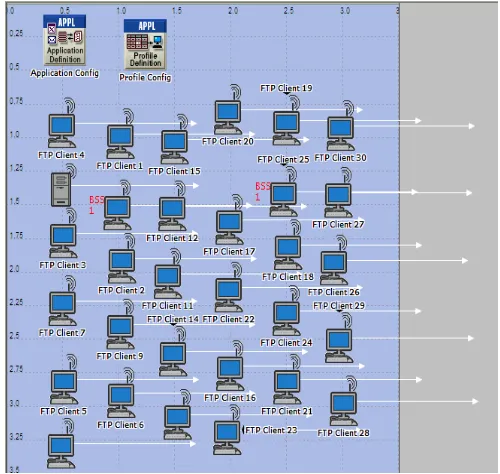
[image:2.612.319.569.256.367.2]Figure 2, Shows a sample network created with 25 Nodes, one static FTP server, application configuration and profile configuration for the network in which FTP has been chosen as an application. Figure 2 depicts a network with 25 fixed nodes whose behavior has to be analyzed nodes in the network with respect to time to determine the effecting features of each protocol
[image:2.612.313.563.467.704.2]OPNET modeler 14.5 is used to investigate the performance of routing protocols AODV and OLSR with varying network sizes, data rates, and network load. We evaluate three parameters in our study on overall network performance. These different types of parameter show the different nature of these Protocols, the parameters are throughput, data dropped and retransmission.
A. Throughput:
Throughput is defined as; the ratio of the total data reaches a receiver from the sender. The time it takes by the receiver to receive the last message is called as throughput. Throughput is expressed as bytes or bits per sec (byte/sec or bit/sec).
B. Data Dropped:
The total size of higher layer data packet (in bits/sec) dropped all the wlan MAC in the network due to
a. Full higher layer data buffer, or
b. The size of the higher layer packet, which is greater than the maximum allowed data size defined in IEEE802.11 standard.
C. Retransmission:
The number of retransmission defines as the number of data packet transmitted divided by the number of data delivered. The number of data packet transmitted takes in to consideration each data packet transmission for each node. It include packet that are leaved and retransmitted by intermediary node.
IV. SIMULATION RESULT AND
OBSERVATIONS
We carried out simulations on Opnet simulator 14.5. The results show differences in performance between considered routing protocols, which are the consequence of various mechanisms on which protocols are based. We carried out our simulations with 25 and 50 nodes.
Figures 3,4,5,6,7 and 8 depicts the throughput, delay and network load of this network with respect to total simulation time which is taken as 8 minutes for which the simulation was run.
In this simulation, the networks is set to 25 and 50 nodes, the traffic is FPT mode, the data transmission rate is 11 Mbps and the simulation time is 8 minutes
A. Throughput:
[image:3.612.314.562.53.234.2]In this fig .show that throughput in AODV is the higher than OLSR we have the minimum throughput Fig.3 it is shows that the network throughput of AODV and OLSR becomes low with the increase of the node number. The reason is that the increase of the node number will lead to the reducing of data packets' receiving in the network due to collision and delay in the network, hence that the network throughput is low.
[image:3.612.314.559.254.444.2]Figure 3. Throughput comparison in routing protocols with 25 nodes
Figure 4. Throughput comparison in routing protocols with 50 nodes
B. Data Dropped:
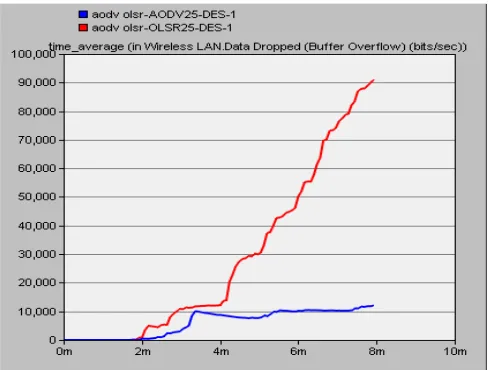
According to Figure 5,6 AODV data dropped [7] is highest, OLSR data dropped is low after end of simulation time.
[image:3.612.316.561.527.712.2]Figure 6. Data dropped comparison in routing protocols with 50 nodes
C. Retransmission:
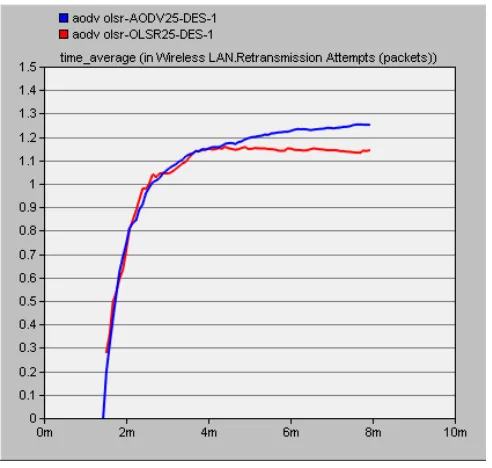
According to Figure 7,8 AODV retransmission attempt is highest, OLSR retransmission attempt is low after end of simulation time.
Figure7. Retransmission comparison in routing protocols with 25 nodes
V. CONCLUSION
In this paper, the simulation study of this work has been done for two routing protocols AODV and OLSR deployed over MANET using FTP traffic analyzing their behavior with respect to throughput, data dropped and retransmission. Motive of doing this simulation was to check the performance of these two routing protocols in MANET in normal operating conditions as well as on the occurrence of node failure on the basis of the above mentioned parameters,
as the selection of efficient and reliable protocol is a critical issue.
Figure 8. Retransmission comparison in routing protocols with 50 nodes
Whereas in terms of network load DSR and AODV are better. The throughput of AODV is better as compared to OLSR and AODV as well as in conditions of node failure. Data dropped and Retransmission of OLSR is low because this is proactive nature of OLSR because of which it continuously tries to find routes to all possible destinations in the network. Hence it has the advantage of having routes immediately available whenever they are required and same strategy is followed in case of node failure. This is the reason for its outstanding performance. At the end we came to the point from our simulation and analytical study that the performance of routing protocols vary with network and selection of accurate routing protocols according to the network, ultimately influence the efficiency of that network in magnificent way.
VI. REFERENCES
[1]. V.Ramesh, Dr.P.Subbaiah, N. Koteswar Rao and M.Janardhana Raju, “Performance Comparison and Analysis of DSDV and AODV for MANET “ in (IJCSE) International Journal on Computer Science and Engineering Vol. 02, No. 02, 2010, 183-188. optimization ad-hoc on-demand muitipath distance vector routing for mobile ad-hoc networks, WICOM'09, 2894-2899.
[2]. C. Tschudin, P. Gunningberg, H. Lundgren, and E. Nordstrom, "Lessons from Experimental MANET Research," Elsevier Ad Hoc Networks Journal, Vol. 3,Issue 3, March 2005.
[image:4.612.36.282.361.595.2][4]. Perkins, C., Belding, E., Das, S., Ad hoc On- Demand Distance Vector (AODV) Routing - RFC 3561, 2003.
[5]. Bjorn Wiberg, "Porting AODV-UU Implementation to ns-2 and Enabling Trace-based Simulation", Master's Thesis, Dept. of Computer System, Uppsala University, Sweden, 18 December 2002.
[6]. Thomas Staub,' "Performance Comparison of MANET Routing Protocols in Ad-hoc and Hybrid Network", Computer Science Project, University of Berne, Switzerland, February 2004.
[7]. T. Clausen, P. Jacquet, "Optimized Link State Routing Protocol", IETF RFC 3626, October 2003.
[8]. R Ogier, P. Spagnolo, "MANET Extension of OSPF using CDS Flooding, draft-ogier-manet-ospf-extension-06.txt, December 2005.
[9]. W. Ahn, “Gathering-based routing protocol in mobile ad hoc networks”, Computer Communications 30 (2006) 202-206.
[10]. C. E. Perkins, E. M. Royer, S. R. Das, and M. K. Marina,"Performance Comparison of Two On-Demand
Routing Protocols for Ad Hoc Networks," IEEE Personal Communications, February 2001,pp. 16-28.
[11]. J. Broch et al., “A Performance Comparison of Multihop Wireless Ad Hoc Network Routing Protocols“, Proc. IEEE/ACM MOBICOM ’98,Oct.1998, pp. 85–97.
[12]. Perkins, C. E., Bhagwat, P.: Highly Dynamic Destination-sequenced Distance-Vector Routing (DSDV) for Mobile Computers, October 1994,Computer Communications, pp. 234-244.
[13]. M. S. Corson, V. Park, "An Internet MANET Encapsulation Protocol (IMEP) Specification", draftietf-manet-imep-spec-00.txt, November 1997.
[14]. Jerome Haerri, Fethi Filali, Christian Bonnet, “Performance Comparison of AODV and OLSR in VANETs Urban Environments under Realistic Mobility Patterns” Institute Eurecomz Department of Mobile Communications, 2006.
[15]. R. Preston, J. Doane, and D. Kiwior, "Modeling Antenna Blockage in Airborne Networks", OPNETWORK 2005.