Volume 2, No. 5, Sept-Oct 2011
International Journal of Advanced Research in Computer Science
RESEARCH PAPER
Available Online at www.ijarcs.info
JPEG Coding System Based on Mean Value Predictive Vector Quantization
K. Arun Kumar* and T.Prabhakara Rao
M.Tech Student*, Assistant Professor Department of C.S.E
Aditya Institute of Technology and Management Tekkali, A.P, India
*[email protected] [email protected]
Abstract: Image compression is a basic need for the progressive transmission or storage of image data via any media. For the effective processing of image data the coding standards were developed. The most commonly used standard in current scenario is the JPEG and JPEG-2000 coding. These standards have become the industry standards and are progressively been in use for almost all image processing applications. In the process of image coding various sub-processing operations occur which process the image blocks by transformation, quantization and encoding before transmitting or storing. In the process, quantization is observed to be a time consuming and is needed to be processed in high precision so as to achieve less processing error and also in reasonable time. The process of quantization has shown greater efficiency in vector quantization than earlier methods. Vector quantization is observed to be an efficient block based lossy compression technique. Due to simpler coding process and high compression ratio VQ are widely used. Predictive vector Quantization (PVQ) is commonly used memory based vector Quantization method. The main drawback with PVQ is the high computational complexity which limits PVQ to use in real time applications. Shorter coding time can be archived by reducing the number of code words or instructions, but the reconstructed image quality will degraded in the case of fewer code words. Hence, it is necessary to propose fast coding algorithms for PVQ. In this paper a modified version of the PVQ approach has been suggested in order to process faster, which ensue to be a compatible mechanism for real time image coding in JPEG based coding system.
Keywords: Compression, quantization, PVQ encoder, mean-square-error, Discrete Cosine Transform.
I. INTRODUCTION
Today's information is in the form of multimedia, which not only consists of text, numeric data and audio but also images and video. The important role of digital images is seen by growing number of applications that use digital images such as scientific visualization, image documenting, digital libraries, multimedia and image databases. Digital images are important data which in many circumstances can provide vital information (e.g. medical imaging, geography image sensing), however, there is a major problem with using digital images. That is, a large data volume generated when an image is digitized, and hence a digital image requires more space to store and takes more time to process and transmit.
The pressure for reducing storage and transmission time for still and moving images has motivated research into image compression and many successful image compression methods. Early image compression techniques have focused on quantization and this has lead to a number of image compression algorithms. Based on this idea enhancement of quantization techniques such as vector quantization Image compression using quantization still continued to evolve and new quantization techniques have been proposed more efficient compression such as image compression using zero tree, image compression with space-frequency quantization [1].
There are other compression techniques based on new ways of representing natural images such as image coding based on the Discrete Cosine Transform (DCT), sub band image coding, image compression through wavelet transform coding and image compression based on fractal theory [6]. Most attempts in image compression
focus on finding new ways to better represent images so that higher compression can be obtained. For example, in one direction, image coding based on wavelet and wavelet packets promise higher compression since for the same level of quality fewer coefficients are required to represent the signal than using Discrete Cosine Transform. In the other direction, fractal image compression has also shown its advantages over traditional image compression techniques such as compression based on DCT or on vector quantization. Especially, for images which possess a high level of self-similarity, high compression can be obtained with fractal-based compression. Research in image compression has also endeavor to understand the human visual system (HVS) with the hope that they can use the knowledge about HVS to better model images and achieve better compression [8]. In addition, there have been a number of other ways to improve image coding such as devising better quantization strategies. Although, many image compression methods have been proposed and developed, the use of an image quality measure to improve image coding has not been fully investigated.
objective methods. Subjective image quality measures are widely used to evaluate the quality of the images in television, video systems and image enlargement. However, careful subjective assessments of image quality are experimentally difficult and lengthy and the results may vary depending on the test conditions. In addition, subjective image quality assessments do not provide constructive methods for performance improvement; hence it is difficult to use them in fine-tuning image compression.
Objective image quality measures not only alleviate the problems the subjective methods have, but also provide support for improving image coding. For instance, objective image quality methods can be used as part of the coding process to optimize the quality of coded images by successive adjustments. Also the objective simulation of performance with respect to bit rate and image quality can provide support to more systematic design of image coders. There are several reported image quality measures.
The most commonly used methods for measuring the quality of a modified image against the original image are the mean-square-error (MSE) measure and its variants. However, these methods do not coincide well with the subjective assessment [1]. They are good distortion indicators for random errors, but not for structured or correlated errors. Other proposed image quality measures detect specific type of noise generated by different compression algorithms such as blockiness, blurring, jaggedness of edges, contrast errors or quantization effects.
The most thorough attempt to measure the quality of images is the Picture Quality Scale method (PQS). However, as the other methods it has drawbacks too i.e., the measure operates on pixel wise differences (i.e., it may not be sufficient for measuring distortion like contrast errors or quantization effects). Also it is designed using prior knowledge of the existing compression algorithms we develop a class of image quality measures and show that derivable image quality measures from this class parallel with human visual perception. We then investigate the idea of employing a better image quality measure to achieve high compression. Finally, we propose a novel concept of multi-level browsing that allows the volume of image data to be minimized before transmission [2]. In space and transmission requirements of digital images there are two main factors that contribute to the communication bottleneck problem. The first factor is the increasing number of users and the volume of multimedia information, especially image data, to be delivered.
The second factor is that the existing networks in many places are not advanced enough and many users still access the Internet via slow links such as modem lines. For instance, the transmission of 8-bit color image with 512x512 pixels over a modem operating at 28800 bits per second which requires more than one minute. Such transmission time can be higher if there is a large number of users accessing an image repository where a large collection of images is stored. The increasing number of mobile computer users accessing the Internet via slow wireless links also further worsens the delay. Many image applications such as distributed image databases, image document repositories and digital libraries not only need to have images delivered to users and applications quickly but also space to store images. The size of such image repositories grows quickly and the space requirement can
easily exceed initial predictions. The space requirements and the image transmission problem have lead to a strong demand for a good image compression technique that maximizes compression while maintaining quality.
II. IMAGE COMPRESSION
Digital images can be compressed either by using lossless or lossy methods. Compressing images using lossless compression can retain the full quality of the original image; however, lossless compression does not reduce the volume of image data significantly. In applications where a high compression ratio is required, lossless compression cannot meet this requirement and lossy compression is needed. Successful lossy compression techniques have been developed in the last two decades. The most popular method is the JPEG block image compression algorithm [10], which is based on the Discrete Cosine Transform (DCT) and has become a standard compression technique. The other compression techniques include block truncation coding, image coding using vector quantization, sub band image coding, fractal image compression, and wavelet transform coding. The three most focused image compression approaches are based on vector quantization, fractals and wavelet. Recent results from fractal and wavelet based image compression techniques have provided higher compression in comparison to the traditional image compression techniques. However, such results have not satisfied the demand for higher compression ratios as image repositories and transmission increased. Therefore, the search for better compression techniques still continues.
III. IMAGE QUALITY EVALUATION AND ITS IMPORTANCE
Lossy compression can provide high compression ratios; however, the reconstructed image does not have the same quality as the original. As a result, there is a need to find a good method for evaluating the quality of compressed images or calculating the errors which have occurred when an image is compressed. The emergence of digital video technology has also motivated the search for an accurate image quality measure. This is because testing a digital video system requires the evaluation of the quality of motion rendition. As discussed early in this chapter, there has been a number of proposed image quality methods.
improving quantization of image compression and expand the field of image coding. DeVoreetal showed that in providing a mathematical framework for image compression, one must decide how to measure the difference in terms of quality between the original and reconstructed image. As compared to the original image, a quality measure which parallels the human visual system is preferred [7]. It also showed by example that an accurate distortion measure can be used to fine-tune an image compression algorithm. The importance of image quality in improving image coding by allowing a more systematic design of image coders was also noted by Miyahara and Kotani.
The use of an objective image quality measure in optimizing quantization parameters was suggested by Algazi. Recently, the quality measure is also seen in wavelet image compression [6]. A good image quality measure will also facilitate the construction of a system which allows users and applications to specify quality levels of the requested images. For instance, in image tele-browsing applications, one may want to build a browser or a network graphic user interface which allows specification of image quality in order to meet different requirements from users.
IV. PREDICTIVE VECTOR QUANTIZATION
A memory less vector quantizer encodes consecutive vectors independently. When these vectors are not statistically independent the performance of the VQ can be improved by introducing memory. A PVQ is one such vector quantizer with memory [11]. It is a multiple codebook quantizer, where past outputs are used to determine which of the code hooks to flee fr the present input. We define the class of PVQ's and describe their operation before turning to designing good PVQ's for a given source.
A K-dimensional PVQ with rate B bits/sample is a finite state vector quantizer with the following elements:
a. M memory less K-dimensional quantizers
called the conditional quantizers with their corresponding codebooks
b. M is a design parameter independent of K or B, while The size N of conditional code books is equal to 2KB state
Variable sn, taking values in {1,……M}
c. State transition function
Figure 1: PVQ(M=4)
In fact, a PVQ, like any other source coder consists of an encoder and a decoder usually situated at both ends of a communications channel as shown in the Figure 1. By making the state transition dependent on the output
sequence only, we are ensuring that the decoder can track the encoder perfectly provided there are no transmission errors. The encoder-decoder structure of the PVQ will not be considered further because it does not affect the results. The PVQ class of feedback vector quantizers is the most general form [3]. A straightforward generalization would be to allow S to be a function of both Sn and Yn. However, designing good PVQ's is already a difficult task, so that we will restrict our attention to the PVQ. A particular PVQ will be denoted by F, and the mapping it implements by P(.). That is, we will write .
A K-dimensional PVQ with rate B bits/sample and M quantizers will be referred to as a (K, B, M) PVQ.
The encoding process in a (K, B, M) PVQ consists of two operations:
i. Given xn and sn determine Yn ii. Given yn determine sn+1.
The first operation is exactly the same as that of the encoder of a K-dimensional memory less VQ, while the second one is a mapping from a finite set to a finite set and can be implemented as a table look-up. The PVQ will therefore have the same computational requirements as the VQ of the same block size [4].
V. PVQ DESIGN
The design of an optimal (K,B,M) PVQ for a given class of sources consists of determining the M conditional quantizers and the state transition function T that will minimize the distortion function over all possible (K,B,M) PVQ's. No general solution to this optimization problem is known, not even for the case of the memory less VQ (M1). Memory less VQ's are usually designed using a clustering algorithm operating on a long training sequence of source samples. These algorithms are based on Lloyd’s [6] optimality conditions, and are only guaranteed to converge to a local minimum of the distortion function. The problem is further complicated for PVQ's by the introduction of the feedback loop.
VI. MEAN VALUE PREDICTIVE VECTOR QUANTIZATION
By analyzing an actual image we can draw a conclusion that most parts of the image are smooth areas which vary little. One typical example is the background of an image. Non-smooth areas only take a small portion, whereas the human perceptual system is sensitive to not smooth areas but non- smooth areas [5]. The proposed MVPVQ classifies input vectors into smooth vectors and non- smooth vectors before encoding. In order to reduce the computational complexity, smooth vectors will not be encoded in the way of PVQ. We also classify training vectors in the process of codebook generation to improve the codebook performance [2]. We adopt the vector variance to judge whether an input vector is smooth or not and it can be calculated as
(1) where k is the vector dimension and is the mean value of the input vector, which can be calculated as follows.
If is satisfied, the input vector can be classified as a smooth vector, where TH1 is the threshold defined before quantizing. It implies that each component of the input vector varies little from the mean value when the input vector is classified as a smooth vector. Each component of the input vector can be presented by p which is close to the mean value of the input vector in this case [5]. Based on the fact that neighboring pixels are highly correlated in an image, the prediction of mean value can be calculated as follows (consider equation 1-9):
(3) where Xi is the neighboring pixels of the input vector and the relationship between Xi and the input vector can drawn. Based on the above description, the encoding steps of MVPVQ can be depicted as follows:
Step 1: Quantize the vectors that located in Row1 and Column 1 (i.e., main blocks) by the traditional PVQ encoder.
Step 2: Predict the mean value of the input vector by the upper and left vectors according to Eq.(3). If the predicted mean value is close to the actual mean value, namely
(4) go to Step3; Otherwise, go to Step4.
Step 3: Calculate the variance of the input vector. If < TH1 , then set the information bit to be `0' and transmit or store one bit index (information bit), go to Step 5.
Step 4: Quantize the input vector with the traditional PVQ. Set the information bit as `1', and then transmit the information bit and the index of the residual codeword. Step 5: Go to Step 2 for next input vector until all input vectors have been processed.
The corresponding decoding steps of MVPVQ can be illustrated as follows:
Step 1: Decode the vectors that located in Row 1 and Column 1 (main blocks) by the traditional PVQ.
Step 2: Judge the information bit of the received index. If the information bit is `0', go to Step 3; otherwise, go to Step 4.
Step 3: Predict the mean value of the input vector using its neighboring reconstructed blocks and set each component of the reconstructed vector to be p, go to Step 5.
Step 4: Decode the input vector by the traditional PVQ decoder.
Step 5: Go to Step 2 for next input vector until all input vectors have been processed.
Considering the correlations among neighboring pixels, the input vector can be predicted by neighboring pixels. Reference [7] has proposed several prediction schemes based on neighboring pixels. It has been shown that predicting the current vector by its neighboring pixels can improve the prediction accuracy, and the computational complexity can be also kept at a low level. In this paper, the multiple-pixels-distance-weighted boundary PVQ (MPDWBPVQ) is proposed [8]. The prediction schemes are as follows:
(5)
(6)
(7) where is the predicted pixel value at the coordinate (i; j). Unlike the original MPDWBPVQ method, the proposed method stores the left upper corner vector in the codebook and quantizes other input vectors in Row1 and Column1 by the traditional PVQ. The corresponding prediction schemes can be described as follows. For vectors in Row 1:
(8) For vectors in Column 1:
(9) From the above encoding process, we can find that it is not necessary to quantize smooth vectors by the traditional PVQ encoder, so MVPVQ can significantly reduce the computational complexity [9]. Furthermore, if the mean value of the smooth input vector can be accurately predicted, only one bit index has to be transmitted or stored for that input vector. Smooth vectors widely exist in the image background, so the bit rate can be efficiently reduced [7]. In order to get higher compression ratio, the codeword indices are also encoded using the Huffman coding technique. Codebook generation is essential to PVQ algorithms as reconstructed residual vectors are selected from this codebook. In MVPVQ, smooth vectors whose mean values can be accurately predicted will not be quantized by the PVQ encoder, so only non-smooth vectors is selected to be training vectors. If each training vector is chosen from the image to be compressed, we also judge whether it’s mean value can be accurately predicted by its neighboring pixels. In this way, we only need to generate the codewords for non- smooth vectors, so the computational complexity will be kept at a low level. Simulations show that the codebook designed in this way (MVPVQ codebook) is also compatible with traditional PVQ algorithms that adopt the same prediction scheme and the reconstructed image quality will be improved.
VII. RESULTS
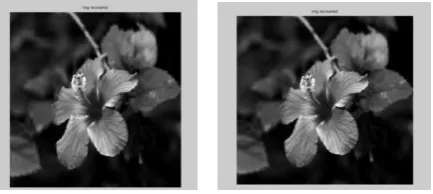
The graphs shown in this section i.e. Figure 2-6 depicts the results of the experiment carried out on MVPVQ and has shown better PSNR value than the JPEG methods.
0.1 0.12 0.14 0.16 0.18 0.2 0.22
24.5 25 25.5 26 26.5 27 27.5 28 28.5 29 29.5
bpp
P
S
N
R
1000 1200 1400 1600 1800 2000 2200 85
86 87 88 89 90 91
number of coefficients under process
%
c
om
pr
es
io
n
ac
he
iv
ed
[image:5.595.41.277.64.217.2]JPEG MVPVQ
Figure 2: Graphical representation of results.
The results as are depicted in the Figure 2 in the graphical representation.
Figure 3(a) Original leaf image sample (b) Recovered image at 0.1 bpp
Figure.4(a) Recovered image at 0.5 bpp 4(b) Recovered image at 0.9 bpp
Figure5 (a) Original flower image sample 5(b) Recovered flower image sample at 0.1 bpp
Figure 6(a) Recovered flower image sample at 0.5 bpp 6 (b) Recovered flower image sample at 0.9 bpp
VIII. CONCLUSION
In traditional VQ method, the generated codebook is directly used to quantize the input vector. If we order this
generated codebook, we can achieve a better output bit rate and the same reconstructed image as using an un-ordered codebook. A low computational complexity PVQ algorithm i.e. MVPVQ, is proposed in this paper. From the simulation results, we can observe that MVPVQ method is a variable bit rate PVQ algorithm and its coding performance is higher than other VQ methods. Thus, the proposed algorithm would be useful for the image processing programmers for better efficiency and also posses an improved accuracy.
IX. REFERENCES
[1]. S. H. Sun and Z. M. Lu, Vector quantization fundamentals and applications, Chinese Science Press, Beijing, 2002, 2, pp.200-214.
[2]. V. Cuperman and A.Gersho, Adaptive di®erential vector coding of speech, Conference ecord Globe-Com 82, pp.1092-1096, 1982.
[3]. T. R. Fischer and D. J. Tinnen, Quantized control with Differential Pulse Code Modulation, 21th Conference on Decision and Control, pp.1222-1227, 1982.
[4]. Z. M. Lu and H. Pei, Hybrid Image Compression Scheme Based on PVQ and DCTVQ, IEICE Transactions on Information and Systems, vol. E88-D, no.10, pp.2422-2426, 2005.
[5]. Z. Li and Z. M. Lu, Fast code vector search scheme for 3D mesh model vector quantization, IET Electronics Letters, vol. 44, no.2, pp. 104-105, 2008.
[6]. Z. M. Lu and Z. Li, Dynamically restricted codebook based vector quantisation scheme for mesh geometry compression" Signal, Image and Video Processing, vol. 2, no.3, 251-260, 2008.
[7]. S. Yang, "Performance Analysis from Rate Distortion Theory of Wavelet Domain Vector Quantization Encoding," Ph.D. Dissertation, Texas Tech University November 2001.
[8]. A. Bovik, Handbook of Image and Video Processing, Academic Press, San Diego CA, 2000, vol:4,pp.310-323.
[9]. A. Abbate, C. M. DeCusatis, and P. K. Das, Wavelets and Subbands Fundamentals and Applications, Birkhauser, Boston, MA, 2002, vol:3,pp. 123-134.
[10].T. K. Moon and W. C. Stirling, Mathematical Methods and Algorithms for Signal Processing, Prentice Hall, Englewood Cliffs, 2000, vol:4,pp.341-352.
[11].K. Sayood, Introduction to Data Compression, Morgan Kaufinarm Publishers, SanFrancisco, CA, 2000,vol:5,pp.23-39.
[12].E. Moyano, F. J. Quiles, A. Garrido, L. Orozco-Barbosa, and J. Duato, "Efficient 3-D Wavelet Transform Decomposition for Video Compression," International Workshop on Digital and Computational Video, Feb. 2001,2,pp.212-218.
Short Biodata of the Author
[image:5.595.39.256.609.706.2]B.Tech in computer Science and Engineering from Nagarjuna university A.P,india, his areas of interests include image processing, Network security .
Tatapudi Prabhakara Rao is M.Tech in Computer Science from Jawaharlal Nehru Technological University kakinada, A.P., India, and B.Tech in computer Science and Engineering from Jawaharlal Nehru