Combining Knowledge-based
Methods and Supervised
Learning for Effective Italian
Word Sense Disambiguation
Pierpaolo Basile
Marco de Gemmis
Pasquale Lops
Giovanni Semeraro
University of Bari (Italy)
email:
[email protected]
Abstract
This paper presents a WSD strategy which combines a knowledge-based method that exploits sense definitions in a dictionary and relations among senses in a semantic network, with supervised learning methods on anno-tated corpora. The idea behind the approach is that the knowledge-based method can cope with the possible lack of training data, while supervised learning can improve the precision of a knowledge-based method when training data are available. This makes the proposed method suitable for disambiguation of languages for which the available resources are lacking in training data or sense definitions. In order to evaluate the effectiveness of the proposed approach, experimental sessions were carried out on the dataset used for the WSD task in the EVALITA 2007 initiative, devoted to the evaluation of Natural Language Processing tools for Italian. The most effective hybrid WSD strategy is the one that integrates the knowledge-based approach into the supervised learning method, which outperforms both methods taken singularly.
1
Background and Motivations
The inherent ambiguity of human language is a greatly debated problem in many research areas, such as information retrieval and text categorization, since the presence of polysemous words might result in a wrong relevance judgment or classification of documents. These problems call for alternative methods that work not only at the lexical level of the documents, but also at themeaninglevel.
The task of Word Sense Disambiguation (WSD) consists in assigning the most ap-propriate meaning to a polysemous word within a given context. Applications such as machine translation, knowledge acquisition, common sense reasoning and others, require knowledge about word meanings, and WSD is essential for all these applica-tions. The assignment of senses to words is accomplished by using two major sources of information (Nancy and Véronis, 1998):
1. thecontextof the word to be disambiguated, e.g. information contained within the text in which the word appears;
2. external knowledge sources, including lexical resources, as well as hand-devised knowledge sources, which provide data useful to associate words with senses.
All disambiguation work involves matching the context of the instance of the word to be disambiguated with either information from an external knowledge source (also known asknowledge-drivenWSD), or information about the contexts of previously disambiguated instances of the word derived from corpora (data-drivenor corpus-basedWSD).
Corpus-basedWSD exploits semantically annotated corpora to train machine learn-ing algorithms to decide which word sense to choose in which context. Words in such annotated corpora are tagged manually using semantic classes chosen from a particu-lar lexical semantic resource (e.g. WORDNET(Fellbaum, 1998)). Each sense-tagged occurrence of a particular word is transformed into a feature vector, which is then used in an automatic learning process. The applicability of such supervised algorithms is limited to those few words for which sense tagged data are available, and their accu-racy is strongly influenced by the amount of labeled data available.
Knowledge-basedWSD has the advantage of avoiding the need of sense-annotated data, rather it exploits lexical knowledge stored in machine-readable dictionaries or thesauri. Systems adopting this approach have proved to be ready-to-use and scalable, but in general they reach lower precision than corpus-based WSD systems.
Our hypothesis is that the combination of both types of strategies can improve WSD effectiveness, because knowledge-based methods can cope with the possible lack of training data, while supervised learning can improve the precision of knowledge-based methods when training data are available.
This paper presents a method for solving the semantic ambiguity ofall words con-tained in a text1. We propose a hybrid WSD algorithm that combines a knowledge-based WSD algorithm, called JIGSAW, which we designed to work by exploiting WORDNET-like dictionaries as sense repository, with a supervised machine learning
1all wordstask tries to disambiguate all the words in a text, whilelexical sampletask tries to
algorithm (K-Nearest Neighbor classifier). WORDNET-like dictionaries are used be-cause they combine the characteristics of both a dictionary and a structured semantic network, supplying definitions for the different senses of words and defining groups of synonymous words by means ofsynsets, which represent distinct lexical concepts. WORDNET also organize synsets in a conceptual structure by defining a number of semantic relationship (IS-A, PART-OF, etc.) among them.
Mainly, the paper concentrates on two investigations:
1. First, corpus-based WSD is applied to words for which training examples are provided, then JIGSAW is applied to words not covered in the first step, with the advantage of knowing the senses of the context words already disambiguated in the first step;
2. First, JIGSAW is applied to assign the most appropriate sense to those words that can be disambiguated with a high level of confidence (by setting a specific parameter in the algorithm), then the remaining words are disambiguated by the corpus-based method.
The paper is organized as follows: After a brief discussion about the main works related to our research, Section 3 gives the main ideas underlying the proposed hybrid WSD strategy. More details about the K-NN classification algorithm and JIGSAW, on which the hybrid WSD approach is based, are provided in Section 4 and Section 5, respectively. Experimental sessions have been carried out in order to evaluate the proposed approach in the critical situation when training data are not much reliable, as for Italian. Results are presented in Section 6, while conclusions and future work close the paper.
2
Related Work
For some Natural Language Processing (NLP) tasks, such as part of speech tagging or named entity recognition, there is a consensus on what makes a successful algorithm, regardless of the approach considered. Instead, no such consensus has been reached yet for the task of WSD, and previous work has considered a range of knowledge sources, such as local collocational clues, common membership in semantically or topically related word classes, semantic density, and others. In recent SENSEVAL-3 evaluations2, the most successful approaches forall wordsWSD relied on information drawn from annotated corpora. The system developed by Decadt et al. (2002) uses two cascaded memory-based classifiers, combined with the use of a genetic algorithm for joint parameter optimization and feature selection. A separate word expert is learned for each ambiguous word, using a concatenated corpus of English sense tagged texts, including SemCor, SENSEVAL datasets, and a corpus built from WORDNET exam-ples. The performance of this system on the SENSEVAL-3 English all words dataset was evaluated at 65.2%. Another top ranked system is the one developed by Yuret (2004), which combines two Naïve Bayes statistical models, one based on surround-ing collocations and another one based on a bag of words around the target word. The statistical models are built based on SemCor and WORDNET, for an overall
dis-ambiguation accuracy of 64.1%. All previous systems use supervised methods, thus
requiring a large amount of human intervention to annotate the training data. In the context of the current multilingual society, this strong requirement is even increased, since the so-called “sense-tagged data bottleneck problem” is emphasized.
To address this problem, different methods have been proposed. This includes the automatic generation of sense-tagged data using monosemous relatives (Leacock et al., 1998), automatically bootstrapped disambiguation patterns (Mihalcea, 2002), parallel texts as a way to point out word senses bearing different translations in a sec-ond language (Diab, 2004), and the use of volunteer contributions over the Web (Mi-halcea and Chklovski, 2003). More recently, Wikipedia has been used as a source of sense annotations for building a sense annotated corpus which can be used to train accurate sense classifiers (Mihalcea, 2007). Even though the Wikipedia-based sense annotations were found reliable, leading to accurate sense classifiers, one of the lim-itations of the approach is that definitions and annotations in Wikipedia are available almost exclusively for nouns.
On the other hand, the increasing availability of large-scale rich (lexical) knowledge resources seems to provide new challenges to knowledge-based approaches (Navigli and Velardi, 2005; Mihalcea, 2005). Our hypothesis is that the complementarity of knowledge-based methods and corpus-based ones is the key to improve WSD effec-tiveness. The aim of the paper is to define a cascade hybrid method able to exploit both linguistic information coming from WORDNET-like dictionaries and statistical information coming from sense-annotated corpora.
3
A Hybrid Strategy for WSD
The goal of WSD algorithms consists in assigning a wordwioccurring in a document
dwith its appropriate meaning or senses. The sensesis selected from a predefined set of possibilities, usually known assense inventory. We adopt ITALWORDNET (Roven-tini et al., 2003) as sense repository. The algorithm is composed by two procedures:
1. JIGSAW- It is a knowledge-based WSD algorithm based on the assumption that the adoption of different strategies depending on Part-of-Speech (PoS) is better than using always the same strategy. A brief description of JIGSAW is given in Section 5, more details are reported in Basile et al. (2007b), Basile et al. (2007a) and Semeraro et al. (2007).
2. Supervised learning procedure- A K-NN classifier (Mitchell, 1997), trained on MultiSemCor corpus3is adopted. Details are given in Section 4.
MultiSem-Cor is an English/Italian parallel corpus, aligned at the word level and annotated with PoS, lemma and word senses. The parallel corpus is created by exploiting the SemCor corpus4, which is a subset of the English Brown corpus containing about 700,000 running words. In SemCor, all the words are tagged by PoS, and more than 200,000 content words are also lemmatized and sense-tagged with reference to the WORDNETlexical database. SemCor has been used in several supervised WSD algorithms for English with good results. MultiSemCor con-tains less annotations than SemCor, thus the accuracy and the coverage of the supervised learning for Italian might be affected by poor training data.
3http://multisemcor.itc.it/
The idea is to combine both procedures in a hybrid WSD approach. A first choice might be the adoption of the supervised method as first attempt, then JIGSAW could be applied to words not covered in the first step. Differently, JIGSAW might be applied first, then leaving the supervised approach to disambiguate the remaining words. An investigation is required in order to choose the most effective combination.
4
Supervised Learning Method
The goal of supervised methods is to use a set of annotated data as little as possible, and at the same time to make the algorithm general enough to be able to disambiguate all content words in a text. We use MultiSemCor as annotated corpus, since at present it is the only available semantic annotated resource for Italian. The algorithm starts with a preprocessing stage, where the text is tokenized, stemmed, lemmatized and annotated with PoS.
Also, the collocations are identified using a sliding window approach, where a collocation is considered to be a sequence of words that forms a compound concept defined in ITALWORDNET(e.g. artificial intelligence). In the training step, a semantic model is learned for each PoS, starting with the annotated corpus. These models are then used to disambiguate words in the test corpus by annotating them with their corresponding meaning. The models can only handle words that were previously seen in the training corpus, and therefore their coverage is not 100%. Starting with an annotated corpus formed by all annotated files in MultiSemCor, a separate training dataset is built for each PoS. For each open-class word in the training corpus, a feature vector is built and added to the corresponding training set. The following features are used to describe an occurrence of a word in the training corpus as in Hoste et al. (2002):
• Nouns- 2 features are included in feature vector: the first noun, verb, or adjec-tive before the target noun, within a window of at most three words to the left, and its PoS;
• Verbs- 4 features are included in feature vector: the first word before and the first word after the target verb, and their PoS;
• Adjectives- all the nouns occurring in two windows, each one of six words (before and after the target adjective) are included in the feature vector;
• Adverbs- the same as for adjectives, but vectors contain adjectives rather than nouns.
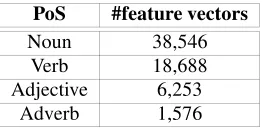
The label of each feature vector consists of the target word and the corresponding sense, represented asword#sense. Table 1 describes the number of vectors for each PoS.
Table 1: Number of feature vectors
PoS #feature vectors
Noun 38,546
Verb 18,688
Adjective 6,253
Adverb 1,576
The similarity is computed as Euclidean distance between vectors, where POS dis-tance is set to 1, if POS tags are different, otherwise it is set to 0. Word disdis-tances are computed by using theLevenshteinmetric, that measures the amount of difference between two strings as the minimum number of operations needed to transform one string into the other, where an operation is an insertion, deletion, or substitution of a single character (Levenshtein, 1966). Finally, the target word is labeled with the most frequent sense in the firstKvectors.
5
JIGSAW - Knowledge-based Approach
JIGSAW is a WSD algorithm based on the idea of combining three different strategies to disambiguate nouns, verbs, adjectives and adverbs. The main motivation behind our approach is that the effectiveness of a WSD algorithm is strongly influenced by the POS tag of the target word.
JIGSAW takes as input a documentd = (w1, w2, . . . , wh) and returns a list of synsetsX = (s1,s2, . . . ,sk) in which each elementsi is obtained by disambiguating thetarget word wibased on the information obtained from the sense repository about a few immediately surrounding words. We define the context Cof the target word to be a window ofn words to the left and another n words to the right, for a total of 2nsurrounding words. The algorithm is based on three different procedures for nouns, verbs, adverbs and adjectives, calledJIGSAWnouns,JIGSAWverbs,JIGSAWothers, respectively.
JIGSAWnouns- Given a set of nounsW ={w1,w2, . . . ,wn}, obtained from docu-mentd, with eachwi having an associated sense inventorySi={si1,si2, . . . ,sik} of possible senses, the goal is assigning eachwiwith the most appropriate sensesih∈Si, according to thesimilarityofwiwith the other words inW (the context forwi). The idea is to define a functionϕ(wi,si j),wi∈W,si j∈Si, that computes a value in[0,1] representing the confidence with which wordwi can be assigned with sensesi j. In order to measure the relatedness of two words we adopted a modified version of the Leacock and Chodorow (1998) measure, which computes the length of the path be-tween two concepts in a hierarchy by passing through theirMost Specific Subsumer (MSS). We introduced a constant factordepthwhich limits the search for the MSS to depthancestors, in order to avoid “poorly informative” MSSs. Moreover, in the simi-larity computation, we introduced both a Gaussian factorG(pos(wi),pos(wj)), which takes into account the distance between the position of the words in the text to be dis-ambiguated, and a factorR(k), which assignssikwith a numerical value, according to the frequency score in ITALWORDNET.
concatenating the gloss and the sentences that ITALWORDNET uses to explain the usage of a synset.JIGSAWverbsincludes, in the contextCfor the target verbwi, all the nouns in the window of 2nwords surroundingwi. For each candidate synsetsikofwi, the algorithm computesnouns(i,k), that is the set of nouns in the description forsik. Then, for eachwjinCand each synsetsik, the following value is computed:
(1) maxjk=maxwl∈nouns(i,k)
sim(wj,wl,depth)
wheresim(wj,wl,depth)is the same similarity measure adopted byJIGSAWnouns. Finally, an overall similarity score amongsikand the whole contextCis computed:
(2) ϕ(i,k) =R(k)·
∑wj∈CG(pos(wi),pos(wj))·maxjk ∑hG(pos(wi),pos(wh))
where bothR(k)andG(pos(wi),pos(wj)), that gives a higher weight to words closer to the target word, are defined as inJIGSAWnouns. The synset assigned towiis the one with the highestϕvalue.
JIGSAWothers- This procedure is based on the WSD algorithm proposed in Baner-jee and Pedersen (2002). The idea is to compare the glosses of each candidate sense for the target word to the glosses of all the words in its context.
6
Experiments
The main goal of our investigation is to study the behavior of the hybrid algorithm when available training resources are not much reliable, e.g. when a lower number of sense descriptions is available, as for Italian. The hypothesis we want to evaluate is that corpus-based methods and knowledge-based ones can be combined to improve the accuracy of each single strategy.
Experiments have been performed on a standard test collection in the context of the All-Words-Task, in which WSD algorithms attempt to disambiguate all words in a text. Specifically, we used the EVALITA WSD All-Words-Task dataset5, which consists of
about 5,000 words labeled with ITALWORDNETsynsets.
An important concern for the evaluation of WSD systems is the agreement rate between human annotators on word sense assignment.
While for natural language subtasks like part-of-speech tagging, there are relatively well defined and agreed-upon criteria of what it means to have the “correct” part of speech assigned to a word, this is not the case for word sense assignment. Two human annotators may genuinely disagree on their sense assignment to a word in a context, since the distinction between the different senses for a commonly used word in a dictionary like WORDNETtend to be rather fine.
What we would like to underline here is that it is important that human agreement on an annotated corpus is carefully measured, in order to set an upper bound to the performance measures: it would be futile to expect computers to agree more with the reference corpus that human annotators among them. For example, the inter-annotator agreement rate during the preparation of the SENSEVAL-3 WSD English All-Words-Task dataset (Agirre et al., 2007) was approximately 72.5%.
Unfortunately, for EVALITA dataset, the inter-annotator agreement has not been measured, one of the reasons why the evaluation for Italian WSD is very hard. In our experiments, we reasonably selected different baselines to compare the performance of the proposed hybrid algorithm.
6.1 Integrating JIGSAW into a supervised learning method
The design of the experiment is as follows: firstly, corpus-based WSD is applied to words for which training examples are provided, then JIGSAW is applied to words not covered by the first step, with the advantage of knowing the senses of the context words already disambiguated in the first step. The performance of the hybrid method was measured in terms of precision (P), recall (R), F-measure (F) and the percentage Aof disambiguation attempts, computed by counting the words for which a disam-biguation attempt is made (the words with no training examples or sense definitions cannot be disambiguated). Table 2 shows the baselines chosen to compare the hybrid WSD algorithm on the All-Words-Task experiments.
Table 2: Baselines for Italian All-Words-Task
Setting P R F A
1stsense 58.45 48.58 53.06 83.11 Random 43.55 35.88 39.34 83.11
JIGSAW 55.14 45.83 50.05 83.11
K-NN 59.15 11.46 19.20 19.38
K-NN + 1stsense 57.53 47.81 52.22 83.11
The simplest baseline consists in assigning a random sense to each word (Random), another common baseline in Word Sense Disambiguation is first sense (1stsense): each word is tagged using the first sense in ITALWORDNET that is the most commonly (frequent) used sense. The other baselines are the two methods combined in the hybrid WSD, taken separately, namely JIGSAW and K-NN, and the basic hybrid algorithm “K-NN + 1stsense”, which applies the supervised method, and then adopts the first sense heuristic for the words without examples into training data. The K-NN baseline achieves the highest precision, but the lowest recall due to the low coverage in the training data (19.38%) makes this method useless for all practical purposes. Notice that JIGSAW was the only participant to EVALITA WSD All-Words-Task, therefore it currently represents the only available system performing WSD All-Words task for the Italian language.
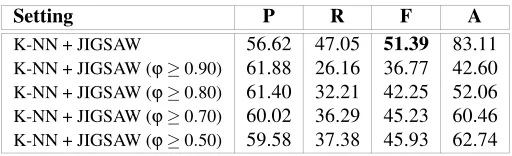
Table 3: Experimental results of K-NN+JIGSAW
Setting P R F A
K-NN + JIGSAW 56.62 47.05 51.39 83.11
K-NN + JIGSAW (ϕ≥0.90) 61.88 26.16 36.77 42.60
K-NN + JIGSAW (ϕ≥0.80) 61.40 32.21 42.25 52.06
K-NN + JIGSAW (ϕ≥0.70) 60.02 36.29 45.23 60.46
Table 3 reports the results obtained by the hybrid method on the EVALITA dataset. We study the behavior of the hybrid approach with relation to that of JIGSAW, since this specific experiment aims at evaluating the potential improvements due to the in-clusion of JIGSAW into K-NN. Different runs of the hybrid method have been per-formed, each run corresponding to setting a specific value forϕ(the confidence with which a wordwi is correctly disambiguated by JIGSAW). In each different run, the disambiguation carried out by JIGSAW is considered reliable only whenϕvalues ex-ceed a certain threshold, otherwise any sense is assigned to the target word (this the reason whyAdecreases by setting higher values forϕ).
A positive effect on precision can be noticed by varyingϕbetween 0.50 and 0.90. It tends to grow and overcomes all the baselines, but a corresponding decrease of recall is observed, as a consequence of more severe constraints set onϕ. Anyway, recall is still too low to be acceptable.
Better results are achieved when no restriction is set onϕ(K-NN+JIGSAW in Ta-ble 3): the recall is significantly higher than that obtained in the other runs. On the other hand, the precision reached in this run is lower than in the others, but it is still acceptable.
To sum up, two main conclusions can be drawn from the experiments:
• when no constraint is set on the knowledge-based method, the hybrid algorithm K-NN+JIGSAW in general outperforms both JIGSAW and K-NN taken singu-larly (F values highlighted in bold in Tables 3 and 4);
• when thresholding is introduced onϕ, no improvement is observed on the whole compared to K-NN+JIGSAW.
A deep analysis of results revealed that lower recall was achieved for verbs and adjectives rather than for nouns. Indeed, disambiguation of Italian verbs and adjec-tives is very hard, but the lower recall is probability due also to the fact thatJIGSAW uses glosses for verbs and adjectives disambiguation. As a consequence, the perfor-mance depends on the accuracy of word descriptions in the glosses, while for nouns the algorithm relies only the semantic relations between synsets.
6.2 Integrating supervised learning into JIGSAW
In this experiment we test whether the supervised algorithm can help JIGSAW to dis-ambiguate more accurately. The experiment has been organized as follows: JIGSAW is applied to assign the most appropriate sense to the words which can be disam-biguated with a high level of confidence (by setting theϕthreshold), then the remain-ing words are disambiguated by the K-NN classifier. The dataset and the baselines are the same as in Section 6.1.
Note that, differently from the experiments described in Table 3, run JIGSAW+K-NN has not been reported since JIGSAW covered all the target words in the first step of the cascade hybrid method, then the K-NN method is not applied at all. Therefore, for this run, results obtained by JIGSAW+K-NN correspond to those get by JIGSAW alone (reported in Table 2).
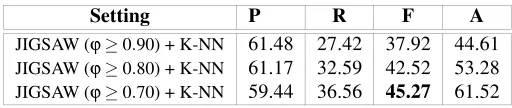
Table 4: Experimental results of JIGSAW+K-NN
Setting P R F A
JIGSAW (ϕ≥0.90) + K-NN 61.48 27.42 37.92 44.61
JIGSAW (ϕ≥0.80) + K-NN 61.17 32.59 42.52 53.28
JIGSAW (ϕ≥0.70) + K-NN 59.44 36.56 45.27 61.52
while a corresponding decrease in recall is observed. The main outcome is that the overall accuracy of the best combination JIGSAW+K-NN (ϕ≥0.70,F value high-lighted in bold in Table 4) is outperformed by K-NN+JIGSAW. Indeed, this result was largely expected because the small size of the training set does not allow to cover words not disambiguated by JIGSAW.
Even if K-NN+JIGSAW is not able to achieve the baselines set on the 1stsense heuristic (first and last row in Table 2), we can conclude that a step toward these hard baselines has been moved. The main outcome of the study is that the best hybrid method on which further investigations are possible is K-NN+JIGSAW.
7
Conclusions and Future Work
This paper presented a method for solving the semantic ambiguity ofall words con-tained in a text. We proposed a hybrid WSD algorithm that combines a knowledge-based WSD algorithm, called JIGSAW, which we designed to work by exploiting WORDNET-like dictionaries as sense repository, with a supervised machine learning algorithm (K-Nearest Neighbor classifier). The idea behind the proposed approach is that JIGSAW can cope with the possible lack of training data, while K-NN can im-prove the precision of JIGSAW method when training data are available. This makes the proposed method suitable for disambiguation of languages for which the available resources are lacking in training data or sense definitions, such as Italian.
Extensive experimental sessions were performed on the EVALITA WSD All-Words-Task dataset, the only dataset available for the evaluation of WSD systems for the Italian language. An investigation was carried out in order to evaluate several com-binations of JIGSAW and K-NN. The main outcome is that the most effective hybrid WSD strategy is the one that runs JIGSAW after K-NN, which outperforms both JIG-SAW and K-NN taken singularly. Future work includes new experiments with other combination methods, for example theJIGSAW output could be used as feature into supervised system or other different supervised methods could be exploited.
References
Agirre, E., B. Magnini, O. L. de Lacalle, A. Otegi, G. Rigau, and P. Vossen (2007). SemEval-2007 Task 1: Evaluating WSD on Cross-Language Information Retrieval. InProceedings of SemEval-2007. Association for Computational Linguistics.
Conference on Computational Linguistics and Intelligent Text Processing, London, UK, pp. 136–145. Springer-Verlag.
Basile, P., M. de Gemmis, A. Gentile, P. Lops, and G. Semeraro (2007a). JIGSAW algorithm for Word Sense Disambiguation. InSemEval-2007: 4th International Workshop on Semantic Evaluations, pp. 398–401. ACL press.
Basile, P., M. de Gemmis, A. L. Gentile, P. Lops, and G. Semeraro (2007b). The JIG-SAW Algorithm for Word Sense Disambiguation and Semantic Indexing of Doc-uments. In R. Basili and M. T. Pazienza (Eds.), AI*IA, Volume 4733 ofLecture Notes in Computer Science, pp. 314–325. Springer.
Decadt, B., V. Hoste, W. Daelemans, and A. V. den Bosch (2002). Gambl, Genetic Algorithm optimization of Memory-based WSD. InSenseval-3: 3th International Workshop on the Evaluation of Systems for the Semantic Analysis of Text.
Diab, M. (2004). Relieving the data acquisition bottleneck in word sense disambigua-tion. InProceedings of ACL. Barcelona, Spain.
Fellbaum, C. (1998). WordNet: An Electronic Lexical Database. MIT Press.
Hoste, V., W. Daelemans, I. Hendrickx, and A. van den Bosch (2002). Evaluating the results of a memory-based word-expert approach to unrestricted word sense dis-ambiguation. InProceedings of the ACL-02 workshop on Word sense disambigua-tion: recent successes and future directions, Volume 8, pp. 95–101. Association for Computational Linguistics Morristown, NJ, USA.
Leacock, C. and M. Chodorow (1998). Combining local context and WordNet simi-larity for word sense identification, pp. 305–332. MIT Press.
Leacock, C., M. Chodorow, and G. Miller (1998). Using corpus statistics and Word-Net relations for sense identification.Computational Linguistics 24(1), 147–165.
Levenshtein, V. I. (1966). Binary codes capable of correcting deletions, insertions, and reversals.Soviet Physics Doklady 10(8), 707–710.
Mihalcea, R. (2002). Bootstrapping large sense tagged corpora. InProceedings of the 3rd International Conference on Language Resources and Evaluations.
Mihalcea, R. (2005). Unsupervised large-vocabulary word sense disambiguation with graph-based algorithms for sequence data labeling. In HLT ’05: Proceedings of the conference on Human Language Technology and Empirical Methods in Nat-ural Language Processing, Morristown, NJ, USA, pp. 411–418. Association for Computational Linguistics.
Mihalcea, R. (2007). Using Wikipedia for Automatic Word Sense Disambiguation. In Proceedings of the North American Chapter of the Association for Computational Linguistics.
Mitchell, T. (1997).Machine Learning. New York: McGraw-Hill.
Nancy, I. and J. Véronis (1998). Introduction to the special issue on word sense disambiguation: The state of the art.Computational Linguistics 24(1), 1–40.
Navigli, R. and P. Velardi (2005). Structural semantic interconnections: A knowledge-based approach to word sense disambiguation.IEEE Transactions on Pattern Anal-ysis and Machine Intelligence 27(7), 1075–1086.
Roventini, A., A. Alonge, F. Bertagna, N. Calzolari, J. Cancila, C. Girardi, B. Magnini, R. Marinelli, M. Speranza, and A. Zampolli (2003). ItalWordNet: building a large semantic database for the automatic treatment of Italian. Computational Linguis-tics in Pisa - Linguistica Computazionale a Pisa. Linguistica Computazionale, Spe-cial Issue XVIII-XIX, Tomo II, 745–791.
Semeraro, G., M. Degemmis, P. Lops, and P. Basile (2007). Combining learning and word sense disambiguation for intelligent user profiling. In Proceedings of the Twentieth International Joint Conference on Artificial Intelligence IJCAI-07, pp. 2856–2861. M. Kaufmann, San Francisco, California. ISBN: 978-I-57735-298-3.