A “person” in the interface: effects on user perceptions of
multibiometrics
Álvaro Hernández, Beatriz López, David Díaz, Rubén Fernández, Luis Hernández
GAPS, Signal, Systems and Radiocommunications Department
Universidad Politécnica de Madrid Ciudad Universitaria s/n, 28040 Madrid, Spain
Javier Caminero
Multilinguism & Speech Technology Group
Telefónica I+D
Emilio Vargas,6, 28043,Madrid,Spain [email protected]
Abstract
In this paper we explore the possibilities that conversational agent technology offers for the improvement of the quality of hu-man-machine interaction in a concrete area of application: the multimodal biometric authentication system. Our approach looks at the user perception effects related to the system interface rather than to the perform-ance of the biometric technology itself. For this purpose we have created a multibio-metric user test environment with two dif-ferent interfaces or interaction metaphors: one with an embodied conversational agent and the other with on-screen text messages only. We present the results of an explora-tory experiment that reveals interesting ef-fects, related to the presence of a conversa-tional agent, on the user’s perception of pa-rameters such as privacy, ease of use, inva-siveness or system security.
1 Introduction
The term biometrics, in Information Technology, refers to an array of techniques to identify people based on one or more unique behavioural or physiological characteristics. The techniques them-selves have improved considerably over the past few decades, in terms of performance and reliability, with reported error rates at levels that indicate a reasonable level of technological maturity (Wayman et al., 2005). But in order to be
truly useful the technology has to be acceptable to people in each of its areas of application. It is widely recognised (BioSec, 2004) that to achieve this goal a user-centred understanding much deeper than that which we have today is needed, and one which encompasses the important problem of in-teraction with the interface. These, of course, are basic goals of the more general field of Human-Computer Interaction, added to which are more specific issues regarding security (Sasse, 2004).
As regards application interface technology, ever more realistic animated characters or embod-ied conversational agents (ECAs) are being gradu-ally introduced in the hope that they will enhance the users’ experience and enrich the interaction. Some applications of ECAs promise to bring us closer to achieving universal usability. For in-stance, they can be used to communicate with hearing impaired people through sign language (Huenerfauth, 2005) or lip-reading (Beskow et al., 2004). Furthermore, language and the appearance, style, gesture repertoire and attitude of the charac-ter can be tuned to each application’s context, to user preferences, and more importantly to take into account cultural particularities.
In what way and to what extent are the percep-tions of users affected by the presence of an ani-mated character in the system interface? And how does this affect users’ opinion and acceptance of a biometric authentication system? We designed an experiment to learn a bit more about these impor-tant usability questions. Expanding on previous studies of factors that impact on the usability of a biometric authentication system, the present paper reports the differences we have found in the sub-jective perceptions of users interacting with our biometric authentication system through interfaces offering two different forms of assistance: informa-tion and assistance in the form of text shown on-screen, and given by a talking animated character.
In the following section we review a variety of social and user perception parameters identified in the literature as being potentially affected by an ECA. In section 3 we describe our user test frame-work and we show our results in section 4.
2 Background
According to Nass et al. (1994) human–machine interaction is fundamentally social. This has clear implications for user interface design. The user’s view of how the system works doesn’t always cor-respond to the actual way the technology works, but, rather, it depends on the user’s preconceptions, on the interaction process itself and on mental models that are influenced by the system interface. Introducing an ECA in the interface can have a visual impact on the user that can affect her per-ception of the system as a whole. Ruttkay et al. (2002) compile a number of user parameters (such as trust, ease of use, effectiveness, and personal taste) that have been shown in the literature to be affected by the presence of an ECA.
Basically, there are two lines of work related to the effects of ECAs on the users’ perception of a system. On one hand, the so called “persona ef-fect,” associated with the presence of the ECA, and on the other, effects connected with the character-istics or qualities a specific ECA might have.
2.1 The persona effect
People seem to like and enjoy using systems with ECAs more than without them, they tend to find systems easier to use and tasks easier to accom-plish, and they also feel more motivated and find learning easier (both learning to use the system and
learning about a particular subject in the case of teaching applications), even though their perform-ance is in fact roughly the same as that of users interacting without the ECA: Some authors specu-late that objective performance improvements be-yond user perceptions will be achieved in the long-run. For instance, Moundridou and Virvou (2001) believe that the increased motivation of students using a tutor application with an animated charac-ter may enhance their learning capacity in the long-term.
Animated characters can even help contain user stress and frustration caused by difficulties during interaction with the system (Mori et al., 2003), and as a result they may improve the efficiency of the interaction over that of a text-only system (Hone et al., 2003). An interesting point is that many of these psychological effects are observed as a re-sponse to the mere presence of the animated char-acter, without it providing any obvious cues or ex-pression to help the user: people’s perceptions have also been found to be affected by an ECA’s behaviour. The phenomenon has been called ‘Per-sona Effect’ (Lester et al., 1997). Later research (Van Mulken et al., 1998) has shown that the mere presence of an ECA can make tasks seem easier and more enjoyable to the user. Furthermore, an ECA showing greater empathic emotion towards the user improves the latter’s overall impression of the system and perception of ease of use (Brave et al., 2005; Mori et al., 2003).
The presence of a human-like character can also have potential dangers such as the system anthro-pomorphisation effect that may lead to users hav-ing unrealistic expectations that are frustrated by actual interaction, as Walker et al. (1994) points out, concluding that a human face in an interface can help attract the user’s attention and increase her level of motivation. At the same time, how-ever, it can create high expectations about the in-telligence of the system, which can lead to frustra-tion if they are then not met.
2.2 ECA feature-related effects
the part of the ECA can have a very positive effect on the user’s perception of the interaction, lower-ing the level of frustration (Hone et al., 2003; Mori et al., 2003) and improving the user’s opinion of the system (Brave et. al 2005).
Another line of research deals with the gestures and nonverbal behaviour of the ECA. A good ges-tural repertoire may promote in the user a percep-tion of naturalness of interacpercep-tion with the system and system socialness (see, e.g., Cassell and Bick-more, 2000).
The physical appearance of the ECA has also been seen to have an influence on the user. For instance, Leenheer (2006) has studied the effect of the colour of the clothing on the ECA, and Hone (2006) shows that a female character reduces user frustration levels better than a male one. Hone also points out that the actual efficiency of the interac-tion may depend on the ECAs characteristics.
Dehn and Van Mulken (2000) suggest that the great variability of results in the literature may be due not only to the different features of the ECAs across the studies, but also to the different areas of application in which the ECAs were used. In this paper we present a study of the influence of an ECA in a specific application domain: biometric authentication. First we identify the user percep-tion parameters that we have considered may be affected by the ECA. Then we describe our ex-ploratory test to examine the persona effect. We have left the observation of the effects of the physical, attitudinal and gestural features of the ECA for future experiments.
3 Test design
We created a multibiometric authentication test platform with two user interfaces, one with an ECA guiding the user through the steps of the re-quired tasks, the other with the same information provided only through text displayed on the screen. We asked the users to carry out two general tasks: a) to try to access the system acting as impostors, and b) to enrol using their own biometric traits and then authenticate their real identity.
3.1 System architecture
The test platform architecture simulates a scenario in which a user has to securely access restricted information stored on a remote server across an IP network (Internet or Intranet). In order to access
such information the user’s identity must be au-thenticated on the basis of two biometric traits (hence our characterisation of the system as multi-biometric). The user may choose the two modes she wishes to authenticate her identity with from among the following four: fingerprint, signature, voice and iris pattern.
The specific technologies used for each biomet-ric mode were:
• Fingerprint: Sensor: Precise 100 digital fingerprint reader. Software: ‘Precise Java’ by Precise Biometrics. (Precise Biometrics, 2007).
• Signature: Sensor: Wacom Intuous2 A6 digitizing tablet (WACOM, 2007). Soft-ware: CiC iSign verification software (CIC, 2007).
• Voice: Sensor: standard microphone. Software: speech and speaker recognition by Nuance Communications (Nuance, 2007). • Iris: Sensor: Panasonic Autenticam
BM-100ET iris video camera (Panasonic, 2007). Software: ‘Private ID‘ recognition algo-rithms by Iridian (Iridian Technologies, 2007).
3.2 User interface
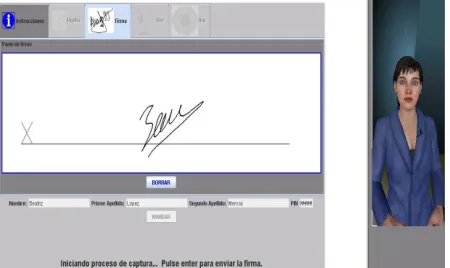
We have created a web interface (using Java App-let technology) with five flaps; one to access the general instructions of use, and one for each of the four biometric modes (in left to right order: finger-print, signature, voice and iris). Below is a biomet-ric trait visualisation area and a text message bar through which (in addition to the ECA) the system guides the user throughout the interaction.
In addition, we divided the test users into two groups to which we presented two different inter-action “metaphors”:
Haus-pie, 2007) to speak to the user. Figure 1 shows the interface with the ECA.
• TEXT Metaphor: The user is only guided through text messages.
[image:4.612.75.300.198.332.2]Note: In the ECA metaphor the text message bar remains active, serving as subtitles to what the ECA says. The messages read by the ECA are ex-actly the same as those given in text form in both metaphores.
Figure 1: User interface for the multibiometric au-thentication system.
3.3 Description of the tests
We designed the tests following the recommenda-tions issued by the International Biometric Group (IBG, 2006). We worked with a sample of 20 us-ers, half of which interacted with the ECA meta-phor and the other half with the TEXT metameta-phor. The users carried out the following tasks distrib-uted in two separate sessions (on different days):
• On the first day an experimenter trained each participant in the use of each biometric mode. The training is specific for each mode and results in the creation of a biometric trait pattern for each user. After creating the user models the impostor tests were carried out. We allowed the users to consult the biometric traits (i.e., fingerprint, signature, voice sample and picture of the iris) of four people (2 females and 2 males), and we asked them to choose one of them in each of five impersonation attempts. In order to ac-cess the system (in this case as impostors) users had to successfully mimic any two biometric traits of the same person. The sys-tem returned the result of the atsys-tempt (suc-cess or failure) at the end of the verification
process. After taking all of the 5 attempts the users were directed to a web question-naire to rate the ease of use, sense of secu-rity and preference of each of the biometric modes, and to give an overall score for the system.
• The second day the users were asked to au-thenticate their own identity. The task was to successfully access the system three times in a maximum of 6 attempts. Just as in the impostor attempts, users had to enter two of their biometric traits in succession, after which they were informed of the system’s decision to accept or reject them. In case of failure in either of the two chosen modes, the system didn’t inform the users of which mode failed. At the end of this second ses-sion the users completed another web ques-tionnaire to give us their evaluation of sys-tem privacy and an overall score of merit for the system, and for each biometric mode they rated pleasantness, ease of use and preference. In addition, those users who in-teracted with the ECA metaphor were asked to rate the usefulness and pleasantness of the ECA.
In addition to the questionnaire information we collected user-system interaction efficiency data such as number of failures, verification times and so on. However, in this paper we focus primarily on the users’ impressions. To summarise, the pa-rameters we have analysed are Preference, Secu-rity, Ease-of-use, Pleasantness and Privacy, all measured on 7-point Likert scales.
4 Results
4.1 Comparative analysis of the ECA y TEXT metaphors
Our general working hypothesis is that interaction with the ECA interface will be more pleasant for the user, which will result in a higher opinion of the system. We specify this in a series of hypothe-ses for each of the perception parameters we intro-duced in the previous section:
Hypothesis 1:
HO: ECA and TEXT Metaphor users rate the
ease-of-use of the biometric modes equally.
H1: ECA Metaphor users rate the ease-of-use of the biometric modes significantly higher than TEXT Metaphor users.
The average ease-of-use score for the ECA Metaphor is: µECA = 1,30; and for the TEXT Meta-phor: µTEXT = 0.65. The two sample t-test showed that the difference was statistically significant (t(74)=1.94; p=0.028). Therefore we may accept the alternative hypothesis that the ECA increases the user’s perception of ease-of-use of biometric technology.
Hypothesis 2:
HO: ECA and TEXT Metaphor users rate the
pleasantness of the biometric modes equally. H1: ECA Metaphor users rate the pleasantness of the biometric modes significantly higher than TEXT Metaphor users.
The average pleasantness score for the ECA Metaphor is: µECA = 1.98; and for the TEXT Meta-phor: µTEXT = 1.20; The two sample t-test showed that the difference was statistically significant (t(77)=2.32; p=0.011). Therefore we may accept the alternative hypothesis that the ECA increases the pleasantness of the interaction with the biomet-ric modes.
Hypothesis 3:
HO: ECA and TEXT Metaphor users rate the
privacy of the system equally.
H1: ECA Metaphor users rate the privacy of the system significantly higher than TEXT Metaphor users.
The two sample t-test showed no statistically significant difference. We are therefore unable to reject the null hypothesis. Instead we propose the opposite alternative hypothesis:
Hypothesis 3.1:
H1: ECA Metaphor users rate the privacy of the system significantly higher than TEXT Metaphor users.
The average score for the perception of privacy for the ECA Metaphor is µECA=-1.20; and for the TEXT Metaphor: µTEXT=-0.60. The two sample t-test showed that the difference was statistically significant (t(67)=-3.42 ; p=0.001). Thus we accept in this case the alternative hypothesis that users’ perception of privacy is lower with the ECA Meta-phor than with the TEXT MetaMeta-phor. This result might lend support to Zajonc’s (1965) suggestion that the presence of a character may enhance arousal or user sensitivity, which might explain why the user might feel uneasy letting the agent have her personal biometric traits.
Hypothesis 4:
HO: ECA and TEXT Metaphor users rate their perception of security of the biometric modes equally.
H1: ECA Metaphor users’ trust in the security of the biometric modes is higher than in the case of the TEXT Metaphor users.
We obtained no statistically significant results, so we reverse the alternative hypothesis:
Hypothesis 4.1:
H1: ECA Metaphor users’ trust in the security of the biometric modes is lower than in the case of the TEXT Metaphor users.
Once more, our results were not statistically sig-nificant. Therefore we cannot infer any relation-ship between the presence of an ECA and users’ sense security of a biometric system.
Hypothesis 5:
HO: Interaction with the ECA Metaphor and with the TEXT Metaphor is equally efficient.
H1: Interaction with the ECA Metaphor is more
The fact that our system is multibiometric –in that it requires simultaneous verification of two from among four possible biometric traits– affects the complexity of the verification process (Ubuek, 2003). We now look at the effect our ECA had on the users’ perception of the cognitive demand and of the need for the extra security our multibiomet-ric system is supposed to provide:
Hypothesis 6:
HO: ECA and TEXT Metaphor users feel equally about the need to require two biometric modes for identity verification to ensure security.
H1: ECA Metaphor users feel that the require-ment of two biometric modes for verification en-hances security to a greater extent than in the case of the TEXT Metaphor users.
The average score for the perceived need for the enhanced security provided by multibiometrics is, for the ECA Metaphor: µECA= 2.8; and for the TEXT Metaphor: µTEXT=2.1. The two sample t-test showed that the difference was statistically signifi-cant (t(12)=2.28 ; p=0.021). Therefore we may confirm the alternative hypothesis.
We found no statistically significant differences between the two metaphors regarding the users’ perception of the extra cognitive demand of multi-biometrics.
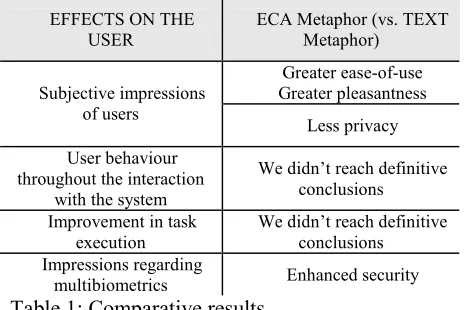
Table 1 summarises our results.
EFFECTS ON THE USER
ECA Metaphor (vs. TEXT Metaphor)
Greater ease-of-use Greater pleasantness Subjective impressions
of users
Less privacy
User behaviour throughout the interaction
with the system
We didn’t reach definitive conclusions
Improvement in task execution
We didn’t reach definitive conclusions Impressions regarding
[image:6.612.67.299.438.593.2]multibiometrics Enhanced security
Table 1: Comparative results
5 Conclusions and future lines of re-search
Some of the most serious obstacles to widespread use that biometic technology is facing are related to user interaction and acceptance. We believe the results presented in this paper open interesting new
lines of research. We found that the presence of an ECA (persona effect) makes users experience in-teraction as easier and more pleasant. Regarding sense of security, our results are in line with other studies on ECAs. The increased pleasantness of use of the biometric modes could help overcome users’ reluctance to accept biometric systems. On the other hand, the presence of the ECA could have a negative affect by enhancing the users’ percep-tion of encroachment on their privacy.
We believe it may be possible to increase the level of users’ perceived privacy and user trust by adopting strategies such as allowing the user to personalise the appearance and even the behaviour of the avatar, as Xiao et al. (2007) suggest. Giving the ECA greater and more natural communication skills (e.g., small talk, specific gestures, etc.) and a more empathic attitude (in line with ideas in the area of affective computing) could have further positive effects.
We may mention the inclusion of ECAs on mul-tibiometric systems as another interesting specific line of research, given the enhancement in the us-ers’ perception of the security of such systems compared to the same without ECA.
6 Acknowledgements
This study has been possible thanks to the support grant received from the TEC2006-13170-C02-02 project of the Spanish Plan Nacional de I+D and the 04-AEC0620-000046/06 (“Recognition of fa-cial and speech patterns for safe multimodal ser-vices in mobile communications”) project by Tele-fónica, funded by the Comunidad Autonoma de Madrid.
7 References
Jonas Beskow, Inger Karlsson, Jo Kewley and Giam-piero Salvi, 2004. SYFACE - A Talking Head Tele-phone for the Hearing-impaired. In Computers help-ing people with special needs 1178-1186.
Biosec: Biometry and Security, 2004. Deliverable D6.3: Report on results of first phase usability testing and guidelines for developers. Available at:
http://www.europeanbiometrics.info/images/resource s/73_471_file.pdf (Accessed: 2007, March)
computer agent. In International Journal of Human Computer Studies, vol. 62, pp. 161-178.
Justine Cassell and Tim Bickmore, 2000. External manifestations of trustworthiness in the interface. In Communications of the ACM, vol. 43, pp. 50-56.
CIC, 2007. Communication Intelligence Corporation, “iSign for Java,”
http://www.cic.com/products/isign/#iSignJava (Accessed: 2007, March)
Doris M. Dehn and Sussane Van Mulken, 2000. The impact of animated interface agents: a review of em-pirical research. In International Journal of Human-Computer Studies, vol. 52, pp. 1-22.
Haptek, 2007. http://www.haptek.com (Accessed: 2007, March)
Kate Hone, Farah Akhtar and Martin Saffu, 2003. Affec-tive agents to reduce user frustration: the role of agent embodiment. In Proceedings of Human-Computer Interaction (HCI2003), Bath, UK, 2003.
Kate Hone, 2006. Empathic agents to reduce user frus-tration: The effects of varying agent characteristics. In Interacting with Computers, vol. 18, pp. 227-245.
Matt Huenerfauth, 2005. American Sign Language Gen-eration: Multimodal LG with Multiple Linguistic Channels. In Proceedings of the ACL Student Re-search Workshop (ACL 2005), pp. 37–42.
IBG, 2006. International Biometric Group, 2006. Com-parative Biometric Testing Available at:
http://www.biometricgroup.com/reports/public/comp arative_biometric_testing.html (Accessed: 2007, March)
Iridian Technologies, 2007. Private ID.
http://www.iridiantech.com/products.php?page=1 (Accessed: 2007, March)
Rinze Leenheer, 2006. Should ECAs ‘dress to im-press’?, 4th Twente Student Conference on IT, 2006.
James C. Lester, Sharolyn A. Converse, Susan E. Kahler, S. Todd Barlow, Brian A. Stone, and Rav-inder S. Bhogal, 1997. The persona effect: affective impact of animated pedagogical agents.In Proceed-ings of the SIGCHI conference on Human factors in computing systems, pp. 359-366.
Lernout and Hauspie, 2007.
http://www.microsoft.com/msagent/downloads/user.a sp (Accessed: 2007, March)
Junichiro Mori, Helmut Prendinger and Mitsuru Ishi-zuka, 2003. Evaluation of an Embodied Conversa-tional Agent with Affective Behavior. In Proceedings of the AAMAS03 Workshop on Embodied
Conver-sational Characters as Individuals , Melbourne, Aus-tralia.
Maria Moundridou and Maria Virvou, 2001. Evaluating the Impact of Interface Agents in an Intelligent Tu-toring Systems Authoring Tool. In Proceedings of the Panhellenic Conference with International participa-tion in Human-Computer interacparticipa-tion.
Clifford Nass, Jonathan Steuer, and Ellen R. Tauber, 1994. Computers are social actors. In Proceedings of the SIGCHI Conference on Human Factors in Com-puting Systems: Celebrating interdependence. CHI '94. ACM Press, New York, NY, 72-78.
Nuance, 2007. Nuance Communications Inc.
http://www.nuance.com (Accessed: 2007, March)
Panasonic, 2007. http://www.panasonic.com (Accessed: 2007, March)
Precise Biometrics, 2007.
http://www.precisebiometrics.com/ (Accessed: 2007, March)
Zsófia Ruttkay, Claire Dormann and Han Noot, 2002. Evaluating ECAs - What and How?. In Proceedings of AAMAS 2002 Workshop on Embodied Conversa-tional Agents -- Let's Specify and Evaluate Them!, Bologna, Italy.
Angela Sasse, 2004. Usability and trust in information systems. Cyber Trust & Crime Prevention Project. University College London.
Susanne Van Mulken, Elisabeth Andre, and Jochen Muller, 1998. The Persona Effect: How substantial is it?. In Proceedings of the ACM CHI 1998 Confer-ence , pp. 53-66. Los Angeles, CA
WACOM, 2007. http://www.wacom.com (Accessed: 2007, March)
Janet H. Walker, Lee Sproull and R. Subramani, 1994. Using a human face in an interface. In Proceedings of the SIGCHI conference on Human factors in com-puting systems: celebrating interdependence, pp. 85-91.
James Wayman, Anil K. Jain, Davide Maltoni and Maio Daio, 2005. Biometric Systems: Technology, Design and Performance Evaluation, Springer.
Jun Xiao, John Stasko and Richard Catrambone, 2004. An Empirical Study of the Effect of Agent Compe-tence on User Performance and Perception. In Pro-ceedings of the Third International Joint Conference on Autonomous Agents and Multiagent Systems-Volume 1, pp. 178-185.
Jun Xiao, John Stasko and Richard Catrambone, 2007.
In-teraction with Embodied Conversational Agents: Ef-fects on Perception and Performance, Proceedings of CHI 2007, San Jose, CA.