!
"
#"#
$ % %#
&
'
((( )
Role of Simulation tools towards the adoption of Routing protocols in VANETs
Kapang Lego
Assistant Professor,Department of Computer Science and Engineering
NERIST, Nirjuli, Arunachal Pradesh, India [email protected]
Pranav Kumar Singh*
Assistant Professor, Department of Computer Science and Engineering
Central Institute of Technology, Kokrajhar Assam, India [email protected]
Abstract: In this Paper our main objective is to focus the need and the role of using good Simulation tool for VANET Environment. Various research studies have given their ideas and working in this direction but there is no simple and good Simulation tool available for rapid development to adopt the technology and protocols in VANET because maximum of them is offline Simulation based studies. This is really a big challenge to analyze the protocols in the realistic scenario of traffic where we have to deal with accidental or hazardous situations i.e. totally different scenario than offline scenario. It is very important to develop the tools that can help to adopt the best technology and protocol for VANET as day by day the traffic is increasing so the safety is going to become a big challenge for human beings.
Keywords: Vanetmobisim, NCTUns, OMNeT++, MOVE, TraNS.
I. INTRODUCTION
A Vehicular Ad-Hoc Network, or VANET, is a technology that uses moving cars as nodes in a network to create a mobile network. VANET turns every participating car into a wireless router or node, allowing cars approximately 100 to 300 meters of each other to connect and, in turn, create a network with a wide range. Most of the concerns of interest to MANETs are of interest in VANETs, but the details differ.
In VANET, or Intelligent Vehicular Ad-Hoc Networking, defines an Intelligent way of using Vehicular Networking. In VANET integrates on multiple ad-hoc networking technologies such as WiFi IEEE 802.11 b/g, WiMAX IEEE 802.16, Bluetooth, IRA, ZigBee for easy, accurate, effective and simple communication between vehicles on dynamic mobility [14].
In VANETs, routing protocols and other techniques must be adapted to vehicular-specific capabilities and requirements. As many previous works have shown, routing performance is greatly dependent to the availability and stability of wireless links, which makes it a crucial parameter that should not be neglected in order to obtain accurate performance measurements in VANETs. Although routing protocols have already been analyzed and compared in the past, simulations and comparisons have almost always been done considering random motions. The main challenge is to perform the analysis in the realistic scenario.
The creation of Vehicular Ad Hoc Networks (VANET) has spawn much interest all over the world, in German there is the FleetNet project and in Japan the ITS project. Vehicular ad hoc networks are also known under a number of different terms such as Inter Vehicle Communication (IVC), Dedicated Short Range Communication (DSRC) or WAVE. The goal of most of these projects is to create new network algorithms or modify the existing for use in a vehicular environment. In the future we hope vehicular ad hoc networks will assist the drivers of vehicles and help to create safer roads by reducing the number of automobile accidents. Therefore we have to focus to develop tools that can help to adopt the protocols for VANET.
II. VANET APPLICATIONS
The VANET application can be divided into two major categories [5]:
[i] Safety and [ii] Non-safety.
A. Safety Applications
Safety applications have the ability to reduce traffic accidents and to improve general safety. It can be further categorized into safety critical and safety-related.
[a] Safety-critical: These are used in the case of hazardous situations (e.g. like collisions). It includes the situations where the danger is high or danger is imminent. Such applications can access the communication channel with highest priority. Safety-critical applications involve V2V (Vehicle to Vehicle) or V2I (Vehicle to Infrastructure)/ I2V (Infrastructure to Vehicle).
[b] Safety-related: These include safety applications where the danger is either low (curve -speed warning) or elevated (work zone warning), but still foreseeable. Safety-related applications can be V2V or V2I/I2V.
B. Non-Safety Applications
These are applications that provide traffic information and enhance driving comfort. Non-safety applications mostly involve a V2I or I2V communication. These services access the channels in the communication system, except the control channel. They access the channel in a low priority mode compared to safety applications.
Non-safety applications include applications for
[a] Traffic optimization: Traffic information and recommendations, enhanced route guidance etc.
[b] Infotainment: Internet access, media downloading, instant messaging etc.
[c] Payment services: Electronic toll collection, parking management etc.
vehicles with road side infrastructure and the associated database.
III. CHALLENGES OF VANET
Vehicular ad hoc networks behave in different ways than conventional MANETs. Driver behavior, mobility constraints, and high speeds create unique characteristics of VANETs.
These characteristics have important implications for designing decisions in these networks. Thus, numerous challenges need to be addressed for inter-vehicular communications to be widely deployed [6] [7] [8].
The three main challenges of VANET are: A) Node Velocity
B) Node Density C) Movement Patterns
A. Node Velocity
One of the most important aspects of mobility in VANETs is the potential node velocity. Nodes either denote vehicles or road side units (RSUs) in this case. Node velocity may range from zero for stationary RSUs or when vehicles are stuck in a traffic jam to over 200 km per hour on highways. In particular, these two extremes each pose a special challenge to the communication system.
A high node velocity means frequent topological changes i.e. the transceivers have to cope with physical phenomena like the Doppler Effect. In the review of issues related to
inter-vehicle communication it is shown that routes
discovered by topology-based routing protocols get invalid (due to changing topology and link failures at high speeds) even before they are fully established.
However, a slow movement usually means stable topology, but a very high vehicle density, which results in high interference, medium access problems, etc. For such reasons, very scalable communication solutions are required.
B. Node Density
The number of other vehicles in mutual radio range may vary from zero to dozens or even hundreds. If we assume a traffic jam on a highway with 4 lanes, one vehicle at every 20 meters and a radio range of 300m, every node theoretically has 120 vehicles in his transmission range. In case of very low density, immediate message forwarding gets impossible. In this case, more sophisticated information dissemination is necessary, which can store and forward selected information, when vehicles encounter each other. In this case, the same message may be repeated by the same vehicle multiple times.
In high density situations, the opposite must be achieved. Here, a message should be repeated only by selected nodes, because otherwise this may lead to an overloaded channel.
C. Movement Patterns
Vehicles do not move around arbitrarily, but use predefined roads, usually in two directions. Unpredictable changes in the direction of vehicles usually only occur at intersections of roads. We can distinguish three types of roads:
[a] City Roads: Inside cities, the road density is relatively high. There are lots of smaller roads, but also bigger, arterial roads. Many intersections cut road segments
into small pieces. Often, buildings right beside the roads limit wireless communication.
[b] Rural Roads: These roads usually have much larger segments, which means that intersections are rarer than in cities. Traffic conditions often do not allow the formation of a connected network, because too few vehicles are on the road. The overall direction of rural roads changes more frequently than the direction of highways.
[c] Highways: Highways typically form a multi-lane road, which has very large segments and well-defined exits and on-ramps. High speed traffic encountered here.
A node can quickly join or leave the network in a very short time leading to frequent network partitioning and topology changes. These movement scenarios pose special challenges particularly for the routing.
IV. WORKING SIMULATORS AND
COMPARISONS:
VANET relies on and is related to two other simulations for its smooth functioning, namely Traffic simulation and Network simulation. Network simulators are used to evaluate network protocols and application in a variety of conditions. The traffic simulators are used for transportation and traffic engineering. These simulations work independently but to satisfy the need of VANET, a solution is required to use these simulators together. Numerous traffic and network simulations have been tried to resolve the issues with VANET but every solution has had its shortcomings. There are a large number of traffic and network simulator and they need to be used together into what can be called VANET simulator. There are few tools for VANET simulation but most of them have the problem of proper ‘interaction’. Thus a proper selection of a simulator is also a question for simulation.
The following widely used simulators come in the category of VANET simulators.
[a] MOVE (MObility model generator for VEhicular networks)
[v] TraNS (Traffic and Network Simulator) [c] VanetMobiSim
[d] NCTUns (National Chiao Tung University Network Simulator)
[e] OMNeT++
The following simulators generate levels of details at network level.
[a] NS (Network Simulator) [1]
[b] GlomoSim (Global Mobile Information System Simulator)[13]
[c] Qualnet (Quality Networking) [2]
Simulation of Urban MObility (SUMO) is an open source, portable microscopic road traffic simulator [3]. It allows the user to build a customized road topology, in addition to the import of different readymade map formats of many cities and towns of the world.
The five main VANET simulators that is widely used are MOVE, TraNS, VanetMobiSim, NCTUns, and OMNeT++ . All these five have some limitations.
A. Move
MOVE generates topological maps using parses provided with the map editor and the node parameters that are defined with the help of the vehicular movement editor. This data is then passed to the network simulator. This way they both benefit from interpreters and are able to perform network and traffic tuning.
Limitations:
[a] For its on generated mobility model the problem is the lack of support for large networks i.e. its packet delivery ratio drops as the number of nodes increase, moreover multiple radio interfaces are not supported by larger networks.
[b] While generating mobility traces, MOVE takes micro-mobility into consideration. The micro- mobility f e a t u r e does n o t i n c l u d e a n y L a n e -changing o r Obstacle m o b i l i t y m o d e l s .
[c] The intersection management follows simplistic stochastic model[2]and therefore random movement of a node in the topology is not considered. The car behavior and interaction with human behavior follows only the car following model.
[d] MOVE utilizes the federated approach, in which they both communicate via parser. The traces from the traffic simulators is sent to parser for the translation and then processed by network simulator. The updated file from network simulator is passed to traffic simulator through parser. The problem rose with this approach was the interactions b e t w e e n t h e t w o s i m u l a t o r s w e r e not held in timely manner, i.e. lack of interaction between traffic and network simulator.
Figure1.MOVE (Federated)
B. TraNS
[image:3.612.336.544.512.630.2]TraNS (Traffic and Network Simulator environment) [10] is a Java based application with a visualization tool that was built to integrate SUMO and NS-2 specifically designed with VANET simulation in mind. TraNs lite is scalable software with the ability to simulate up to 3,000 nodes and can extract mobility traces from TIGER (Topologically Integrated Geographic Encoding and Referencing) [4] database or using Shapefile (A vector map, with points, polylines and polygons) and these maps could be cropped down according to the user’s specification. TraCI [15] (Traffic Control Interface) interface can combine TraNS lite with ns-2 for traffic and network communication.
Figure 2: TraNS (Integrating SUMO and NS-2)
TraNs utilizes the integrated approach by combining the two well known simulators SUMO and NS-2 inside a single module to facilitate the vehicular simulation as shown in the diagram above. In this way, SUMO translates the traffic file in a form of dump file, which is later on read by a network simulator.
L i m i t a t i o n :
The problem with TraNs architecture is that the output obtained from NS-2 cannot be passed back to SUMO, thus the two loosely coupled simulator fails produce the results that are similar to real life examples, i.e. Loose coupling, the feedback process is slow.
C. Vanet MobiSim
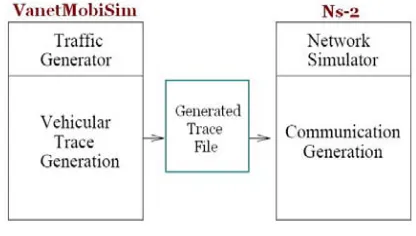
VanetMobiSim is an extension to CanuMobiSim[11]. Because of its limited scope of CanuMobiSim to be used in specific areas only, it was unable to produce high levels of details in specific scenarios. Therefore CanuMobiSim was expanded to achieve a high level of realism in the form of VentMobiSim. Modeling of VanetMobiSim includes car-to-car and car-to-infrastructure relationship. Thus it combines the stop signs, traffic lights and activity based macro-mobility with the support of human mobility dynamics.
VanetMobiSim contains a parser to extract topologies from GDF, TIGER or cluster Voronoi graphs that will be used by network simulators.
Figure3. VanetMobiSim (Separate Traffic and Network Simulator)
D. NCTUns
NCTUns (National Chiao Tung University Network Simulator) [12] based on Harvard simulator proposed by S.Y. Wang in 2002. NCTUns is purely written in C++ with a powerful GUI support. Unlike TraNs, NCTUns tightly couples traffic and network simulators inside a single module to provide single vehicular network enviroment. It added the following support for ITS (Intelligent Transportation System) simulation.
[a] Driver Behaviour Model [b] Network road construction [c] RSU (Roadside unit) Simulation
[d] Onboard unit (OBU) device equipped with [e] IEEE 802.11(b) Ad hoc mode
[f] IEEE 802.11(b) infrastructure mode [g] GPRS radio
[h] DVB RCTS satellite radio
NCTUns can simulate 80.211a, 802.11b, 802.11g and 802.11p technologies. It includes free space, two ray ground and free space with a shadowing path loss model.
Limitation: - NCTUns can support a maximum of only 4096 nodes i.e limited no. of nodes inside a single simulation.
E. OMNeT++
OMNeT++ is an extensible, modular, component-based C++ simulation library and framework, primarily for building network simulators. "Network" is meant in a broader sense that includes wired and wireless communication networks,
On-chip networks, queueing networks, and so on. Domain-specific functionality such as support for sensor networks, wireless ad-hoc networks, Internet protocols, performance modeling, photonic networks, etc., is provided by model frameworks, developed as independent projects [16].
To perform IVC evaluations, both simulators are running in parallel, connected via a TCP socket. The protocol for this communication has been standardized as the Traffic Control Interface (TraCI).
This allows bidirectionally-coupled simulation of road traffic and network traffic. Movement of vehicles in the road traffic simulator SUMO is reflected in movement of nodes in an OMNeT++/INET simulation. Nodes can then interact with the running road traffic simulation, e.g. to simulate the influence of IVC on road traffic.
Limitation: In OMNeT++ the various important commands that are to be required to send to traffic simulator is not yet implemented like STOP Node, Change Target, Change Lane, Slow Down and Position Conversion. It is also found that it’s very difficult to setup the bidirectional coupling in OMNeT++ .
V. PROPOSED MODEL OF VANET
SIMULATOR
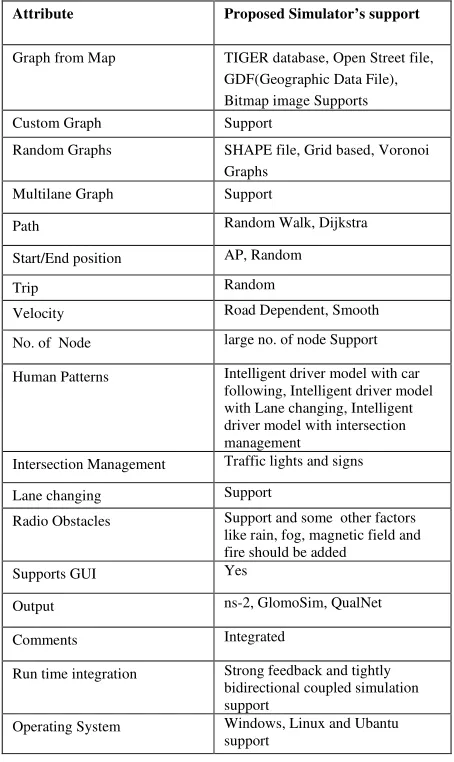
[image:4.612.326.553.72.453.2]After doing the detail study of applications, challenges of VANET and to deal with the realistic scenario of today’s traffic we proposed a model of simulator with the following attribute support given in the table 1.
Table 1. Proposed Simulator Model Supports
Attribute Proposed Simulator’s support
Graph from Map TIGER database, Open Street file, GDF(Geographic Data File), Bitmap image Supports
Custom Graph Support
Random Graphs SHAPE file, Grid based, Voronoi Graphs
Multilane Graph Support
Path Random Walk, Dijkstra
Start/End position AP, Random
Trip Random
Velocity Road Dependent, Smooth
No. of Node large no. of node Support
Human Patterns Intelligent driver model with car following, Intelligent driver model with Lane changing, Intelligent driver model with intersection management
Intersection Management Traffic lights and signs
Lane changing Support
Radio Obstacles Support and some other factors like rain, fog, magnetic field and fire should be added
Supports GUI Yes
Output ns-2, GlomoSim, QualNet
Comments Integrated
Run time integration Strong feedback and tightly bidirectional coupled simulation support
Operating System Windows, Linux and Ubantu support
We studied and worked on above mentioned five VANET simulators but each simulator has shortcomings either in terms of Bidirectional coupled simulation, or in terms of no. of node support, or Graph from Map file format support, or output file for network simulator support, or in terms of Radio obstacles and many other factors. These issues must be resolved for adoption of routing protocols towards the development of VANET.
It is also found that some VANET simulators are very difficult to install or build on different Operating system. This is a major problem for the researchers to select the simulators that can be easily installed to their working platform for quick result.
The main constraint for the Simulator is to support Bidirectional Coupled Simulation. This factor is strongly recommended by us.
A. Bi-directional Coupling of Network Simulator and Road Traffic Simulator
All these factors are external and almost unforeseeable, but they do impact the behavior of drivers, resulting in stopping the vehicle or changing the route.
The change in speed of the vehicle, change of route or even change of lane is only managed by the road traffic simulator. This requirement calls for some means to integrate both network simulator and road traffic simulator at the runtime and make them exchange information regarding the simulation, so that decisions like change in speed of the vehicle, change of route or change of lane can be made.
In TraNs and OMNeT++ Bidirectional Coupling is provided by TraCI.
B. Traffic Control Interface (TraCI)
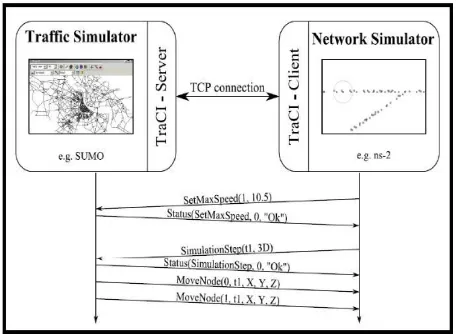
[image:5.612.61.289.351.518.2]TraCI (Wegener et al., 2008) is the software module that enables bi-directional coupling of network and road traffic simulator. It uses client server architecture to give access to SUMO. The TraCI server is a part SUMO while TraCI client is available for integration with network simulators like NS2 and OMNET++ (Varga, 2001). Once the TraCI server is started by running SUMO, it waits for an application using TraCI client to take control of the simulation. The client application implemented in network simulator sends messages regarding the current events in the simulation, to which the SUMO will respond by sending necessary updates.
Figure 4: Command Exchange between TraCI client andserver (Reproduced from Wegener et al., 2008)
VI. CONCLUSION
In this paper we have presented the proposed model of Simulator for VANET to deal with real life scenario. Road safety is main challenge for today’s life. Before we set out to test such projects in reality it is important to perform a series of simulated tasks to cover all possible constraints since outdoor experiments are costly and they may or may not provide us with all the necessary stimuli. Software based simulations are designed to provide an alternative to obtain the required results. VANET hits the protocol’s strength due to its highly dynamic features, thus in testing a protocol suitable for VANET implementation the use of realistic mobility model should be considered.
We proposed a model that will help in generating realistic mobility patterns and will provide a detailed classification required for realistic mobility patterns.
VANET simulation requires that a traffic and network simulator should be jointly used with a powerful feedback between them to render the simulation results as accurate as real life.
VII. FUTURE WORK
More research studies and effort is required in future for the development of technology and protocols for the VANET. We have planned to work for the protocols performance evaluation in bidirectional coupled simulation in real life traffic where radio obstacles are also a main constraint along with accidental and hazardous situation.
VIII. REFERENCE
[1] The Network Simulator ns-2.
http://www.isi.edu/nsnam/ns/index.html. [2] Qualnet Network Simulator.
http://www.scalable.networks.com/. [3] Simulation of Urban MObility.
http://sumo.sourceforge.net/.
[4] TIGER (Topologically Integrated Geographic Encoding and Referencing).
http://www.census.gov/geo/www/tiger/.
[5] Vehicle Safety Communications Project Task 3 Final Report. Technical report, The CAMP Vehicle Safety Communications Consortium, Mar 2005. Sponsored by U.S. Department of Transportation (USDOT). Available through National Technical Information Service, Springfield, Virginia 22161.
[6] Moez Jerbi, Rabah Meraihi, Sidi-Mohammed Senouci, and Yacine Ghamri-Doudane.An Improved Vehicular Ad Hoc Routing Protocol for City Environments. IEEE International Conference on Communications (ICC ’07), pages 3972–3979, 2007. [7] Elmar Schoch, Frank Kargl, Michael Weber, and Tim
Leinmuller. CommunicatioN Patterns in VANETs. IEEE Communications Magazine, 46:119–125, Nov 2008.
[8] A. Stampoulis and Z. Chai. Survey of Security in Vehicular Networks. Technical report, 2007. Project CPSC 534.
[9] F. Karnadi, Z. Mo, K.-C. Lan,”Rapid Generation of Realistic Mobility Models for VANET”, in Proc. of the IEEE Wireless Communication and Networking Conference (WCNC’07), March 2007.
[10] Traffic and Network Simulation Environment http://wiki.epfl.ch/trans/.
[11]VanetMobiSim Project Home Page, http://vanet.eurecom.fr.
[12] Shie-Yuan Wang, Chih-Che Lin “NCTUns 5.0: A Network Simulator for IEEE 802.11(p) and 1609 Wireless Vehicular Network” Department of Computer Science National Chiao Tung University Hsinchu, Taiwan.
[13] Global Mobile Information Systems Simulation Library, http://pcl cs.ucla.edu/projects/glomosim. [14] en.wikipedia.org/wiki/Vehicular_ad-hoc_network [15]http://apps.sourceforge.net/mediawiki/sumo/index.php?t itle=TraCI