Off-shell initial state effects in Drell-Yan process
at hadron colliders
MaximNefedov1,∗and VladimirSaleev1,∗∗
1Samara National Research University, Moskovskoe Shosse 34, 443086 Samara, Russia
Abstract.We discuss production of Drell-Yan lepton pairs at hadron colliders
in the framework of the parton Reggeization approach, which includes off-shell initial state effects in a gauge-invariant way. We have compared our numerical results forqT-spectra of the lepton pair with the experimental data, obtained by E-288 collaboration (√S =19.4 and 23.8 GeV) and found a good agreement. We have also made predictions for the Drell-Yan structure functions at NICA pp-collider (
√
S =24 GeV).
1 Introduction
The Drell-Yan (DY) process of production of lepton pairs with large invariant mass in hadronic collisions is one of the most important test of perturbative quantum chromodynam-ics (QCD), as well as the unique source of information about partonic structure of hadrons. Apart from the inclusive cross-section, differential w.r.t. squared invariant mass (Q2),
trans-verse momentum (qT) and rapidity (Y) of the lepton pair or some equivalent variable, such as
momentum fraction in the Collinear Parton model (CPM) (xA,B), also structure functions or
angular coefficients, which parameterize the angular distribution of leptons in the rest frame of the lepton pair are often under consideration. Behavior of the latter class of observables in the region of relatively smallqT ≤Qwill be the main subject of the present paper.
At low qT Q, already the prediction of inclusive cross-section, integrated over all
directions of lepton momentum in the center-of-mass frame of the pair, presents a consider-able difficulty for the conventional CPM, since at any fixed order of perturbation theory the cross-section diverges as 1/q2TatqT →0. These un-physical divergence is regulated through
the resummation of higher-order corrections inαs enhanced by log2(qT/Q) and log(qT/Q)
through Collins-Soper-Sterman formalism [1], which later has been reformulated in a form of Transverse Momentum Dependent (TMD) factorization theorem [2].
In TMD-factorization, the hard-scattering coefficient (HSC) does not depend explicitly on the transverse momenta of colliding partons. Instead, it is calculated with on-shell initial-state partons and the corresponding partonic tensor automatically satisfies the QED Ward identity. However, it is possible to develop a complementary approach to TMD factorization, starting not from the collinear limit but from Multi-Regge limit for QCD scattering amplitudes, i.e. from the limit when all final-state particles are highly-separated in rapidity. We call this scheme of calculations – the Parton Reggeization Approach (PRA).
In PRA, the HSC, although being gauge-invariant, nevertheless explicitly depends on the transverse momenta of initial-state partons. Below we demonstrate, that this dependence is important to calculate the angular structure functions.
2 Parton Reggeization Approach
A more detailed introduction to the PRA and derivation of our factorization formula is pre-sented in [3]. Here we only briefly outline the main ideas. Factorization formula of PRA is based on modified-MRK approximationfor QCD matrix elements. This approximation
smoothly interpolates between the well-known collinear and Multi-Regge asymptotics (see e.g. [4] for the review of the latter) of the matrix element of ordinary CPM hard subpro-cess with emission of two additional partons. In the collinear limit, additional partons have
|kT| µwhereµis the hard scale (µ ∼ Qin the case of DY process), while in the
Multi-Regge limit, additional partons are highly separated in rapidity from the system of interest (l+l−for DY process), while their typical|kT| ∼µ. In both limits, QCD matrix element can
have the t-channel-factorized form, however in the MRK case the partons, propagating in
thet-channels are not ordinary QCD quarks and gluons, but special gauge-invariant degrees
of freedom of high-energy QCD, called Reggeized quarks (Q) and gluons (R). Due to the t-channel-factorized form of the mMRK-approximation, the cross section of lepton pair
pro-duction in proton-proton collisions,p(P1)+p(P2)→l+(k1)+l−(k2)+X, can be presented in kT−factorized form:
dσ= 1
Z
0 dx1
x1
Z d2q
T1
π Φq(x1,t1, µ2)
1
Z
0 dx2
x2
Z d2q
T2
π Φq¯(x2,t2, µ2)·dσˆPRA, (1)
wherex1 =q+1/P+1,x2 =q−2/P−2, four-momenta of partons in the initial-state of the leading
order (LO) PRA hard-scattering subprocessQ(q1)+Q¯(q2) → l++l−are parameterized as q1=12q+1n−+qT1,q2= 12q−2n++qT2,t1,2=qT1,2=−q21,2, and light-cone vectors are defined
asnµ− = 2P
µ 1/
√
S,nµ+ =2Pµ2/
√
S whereS =(P1+P2)2 =2P1P2. For any four-vector the
light-cone components arek± = (kn±), so thatk2 = k+k−−k2T, and we do not distinguish
between the upper and lower light-cone indicesk±=k ±. The partonic cross-sectiondσˆPRAis:
dσˆPRA= |APRA| 2
2S x1x2 ·(2π) 4δ(4)(q
1+q2−k1−k2)dΦ(k1,k2), (2)
where dΦ(k1,k2) is the element of Lorentz-invariant phase space for final-state leptons,
2x1x2S is the appropriate flux-factor for the initial state off-shell partons (see discussion
in [3]).
The LO unintegrated PDF (unPDF) Φq,q¯(x1,2,t1,2, µ2) in Eq. 1 is related with ordinary
PDFs of CPM as follows:
Φq(x,t, µ2)=
Tq(t, µ2)
t ×
αs(t)
2π 1−∆ Z
x
dzx z
Pqq(z)fq
x
z, µ 2
+Pqg(z)fg
x
z, µ 2
, (3)
wherefq,g(x, µ2) are relevant collinear PDFs, and the Kimber-Martin-Ryskin cut condition [5,
6],∆ = √√t
µ2+√t, follows from the rapidity ordering between the last emission and the hard
Tq(µ2, µ2)=0 andTq(µ2, µ2)=1, which lead to the following normalization for unintegrated
PDF:
µ2
R
0
dtΦq(x,t, µ2)=x fq(x, µ2).
In the PRA, the squared amplitude of the subprocess (QQ¯ → l+l−) can be presented as
convolution of standard lepton tensorLµν=2[−Q2gµν+2(kµ1kν2+kν1kµ2)] and the partonic tensor wPRA
µν :
|A(QQ¯→l+l−)|2= 16π2 NcQ4
α2e2
qL
µνwPRA µν ,
whereNc=3 and partonic tensor reads
wPRA µν = 14tr
" q−
2
2 nˆ+ !
Γµ(q1,q2) q+1
2 nˆ −
!
Γν(q1,q2)
#
, (4)
where factor 1/4 stands for averaging over spins of quark and antiquark, ˆk = kµγµ and
Γµ(q1,q2) is the Fadin-ShermanQQ¯γvertex [7,8]:
Γµ(q1,q2)=γµ−qˆ1n −
µ q− 2
−qˆ2n + µ
q+1. (5)
The QED Ward identity (q1+q2)µΓµ(q1,q2)=0 is satisfied by this vertex for anyq1andq2.
The first term in Eq. (5) corresponds to the usualt-channel quark-antiquark annihilation
diagram (a) in the Fig.1. While other two (“eikonal”) terms in Eq. (5), contain factors 1/q+1 and 1/q−
2. These factors can be understood as remnants ofs-channel propagators in the
diagrams where photon interacts with particles highly separated in rapidity from the lepton pair. More rigorously, the common lore in high-energy QCD (see e.g. [4,9] and references therein) is, that particles in the central rapidity region interact with other particles, highly separated from them in rapidity, as with Wilson lines stretched along the light-cone. The “eikonal” terms in Eq. (5) correspond to the coupling of photon with these Wilson lines. Corrections to this approximation are suppressed by powers ofe−∆y, where∆yis the rapidity
gap. In other words, inclusion of the second and third terms in Eq. (5) is the simplest possible way to effectively take into account the diagrams (b) and (c) in Fig.1, where photon interacts directly with the proton and its remnants. This approximation assumes only that the systems
X1 andX2 are highly separated in rapidity from the central region. Rapidity gap between
collinear subgraphs exists forqT Qat the level ofleading regionfor the Drell-Yan process.
This rapidity gap is filled by soft particles emitted from the Glauber gluon exchanges between collinear subgraphs, which does not lead to violation of factorization (See e.g sec. 14.2 and 14.3 in [2]).
3 Structure functions for DY process in PRA
In the notation of [10] the differential cross section of DY pair production in collision of non-polarized protons can be written as the combination of helicity structure functions (SFs):
dσ dxAdxBd2qTdΩ
= α2
4Q2
h
F(1)UU·1+cos2θ+F(2)UU·1−cos2θ+
+ F(cosUUφ)·sin(2θ) cosφ+FUU(cos 2φ)·sin2θcos(2φ)i,
were xA,B = Qe±Y/ √
X1
X2
X1
X2
X1
X2
(a) (b) (c)
Figure 1. Feynman diagrams for thet-channel quark-antiquark annihilation subprocess (a), which leads to the usual parton-model picture, and direct interaction subprocesses (b,c) which are necessary to restore QED gauge invariance of diagram (a)
factorization formula (1) SFs can be represented as:
FUU(1,...)= S
6π2Q4
T
Z
dt1
Z
dφ1X
q
Φp
q(x1,t1, µ2)Φ
p
¯
q(x2,t2, µ
2)·e2
qf(1
,...), (6)
wheret2 =(qT−qT1)2,Q2T =Q2+q2Tandeqis the quark electric charge in units of electron
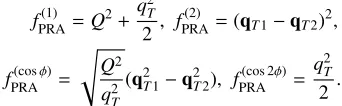
charge. Projecting the partonic tensor (4) on transverse, longitudinal, single spin-flip and double spin-flip helicity states of the virtual photon, one obtains the following expressions for partonic SFs in PRA [12]:
fPRA(1) =Q2+q 2
T
2 , f
(2)
PRA=(qT1−qT2)2,
fPRA(cosφ)=
s
Q2 q2T(q
2
T1−q2T2), fPRA(cos 2φ)= q2T
2 . (7)
In the case of collisions of identical target and projectile (e.g. in pp-collisions), the SF FcosUUφ is equal to zero in PRA, due to the factor (t1−t2) in Eq.7. However, for collisions
of different particles we expect nonzero value ofFcosUUφdue to the difference of
transverse-momentum distributions of quarks and antiquarks in the projectile and on the target.
4 Numerical results and discussion
To justify the use of PRA at relatively low √S =24 GeV, which is expected to be achieved
during the operation of NICA collider in the pp-collider mode (see e.g. [13]), we compare
our numerical results for the differential cross-sectionEdσ/d3qas a function ofqT,Y and
Qwith the experimental data of E-288 Collaboration [14], obtained in the collisions of the
proton beam with the platinum fixed target at √S =19.4 and 23.8 GeV (Fig.2). The KMR
unPDF is generated from the LO PDFs MSTW-2008 [15]. We use the factorization scale-choiceµF =ξQT and varyξin the range 1/2 ≤ξ≤2 to obtain the scale-uncertainty band.
The “π2-resummation” K-factor (see Eq. (53) in [12]) is applied to the cross-section. From
Figs.2and3one can see, that LO PRA calculation describes the E-288 data at all values of
qT,QandYreasonably well.
Comparison of LO PRA predictions for theqT-dependence of polarization parametersλ
andνwith the experimental data of NuSea Collaboration [16] obtained in thepp-collisions
with √S =39 GeV is presented in [12] and also demonstrates a good agreement with data.
10-7 10-6 10-5 10-4 10-3 10-2 10-1
0 1 2 3 4 5
Ed
σ
/d
3q, nb/GeV 2/nucl.
qT, GeV
E-288, p-Pt, √S=19.4 GeV (Elab=200 GeV),
0.1<Y<0.7
5<Q<6 GeV, ×27
6<Q<7 GeV, ×9
7<Q<8 GeV, ×3
8<Q<9 GeV
10-7 10-6 10-5 10-4 10-3 10-2 10-1
0 1 2 3 4 5
Ed
σ
/d
3q, nb/GeV 2/nucl.
qT, GeV
E-288, p-Pt, √S=23.8 GeV (Elab=300 GeV),
-0.09<Y<0.51
5<Q<6 GeV, ×27
6<Q<7 GeV, ×9
7<Q<8 GeV, ×3
8<Q<9 GeV
Figure 2. Transverse momentum spectra of DY pairs. The histogram corresponds to calculation in PRA. The data are from the E288 Collaboration [14], left panel: √S =19.4 GeV, 0.1<Y <0.7; right panel: √S=23.8 GeV,−0.09<Y<0.51
10-5
10-4
10-3
10-2
10-1
100
-0.3 -0.2 -0.1 0.0 0.1 0.2 0.3 0.4 0.5 0.6
d
σ
/(d
√
τ
dY), nb/nu
cl.
Y
E-288, p-Pt, √S=19.4 GeV (Elab=200 GeV)
√τ=0.273 √τ=0.315
√τ=0.414
10-5
10-4
10-3
10-2
10-1
100
-0.3 -0.2 -0.1 0.0 0.1 0.2 0.3 0.4 0.5 0.6
d
σ
/(d
√
τ
dY), nb/nu
cl.
Y
E-288, p-Pt, √S=23.8 GeV (Elab=300 GeV)
√τ=0.229 √τ=0.273 √τ=0.315
√τ=0.473
Figure 3.Rapidity spectra of DY pairs. The histogram corresponds to calculation in PRA. The data are from the E288 Collaboration [14], left panel: √S=19.4 GeV; right panel: √S =23.8 GeV
In Fig.4the PRA predictions for helicity SFsF(1UU,2,cos 2φ) are plotted for the case of pp
-collisions with √S =24 GeV for two bins in the invariant mass of the pair: 2≤Q≤5 GeV
and 5≤Q≤10 GeV.
In the “parton-model style” TMD-factorization [10], based solely on theqq¯-annihilation
picture (diagram (a) in Fig. 1), the TMD quark correlators for the case of unpolarized protons are parameterized in terms of un-polarized quark distribution f1q(x,q2T) and
Boer-Mulders [17] functionh⊥1q(x,q2T). While the former is responsible for the (1+cos2θ) angular
dependence and contributes mostly toFUU(1) function, the latter leads to nonzeroFUU(cos 2φ). The
(1−cos2θ) angular dependence does not arise in TMD-factorization at the leading power in
q2T/Q2 [10]. In agreement with this, in PRA the SFF(2)UU is suppressed by factor Q2 w.r.t. F(1)UU.
As we have shown in [18], the numerical value ofFcos 2UUφeven atq2T Q2strongly
de-pends on the details of the procedure of restoration of gauge-invariance of the hard-scattering coefficient. On the other hand, in the TMD-factorization, based on the diagram (a) in Fig.1, the hadronic tensor (e.g. Eq. (73) in [10]) does not satisfy Ward identity forqT , 0. This
10-6
10-5
10-4
10-3
10-2
10-1
0 1 2 3 4 5
FUU (1), F
UU
(2), F
UU
(cos 2
ϕ
) GeV
-2
qT, GeV
pp √S=24 GeV, 2<Q<5 GeV
0.1<xA,B<0.3
FUU(1)
FUU(2)
FUU(cos 2ϕ)
10-6
10-5
10-4
10-3
10-2
10-1
0 1 2 3 4 5
FUU (1), F
UU
(2), F
UU
(cos 2
ϕ
) GeV
-2
qT, GeV
pp
√S=24 GeV, 5<Q<10 GeV 0.1<xA,B<0.3
FUU(1)
FUU(2)
FUU(cos 2ϕ)
Figure 4.Predictions for unpolarized Drell-Yan SFsF(1)UU,F(2)UUandFUU(cos 2φ)inpp-collisions at√S =24 GeV. Solid lines with uncertainty bands – PRA predictions
Acknowledgements. Authors thank the Foundation for the Advancement of Theoretical
Physics and Mathematics BASIS, grant No. 18-1-1-30-1. The work of M.N. is supported in part by the Russian Foundation for Basic Research through the Grant No. 18-32-00060.
References
[1] J.C. Collins, D.E. Soper, and G.F. Sterman, Nucl. Phys. B250, 199 (1985)
[2] J. C. Collins, Foundations of perturbative QCD (Cambridge University Press,
Cam-bridge, 2011)
[3] A.V. Karpishkov, M.A. Nefedov, and V.A. Saleev, Phys. Rev. D96, 096019 (2017) [4] L.N. Lipatov, Phys. Rept.286, 198 (1997)
[5] M.A. Kimber, A.D. Martin, and M.G. Ryskin, Phys. Rev. D63, 114027 (2001) [6] G. Watt, A. D. Martin, and M. G. Ryskin. Eur. Phys. J. C31, 73 (2003) [7] V.S. Fadin and V.E. Sherman, JETP Lett.23, 599, (1976)
[8] [13] L.N. Lipatov and M.I. Vyazovsky, Nucl. Phys. B596, 399 (2001) [9] I. Balitsky and G.A. Chirilli, Phys. Rev. D88, 111501 (2013)
[10] S. Arnold, A. Metz, and M. Schlegel. Phys. Rev. D79, 034005 (2009) [11] J.C. Collins and D.E. Soper, Phys. Rev. D16, 2219 (1977)
[12] M. A. Nefedov, N. N. Nikolaev, and V. A. Saleev, Phys. Rev. D87, 014022 (2013) [13] I. A. Savin et al., EPJ Web Conf.85, 02039 (2015)
[14] A. S. Ito et al., D Phys. Rev.23, 604 (1981)
[15] A.D. Martin, W.J. Stirling, R.S. Thorne, and G. Watt, Eur. Phys. J. C63, 189 (2009) [16] L.Y. Zhu et al., Phys. Rev. Lett.102, 182001 (2009)
[17] D. Boer and P.J. Mulders, Phys. Rev. D57, 5780 (1998)