Cuprous Oxide Thin Film Non-Enzymatic Glucose Sensor Using Differential Pulse Voltammetry (DPV) and Other Voltammetry Methods and Comparing to Different Thin Film Electrodes on the Detection of
Glucose in an Alkaline Solution Yifan Dai1, Alireza Molazemhosseini2, Kevin Abbasi3, Chung Chiun Liu1*
1Department of Chemical and Biomolecular Engineering and Electronics Design Center, Case Western
Reserve University, 10900 Euclid Ave, Cleveland, OH, 44106, USA; [email protected]
2Dipartimento di Chimica Materiali ed Ingegneria Chimica “Giulio Natta”, Politecnico di Milano, Via
Mancinelli 7, 20131, Italy; [email protected]
3Swagelok Center for Surface Analysis of Materials (SCSAM), Case Western Reserve University, 10900
Euclid Ave, Cleveland, OH, 44106, USA; [email protected]
*Correspondence: [email protected]; Tel: +1-216-368-2935 Abstract
A cuprous oxide (Cu2O) thin layer served as the base for a non-enzymatic glucose sensor in an alkaline
medium, 0.1 NaOH solution, with a linear range of 50-200 mg/dL using differential pulse voltammetry (DPV) measurement. An X-ray photoelectron spectroscopy (XPS) study confirmed the formation of the cuprous oxide layer on the thin gold film sensor prototype. Quantitative detection of glucose in both phosphate-buffered saline (PBS) and undiluted human serum were carried out. Neither ascorbic acid nor uric acid even at a relatively high concentration level of 100mg/dL in serum interfered with the glucose detection, demonstrating the excellent selectivity of this non-enzymatic cuprous oxide thin layer based glucose sensor. Chronoamperometry (CA) and single potential amperometric voltammetry were used to verify the measurements obtained by differential pulse voltammetry (DPV), and the positive results validated that the detection of glucose in a 0.1 M NaOH alkaline medium by DPV measurement was effective. Nickel, platinum and copper are commonly used metals for non-enzymatic glucose detection. The performance of these metal-based sensors for glucose detection using DPV were also evaluated. Cuprous oxide (Cu2O) thin layer based sensor showed the best sensitivity for glucose detection among
the sensors evaluated.
Key Words: cuprous oxide; non-enzymatic glucose sensor; alkaline solution; differential pulse voltammetry
1. Introduction
An abnormal glucose concentration level is directly related to diabetes, obesity, hyperglycemia and encephalopathy [1]. Therefore, a cost-effective, accurate, consistent glucose sensor is important in medical diagnosis. Measuring glucose concentration is also important for bio-processing and bio-reactor applications, as well as for home care usage. Current glucose sensors are typically based on an
enzymatic mechanism with the advantages of low cost and simple operation [2-6]. However, an enzyme-based biosensor is limited in accuracy and the reproducibility of measurements are only fair due to the loss of enzyme activity over time. Furthermore, the enzyme also has limited active life time affecting the manufacturing and shelf-life of the glucose sensor. Hence, a cost-effective, accuracy, highly-reproducible, non-enzymatic glucose sensor is desirable for medical applications and bio-processing involving glucose as a reactant or product.
Oxidation of glucose can be detected electrochemically. Metal oxides, polymer films and noble metals have been used as substrate or catalyst for glucose oxidation reaction in non-enzymatic glucose sensor development [6, 7, 8]. Low sensitivity, complex sensor preparation procedures and unpracticality for real usage were the major drawbacks. In this study, copper oxide was used for the detection of glucose in both phosphate-buffered saline (PBS) and human serum. Metal oxides exhibited good electrochemical properties based on their relatively high reactivity and large specific area at nanoscale. However, most of the synthesis and deposition processes of copper oxides were elaborate and tedious, requiring high temperature and relatively long operational time. In this study, electrochemical deposition of cuprous oxide (Cu2O), was accomplished within a relatively short deposition time and with excellent
reproducibility. The formation of Cu2O was accomplished using CuSO4.5H2O, lactic acid (C3H6O3) and
NaOH, similar to the preparation approach described by Rahmen [9]. The deposited thin layer Cu2O was
examined by X-ray photoelectron spectroscopy (XPS) showing high reactivity and reproducibility for both the deposition process and the electrochemical glucose detection.
In the presence of glucose and copper ions from the cuprous or cupric oxide, glucose was oxidized and the copper ions were reduced. The kinetics of the reaction mechanisms were not totally agreed upon, and the assessment of the actual kinetics of copper ions with glucosewasbeyond the scope of this presentation. Nevertheless, based on reported information of copper (II) oxide for oxidation reaction by hydroxide ions [10, 11], copper (I) oxide did demonstrate a high conductivity.
In this study, Cu2O was deposited by electrochemical deposition on a thin gold film sensor prototype
used in previous studies [12-16]. Glucose concentration ranges of 50-200mg/dL in 0.1 M NaOH solution were detected using differential pulse voltammetry (DPV). Glucose detection was also performed in undiluted human serum using a minute quantity of 0.1 M NaOH, 3 µL serum containing glucose by DPV. Interference studies by uric acid and ascorbic acid showed that this Cu2O based glucose sensorhadgood
2. Materials and Methods 2.1 Apparatus and Reagents
Copper sulfate pentahydrate (#209198), lactic acid (#252476), sodium hydroxide (#306576), D-(+)-glucose (#G-8270), uric acid (#U-0881), L-ascorbic acid (#A5960) and human serum (#H3667) were obtained from Sigma Aldrich (St. Louis, MO). Sodium chloride (#S-271) was purchased from Thermo- Fisher (Pittsburgh, PA). Nickel chloride (#A0282977), and boric acid (#A0281874) were obtained from Acros Organics, Thermo-Fisher (Pittsburgh, PA). A CHI 660C Electrochemical Workstation (CH
Instrument, Inc., Austin, TX,) was used for CV and DPV investigations. Other models of CHI 660 (Models A-E) could also be used. All experiments were conducted at room temperature. X-ray photoelectron spectroscopy (XPS) was performed by a PHI (Physical Electronics Inc., Chanhassen, MN.) Versaprobe 5000 Scanning X-Ray Photoelectron Spectrometer using an Aluminum Kα X-ray radiation (50W, 15KV, 1486.6 eV, 100 µm spot size on the sample) served as the excitation source. The analyzer was operated at a constant pass energy of 23.5 eV. Under these conditions, the Au 4f7/2 photoelectron peak was
recorded with 0.7 eV at a binding energy of 84.0 eV. The calibration of the binding energy of the spectra was performed with the C 1s peak of the adventitious carbons, which was at 284.8 eV. The spectra of each sample was obtained with a short acquisition time of 10 minutes to examine C 1s, Cu 2p and Cu LMM XPS regions in order to avoid, as much as possible, the photo-reduction of species. The
information from the outermost ~10 nm of the surface was converted to a depth profile using data acquired in an angular dependent XPS experiment. When the angle between sample normal and the analyzer entrance was increased, with the X-ray source and analyzer kept in fixed positions, the
photoelectrons originated from an increasingly surface localized zone. Spectrums were acquired at take-off angles of 0°, 45° and 80 ° in order to obtain information about the composition as a function of the depth.
The electrochemical methods used in this study were described separately in Section 3 below. 2.2 Fabrication of Non-enzymatic Cu2O Glucose Sensor
Sputtered thin gold film sensor prototype used in this study had been described elsewhere [12-16]. Electrochemical deposition of the cuprous oxide film on the thin gold film working sensor element was carried out. A mixture of 0.2 M cupric sulfate, 3 M of lactic acid and approximately 3 M of sodium hydroxide for adjusting pH value to 12 was used as electrolyte in this Cu2O deposition [9, 17]. A water
deposition of the cuprous oxide layer on the thin gold film working electrode. After deposition, the cuprous oxide thin film sensor was washed with DI water, dried by nitrogen and ready for use.
Figure1. Comparison of gold sensor prototype and prepared cuprous oxide film sensor. 3. Results and Discussion
3.1 Surface Characterization of Cuprous Oxide Layer with XPS
X-ray photoelectron spectroscopy (XPS) was used for examining the formation of cuprous oxide film on the thin gold film working electrode. The chemical shift of the Cu 2p3/2 photoelectron peak was not detectable with the energy resolution of the XPS. The presence and the intensity of the satellite peaks for the kinetic energy was at 940-945 eV region, indicating a binding energy of 570 eV. The peak shape and position of Cu LMM were experimentally verified and matched with the reference data [18]. The experimental data from 2 different samples along with the reference data are shown in Figure 2. The decreasing of the take-off angle increased the height of the Cu2p due to the smaller of the take-off angle resulting in the sample became closer to the detector and with more photoelectrons reaching the detector. Consequently, the results also confirmed the presence of Cu2O by forming weak satellites in
Figure 2. High resolution XPS spectrums of Copper photoelectron peaks compared on two different samples. The take-off angle on one of the samples verified the consistency of the measurement at different thicknesses.
3.2 Electrochemical Measurement of Glucose by Differential Pulse Voltammetry (DPV)
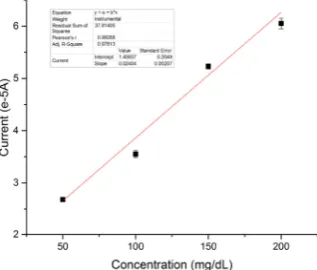
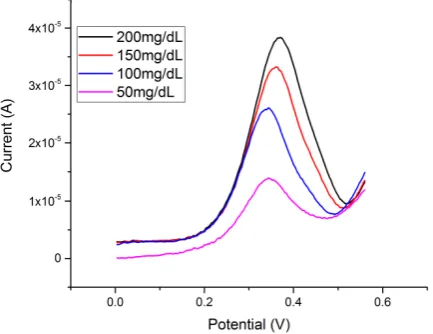
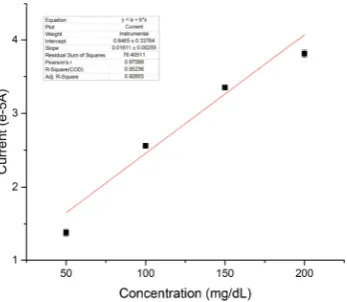
Glucose was prepared ina0.1 M NaOH solution with the concentration ranging from 50 mg/dL to 200 mg/dL. Based on the mechanism of reaction of glucose with cuprous oxide in alkaline solution, an increase of the anodic peak current at a potential of approximately +0.4 V versus a thick-film printed Ag/AgCl reference electrode was observed with increasing concentration of glucose. In a typical experimental run, 20 µL of 0.1 M NaOH with known glucose solution was drop-casted on the cuprous oxide based sensor. A rest time was set for 10 s allowing the hydroxide ion to first oxidize the cuprous oxide. DPV was then conducted in the range of 0 to + 0.75 V versus the thick-film printed Ag/AgCl reference electrode. DPV measurements of different glucose concentrations in 0.1 M NaOH solution are shown in Figure 3a. The calibration curve based on the DPV current output and concentration of glucose is shown in Figure 3b. A linear relationship Y=0.024X+1.46 with adjusted R square value of 0.978 (n>5) is established demonstrating excellent sensitivity and reproducibility of cuprous oxide film based glucose sensor.
Figure 3a. DPV measurements of glucose concentrations ranging from 200mg/dL to 50mg/dL.
3.3 Glucose detection by Chronoamperometry (CA) and Single-potential Amperometric Voltammetry
Determination of glucose using a Cu2O thin layer based sensor and DPV measurement demonstrated
that the detection technique was very effective. However considering the electrochemical complexity of DPV compared to commonly used CA and single-potential amperometric voltammetry, glucose
detection by CA and single-potential amperometric voltammetry were also carried out. The results validated that Cu2O thin layer based sensor for glucose detection with different electrochemical
detection techniques in addition to DPV measurement was successful. Furthermore, the results of this study verified the effectiveness of a Cu2O thin layer based sensor for glucose detection in an alkaline
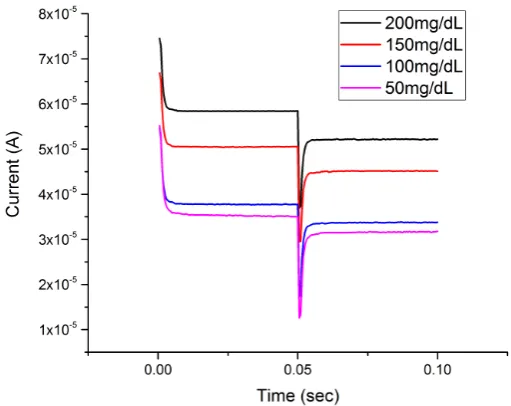
medium. Figure 4 shows the chronoamperometry (CA) response of a Cu2O thin layer based sensor to
different glucose concentration in 0.1M NaOH test medium. The testing procedure was the same as mentioned in section 3.2. In this CA measurement, a voltage of + 0.35 V versus Ag/AgCl reference was applied and then with a step change of potential to +0.4 V in voltage.
Figure 4. Chronoamperometry measurement of glucose concentrations ranging from 200mg/dL to 50mg/dL.
the reaction between glucose and Cu2O to reach a steady state. The single-potential amperometric
voltammetry took 0.3 s to complete.
Figure 5. Single-potential amperometric voltammetry measurement of glucose concentrations ranging between 50 mg/dL and 200 mg/dL
The detection responses of both chronoamperometry and single-potential amperometric voltammetry as demonstrated in Figures 4 and 5 provided verification of the detection of glucose of a Cu2O thin layer
based sensor in an alkaline medium by DPV technique. 3.4 Detection of Glucose in Undiluted Human Serum by DPV
Figure 6a. Differential pulse voltammetry measurement of glucose concentrations ranging from 50 mg/dL to 200mg/dL in undulated human serum.
Figure 6b. Calibration linear relationship of DPV current outputs and concentrations of glucose. DPV measurements demonstrated that this Cu2O thin layer based glucose sensor could be used
effectively in blood serum by adding a minor volume of 3 µL of 0.1 M NaOH to the glucose test sample. This 3 µL of 0.1 M NaOH or similar hydroxide ion containing solutions could be applied to the glucose test sample in serum with minimum inconvenience.
3.5 Interference Study of Cu2O Thin Layer Based Sensor for Glucose Detection
Interference testing was important to ensure the selectivity of the Cu2O thin layer based sensor for
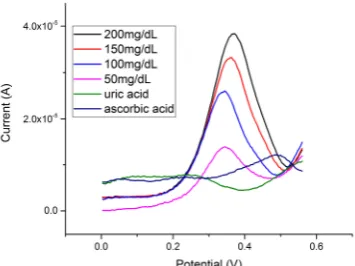
glucose detection. Two common inference chemicals of glucose sensing, ascorbic acid and uric acid, were used in this study. The actual quantities of these interfering species are relatively minute compared with the quantity of glucose in human blood [19]. However, a relatively large quantity of ascorbic acid or uric acid was used in this interference study demonstrating that the selectivity of this Cu2O thin layer based glucose sensor was excellent. 100mg/dL of ascorbic acid and 100mg/dL of uric
acid were prepared individually in undiluted human serum. The same testing protocol described in section 3.4 was conducted. Both ascorbic acid and uric acid at this high concentration level did not contribute any current in the DPV measurement of glucose detection as shown Figure 7. The results demonstrated that the selectivity of this Cu2O thin layer based sensor for glucose sensing in an alkaline
Figure 7. Interference tests from uric acid and ascorbic acid performed by DPV. 3.6 Non-enzymatic Metallic Catalyst Based Glucose Sensors in Alkaline Solution
In additional to cuprous oxide thin film, metallic catalysts, such as nickel, platinum, and copper, also showed promising ability in reaction with glucose in an alkaline condition [4, 5, 19-21]. The reaction mechanism demonstrated that the alkaline solution oxidized metal catalysts, then glucose reduced the oxidized metal producing gluconic acid [4, 5, 14, 19, 21]. Thus, the performance of metallic catalysts, including nickel, platinum and copper for detection of glucose in alkaline solution, were examined and compared with the cuprous oxide thin film sensor.
3.6.1 Electrochemical Deposited Copper Film for the Detection of Glucose in Alkaline Solution
Copper was used for the detection of organic compounds based on its oxidation activity in alkaline solution [21], including using cuprous and cupric oxides as discussed above. In order to assess the effect and the role of copper serving as a metal based sensor for glucose detection, copper was
electrochemically deposited onto the thin gold film sensor prototype and evaluated. Cathodic reduction of Cu +2 ions from an electrolyte was employed for the electrochemical deposition of copper onto the
thin gold film sensor prototype. Typically, an electrolyte of 0.05M of CuSO4 and 0.1M of H2SO4 in
aqueous solution was used for the copper deposition. 20 µL of the electrolyte was placed on the gold thin film sensor and linear sweep voltammetry of -0.9 V to -0.3 V was applied for deposition of copper at room temperature. Cathodic peak current at -0.86 V versus Ag/AgCl reference electrode was observed for this reduction reaction. The protocol of detecting of glucose using this copper based sensor was identical to the evaluation of other metal or metal catalyst based glucose sensors as described in section 3.2. DPV was applied, and the oxidation reaction between glucose and copper took place at around +0.40 V vs. Ag/AgCl as reference electrode. Figure 8a shows the anodic currents of the DPV
measurements of glucose concentrations of 50-200mg/dL in a 0.i M NaOH solution. The anodic peak currents appeared at approximately +0.40 V versus the thick-film printed Ag/AgCl reference electrode. 3.6.2 Electrochemical deposited nickel film for detection of glucose in basic solution
Nickel was a good biological reaction catalyst with a significant chemical activity [20]. Nickel was an active material for glucose detection in the presence of OH- [21, 22]. The performance of nickel on the
solution pH value to around 1.5 was prepared for the deposition of nickel [23]. 20 µL of an electrolyte was placed on the gold thin film sensor and linear sweep voltammetry of -1.2 V to -0.7 V was applied for deposition of nickel at room temperature. An increasing reduction cathodic deposition peak was observed at -1 V vs. Ag/AgCl as reference electrode. The procedure of detection of glucose in an alkaline solution using this nickel based sensor was identical to the process described in section 3.2. Differential pulse voltammetry was applied and an anodic peak was obtained at +0.38V versus the thick film printed Ag/AgCl reference electrode [13, 14, 16], which was also confirmed by Luo’s study [21]. Figure 8b shows the differential pulse voltammetry graph for the detection of glucose in 0.1 M NaOH solution using the electrochemically deposited nickel thin film sensor covering the glucose concentration range of 50mg/dL to 200mg/dL.
3.6.2 Sputtered Thin Platinum Film Sensor for the Detection of Glucose in Alkaline Solution
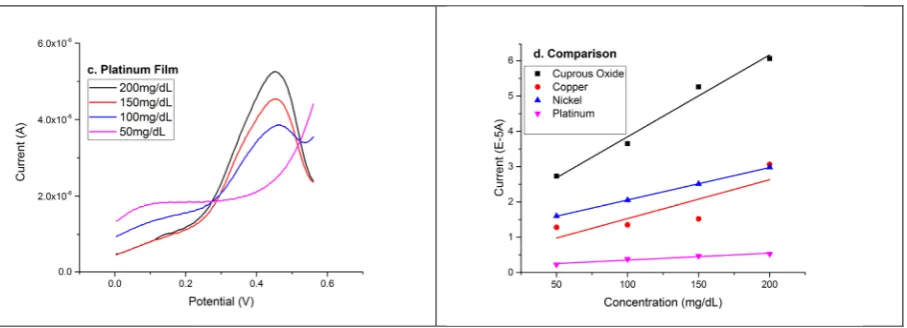
Figure 8. Detection response based on different metal films (a. copper, b. nickel, c. platinum, d. comparison).
This section 3.6 discussed the experimental performance of various metals as catalysts for glucose detection using DPV measurements. Figure 8d summarized the performance of these non-enzymatic glucose sensors by displaying their calibration curves based on the data acquired. Compared with metal films sensor for detection of glucose in alkaline solution, cuprous oxide demonstrated the highest current outputs, showing a promising application as a non-enzymatic glucose sensor.
4. Conclusions
A non-enzymatic cuprous oxide (Cu2O) thin layer based sensor for the detection of glucose in an alkaline
medium, 0.1 NaOH solution over the glucose concentration range of 50-200 mg/dL was successfully developed using differential pulse voltammetry (DPV) measurement. X-ray photoelectron spectroscopy (XPS) confirmed the formation of cuprous oxide, Cu2O layer on the thin gold film sensor prototype. The
evaluation of glucose in both phosphate-buffered saline (PBS) and undiluted human serum were carried out. The 0.1 M NaOH alkaline solution used was minute, 3 µL in a total of 6 µL test medium. Neither ascorbic acid nor uric acid, even at a high concentration level of 100mg/dL in serum, interfered with the cuprous oxide (Cu2O) thin layer based sensor in glucose measurement., demonstrating the selectivity of this non-enzymatic cuprous oxide (Cu2O) thin layer based sensor was excellent. Chronoamperometry
(CA) and single-potential amperometric voltammetry were also used in the glucose detection
experimentally using this cuprous oxide (Cu2O) thin layer based sensor. The positive results verified the
validity of detecting glucose in a 0.1 M NaOH alkaline medium by DPV measurement. Nickel, platinum and copper were commonly used metals for non-enzymatic glucose detection. The performance of these metal based sensors for glucose detection using DPV technique were experimentally evaluated. Cuprous oxide (Cu2O) thin layer based sensor showed the best sensitivity for glucose detection among
the sensors evaluated.
Author Contributions: C.C.L., A.M. and Y.D. conceived and designed the experiments; Y.D. A.M. K.A. performed the experiments; C.C.L., A.M. Y.D. K.A. analyzed the data; Y.D., A.M. K.A. and C.C.L. all contributed to prepare this manuscript.
References
[1] http://www.medicinenet.com/encephalopathy/article.htm
[2] Zhang M.; et al. Highly sensitive glucose sensors based on enzyme-modified whole-graphene solution-gated transistors. Scientific reports (2015) 5, 8311.
[3] Tian K.; Alex S.; Siegal G.; Tiwari A. Enzymatic glucose sensor based on Au nanoparticle and plant-like ZnO film modified electrode. Materials Science and Engineering: C (2015), 46, 548-552.
[4] Jiang LC.; Zhang WD. A highly sensitive nonenzymatic glucose sensor based on CuO nanoparticles-modified carbon nanotube electrode. Biosens. Bioelectron. (2010) 25, 1402–1407.
[5] Reitz E.; et al. CuO nanospheres based nonenzymatic glucose sensor, Electroanalysis (2008),20, 2482–2486.
[6] Li LH.; Zhang WD. Preparation of carbon nanotubes supported platinum nanoparticles by an organic colloidal process for nonenzymatic glucose sensing. Microchimica Acta (2008), 163, 305- 311.
[7] Sun YP.; Buck H.; Mallouk TE. Combinatorial discovery of alloy electrocatalysts for amperometric glucose sensors. Analytical Chemistry (2001), 73, 1599-1604.
[8] Espro C.; et al. CuO nanowires-based electrodes for glucose sensors. Chemical Engineering Transactions (2014), 41, 415-420.
[9] Rahman A S.; Shorowordi K M. Electrodeposition and characterization of copper oxide thin films for solar cell applications. Procedia Engineering (2015), 105, 679-685.
[10] Torto N.; Ruzgas T.; Gorton L. Electrochemical oxidation of mono- and disaccharides at fresh as well as oxidized copper electrodes in alkaline media, J. Electroanal. Chem.(1999) 464, 252–258,
[11] Corbo D.; Bertotti M. Amperometric determination of ethanol in beverages at copper electrodes in alkaline medium, Anal. Chim. Acta (2002), 472,123–131,
[12] Dai, Y.; Liu, C.C. A simple, cost-effective sensor for detecting lead ions in water using under-potential deposited bismuth sub-layer with differential pulse voltammetry (DPV). Sensors (2017), 17, 950.
[13] Dai, Y.; Molazemhosseini, A.; Liu, C.C. In vitro quantified determination of β-amyloid 42 peptides, a biomarker of neuro-degenerative disorders, in PBS and human serum using a simple, cost-effective thin gold film biosensor. Biosensors (2017), 7, 29.
[15] Dai, Y.; Liu, C.C. Detection of 17 β-Estradiol in environmental samples and for health care using a single-use, cost-effective biosensor based on differential pulse voltammetry (DPV). Biosensors (2017), 7, 15.
[16] Dai, Y.; Molazemhosseini, A.; Liu, C.C. A single-use, in vitro biosensor for the detection of T-tau protein, a biomarker of neuro-degenerative disorders, in PBS and human serum using differential pulse voltammetry (DPV). Biosensors (2017), 7, 10.
[17] Du, QT.; et al. Electrochemical deposition and formation mechanism of single-crystalline Cu2O
octahedral on aluminum. Journal of Analytical Methods in Chemistry (2012), 406162.
[18] Surface Analysis: The principal techniques 2nd edition by John Vickerman and Ian Gilmore Wiley
Publications, ISBN 978-0-470-01763-0 (2009)
[19] Zhou C,; Xu L,; Song J,; Xing R,; Xu S,; Liu D,; Song H. Ultrasensitive non-enzymatic glucose sensor based on three-dimensional network of ZnO-CuO hierarchical nanocomposites. Scientific Reports(2014), 4:7382.
[20] Zamble D. Nickel in biology. Royal society of chemistry (2015) 7, 588.
[21] Luo P.; Zhang F.; Baldwin R. Comparison of metallic electrodes for constant-potential amperometric detection of carbohydrates, amino acids and related compounds in flow systems. Analytica Chimica Acta (1991), 244, 169-178.
[22] Fleischmann M.; Korinek K.; PletcherD. The oxidation of organic compounds at a nickel anode in alkaline solution. J. Electroanal. Chem (1971), 31, 39.