www.ijiset.com
ESSENTIAL LIMONENE OIL MICROENCAPSULATION
FOR APPLICATION IN ACTIVE BIODEGRADABLE
PACKAGING
Bruna V. Quevedo1, Amanda A. Moraes1, Henrique S. M. Lopes1, Priscila Breda2, Daniel Komatsu1,2, Maira de L. R.
Komatsu1
1 Faculdade de Tecnologia José Crespo Gonzales/Fatec
Sorocaba,SP/Brasil
2 Pontifícia Universidade Católica de São Paulo/PUC
Sorocaba, SP/Brasil
Abstract
Essential oils have been employed in active packaging because their incorporation confers antimicrobial and antioxidant prope rties. The encapsulation process can be used to increase stability and control oil release, increasing its effectiveness. The main objective of this work is to obtain microspheres containing D-Limonene essential oil (LIM) for future application in active packaging. Sodium alginate microspheres containing LIM were obtained by ionic gelation and characterized by SEM and FTIR. The LIM release was quantified by the UV-Vis technique. The results showed that the encapsulation technique used was effective and that the LIM is gradually released, which may be related to its partial retention in the hydrophobic portion of micelles formed during the crosslinking of the mi crospheres. The technique employed is effective for obtaining the microspheres, which confer chemical stability of the active compound.
Keywords: active packaging, microsphere, essential oil, limonene.
1. Introduction
Polymeric materials are increasingly used in the manufacture of food packaging, since they are inexpensive, easily processed and have specific functions such as containing, preserving and protecting food from degradation caused by microorganisms, the action of oxygen and light, establishing quality parameters and greater consumer safety. Biodegradable packaging has been the target of research to act as a promising alternative to replace fossil-based plastic packaging, which is linked to environmental impacts caused by its high resistance to degradation.
Biodegradability and compostability under appropriate conditions are intrinsic characteristics of biodegradable materials, including the poly (lactic acid) PLA biopolymer and its poly (L-co-D, L lactic acid) copolymer, both derived from sources renewable and which may be used as substitutes for petroleum-derived polymers.1,2
Associated with the development of biodegradable food packaging, the emitter system active packaging is highlighted, where technological processes of microencapsulation of the active agent in the polymeric film are employed. These have antioxidant and antimicrobial action, without the need for preservatives and chemical additives directly on food packaging, increasing the food safety, quality and shelf life of packaged foods, beneficial for the consumer and reducing waste.3
Essential oils have been the subject of studies for application as active agents in food packaging because they are natural substances of plant origin and have excellent antioxidant, antibacterial and antifungal properties.4
Limonene is found abundantly in more than 300 plant species and is formulated with two enantiomer isomers, L-Limonene and D-L-Limonene. This stands out due to the fact that it is an abundant by-product in the citrus industry, obtained from orange peel residues.5,6
Fittings, which according to the manufacturer is extracted from citrus peel through the steam distillation process and is 100% pure.
3. Methods
To obtain the sodium alginate-based microspheres (MES ALG) and incorporated with limonene oil (MES ALG + LIM), a homogeneous 1% (w/v) sodium alginate solution was added by dripping to a 2% (w/v) aqueous solution of calcium chloride and 3% LIM. The system was kept under slow magnetic stirring at room temperature. Then the microspheres were kept for 5 minutes, removed from the aqueous solution and oven dried at 30 °C for 24 hours. The process of obtaining pure sodium alginate microspheres was also performed without the addition of LIM (MES ALG), following the same procedures as above.
4. Characterization
4.1 Scanning Electron Microscopy (SEM)
The sample surfaces were covered with a thin layer of gold. A JEOL JSM 6010 microscope of 3kV voltage was used.
4.2 Fourier Transform Infrared Absorption Spectroscopy (FTIR)
Spectrum 65 (Perkin Elmer) equipment, range from 4000 to 500 cm− 1, resolution of 4 cm− 1 and 32 scans were used.
4.3 Controlled Release Assay (UV-VIS)
To determine LIM release, MES ALG + LIM samples were immersed in 4 mL methanol and kept in a 37 ° C water bath, which were measured using a 228 nm wavelength UV-Vis spectrophotometer and discarded. After this disposal, 2 mL of methanol was added to the system to keep the volume constant. LIM release was calculated using a calibration curve. The test was performed in duplicate.
5. Results and Discussions
5.1 Scanning Electron Microscopy (SEM)
www.ijiset.com
Figure 1: MES ALG + LIM microscopy with (a) 40x magnification and (b) 75x magnification
5.2 Fourier Transform Infrared Spectroscopy (FTIR)
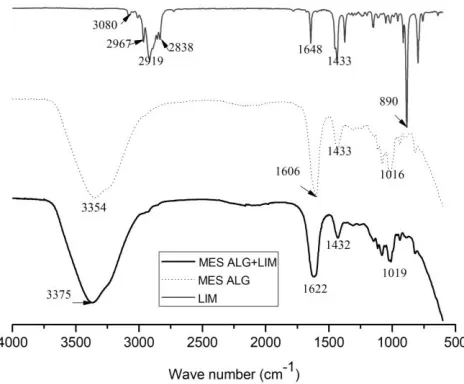
In the spectra analyzed in Figure 2, the most relevant bands for FTIR analysis are highlighted. In the spectrum corresponding to LIM, the band analyzed at 3080 cm-1 corresponds to the -CH stretch of alkenes, while the bands found
between 2967 to 2838 cm-1 are associated with angular deformation CH
3 and CH2 which may be linked to primary and
secondary carbons. The spectra observed at 1648 and 1433 cm-1 correspond to the C=C stretch found in cycloalkenes,
characteristic of D-limonene. The peak analyzed at 890 cm-1 is associated with the branches of the compound structure
(R2C = CHR).9
a)
the former has hydrophilic character, while LIM is hydrophobic, indicating the low chemical affinity between them.10
5.3 Controlled Release Assay (UV-VIS)
The LIM release results were obtained by the UV-Vis spectroscopy technique, at 228 nm wavelength, with the aid of a calibration curve, whose equation obtained from this curve is represented in Eq. (1).
Abs = 3.8766 x Con - 0.0227 R2 = 0.9808 (1)
in which:
Abs = absorbance; Con = oil concentration in mg/mL.
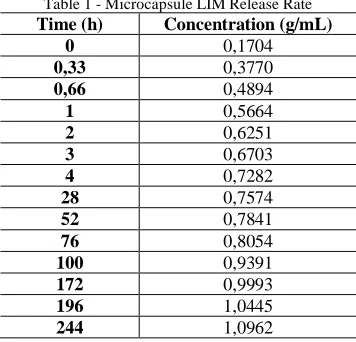
The values obtained from the LIM release rate are presented in Table 1.
Table 1 - Microcapsule LIM Release Rate Time (h) Concentration (g/mL)
0 0,1704
0,33 0,3770
0,66 0,4894
1 0,5664
2 0,6251
3 0,6703
4 0,7282
28 0,7574
52 0,7841
76 0,8054
100 0,9391
172 0,9993
196 1,0445
244 1,0962
www.ijiset.com
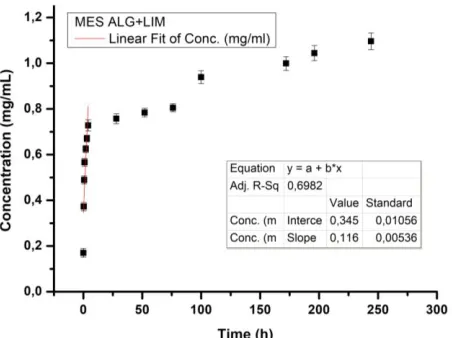
Figure 3: Graph of LIM release rate as a function of time and concentration
The interaction of LIM depends on its solubility in the polymer and its gradual release after some time may be related to the partial retention of LIM in the hydrophobic portion of micelles formed during Ca2 + ion crosslinking, resulting in a more
compact network and responsible for the controlled release of LIM.8,11,12
6. Conclusions
The results allow us to conclude that the microencapsulation of D-limonene essential oil in the sodium alginate matrix by ionic gelation is effective and allows obtaining microspheres with potential to confer stability of the volatile and antimicrobial properties of the employed oil. Good chemical stability can be observed of the microencapsulated active compound, proven by the UV-Vis technique, which suggests that the microspheres obtained in this work can be employed to obtain active packages.
Acknowledgments
The authors thank PUC-SP's LabioMat for their FTIR analysis; to Labnus from Uniso, for the swelling test, to LaPTeC, from Unesp Sorocaba, by SEM analysis and to Prof. Dr Walter Ruggeri Waldman of UFSCar Sorocaba, for the donation of sodium alginate.
References
[1] I. Majid; M. Thakur; V. Nanda Mater. Sci.Eng. C. 2018, 760, 11.
[2] I. Armentano; N. Bitinis; E. Fortunati; S. Mattioli; N. Rescignano; R. Verdejo; M.A. Lopez-Manchado; J.M. Kenny Prog. Polym.Sci.
2013, 38, 1720.
[3] L. Lin; M.A.-S. Abdel-Samie; H. Cui Encycl. Food Secur. Sustainability. 2019, 1, 484. [4] K. Hac-Wydro; M. Flasinski; K. Romanczuk Food Chem. 2017, 235, 127.
[5] D. Gerchman; B. Bones; M.B. Pereira; A.S. Takimi Prog. Org. Coat. 2019, 129, 133. [6] C. Ravichandran; P.C. Badgujar; P. Gundev; A. Upadhyay FCT. 2018, 120, 668.
[7] M. Zanetti; T.K. Carniel; F. Dalcanton; R.S. Anjos; H.G. Riella; P.H.H. Araújo; D. Oliveira; M.A. Fiori TFST. 2018, 81, 51. [8] H.C.B. Paula; E.F. Oliveira; F.O.M.S. Abreu; R.C.M. Paula; S.M. Morais; M.M.C. Forte Polímeros. 2010, 20, 112. [9] SANTOS, P. B. P. Tese de Mestrado, Universidade Federal de Sergipe, 2014.
[10] M. Junior; M. Roberto; G. M. Pastore Química Nova. 2007, 30, 382. [11] Y. Baimark; Y. Srisuwan Adv. Powder Technol. 2014, 25, 1541.
Sorocaba (Fatec) in the course of Polymer Technology and also a researcher at the PUC-SP Biomaterials laboratory, Sorocaba campus.