_____________________________________________________________________________________________________
*Corresponding author: E-mail: [email protected];
www.sciencedomain.org
Comparing the Effects of One Session of Interval
and Continuous Aerobic Exercise on Protein and
Purine Catabolism among High School Boys in
Gonabad-Iran
Mahmood Reza Mottaghy Shahri
1, Hossein Abtahi
2, Mostafa Amiri
1,
Hossein Shahdoost
3, Zahra Rohani
1and Mojtaba Kianmehr
4*1
Department of Basic Sciences, Faculty of Allied Medical Sciences, Gonabad University of Medical Sciences, Gonabad, Iran. 2
Department of Biochemistry, Faculty of Medicine, Gonabad University of Medical Sciences, Gonabad, Iran. 3
Department of Physical Education, Education Office, Gonabad, Iran. 4
Department of Medical Physics, Faculty of Medicine, Gonabad University of Medical Sciences, Gonabad, Iran.
Authors’ contributions
This work was carried out in collaboration between all authors. Authors MRMS, MK, HS and ZR designed the study and wrote the protocol. Author HA managed the literature searches. Authors MRMS, MK and HS collected the data and performed the statistical analyses. Authors HA and MA wrote the manuscript. Author MA revised and proofread the manuscript. All authors read and approved the final manuscript.
Article Information
DOI: 10.9734/BJMMR/2016/22605 Editor(s): (1)Shashank Kumar, Assistant Professor, Center for Biochemistry and Microbial Sciences Central University of Punjab, India.
Reviewers: (1) Salma Abedelmalek, Sousse Faculty of Medicine, Sousse, Tunisia. (2)Anonymous, University of Manitoba, Canada. (3)Pawel F. Nowak, Opole University of Technology, Poland. (4)Marco Matteo Ciccone, University of Bari, Italy. (5)Gabriel Costa e Silva, Rio de Janeiro Federal Rural University, Brazil. Complete Peer review History:http://sciencedomain.org/review-history/12888
Received 14th October 2015 Accepted 17th December 2015 Published 4th January 2016
ABSTRACT
Aims: Protein, one of the energetic agents, possesses basic and biologic roles, but when the body
faces a severe shortage in nutrients, proteins provides the required energy. This study was
conducted to examine the impact of interval and continuous aerobic exercises on urea, uric acid, creatinine of urine, and protein catabolism among 15-18 year old boys at high schools.
Study Design: This was a quasi-experimental crossover study.
Place and Duration of Study: Molla Mozaffar Boarding High School for Boys and Gonabad
University of Medical Sciences, Gonabad, Iran. The study took about six months in 2013.
Methodology: Twenty voluntary high school boy students who were ordinary and healthy
individuals but not athletes were selected randomly. At the beginning of each training session, they warmed up for 10 minutes. Then, activities were performed with the intensity of 65-75 percent of the maximum heart rate. The interval aerobic training was in 3 cycles of 1000 meters; and the active breaking mode of half to one was used between the repetitions. In the continuous aerobic training 3000 meter, practicing was performed continually without any breaks. Heart rate, the intensity of training, and the running distance were measured by the measuring gadgets on the treadmill. Before and after each exercise, the urine was collected for 24 hours. Urea, uric acid, and creatinine of the first 24-hour urine sample were determined.
Results: The results of the experiments were analyzed using t-test. There were not any significant
differences among average levels of urea, uric acid, and creatinine of urine and protein catabolism rate in the first 24-hour urine sample after one session of interval and continuous aerobic exercise (P > 0.05).
Conclusion: It was found that one session of the interval and continuous aerobic exercise has no
significant effect on protein catabolism rate among the 15-18 year old high school boy students.
Keywords: Interval and continuous aerobic exercise; urea; uric acid; creatinine; urine.
1. INTRODUCTION
Exercise, especially the aerobic one, has considerable beneficial effects on all aspects of health. However, it also has some side-effects which limit the usefulness of exercise in some ages, conditions, and even situations. For instance, for growing children who need more nutritious compounds (carbohydrates, lipids, amino acids, vitamins, minerals, and so on) for the growth of fundamental tissues such as those of brain, bone and cartilage, and hematopoietic and immune systems, performing intense exercises might counteract the growing tissues [1].
In addition to the training state of the individual, the effects of exercise on protein metabolism, especially muscle proteins, depend on the mode, intensity, and duration of the exercise. Resistance exercise has both anabolic and catabolic effects on muscle proteins so that catabolism of muscular protein will be determinants at the fasting state [2]. Some studies showed that acute and chronic endurance exercises, although with different degrees, improve nitrogen retention by the body [3] and increase the synthesis of muscular proteins [4-6]. In an investigation, a four-week aerobic training increased both synthesis and breakdown of muscle proteins with little more increment in breakdown [2]. In this study, there were more catabolic effects of the endurance
exercise on muscle proteins due to the lack of the changes in body composition. This may have resulted from the fasting state of the exercising people. In other words, feeding would compensate the effect of aerobic exercise in fasting state synthesizing proteins instead of their breakdown [2]. This clearly clarifies the importance of enough food in response to the increase in demanding energy during aerobic exercises.
exercise. Acute phase proteins are secreted in acute phase reaction which decreases anabolic protein such as albumin. Determining a growth hormone called Insulin-like growth factor I (IGF-I) and its carrier protein (IGFBP-3) in two groups of subjects treated with moderate-intensity continuous exercise and high-intensity interval exercise showed that both IGF-1 and IGFBP-3increased during exercises with similar fashion. In this study, total work which was similar in the two exercises stimulated up-regulations of both proteins [12].
Based on the importance of exercise in health, obeying government exercising policies and performing a proper exercise for pre-puberty children who are in their growing age are extremely important. In order to find this kind of exercise, we compared the effects of two types of aerobic exercises, interval and continuous endurance ones, in catabolizing vital compound of the body required for puberty.
2. MATERIALS AND METHODS
2.1 Participants
In this quasi-experimental crossover study, the statistical population included 615 high school boy students, aged between 15-18 years old, all of whom were residing in the school dormitories in Gonabad city, Iran, in 2013. They were studying at four boarding high schools, from among which Molla Mozaffar high school including 165 students was randomly selected. To decide on the number of participants needed, a pilot study was carried out on 10 children (5 in each group) regarding the average of urine urea in the two groups and the following results were obtained: x̄1=385, x̄2=438, S1=44, S2=33 (effect
size = 1.36). By comparing the group means through sample sizes for two independent samples and considering power of the test (0.8) and confidence level (0.95), the sample size was obtained as 8.44 participants for each group. With regard to the attrition rate of 15%, 20 high school boy students were randomly assigned into two groups of 10 students each.
This research was undertaken after receiving informed consent from the high school boy students. The students were also made aware of the fact that they could withdraw from the study at any stage of the research if they wanted to. Further, all necessary information was provided for them at the beginning of the research. This study started with the permission of the Ethics
Committee for Research at Gonabad University of Medical Sciences.
The inclusion criteria for selecting samples were: being healthy, not doing a regular exercise, having a BMI in the normal range, and eating foods served in school. The exclusion criteria included: not being able to continue with the study medically, not contented to continue the study, doing regular exercises during the treatment, and not following the intended regimen during the study.
2.2 Experimental Design
The study was based on a crossover design through which each of the 20 participants completed two exercise sessions: Group A were the students performing one session of continuous exercise and group B the students exercising in the same way as group A, but they performed the interval exercise instead of the continuous one. The second session began after one week of wash-out period. For performing the second session, based on crossover studies, group A did interval exercise while continuous exercise was practiced by group B.
To control and minimize the unwanted effects of the temperature, humidity, sunlight, and also to check variables such as heart rate, blood pressure, distance, velocity of running, the programs were performed on a treadmill located in a specific room with proper conditions of light, humidity, temperature of 22°C, noise, and so on.
2.3 Training
Based on a pilot study, and in order to maintain a range of 130-160 beat/min, all participants in the experimental groups had to meet the following conditions: a) The time spent for running a 1000-meter distance had to be 5.5 minutes, b) The velocity of running had to be 3 meter/second, and c) the time for inactive rest had to be at the interval of 2.5-3 minutes to maintain heart rate at the range of 120-130 beat/min.
Therefore, after 10 minutes of warming up by slow running, each group performed its specific program with the 65-75% of maximum heart rate.
In the continuous aerobic exercise, all the distance of 3000 meters was run continuously without any rest.
Before collecting 24-hour urine samples, the participants were required to avoid both eating any additional food or dessert between the programmed meals and performing any exercises other than those determined by the program during the study.
2.4 Test Protocol
Two samples of the 24-hour urine, one sample just before exercising and the other one just after performing exercise, were received and analyzed for urea (metabolite of protein catabolism), creatinine (dehydrated form of creatine), and uric acid (product of purine catabolism). Concentration of analyses of urea, creatinine, and uric acid were determined spectrophotometrically using assay kits from Pars Azmoon Company, Iran (the kits performance characteristics are given in Table 1).
Wilmore and Costil mentioned that one gram nitrogen excreted in urine correlates with degradation and disposition of 6.25 grams protein [13]. Based on molecular formula of urea, every 60 grams urea contains 28 grams nitrogen. Therefore, in order to convert urea into urea nitrogen, urea contents of urine samples were divided by 2.14.
The participants’ heart rate, exercise pressure, and the intended distance were controlled using the sensors in the treadmill model T-690 made in Germany. As the exercise gymnasium was
equipped with air conditioning systems, the temperature was controlled and was being kept consistent at 22 degrees centigrade during all the exercise phases. To measure weight and height, a medical scale of SECA model having an index for measuring height made in Germany was used. To measure blood pressure, a standard mercury sphygmomanometer was used.
2.5 Statistical Analysis
Data were presented as mean values and standard deviation of mean (SD). To analyze the data, first, the normality tests for data distribution for both experimental and control groups were performed using Kolmogorov-Smirnov test. As the data were distributed normally, the independent t-test for the two groups was run to compare the quantitative variables of weight, height, BMI, systolic pressure, diastolic pressure, and pulse per minute. In case of age which did not show normal distribution, Mann-Whitney u test was used between the two groups.
One-way repeated measure ANOVA was used to assess the effect of interval and continuous aerobic exercise on urine urea levels, urine creatinine levels, urine uric acid levels and urine BUN/creatinine ratio. The data were analyzed using SPSS software (Version 14, SPSS Inc., Chicago, Illinois) at a significant level of 0.05.
3. RESULTS
Table 2 shows the demographic information and data related to the physical health of non-athlete healthy high school boy students in each of the two groups of A and B.
Table 1. The kits performance characteristics from Pars Azmoon company, Iran
Performance characteristics Urea Creatinine Uric Acid
Limit of detection 2-200 mg/dl 0.2-15 mg/dl 0.3-15 mg/dl
Intra-assay precision 3.29% 3.22% 1.46%
Inter-assay precision 4.1% 1.78% 1.57%
In comparison with international standard kits R= 0.999 R= 1 R= 0.998
Table 2. Characteristics of participants in groups A and B (Data expressed as mean±SD)
Group A (n = 8) Group B (n = 9) P -value
Age (year)* 15.75±0.88 15.77±0.44 0.748
Weight (kg) 48.25±8.10 54.44±9.47 0.171
Height (cm) 166.50±7.11 169.22±7.24 0.447
BMI (kg/m2) 17.33±2.33 18.90±2.29 0.174
Systolic pressure (mmHg) 102.5±3.7 108.3±10.6 0.153
Diastolic pressure (mmHg) 68.7±6.4 72.2±9.7 0.405
Pulse per minute 86.62±5.01 86.22±4.81 0.868
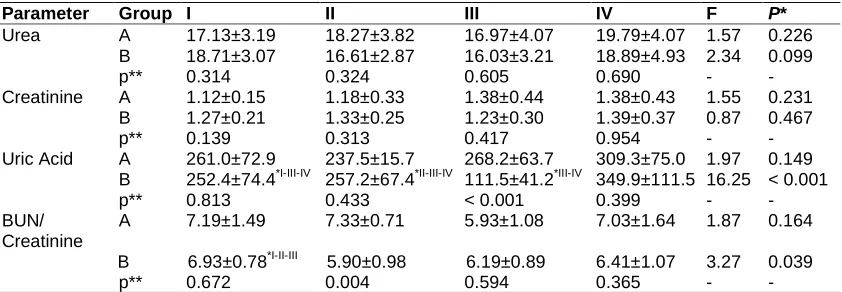
Table 3. Urine biochemical parameters in groups A and B (Data expressed as mean±SD) P* F IV III II I Group Parameter 0.226 1.57 19.79±4.07 16.97±4.07 18.27±3.82 17.13±3.19 A Urea 0.099 2.34 18.89±4.93 16.03±3.21 16.61±2.87 18.71±3.07 B - - 0.690 0.605 0.324 0.314 p** 0.231 1.55 1.38±0.43 1.38±0.44 1.18±0.33 1.12±0.15 A Creatinine 0.467 0.87 1.39±0.37 1.23±0.30 1.33±0.25 1.27±0.21 B - - 0.954 0.417 0.313 0.139 p** 0.149 1.97 309.3±75.0 268.2±63.7 237.5±15.7 261.0±72.9 A Uric Acid < 0.001 16.25 349.9±111.5 111.5±41.2*III-IV 257.2±67.4*II-III-IV 252.4±74.4*I-III-IV B - - 0.399 < 0.001 0.433 0.813 p** 0.164 1.87 7.03±1.64 5.93±1.08 7.33±0.71 7.19±1.49 A BUN/ Creatinine 0.039 3.27 6.41±1.07 6.19±0.89 5.90±0.98 6.93±0.78*I-II-III B - - 0.365 0.594 0.004 0.672 p**
Roman numerals I and III, II and IV are urine samples collected before and after exercises. There is a washing-out period between collecting samples of II and III, *Repeated measures analysis of variance was used, **Independent
samples t-test was used
Based on Table 2, there are no significant differences (P > 0.05) between the two groups (A and B) regarding the demographic characteristics of the participants.
As shown in Table 3, none of the two exercise regimens have affected the 24-urine urea
concentrations in four times of urine collection (P > 0.05). Besides, there was no significant
difference in the amount of 24-hour urine urea of 15-18 year old high school boy students before and after one session of continuous and interval aerobic activity.
In addition, there was no significant difference between the amounts of creatinine measured at different stages (P > 0.05). The creatinine volume belonging to the high school boy students aged 15-18 years old was similar prior to and after one session of continuous and interval aerobic exercise (P = 0.735).
In contrast, as the table displays, there was a significant difference in the amount of uric acid in group B at the measurement stages (P < 0.001). However, there was not any difference in the 24-hour uric acid volume of 15-18 year old high school boy students prior to and following one session of continuous and interval aerobic exercise (P = 0.197).
As the table reveals, there was also a significant difference between the proportion of BUN to creatinine during the measurement stages in group B (P = 0.039). Conversely, there was no significant difference in the volume of BUN to the 24-hour urine creatinine of 15-18 year old high school boy students prior to and after one session of continuous and interval aerobic exercise (P = 0.128).
4. DISCUSSION
Our findings showed that both exercise types did not have any effect on the 24-urine urea concentrations and the amounts of creatinine in four times of urine collection. Furthermore, no significant difference was observed in the above-mentioned variables among 15-18 year old high school boy students before and after one session of continuous and interval aerobic activity. On the other hand, there was a significant difference in the amount of uric acid and the proportion of BUN to creatinine in group B. However, there was no difference in the above variable in 15-18 year old high school boy students prior to and following one session of continuous and interval aerobic exercise.
tissue protein breakdown as a source of amino acids during exercise. For example, MacLean et al., showed that BCAA supplementation reduces skeletal muscle proteolysis [17].
In a study by Poortmans et al. [18] they reported that seemingly endurance-type exercise did not affect the skeletal muscular protein synthesis as much as the resistance exercise did. They further stated that this may be somewhat because of proteolysis of non-myofibrillar proteins in post-exercise phase and that prolonged aerobic exercise caused a higher release of nitrogen in blood and urine. The levels of carbohydrate stores could be a determinant in using amino acids as a source of energy. It has been found that the BCKAD is stimulated, to a greater extent, in glycogen-depleted rats in which the levels of insulin is low [19]. In addition, urea production is accelerated in carbohydrate-depleted subjects [20,21] so that the energy acquired from amino acid catabolism in carbohydrate depleted exercising people was more in comparison with that of carbohydrate-supplemented individuals exercising with the same manner [16]. Although leucine oxidation, as a marker of protein catabolism, increases during endurance exercise in the two genders of male and female [22], it is not equal in them. In fact, males having a greater mass of skeletal muscle possess higher values of leucine oxidation and, consequently, higher protein catabolism during exercises than their female counterparts [8,23]. Before puberty, both boys and girls have the same muscle mass which increases in boys during puberty, a finding which is due to the effect of testosterone [22]. Based on the investigation of Kevin et al. [24] performed on swimmers, there were no significant differences among employed groups of rest, resistance exercise, endurance exercise, and the combination of resistance and endurance exercises in protein breakdown. Interestingly, only the group with the combined exercises had significantly more protein synthesis than the rest group. In a review done by Pasiakos and Carbone [25], they claimed that resistance exercise led to a significant increase in protein degradation which was transient in spite of endurance exercise in the first 24 H post-exercise due to the resting levels by 48 H. Beelen et al. [26] showed that protein carbohydrate co-ingestion prevented protein catabolism and made the net protein balance positive during resistance exercise. Similar results were found in the study of Biolo et al. [27] through which they concluded that simultaneous treatments with amino acid mixture after exercise
resulted in the absence of increment in protein breakdown but increased the muscle protein synthesis. In another study conducted by Phillips et al. [28,29] they drew the conclusion that although resistance exercise increased both muscle protein synthesis and its breakdown, it increased protein synthesis much more than that of protein catabolism in muscles. Similarly, Carraro et al. [30] reported that total nitrogen excretion did not change after aerobic exercise [31,32]. Dreyer et al. [33] also confirmed the increase in muscle protein synthesis following resistance exercise except during the exercise. Further, Koopman et al. [34] demonstrated the absence of net negative protein breakdown in individuals performing endurance exercise. Based on the study carried out by Durham et al. [35] an extreme period of resistance exercise did increase the plasma concentration of phenylalanine as an indicator of whole body protein catabolism; however, this exercise did not significantly change the leg protein turnover including protein breakdown and synthesis. Some studies showed that the increases in protein synthesis following exercises are associated with increment of acute phase proteins such as fibronectin and fibrinogen as a mechanism for sparing muscle protein breakdown [36].
Conceivably, as exercise increases, blood urea level will increase as a result of being one of the pre-renal factors of azotemia. Although this increase in plasma urea concentration is thought to be reflected in large extents of urinary-nitrogen excretions, as a result of a phenomenon called back diffusion of urea in the kidney, there is a dramatic rise in nitrogen excretion in sweat without any change in urinary urea excretion [37].
5. CONCLUSION
The findings compromise the importance of urea measurement in urine as an indicator of protein breakdown and may explain the absence of significant increases in protein breakdown in our study.
Lack of significant differences between the creatinine and uric acid excretions in phases of I and II and also phases III and IV in both exercise regimens indicates that the growth of muscles following protein synthesis has overcome the protein breakdown followed by the muscle degeneration.
exercises indicates that these exercises increased, in part, protein synthesis in muscles. However, this does not mean that there is no protein breakdown. We hypothesize that protein breakdown and, hence, amino acids released from some organs might compensate the need of amino acids for protein synthesis. Another word, amino acids derived from some extra-muscular tissues have shifted partly to muscles for protein synthesis. This considers being not good especially for individuals at the growing age. At the end, it should be mentioned that one of the limitations of the study was lack of a control group.
CONSENT
This research was conducted after obtaining informed consent from the high school boy students participating in the study.
ETHICAL APPROVAL
This study started with the permission of the Ethics Committee for Research at Gonabad University of Medical Sciences (date, 2011, 02, 14; ID: 389/1/P).
COMPETING INTERESTS
We declare no competing of interest in the process of accomplishing the study.
REFERENCES
1. Beelen M, et al. Impact of protein coingestion on muscle protein synthesis during continuous endurance type exercise. Am J Physiol Endocrinol Metab. 2011;300(6):E945-54.
2. Matthew A Pikosky, PCG, William F Martin, Kimberly C Grabarz, Arny A Ferrando, Robert R Wolfe, Nancy R Rodriguez. Aerobic exercise training increases skeletal muscle protein turnover in healthy adults at rest. The Journal of Nutrition. 2006;136:379-383.
3. Tracey J Smith, MAP, Ann Grediagin, Carmen Castaneda-Sceppa, Lauri O Byerley, Ellen L Glickman, Andrew J Young. Aerobic fitness does not modulate protein metabolism in response to increased exercise: A controlled trial. Nutrition & Metabolism. 2009;6(28):10-20. 4. Carraro F, SC, Hartl WH, Rosenblatt J,
Wolfe RR. Effect of exercise and recovery on muscle protein synthesis in human
subjects. Am J Physiol. 1990;259:E470-E476.
5. Tipton KD FA, Williams BD, Wolfe RR. Muscle protein metabolism in female swimmers after a combination of resistance and endurance exercise. J Appl Physiol. 1996;81:2034-2038.
6. Short KR VJ, Bigelow ML, Proctor DN, Nair KS. Age and aerobic exercise training effects on whole body and muscle protein metabolism. Am J Physiol Endocrinol Metab. 2004;286:E92-E101.
7. Kevin R Short, JLV, Maureen L Bigelow, David N Proctor, Sreekumaran Nair K. Age and aerobic exercise training effects on whole body and muscle protein metabolism. Am J Physiol Endocrinol Metab. 2004;286:E92-E101.
8. Lamont LS, MA, Kalhan SC. Gender differences in leucine, but not lysine, kinetics. J Appl Physiol. 2001;91:357-362. 9. Ebbeling CB, Rodriguez NR. Effects of
reduced energy intake on protein utilization in obese children. Metabolism. 1998;47: 1434-1439.
10. Ebbeling CB, Rodriguez NR. Effects of exercise combined with diet therapy on protein utilization in obese children. Med. Sci. Sports Exerc. 1999;31:378-385. 11. Sheffield-Moore M, CWY, Volpi E, Wolf
SE, Morio B, Chinkes DL, Paddon-Jones D, Wolfe RR. Postexercise protein metabolism in older and younger men following moderate-intensity aerobic exercise. Am J Physiol Endocrinol Metab. 2004;287:E513-E522.
12. Copeland JL, LH. IGF-I and IGFBP-3 during continuous and interval exercise. Int J Sports Med. 2008;29:182-187.
13. Wilmore JH, CD. Physiology of sport and exercise. Champaign, IL: Human Kinetics Publishers; 1994.
14. MG, DP. Amino acids and proteins for the athlete: The anabolic edge. Boca Raton, FL: CRC Press; 1997.
15. SM P. Assessment of protein status in athletes, in nutritional assessment of athletes, WI. Driskell JA, Editor, CRC Press: Boca Raton, FL. 2002;283-316. 16. Manninen AH. Protein metabolism in
17. MacLean D, Graham TE, Saltin B. Branched-chain amino acids augment ammonia metabolism while attenuating protein breakdown during exercise. Am J Physiol. 1994;276:E1010-E1022.
18. Poortmans JR, et al. Protein turnover, amino acid requirements and recommendations for athletes and active populations. Braz J Med Biol Res. 2012; 45(10):875-90.
19. Rennie MJ, BJ, Millward DJ. Physical activity and protein metabolism, in physical activity, fitness, and health. Bouchard SRC, Stephens T, Editor, Human Kinetics: Champaign, IL. 1994;432-450.
20. Kasperek GJ, SR. Effect of exercise intensity and starvation on activation of branched-chain keto acid dehydrogenase by exercise. Am J Physiol. 1987;252:E22-E37.
21. Wagenmakers AJM, SJ, Veerkamp JH. Effect of starvation and exercise on actual and total activity of the branched chain 2-oxo acid dehydrogenase complex in rat skeletal muscle. Biochem J. 1984;223:815-821.
22. KD T. Gender differences in protein metabolism. Curr Opin Clin Nutr Metab Care. 2001;4:493-498.
23. Phillips SM, AS, Tarnopolsky MA. Gender differences in leucine kinetics and nitrogen balance in endurance athletes. J Appl Physiol. 1993;75:2134-2141.
24. Kevin D Tipton, AAF, Bradley D Williams, Robert R Wolfe. Muscle protein metabolism in female swimmers after a combination of resistance and endurance exercise. J Appl Physiol. 1996;81:2034-2038.
25. Pasiakos SM, Carbone JW. Assessment of skeletal muscle proteolysis and the regulatory response to nutrition and exercise. IUBMB Life. 2014;66(7):478-84. 26. Beelen M, KR, Gijsen AP, Vandereyt H,
Kies AK, Kuipers H, Saris WH, van Loon LJ. Protein coingestion stimulates muscle protein synthesis during resistance-type exercise. Am J Physiol Endocrinol Metab. 2008;295:E70-E77.
27. Biolo G, et al. An abundant supply of amino acids enhances the metabolic effect of exercise on muscle protein. Am J Physiol. 1997;273(1 Pt 1):E122-9.
28. Phillips SM, et al. Mixed muscle protein synthesis and breakdown after resistance exercise in humans. Am J Physiol. 1997; 273(1 Pt 1):E99-107.
29. Phillips SM, KDT, Ferrando AA, Wolfe RR. Resistance training reduces the acute exercise-induced increase in muscle protein turnover. Am J Physiol Endocrinol Metab. 1999;276:E118-E124.
30. Carraro F, et al. Effect of exercise and recovery on muscle protein synthesis in human subjects. Am J Physiol. 1990; 259(4 Pt 1):E470-6.
31. Wolfe RR, et al. Isotopic analysis of leucine and urea metabolism in exercising humans. J Appl Physiol Respir Environ Exerc Physiol. 1982;52(2):458-66.
32. Wolfe RR, et al. Isotopic determination of amino acid-urea interactions in exercise in humans. J Appl Physiol Respir Environ Exerc Physiol. 1984;56(1):221-9.
33. Dreyer HC, et al. Resistance exercise increases AMPK activity and reduces 4E-BP1 phosphorylation and protein synthesis in human skeletal muscle. J Physiol. 2006; 576(Pt 2):613-24.
34. Koopman R, et al. Combined ingestion of protein and carbohydrate improves protein balance during ultra-endurance exercise. Am J Physiol Endocrinol Metab. 2004; 287(4):E712-20.
35. Durham WJ, et al. Leg glucose and protein metabolism during an acute bout of resistance exercise in humans. J Appl Physiol (1985). 2004;97(4):1379-86. 36. Carraro F, et al. Whole body and plasma
protein synthesis in exercise and recovery in human subjects. Am J Physiol. 1990; 258(5 Pt 1):E821-31.
37. McArdle WD, KF, Katch VL, Carbohydrates, lipids and proteins, in exercise physiology: Energy, nutrition and human performance. Williams & Wilkins: Baltimore. 2001;6-46.
_________________________________________________________________________________
© 2016 Shahri et al.; This is an Open Access article distributed under the terms of the Creative Commons Attribution License (http://creativecommons.org/licenses/by/4.0), which permits unrestricted use, distribution, and reproduction in any medium, provided the original work is properly cited.
Peer-review history: