Implementing Capability Maturity Model for
Higher Education as Education ERP Solution
Prof Pinak pani Chakrabarty
Department of Computer Science and Engineering, Neotia Institute of Technology, Management and Science
Affiliated to West Bengal University of Technology P.O. Amira, Diamond Harbour Road, South 24 Parganas,
Pin – 743368
Abstract:- A large number of IT delivery centers have been certified for SEI CMM Levels along with PCMM Levels for their corresponding HR segment. This has brought a matured Global Delivery Mechanism as far as IT is concerned.
In reference papers [1] and [2], we have tried to bring the essence of CMM of software engineering applied in Software Delivery Centers to the Higher Education Arena (primarily in Engineering and Management colleges) visualized as 5P (People, Process, Project, Publication, Patent) Delivery Centers. As it is very fundamental to ascertain a minimum benchmark across the quality of outputs produced by the large number of engineering and management colleges, the defined Capability Maturity Model will try to bring about a comprehensive improvement in this regard and will also enable to keep the measurement of the improvement made. In these two papers, we identified the Key Process Areas (KPA) available in this domain and try to segment them in different levels (viz. Department-level – Level 2, Institution or University level – Level 3, Measurement-level – Level 4, Optimizing-level – Level 5). All the practices of the KPAs are elaborated. We identified the Process metrics for measuring the maturity of the practices corresponding to individual KPA. We also identified the product metrics coming out of the Higher Education Institution identified as a container viz. People Metric, Project Metric, Publication Metric, Patent Metric.
In this paper, the theoretical higher education framework has been practically implemented developing an Education ERP solution using ASP.NET as front end and SQL Server as backend database.Each of the KPA has been identified as different module of the system and all the forms corresponding to transactions and metrics evaluations are designed and developed. Extensive database design has been carried out for the Education ERP solution.
In this paper, we have included some of the database design Entity Relationship models and sample front-end forms as samples of implementation.
Keyword:-
SEI – Software Engineering Institute, Carnegie Mellon University
CMM – Capability Maturity Model PCMM - People Capability Maturity Model KPA – Key Process Area
1. INTRODUCTION
SEI CMM Levels has been found to be very effective for software delivery centers. The whole issue is to bring the essence of CMM and PCMM into the engineering and management colleges so that we develop a nearly homogeneous, effective management practices in higher education environment.
Engineering and Management colleges can be visualized as 5P (People, Project, Process, Publication, Patent) Delivery Centers.
In papers [1] and [2], we identified the KPAs for different levels to define the CMM applicable in the higher education arena. Along with the KPAs, we also identified the practices for each KPA and then elaborated on the metrics identified for all these KPAs. Apart from the process metrics, we also identified the product metrics coming out of the higher education container.
Level 2 KPAs : Departmental Level RM Routine Management CM Class Management LM Lab Management
SPM Stores and Purchase Management IH Infrastructure Help-Desk FM Faculty Management TM Transition Management QA Quality Audit
II Industry Interaction LIM Library Management SC Seminar & Conference RES Research
Level 3 KPAs : Institution or University Level SM Syllabus Management AM Admission Management IM Infrastructure Management SBR Statutory Bodies Requirement EM Examination Management REM Result Management AI Alumni Interaction PR Peer Reviews
Level 4 KPAs : Measurement Level QM Quality Management QPM Quantitative Process Management Level 5 KPAs : Optimizing Level
PPR Problem Prevention and Resolution PCM Process Change Management TCM Technology Change Management
The practices and metrics of these 12+12+2+3 = 29 KPAs have been identified in detail in papers [1] and [2]. Then, the theoretical framework of new CMM in Education is implemented in a Web-based Education ERP solution. This solution can be a good candidate to transform itself to a cloud solution in near future.
In this paper , we furnish the design related issues of the Education ERP for implementing the higher education CMM.
2. IMPLEMENTATION OF HIGHER EDUCATION CMM AS
EDUCATION ERP
The conceptualized framework of Higher Education CMM is being implemented as Education ERP solution using .NET platform for development and along with SQL Server as database platform.
We have developed two systems. First one is web-based OLTP system implementing the practices of KPAs. In this system, each of the KPAs is identified as a module in the system. Practices of each KPA have been studied and suitable Web pages and Entity Relationship Diagram have been identified for development of the module for that KPA.
Here, we will furnish the design information about three vital level 2 KPAs viz. Class Management, Lab Management and Stores and Purchase Management.
The sample web pages are also furnished here in Figures.
Figure 1: Education ERP – OLTP Solution
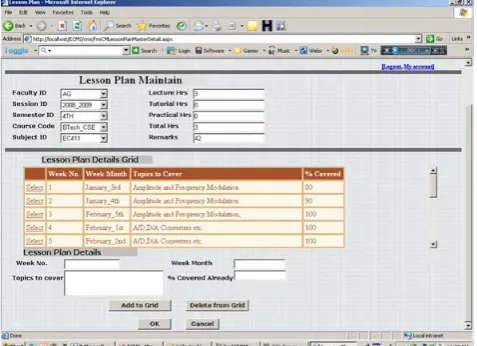
Figure 2: Education ERP – Class Management Module – Lesson Plan
Figure 3: Education ERP – Lab Management Module – Student Group Association
Figure 5: Education ERP – Stores and Purchase Management Module – Maintain Non-consumable Item
Figure 6: Education ERP – Stores and Purchase Management Module – Update Non-consumable Item
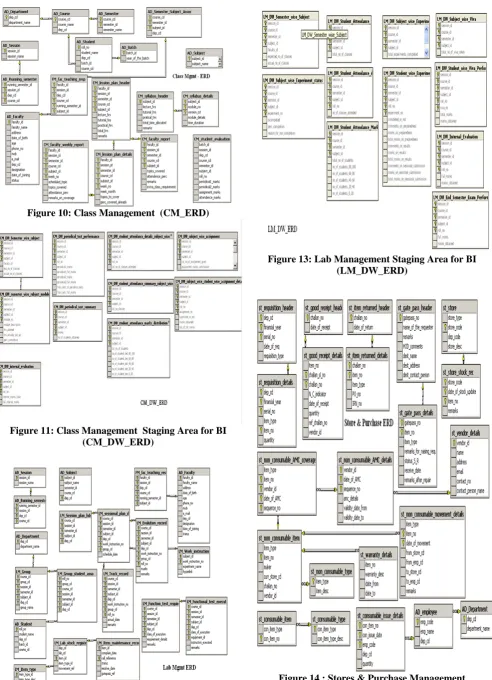
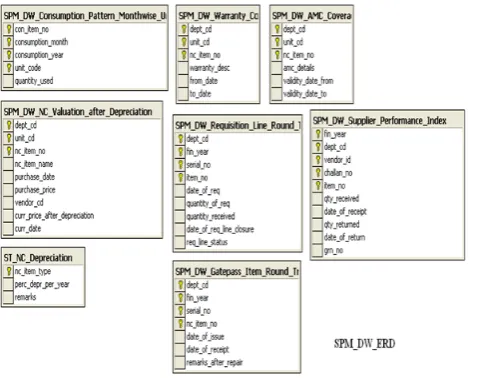
The second system is developed as a web based system for evaluation of metrics out of the OLTP database for each individual KPA. The Entity Relationship diagram for the Staging Area , the extraction logic and final metric display layouts all have been designed for each individual KPA. Data is extracted from the OLTP database mostly by stored procedures and stored in the Staging Area designed for evaluation of metrics for each KPA before displaying into appropriate forms designed appropriately for metrics. Three Entity Relationship diagrams viz. CM_ERD, LM_ERD and SPM_ERD for these above mentioned KPAs are furnished in Figure 10, 12 and 14 respectively.
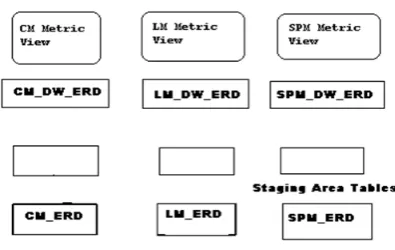
Figure 7 provides the actual summary visualization of the implemented system for these three KPAs.
Figure 7: Metric Generation from OLTP System
The sample web pages for Business Intelligence module are also furnished here in Figures
Figure 8: ECMS Business Intelligence Module UI
Figure 9: ECMS BI Module Sample Form – Lesson Plan Coverage
Figure 10: Class Management (CM_ERD)
Figure 11: Class Management Staging Area for BI (CM_DW_ERD)
Figure 15: Stores & Purchase Management Staging Area for BI (SPM_DW_ERD)
3. CONCLUSION
This paper is targeted to bring the essence of the best of quality system of IT industry to the higher education arena to guarantee success by design. The KPAs and Metrics of new CMM for Higher Education are identified and designed to fulfill the practical needs felt during administering the higher education institution. The measurement aspects for indicating both Process and Product maturity needs to be monitored to keep control on the Higher Education container. This will help to objectively ascertain relative grading of all the institutes of higher education and also their internal efficiency.
The Education ERP system along with the Business Intelligence module is envisaged to provide a seam-less web-based OLTP (On-Line Transaction Processing) system for meeting the functional transactional requirements and also for addressing the statistical and business intelligence requirements.
REFERENCES
1. Stressing CMM in the Higher Education Arena - Pinak pani
Chakrabarty - International Conference on IT - Haldia Institute of Technology, March 2007, Haldia, West Bengal, March 2007
2. Capability Maturity Model for Higher Education Arena - Pinak pani
Chakrabarty - 9th International Conference on Management of
Transformation - National Academy of Agricultural Sciences, New Delhi, 2-5 January, 2008
3. Key Practices of the Capability Maturity Model, Version 1.1 :
M.C.Paulik, C V Weber, S M Garcia, M B Chrissis, M Bush
4. People Capability Maturity Model (P-CMM), Version 1.0 – Bill
Curtis, William E. Hefley, Sally Miller
5. Basics in Software Measurement and Analysis – Some Do’s and
Don’ts – Steve Kan – IBM – SEPG Conference
6. Definition and Analysis of Organizational Performance: Practical
use of Statistical Models – Bijan Kumar Samanta – SEPG Conference
7. Designing an Effective Survey – Mark Kasunic – Software
Engineering Institute
8. Making Measurement Work for You – Joseph Seppy – SEPG
Conference
9. Measurement and Analysis in CMMI – Dennis Goldenson, Joe
Jarzombek, Terry Rout – SEPG Conference
10. Measurement within the CMMI – Kent Johnson and Margaret Kulpa
– SEPG Conference
11. Organizational Performance Management – Will Hayes and Dave
Zubrow – Software Engineering Institute
12. Getting started with Measurement and Analysis – Joyce Statz and
Beth Layman – SEPG Conference
13. Key Practices of the Capability Maturity Model , Version 1.1 : M C
Paulik , C V Weber, S M Garcia , M B Chrissis, M Bush.
14. People Capability Maturity Model (P-CMM) Version 1.0 - Bill
Curtis, William E. Hefley, Sally Miller.
AUTHOR