Simple construction of
-biased distribution
Long Hoang Nguyen and Andrew William Roscoe
Oxford University Department of Computer Science Parks Road, Oxford, OX1 3QD
Email: {Long.Nguyen,Bill.Roscoe}@cs.ox.ac.uk
Abstract
-biased distribution has many applications in practice, including universal hashing computation. In this paper we will improve an existing-biased distribution construction due to Alon et al. [2] that requires to uniformly and efficiently sample irreducible polyno-mials of a large degree, e.g. between 80 and 160. To remove the need for such a sampling which can be computationally expensive, we will replace the irreducible polynomials by random monic polynomials of higher degree, i.e. every degreermonic polynomial whether irreducible or reducible is selected with the same probability 2−r. To analyse the security
of the scheme, we need to find the maximum number of degreerpolynomials that divide a degreenpolynomial where n > r. We end this paper by pointing out another use of our result in the fundamental problems of identity polynomial and primality testing in number theory
1
Introduction
A linear feedback shift register or LFSR is rarely used on its own in cryptographic appli-cations because of its linearity property or low linear complexity that can be exploited by the attacker. Consequently there are two approaches to get around this problem to date. The first strategy is to increase the linear complexity of a LFSR-based pseudorandom num-ber generator by introducing non-linear operators such as AND into the computation of the PRNG or combining the outputs of multiple LFSRs by a non-linear function. This method is often combined with extending the length of LFSRs from 80 to say 19937 bits as in the Mersenne Twister. Although such a PRNG can still be implemented very fast, it does not completely eliminate the linearity property, and hence still cannot be used for cryptographic applications.
the same time then they will need to agree in advance on the same algorithm that can return a unique and random irreducible monic polynomial of degree r on fly. Such a mechanism might not be always available in practice.
What we propose to investigate in this paper is that instead of randomly selecting only irreducible polynomials, we want every polynomial of degree r (i.e. both irreducible and reducible) is randomly picked with the same probability 1/2r. This will solve the problem of mapping each random number or seed to a unique feedback rule of a LFSR efficiently. But intuitively to achieve the same level of security, e.g. a bias of 2−80 as required in many cryptographic applications such as the Toeplitz-based universal hash function of Krawczyk [6] discussed in Section 4, we would need to choose a random polynomial of a significant higher degree compared to one that is based on only irreducible polynomials.
It turns out that the security of our scheme is closely related to the solution of the following problem: given integers r and n where n > r, what is the maximum number of degree r polynomials that can divide a degree n polynomial? Although this problem might look like it has been studied and solved by number theorists a long time ago, to the best of our knowledge there has not been any satisfactory solution for this problem in the literature. What we have discovered is that this problem has applications in not only biased distribution constructions but also the fundamental problems of identity polynomial and primality testing as recently demonstrated by Agrawal and Biswas [1]. These authors however provide a very weak analysis for this problem as discussed in their paper and in Section 5 of this paper. In section 3 we will use some number theory facts in combination with computer programming to give an estimated but highly accurate solution for this problem as demonstrated by our experimental results.
2
Notations
Definition 1. [2, 6] LetS be a distribution of sequences of lengthl. Let (α, s)2 denote the
inner product modulo 2 ofα∈(F2)l and s∈(F2)l.
• S is said to pass the linear testα∈(F2)l with biaseif|Pr{s∈S}[(α, s)2 = 1]−1/2| ≤e.
• S is said to be ane-biased distribution if it passes all linear testsα6= 0 with bias e.
3
Randomised LFSR
We consider only polynomials over GF(2). Any (M−1)-bit messagemcan be represented by a polynomialm(x) of degree deg(m(x)) =M−1, where function deg(X) returns the degree of polynomialX.
m(x) =m0+m1x+· · ·+mM−1xM−1
If we want to construct a distribution of sequences of lengthM−1 from a source of 2r truly random bits then our algorithm is as follows:
• The first r bits determine the coefficients of a degree r monic polynomialf(x) that is the feedback rule of the resulting LFSR.
Using existing results proved in [2] (Proposition 1), the value of the biaseof this distribution is calculated as the ratio between the maximum number of monic polynomials of degreerthat divide a polynomial of degreeM−1 and the total number of degree r monic polynomials.1
e= MAXm∈{0,1}M−1]{f(x)|deg(f(x)) =r and f(x)|m(x)} 2r
We know that the number of irreducible monic polynomials of degreeiis
1
i
X
d|i
µ i d 2d
This expression is well approximated by 2i/i, and hence we will treat the number of irreducible monic polynomials of degreeias if it is exactly b2i/ic.
Calculating the biaseis very simple when the feedback rulef(x) is an irreducible polyno-mial because any degreeM−1 polynomial will have at mostb(M−1)/rcdistinct irreducible factors of degreer. This is however not the case when any f(x) is randomly selected as in our scheme.
Without loss of generality, we can assume that
M−1 = 1b21/1c+ 2b22/2c+ 3b23/3c+· · ·+tb2t/tc (1)
≤ 21+ 22+ 23+· · ·+ 2t= 2t+1−1
The product of all distinct irreducible polynomials of degreei≤t is therefore a polynomial of degreeM −1, and we refer to such a polynomial as m1(x). We also define Pt the set of
all distinct irreducible polynomials of degreei≤t, and hence
m1(x) =
Y
g(x)∈Pt
g(x)
Suppose that
m(x) =g(x)h(x)
whereg(x) is an irreducible monic polynomial of degree greater thantthen thanks to Equal-ity 1 it is always possible to construct another polynomialg0(x) where deg(g(x)) = deg(g0(x)) and g0(x) = g1(x)g2(x)· · ·gl(x) is a product of some l distinct irreducible polynomials from
Pt and none of which dividesh(x). In other words,m0(x) =g0(x)h(x) will have more factors
as monic polynomials of degreer thanm(x). What this argument shows is that a polynomial
m(x) of degreeM−1 will have more distinct factors as monic polynomials of degreer when
m(x) is the product of only irreducible monic polynomials of degree less than or equal to
t. Consequently, m1(x) as defined above potentially gives us a tight lower bound for the worst-case representation of a message ofM −1 bits.
We next will locate the upper bound for the worst-case representation of a message of
M −1 bits. We observe that for any irreducible monic polynomial g(x) of degree i ≤ t,
1
it is no better that g(x) occurs more than br/ic times in the prime decomposition of a polynomial of degreeM−1. As a consequence, we will refer tom2(x) as the product of every
irreducible polynomial g(x) ∈ Pt and each g(x) appears exactly br/deg(g(x))c times in the
prime decomposition ofm2(x).
m2(x) =
Y
g(x)∈Pt
g(x)br/deg(g(x))c
We therefore arrive at
deg(m2(x)) = X
i≤t
br/icib2i/ic
> br/tcdeg(m1(x)) =M −1
Since the degree ofm2(x) is greater thanM−1, we have gone over the top to define an upper bound for the worst-case representation of a message ofM−1 bits. In the next subsection, we will demonstrate that our lower and upper bounds corresponding to m1(x) and m2(x) significantly narrow down the range where the worst-case scenario lies.
3.1 Experiments
Since there are many ways a degreer polynomial f(x) can be constructed as a product of some of the irreducible factors from Pt, we have not been able to find a formula that can
give us the exact number of degree r polynomials that divide either m1(x) or m2(x), but
fortunately these numbers can be computed exhaustively by computers and these task can be done very quickly. In the following, we give the pseudo-code of the algorithms which can compute the numbers.
M1(r, t) returns the number of monic polynomials of degreer that divide m1(x) M1(r, t)
1. if(r = 0) then return 1
2. else if(t= 0 andr = 1) then return 2 3. else if(t= 0 andr = 2) then return 1 4. else if(t= 0 andr >2) then return 0 5. else if(t >0) then
6. L=b2t/tc
7. l=min(r/t, L) 8. sum= 0 9. for i= 0 to l
10. sum=sum+ Li
M2(r, t) returns the number of monic polynomials of degreer that divide m2(x)
M2(r, t)
1. if(r = 0 ort= 0) then return 1 2. else
3. L=b2t/tc
4. l=r/t
5. sum= 0 6. for i= 0 to l
7. if(t6= 1 or r=i∗t) thensum=sum+ M2’(L, i)∗M2(r−i∗t, t−1) 8. returnsum
M2’(L, i)
1. if(i= 0) then return 1 2. else
3. z=min(L, i) 4. sum= 0 5. for j= 0 to z
6. sum=sum+ Lj
∗M2’(j, i−j) 7. returnsum
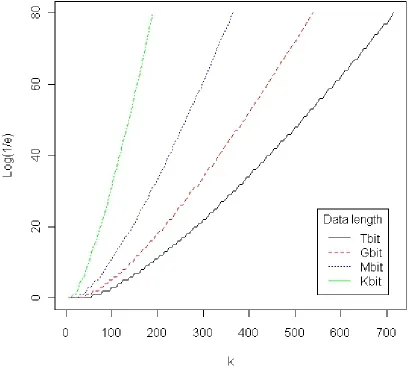
In the first experiment, we fix M = 2t+1−1 or the length of input message and let the LFSR bitlengthr vary from 0 to 700. This experiment is repeated four times with different values fort: 10, 20, 30 and 40. We plot log(1/e) againstr in the graph of Figure 1.
In the second experiment, we fix the biase and let the message length vary from 210 to 260 bits. This experiment is repeated twice with different values for e: 2−80 and 2−40. We plot the LFSR bitlengthr against tin the graph of Figure 2.
4
Toeplitz matrix based construction
The following universal hashing construction is invented independently by Krawczyk [6] and Mansour et al. [8]. Since this construction uses a Toeplitz matrix multiplication, we give the definition for a Toeplitz matrix below.
Definition 2. A Toeplitz matrixAis a (not necessary square) matrix where each left-to-right diagonal is fixed, i.e. for all pairs of indexes (i, j): Ai,j =Ai+1,j+1.
If we want to compute ab-bit universal hash of aM-bit messagem, then (M+b−1)-bit keyk
is drawn randomly from a distributionR={0,1}M+b−1. We can generate a Toeplitz matrix A(k) of M rows and b columns from key k, i.e. we assume a linear map from (F2)M+b−1 to
the set of Toeplitz matrices in (F2)M×b, and then
h(k, m) = m×A(k) (2)
The symbol ‘×’ in Equation 2 represents a product of vectorm and matrixA(k) over F2.
If keykis drawn randomly and uniformly fromR, then the collision probability isc= 2−b.
number generator or one with a low linearity complexity must not be used because this construction is linear in the key, i.e. h(k1 +k2, m) = h(k1, m) +h(k2, m). To justify this
argument, in Annex A, we describe an attack on this construction if key expansion is done by a linear feedback shift register (or LFSR) whose feedback rule is fixed and known to an attacker.
We note that Krawczyk [6] suggested that k could be drawn from a biased distribution on sequences of length K = M +b−1. Such a biased distribution can be generated by the scheme of Alon et al. [2]2 that requires to uniformly and efficiently sample irreducible monic polynomial of degree k. As we have explained earlier that this sampling can be very inefficient, and thus we propose to replace the irreducible polynomials by random monic polynomial as explained earlier.
Theorem 1. LetR be an-biased distribution on sequences of lengthK, then the Toeplitz matrix based scheme (2−b+)-almost universal.
Proof of this theorem can be found the paper of Krawczyk [6] (Theorem 13 and Theorem 5).
5
Identity polynomial testing
A restricted but common form of the identity polynomial testing problem is: given a degree
nunivariate binary polynomial m(x), check ifm(x) is identically zero. This task is trivial if
m(x) is explicitly given as a sum of monomials, however in many cases m(x) is given in an implicit form, including a product of many polynomials or an arithmetic circuit.
In the following we introduce a new and very simple algorithm that can solve this problem efficiently. Given a binary polynomialm(x) of degreen, or if we are given an arithmetic circuit of sizesthen the corresponding polynomial degree nis bounded by 2s, we randomly choose a monic polynomialf(x) of degree r. We accept if m(x) is divisible byf(x).
Ifm(x) is zero then the algorithm always accepts. Ifm(x) is non-zero then the probability of false acceptance is at most the ratio between the maximum number of degreerpolynomials that can divide a degree n polynomial and 2r, which is the problem we solve in Section 3. Obviously this algorithm requiresrrandom bits and the degree of the factor polynomialf(x) is also r. We observe that the bigger r is the less likely we have a false acceptance when
m(x) is non-zero. The probability of false acceptance can be estimated by our approximated solution given in Figure 1 of Section 3.
Previously Agrawal and Biswas [1] introduced a very similar algorithm but theirs suffers from two major weaknesses: (1) the degree r of the randomly selected factor or polynomial is restricted to lognwhich leads to a very big probability of false-acceptance, in contrast the degree r is unrestricted in ours; and (2) in the analysis of Agrawal and Biswas, they do not consider the random polynomialf(x) with multiple irreducible factors of degree less than r
or with irreducible factors of degree less thanr/2 + 1 as in ours, and thus their analysis will not give good estimated solution even when they let the degree of f(x) be comparable to ours.
Being aware of these weaknesses, Agrawal and Biswas introduced a more complicated algorithm which randomly selects the factor polynomialf(x) from a set of nearly co-prime polynomials. While this algorithm only needs logn random bits, the degree of the factor
2
polynomial f(x) is at least log3n and thus is much more expensive to check for divisibility than ours.
In this section we focus on testing whether a univariate polynomial overZ2 is zero, but of course we are also interested in the case where the input polynomial is not only multivariate but also its coefficients are over Zp where p is prime. Using the strategy introduced by
Agrawal and Biswas any multivariate polynomial can be deterministically transformed to a univariate higher degree polynomial such that the resulting polynomial is zero iff the original one is zero. Secondly our analysis for binary polynomial of Section 3 can be easily adjusted to deal with polynomial overZp. From the distribution for irreducible polynomials [7], the
number of irreducible polynomials of degreer overZq is
1
r
X
d|r
µr d
qd
which is bounded above by prr −pr/2. Using this information, our algorithm and program presented in Section 3 can easily estimate the probability of false acceptance.
References
[1] M. Agrawal and S. Biswas. Primality and Identity Testing via Chinese Remaindering. FOCS’99.
[2] N. Alon, O. Goldreich, J. Hastad and R. Peralta.Simple Constructions of Almost k-wise Independent Random Variables.In Proceedings of the IEEE Symposium on Foundations of Computer Science, 1990, vol. 2, pp. 544-553.
[3] J.L. Carter and M.N. Wegman. Universal Classes of Hash Functions. Journal of Com-puter and System Sciences, 18 (1979), 143-154.
[4] S.W. Golomb. Shift Register Sequences. ISBN: 0894120484, Aegean Park Press, 1981.
[5] H. Krawczyk. LFSR-based Hashing and Authentication. Advances in Cryptology, CRYPTO 1994, LNCS vol. 839, 129-139.
[6] H. Krawczyk.New Hash Functions For Message Authentication.Advances in Cryptology - Eurocrypt 1995, LNCS vol. 921, pp. 301-310.
[7] Lidl and H. Niederrieter.Introduction to finite fields and their applications. Cambridge University Press, 1986.
[8] Y. Mansour, N. Nisan and P. Tiwari.The Computational Complexity of Universal Hash-ing. Proceedings of the 22nd Annual ACM Symposium on Theory of Computing, pp. 235-243, 1990.
[9] M. Matsumoto and T. Nishimura. Fast Mersenne Twister Homepage where the pub-licly available source code for this pseudorandom number generator can be found:
http://www.math.sci.hiroshima-u.ac.jp/ m-mat/MT/SFMT/
A
An attack on LFSR-based
h
(
k, m
)
of subsection 4
Let (m, m0)2 denote the inner product modulo 2 ofm and m0 ∈(F2)M.
Suppose thath(k, m) of subsection 4 uses ar-bit LFSR to generate a (K=M+b−1)-bit keyk0 =k0· · ·kK−1 out of the r-bit keyk=k0k1· · ·kr−1. In this attack, we need to assume
that the feedback rule of the LFSR is fixed and known to the intruder, such a feedback rule can be represented by an irreducible monic polynomial.
f(x) = f0+f1x+f2x2+f3x3+· · ·+fr−1xr−1+xr (3)
For anyn∈[r, K−1] we then have
kn = f0kn−r+f1kn−r+1+· · ·+fr−1kn−1 =
r−1
X
i=0
fikn−r+i (4)
Since we need to generate a M ×b Toeplitz matrix A(k) from key k, we use the following linear map from (F2)M+b−1 to the set of Toeplitz matrices in (F2)M×b: Ai,j(k) = k0i+j. In
other words, each column (out of b columns) of A(k) is a continuous sequence of M bits taken fromk0, and each columni+ 1 is shifted (upward) relative to the columni, with a new element set to the last position of the columni+ 1. This is a matrix where eachright-to-left diagonal is fixed as opposed to the fixedleft-to-right diagonal property of a Toeplitz matrix as defined in Definition 2, but it is essentially the same as a Toeplitz matrix.
The input messagem can also be represented by a polynomialm(x) of degree M−1.
m(x) =m0+m1x+· · ·+mM−1xM−1
What we want to prove is the following Lemma and Theorem.
Lemma 1. For any n ≥ r, the reduction of xn modulo f(x) is a linear combination of {x0, x1, . . . , xr−1}, and that this linear combination is identical to the coefficients in the
expression ofkn as a linear combination of{k0, . . . , kr−1}.
Proof. Since we always have Equation 4 above, we additionally need to prove that for any
n≥r we also have:
xn = f0xn−r+f1xn−r+1+· · ·+fr−1xn−1 (modf(x))
This can be proved by induction. This is clearly true whenn=r. We now assume that this is true forn=isuch that i≥r: xi =f0xi−r+f1xi−r+1+· · ·+fr−1xi−1 (modf(x)), then multiplying both sides by ximplies that this is also true for n=i+ 1.
Although this only shows that kn is a linear combination of {kn−r, . . . , kn−1} which is
identical to the coefficients in the expression ofxnas a linear combination of{xn−r, . . . , xn−1},
if we repeatedly apply the same result to every element in these linear combinations untilkn
and tn are only repsensented by {k
0, . . . , kr−1} and {x0, x1, . . . , xr−1}, respectively, we will
get the proof.
Theorem 2. Iff(x) devidesm(x) then the inner product modulo 2 ofmand the first M
Proof. We first have
(k0· · ·kM−1, m0· · ·mM−1)2 =
M−1
X
i=0
kimi=
X
mi=1, i∈[0,M−1]
ki
For any i≥r ki is a linear combination of {k0, . . . , kr−1}, and thus Σmi=1ki is also a linear
combination of{k0, . . . , kr−1}. Using Lemma 1, the latter linear combination will be identical
to the coefficients in the expression of Σmi=1x
i as a linear combination of {x0, . . . , xr−1}
modulof(x). Now suppose that:
(k0· · ·kM−1, m0· · ·mM−1)2=
X
mi=1, i∈[0,M−1]
ki =a0k0+a1k1+· · ·+ar−1kr−1
Using Lemma 1 and the above observation, we will have
a0x0+a1x1+· · ·+ar−1xr−1 =
X
mi=1, i∈[0,M−1]
xi (modf(x))
=
X
mi=1, i∈[0,M−1]
xi
(modf(x))
= m(x) (mod f(x))
As a result, whenf(x)|m(x) all of the coefficients in the expression of (k0· · ·kM−1, m0· · ·mM−1)2
as a linear combination of{k0, . . . , kr−1}will be zero regardless of the value of the initial seed k=k0· · ·kr−1.