Indhumathi D*, Krishnaraj
Dept of Pharmaceutics, S.R.M University, S.R.M College of Pharmacy, Kattankulathur, Kanchipuram Dist, Chennai, Tamil Nadu, India.
*Corresponding author’s E-mail:[email protected]
Accepted on: 24-04-2015; Finalized on: 31-05-2015. ABSTRACT
This research aims to identify the influence of the OTC Drugs advertising on the Physicians acceptance level with reference to Sales Representatives, characteristics of Advertisement media, Advertisement Message and Advertisement Component. The population of the research consists of all physicians working in SRM Multi speciality Hospital at Chennai. The researchers used a questionnaire to collect the primary data for the sample of the research in order to achieve the researcher’s objectives. The results of the research showed that the level of physicians’ acceptance is mostly influenced by the characteristics of sales representatives. The Advertisement media, Advertisement Message and Advertisement Component have no influence on the level of physicians’ acceptance. In order for pharmaceutical companies to compete in the global market they must change their strategies in advertising by choosing the most appropriate way of advertising. Furthermore, pharmaceuticals companies that take care of their physicians and treat them as assets will have strong positive image and high credibility in the market. Finally pharmaceutical advertisement through sales representatives in an innovative way can help companies to differentiate themselves in the market.
Keywords: Over the counter drugs (OTC), Advertisement, Physicians, Level of acceptance, Hospital.
INTRODUCTION
harmaceutical advertising plays a major role in the marketing of pharmaceutical products, leading to crucial modifications to methods employed by pharmaceutical companies in product marketing. The most common method of pharmaceutical marketing in India, a developing country, is through medical representatives visiting physicians at their offices, providing free samples for distribution to patients, and advertising in professional journals. This has been slowly changing since 1997, when the United States Food and Drug Administration (FDA) modified its policy on pharmaceutical marketing. This change increased the feasibility of advertising drugs through broadcast media, and is therefore believed to have provided the impetus for a move from doctor-directed to consumer-directed advertising not only in the US, but also elsewhere (FDA 1997).
The direct result of such advertising is that patients themselves begin to request certain advertised medicine, and this results in a greater number of prescriptions written by doctors1.
Customer Relationship Management (CRM) is a comprehensive strategy and process of acquiring, retaining, and partnering with selective customers to create superior value for the company and the customer2,3.
In order for pharmaceutical companies to compete in the market they must change their strategies in advertising by choosing the most appropriate advertising characteristics4. Therefore, the current research will investigate the effect of pharmaceutical advertisement
characteristics on the degree of drug acceptance for physicians, and the effect of these characteristics on their prescriptions in SRM Hospital5.
Over The Counter (OTC) drugs are non-prescription drugs that are not normally covered by a Medicare Prescription Drug Plan.
The use of over the counter drugs allows the patient to have greater access to a variety of drugs available in the market to treat some medical conditions.
In addition, it allows the patient to save money, because they usually cost less than other drugs.
Over the counter drugs are drugs approved by the United States Food and Drug Administration (FDA) and have proven to be safe and effective6.
The most important factor is limited effect of sales representatives is that physicians know they have other sources of information.
In India, pharmacists and pharmacy attendants play an important role in fostering self-medication among the public7.
Research Problem
The marketing activities of international drug companies through pharmaceutical advertising in different media might affect the choices or preferences that Indian physicians have toward specific brands of drugs. In order to maintain a high market share, pharmaceutical drug companies should know how their pharmaceutical advertisement characteristics and marketing promotion tools will affect the degree of drug acceptance of physicians.
The Inference of the Characteristics of Phamaceutical Drug Advertising Upon
the Level of Physician's Acceptance
P
The problem of this research stems from the following questions:
1) To what extent does pharmaceutical drug advertising influence the level of physicians’ acceptance of drugs?
2) What are the most important advertising characteristics that highly affect the level of physicians’ acceptance?
Research Importance
The importance of this research stems mainly from the following two points:
1) This research will be an important development to current understanding by clarifying the relationship between drug advertisement characteristics and the degree of physicians’ acceptance of these drugs.
2) This research suggests several practical recommendations that might help pharmaceutical companies to gain an understanding to know how to promote their drugs in the Indian context.
Research Objective
The key objective is to identify the influence of the characteristics of pharmaceutical drug advertising on the degree of physicians’ acceptance in SRM Hospital at Chennai, and to identify the most important aspects of pharmaceutical advertising characteristics that affect the physicians’ acceptance of the drug.
Method of Investigation
Research Theoretical Framework
From this literature review and the research objectives, the following theoretical research model can be developed.
Figure 1
Operational Definitions
The current research is going to use different scales to measure the main variables (Independent variables and dependent variables), scales to measure the research. Constructs were drawn from the available literature.
Definition of the Independent Variable
Sales Representatives
A well qualified medical representatives who visited Doctors frequently and provide information about their medicines along with free Samples.
Advertisement Media
Categorizes the delivery systems into general groups such as Print media, broadcast media, outdoor advertising, direct mail, and other support media.
Print Media
Comprising newspapers and magazines that are printed for mass readership.
Broadcast Media
Utilizes radio waves to transmit signals; most notably, radio and television.
Network Media
The internet provides a unique platform for interactions. Products can be purchased on demand, and very conveniently.
Language
Language in marketing and advertising is particular powerful in exerting an influence.
Advertising Appeal
Is the basis or approach used in an advertising message to attract the attention or interest of consumers and/or influence their feelings toward the product or service.
Simplicity
Advertisements must be attention-grabbing, but must also clearly convey the essential information.
Credibility
As discussed above, credibility is crucial to an advertisement’s success.
Frequency
It has been suggested that advertisements lose their efficacy after between three and ten repetitions.
Duration
Is defined as the length of exposure to the advertisement, and affects a viewer’s ability to remember the content1.
Definition of the Dependent Variable
Level of Acceptance
Is the extent to which the physicians accept and prescribe the advertised drug based on the advertisement.
Advertisement may be rejected if they appear to be false, misleading, and illegal.
Hypotheses
H0.1
This hypothesis can be divided into the following sub hypotheses:
H0.1.1
There is statistically significant effect of advertising through print media in SRM Hospital on the degree of physicians’ acceptance of the drug.
H0.1.2
There is no statistically significant effect of advertisement through broadcast media in SRM Hospital on the degree of physicians’ acceptance of the drug.
H0.1.3
There is no statistically significant effect of advertisement through network media in SRM Hospital on the degree of physicians’ acceptance of the drug.
H0.1.4
There is no statistically significant effect of advertisement language in SRM Hospital on the degree of physicians’ acceptance of the drug.
Research Methodology
Research Population
The population in this research is all physicians working in the private sector in SRM Hospital at Chennai. According to the Indian Medical Association (IMA, 2010), the following represents the physician’s specialties:
General Practitioner, Pediatrics, Ophthalmologist, Orthopedic, E.N.T. Surgeon, Cardiology, Psychiatry, Dermatologist and Physiotherapy.
Research Sample
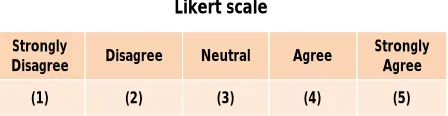
The researchers disseminated 100 questionnaires within that 5 speciality upon key respondents (unit of analysis) who are physicians. It will be represented by using the 5-points likert scale questionnaire.
Likert scale
Strongly
Disagree Disagree Neutral Agree
Strongly Agree
(1) (2) (3) (4) (5)
Data Collection Instrument
Questionnaire is the data collection instrument which the researcher has to use to collect responses from the research sample. The questionnaire was originally designed and should be distributed in English.
Components of Questionnaire
The questionnaire starts with a letter to identify the purpose of the research which might lead to increase response rate and answers reliability, in addition to asking respondents kindly to be cooperative in fulfilling the questionnaire subjectively, then appreciating respondents’ efforts.
After that, the questionnaire consists of two main parts:
a. First part represents the demographic variables of the physicians which are: gender, age and educational level.
b. Second part consists of 44 questions to cover all main variables of this research.
Data Analysis Techniques
Before starting data analysis, the researcher has to code the collected data, so that computer could understand that form. The data has been analyzed using SPSS V.17 program.
RESULTS AND DISCUSSION
Data Analysis
This chapter consists of four sections.
The first two sections present the descriptive analysis of the demographic data and the research’s variables.
The third section presents the hypotheses testing and the results discussion.
The final section demonstrates multicollinearity analysis. Before starting the analysis, it is important to know that a total number of 100 questionnaires were distributed by hand. 85 questionnaires were returned, and checked to detect if there were any missed data.
The final number of acceptable questionnaires was 75 with a response rate of 75%. Data collection took 40 days.
Table 1: Descriptive Analysis of Demographic Data
The frequency distribution of Demographic Characteristics
Demographic Variables
Frequency [N]
Percent [%]
Exposed To Drug
Yes 19 25.3
No 56 74.7
Gender Male 51 68.0
Female 24 32.0
Age
Age 25 - 35 Yrs 34 45.3
Age 36 - 45 Yrs 33 44.0
Age 46 - 55 yrs 7 9.4
Age > 55 Yrs 1 1.3
Education Level
General
practitioner 44 58.7
Specialist 29 38.7
Subspecialist 1 1.3
Consultant 1 1.3
Descriptive Analysis of Research’s Variables
In this section descriptive statistics were computed for all research variables.
Descriptive Analysis of Sales Representatives
This low score on print media scale means that the level of physicians’ acceptance is not highly affected by print media.
Descriptive Analysis of Advertisement Media
The mean score of the advertisement media dimension was (2.528) with a standard deviation of (0.766). This low score on advertisement media scale means that the level of physician’s acceptance is not highly affected by advertisement media.
Descriptive Analysis of Advertisement Component
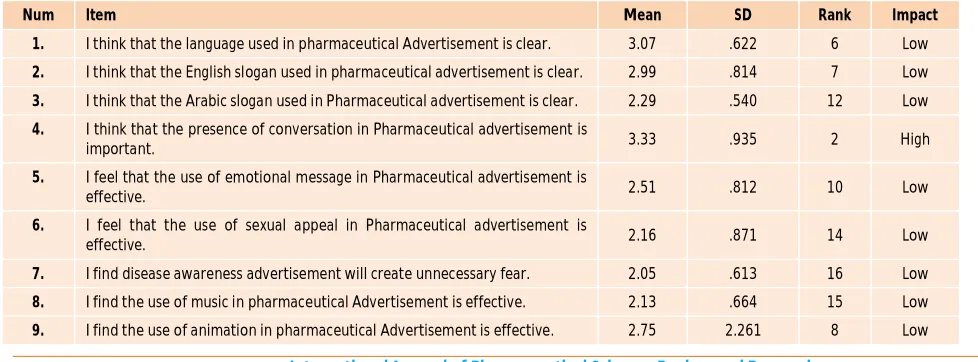
Table 2 shows that the mean score of the advertisement component dimension was (2.721) with a standard deviation of (0.878). This high score on advertisement component scale means that the level of physician’s acceptance is highly affected by advertisement component.
Descriptive Analysis of Advertisement Message Items
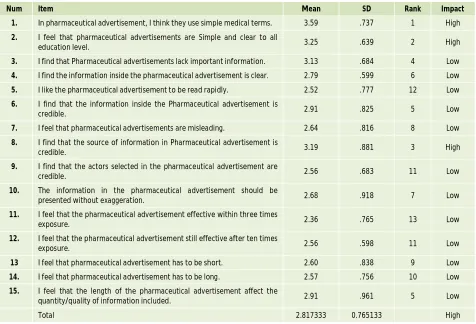
Table 3 shows that the mean score of the advertisement message dimension was (2.817) with a standard deviation of (0.7651). This high score on advertisement message scale means that the level of physicians’ acceptance is highly affected by advertisement message.
Descriptive Analysis of Level of acceptance
The mean score of the level of acceptance dimension was (2.473) with a standard deviation of (0.9425). This low score on level of acceptance scale shows that the physician’s level of drug acceptance is affected by pharmaceutical drug advertisement.
The correlation coefficient R is a statistical technique which shows whether and how strongly pairs of variables are related to each other, here the correlation coefficient is R=0.143, which means that there is no strong correlation between the characteristics of OTC drugs advertising in Chennai and the degree of acceptance of these drugs. Here in this research, R square=0.020 which means that 2.0% of the variability of the level of acceptance has been explained by the characteristics of
OTC drug advertising dimensions, it indicates to the goodness of fit of the research model.
It is clear that F-value for the collected primary data was
1.936 which is significant at the level of α <0.05 (sig.
=.000). Consequently, the researchers rejected the main null hypothesis and accepted the main alternative hypothesis which means that there is a statistically significant effect of the characteristics of pharmaceutical drug advertising in Chennai on the degree of acceptance of these drugs.
Advertisement media had the highest beta value of 0.021. While advertisement message, advertisement component and sales representatives represented the lowest beta values which were -0.012, -1.220, and -0.122 respectively. So, that advertisement media has the highest contributions in the research model. The second part of Table (7) demonstrated t and P values, which estimate
the impact of each variable. Large (t) values and small (α)
values suggest a greater effect of the predictor variable on the criterion variable.
Dependent Variable: Level of Acceptance
Multicollinearity is a statistical phenomenon in multiple regression analysis. Tolerance and Variance Inflation Factor (VIF) are the most widely used measures to assess multicollinearity. The multicollinearity test for the five pharmaceutical drug advertisement characteristics were accomplished and all (VIF) values were less than (10), and tolerance values were more than (0.10) as shown in Table 8. So that, there is no Collinearity within collected data, and then there was no bias.
The Sub-Hypotheses
Table 9 summarizes the results of sub-null hypotheses. Based upon the decision rule is to reject the sub-null hypotheses if the significant level is equal to or less than 0.05, and then to accept the sub-alternative hypotheses. The accepted sub-hypotheses is advertising through sales representatives, while the rejected sub-hypotheses mainly related advertising through advertisement message, advertisement component, advertisement media and the level of acceptance.
Table 2: Means, SD, Rank and impact for respondent’s answers on Advertisement Component items.
Num Item Mean SD Rank Impact
1. I think that the language used in pharmaceutical Advertisement is clear. 3.07 .622 6 Low
2. I think that the English slogan used in pharmaceutical advertisement is clear. 2.99 .814 7 Low
3. I think that the Arabic slogan used in Pharmaceutical advertisement is clear. 2.29 .540 12 Low
4. I think that the presence of conversation in Pharmaceutical advertisement is
important. 3.33 .935 2 High
5. I feel that the use of emotional message in Pharmaceutical advertisement is
effective. 2.51 .812 10 Low
6. I feel that the use of sexual appeal in Pharmaceutical advertisement is
effective. 2.16 .871 14 Low
7. I find disease awareness advertisement will create unnecessary fear. 2.05 .613 16 Low
8. I find the use of music in pharmaceutical Advertisement is effective. 2.13 .664 15 Low
10. I find the use of comedies in pharmaceutical Advertisement is effective. 2.17 .742 13 Low
11. I feel that colorful pharmaceutical advertisements Attract my attention. 2.37 .767 11 Low
12. I find that Pharmaceutical advertisements are Interesting when a picture
appears in it. 2.57 1.029 9 Low
13 I like the presence of detailed information about Side effect in the
pharmaceutical advertisement. 3.24 1.113 4 High
14. I like the presence of detailed information about the Disease in the
pharmaceutical advertisement. 3.39 .868 1 High
15. I like the presence of detailed information about the Efficacy in the
pharmaceutical advertisement. 3.23 .709 5 High
16. I like the presence of detailed information about the Drug use in the
pharmaceutical advertisement. 3.29 .693 3 High
Total 2.72125 0.878313 High
Table 3: Means, SD, Rank and impact for respondent’s answers on Advertisement message items.
Num Item Mean SD Rank Impact
1. In pharmaceutical advertisement, I think they use simple medical terms. 3.59 .737 1 High
2. I feel that pharmaceutical advertisements are Simple and clear to all
education level. 3.25 .639 2 High
3. I find that Pharmaceutical advertisements lack important information. 3.13 .684 4 Low
4. I find the information inside the pharmaceutical advertisement is clear. 2.79 .599 6 Low
5. I like the pharmaceutical advertisement to be read rapidly. 2.52 .777 12 Low
6. I find that the information inside the Pharmaceutical advertisement is
credible. 2.91 .825 5 Low
7. I feel that pharmaceutical advertisements are misleading. 2.64 .816 8 Low
8. I find that the source of information in Pharmaceutical advertisement is
credible. 3.19 .881 3 High
9. I find that the actors selected in the pharmaceutical advertisement are
credible. 2.56 .683 11 Low
10. The information in the pharmaceutical advertisement should be
presented without exaggeration. 2.68 .918 7 Low
11. I feel that the pharmaceutical advertisement effective within three times
exposure. 2.36 .765 13 Low
12. I feel that the pharmaceutical advertisement still effective after ten times
exposure. 2.56 .598 11 Low
13 I feel that pharmaceutical advertisement has to be short. 2.60 .838 9 Low
14. I feel that pharmaceutical advertisement has to be long. 2.57 .756 10 Low
15. I feel that the length of the pharmaceutical advertisement affect the
quantity/quality of information included. 2.91 .961 5 Low
Total 2.817333 0.765133 High
Table 4: Reliability Statistics.
Variables Number of
items
Cronbach Alpha
Sales representatives 5 0.035
Advertisement Media 7 0.859
Advertisement Component 16 0.472
Advertisement message 15 0.590
Level of acceptance 6 0.556
Table 5: Model Summary.
Model Summary
Model R R Square Adjusted R Square Std. Error of the Estimate
1 0.143 0.020 0.010 0.973
Table 6: ANOVA to ensure the fit of the model to test H0.1b
ANOVA
Model Sum of Squares df Mean Square F Sig.
1
Regression 7.334 4 1.833 1.936 0.104
Residual 350.416 370 0.947 NS
Total 357.749 374
a. Dependent Variable: Level of Acceptance
b. Predictors: (Constant), Advertisement message, Sales Representatives, Advertisement Component, Advertisement Media
Table 7: Results of Multiple Regression Analysis.
Model Unstandardized Coefficients Standardized Coefficients
B SE Beta t P Value
(Constant) 3.297 0.365 9.035 0.000
Sales Representatives -.178 0.076 - 0.122 - 2.347 0.019
Advertisement Media 0.029 0.073 0.021 0.398 0.691
Advertisement Component -.075 0.061 -.065 -1.220 0.223
Advertisement message -.015 0.067 -.012 - 0.220 0.826
Multicollinearity Analysis
Table 8: Collinearity Statistics.
Model Collinearity Statistics
Tolerance VIF
Sales Representatives 0.982 1.019
Advertisement Media 0.918 1.090
Advertisement Component 0.939 1.065
Advertisement message 0.937 1.067
Table 9: Summary of the Result of Hypothesis Tests.
Hypothesis Decision Conclusion
H0.1 Reject There is not a statistical significant relationship between the Characteristics of OTC and Level of Acceptance
H0.1.1 Accept There is statistical significance effect between Characteristics of Sales Representatives and Level of Acceptance
H0.1.2 Reject There is no statistical significance effect between Characteristics of Advertisement Media and Level
of Acceptance
H0.1.3 Reject There is no statistical significance effect between Characteristics of Advertisement Component and
Level of Acceptance
H0.1.4 Reject There is no statistical significance effect between Characteristics of Advertisement message and
Level of Acceptance
CONCLUSION
The conclusion of the given sample distribution on the basis of physicians acceptance was described depending upon the hypothetical data mentioned in the above table.
1. We found that among these five hypothetical data four data were rejected and one was accepted.
2. There was no statistical significance relationship of Advertisement media, Advertisement component, Advertisement message with level of acceptance since hypotheses 0.1.2, 0.1.3 and 0.1.4 were rejected.
3. There was no statistical significance relationship between the characteristics of OTC Drugs and Level
of acceptance for hypothesis 0.1 since the decision was rejected.
4. There was statistical significance effect between characteristics of Sales representative and Level of acceptance since the hypothesis 0.1.1 was accepted (Table 9).
Recommendations
Based on the findings of this research, there are several recommendations for marketing managers and sales and marketing departments in pharmaceutical drug companies. These recommendations are:
physicians’ acceptance was reasonably low and positive R= 0.143 (Table 5).
b. Among the nine characteristics of pharmaceutical advertisement, Advertisement media, Advertisement component, Advertisement message advertisement duration and OTC Drugs has the greatest effect on the level of physicians’ acceptance. Thus, pharmaceutical drug companies must be careful about these factors in advertising.
c. Marketing managers at pharmaceutical companies should direct more of their effort capabilities toward advertising through sales representatives which should increase the level of physicians’ acceptance.
REFERENCES
1. Hani H. Al-Dmour Zu’ bi M. F. Al-Zu’ bi and Ashraf Ghassan Fahmawi, The Inference of the Characteristics of Pharmaceutical Drug Advertising upon the level of Physicians’ Acceptance of Drugs in Jordan, International Journal of Business and Management, 8(9), 2013, 63-71.
2. Ekakitie-Emonena and Sunny, A critique of Russel winner’s model of customer relationship management, Australian Journal of Business and Management Research, 1(11), 2012, 1-6.
3. Jasmina Magdic and Zeljka Car, Model for Implementing Customer Relationship Management System, Central European Conference on Information and Intelligent System, 2012, 379-385.
4. Gisela Demo and Kesia Rozzett, Customer Relationship Management Scale for the Business-to-Consumer Market: Exploratory and Confirmatory Validation and Models Comparison, International Business Research, 6(11), 2013, 29-31.
5. Anoop Paruchuri, Vini Pavithran, M. Pavani, S. Selvamuthukumaran and G. P. Mohanta, Drug Regulatory Status Assignment Criteria: A Contrast Among 2 Countries, International Journal of Pharmaceutical Sciences and Research, 4(1), 2013, 181-183.
6. Gupta VK, Gupta CD and Patel JR, Assessment of Awareness and Attitudes towards Over-the-Counter (OTC) Drugs amongst Urban Population: A Questionnaire Based
Study, Research Journal of Pharmaceutical, Biological and Chemical Sciences, 3(2), 2012, 1037-1041.
7. Archana Mishra and Pikee Saxena, Over-the-Counter Sale of Emergency Contraception: A Survey of Pharmacists in Delhi, Sexual Medicine, Inc. on behalf of International Society for Sexual Medicine, (1), 2013, 16-20.
8. Atul Parvatiyar and Jagdish N. Sheth, Customer Relationship Management: Emerging Practice, Process, and Discipline, Journal of Economic and Social Research, 3(2), 2002, 1-12.
9. Dieter Scharitzer and Harald C.Kollarits, Satisfied customers: profitable consumers relationships: pharmaceuticals marketing how pharmaceuticals sales representatives can achieve economic success through relationship management with settled general practioners – an empirical study, Total Quality Management, 11(7), 2000, S955-S957.
10. Kavitha. G, Impact of Information Technology in Indian HealthCare System, International Journal of Engineering and Technology (IJET), 5, 2013, 110-114.
11. Melissa A. Fischer, Mary Ellen Keough, Joann L. Baril, Laura Saccoccio, Kathleen M. Mazor, Elissa Ladd, Ann Von Worley, and Jerry H. Gurwitz, Prescribers and Pharmaceutical Representatives: Why Are We Still Meeting? Attorney General Consumer and Prescriber Grants Program, JGIM (J Gen Intern Med), 2009, 795-799.
12. Pankaj Jain, Ajay Sachan, Rajeev K Singla and Pankaj Agrawal, Statistical Study on Self Medication Pattern in Haryana, India, Indo Global Journal of Pharmaceutical Sciences, 2(1), 2012, 21-35.
13. Rajagopal and Romula Sanchez, Analysis of customer portfolio and relationship management models: bridging managerial dimensions, Journal of Business and Industrial Marketing, 20(6), 2005, 307-313.
14. Rajesh Uttam Kanthe, Self Medication, Doctor and Marketing of OTC Products, Asian Journal of Management Research, 2010, 229-237.
15. Rajani Kadri, Sudhir Hegde, Ajay A Kudva, Asha Achar and Sunil P Shenoy, Self-medication with over the counter ophthalmic preparations: is it safe? International Journal of Biological & Medical Research, 2(2), 2011, 528-530.