Available online: https://edupediapublications.org/journals/index.php/IJR/ P a g e | 1451
An Iot Based Fire Disturbing and Verification Framework for
Workhouse Utilizing Raspberry Pi 3
ABSTRACT: Ensuring minimum rights and safety of the garment workers has become a burning issue nowadays. The workers of garment factories are facing some labyrinths and broken out of fire is surely one of them. The investors are losing their interest and the prominence of this sector is getting toneless. In this paper, we have propounded a system which is capable to detect fire and can provide the location of the affected region. Raspberry Pi 3 has been used for controlling multiple Arduino. It is integrated with a couple of sensors and camera. A 3600 relay motor is assembled with the camera. We have provided a confirmation of the fire suspecting system to avoid any false alarm. The system will immediately send a message along with the image of the affected spot and Arduino’s location. An admin can confirm or deny the impeachment and if the admin confirms the situation as a breaking out of fire, then the system will immediately raise an alarm and an automatic message will be sent to the nearby fire brigade.
Keywords— Fire Detection; Raspberry Pi; WiFi module; Sensors; Arduino; Camera; Authentication; Notification.
I. INTRODUCTION
The security bases home automation system is implemented in this paper. Home Automation Systems are of great use to the people since they help in maintaining a secured home environment and makes handling household works easier, thus creating a smarter and efficient way of living. There is numerous home automation system with security based on raspberry pi controller.
The RMG sector of Bangladesh is the main catalyst behind the averaged GDP growth rate. Over 4.2 million employment opportunities have been provided by this sector. More than a million laborers are working in these garments factories. But
this outstanding growth is being
challenged by the frequent accidents in factories and industries. Over the past decade the RMG sector of Bangladesh has been through a number of tragic accidents. The majority of those accidents were caused by fire. On 24 November 2012, fire took 117 lives in “Tazreen Fashion factory” in capital Dhaka. This incident shows that many garment factories do not have proper fire prevention and rescue
system. Hundreds of factories are
vulnerable to fire broke out because the factories are very old and lack fire detection technology.
Moreover, most of the factories do not have an automatic system to stop fuel and electricity supply when fire breaks out, and it takes a lot of time for the fire service for reaching the disaster spot.
In this perspective, a system to detect fire and alarm the employees before it breaks out is a crying need. In this paper, we designed an IOT based fire alarming system to help detect fire as soon as possible and save precious human lives. The system will use several sensors to detect any symptoms of fire. The sensors will be placed on proper places after doing surveys on the factory for its vulnerable 1
PARACHOORI SAI KRISHNA, 2SHAIK SHAFIYA
1
ASSISTANT PROFESSOR, SREE RAMA INSTITUTE OF TECHNOLOGY AND SCIENCE, KUPPENAKUNTLA
2
Available online: https://edupediapublications.org/journals/index.php/IJR/ P a g e | 1452
places of fire. After choosing the best places for placing the sensors, the sensor will be activated. The data collected by
sensors will be sent to Arduino
microcontrollers placed on various places. The microcontroller will then process the data.
All the microcontrollers will be controlled centrally by Raspberry Pi microcomputer. Intelligent algorithm is used to decide when to start alarm for fire. Besides, the system will stop gas and electricity supplies on sensing fire break out and will start firing suppression system, like opening fire extinguishing water valves. At the same time the system will send SMS using GSM module to the nearby fire service station informing them of the incident. The system will also inform the location of the fire to the administrator using GPS module. Several types of sensors will be used, for example, temperature sensor, gas sensor, smoke sensor, flame sensor, etc.
II. RELATED WORKS
A fire detection system for vehicles is
implemented by the Sowah et. al. They
used temperature, flame and smoke sensors for sensing fire. The system can extinguish fire in 20 seconds and they used the air-conditioning system. The authors have focused on how to process the data collected by the sensors rather than how to detect or sense the fire. They used neural network to process the collected data and make the network energy efficient.
A fire alarming system based on video processing propounded. They used smoke color and spreading characteristics of smoke to detect possible fire outbreak. But processing the images is time consuming and needs sophisticated resources. In case of a garment factory, the fire should be
detected as soon possible because the garments are very much susceptible to fire. In a fire monitoring and control system was designed where they used various sensors like flame, smoke, gas sensors for detecting fire and staring fire extinguishing process. System architecture is shown in fig 1.
FIG. 1. SYSTEM ARCHITECTURE
They also used the GSM/GPS system for locating the exact location of the fire. In our proposed system, we are using more sensors than the aforementioned system and we process them centrally using Raspberry Pi computer which can handle a lot of Arduino along with sensors very
smoothly and efficiently. Fuzi et. al.
designed a fire alert detection system with ZigBee wireless module.
The system includes Arduino Uno
Microcontroller, temperature sensor,
buzzer alarm and operating software. The system used only temperature sensor for detecting fire and the receiver could receive signal from a distance of 10 meter. Although this is a novel approach, it is not as efficient and accurate in detecting fire as sensor based system.
III. SYSTEM DESCRIPTION A. System Architecture
Available online: https://edupediapublications.org/journals/index.php/IJR/ P a g e | 1453
couple of sensors and module which is the Light intensity sensor, Gas sensor, ESP-01 WLAN Sensor Module, Servo motor, Camera module, GSM module and Relay module. The light intensity sensor has a photo-resistor that can detect the intensity of light in the particular place or environment. The output signal of this sensor is analog value. System overview considering a three-storied building is shown in fig 2.
The value of the sensor depends on the brightness of light. Gas sensor can detect the existence of gas in a particular area. The Camera module takes the shot of the limited place and the servo motor rotates the camera module. The ESP-01 WLAN sensor module helps to send data to the Raspberry Pi 3 by wireless communication system. The Relay module is used to activate the alarm and the GSM module helps to notify the master user or the admin. If the light intensity and gas sensor have desire value, then the camera module takes snap of the location and sends it to the Arduino.
FIG. 2. SYSTEM OVERVIEW CONSIDERING A THREE-STORIED BUILDING
If both the sensor value is hit up to mark that means A>200 and B>500, then the condition is true and the camera module will rotate 60° by the help of servo motor. This condition will active when only a single pair of sensor value is true. But if the two pair are active at the same time,
then the condition will be A>140 and B>350 for both pairs. After that camera module takes the snap, then it throws the pair no to the Raspberry Pi 3 by using ESP-01 used as Wifi module.
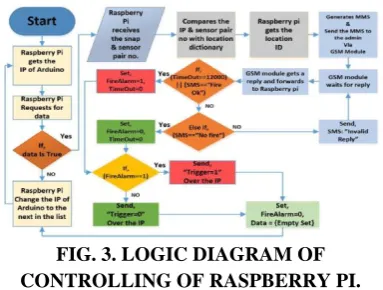
FIG. 3. LOGIC DIAGRAM OF CONTROLLING OF RASPBERRY PI.
When raspberry pi received the snap and sensor pair no then it will compare with IP and sensor pair no. If matched, then generate an MMS and send the MMS to the Admin via GSM module. The GSM module waits for reply. If the reply is “Fire OK” then it will trigger the alarm using relay. If the reply is “No fire” then it will stop the alarm. If the reply is unknown something, then it will return an invalid reply. After 5 minutes it will check the condition automatically. By using this single pair and multi pair sensor combination we can cover 360 degree and detect fire activity on a particular place.
IV.PROPOSED SYSTEM
Available online: https://edupediapublications.org/journals/index.php/IJR/ P a g e | 1454
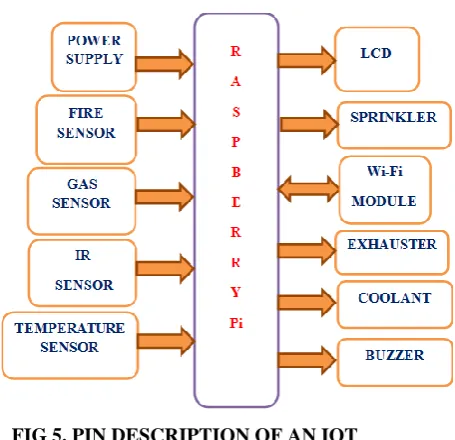
In the previous model, we are providing only fire security. In the new model, we are providing total security to the home, organizations, and industries by using different sensors. In this we are using the gas sensor for detecting the hazardous gases. IR sensor is used for detecting the intruders. Fig 4 shows an IOT based fire alarming and authentication system. Temperature sensor is used for detecting the temperature changes. The proposed system contains gas sensor for detecting gas leakage and to actuate exhaust fan, IR sensor to detect door open/close condition and actuates motor.
In this, along with the monitoring we can provide the controlling also. By using the exhauster we can remove the hazardous gases and by using the coolant we can reduce the temperature. By using the buzzer we can gives the alerts respectively.
Pin description
A smart home application features great help to our everyday life. This system rejuvenates facilities of a house to evolve into a smart home by adding more security features. The improvement in security aspect offers innovative and productive scope to the means of living.
The recognition problem is always questionable in smart home applications. This protection mechanism notifies the user accordingly, giving a clear picture of the scenario happening at the user’s house. The sensor based system highlights many features enabling it to be widely used. Fire sensor detects any temperature increase in the living room and posts its status in the URL given to the user. The gas sensor helps in detecting the presence of any gas leakage based on the intensity of the gas in air.
FIG 5. PIN DESCRIPTION OF AN IOT BASED FIRE ALARMING AND
AUTHENTICATION SYSTEM
The hazardous gases are detected by the gas sensor. IR sensor is for detecting the intruders. Temperature sensor is used for detecting the temperature changes. Fire sensor is used for detecting the fire. In this, we can provide the controlling also. By using the exhauster we can remove the hazardous gases and by using the coolant we can reduce the temperature. By using the buzzer we can gives the alerts respectively.
The system can be executed in real time environment. Raspberry Pi controller controls the sensors and actuators. The system performs as smart home security system by efficient intruder, gas leakage and fire detection. It also manages automated door locking mechanism.
V. RESULTS
Available online: https://edupediapublications.org/journals/index.php/IJR/ P a g e | 1455
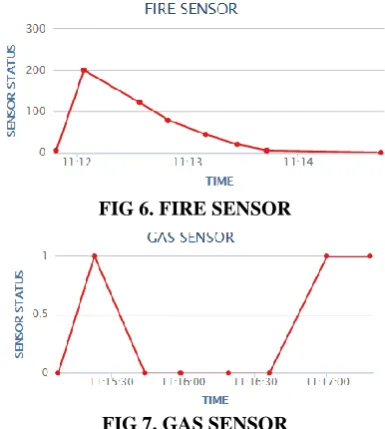
FIG 6. FIRE SENSOR
FIG 7. GAS SENSOR
The above figure shows the graphical representation of gas sensor. The graph is measuring the sensor status with respect to time.
FIG 8. IR SENSOR
FIG 9. TEMPERATURE SENSOR
The above figures 8 & 9 shows the
graphical representation of IR and
Temperature sensors.
The entire system performance can be measured in terms of sensor accuracy, Face detection and recognition accuracy
and fire detection accuracy. In this phase, the performance of sensors accuracy is
accessed and fire flame detection.
Accuracy of the security system is important to ensure the reduction of false alarming and to effectively identify the condition of the environment.
VI. CONCLUSION
In this paper, we discussed the latest technology that can help to reduce catastrophic accidents caused by fire. We designed the whole system and evaluated its effectiveness as well as scalability.
With the improvement of sensor
technology, the system will become more efficient and useful. If this system can be successfully integrated in every factories, then it is hoped that the loss of life and property due to the fire accidents will reduce remarkably and the country’s economy will not be stumbled by such tragic accidents.
VII. REFERENCES
[1] Ethirajan Anbarasan, “Dhaka
Bangladesh clothes factory fire kills more than 100,” in BBC, 25 November 2012. [2] Oxfam, “31 die in Bangladesh factory fire as brands do too little, too late,” in press.
[3] Sowah, Robert, et al., “Design and implementation of a fire detection and control system for automobiles using fuzzy
logic,” in Proceedings of Industry
Applications Society Annual Meeting, 2016.
Available online: https://edupediapublications.org/journals/index.php/IJR/ P a g e | 1456
[5] Chen, Thou-Ho, et al. “The smoke detection for early fire-alarming system base on video processing,” in Proceedings of International Conference on Intelligent Information Hiding and Multimedia, 2006. [6] Gaikwad, K. M., et al., “Fire Monitoring and Control System,” in Proceedings of International Research Journal of Engineering and Technology (IRJET), 2016.
[7] Fuzi, Mohd Faris Mohd, et al., “HOME FADS: A dedicated fire alert detection system using ZigBee wireless network,” in Proceedings of Control and System
Graduate Research Colloquium
(ICSGRC), 2014.
[8] Kwon, Oh-Hyun, Sung-Min Cho, and
Sun-Myung Hwang, “Design and
implementation of fire detection system,” in Proceedings of Advanced Software Engineering and Its Applications, 2008.
[9] Islam, Taoufikul, Hafiz Abdur
Rahman, and Minhaz Ahmed Syrus, “Fire detection system with indoor localization using ZigBee based wireless sensor network,” in Proceedings of International Conference on Informatics, Electronics & Vision (ICIEV), 2015.
[10] Trivedi, Kartik, and Ashish Kumar
Srivastava, “An energy efficient
framework for detection and monitoring of forest fire using mobile agent in wireless sensor networks,” in Proceedings of
International Conference on
Computational Intelligence and