On the four-loop strong coupling beta-function in the SM
AlexanderBednyakov1, and AndreyPikelner2,
1Joint Institute for Nuclear Research,141980 Dubna, Russia
2II. Institut für Theoretische Physik, Universität Hamburg, Luruper Chaussee 149, 22761 Hamburg, Germany
Abstract.In the talk the leading four-loop contribution to the beta-function of the strong coupling in the SM is discussed. Some details of calculation techniques are provided. Special attention is paid to the ambiguity due to utilizedγ5 treatment and a particular prescription with anticommutingγ5 is advocated. As a by-product of our computation the four-loop beta-function in QCD with “gluino” is also obtained.
The Standard Model (SM) of fundamental interactions being renormalizable can, in principle, by used to make predictions at scales far above the Z-boson massQ2 M
Z. At such scales it is
convenient to use “running”, or scale-dependent, couplingsa(Q), which are obtained from a set of measurable quantities{O}by means of the following two-step procedure:
PDG [1] 20XX
{O}=Mb,MW,MZ,
MH,Mt,GF
Fixedμ0 gi(μ0), yi(μ0), λ(μ0)
in MS scheme
Evolve fromμ0 to scaleμ
The first step is calledmatchingand boils down to the extraction/fitting of the model parameters a(μ0 MZ) at the electroweak scale (in what follows, we employ MS-scheme). The second step —
“running” — allows one to utilize renormalization-group equations (RGEs) to re-summ potentially large logarithms logμ2/μ20contributing to finite-order relations betweena(μ0) anda(μ).
One of the most important applications of such a procedure is the vacuum stability analysis of the SM (see, e.g., [2, 3] and references therein). It turns out that for large values of Higgs fieldφthe effective potential can be approximated as
Veff(φv)
λ(μ=φ)
4 φ
4, (1)
where the scale dependence of self-couplingλ(μ) is governed by the following (one-loop) RGEs
(4π)2 dλ
dlnμ2 =12λ+6y 2
tλ−3y4t +. . . , (4π)2
dyt
dlnμ2 = 9 4y
3
t −4gs2yt+. . . , (2)
in which the “de-stabilizing” contribution due to top-quark Yukawa couplingyt is emphasized. The
importance of the strong couplinggs can be deduced from RGE foryt - strong interactions tend to
decrease the latter withμ.
e-mail: [email protected]
At present, the state-of-the-art analysis utilizes full two-loop matching [4] together with three-loop evolution via RGEs [5–7]. In this talk, we discuss one little step towards the full four-loop analysis — calculation of leading N3LO corrections toβas. The latter is defined here as (hcounts powers of
couplings)
d as
d logμ2 =βasas=−as 3
i=0
βihi+2. (3)
For convenience, we introduce a set of SM parameters (withξbeing a gauge-fixing parameter)
(16π2)a=g2
s, y2t, λ,(16π2)ξ
. (4)
Since we are interested in the leading corrections toβ3 (3), the electroweak gauge interactions are neglected together with Yukawa interactions of all SM fermions but the top-quark.
For completeness, let us mention here that thematchingprocedure for the strong coupling con-stant is different than that mentioned earlier. One usually considers five-flavor (nf =5) QCD as an
effective theory obtained from a more fundamental one (e.g., QCD with “active” top quark) and find the relations of the form:
a(5)s (μ)=as(μ)ζas(μ,M),
whereM corresponds to the mass of a heavy field. The (“threshold”) corrections to the so-called decoupling constantζasare known in pure QCD up to four loops [8–10], while two-loop electroweak
contribution is considered in Ref. [11].
Before going to the result, let us discuss some technicalities and important issues encountered in our calculation. To simplify our life we made use of the background-field gauge (BFG) [12, 13]. The advantage of BFG lies in the QED-like relation between the gauge coupling renormalization constant Zas and that of the background gluon fieldZGˆ:
Zas =1/ZGˆ, Zξ=ZG˜. (5)
Obviously, this allows one to obtain the final result solely from massless propagator-type integrals. In (5), we also indicate the relation between the renormalization constants of quantum gluon field ˜G and gauge-fixing parameter. It is worth mentioning that, since in MS-scheme beta-functions do not depend on masses, one can avoid any special infra-red rearrangement (IRR) [14] tricks.
For diagram generation we employ the packageDIANA[15], which internally uses QGRAF[16]. The color [17] and Dirac algebra are carried out by means of FORM. All the generated two-point functions are mapped onto three auxiliary topologies, each containing 11 propagators and 3 irreducible numerators. The corresponding diagrams are evaluated by means of theC++version of the FIRE
package [18], which performs integration-by-parts (IBP) [19] reduction based on the reduction rules prepared by theLiteRed[20] package. The IBP reduction leads to a small set of master integrals. The expressions for the latter are known in analytical form up to the finite parts [21].
calculated four-loop correctionΔβ3≡β3(nf,ng)−β3(nf) to the beta-function of the strong coupling
Δβ3 =ng
dabcd A d abcd A NA 256 9 − 832
3 ζ3
−C4A
68507 243 −
52 9 ζ3
+nfng
C2
ACFTF
23480
243 − 352
9 ζ3
+CAC2FTF
−152
27 − 64
9 ζ3
+
C3ATF
30998
243 + 128
3 ζ3
+dabcdF dabcdA
NA
−704
9 + 512
3 ζ3
+n2g
C4A
26555 486 −
8 9ζ3
+d abcd A d abcd A NA −176 9 + 128
3 ζ3
+n2
gnf
C3
ATF
934 243 +C
2
ACFTF
308 243
+C4
An3g
23 27
+n2fng
C2AT2F1252
243 +CACFT 2 F 1232 243 (6)
in terms of the SU(3) casimirs andnf(ng) corresponding to the number of quarks(gluino). The
beta-function for such a model at four loops was predicted by A.F. Pikelner [22] along the lines of Ref. [23] and can be used, e.g, in the derivation of{β}-expansions [24]. We found perfect agreement and, thus, both confirmed the prediction and verified our computer setup.
Let us now discuss an important obstacle – the ambiguities in the dimensionally regularized ex-pressions due toγ5. It is known that there is a clash between anticommutativity {γμ, γ5} = 0 and strictly four-dimensional relation
tr (γμγνγργσγ
5)=−4iμνρσ (7)
inD4 (see, e.g.,[25]). A self-consistent BMHV-algebra [26, 27] breaksD-dimensional Lorentz in-variance and requires too much effort when applied to multi-loop problems involving chiral fermions. External axial currents in QCD can be conveniently treated within the prescription due to Larin [28]. Another approach [29] is based on anticommutingγ5but promote every fermionic trace “tr” to a non-cyclic linear functional, which depends on the choice of utilizedreading point/prescription, i.e., the position, at which we start(end) reading the trace.
χ/φ+
h0/φ−
χ/φ+
h0/φ−
χ/φ+
h0/φ−
R=1 R=2 R=3
Figure 1.A typical diagram giving rise to a non-trivial contribution due to traces involving odd number ofγ5. Three non-equivalent reading prescriptions are indicated by dots. In our problem it does not matter, whether we start or end the traces at the indicated points. All internal “cut” points turn out to be equivalent.
use anticommutingγ5, Eq. (7) and the contraction1
μνρσ
αβγδ=−T[[μνρσαβγδ]], Tμνρσαβγδ =δμαδνβδργδσδ
to get a unique result. However, similar calculation was carried out by M. Zoller [30] and an agreement was found only in the “naive” part, in which contributions due to traces with odd number ofγ5 are neglected. The discrepancy triggered further investigation of the issue and it was found that, indeed, the results for the diagrams giving rise to non-trivialγ5contribution do depend on the choice of “cut” points, at which one breaks a closed Dirac trace.
The result for the 1/ part of the diagrams can be casted into
a2
sa2tTF2
(X1+X2ζ3)·R
and for non-planar ones we haveX1=−1/18,X2=1/6, while in the planar caseX1=1/6,X2 =0. The coefficientRdepends on the “cut” points and it turns out that there are three non-equivalent cases, indicated by dots in Fig.1. If both traces are cut at external gluon vertices, one hasR = 1. If only one external vertex is chosen as a “cut” point,R = 2. Finally, for both traces terminated at internal vertices we haveR=3.
A natural question arises whether it is possible to single out a unique prescription. In our original paper [31] we advocate the choiceR =3. The main argument comes from the calculation of finite,
O(0), parts of the diagrams. It is known that IRR procedure (e.g.,of Ref. [30]), usually utilized to find RGEs in MS, is only aimed to calculate the pole part of a diagram and does not guarantee that theO(0) terms remain the same after its application. Since we effectively do not do any IRR tricks, we can safely calculate the finite parts and check, whether it is transverse inD-dimensions or not2.
It turns out that the case withR=3 leads to transverse gluon self-energy, while the caseR =2 gives rise to a correction to the longitudinal part, thus, explicitly breaking gauge invariance. In spite of the fact that the prescriptionR=2 also produce zero upon multiplication by the product of external momentaqμqν, we exclude it by simple symmetry argument (we do not want to give preference to either external vertex).
At the end of the day we obtain the following gauge-parameter independent expression [31]:
β3 = βQCD3 (nf =2nG)+a3sat TFCF2(6−144ζ3)+TFCACF
523
9 −72ζ3
+1970 9 TFC
2
A
− 1288
9 T 2
FCFnG−
872 9 T
2
FCAnG
+asa3tTF
423
2 +12ζ3
+60asa2taλTF−72asata2λTF
− a2sa2t ⎡ ⎢⎢⎢⎢⎢ ⎢⎢⎣TF2
⎛ ⎜⎜⎜⎜⎜
⎜⎜⎝48−96ζ3+R
3
· 16
3 +32ζ3
⎞⎟⎟⎟⎟⎟⎟⎟⎠+T
FCF(117−144ζ3)+222TFCA
⎤ ⎥⎥⎥⎥⎥
⎥⎥⎦, (8)
wherenGcorresponds to the number of SM families.
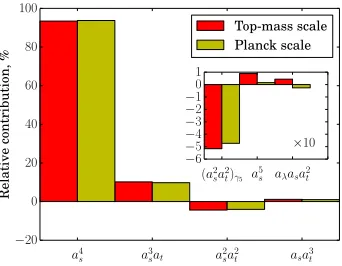
It is interesting to compare the relative sizes of different four-loop terms (8) and recent five-loop pure QCD contribution toβ4 [32]. From Fig. 2 one can see thata4s ammounts for about 94% of
β3+β4both at the top-mass and Planck scales. The mixeda3sat anda2sa2t terms have opposite signs
and partially compensate each other. The contributions due to five loops [32] and that fromγ5are also of different signs and are both less than a percent.
1Non-trivial contributions due toγ
a4
s a3sat as2a2t asa3t −20
0 20 40 60 80 100
Relative
contribution,
%
Top-mass scale Planck scale
(a2
sa2t)γ5 a5s aλasa2t −6
−5
−4
−3
−2
−10 1
×10
Figure 2. Relative size of the calculated four-loop contributions and the pure QCD five-loop termO(a5
s) with respect to the sumβ3+β4. Non-trivial part due toγ5is indicated.
To summarize, we calculated different four-loop corrections to beta-functions forαs both in the
SM and in hypothetical QCD with "gluino". Theγ5ambiguities were studied and a reading prescrip-tion for "odd" fermion traces, consistent with gauge symmetry, was singled out. In our future studies, we plan to extend the result forβ3 to the full SM case and compute leading electroweak threshold corrections at three loops.
Acknowledgments
The authors thank the Organizing committee of the QUARKS-2016 seminar for warm hospitality. This work is supported in part by RFBR grant 14-02-00494-a and the Heisenberg-Landau programme.
References
[1] K. Olive et al. (Particle Data Group), Chin.Phys.C38, 090001 (2014)
[2] G. Degrassi, S. Di Vita, J. Elias-Miro, J.R. Espinosa, G.F. Giudice et al., JHEP1208, 098 (2012),
1205.6497
[3] A.V. Bednyakov, B.A. Kniehl, A.F. Pikelner, O.L. Veretin, Phys. Rev. Lett.115, 201802 (2015),
1507.08833
[4] B.A. Kniehl, A.F. Pikelner, O.L. Veretin, Nucl.Phys.B896, 19 (2015),1503.02138
[5] L.N. Mihaila, J. Salomon, M. Steinhauser, Phys.Rev.Lett.108, 151602 (2012),1201.5868
[6] A. Bednyakov, A. Pikelner, V. Velizhanin, Phys.Lett.B722, 336 (2013),1212.6829
[7] K. Chetyrkin, M. Zoller, JHEP1304, 091 (2013),1303.2890
[8] K.G. Chetyrkin, J.H. Kuhn, C. Sturm, Nucl. Phys.B744, 121 (2006),hep-ph/0512060
[9] Y. Schroder, M. Steinhauser, JHEP0601, 051 (2006),hep-ph/0512058
[10] B.A. Kniehl, A.V. Kotikov, A.I. Onishchenko, O.L. Veretin, Phys. Rev. Lett.97, 042001 (2006),
hep-ph/0607202
[11] A.V. Bednyakov, Phys. Lett.B741, 262 (2015),1410.7603
[12] L. Abbott, Nucl.Phys.B185, 189 (1981)
[14] A. Vladimirov, Theor.Math.Phys.43, 417 (1980)
[15] M. Tentyukov, J. Fleischer, Comput.Phys.Commun.132, 124 (2000),hep-ph/9904258
[16] P. Nogueira, J.Comput.Phys.105, 279 (1993)
[17] T. van Ritbergen, A. Schellekens, J. Vermaseren, Int.J.Mod.Phys. A14, 41 (1999),
hep-ph/9802376
[18] A.V. Smirnov, Comput. Phys. Commun.189, 182 (2014),1408.2372
[19] K. Chetyrkin, F. Tkachov, Nucl.Phys.B192, 159 (1981) [20] R. Lee (2012),1212.2685
[21] P.A. Baikov, K.G. Chetyrkin, Nucl. Phys.B837, 186 (2010),1004.1153
[22] A. Pikelner, paper in preparation.
[23] L. Clavelli, P.W. Coulter, L.R. Surguladze, Phys. Rev.D55, 4268 (1997),hep-ph/9611355
[24] A.L. Kataev, S.V. Mikhailov, Phys. Rev.D91, 014007 (2015),1408.0122
[25] F. Jegerlehner, Eur.Phys.J.C18, 673 (2001),hep-th/0005255
[26] G. ’t Hooft, M. Veltman, Nucl.Phys.B44, 189 (1972)
[27] P. Breitenlohner, D. Maison, Commun. Math. Phys.52, 11 (1977) [28] S. Larin, Phys.Lett.B303, 113 (1993),hep-ph/9302240
[29] J.G. Korner, D. Kreimer, K. Schilcher, Z. Phys.C54, 503 (1992) [30] M.F. Zoller, JHEP02, 095 (2016),1508.03624
[31] A.V. Bednyakov, A.F. Pikelner (2015),1508.02680