International Journal of General Medicine
Impact of an integrated intervention program
on atorvastatin adherence: a randomized
controlled trial
Nilesh J Goswami1 Mitch DeKoven2 Andreas Kuznik3 Jack Mardekian3 Michelle R Krukas2 Larry Z Liu3,4 Patrick Bailey1 Cynthia Deitrick5 John Vincent3
1Prairie Heart Cardiovascular
Consultants, Springfield, IL, USA;
2Health Economics and Outcomes
Research, IMS Health, Alexandria, VA, USA; 3Pfizer Inc, New York, NY,
USA; 4Weill Cornell Medical College,
Cornell University, New York, NY, USA; 5Prairie Heart Education and
Research Cooperative, Springfield, IL, USA
Correspondence: Mitch DeKoven Health Economics and Outcomes Research, IMS Health, 1725 Duke Street, Suite 510, Alexandria, VA, USA 22314 Tel +1 703 837 5153
Fax +1 703 837 5170
Email [email protected]
Background: This trial evaluated the effectiveness of an integrated intervention program that included a 3-to-5-minute nurse counseling session, copay relief cards, and a monthly newsletter on adherence to atorvastatin treatment.
Methods and results: A prospective, integrated (composed of nurse counseling, adherence tip sheet, copay relief card, opportunity to enroll in 12-week cholesterol management program) randomized interventional study was designed involving patients .21 years of age who were prescribed atorvastatin at a large single-specialty cardiovascular physician practice in Illinois from March 2010 to May 2011. Data from the practice’s electronic medical record were matched/ merged to IMS Health’s longitudinal data. A total of 500 patients were enrolled (125 in the control arm; 375 in the intervention arm). After data linkage, 53 control patients and 155 intervention patients were included in the analysis.
Results: Mean age was 67.8 years (control) and 69.5 years (intervention); 67.9% and 58.7%, respectively, were male. The mean 6-month adherence rate was 0.82 in both arms. The mean proportion of days covered for both the new-user control and intervention groups was the same, averaging 0.70 day (standard deviation [SD], 0.27 day); for continuing users, the proportion of days covered for the control group was 0.83 (SD, 0.24) and for the intervention group was 0.84 (SD, 0.22). For continuing users, the control group had mean persistent days of 151.6 (SD, 50.2) compared with 150.9 days (SD, 50.9) for the intervention group. New users had fewer persistent days (control 111.4 days, SD, 69.6 days; intervention 112.0 days, SD, 58.8 days) compared with continuing users. The Cox proportional hazards model of the risk of discontinuation with index therapy was not significantly different between the intervention and control groups (hazard ratio 0.83, P= 0.55).
Conclusion: The integrated intervention program did not significantly improve atorvastatin adherence relative to usual care in the studied patient population.
Keywords: adherence, randomized clinical trial, atorvastatin
Introduction
Heart disease is the leading cause of death for men and women in the United States, and the predominant etiology is coronary artery disease. Atorvastatin (Lipitor®, Pfizer
Inc. New York, NY, USA) is a highly efficacious lipid-lowering agent that acts as a competitive inhibitor of 3-hydroxy-3-methylglutaryl-CoA-reductase.1 Primary and
secondary prevention studies have shown that the use of 3-hydroxy-3-methylglutaryl-CoA-reductase inhibitors (statins) in patients with coronary artery disease reduces recurrent events and mortality.2,3
Atorvastatin is one of the most studied drugs with regards to clinical data, having been shown to reduce acute coronary heart disease events, coronary revascularization,
Dove
press
O R I G I N A L R E S E A R C H
open access to scientific and medical research
Open Access Full Text Article
International Journal of General Medicine downloaded from https://www.dovepress.com/ by 118.70.13.36 on 22-Aug-2020
For personal use only.
Number of times this article has been viewed
This article was published in the following Dove Press journal: International Journal of General Medicine
and rate of stroke.4,5 In addition, its efficacy has been
con-firmed in a variety of populations.6–8 However, the beneficial
effects described above may only be realized if patients take their medicines as prescribed by their health care practitioner (ie, adhere to treatment); unfortunately, adherence to these medicines is modest at best.9,10 Several studies have shown
that adherence to statins decreases to 50% by 12 months after the initial prescription,11,12 although some evidence
suggests that adherence to atorvastatin may be higher than it is for other statins.13 For medications across a wide range
of disease areas 15%–20% of new prescriptions are never filled, 20%–35% of patients who do fill the first prescrip-tion fail to fill a second, and adherence continues to decline rapidly throughout the first 3–6 months of therapy.14,15 More
specifically, statin persistence in older patients 65 years of age, declines over time, with the greatest drop occurring in the first 6 months of treatment.16
Multiple barriers to taking medicines have been described by the World Health Organization and others, the most com-mon being forgetfulness. Others include lack of knowledge, fear of adverse events, psychological factors, and cost. Intervention strategies that integrate counseling, emotional support, and cost sharing are motivational and have been shown to improve adherence.17–23 The objective of this study
was to describe and evaluate the effectiveness of an integrated intervention program on patients’ adherence to statin therapy, using atorvastatin as a specific example.
Methods
This was a randomized, prospective study that involved patients who were prescribed atorvastatin at Prairie Heart Cardiovascular Consultants, Springfield, ILL, USA, that per-forms diagnostic catheterization, angioplasties, implants, and heart surgeries. Ten practicing physicians (all board-certified cardiologists, some of whom are interventionalists, and others noninterventionalists) participated, on the basis of their total clinic volume and clinical research interest. Patients who met the study criteria (described below), and were prescribed atorvastatin by a participating physician after study initia-tion, whether they were considered new or returning practice patients, were eligible to enroll into this trial.
Eligible patients were randomized using a telephone randomization system to one of two groups: an interven-tion group and a control group (with a patient ratio of 3:1 intervention:control). All patients randomized to the intervention group were provided adherence counseling from a nurse(via a 5–10-minute discussion), and an adher-ence tip sheet. Patients in the intervention group were also
given the opportunity to enroll in the My HeartWise™ Pro-gram,24 a 12-week guide to managing cholesterol (included
monthly mailing of educational materials). The practice physicians also had the discretion to provide eligible patients in the intervention group with a copay relief card (usable with commercial payers, not Medicare). The control group received usual care, with no additional adherence counsel-ing or tip sheet.
Data source
Data for this study was sourced from the practice’s electronic medical record system and was matched and merged to IMS Health’s (Plymouth Meeting, PA, USA) longitudinal (LRx) data. The matching process was based upon patient name, gender, mailing address, and date of birth. This generated a de-identified database that was used for the study’s analyses. The IMS LRx database covers 65% of all retail prescrip-tions in the United States and includes mail service and specialty pharmacy provider prescriptions. In this database, the de-identified patient, pharmacy, and prescriber can be tracked, as well as all dispensed prescriptions independent of the method of payment. Prescription records are collected directly from pharmacies, which provide encrypted patient identifiers, compliant with Health Insurance Portability and Accountability Act privacy regulations.
Sample selection
The target sample was enrolled in the study from March 2010 through May 2011. The period of analysis for each patient was 180 days from the first fill date of the index atorvastatin prescription (index date) to the end of the study. All subjects enrolled met the Lipitor physician prescribing information for atorvastatin and were entered into the trial at the physician’s discretion. All subjects had to satisfy inclu-sion criteria to be considered eligible for participation by one of the ten participating physicians of the practice’s study team: (1) be older than 21 years of age and, on the basis of clinical assessment by his or her physician, a candidate for statin therapy; (2) have received a first prescription for atorvastatin after study initiation at the practice, including patients who were new to the practice and returning practice patients (new versus continuing atorvastatin patients were deciphered by requiring claims activity 6 months before and after the index date); and (3) provide a personally signed and dated informed consent document indicating that the participant (or a legally acceptable representative) had been informed of all pertinent aspects of the study. Patients were excluded from the study if they were unwilling to participate
Dovepress
Goswami et al
International Journal of General Medicine downloaded from https://www.dovepress.com/ by 118.70.13.36 on 22-Aug-2020
in the adherence counseling or unwilling to give a written informed consent document. Ethics approval for the study was granted by Fox Commercial Institutional Review Board (Springfield, IL, USA).
Statistical analysis
Descriptive statistics were tabulated for all patient characteristics. A sample size of 500 patients, selected in order to have at least 300 evaluable patients (225 intervention patients and 75 control patients), was calculated for this study. This sample size provides at least 80% power at a Type 1 error rate of 0.05 to detect an effect size (proportion of days covered [PDC]intervention- PDCcontrol)/PDCstandard deviation) of at least 0.37. For continuous variables, measures of central tendency (mean and median) and measures of dispersion (standard deviation [SD]) were calculated and reported. For categorical variables, frequencies and percentages were calculated and reported.
As one of the main objectives of the study was to calculate the adherence to atorvastatin after study enrollment, both the PDC and medication possession ratio (MPR) during the 180 days from the patient’s index date were used in the analy-sis. The PDC was calculated as the total number of days with the medication on hand during the 180 days from the index date divided by the total number of days in the study period (180). If the patient filled a prescription near the end of the study period that extended beyond the study period, the data for this patient was censored at that point. For example, if a patient filled a 30-day prescription on day 160, only 20 days’ supply of that prescription (ie, up to day 180) was used in the numerator to calculate PDC. Mean PDC was reported overall and for the intervention and control groups. The MPR was defined as the number of days on medication after study enrollment divided by the number of days between the first fill and the last refill plus the days supply of last refill. The MPR for up to 180 days after the index date was computed:
MPR
=
∑
days supply of medicationnumber of days between the fiirst fill and the last refill days supply of the last
∑
+ rrefill
If the last refill in the study period provided supply that lasted beyond 180 days after the index date, the supply of that refill was truncated at day 180 postindex in calculating the MPR. Calculation of the MPR required that the patient had at least two medication fills. If the patient had evidence of only a single fill, the MPR was set to zero.
Both PDC and MPR were dichotomized into a categori-cal “adherent/not adherent” variable. Patients were defined as adherent if their PDC/MPR 80%; all others were classified as nonadherent. The proportion of patients who met this criterion was reported overall and for the intervention and control groups. Exploratory logistic regressions were performed using the adherent or nonadherent categoriza-tion as the dependent variable (adjusted for demographic and baseline characteristics), to explore variables that were important in predicting adherence for both intervention and control patients. Parameter estimates and P-values were reported for each covariate modeled.
Persistence was measured as the number of days a patient was supplied with medication before experiencing a gap in medication 30 days. Mean and median days of persistence were reported for the intervention and control groups. Persistence was compared between the control and the intervention groups using a time-to-event Cox propor-tional hazards model, adjusted for the same demographic and baseline characteristics used in the logistical regression analyses of PDC and MPR.
Results
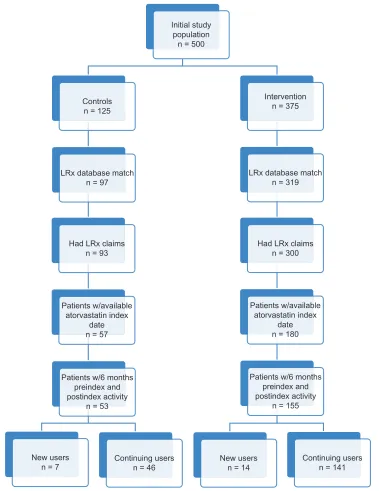
The study initially included 500 patients (125 control patients and 375 patients who received the adherence intervention). After matching with the LRx database, 97 controls and 319 intervention patients remained eligible for analysis. However, only 93 controls and 300 intervention patients actually had any LRx claims available for analysis during the study window. Of this group, 57 controls and 180 intervention patients had an atorvastatin prescription after enrollment in the study, which served as the index date. After applying the study requirement of claims activity 6 months before and after the index date, only 53 controls (seven new users [first atorvastatin prescription after randomization] and 46 continuing users [evidence of atorvastatin prescription within 6 months prior to randomization]) and 155 intervention patients (14 new users and 141 continuing users) remained eligible for analysis (Figure 1).
Patient demographic and clinical
characteristics
Table 1 provides the descriptive data around the baseline demographic and clinical characteristics for both the control and intervention cohorts. Among the control group, the aver-age aver-age was 67.8 years, compared with 69.5 years for the intervention group. Most of the control group (58.5%) was
Dovepress Impact of an intervention program on atorvastatin adherence
International Journal of General Medicine downloaded from https://www.dovepress.com/ by 118.70.13.36 on 22-Aug-2020
65 years of age or older; similarly, 65.2% of the intervention group was older than 65 years of age. The sex distribution was predominantly male for both groups (67.9% of the con-trols and 58.7% of the intervention group). Most patients (67.9% of the controls and 70.3% of the intervention group) were in “commercial” or “other” insurance plans.
At the index date, the control population was taking an average of 7.8 unique prescriptions, as compared to 7.1 for the intervention group. Along the same lines, the control group filled an average of 32.8 prescriptions (for any medication)
in the 6 months prior to the index date, whereas the interven-tion group filled an average of 26.2 prescripinterven-tions. Targeted clinical characteristics for the study cohorts also are pre-sented in Table 1. The two groups were similar with respect to their pre-enrollment clinical variables. A prior CV event was identified in 98.1% of the controls and 85.2% of the intervention group in the preindex period. Control patients received more antidiabetic (control 30.2%; intervention 28.4%) and antihypertensive (control 96.2%; intervention 94.2%) medications compared to intervention patients.
Initial study population
n = 500
Intervention n = 375 Controls
n = 125
LRx database match
n = 97 LRx database matchn = 319
Had LRx claims
n = 93 Had LRx claimsn = 300
Patients w/available atorvastatin index
date n = 57
Patients w/available atorvastatin index
date n = 180
Patients w/6 months preindex and postindex activity
n = 53
Patients w/6 months preindex and postindex activity
n = 155
New users
n = 7 Continuing usersn = 46
Continuing users n = 141 New users
n = 14
Figure 1 Patient disposition.
Abbreviations: n, number; LRx, IMS Health’s longitudinal data; w/6, within 6.
Dovepress
Goswami et al
International Journal of General Medicine downloaded from https://www.dovepress.com/ by 118.70.13.36 on 22-Aug-2020
A history of hypertension was similar across the groups, with 79.2% of the controls having the comorbid condition as compared to 81.9% of the intervention group.
Adherence
Adherence to index therapy was measured using both PDC and MPR (Table 2), with results stratified as to whether the patient was considered a new user or a continuing user, on the basis of the presence (or absence) of atorvastatin prescrip-tions in the 6-month preindex period. On the basis of PDC (0.80), approximately 72% of all patients were considered adherent (76.4% based upon MPR), with a mean PDC of 0.82 (0.81 based upon MPR). The mean PDC for the new-user control and intervention groups were similar, averaging 0.70
(SD, 0.27), whereas for continuing users, the control group exhibited a PDC of 0.83 (SD, 0.24) and the intervention group 0.84 (SD, 0.22). The mean MPR for new users within the control group was 0.58 (SD, 0.44) and was 0.62 (SD, 0.42) for new users within the intervention group. Three of the seven new users in the control group (42.9%) were considered to have good adherence (PDC and MPR 0.80) while five (35.7% when examining PDC) and six (42.9% when examining MPR) new users in the intervention group were considered to have good adherence. Continuing users within the control group had a mean MPR of 0.83 (SD, 0.29) as compared with 0.84 (SD, 0.28) for those in the intervention group. In general, the continuing users in both groups were considered to have good adherence, with 76.1% of the control group (when using PDC, versus 80.4% when using MPR) and 75.2% of the intervention group (when using PDC, versus 80.1% when using MPR) having PDC . 0.80.
Figure 2A shows the overall adherence (PDC) over time of both the control and intervention groups, up to 12 months postindex. For the control group, the mean PDC decreased from an average of 0.89 (3 months postindex) to 0.73 (12 months postin-dex); this decline was almost exactly matched in the intervention group, going from 0.91 (3 months postindex) to 0.74 (12 months postindex). Not all study patients had 12 months of follow-up for this analysis, and these were censored at the end of follow-up (the control grofollow-up had 33 patients, and 101 remained in the intervention group). Similarly, the percentage of patients who were considered to have good adherence (PDC 0.80) decreased from 84.9% (3 months postindex) to 60.6% (12 months postindex) in the control group and from 82.6% (3 months postindex) to 58.4% (12 months postindex) in the intervention group (Figure 2B).
Table 1 Patient demographic and clinical characteristics
Demographics Control (n =53)
Intervention (n =155) Age (years)
Mean 67.8 69.5
SD 10.6 12.3
Median 68.0 69.0
Age group (n, %)
18–44 years 0 0.0% 1 0.6%
45–54 years 8 15.1% 15 9.7%
55–64 years 14 26.4% 38 24.5%
65–74 years 16 30.2% 48 31.0%
75+ years 15 28.3% 53 34.2%
Male (n, %) 36 67.9% 91 58.7%
Index insurance type (n, %)
Medicare 16 30.2% 44 28.4%
Cash 0 0.0% 0 0.0%
Medicaid 1 1.9% 2 1.3%
Commercial/other 36 67.9% 109 70.3%
Number of unique prescriptions at index
Mean 7.8 7.1
SD 3.6 3.2
Median 7.0 7.0
Health services in the 6 months before the index date Number of scripts filled (for any medication)
Mean 32.8 26.2
SD 23.4 17.9
Median 29.0 21.0
At least one fill for atorvastatin (continuing patients) (n, %)
46 86.8% 141 91.0%
Pre-enrollment clinical variables (n, %)
Prior cardiovascular event 52 98.1% 132 85.2%
Diabetes 6 11.3% 7 4.5%
Hypertension 42 79.2% 127 81.9%
Pre-index prescriptions (6 months pre-index) (n, %)
Antiplatelets 22 41.5% 48 31.0%
Non-statin-lowering agents 12 22.6% 31 20.0%
Antidiabetics 16 30.2% 44 28.4%
Antihypertensives 51 96.2% 146 94.2%
Antiarrhythmics 2 3.8% 9 5.8%
Abbreviations: n, number; SD, standard deviation.
3
PDC
0.00 0.10 0.20 0.30 0.40 0.50 0.60 0.70 0.80 0.90 1.00
6
Months since index date
Control Intervention
9 12
Figure 2A Mean adherence (PDC).
Abbreviation: PDC, proportion of days covered.
Dovepress Impact of an intervention program on atorvastatin adherence
International Journal of General Medicine downloaded from https://www.dovepress.com/ by 118.70.13.36 on 22-Aug-2020
After adjusting for baseline demographic and clini-cal characteristics, there was no significant difference in PDC with index therapy between the two patient cohorts (odds ratio = 1.03 for intervention versus control; P= 0.95) (Table 3). Patients aged 65–74 years (as compared with patients aged 18–54 years) with a prior CV event or history of hypertension were less likely to be adherent to index therapy over 6 months, whereas males, patients aged 55–64 years or 75+ years (as compared with the patients aged 18–54 years), and patients with a history of diabetes were more likely to be adherent over the 6-month postindex period. The same logistic regression model with MPR as the dependent variable yielded similar results (odds ratio = 1.14 for intervention versus control; P, 0.75). Patients aged 65–74 years (as compared with patients aged 18–54 years) and with a history of hyper-tension were less likely to be adherent to index therapy over
6 months. Patients who were male, aged 55–64 years or 75+
years (as compared with patients aged 18–54 years), with a prior CV event, or with a history of diabetes were more likely to be adherent over the 6-month postindex period.
Persistence
Table 2 provides the descriptive data for persistence with the index therapy over the 6-month postindex period. Index atorvastatin patients who were deemed continuing users had more persistent days over the 6-month postindex period com-pared with new users. For continuing users, the control group had mean persistent days of 151.6 (SD, 50.2) compared with 150.9 (SD, 50.9) for the intervention group. The new users had fewer persistent days (control 111.4 days, SD, 69.6 days; intervention 112.0 days, SD, 58.8 days) compared with the continuing users.
The Cox proportional hazards model of the risk of dis-continuation with index therapy (Table 3) did not show a significant difference between the intervention and control groups after adjusting for baseline demographic and clinical characteristics (hazard ratio 0.83, P, 0.55). Patients aged 65–74 years (as compared with patients aged 18–54 years) or with a history of hypertension were at greater risk for discontinuing their index therapy, whereas males and patients aged 55–64 years or 75+ years (as compared with patients aged 18–54 years), with a prior CV event, or with a history of diabetes were at a lower risk of discontinuing index therapy.
Discussion
This trial was designed to evaluate the effectiveness of an integrated intervention program (nurse counseling,
Table 2 Summary of adherence measures
All users New users Continuing users
Control Intervention Control Intervention Control Intervention PDC
Adherent (0.80) (n, %) 38 71.7% 111 71.6% 3 42.9% 5 35.7% 35 76.1% 106 75.2%
Adherence
Mean 0.81 0.82 0.70 0.70 0.83 0.84
SD 0.24 0.23 0.27 0.27 0.24 0.22
MPR
Adherent (0.80) (n, %) 40 75.5% 119 76.8% 3 42.9% 6 42.9% 37 80.4% 113 80.1%
Adherence
Mean 0.79 0.82 0.58 0.62 0.83 0.84
SD 0.32 0.30 0.44 0.42 0.29 0.28
Persistence
Mean 146.3 147.4 111.4 112.0 151.6 150.9
SD 54.1 52.6 69.6 58.8 50.2 50.9
Abbreviations : PDC, proportion of days covered; n, number; SD, standard deviation; MPR, medication possession ratio.
3
Percent of patients
0% 10% 20% 30% 40% 50% 60% 70% 80% 90% 100%
6
Months since index date
Control Intervention
9 12
Figure 2B Percentage of patients considered adherent (PDC). Abbreviation: PDC, proportion of days covered.
Dovepress
Goswami et al
International Journal of General Medicine downloaded from https://www.dovepress.com/ by 118.70.13.36 on 22-Aug-2020
adherence tip sheet, copay relief card, option to enroll in My HeartWiseTM Program) on patients’ adherence to statin
therapy, using atorvastatin as an example. Our findings indicate that both the control and intervention groups were quite similar (no inferential statistics were conducted) – both groups were from a relatively sick population exhibiting polypharmacy behavior (at least 85% of each group had a prior CV event). Most patients who had one, two, or three atorvastatin prescription refills during the study period obtained a 90-day supply (data not shown). In general, adher-ence and persistadher-ence for both the control and intervention groups were essentially the same, regardless of whether PDC or MPR was used as the outcome of interest. These unadjusted results were further validated by the findings of the logistic regression and Cox proportional hazards models, which did not indicate a significant difference among the cohorts of interest. As the control group’s adherence was initially high, there was little room for improvement as a result of the intervention. In addition, the large number of continuing users and the level of treatment patients received at this particular cardiology practice group could explain the high adherence rate observed in this study, which in turn could partially explain the lack of a significant impact due to the intervention. The literature confirms that new users often exhibit lower adherence rates as compared with con-tinuing users.13 In a recent retrospective database analysis
of treatment-naïve hyperlipidemia patients, 65% of patients were considered nonadherent (PDC = 0.33).25
The overall cost of medication nonadherence to the health care system is staggering. Between one third and two thirds of medication-related hospital admissions are linked to poor adherence.9 Total cost estimates for nonadherence amount to
at least US$300 billion a year.26,27 Some general reasons for
nonadherence include the patient being unconvinced of the need for therapy and/or its effectiveness, medication side effects, difficulty with regimen administration, forgetfulness, and out-of-pocket costs. As such, adherence interventions seek to directly address some, if not all, of these barriers. Evidence suggests that effective interventions combine education, motivation, support, reminders, and rewards, as a successful program must be delivered by a trusted source, be personalized to the patient’s situation, reinforce medical need and expected outcomes, segment and target at-risk populations, and reinforce and reward initiation and maintenance.28–30
Some interventions directed at patients with hypertension have resulted in an improvement in adherence or clinical out-comes. Two such studies of complex intervention programs, involving provision of care at the worksite, special pill contain-ers, counseling, remindcontain-ers, self-monitoring, support groups, and feedback and reinforcement, reported such positive effects.31,32 Another study tested a telephone-linked computer
system for monitoring and counseling hypertension patients. When adjusted for age, sex, and baseline adherence, patients using the telephone-linked computer system demonstrated a greater improvement in medication adherence than did those
Table 3 Results of multivariable regression models
Variable*,†,‡ PDC
(logistic regression)
MPR
(logistic regression)
Risk of discontinuation (Cox proportional hazards model)
Odds ratio
95% CI Odds ratio
95% CI Hazard ratio
95% CI Lower
limit
Upper limit
Lower limit
Upper limit
Lower limit
Upper limit
Intervention versus control 1.03 0.48 2.21 1.14 0.51 0.51 0.83 0.46 1.52
Male versus female 1.26 0.64 2.50 1.21 0.59 0.59 0.91 0.53 1.55
Age group
55–64 years versus 18–54 years*,† 3.98 1.22 12.99 3.84 1.05 1.05 0.39 0.14 1.10
65–74 years versus 18–54 years 0.76 0.27 2.09 0.64 0.22 0.22 1.51 0.67 3.42
75+ years versus 18–54 years 2.44 0.85 7.03 1.81 0.60 0.60 0.73 0.31 1.72
Pre-enrollment comorbidities Prior cardiovascular event
(yes versus no)
0.91 0.28 2.92 1.16 0.36 0.36 0.77 0.31 1.88
Hypertension (yes versus no)*,†,‡ 0.20 0.06 0.63 0.26 0.08 0.08 3.19 1.24 8.19
Diabetes (yes versus no) 1.45 0.34 6.23 1.04 0.24 0.24 0.66 0.20 2.22
Number of unique medications at index (log of)
0.93 0.48 1.83 1.12 0.56 0.56 1.14 0.67 1.92
Notes: *Statistically significant variable for PDC model; †statistically significant variable for MPR model; ‡statistically significant variable for Cox model. Abbreviations: PDC, proportion of days covered; MPR, medication possession ratio; CI, confidence interval.
Dovepress Impact of an intervention program on atorvastatin adherence
International Journal of General Medicine downloaded from https://www.dovepress.com/ by 118.70.13.36 on 22-Aug-2020
receiving usual care.33 A previous systematic review of
adher-ence interventions concluded that all interventions that were effective for long-term care were complex (including com-binations of more convenient care, information, counseling, reminders, self-monitoring, reinforcement, family therapy, and other forms of additional supervision or attention); even so, the most effective ones did not lead to large improvements in adherence and treatment outcomes.33 Finally, the relative
cost-effectiveness of adherence interventions should be taken into consideration when designing and implementing adherence-improving programs.34,35
There are several limitations that are worth noting here. The reader should be aware that both the patients and clinicians were not blinded to the study. The frequency with which discount cards were given to control patients was not tracked. However, because many of the patients were older than 65 years of age, the impact of discount cards was likely limited, as Medicare patients did not qualify to receive them. Although inferential statistics were not provided, the demo-graphic profiles of the two cohorts were a bit disparate. The number of new users was small compared with the number of continuing users, an issue that should be taken into con-sideration when interpreting the findings (as a general guide, studies with a single intervention group and a control group need to include at least 60 participants per group if they are to have at least 80% power to detect an absolute difference of 25% in the proportion of patients judged to have adequate adherence).33 In addition, one should consider that perhaps
180 days of follow-up was not sufficient to identify a mean-ingful difference between the two cohorts. Regarding the data source, LRx does not track mail order prescriptions; as such, patients who may have been excluded due to lack of atorvastatin claims may have filled their prescriptions via this channel. In addition, administrative/pharmacy claims do not address whether or not the patient filled the prescription that was written for a particular medication, nor do they reveal the actual underlying barriers to adherence.
Conclusion
This study suggests that the impact of an integrated program including nurse counseling, copay relief cards, and a monthly newsletter did not significantly improve atorvastatin adher-ence relative to usual care in the studied patient population. Because adherence and persistence may be affected by numerous factors, including comorbidities and economic conditions, further evaluation of differences in adherence and persistence among the patients may be warranted.
Disclosure
This study was sponsored by Pfizer, Inc, NJG is a speaker for The Medicines Company, Medtronic, and Boston Scientific and is the medical director for SynvaCor. MDK and MRK are employees of IMS Health, which was a paid consultant to Pfizer in connection with the development of this article. AK, JM, LZL, and JV are employees of Pfizer, Inc, and own stock in Pfizer, Inc. PB and CD have no disclosures to declare at this time. The authors report no other conflicts of interest in this work.
References
1. HMG-CoA reductase inhibitors. In: Burnham TH, editor. Drug Facts and Comparisons. St Louis, MO: Facts and Comparisons, Inc; 2002: 536–542a.
2. Bavry AA, Mood GR, Kumbhani DJ, Borek PP, Askari AT, Bhatt DL. Long-term benefit of statin therapy initiated during hospitalization for an acute coronary syndrome: a systematic review of randomized trials. Am J Cardiovasc Drugs. 2007;7(2):135–141.
3. Allen Maycock CA, Muhlestein JB, Horne BD, et al; for the Intermountain Heart Collaborative Study. Statin therapy is associated with reduced mortality across all age groups of individuals with significant coronary disease, including very elderly patients. J Am Coll Cardiol. 2002;40(10):1777–1785.
4. Colhoun HM, Betteridge DJ, Durrington PN, et al; for the CARDS Investigators. Primary prevention of cardiovascular disease with ator-vastatin in type 2 diabetes in the Collaborative Atorator-vastatin Diabetes Study (CARDS): multicentre randomised placebo-controlled trial. Lancet. 2004;364(9435):685–696.
5. Sever PS, Dahlöf B, Poulter NR, et al; for the ASCOT Investigators. Prevention of coronary and stroke events with atorvastatin in hyperten-sive patients who have average or lower-than-average cholesterol con-centrations, in the Anglo-Scandinavian Cardiac Outcomes Trial – Lipid Lowering Arm (ASCOT-LLA): a multicentre randomised controlled trial. Drugs. 2004;64 Suppl 2:43–60.
6. Koren MJ, Hunninghake DB; for the ALLIANCE Investigators. Clinical outcomes in managed-care patients with coronary heart disease treated aggressively in lipid-lowering disease management clinics: the alliance study. J Am Coll Cardiol. 2004;44(9):1772–1779.
7. Waters DD, Schwartz GG, Olsson AG, et al; for the MIRACL Study Investigators. Effects of atorvastatin on stroke in patients with unstable angina or non-Q-wave myocardial infarction: a Myocardial Ischemia Reduction with Aggressive Cholesterol Lowering (MIRACL) substudy. Circulation. 2002;106(13):1690–1695.
8. LaRosa JC, Grundy SM, Waters DD, et al; for the Treating to New Targets (TNT) Investigators. Intensive lipid lowering with atorvastatin in patients with stable coronary disease. N Engl J Med. 2005;352(14): 1425–1435.
9. Osterberg L, Blaschke T. Adherence to medication. N Engl J Med. 2005;353(5):487–497.
10. Sabaté E. Adherence to Long-Term Therapies:Evidence for Action. Geneva, Switzerland: World Health Organization; 2003.
11. Goodman A. Cost-sharing strategies decrease adherence to statin therapy. American Health and Drug Benefits. 2009;2(1):28.
12. Ockene IS, Hayman LL, Pasternak RC, Schron E, Dunbar-Jacob J. Task force #4 – adherence issues and behavior changes: achieving a long-term solution. 33rd Bethesda Conference. J Am Coll Cardiol. 2002;40(4):630–640.
13. Jackevicius CA, Mamdani M, Tu JV. Adherence with statin therapy in elderly patients with and without acute coronary syndromes. JAMA. 2002;288(4):462–467.
Dovepress
Goswami et al
International Journal of General Medicine downloaded from https://www.dovepress.com/ by 118.70.13.36 on 22-Aug-2020
International Journal of General Medicine
Publish your work in this journal
Submit your manuscript here: http://www.dovepress.com/international-journal-of-general-medicine-journal The International Journal of General Medicine is an international,
peer-reviewed open-access journal that focuses on general and internal medicine, pathogenesis, epidemiology, diagnosis, monitoring and treat-ment protocols. The journal is characterized by the rapid reporting of reviews, original research and clinical studies across all disease areas.
A key focus is the elucidation of disease processes and management protocols resulting in improved outcomes for the patient.The manu-script management system is completely online and includes a very quick and fair peer-review system. Visit http://www.dovepress.com/ testimonials.php to read real quotes from published authors. 14. Berg JS, Dischler J, Wagner DJ, Raia JJ, Palmer-Shevlin N. Medication
compliance: a healthcare problem. Ann Pharmacother. 1993; 27(Suppl 9):S1–S24.
15. National Pharmaceutical Council. Noncompliance with Medication Regimens:An Economic Tragedy. Emerging Issues in Pharmaceutical Cost Containing. Washington, DC: National Pharmaceutical Council; 1992:1–16.
16. Benner JS, Glynn RJ, Mogun H, Neumann PJ, Weinstein MC, Avorn J. Long-term persistence in use of statin therapy in elderly patients. JAMA. 2002;288(4):455–461.
17. Ogedegbe G, Chaplin W, Schoenthaler A, et al. A practice-based trial of motivational interviewing and adherence in hypertensive African Americans. Am J Hypertens. 2008;21(10):1137–1143.
18. World Health Organization. Adherence to long-term. 24. therapies. Geneva, Switzerland; 2003; ISBN 92 4 1545992. Available from: http://www.gammagard.com/pdf/1-nurse-intro-to-pi.pdf. Accessed on July 1, 2013
19. Stewart MA. Effective physician-patient communication and health outcomes: a review. CMAJ. 1995;152(9):1423–1433.
20. Roter DL, Hall JA, Merisca R, Nordstrom B, Cretin D, Svarstad B. Effectiveness of interventions to improve patient compliance: a meta-analysis. Med Care. 1998;36(8):1138–1161.
21. Rogers CR. Carl Rogers on the development of the person-centered approach. Person-Centered Review. 1986;1(3):257–259.
22. Emmons KM, Rollnick S. Motivational interviewing in health care settings. Opportunities and limitations. Am J Prev Med. 2001;20(1): 68–74.
23. Ruppar TM. Randomized pilot study of a behavioral feedback intervention to improve medication adherence in older adults with hypertension. J Cardiovasc Nurs. 2010;25(6):470–479.
24. Chase J. IMC2 Health and Wellness. New York, NY: MM&M/
Haymarket Media, Inc; 2013. Available from: http://media. mmm-online.com/documents/14/imc2_3483.pdf. Accessed June 18, 2013.
25. Wiegand P, McCombs JS, Wang JJ. Factors of hyperlipidemia medication adherence in a nationwide health plan. Am J Manag Care. 2012;18(4):193–199.
26. New England Healthcare Institute. Thinking Outside the Pillbox: A System-wide Approach to Improving Patient Medication Adherence for Chronic Disease. Cambridge, MA: New England Healthcare Institute; 2009.
27. Balkrishnan R. The importance of medication adherence in improving chronic-disease related outcomes: what we know and what we need to further know. Med Care. 2005;43(6):517–520.
28. Haynes RB, McKibbon KA, Kanani R. Systematic review of randomised trials of interventions to assist patients to follow prescriptions for medications. Lancet. 1996;348(9024):383–386.
29. Newell SA, Bowman JA, Cockburn JD. A critical review of interventions to increase compliance with medication-taking, obtaining medication refills, and appointment-keeping in the treatment of cardiovascular disease. Prev Med. 1999;29(6 Pt 1):535–548.
30. McDonald HP, Garg AX, Haynes RB. Interventions to enhance patient adherence to medication prescriptions: scientific review. JAMA. 2002;288(22):2868–2879.
31. Haynes RB, Sackett DL, Gibson ES, et al. Improvement of medica-tion compliance in uncontrolled hypertension. Lancet. 1976;1(7972): 1265–1268.
32. Logan AG, Milne BJ, Achber C, Campbell WP, Haynes RB. Work-site treatment of hypertension by specially trained nurses. A controlled trial. Lancet. 1979;2(8153):1175–1178.
33. Friedman RH, Kazis LE, Jette A, et al. A telecommunications system for monitoring and counseling patients with hypertension. Impact on medication adherence and blood pressure control. Am J Hypertens. 1996;9(4 Pt 1):285–292.
34. Chapman RH, Kowal SL, Cherry SB, Ferrufino CP, Roberts CS, Chen L. The modeled lifetime cost-effectiveness of published adherence-improving interventions for antihypertensive and lipid-lowering medications. Value Health. 2010;13(6):685–694.
35. Chapman RH, Ferrufino CP, Kowal SL, Classi P, Roberts CS. The cost and effectiveness of adherence-improving interventions for anti-hypertensive and lipid-lowering drugs*. Int J Clin Pract. 2010;64(2): 169–181.
Dovepress
Dove
press
Impact of an intervention program on atorvastatin adherence
International Journal of General Medicine downloaded from https://www.dovepress.com/ by 118.70.13.36 on 22-Aug-2020