Coreference Resolution with ILP-based Weighted Abduction
N ao ya Inoue
1Ekaterina Ovchinnikova
2Kentaro Inui
1J er r y Hobbs
2(1) Tohoku University, 6-6-05 Aoba, Aramaki, Aoba-ku, Sendai, 980-8579, Japan (2) USC/ISI, 4676 Admiralty Way, Marina del Rey, CA 90292, USA
[email protected],[email protected],[email protected],[email protected]
A
BSTRACTThis paper presents the first systematic study of the coreference resolution problem in a general inference-based discourse processing framework. Employing the mode of inference called weighted abduction, we propose a novel solution to the overmerging problem inherent to inference-based frameworks. The overmerging problem consists in erroneously assuming distinct entities to be identical. In discourse processing, overmerging causes establishing wrong coreference links. In order to approach this problem, we extend Hobbs et al. (1993)’s weighted abduction by introducing weighted unification and show how to learn the unification weights by applying machine learning techniques. For making large-scale processing and parameter learning in an abductive logic framework feasible, we employ a new efficient implementation of weighted abduction based on Integer Linear Programming. We then propose several linguistically motivated features for blocking incorrect unifications and employ different large-scale world knowledge resources for establishing unification via inference. We provide a large-scale evaluation on the CoNLL-2011 shared task dataset, showing that all features and almost all knowledge components improve the performance of our system.
1 Introduction
In this paper, we explore coreference resolution in a discourse processing framework based on a mode of inference calledweighted abduction(Hobbs et al., 1993). This framework is appealing because it is a realization of the observation that we understand new material by linking it with what we already know. It instantiates in natural language understanding the more general principle that we understand our environment by coming up with the best explanation for the observables in the environment. Hobbs et al. (1993) show that the lowest-cost abductive proof provides the solution to a whole range of natural language pragmatics problems, such as word sense disambiguation, anaphora and metonymy resolution, interpretation of noun compounds and prepositional phrases and detection of discourse relations. For examples of the application of weighted abduction to discourse processing see (Charniak and Goldman, 1991; Inoue and Inui, 2011; Ovchinnikova et al., 2011; Ovchinnikova, 2012).
If weighted abduction is applied to discourse processing, coreference links naturally follow as a by-product of constructing best explanations. In weighted abduction, coreference resolution is equal to unification of predications; see Sec. 3.1. Similarly, if deductive model building is applied to discourse interpretation, coreference links result from the model minimality. Both inference approaches are based on the idea that predications having the same predicates describe the same situation and therefore their arguments can be assumed to be equal if no logical contradictions follow. If the necessary knowledge is missing from the knowledge base, both the deductive and the abductive procedures are likely to miss relevant coreference links and establish wrong links (overmerge entities). Theovermergingproblem is a serious obstacle in applying reasoning to discourse processing, because it leads to a large number of incorrect inferences; see (Ovchinnikova, 2012) for examples. There have been attempts to employ semantic similarity for merging predications in a deductive framework (Dellert, 2011) and attempts to use linguistically motivated constraints in order to prohibit incorrect unification in an abductive framework (Ovchinnikova et al., 2011; Ovchinnikova, 2012). However, the issue of overmerging was never systematically studied and the proposed solutions were never evaluated. In this paper, we investigate whether adding linguistically motivated features can help to block incorrect links in an inference-based framework.
improve coreference resolution. In the world knowledge employed, our work is most similar to the study on twin sentences presented in (Rahman and Ng, 2012). However, instead of using world knowledge for generating features in a machine learning framework, we explore inference-based discourse processing. Regarding inference, our method may seem related to the coreference resolution research based on Markov Logic Networks (MLNs) (Poon and Domingos, 2008; Song et al., 2012). However, previous MLN-based work on coreference resolution does not incorporate inference rules based on world knowledge.
The key contributions of our work are the following. First, we propose a novel solution to the overmerging problem in an inference-based framework. We extend (Hobbs et al., 1993)’s weighted abduction in order to accommodate unification weights and show how to learn the weights by applying machine learning techniques. For making large-scale processing and parameter learning in an abductive logic framework feasible, we employ a new efficient implementation of weighted abduction based on the Integer Linear Programming technique (Inoue and Inui, 2011).1 Second, we propose several linguistically motivated features for
blocking incorrect unifications and we employ different large-scale world knowledge resources for establishing unification via inference. Third, we report on a large-scale evaluation showing that all features and knowledge components improve the performance.
The structure of this paper is as follows. In Sec. 2, we introduce weighted abduction and its ILP-based implementation. Section 3 describes our discourse processing pipeline based on weighted abduction and discusses the overmerging problem, our solution to it, and types of knowledge we employ for generation of features and axioms. Section 4 presents the experiments on coreference resolution. The final section concludes the paper.
2 Abductive Inference
2.1 Weighted Abduction
Abduction is inference to the best explanation. Formally, logical abduction is defined as follows: Given:Background knowledgeB, observationsO, where bothBandOare sets of first-order logical formulas,
Find:A hypothesisHsuch thatH∪B|=O,H∪B6|=⊥, whereHis a set of first-order logical formulas. We say thatpishypothesizedifH|=p, and thatpisexplainedif(∃q)q→p∈Band qis hypothesized or explained.
Typically, there exist several hypothesesHexplainingO. Each of them is called acandidate hypothesis. To rank candidate hypotheses according to plausibility, we use the framework of weighted abductionas defined by Hobbs et al. (1993). In this framework, observationOis a conjunction of propositions existentially quantified with the widest possible scope. Each proposition has a positive real-valued cost. We use the notationP$cto indicate that proposition
Phas costcandcost(P)to represent the cost ofP.
The background knowledgeBis a set of first-order logic formulas of the formPw1
1 ∧...∧Pnwn→
Q1∧...∧Qm. All variables occurring in the antecedent of such axioms are universally quantified
with the widest possible scope. Other variables are existentially quantified within the scope of the universal quantifiers. Propositions in the antecedents are assigned positive real-valued weights. We use the notationPwto indicate that propositionPhas weightw.
The two main inference operations in weighted abduction are backward chaining and unification. Backward chainingis the introduction of new assumptions given an observation and background knowledge. For example, givenO=∃x(q(x)$10)andB={∀x(p(x)1.2→q(x))}, there are two candidate hypotheses:H1=∃x(q(x)$10)andH2=∃x(p(x)$12). In weighted abduction, acost
function f is used to calculate assumption costs. The function takes two arguments: costs of the propositions backchained on and weight of the assumption. Usually, a multiplication function is used, i.e. f(c,w) =c·w, wherecis the cost of the propositions backchained on andwis weight of the corresponding assumption. For example, ifq(x)costs $10 andwofpis 1.2 in the example above, then assumingpinH2costs $12.
Unificationis the merging of propositions with the same predicate name by assuming that their arguments are same. For example,O=∃x,y(p(x)$10∧p(y)$20∧q(y)$10). There is a candidate hypothesisH=∃x,y(p(x= y)$10∧x= y$0∧q(x =y)$10), wherep(x)$10 and p(y)$20are merged by assumingx=y(calledvariable unification assumption). Hobbs et al. (1993) assign the smallest cost to the result of the unification (i.e. $10), and zero cost to the variable unification assumption. This principle often causes incompatible entities to be identified (e.g., a dog and a cat) on the basis of slender evidence, since unification always reduces the cost of hypothesis. In order to address this issue, we propose to assign a cost to the variable unification assumption. We use a weighted feature function to assign the cost, where the appropriate weights are learnable from the dataset (see Sec. 3 for further details). Both operations (backchaining and unification) can be applied to an observation as many times as possible to generate a possibly infinite set of candidate hypotheses. Henceforth, we denote
HOto represent a set of all possible candidate hypotheses forO. Weighted abduction defines a costof candidate hypothesisHascost(H) =Ph∈Hcost(h), wherehis an atomic conjunct inH
also called anelemental hypothesis(e.g.,p(x)in the aboveH). In this framework, minimum-cost explanations are best explanations.
2.2 ILP-based Weighted Abduction
Recently, an implementation of weighted abduction based on Integer Linear Programming (ILP) was developed by Inoue and Inui (2011). In this approach the abductive reasoning problem is formulated as an ILP optimization problem. We adopt this solution since (i) the ILP-based reasoner is significantly more efficient than existing implementations of weighted abduction (Inoue and Inui, 2011), and (ii) its declarative nature makes it is highly extensible (Sec. 3). GivenBandO, the framework first enumerates setPofpotential elemental hypotheses(atomic assumptions). Then it generates ILP variables and constraints based on this set to represent all possiblecandidate hypotheses. The four main ILP variables arehp∈ {0, 1}, rp∈ {0, 1},
up,q∈ {0, 1}, andsx,y∈ {0, 1}, wherep,qare potential elemental hypotheses andx,yare
first-order logical variables or constants used inP.hpis used to represent whetherpis hypothesized
(hp=1) or not (hp=0).rpis used to represent whetherppays its cost (rp=0) or not (pis
explained,rp=1). The ILP objective function is as follows.
min.cost(H) = X
p∈{p|p∈P,hp=1,rp=0}
cost(p) (1)
The space of candidate hypotheses is restricted by several ILP constraints. For example, one of the constraints allows us to setrp=1 (pdoes not pay its cost) only if at least one proposition
q∈Q, whereQis a set of propositions that explainp, is hypothesized (hq=1). The ILP
formulation of this constraint isrp≤Pq∈Qhq.
In order to represent unification of two propositionspandqwe introduce variablesuands, such thatup,q=1 ifpandqare unified andup,q=0 otherwise;sx,y=1 if variablesxandyare
set to be equal andsx,y=0 otherwise. Additional constraints are defined on these variables. For
example,p(x1,x2, ...,xn)andp(y1,y2, ...,yn)can be unified (up(x1,x2,...,xn),p(y1,y2,...,yn)=1) only
if their corresponding arguments are assumed to be equal (for alli∈ {1, 2, ...,n},sxi,yi=1). This is captured by the following ILP constraint:n·up(x1,x2,...,xn),p(y1,y2,...,yn)≤
Pn i=1sxi,yi. Formulation of the ILP constraints corresponding to variable inequality is rather straightfor-ward.2 For each pair of variablesx and y such thatx 6= y∈P, the following equality is
introduced:sx,y=0.
3 Coreference Resolution in ILP-based Abductive Framework
3.1 Abduction for Discourse Processing
Abductive reasoning can be used to recover implicit information from natural language texts. The implicit information includes semantic relations between discourse entities, anaphoric relations, character’s intentions, etc; see (Hobbs et al., 1993) for detailed examples. A logical form (LF) of a text represents observations, which need to be explained by background knowledge. In our discourse processing pipeline, a text is first input to the English parserBoxer (Bos, 2008). For each segment, the parse produced byBoxeris a first-order fragment of the DRS language used in Discourse Representation Theory (Kamp and Reyle, 1993). An add-on to Boxerconverts the DRS into a logical form in the style of (Hobbs, 1985).
The LF is a conjunction of propositions, which have generalized eventuality arguments that can be used for showing relationships among the propositions. According to (Hobbs, 1985), any predication in the logical notation has an extra argument, which refers to the “condition” of that predication being true. Thus, in the logical formJ ohn(e1,j)∧run(e2,j)for the sentence
John runs,e2is a running event by John ande1is a condition ofjbeing named “John”.
In the context of discourse processing, we call a hypothesis explaining a logical forman interpretationof this LF. The interpretation of the text is carried out by an abductive system. The system tries to prove the logical form of the text, allowing assumptions where necessary. Where the system is able to prove parts of the LF, it is anchoring it in what is already known from the overall discourse or from a knowledge base. Where assumptions are necessary, it is gaining new information.
Let us illustrate the procedure with an example implying coreference resolution. Suppose we need to interpret the textJohn gave Bill a book; he was happy to have it. A simplified logical form of this sentence is as follows:
J ohn(e1,x1)∧give(e2,x1,x2,x3)∧Bill(e3,x2)∧book(e4,x3)∧he(e5,x4)∧have(e6,x4,x5)∧
it(e7,x5)
(1)give(e1,x1,x2,x3)→get(e2,x2,x3)
(2)get(e1,x1,x2)→have(e2,x1,x2)
Given these axioms, we can backchain onhave(e6,x4,x5)togive(e0,u,x5,x4). After unifying
this proposition withgive(e2,x1,x2,x3), we can infer the equalityx2=x4andx3=x5, which
corresponds to linkinghetoBillandittobookin the sentence.
3.2 Weighted Unification
Frequently, the lowest-cost interpretation results from identifying two entities with each other, so that their common properties only need to be proved or assumed once. This feature of the algorithm is called “unification”, and is one of the principal methods by which coreference is resolved. A naive approach to coreference in an inference-based framework is to unify propositions having the same predicate names unless it implies logical contradictions (Hobbs et al., 1993; Bos, 2011). However, in situations when knowledge necessary for establishing contradictions is missing, the naive procedure results inovermerging. For example, given O=animal(e1,x)∧animal(e2,y), weighted abduction incorrectly assumesxequalsyeven
whendog(e3,x)andcat(e4,y)are observed. ForJohn runs and Bill runs, with the observations
O=J ohn(e1,x)∧run(e2,x)∧Bill(e3,y)∧run(e4,y), weighted abduction assumes John and
Bill are the same individual just because they are both running. If we had complete knowledge about disjointness (dogandcatare disjoint, people have unique first names), the overmerging problem might not occur because of logical contradictions. However, it is not plausible to assume that we would have an exhaustive knowledge base.
In this study, we impose costs on variable unification assumptions in order to avoid the overmerging. If the unification weights are introduced, unification does not always reduce the overall cost of the hypothesis anymore, which loosens the assumption that all propositions with the same predicate names are coreferential.
How can we define unification weights? The cost of a variable unification assumption, say x =y, depends on the properties ofx and y. For example, it depends on lexico-syntactic properties. Ifx is different from yorx writes yare observed in a text then its unlikely thatxand yrefer to the same entity. At the same time, observations likedog(x)∧animal(y)serve as an evidence thatxandymight be coreferential.
We extend the ILP-based weighted abduction framework developed by (Inoue and Inui, 2011) and use a feature-based linear functionφ(x,y)to determine a cost ofx= y. Features are based on various types of knowledge (see Sec. 3.3). In order to compute the weight of each feature, we parametrize the feature function by an-dimensional real-valued weight vector w={w1,w2, ...,wn}, and propose to tunewin a supervised manner.
In order to exploit the cost of variable unification assumptions in the reasoning process, we extend the ILP-based objective function for weighted abduction equation (1) as follows:
min.cost(H;w) =Z1 X
p∈{p|p∈P,hp=1,rp=0}
cost(p) + 1
|TP|2
X
x,y∈TP n
X
i
wi·fx,y,i, (2)
whereZis a total cost of observations, andTPis a set of logical atomic terms that appear in
the set of potential elemental hypotheses, andfx,y,i∈ {0, 1}is a newly introduced ILP variable
The features can be designed by a user. The value of each feature depends on the presence of certain propositions in the corresponding candidate hypothesis. For example, the value of feature fx,y,i can depend on the presence ofdog(x)andcat(y). This dependence is
represented by the following ILP constraint:−m+1≤m·fx,y,i−
Pm
j=1hpm≤0, wherehis an ILP variable (see Sec. 2.2) andp1,p2, ...,pmare propositions on whichfx,y,idepends (i.e.
fx,y,i=1⇔hp1=1∧hp2=1∧...∧hpm=1). Weight Learning
In order to train weight vectorw, we employ the modified version of the Passive-Aggressive (PA) algorithm (Crammer et al., 2006), which is a supervised large-margin online learning algorithm applicable to a wide range of linear classifiers ranging from binary classifiers to structured predictors. The original PA algorithm requires the complete set of gold standard labels to be present in the training set. In our case, however, the training set is annotated just with the coreference links (unification sets), but not with other assumptions supporting unification. For example,dog(x)∧animal(y)will be annotated withx=y, but not withdog(y). Therefore we modified the original algorithm for learning weights from a partial gold standard. Algorithm 1 depicts our learning algorithm. Every time we receive a training instance(O,Ht)
from a setDof training instances, whereOis an observation andHtis a set of gold standard
variable unification assumptions forO, we first find the lowest-cost hypothesisHˆgiven the current weight vector (line 3). If variable unification assumptions made inHˆare inconsistent withHt(e.g.,dogandanimalare unified inHˆ, but not inHt), we train the weight vector
(line 5–7). In order to train the vector, we find the lowest-cost hypothesisHamong candidate hypotheses thatare consistent with Ht(line 5). To getH, we add ILP constraints for allx=yin
Ht(sx,y=1)and for allx6=yinHt(sx,y=0)to the ILP optimization problem.
The new weight vectorwshould satisfy the following conditions: (i)cost(H;w)is less than cost( ˆH;w)by at least a margin∆( ˆH,H), and (ii) the difference between current weight vector w′and new weight vectorwis minimal. In line 6, we calculate how muchwshould be
corrected, whereCis a parameter of the PA algorithm that is the aggressiveness of weight updates.φ( ˆH)andφ(H)are the sums of feature vectors for variable unification assumptions inHˆandHrespectively.∆( ˆH,H)is a loss function that measures how differentHˆandHare. The more differentHˆandHare the larger an ensured margin is. In our experiments, we use the loss function∆P( ˆH,H) =WO/TO, whereTOis the total number of pairs of logical atomic
terms in the observation andWOis the total number of variable unification assumptions for
observed logical terms inHˆthat disagrees withH. We implemented this training algorithm in a distributed learning framework (McDonald et al., 2010).
3.3 Features
Each feature we use is defined for pairs of unifiable variables(v1,v2). The features are
summa-rized in Table 1.
Algorithm 1Passive-Aggressive algorithm for partial gold standard dataset.
1:for alli∈ {1, 2, ...,N}do
2: for all(O,Ht)∈Ddo 3: Hˆ←arg min
H∈HO
cost(H;w) 4: ifHˆ6|=Htthen
5: H←arg min
H∈HO
cost(H;w)s.t.H|=Ht
6: τ←min(C,cost(H;w)−cost( ˆH;w)+∆(H,Hˆ) ||φ( ˆH)−φ(H)||2 ) 7: w←w+τ(φ(H)−φ( ˆH))
8: end if
9: end for
10: end for
Feature type Feature
Incompatible A(v1 ,v2) =
1 if∃p1(..,v1, ..),p2(..,v2, ..):p1,p2are WN antonyms;
0 otherwise properties S(v1,v2) =
1 if∃p1(..,v1, ..),p2(..,v2, ..):p1,p2are WN siblings;
0 otherwise
P(v1,v2) =
1 if∃p1(e1,v1),p2(e2,v2):p1,p2are proper names,
not in the same WN synset; 0 otherwise
Conditional unification CU(v1,v2) =
1 if∃p1(v1,x1, ..,xn),p2(v2,y1, ..,yn): p1,p2are frequent predicates
and∀i∈ {1, ..,n}:sxi,yi=1;
0 otherwise
Argument inequality SA(v1,v2) =
1 if∃p(..,v1, ..,v2, ..);
0 otherwise
EA(v1,v2) =
1 if∃p(v1, ..,e1, ..),p(v2, ..,e2, ..):sv1,v2∧se1,e2=0; 0 otherwise
Explicit non-identity N I(v1,v2) =
1 if∃p(e,v1,v2):pis a non-identity predicate;
0 otherwise
Functional relations FR(v1,v2) =
1 if∃p(e1,v1,x1),p(e2,v2,x2):
pis a functional relation predicate andx16=x2andv1=v2;
0 otherwise Modality M(v1,v2) =
1 if|M C P red(v1)∩M C P red(v2)|=;;
0 otherwise
Common properties C P1(v1
,v2) =|C P red(v1,v2)|,
C P2(v1,v2) = P
p∈C P red(v1,v2)F req(p)
C P3(v1,v2) = P
p∈C P red(v1,v2)W NAbst(p) Derivational relation DR(v1,v2) =
1 if∃p1(v1, ..),p2(v2, ..):
p1,p2are derivationally related;
0 otherwise
Table 1: Summary of the feature set.
because they are both going. We want to allow unification of frequent predications (e.g.,go) only if there is other evidence for their arguments to be unified. In order to capture this idea, we introduce binary featureCUand compute its value as follows: Ifv1andv2occur as first
arguments of propositionsp1(v1,x1, ..,xn),p2(v2,y1, ..,yn), such thatp1,p2are frequent
predi-cates, and∀i∈ {1, ..,n}:sxi,yi=1 (wheresis an ILP variable, see Sec. 2.2) thenCU(v1,v2) =1; otherwiseCU(v1,v2) =0.
Argument inequality We use two argument constraints to generate features. First, we assume that arguments of the same proposition usually cannot refer to the same entity. Reflexive verbs represent an exception (e.g.,John cut himself), but we assume that these cases are resolved by theBoxersemantic parser (see Sec. 3.1) and do not require inference. We create binary feature SAand compute its value as follows: Ifv1andv2occur as arguments of the same proposition
thenSA(v1,v2) =1; otherwiseSA(v1,v2) =0.
One more feature we introduce concerns event variables. For example, given the sentencesJohn said that Mary was readingandJohn said that he was tiredwe do not want to unify bothsay propositions, because in each case something different has been said. Predicates likesayusually have clauses as their arguments. Unifying clauses just because they are arguments of the same predicate is often incorrect. In our framework, a clause is represented by an event variable, i.e. a variable which is a first argument of the head of the clause. We make the following assumption: If two unifiable propositionsp(v1, ..,e1, ..),p(v2, ..,e2, ..)have event variables as
their arguments, then they are unlikely to be unified if the event arguments have not been already unified. We create binary featureEAand compute its value as follows: if (i) there are two unifiable propositionsp(v1, ..,e1, ..),p(v2, ..,e2, ..)that have event variablese1,e2as
non-first arguments, (ii)e16=e2, and (iii)v1=v2, thenEA(v1,v2) =1; otherwiseEA(v1,v2) =0.
Explicit non-identity We manually collected a set of 33 predicates indicating explicit non-identity, e.g.,similar to,different from. Presence of these predicates in a logical form indicates that their second and third arguments are unlikely to refer to the same entity. We create binary featureN Iand compute its value as follows: If there isp(e,v1,v2)andpis a predicate indicating
explicit non-identity thenN I(v1,v2) =1; otherwiseN I(v1,v2) =0.
Functional relations A binary relationris functional if∀x,y1,y2:r(x,y1)∧r(x,y2)→y1=
y2. For example, a person can be a son of exactly one man. Lin et al. (2010) automatically learn
functional relations from a corpus and assign a confidence score to each extracted relation. We use the set of functional relations generated by Lin et al. (2010) in order to generate feature FR. We extract 1,661 functional relations from the dataset. We create a binary featureFRand compute its value as follows: if (i) there are two predicatesp(e1,v1,x1),p(e2,v2,x2), wherep
indicates a functional relation, (ii)x16=x2, and (iii)v1=v2thenFR(v1,v2) =1; otherwise
FR(v1,v2) =0.
Modality We assume that two predications having different modality are unlikely to refer to the same entity. For example, givenJohn runsandhe does not/might run,Johnandheare unlikely to be coreferential. LetM P red(v)be a set of predicates that represent the modality of eventv. In our experiments, we consider three modality-denoting predicates produced by theBoxersemantic parser (nec,pos,not), and verbal predicates (e.g.,think) as modality-denoting predicates. We create binary featureMand compute its value as follows: if there are two unifiable verbal propositionsp(v1, ...),p(v2, ...)and|M P red(v1)∩M P red(v2)|=;then
Common properties We assume that the more properties two entities share the more likely it is that they are identical. For example, givenJohn was jogging, while Bill was sleeping. He jogs every day,Johnandheare likely to be coreferential, because they are both arguments ofjog. Let C P red(v1,v2)be a set of pairs of predicatesp1,p2, such thatv1,v2occur at the same argument
positions of p1 andp2 whilep1 arep2 equal or they occurs in the same WordNet synset. We generate three types of real-valued features:C P1(v1,v2) =|C P red(v1,v2)|,C P2(v1,v2) =
P
p∈C P red(v1,v2)F req(p), andC P3(v1,v2) =
P
p∈C P red(v1,v2)W NAbst(p), whereF req(p)is a
word-frequency ofpfrom the Corpus of Contemporary American English3, andW NAbst(p)is a level
of abstraction ofpin the WordNet hierarchy (the number of steps to the root).
Derivational relations We use WordNet derivational relations between nouns and verbs in order to link nominalizations and verbs. For example, givenSales of cars grew. The growth followed year-to-year increases,grewandgrowthare coreferential. We generate binary feature DRto capture these links (see Table 1).
3.4 Knowledge for Inference
The abductive reasoning procedure is based on a knowledge base consisting of a set of axioms. In the experiment described in this paper we employed the following background knowledge.
WordNet The dataset we use for evaluation (see Sec. 4) is annotated with WordNet (Fellbaum, 1998) senses. Given this annotation, we mapped word senses to WordNet synsets. Given WordNet relations defined on synsets, we generate axioms of the following form:
Hyperonymy, instantiation:s ynset1(s1,x)→s ynset2(s2,x)
Causation, entailment:s ynset1(s1,e1)→s ynset2(s2,e2)
Meronymy, membership:s ynset1(s1,x1)→s ynset2(s2,x2)∧o f(x1,x2)
We extracted 22,815 axioms from WordNet.
FrameNet We generated axioms mapping predicates with their arguments into FrameNet (Ruppenhofer et al., 2010) frames and roles. For example, the following axiom maps the verb giveto theGIVINGframe.
GIVING(e1)∧DONOR(e1,x1)∧RECIPIENT(e1,x2)∧THEME(e1,x3)→give(e1,x1,x3)∧to(e2,e1,x2) Weights of these axioms are based on frequencies of lexeme-frame mappings in the annotated corpora provided by the FrameNet project. Moreover, we used FrameNet frame relations to derive axioms. An example of an axiomatized relation is given below.
GIVING(e1)∧DONOR(e1,x1)∧RECIPIENT(e1,x2)∧THEME(e1,x3)→
GETTING(e2)∧SOURCE(e2,x1)∧RECIPIENT(e1,x2)∧THEME(e1,x3)
In order to generate the FrameNet axioms, we used the previous work on axiomatizing FrameNet by Ovchinnikova (2012). We generated 12,060 axioms from the dataset. In addition, we used a resource assigning possible lexical fillers disambiguated into WordNet synsets to FrameNet roles (Bryl et al., 2012). For example, the roleTHEMEof theGIVINGframe is mapped to synsets
object#n#1andthing#n#1. Given this information, the following axiom is generated.
thing#n#1(s,x)→GIVING(e1)∧THEME(e1,x)
3http:
Weights of these axioms are based on the scores provided by Bryl et al. (2012). We generated 24,571 axioms from the dataset.
Narrative chains Similar to (Rahman and Ng, 2012), we employ narrative chains learned by Chambers and Jurafsky (2009), which were shown to have impact on resolving complex coreference; see (Rahman and Ng, 2012) for details. Narrative chains are partially ordered sets of events centered around a common protagonist that are likely to happen in a sequence. Knowledge about such sequences can facilitate coreference resolution. For example, given Max fell, because John pushed himwe know thatMaxandhimare coreferential, because we know that an object of the pushing event can be a subject of the falling event. For example, we generate the following axioms.
Script#1(s,e1,x1,u)→arrest(e1,x1,x2,x3)∧police(e2,x1)
Script#1(s,e1,x1,u)→charge(e1,x1,x2,x3)∧police(e2,x1)
Weights of these axioms are based on the scores provided by (Chambers and Jurafsky, 2009). We extract 1,391,540 axioms from the dataset.
3.5 Disambiguation of Named Entities
In the experiment on coreference resolution, we extendedBoxer’s output with the information inferred by theAIDAtool. TheAIDAtool (Yosef et al., 2011) is a framework for entity detection and disambiguation. Given a natural language text, it maps mentions of ambiguous names onto canonical entities like people or places, registered in a knowledge base like DBpedia (Bizer et al., 2009) or YAGO (Suchanek et al., 2008). For example, mentionsA. EinsteinandEinstein will be both mapped to the YAGO nodeAlbert_Einstein. An add-on to our pipeline assigns the same variables to each two named entities disambiguated byAIDAinto the same YAGO node.
4 Evaluation
We evaluate coreference resolution in our weighted abduction framework using the CoNLL-2011 shared task dataset (Pradhan et al., CoNLL-2011). The CoNLL-CoNLL-2011 dataset was based on the English portion of the OntoNotes 4.0 data (Hovy et al., 2006). OntoNotes is a corpus of large scale annotation of multiple levels of the shallow semantic structure in text. The OntoNotes coreference annotation captures general anaphoric coreference. Note that OntoNotes captures explicit coreference links only, while our procedure also discovers implicit semantic overlap. The CoNLL-2011 shared task was to automatically identify mentions of entities and events in text and to link the corefering mentions together to form entity/event chains. In our experiment, we do not identify mentions, but only compute precision and recall of the inferred coreference links given the mentions identified in the gold standard annotation.
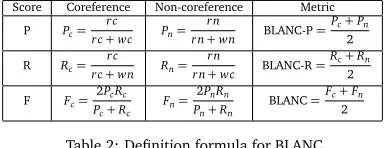
In the CoNLL-2011 shared task, four metrics were used for evaluating coreference performance: MUC, B3, CEAF, and BLANC. The evaluation metrics are described in (Pradhan et al., 2011).
Each of the metric tries to address the shortcomings of the earlier metrics. MUC is the oldest metric; it has been criticized for not penalizing overmerging (Recasens and Hovy, 2010). Since one of the goals of this study is to reduce overmerging in our inference-based framework, this metric does not seem to be representative for us. The B3and CEAF metrics were also
considered to produce counterintuitive results (Luo, 2005; Recasens and Hovy, 2010). BLANC, as the most recent evaluation metric, overcomes the drawbacks of MUC, B3, and CEAF. The
rc,wc,rn,wnindicate the number of right coreference links, wrong coreference links, right non-coreference links, and wrong non-coreference links correspondingly.
Score Coreference Non-coreference Metric P Pc=
rc
rc+wc Pn=
rn
rn+wn BLANC-P= Pc+Pn
2
R Rc=rc+rcwn Rn=rnrn+wc BLANC-R=Rc+2Rn
F Fc=P2PcRc c+Rc Fn=
2PnRn
Pn+Rn BLANC=
Fc+Fn
2
Table 2: Definition formula for BLANC.
We rely on BLANC when drawing conclusions, but present values of the other three evaluation metrics as well.
4.1 Results and Discussions
We intend to evaluate whether the introduction of linguistically motivated features (Sec. 3.3) and world knowledge (Sec. 3.4) enables us to outperform the naive inference-based approach implying that predications with the same names refer to the same entities. In order to evaluate the impact of each feature and knowledge component separately, we run ablation tests. Note that for 145 of 6,894 sentences in the test set, no logical forms were produces by theBoxer semantic parser. Moreover, in the run employing WordNet-based inference, inference results could not be produced for 101 of 303 test texts because of the computational complexity of reasoning. In order to keep the comparison fair, we use evaluate all features and knowledge components on the same set of 202 texts, for which inference results were produced in all runs. Table 3 represents the results of the ablation tests. We test the features listed in Table 1 as well as axioms extracted from WordNet (WN), FrameNet (FN), narrative chains (NC) and knowledge provided by AIDA (AI). All features representing incompatible properties are tested together (I Pin Table 3). Similarly, all argument inequality features (AI) and common property features (C P) are tested together.
The first row represents results for the run without employing any features and knowledge resources. In the second run, world knowledge is employed without linguistic features. These two runs correspond to the original weighted abduction approach to unification implying unification of all predications having the same predicate names. We see that adding knowledge results in lower values of BLANC. This happens because of the overmerging problem increased by additional coreference links inferred with the help of the employed knowledge resources. Then we test linguistic features intended to block incorrect unification (I P,CU,AI,N I,FR, M) one by one. Each of the features improves the BLANC values; conditional unificationCU has the most significant impact.4 The common property feature (C P) and the derivational
relations feature (M) introduce additional unifications. Therefore we test them together with the best combination of the unification blocking features (I P+CU+AI+N I+FR+M). Both features have a positive impact as compared to the run employing just the unification blocking features. Now we test each world knowledge component using the best combination of features
[image:12.420.105.300.101.175.2](I P+CU+AI+N I+FR+M+C P). Each knowledge component except for WordNet has a positive impact in terms of BLANC as compared to the run using the best combination of all features.
Features Inference MUC B3 CEAFE BLANC
[image:13.420.61.378.97.229.2]I P CU AI N I FR M C P DR WN FN NC AI R P F R P F R P F R P F 73.7 69.6 71.6 75.5 39.9 52.2 30.7 36.1 33.2 53.0 51.7 39.1 p p p p 72.3 68.6 70.4 74.6 41.6 53.4 32.3 37.1 34.5 52.3 51.3 39.9 p 71.2 68.8 70.0 73.2 41.8 53.2 32.8 35.9 34.3 53.5 51.9 41.0 p 33.4 58.2 42.5 42.5 76.2 54.6 59.6 28.6 38.7 55.7 60.9 56.6 p 70.1 68.4 69.3 72.3 41.8 53.0 33.1 35.3 34.2 53.0 51.6 41.0 p 70.4 68.5 69.4 72.5 41.6 52.9 32.3 34.8 33.5 52.8 51.5 40.5 p 70.4 68.5 69.5 72.7 41.7 53.0 32.5 35.0 33.7 52.9 51.6 40.7 p 70.3 68.4 69.3 72.6 41.9 53.1 32.8 35.4 34.1 53.3 51.7 41.0 p p p p p p p 39.4 62.0 48.2 46.6 74.1 57.2 59.6 30.9 40.8 58.4 61.6 59.4 p p p p p p p 36.6 61.2 45.8 44.6 75.8 56.1 59.8 29.6 39.6 57.5 61.4 58.6 p p p p p p p p p 36.2 60.3 45.2 44.5 75.3 56.0 59.7 29.6 39.6 57.4 61.2 58.5 p p p p p p p p p 40.7 63.1 49.5 48.5 73.2 58.4 58.6 30.8 40.4 59.5 61.0 60.1 p p p p p p p p p 40.1 63.0 49.0 47.4 74.0 57.8 59.1 30.8 40.5 59.0 61.5 59.9 p p p p p p p p p 42.5 64.3 51.1 49.1 72.8 58.7 58.6 31.5 41.0 59.7 61.5 60.4 p p p p p p p p p p p p 42.9 64.4 51.5 50.5 73.3 59.9 59.4 32.8 42.3 59.9 60.9 60.3
Table 3: Ablation tests of features and world knowledge.
The results of the ablation tests show significant improvement over the naive approach (by more than 20% F-measure), but can we claim that we solved the overmerging problem? We perform one more experiment in order to get a deeper understanding of the performance of our discourse processing pipeline in coreference resolution.
The best performance in the CoNLL-2011 shared task was achieved by theStanford NLPsystem (Lee et al., 2011) that is a rule-based resolver encoding traditional linguistic constraints on coreference. We replicate the results ofStanford NLPas applied to the CoNLL-2011 dataset; see the first row in Table 4. We use the output ofStanford NLPonly for those texts, which could be processed by our discourse processing pipeline, therefore the recall/precision values for Stanford NLPin Table 4 are lower than the original results published in (Lee et al., 2011). We aim at checking whether enriching the output of the state-of-the-art coreference resolver with additional links inferred by our system using all features and all world knowledge will improve the performance. The evaluation of the “merged” output is presented in the second row of Table 4 (SNLP+WA). Unfortunately, the precision of SNLP+WA is lower than that of SNLP alone. This happens because adding world knowledge results in new coreference links, while the overmerging problem is not completely solved. SNLP discovers 2277 out of 7557 correct coreference links and 40247 out of 41527 correct non-coreference links. In the merged output, there are more correct coreference links (3065), but less correct non-coreference links (36959). Note thatStanford NLPperforms noun phrase coreference resolution only, while our system is not restricted to noun phrases and can also discover implicit coreference links.
System MUC B3 CEAFE BLANC
R P F R P F R P F R P F
[image:13.420.64.367.457.490.2]SNLP 42.8 74.4 54.3 50.4 85.2 63.4 66.3 32.6 43.7 63.5 76.2 66.7 SNLP+WA 52.0 70.1 59.7 57.3 72.7 64.1 60.5 37.2 46.1 64.8 64.7 64.7
Table 4: Performance of theStanford NLPsystem (SNLP) compared to performance of our weighted abduction engine enriched withStanford NLP(SNLP+WA) output.
incom-patible properties to have a more significant impact on precision than they actually had in the ablation tests. But in the current study, we consider only those properties to be incompatible which are expressed syntactically in the same way, e.g.,Japanese goodsvs. German goods. However, the same property can be expressed by a wide variety of syntactic constructions, e.g., goods from Germany,goods produced in Germany,Germany produced goodsetc. In order to discover deeper contradictions, we have to work on normalization of the representation of prop-erties, e.g., useorigin:Germany:xinstead ofGerman(e,x)andfrom(e1,x,y)∧Germany(e2,y).
FrameNet attempts to achieve such a normalization by using standardized frame and role names. Unfortunately, the limited coverage of the FrameNet resource (Shen and Lapata, 2007; Cao et al., 2008) does not allow us to solve the problem on a large scale.
Analyzing the results, we also found overmergings not implying any explicit contradictions. For example, in the sentenceHe sat near him, bothhepropositions are unlikely be coreferential, but our framework fails to capture that. Such overmergings might be blocked by explicit modeling of discourse salience. In the future, we plan to use existing discourse salience models (e.g., (Lappin and Leass, 1994)) to create real-valued salience features for weighted unification. One more issue concerns the quality of the obtained interpretations. Our learning framework assumes that we can obtain optimal solutions, but we also exploit suboptimal solutions by imposing a timeout in this experiment. However, it has been reported that exploiting suboptimal solutions sometimes hurts performance (Finley and Joachims, 2008). In the future, we will address this problem using an approximate learning framework (e.g., (Huang et al., 2012)).
Conclusion and perspectives
In this paper, we investigated the overmerging problem in a general inference-based discourse processing pipeline using the mode of inference called weighted abduction. In our framework, resolving coreference is a by-product of constructing best interpretations of text. Coreference links naturally result from unifications of predications during the inference process. The naive approach to unification involves unifying predications with the same predicate names. This paper presents the first systematic study of the overmerging problem resulting from naive unification. We proposed several linguistically motivated features for blocking incorrect unifications as well as employed different large-scale world knowledge resources for establishing unification via inference. We extended ILP-based weighted abduction in order to accommodate unification weights and showed how to learn the weights in a supervised manner. All features and almost all knowledge components proved to improve the performance of our system tested on a large state-of-the-art test dataset.
We cannot claim that the problem of overmerging has been solved, because we still discover overmerging of explicit anaphora produced by our system as compared to a state-of-the-art rule-based coreference resolver. However, the proposed framework presents a significant improvement over the naive approach (by over 20% of F-measure). Moreover, it is highly extensible for including more features and knowledge sources.
Acknowledgments
References
Bizer, C., Lehmann, J., Kobilarov, G., Auer, S., Becker, C., Cyganiak, R., and Hellmann, S. (2009). Dbpedia - a crystallization point for the web of data.J. Web Sem., 7(3):154–165. Bos, J. (2008). Wide-Coverage Semantic Analysis with Boxer. In Bos, J. and Delmonte, R., editors,Proceedings of STEP, Research in Computational Semantics, pages 277–286. College Publications.
Bos, J. (2011). A survey of computational semantics: Representation, inference and knowledge in wide-coverage text understanding.Language and Linguistics Compass, 5(6):336–366. Bryl, V., Tonelli, S., Giuliano, C., and Serafini, L. (2012). A novel framenet-based resource for the semantic web. InSAC, pages 360–365.
Cao, D. D., Croce, D., Pennacchiotti, M., and Basili, R. (2008). Combining word sense and usage for modeling frame semantics. InProc. of STEP 2008, pages 85–101.
Chambers, N. and Jurafsky, D. (2009). Unsupervised Learning of Narrative Schemas and their Participants. InProceedings of ACL, pages 602–610.
Charniak, E. and Goldman, R. P. (1991). A Probabilistic Model of Plan Recognition. In Proceedings of AAAI, pages 160–165.
Crammer, K., Dekel, O., Keshet, J., and S. Shalev-Shwartz, Y. S. (2006). Online Passive-Aggressive Algorithms. pages 551–585.
Dellert, J. (2011). Challenges of Model Generation for Natural Language Processing. Master’s thesis, University of Tübingen.
Denis, P. and Baldridge, J. (2009). Global Joint Models for Coreference Resolution and Named Entity Classification. InProcesamiento del Lenguaje Natural 42, pages 87–96, Barcelona: SEPLN.
Fellbaum, C., editor (1998).WordNet: an electronic lexical database. MIT Press.
Fernandes, E., dos Santos, C., and Milidiú, R. (2012). Latent structure perceptron with feature induction for unrestricted coreference resolution. InCoNLL Shared Task 2012, pages 41–48.
Finkel, J. R. and Manning, C. D. (2008). Enforcing transitivity in coreference resolution. In Proceedings of ACL, pages 45–48.
Finley, T. and Joachims, T. (2008). Training structural svms when exact inference is intractable. InProceedings of the 25th international conference on Machine learning, ICML ’08, pages 304–311, New York, NY, USA. ACM.
Hobbs, J. R. (1985). Ontological promiscuity. InProceedings of ACL, pages 61–69, Chicago, Illinois.
Hobbs, J. R., Stickel, M., Martin, P., and Edwards, D. (1993). Interpretation as abduction. Artificial Intelligence, 63:69–142.
Huang, L., Fayong, S., and Guo, Y. (2012). Structured perceptron with inexact search. In HLT-NAACL, pages 142–151.
Inoue, N. and Inui, K. (2011). ILP-Based Reasoning for Weighted Abduction. InProceedings of AAAI Workshop on Plan, Activity and Intent Recognition.
Inoue, N. and Inui, K. (2012). Large-scale Cost-based Abduction in Full-fledged First-order Predicate Logic with Cutting Plane Inference.
Irwin, J., Komachi, M., and Matsumoto, Y. (2011). Narrative schema as world knowledge for coreference resolution. InProceedings of the Fifteenth Conference on Computational Nat-ural Language Learning: Shared Task, pages 86–92, Portland, Oregon, USA. Association for Computational Linguistics.
Kamp, H. and Reyle, U. (1993). From Discourse to Logic: Introduction to Model-theoretic Semantics of Natural Language, Formal Logic and Discourse Representation Theory. Studies in Linguistics and Philosophy. Kluwer, Dordrecht.
Lappin, S. and Leass, H. J. (1994). An algorithm for pronominal anaphora resolution. Compu-tational Linguistics, 20(4):535–561.
Lee, H., Peirsman, Y., Chang, A., Chambers, N., Surdeanu, M., and Jurafsky, D. (2011). Stanford’s multi-pass sieve coreference resolution system at the CoNLL-2011 shared task. In Proceedings of the Fifteenth Conference on Computational Natural Language Learning: Shared Task, CONLL Shared Task ’11, pages 28–34, Stroudsburg, PA, USA. Association for Computa-tional Linguistics.
Levesque, H. J. (2011). The Winograd Schema Challenge. InAAAI Spring Symposium: Logical Formalizations of Commonsense Reasoning.
Lin, T., Mausam, and Etzioni, O. (2010). Identifying Functional Relations in Web Text. In EMNLP, pages 1266–1276.
Luo, X. (2005). On coreference resolution performance metrics. InHLT/EMNLP, pages 25–32.
McDonald, R., Hall, K., and Mann, G. (2010). Distributed training strategies for the structured perceptron. InNAACL2010, pages 456–464.
Ng, V. (2007). Shallow semantics for coreference resolution. InProceedings of IJCAI, pages 1689–1694.
Ng, V. (2010). Supervised noun phrase coreference research: The first fifteen years. In Proceedings of the ACL, pages 1396–1411.
Ng, V. and Cardie, C. (2002). Improving machine learning approaches to coreference resolution. InProceedings of the 40th Annual Meeting on Association for Computational Linguistics, ACL ’02, pages 104–111, Stroudsburg, PA, USA. Association for Computational Linguistics.
Ovchinnikova, E., Montazeri, N., Alexandrov, T., Hobbs, J. R., McCord, M., and Mulkar-Mehta, R. (2011). Abductive Reasoning with a Large Knowledge Base for Discourse Processing. In Proceedings of IWCS, pages 225–234, Oxford, UK.
Ponzetto, S. P. and Strube, M. (2006). Exploiting semantic role labeling, wordnet and wikipedia for coreference resolution. InProceedings of the main conference on Human Language Technology Conference of the North American Chapter of the Association of Computational Linguistics, HLT-NAACL ’06, pages 192–199.
Poon, H. and Domingos, P. (2008). Joint unsupervised coreference resolution with markov logic. InProceedings of EMNLP, pages 650–659.
Pradhan, S., Ramshaw, L., Marcus, M., Palmer, M., Weischedel, R., and Xue, N. (2011). CoNLL-2011 shared task: modeling unrestricted coreference in OntoNotes. InProceedings of the Fifteenth Conference on Computational Natural Language Learning: Shared Task, CONLL Shared Task ’11, pages 1–27, Stroudsburg, PA, USA. Association for Computational Linguistics.
Rahman, A. and Ng, V. (2012). Resolving Complex Cases of Definite Pronouns: The Winograd Schema Challenge. InProceedings of EMNLP-CoNLL, pages 777–789.
Recasens, M. and Hovy, E. (2010). BLANC: Implementing the Rand Index for Coreference Evaluation.Journal of Natural Language Engineering.
Ruppenhofer, J., Ellsworth, M., Petruck, M., Johnson, C., and Scheffczyk, J. (2010). FrameNet II: Extended Theory and Practice. Technical report, Berkeley, USA.
Shen, D. and Lapata, M. (2007). Using Semantic Roles to Improve Question Answering. In Proceeding of EMNLP-CoNLL, pages 12–21.
Song, Y., Jiang, J., Zhao, W. X., Li, S., and Wang, H. (2012). Joint learning for coreference resolution with markov logic. InProceedings of the 2012 Joint Conference on Empirical Methods in Natural Language Processing and Computational Natural Language Learning, pages 1245– 1254, Jeju Island, Korea. ACL.
Soon, W. M., Ng, H. T., and Lim, D. C. Y. (2001). A machine learning approach to coreference resolution of noun phrases.Comput. Linguist., 27(4):521–544.
Suchanek, F. M., Kasneci, G., and Weikum, G. (2008). YAGO: A Large Ontology from Wikipedia and WordNet.J. Web Sem., 6(3):203–217.