Multi-Document Summarization via
the Minimum Dominating Set
Chao Shen and Tao Li
School of Computing and Information Sciences Florida Internation University
{cshen001|taoli}@cs.fiu.edu Abstract
Multi-document summarization has been an important problem in infor-mation retrieval. It aims to dis-till the most important information from a set of documents to gener-ate a compressed summary. Given a sentence graph generated from a set of documents where vertices repre-sent repre-sentences and edges indicate that the corresponding vertices are simi-lar, the extracted summary can be de-scribed using the idea of graph dom-ination. In this paper, we propose a new principled and versatile frame-work for multi-document summariza-tion using the minimum dominating set. We show that four well-known summarization tasks including generic, query-focused, update, and compara-tive summarization can be modeled as different variations derived from the proposed framework. Approximation algorithms for performing summariza-tion are also proposed and empirical experiments are conducted to demon-strate the effectiveness of our proposed framework.
1 Introduction
As a fundamental and effective tool for docu-ment understanding and organization, multi-document summarization enables better mation services by creating concise and infor-mative reports for a large collection of doc-uments. Specifically, in multi-document sum-marization, given a set of documents as input, the goal is to produce a condensation (i.e., a generated summary) of the content of the
entire input set (Jurafsky and Martin, 2008). The generated summary can be generic where it simply gives the important information con-tained in the input documents without any particular information needs or query/topic-focused where it is produced in response to a user query or related to a topic or concern the development of an event (Jurafsky and Mar-tin, 2008; Mani, 2001).
Recently, new summarization tasks such as update summarization (Dang and Owczarzak, 2008) and comparative summarization (Wang et al., 2009a) have also been proposed. Up-date summarization aims to generate short summaries of recent documents to capture new information different from earlier docu-ments and comparative summarization aims to summarize the differences between compa-rable document groups.
In this paper, we propose a new principled and versatile framework for multi-document summarization using the minimum dominat-ing set. Many known summarization tasks in-cluding generic, query-focused, update, and comparative summarization can be modeled as different variations derived from the pro-posed framework. The framework provides an elegant basis to establish the connections be-tween various summarization tasks while high-lighting their differences.
a minimum dominating set is a dominating set with the minimum size. The minimum dominating set of the sentence graph can be naturally used to describe the summary: it is representative since each sentence is either in the minimum dominating set or connected to one sentence in the set; and it is with minimal redundancy since the set is of mini-mum size. Approximation algorithms are pro-posed for performing summarization and em-pirical experiments are conducted to demon-strate the effectiveness of our proposed frame-work. Though the dominating set problem has been widely used in wireless networks, this pa-per is the first work on using it for modeling sentence extraction in document summariza-tion.
The rest of the paper is organized as fol-lows. In Section 2, we review the related work about multi-document summarization and the dominating set. After introducing the min-imum dominating set problem in graph the-ory in Section 3, we propose the minimum dominating set based framework for multi-document summarization and model the four summarization tasks including generic, query-focused, update, and comparative summariza-tion in Secsummariza-tion 4. Secsummariza-tion 5 presents the exper-imental results and analysis, and finally Sec-tion 6 concludes the paper.
2 Related Work
Generic Summarization For generic sum-marization, a saliency score is usually as-signed to each sentence and then the sen-tences are ranked according to the saliency score. The scores are usually computed based on a combination of statistical and linguistic features. MEAD (Radev et al., 2004) is an implementation of the centroid-based method where the sentence scores are computed based on sentence-level and inter-sentence features. SumBasic (Nenkova and Vanderwende, 2005) shows that the frequency of content words alone can also lead good summarization re-sults. Graph-based methods (Erkan and Radev, 2004; Wan et al., 2007b) have also been proposed to rank sentences or passages
based on the PageRank algorithm or its vari-ants.
Query-Focused Summarization In
query-focused summarization, the informa-tion of the given topic or query should be incorporated into summarizers, and sentences suiting the user’s declared information need should be extracted. Many methods for generic summarization can be extended to incorporate the query information (Saggion et al., 2003; Wei et al., 2008). Wan et al. (Wan et al., 2007a) make full use of both the relationships among all the sentences in the documents and relationship between the given query and the sentences by manifold ranking. Probability models have also been proposed with different assumptions on the generation process of the documents and the queries (Daum´e III and Marcu, 2006; Haghighi and Vanderwende, 2009; Tang et al., 2009).
Update Summarization and
Compara-tive Summarization Update
The Dominating Set Many approxima-tion algorithms have been developed for find-ing minimum dominatfind-ing set for a given graph (Guha and Khuller, 1998; Thai et al., 2007). Kann (Kann, 1992) shows that the minimum dominating set problem is equiv-alent to set cover problem, which is a well-known NP-hard problem. Dominating set has been widely used for clustering in wireless net-works (Chen and Liestman, 2002; Han and Jia, 2007). It has been used to find topic words for hierarchical summarization (Lawrie et al., 2001), where a set of topic words is ex-tracted as a dominating set of word graph. In our work, we use the minimum dominating set to formalize the sentence extraction for docu-ment summarization.
3 The Minimum Dominating Set Problem
Given a graph G =< V, E >, a dominating set of G is a subset S of vertices with the following property: each vertex of G is either in the dominating setS, or is adjacent to some vertices in S.
Problem 3.1. Given a graph G, the mini-mum dominating set problem (MDS) is to find a minimum size subsetSof vertices, such that
S forms a dominating set.
MDS is closely related to the set cover prob-lem (SC), a well-known NP-hard probprob-lem.
Problem 3.2. Given F, a finite collection {S1, S2, . . . , Sn} of finite sets, the set cover
problem (SC) is to find the optimal solution
F∗= arg min
F⊆F|F
|s.t.
S∈F
S =
S∈F
S.
Theorem 3.3. There exists a pair of polyno-mial time reduction between MDS and SC.
So, MDS is also NP-hard and it has been shown that there are no approximate solutions within clog|V|, for some c > 0 (Feige, 1998; Raz and Safra, 1997).
3.1 An Approximation Algorithm
A greedy approximation algorithm for the SC problem is described in (Johnson, 1973). Ba-sically, at each stage, the greedy algorithm
chooses the set which contains the largest number of uncovered elements.
Based on Theorem 3.3, we can obtain a greedy approximation algorithm for MDS. Starting from an empty set, if the current sub-set of vertices is not the dominating sub-set, a new vertex which has the most number of the ad-jacent vertices that are not adad-jacent to any vertex in the current set will be added.
Proposition 3.4. The greedy algorithm ap-proximates SC within 1 + lns where s is the size of the largest set.
It was shown in (Johnson, 1973) that the approximation factor for the greedy algorithm is no more thanH(s) , thes-th harmonic num-ber:
H(s) =
s
k=1
1
k ≤lns+ 1
Corollary 3.5. MDS has a approximation al-gorithm within 1 + ln Δwhere Δis the maxi-mum degree of the graph.
Corollary 3.5 follows directly from Theo-rem 3.3 and Proposition 3.4.
4 The Summarization Framework
4.1 Sentence Graph Generation
To perform multi-document summarization via minimum dominating set, we need to first construct a sentence graph in which each node is a sentence in the document collection. In our work, we represent the sentences as vec-tors based on tf-isf, and then obtain the cosine similarity for each pair of sentences. If the similarity between a pair of sentences si and
sj is above a given threshold λ, then there is
an edge betweensi and sj.
For generic summarization, we use all sen-tences for building the sentence graph. For query-focused summarization, we only use the sentences containing at least one term in the query. In addition, when a queryqis involved, we assign each node si a weight, w(si) =
d(si, q) = 1−cos(si, q), to indicate the
Generic Summary
(a)
Query-focused Summary
query
(b)
Updated Summary
C1
C2
(c)
Comparative Summary
Comparative Summary Comparative Summary
C2
C1
C3
[image:4.595.84.515.71.175.2](d)
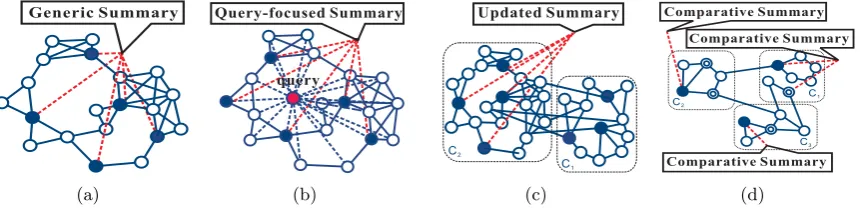
Figure 1: Graphical illustrations of multi-document summarization via the minimum domi-nating set. (a): The minimum domidomi-nating set is extracted as the generic summary. (b):The minimum weighted dominating set is extracted as the query-based summary. (c):Vertices in the right rectangle represent the first document set C1, and ones in the left represent the
sec-ond document set where update summary is generated. (d):Each rectangle represents a group of documents. The vertices with rings are the dominating set for each group, while the solid vertices are the complementary dominating set, which is extracted as comparative summaries.
the minimum dominating set. A graphical il-lustration of the proposed framework is shown in Figure 1.
4.2 Generic Summarization
Generic summarization is to extract the most representative sentences to capture the impor-tant content of the input documents. Without taking into account the length limitation of the summary, we can assume that the sum-mary should represent all the sentences in the document set (i.e., every sentence in the docu-ment set should either be extracted or be sim-ilar with one extracted sentence). Meanwhile, a summary should also be as short as possi-ble. Such summary of the input documents under the assumption is exactly the minimum dominating set of the sentence graph we con-structed from the input documents in Section 4.1. Therefore the summarization problem can be formulated as the minimum dominat-ing set problem.
However, usually there is a length restric-tion for generating the summary. Moreover, the MDS is NP-hard as shown in Section 3. Therefore, it is straightforward to use a greedy approximation algorithm to construct a subset of the dominating set as the final summary. In the greedy approach, at each stage, a sentence which is optimal according to the local crite-ria will be extracted. Algorithm 1 describes
Algorithm 1 Algorithm for Generic Summariza-tion
INPUT: G, W OUTPUT: S
1: S=∅ 2: T =∅
3: whileL(S)< W andV(G)! =S do
4: forv∈V(G)−S do
5: s(v) =|{ADJ(v)−T}|
6: v∗= arg maxvs(v)
7: S=S∪ {v∗}
8: T=T∪ADJ(v∗)
an approximation algorithm for generic sum-marization. In Algorithm 1, G is the sen-tence graph, L(S) is the length of the sum-mary, W is the maximal length of the sum-mary, and ADJ(v) = {v|(v, v) ∈ E(G)} is the set of vertices which are adjacent to the vertex v. A graphical illustration of generic summarization using the minimum dominat-ing set is shown in Figure 1(a).
4.3 Query-Focused Summarization
Letting G be the sentence graph constructed in Section 4.1 andq be the query, the query-focused summarization can be modeled as
D∗= arg minD⊆Gs∈Dd(s, q) (1)
s.t. Dis a dominating set of G.
s∈Dd(s, q) ≤
s∈Dd(s, q). The problem
in Eq.(1) is exactly a variant of the minimum dominating set problem, i.e., the minimum weighted dominating set problem (MWDS).
Similar to MDS, MWDS can be reduced from the weighted version of the SC problem. In the weighted version of SC, each set has a weight and the sum of weights of selected sets needs to be minimized. To generate an ap-proximate solution for the weighted SC prob-lem, instead of choosing a set i maximizing |SET(i)|, a set i minimizing |SETw(i)(i)| is cho-sen, where SET(i) is composed of uncovered elements in seti, andw(i) is the weight of set
i. The approximate solution has the same ap-proximation ratio as that for MDS, as stated by the following theorem (Chvatal, 1979).
Theorem 4.1. An approximate weighted
dominating set can be generated with a size at most1+log Δ·|OP T|, whereΔis the maximal degree of the graph and OP T is the optimal weighted dominating set.
Accordingly, from generic summarization to query-focused summarization, we just need to modify line 6 in Algorithm 1 to
v∗ = arg min
v
w(v)
s(v), (2)
wherew(v) is the weight of vertexv. A graph-ical illustration of query-focused summariza-tion using the minimum dominating set is shown in Figure 1(b).
4.4 Update Summarization
Give a query q and two sets of documents C1
and C2, update summarization is to generate
a summary ofC2based onq, givenC1. Firstly,
summary of C1, referred as D1 can be
gener-ated. Then, to generate the update summary of C2, referred as D2, we assume D1 and D2
should represent all query related sentences in
C2, and length of D2 should be minimized.
LetG1 be the sentence graph for C1. First
we use the method described in Section 4.3 to extract sentences from G1 to form D1. Then
we expandG1 to the whole graphGusing the
second set of documents C2. G is then the
graph presentation of the document set in-cludingC1 and C2. We can model the update
summary ofC2 as
D∗ = arg minD2
s∈D2w(s) (3)
s.t. D2∪D1 is a dominating set of G.
Intuitively, we extract the smallest set of sen-tences that are closely related to the query from C2 to complete the partial dominating
set of G generated from D1. A graphical
il-lustration of update summarization using the minimum dominating set is shown in Fig-ure 1(c).
4.5 Comparative Summarization
Comparative document summarization aims to summarize the differences among compara-ble document groups. The summary produced for each group should emphasize its difference from other groups (Wang et al., 2009a).
We extend our method for update marization to generate the discriminant sum-mary for each group of documents. Given N
groups of documents C1, C2, . . . , CN, we first
generate the sentence graphsG1, G2, . . . , GN,
respectively. To generate the summary for
Ci,1 ≤ i ≤ N, we view Ci as the update
of all other groups. To extract a new sen-tence, only the one connected with the largest number of sentences which have no represen-tatives in any groups will be extracted. We denote the extracted set as the complemen-tary dominating set, since for each group we obtain a subset of vertices dominating those are not dominated by the dominating sets of other groups. To perform comparative sum-marization, we first extract the standard dom-inating sets for G1, . . . , GN, respectively,
de-noted as D1, . . . , DN. Then we extract the
so-called complementary dominating set CDi
forGi by continuing adding vertices in Gi to
find the dominating set of ∪1≤j≤NGj given
D1, . . . , Di−1, Di+1, . . . , DN. A graphical
DUC04 DUC05 DUC06 TAC08 A TAC08 B Type of Summarization Generic Topic-focused Topic-focused Topic-focused Update
#topics NA 50 50 48 48
#documents per topic 10 25-50 25 10 10
[image:6.595.113.481.71.113.2]Summary length 665 bytes 250 words 250 words 100 words 100 words
Table 1: Brief description of the data set
5 Experiments
We have conducted experiments on all four summarization tasks and our proposed meth-ods based on the minimum dominating set have outperformed many existing methods. For the generic, topic-focused and update summarization tasks, the experiments are per-form the DUC data sets using ROUGE-2 and ROUGE-SU (Lin and Hovy, 2003) as evalua-tion measures. For comparative summariza-tion, a case study as in (Wang et al., 2009a) is performed. Table 1 shows the characteristics of the data sets. We use DUC04 data set to evaluate our method for generic summariza-tion task and DUC05 and DUC06 data sets for query-focused summarization task. The data set for update summarization, (i.e. the main task of TAC 2008 summarization track) consists of 48 topics and 20 newswire articles for each topic. The 20 articles are grouped into two clusters. The task requires to pro-duce 2 summaries, including the initial sum-mary (TAC08 A) which is standard query-focused summarization and the update sum-mary (TAC08 B) under the assumption that the reader has already read the first 10 docu-ments.
We apply a 5-fold cross-validation proce-dure to choose the thresholdλused for gener-ating the sentence graph in our method.
5.1 Generic Summarization
We implement the following widely used or recent published methods for generic summa-rization as the baseline systems to compare with our proposed method (denoted as MDS). (1) Centroid: The method applies MEAD al-gorithm (Radev et al., 2004) to extract sen-tences according to the following three pa-rameters: centroid value, positional value, and first-sentence overlap. (2)
LexPageR-ank: The method first constructs a sentence connectivity graph based on cosine similarity and then selects important sentences based on the concept of eigenvector centrality (Erkan and Radev, 2004). (3) BSTM: A Bayesian sentence-based topic model making use of both the term-document and term-sentence associations (Wang et al., 2009b).
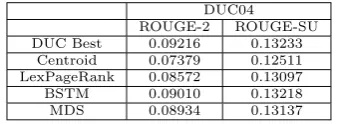
Our method outperforms the simple Cen-troid method and another graph-based Lex-PageRank, and its performance is close to the results of the Bayesian sentence-based topic model and those of the best team in the DUC competition. Note however that, like clus-tering or topic based methods, BSTM needs the topic number as the input, which usually varies by different summarization tasks and is hard to estimate.
5.2 Query-Focused Summarization
We compare our method (denoted as MWDS) described in Section 4.3 with some recently published systems. (1) TMR (Tang et al., 2009): incorporates the query information into the topic model, and uses topic based score and term frequency to estimate the im-portance of the sentences. (2) SNMF (Wang et al., 2008): calculates sentence-sentence similarities by sentence-level semantic analy-sis, clusters the sentences via symmetric non-negative matrix factorization, and extracts the sentences based on the clustering result. (3) Wiki (Nastase, 2008): uses Wikipedia as external knowledge to expand query and builds the connection between the query and the sentences in documents.
ap-DUC04 ROUGE-2 ROUGE-SU DUC Best 0.09216 0.13233
[image:7.595.86.256.70.132.2]Centroid 0.07379 0.12511 LexPageRank 0.08572 0.13097 BSTM 0.09010 0.13218 MDS 0.08934 0.13137
Table 2: Results on generic summariza-tion.
DUC05 DUC06
ROUGE-2 ROUGE-SU ROUGE-2 ROUGE-SU DUC Best 0.0725 0.1316 0.09510 0.15470
[image:7.595.288.548.70.132.2]SNMF 0.06043 0.12298 0.08549 0.13981 TMR 0.07147 0.13038 0.09132 0.15037 Wiki 0.07074 0.13002 0.08091 0.14022 MWDS 0.07311 0.13061 0.09296 0.14797
Table 3: Results on query-focused summariza-tion.
proximate minimal dominating set of the sen-tence graph. On DUC05, our method achieves the best result; and on DUC06, our method outperforms all other systems except the best team in DUC. Note that our method based on the minimum dominating set is much sim-pler than other systems. Our method only depends on the distance to the query and has only one parameter (i.e., the threshold λ in generating the sentence graph).
0.065 0.07 0.075 0.08 0.085 0.09 0.095
0.05 0.1 0.15 0.2 0.25
ROUGE-2
Similarity threshold λ
[image:7.595.78.291.329.484.2]DUC 06 DUC 05
Figure 2: ROUGE-2 vs. thresholdλ
We also conduct experiments to empirically evaluate the sensitivity of the threshold λ. Figure 2 shows the ROUGE-2 curve of our MWDS method on the two datasets when λ
varies from 0.04 to 0.26. When λ is small, edges fail to represent the similarity of the sen-tences, while if λ is too large, the graph will be sparse. As λis approximately in the range of 0.1−0.17, ROUGE-2 value becomes stable and relatively high.
5.3 Update Summarization
Table 5 presents the experimental results on update summarization. In Table 5, ‘TAC Best” and “TAC Median” represent the best
and median results from the participants of TAC 2008 summarization track in the two tasks respectively according to the TAC 2008 report (Dang and Owczarzak, 2008). As seen from the results, the ROUGE scores of our methods are higher than the median results. The good results of the best team typically come from the fact that they utilize advanced natural language processing (NLP) techniques to resolve pronouns and other anaphoric ex-pressions. Although we can spend more efforts on the preprocessing or language processing step, our goal here is to demonstrate the ef-fectiveness of formalizing the update summa-rization problem using the minimum dominat-ing set and hence we do not utilize advanced NLP techniques for preprocessing. The exper-imental results demonstrate that our simple update summarization method based on the minimum dominating set can lead to compet-itive performance for update summarization.
TAC08 A TAC08 B
ROUGE-2
ROUGE-SU
ROUGE-2
ROUGE-SU
[image:7.595.304.530.478.531.2]TAC Best 0.1114 0.14298 0.10108 0.13669 TAC Median 0.08123 0.11975 0.06927 0.11046 MWDS 0.09012 0.12094 0.08117 0.11728
Table 5: Results on update summarization.
5.4 Comparative Summarization
Topic Complementary Dominating Set Discriminative Sentence Selection Dominating Set 1 · · · U.S. Secretary of State
Madeleine Albright arrives to consult on the stand-off between
theUnited Nations and Iraq.
the U.S. envoy to the United
Nations, Bill Richardson, · · ·
play down China’s refusal to sup-port threats of military force against Iraq
The United States and Britain do not trust President Sad-dam and wants cdotswarning of serious consequences if Iraq
violates the accord.
2 Thailand’s currency, the
baht, dropped through a
key psychological levelof· · ·
amid a regional sell-off sparked by escalating social unrest in
Indonesia.
Earlier, driven largely bythe
de-clining yen, South Korea’s
stock market fellby· · ·, while
theNikkei 225 benchmark
in-dex dippedbelow 15,000 in the
morning· · ·
In the fourth quarter, IBM
Corp. earned $2.1 billion, up
3.4 percent from $2 billion a
year earlier.
3 · · · attorneys representing Pres-ident Clinton and Monica Lewinsky.
The following night Isikoff · · ·, where he directly followed the recitation of the top-10 list: “Top
10 White House Jobs That
Sound Dirty.”
In Washington, Ken Starr’s grand jury continued its inves-tigation of theMonica
Lewin-sky matter.
4 Eight women and six men were named Saturday night as the
first U.S. Olympic
Snow-board Team as their sport
gets set to make its debut in
Nagano, Japan.
this tunnel is finland’s cross coun-try version of tokyo’s alpine ski dome, and olympic skiers flock from russia, · · ·, france and aus-tria this past summer to work out the kinks· · ·
If the skiers themen’s super-Gand thewomen’s downhill
on Saturday, they will be back on schedule.
5 U.S. officials have announced
sanctions Washington will
im-pose on India and Pakistan
for conductingnuclear tests.
Thesanctionswould stop all
for-eign aid except for humanitarian purposes,ban military sales to
India· · ·
And Pakistan’s prime
min-istersays his country will sign
the U.N.’s comprehensive
ban on nuclear tests if
In-diadoes, too. 6 · · · remain in force around
Jakarta, and at the Parliament
building where thousands of
students staged a sit-in
Tues-day· · ·.
“President Suharto has given
much to his country over the past 30 years, raising
Indone-sia’sstanding in the world· · ·
[image:8.595.75.533.70.405.2]What were the students doing at the time you were there, and what was the reaction of the students to the troops?
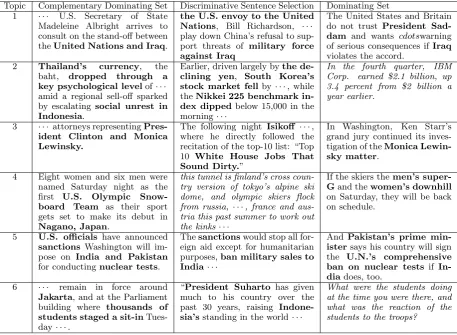
Table 4: A case study on comparative document summarization. Some unimportant words are skipped due to the space limit. The bold font is used to annotate the phrases that are highly related with the topics, and italic font is used to highlight the sentences that are not proper to be used in the summary.
randomly to produce a one-sentence summary. For comparison purpose, we extract the sen-tence with the maximal degree as the base-line. Note that the baseline can be thought as an approximation of the dominating set using only one sentence. Table 4 shows the summaries generated by our method (comple-mentary dominating set (CDS)), discrimina-tive sentence selection (DSS) (Wang et al., 2009a) and the baseline method. Our CDS method can extract discriminative sentences for all the topics. DSS can extract discrimina-tive sentences for all the topics except topic 4. Note that the sentence extracted by DSS for topic 4 may be discriminative from other top-ics, but it is deviated from the topic Nagano Olympic Games. In addition, DSS tends to select long sentences which should not be pre-ferred for summarization purpose. The
base-line method may extract some general sen-tences, such as the sentence for topic 2 and topic 6 in Table 4.
6 Conclusion
In this paper, we propose a framework to model the multi-document summarization us-ing the minimum dominatus-ing set and show that many well-known summarization tasks can be formulated using the proposed frame-work. The proposed framework leads to sim-ple yet effective summarization methods. Ex-perimental results show that our proposed methods achieve good performance on several multi-document document tasks.
7 Acknowledgements
References
Chen, Y.P. and A.L. Liestman. 2002. Approximating minimum size weakly-connected dominating sets for clustering mobile ad hoc networks. InProceedings of International Symposium on Mobile Ad hoc Net-working & Computing. ACM.
Chvatal, V. 1979. A greedy heuristic for the set-covering problem. Mathematics of operations re-search, 4(3):233–235.
Dang, H.T. and K Owczarzak. 2008. Overview of the TAC 2008 Update Summarization Task. In Pro-ceedings of the Text Analysis Conference (TAC).
Dang, H.T. 2007. Overview of DUC 2007. In
Docu-ment Understanding Conference.
Daum´e III, H. and D. Marcu. 2006. Bayesian query-focused summarization. InProceedings of the
ACL-COLING.
Erkan, G. and D.R. Radev. 2004. Lexpagerank: Pres-tige in multi-document text summarization. In
Pro-ceedings of EMNLP.
Feige, U. 1998. A threshold of lnnfor approximating set cover. Journal of the ACM (JACM), 45(4):634– 652.
Goldstein, J., V. Mittal, J. Carbonell, and M. Kantrowitz. 2000. Multi-document summariza-tion by sentence extracsummariza-tion. InNAACL-ANLP 2000
Workshop on Automatic summarization.
Guha, S. and S. Khuller. 1998. Approximation algo-rithms for connected dominating sets.Algorithmica, 20(4):374–387.
Haghighi, A. and L. Vanderwende. 2009. Exploring content models for multi-document summarization.
InProceedings of HLT-NAACL.
Han, B. and W. Jia. 2007. Clustering wireless ad hoc networks with weakly connected dominating set.Journal of Parallel and Distributed Computing, 67(6):727–737.
Johnson, D.S. 1973. Approximation algorithms for combinatorial problems. InProceedings of STOC.
Jurafsky, D. and J.H. Martin. 2008. Speech and lan-guage processing. Prentice Hall New York.
Kann, V. 1992. On the approximability of
NP-complete optimization problems. PhD thesis,
De-partment of Numerical Analysis and Computing Science, Royal Institute of Technology, Stockholm.
Lawrie, D., W.B. Croft, and A. Rosenberg. 2001. Finding topic words for hierarchical summarization. InProceedings of SIGIR.
Lin, C.Y. and E. Hovy. 2003. Automatic evaluation of summaries using n-gram co-occurrence statistics.
InProceedings of HLT-NAACL.
Mani, I. 2001. Automatic summarization. Computa-tional Linguistics, 28(2).
Nastase, V. 2008. Topic-driven multi-document summarization with encyclopedic knowledge and spreading activation. InProceedings of EMNLP.
Nenkova, A. and L. Vanderwende. 2005. The impact of frequency on summarization. Microsoft Research, Redmond, Washington, Tech. Rep. MSR-TR-2005-101.
Radev, D.R., H. Jing, M. Sty´s, and D. Tam. 2004. Centroid-based summarization of multiple docu-ments. Information Processing and Management, 40(6):919–938.
Raz, R. and S. Safra. 1997. A sub-constant error-probability low-degree test, and a sub-constant error-probability PCP characterization of NP. In
Proceedings of STOC.
Saggion, H., K. Bontcheva, and H. Cunningham. 2003. Robust generic and query-based summarisation. In
Proceedings of EACL.
Tang, J., L. Yao, and D. Chen. 2009. Multi-topic based Query-oriented Summarization. In Proceed-ings of SDM.
Thai, M.T., N. Zhang, R. Tiwari, and X. Xu. 2007. On approximation algorithms of k-connected m-dominating sets in disk graphs. Theoretical Com-puter Science, 385(1-3):49–59.
Wan, X., J. Yang, and J. Xiao. 2007a. Manifold-ranking based topic-focused multi-document sum-marization. InProceedings of IJCAI.
Wan, X., J. Yang, and J. Xiao. 2007b. Towards an iterative reinforcement approach for simultaneous document summarization and keyword extraction. InProceedings of ACL.
Wang, D., T. Li, S. Zhu, and C. Ding. 2008. Multi-document summarization via sentence-level seman-tic analysis and symmetric matrix factorization. In
Proceedings of SIGIR.
Wang, D., S. Zhu, T. Li, and Y. Gong. 2009a. Com-parative document summarization via discrimina-tive sentence selection. InProceeding of CIKM.
Wang, D., S. Zhu, T. Li, and Y. Gong. 2009b. Multi-document summarization using sentence-based topic models. In Proceedings of the
ACL-IJCNLP.
Wei, F., W. Li, Q. Lu, and Y. He. 2008. Query-sensitive mutual reinforcement chain and its ap-plication in query-oriented multi-document summa-rization. InProceedings of SIGIR.